See patterns build from your natural voice.
Real charts from ten days of the founder’s own logs. Pick a question. Your answers will look different, and that is the point.
Every check-in adds a dot. A week in, they line up into a picture of your days. One evening here, the words said fine. The voice read energy 31 and fatigue 72.
Log a minute a day. The picture builds itself.
See it in your own voice. In one real 44-minute call, stress was calm until the price came up. Saying it out loud pushed it to 87. Twice.
Say the number out loud a few times before the call. A sentence you have practiced stops spiking.
When your breathing is full and steady, your confidence holds. When it turns short and shallow, confidence slips with it. Hour by hour, the two move together.
Book the conversation that scares you before noon.
When breathing improved, confidence rose with it. Fatigue pulled it down. Your own patterns show you what to work on. So work on it.
Losing your footing mid-call? Slow the exhale. The voice follows.
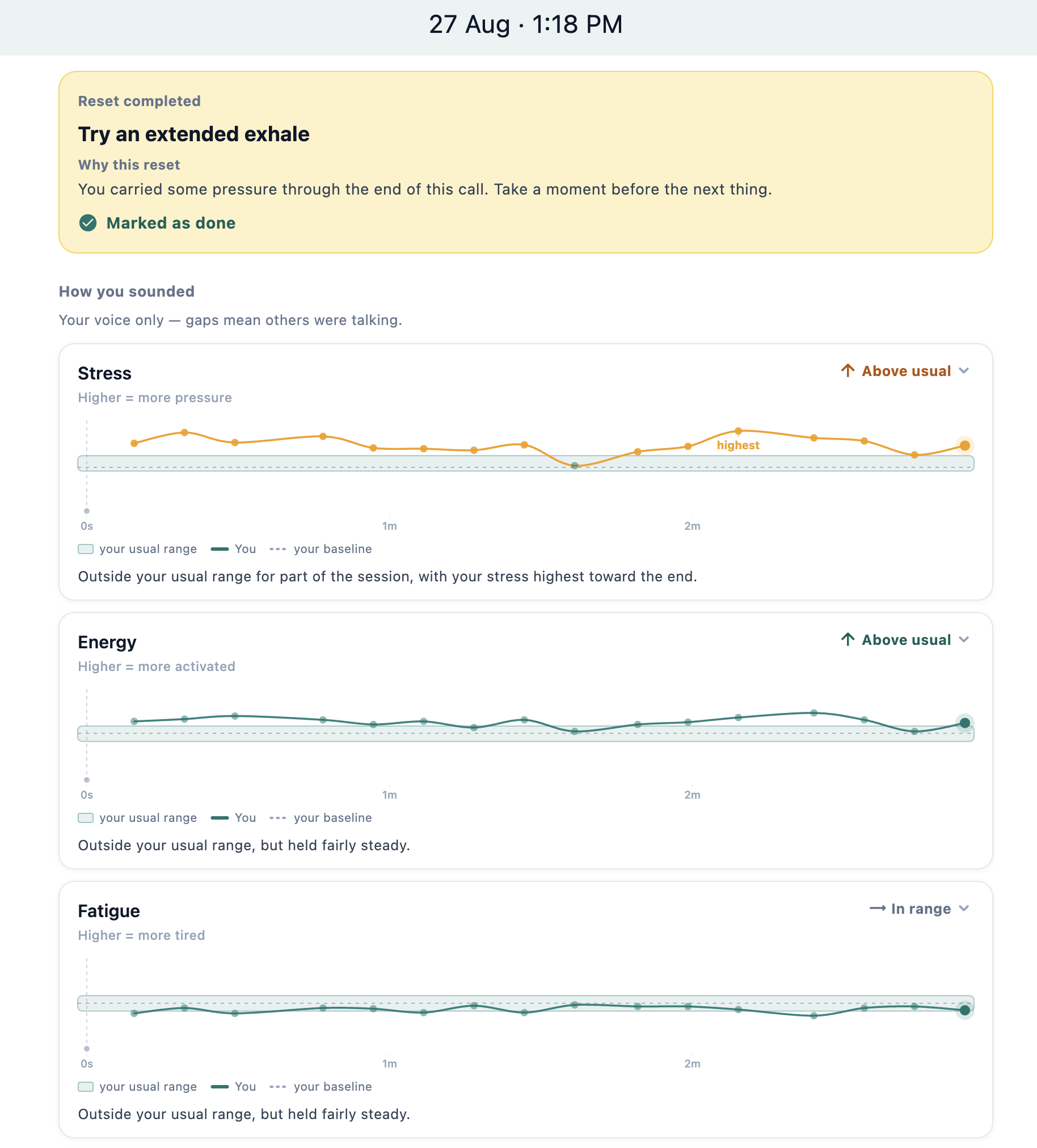
Press Start. Take the call. See how you held up.
No dashboard to babysit, no behavior to change. It works while you work.
It lives in your menu bar
One click before the call — Start. That’s the entire workflow. No window, no note-taking bot joining the meeting.
It reads only you, as you work
Pace, pitch, strain, steadiness — measured against your own baseline, on your machine. When anyone else speaks, it’s deaf by design.
See how you held up
A minute-by-minute timeline of your state across the whole call — where you were steady, where you slipped, and how it lines up with the outcome.
Away from your desk? A natural-voice read on iPhone or Android — same engine, same baseline.
The other side of every call is never heard, analyzed, or stored.
Ontor is speaker-gated: the moment anyone but you talks, no audio exists to capture. There is nothing to disclose and no one to ask — because nothing of theirs is ever touched. Self-tracking, not surveillance.
If you sell for a living: this is the opposite of the call-recording stack your manager bought. Nothing here is for them — your calls, your data, your edge.
Speaker-gated
Enrolled to your voice. Everyone else is silence to it — by design, not by policy.
On-device
All analysis runs on your machine. Audio is processed in memory and discarded.
No wearable needed
Nothing to wear, charge, or remember. On-device by default — cloud sync only if you turn it on.
Your voice carries signals. Research has read them for decades.
Decades of peer-reviewed research show the human voice carries measurable markers of activation, effort, and strain — how energized, tense, or worn down you are shows up in pitch, rhythm, and voice quality. Ontor turns how you sound into these signals and tracks each against your own baseline, so you see when today differs from your normal — never how you compare to anyone else.
On your device
Your voice is analyzed on the device itself. Nothing leaves it unless you turn on optional sync.
Your baseline, not a benchmark
Every reading is relative to your own recent history — the only fair comparison.
Grounded in published science
The signals map to established findings in voice research on arousal, vocal effort, and speech production.
Built on established acoustic-voice research — the same signal families used across decades of studies on vocal effort, arousal, and speech — adapted for private, personal, day-over-day tracking.
Ontor is a self-insight and performance tool, not a medical device. It surfaces trends and prompts reflection — it doesn’t diagnose.