Your whole practice is built around a client's stress, energy, and nervous-system state. And you get to see it for about one hour a week. The other six days, you're rebuilding from "how was your week?" — a foggy, second-hand recap of the exact thing you specialize in. That blind spot is where progress stalls and where the proof of your work quietly disappears. Here's why self-report can't close it, and what does.
The six-day blind spot — what coaches now call the Coaching Gap
A weekly session is a snapshot. You spend the first ten minutes reconstructing the week from memory, the client fills in what they can recall, and you make your read from that. But nervous-system state isn't a weekly event — it shifts day to day, often hour to hour. The dysregulation that mattered most happened on Wednesday afternoon, and by Monday's session it's a vague "I had a rough patch."
Executive coach Brad Federman names the structure of that problem directly: "{Line of Sight Blindness} + {Absence of Real Time Assistance} = The Coaching Gap." Hiring an executive coach, he writes, "is like hiring a football coach who is never allowed to attend the games" — the coach "can only influence you during a scheduled session and hope you put those tools to good use when pressure strikes" (Brad Federman on LinkedIn, 2025). Coachees feel it too: sessions spent catching up on what happened between meetings, rather than working the live pressure when it hit.
Coach Rickard Hultgren names the same gap from the intention side. The title says it outright: "The hardest part of coaching happens after the session." Inside the hour, a client has protected attention; then "The intention has to survive outside that protected environment." His open question is whether what matters most is the insight hour — "Or is something equally important happening during the following six days, when that insight repeatedly collides with circumstances?" A week later, he notes, "Now the client has to reconstruct several days from memory" (Rickard Hultgren on LinkedIn, Aug 2026).
The thing you're best at reading is the thing you can't see when it actually happens.
Quiet burnout hides in the between-session channel
Self-report isn't only incomplete — sometimes the early signal is what stops arriving. Coach Samuel Au describes a high-performing engineering manager who was still shipping, still "fine" in session: "When we started, she used to send me long voice notes between sessions… Somewhere in the last two months, those had stopped. Her updates were short now. Clean. Done." She wasn't failing; she was withdrawing. "This is quiet burnout, and almost nobody catches it, because it doesn't look like burnout" (Samuel Au on LinkedIn, 2025). The between-session voice channel was the tell — and then it went quiet.
If your only instrument for the in-between is what the client says on Monday, you can miss the week the voice notes shortened.
Self-report is the only instrument, and it leaks
Most coaches have exactly one tool for the in-between: what the client says. And self-report drifts in predictable ways. People forget, they round up, and without a clear picture of their own consistency, a little self-deception leaks in — they think they did the practice more than they did (Real Balance). Research on health coaching is direct about it: incomplete and unreliable self-report data is a main barrier to data actually improving the work, and objective measures give coaches something fundamentally different from "how do you feel?" (PMC).
None of this means self-report is worthless. It means it needs a second, objective read next to it.
Why wearables never closed it for a talking practice
The obvious fix is a device, and many coaches have said no — for good reasons. A wearable reads the body (heart rate, HRV, sleep) and infers stress from it. It can't see the psychological and nervous-system layer you actually coach: regulation, capacity, the state underneath the behavior. It also asks every client to buy, wear, and charge hardware, and it doesn't fit a practice built on talking and breathing.
Coach-education vendors are still pushing wearables as an "expected layer of elite coaching" in 2025 for between-session visibility (ANHCO) — which is useful as a market-demand signal that buyers want between-session data, not as proof that wrist sensors fit a voice-and-breath practice. The gap that matters for nervous-system coaches stayed open: the one thing you most need to see between sessions is often the one thing the available tools don't measure in your modality.
What an objective between-session read changes
Close that gap and three things shift at once.
You walk in already knowing the week. No ten-minute reconstruction. You see the actual trajectory and spend the session on what matters — less Coaching Gap catch-up, more work on the live pattern.
You can finally prove your work. Nervous-system coaching is notoriously hard to quantify, so it gets sold on anecdote. A read you can compare before and after a protocol — a breathwork series, a reset week — turns "I think that helped" into something you can show the client and yourself.
It unlocks the corporate conversation. This is the one with real money attached. Employee burnout costs U.S. employers between roughly $4,000 and $20,683 per person every year depending on role, and disengagement can run a 1,000-person company up to $5 million annually (AJPM abstract; access can be bot-walled — treat figures as published estimates pending full-text check). HR will fund what it can measure. Objective pre/post data across a cohort is the ROI story that gets a wellness program renewed instead of cut.
How it works in practice
The point isn't to hand you a dashboard to manage. It's lighter than that.
The client does a short voice check-in on their own phone — speaking naturally — and can share trend context with you when they opt in. You review the week before the session, and around a protocol you compare the before and after. That's it.
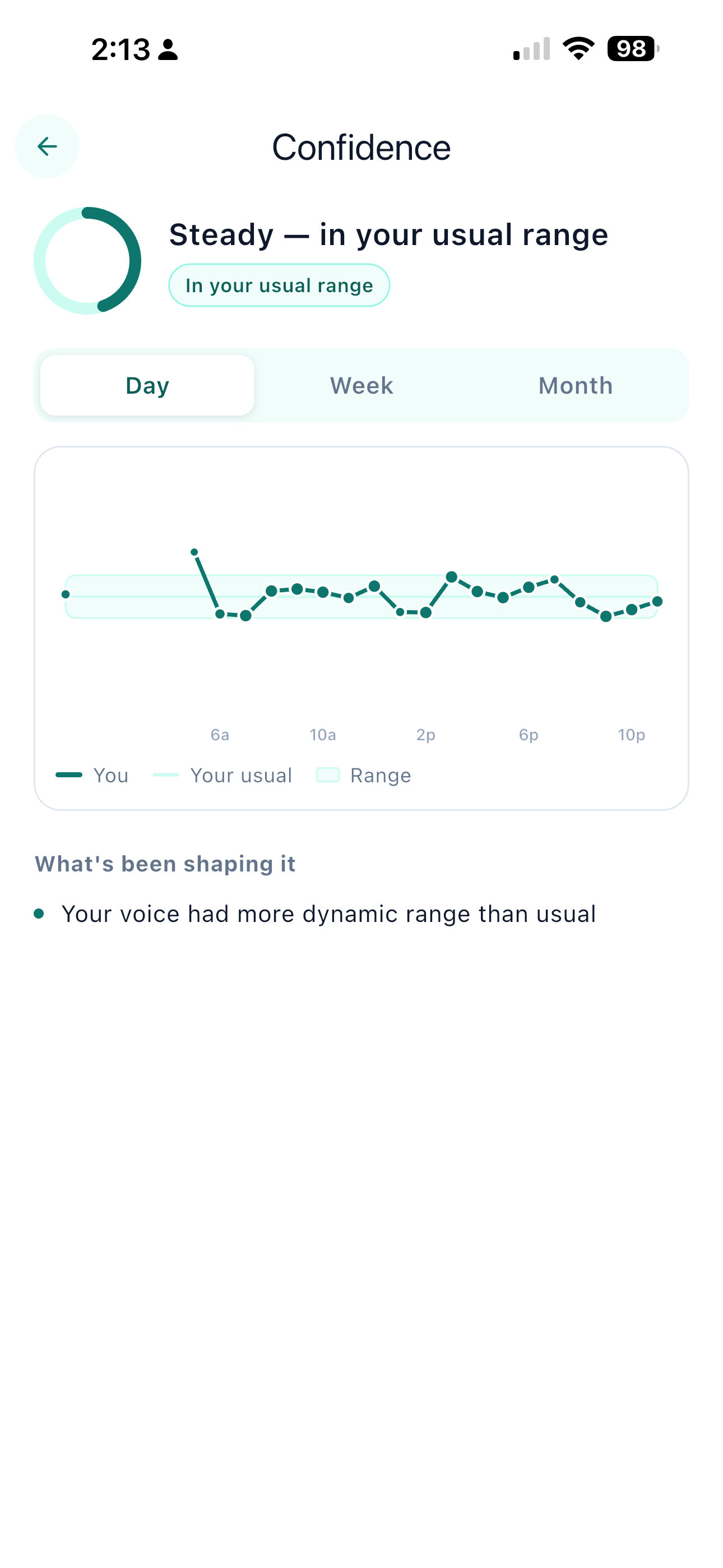
That's the idea behind Ontor. It compares how a client sounds with their own usual range across signals such as energy, stress, fatigue, and vocal strain, notices changes that last, and can suggest a short reset when one may help (How Ontor works). For teams, each person keeps personal readings while leaders can see aggregate patterns and before-and-after comparisons (Ontor for teams). Ontor does not determine mood or diagnose a health condition. You can read more on how voice biomarkers work if you want the detail.
Ontor is a general-wellness, self-awareness tool, not a clinical or diagnostic device. It doesn't replace your judgment — it gives you more of the week you've been missing.
FAQ
Why is the time between sessions a problem? You see a client about an hour a week and rebuild the rest from memory. Coaches describe that as a Coaching Gap: line-of-sight blindness plus no real-time assistance when pressure hits (Federman). Others put it as intention that must survive the following six days — then a Monday reconstruction from memory (Hultgren).
Why isn't self-report enough? It drifts — and quiet burnout can look like "I'm fine" while between-session voice notes shorten (Au). Research also names unreliable self-report as a main barrier to data helping coaching (PMC).
Why not just use wearables? They read the body, add hardware, and often don't fit a talking, breath-based practice — even as coach-education markets push them as an elite layer (ANHCO).
How would I actually use it? The client checks in by voice and can share trends; you review before the session and compare before/after a protocol (How Ontor works; Ontor for teams).
Ontor is a general wellness tool for self-awareness. It does not diagnose, treat, or prevent any condition, and it is not a substitute for clinical care or professional judgment.
Curious whether this fits your practice? Join the Ontor beta → · Read the FAQ