
Collectors develop calluses. Your recovery dashboard never shows it.
Collections scoreboards are loud. Dials, right-party contact, dollars recovered, queue depth. What stays quiet is whether the person on the headset still has empathy left after dozens of similar hardship conversations.
Members and debtors hear that gap first. Leaders meet it later as colder calls, more escalations, and another month-end that burned the floor for a number that looked fine on the wallboard.
This is not the same problem as a cool-down after a hostile disposition. Hostile-call residue is about the next connect after an escalation code. It is also not early-tenure confidence collapse in the first 60 days of nesting, and it is not what happens when AI strips easy contacts and concentrates emotion into the human queue. This piece is about cumulative empathy numbness under repetitive hardship work plus quota and month-end design.
What a collections AVP already names out loud
Matt Stegall, AVP of Member Solutions and Advocacy at Vantage Credit Union ($1.1B), put the mechanism in plain language in a CreditUnions.com feature on collections structure:
"Over time, you can start to develop calluses. It's important not to let that happen. Every member still deserves the same level of empathy and service, regardless of how many similar conversations you've already had."
That is buyer language for gradual numbness, not a one-call meltdown. The article narration around his comments describes repetitive hardship conversations, difficulty reaching members, and goal pressure that leave collectors emotionally numb. The member still needs the same service. The collector has already had that conversation many times this week.
Stegall also ties goal design to how people treat shared work:
"In environments that rely heavily on individual goals, you sometimes see people adopt the mindset of, "I'm just going to take care of my own work." They may not give as much time or attention to someone else's account, even if they happen to get the phone call."
And he defines success the way members experience it:
"The biggest success in any collection call is that the member feels like they are still as valued and as important a part of the credit union as they were the day they got the account with us or the day they got that new loan with us."
His shop's structural answer is role specialization, team goals over pure individual quotas, and predictive queuing early in the month so the end-of-month rush does not drive burnout. Keep that redesign. It still leaves a narrower live-voice question: after the fiftieth similar hardship call, is this collector still inside the empathy and voice range members deserve, or only still hitting dials?
Pressure that builds quietly into shorter patience
Kevin Smith-Henley, a financial-services supervisor who leads collections and AR analysts, described the same drift from the floor on LinkedIn. Collections is a pressure role: daily targets, difficult conversations, escalated emotions. Burnout, in his framing, does not arrive overnight. It builds quietly, then shows up as shorter patience on calls, reduced empathy, lower engagement, absenteeism, and "just get through the day" energy. Performance drops because people are exhausted, not because they stopped caring.
Weight that as manager-level corroboration of Stegall's calluses line. Do not treat a LinkedIn post as a universal industry constant. The ops point still lands: reduced empathy is a live call failure mode that dialer and recovery reports rarely name.
Vendor context (capped): gradual draining of empathy under hardship work
Zevo Health's financial-services writing (vendor wellness marketing; cap it) describes hardship and debt-collections frontline work absorbing crisis after crisis. In that framing, empathy and emotional energy drain gradually until people become irritable, emotionally numb, or detached, which then shows up in colder customer experiences. They argue for systemic workflow fixes, including short decompression after intense calls, not only an EAP after someone collapses.
Useful only as corroboration of the gradual-numbness pattern Stegall names. Do not import clinical labels, trauma language, or vendor program claims into how you run your floor. Ontor is not a clinical product and does not diagnose compassion fatigue or any health condition.
What dials, recovery, and queue depth still miss
Typical stack:
- Dialer and workforce metrics (occupancy, adherence, AHT)
- Collections outcomes (promises, payments, right-party contact)
- Queue and account aging
- QA on what was said
- Month-end goal progress
Useful. Incomplete for calluses. A recovery rate will tell you dollars came in. Occupancy will tell you the seat was busy. Neither tells you whether someone is still treating the next human like a human after a long string of similar hardship connects, or whether month-end individual-quota races just taught the floor to protect "my work" instead of the member on the line.
Dashboards show dials and recovery. They miss whether empathy and voice are still in range.
How this differs from cool-downs, early tenure, and AI queues
Cool-downs after hostile calls answer: was this call coded too hot to continue immediately?
Early-tenure confidence answers: is a new collector losing confidence across training, nesting, and production in the first 60 days?
AI emotional queue answers: after deflection, is the remaining human queue an all-hard emotional mix while AHT and occupancy still assume a balanced day?
This article answers a fourth question: after dozens of similar hardship conversations under quota and month-end pressure, has the collector developed calluses while the recovery dashboard still looks fine?
Same beachhead. Different mechanism. Different ops move.
A private check against your usual voice (not a clinical empathy score)
Ontor is a performance tool that reads how you sound, not what you said. While someone speaks, it compares voice signals to that person's own usual range. When a lasting shift shows up (for example stress, fatigue, confidence, or breathing), it can suggest a short reset. People can also compare before and after.
For teams, Ontor's public framing is aggregate patterns for workload, coaching, and support. Individual sessions and readings stay with the person. Leaders get team-level context for recovery design under repetitive hardship load. They do not get a personal scoreboard for hire or fire decisions.
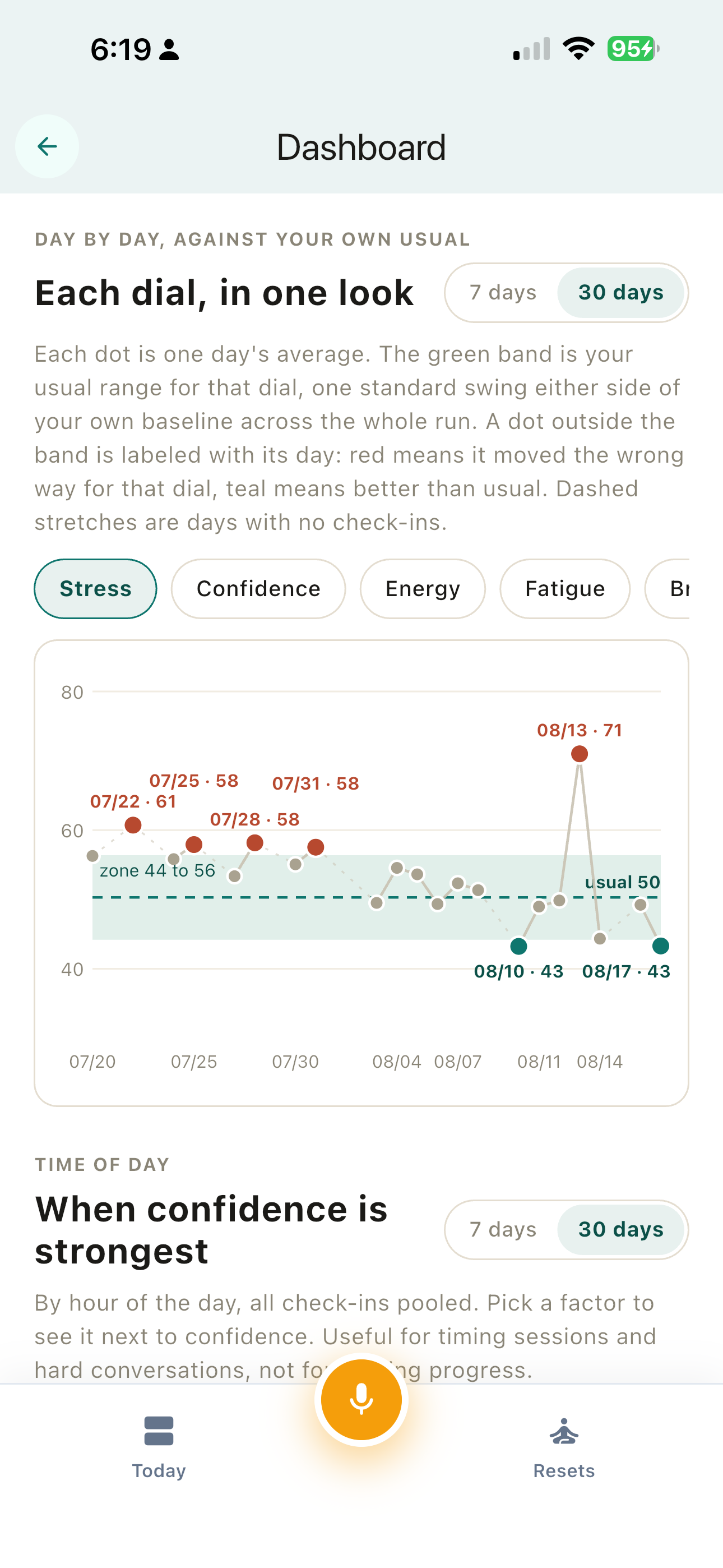
In my own Ontor session history, the calluses gap shows up the same way Stegall named it for collectors. After a long stretch of similar high-pressure conversations, how I sound can leave my personal usual range while calendars and outcome boards still look fine. That private usual-band drift is the part dials and recovery rates do not surface before the next member hears the voice.
Here is stress day by day against my personal usual band, from my own Ontor dashboard and session history. That personal usual-band check is what collections recovery dashboards miss when empathy has already thinned and dials still clear. It is not collections outcome data:
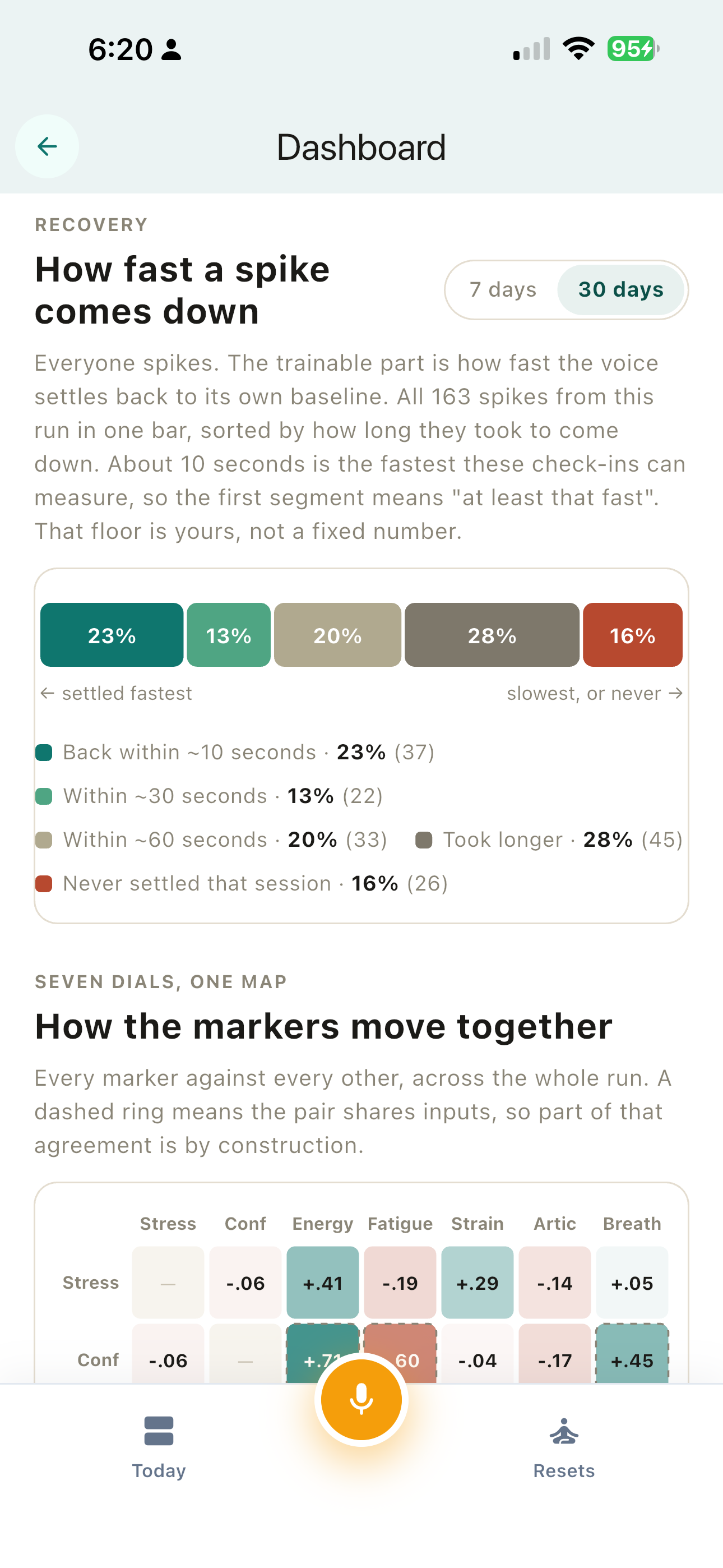
And here is recovery timing from that same personal Ontor history: how fast a spike comes back toward my own baseline across a run of sessions. Some spikes settle quickly. Some take longer. Some never settle in that session. That is one reason a private usual-range check matters under repetitive load. It is not evidence that a suggested reset caused recovery, and it is not a clinical compassion-fatigue score:
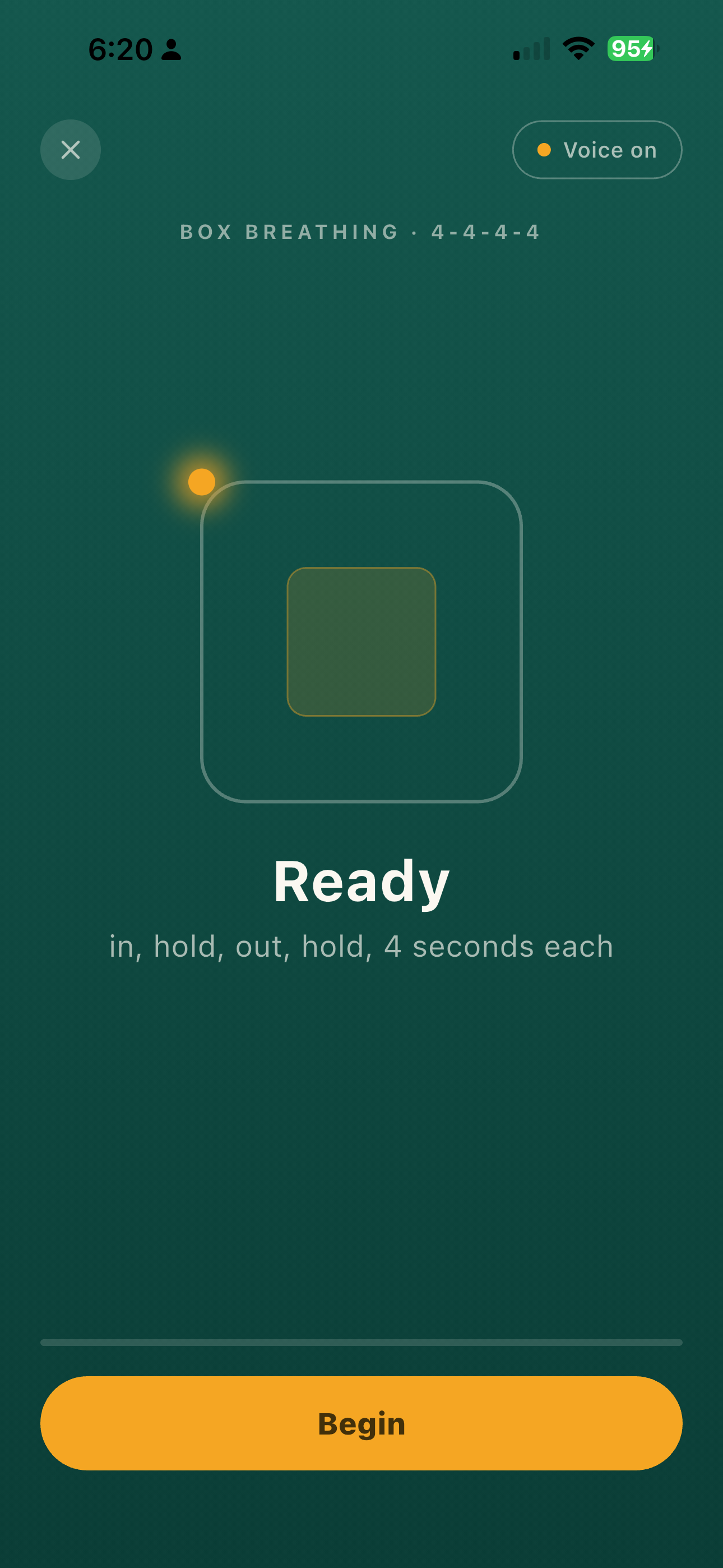
Here is a real Ontor box breathing reset screen from my own product use. When repetitive hardship work pushes you off your usual voice, this is the short private loop available before the next connect. It complements structural redesign (team goals, smoother month-end queues). It does not replace it, and it is not proof of recovery-rate lift:
In exploratory work on that same personal Ontor history (one person, not a population study), high-stress episodes often did not show an observed return to my personal median within an hour. That is one reason a private usual-range check under cumulative load matters. It is not evidence that a suggested reset caused recovery.
This is not a claim that voice markers diagnose empathy loss, predict attrition clinically, or guarantee recovery-rate, AHT, or retention improvement. The claim stays narrow: when repetitive hardship conversations plus quota design push how someone sounds away from their usual range, a private signal plus a short reset is a loop collectors can run before the next member connect, while leaders watch cohort patterns only in aggregate.
What a measured pilot looks like for collections leaders
Start narrow.
- Pick one collections or recovery pod with repetitive hardship conversations and real month-end or individual-quota pressure (credit union Member Solutions, ARM front-end, or a hardship queue).
- Give people a private way to notice lasting stress, fatigue, or confidence drift and try short resets between connects.
- Keep leaders on aggregate patterns only (for example, whether the pod is outside usual range more often in late-month blocks or after long same-theme hardship stretches).
- Decide in advance what you are learning: did people use resets, did resets fit real AHT and wrap-up constraints, did managers get any earlier read on team strain without seeing individuals, and did structural moves (team goals, smoother queues) still get credit for the design work they do.
Do not promise recovery-rate, occupancy, or attrition guarantees from a pilot. Measure whether the tool fits a floor where dials can still look healthy after empathy has thinned.
Bottom line
Collectors can develop calluses after dozens of similar hardship conversations. Individual quotas and month-end rushes make it worse. Recovery dashboards still count dials and dollars. They miss whether empathy and voice are still in range for the next human on the line.
A private, baseline-relative voice signal will not fix broken goal design or impossible staffing. It can give collectors something concrete between hardship connects, and give leaders aggregate context while personal readings stay with the person.
Start a free trial for you and your team. Soft secondary path for a measured pilot: Ontor for teams. Related reading: cool-downs after hostile calls, early-tenure confidence, and AI emotional queue.
About the author
Sabber Ahamed is the founder of Ontor and an applied ML scientist (PhD in geophysics and signal processing) who builds on-device voice tools. Ontor compares how you sound to your own usual ranges and suggests short resets, without claiming clinical or revenue outcomes from marker changes.
References
- Matt Stegall (AVP Member Solutions & Advocacy, Vantage Credit Union), quoted by Savana Morie. A Collections Structure That Looks Out For Members And Employees. CreditUnions.com / Callahan. Article.
- Kevin Smith-Henley. LinkedIn post on collections pressure, reduced empathy, and quieter burnout signs. 5 Mar 2026. Post. Profile: linkedin.com/in/kevin-smith-henley-20b61780. (Manager-level corroboration; secondary weight.)
- Kevin Daly / Zevo Health. The emotional toll of supporting vulnerable customers in financial services. 3 Feb 2026. Article. (Vendor-capped; gradual empathy-drain / short decompression vocabulary only; no clinical claims.)
- Ontor. How Ontor works; Ontor for teams; About the founder.
- Ontor. Cool-downs after hostile calls; Early-tenure confidence; AI emotional queue.