Leaders already ask how the floor sounds vs day one. The dialer never answers.
Mid-market phone leaders already know the listen-in question. How do they sound over the phone? Compared to when they first started? Do they sound tired?
Dial and talk-time boards still answer a different question. They count activity. They do not keep a continuous read of voice-state versus that person's own usual range. So the early-warning leaders already trust in their ear only shows up when someone has time to shadow, or when attrition arrives late.
This piece is for VP Sales, CROs, Heads and Directors of Sales / Sales Development, and Sales Ops running roughly 20-200 voice seats in general B2B outbound. It is not coaches-channel content. It is not freight, staffing, or collections. It is also not the published article on live tonality under resistance, not the 5-10 second between-call micro-gap piece, and not the SDR attrition cost math. The question here is narrower: manager early-warning via continuous how-you-sound versus day-one / personal usual range.
The question leaders already ask on the floor
Talha Husayn (then VP of Sales Development at Orum) put the early-warning list in buyer language for SDR leaders:
"BURNOUT. How do they sound over the phone? What is the quality of their email outreach or replies? How does it compare to when they first started? Do they sound tired or drag their heels on certain tasks?"
And the ops move that follows:
"Notice the signs - give them a break. When is the last time they took a vacation?"
Treat that as sales-leadership practice from someone running an SDR org, not as Ontor's measurement of your floor. The useful spine is the comparison itself: phone sound versus when they first started. Leaders already treat audible tiredness as an early signal. The dialer never stores that comparison.
Front-line leaders who reshared the thread amplified the same object: how they sound, and call attitude, as burnout detection language. Keep that as peer corroboration of the question, not as clinical proof.
Managers already prescribe pre-block resets for vocal presence
Phoenix Goodman (Sales Development Manager at Salesforce; prior outbound / SDR lead roles) frames cold-call hesitation as a missing reset ritual, not a motivation deficit:
"Cold call fear isn't a lack of motivation."
"It's usually a lack of a reset ritual."
His floor prescriptions are concrete: stand when you call for posture and vocal presence; script only the first 15 seconds; take a short breathing pause before a high-output dial block. He lands the point leaders care about:
"You don't need to feel ready to start calling."
"You just need a ritual that helps you show up anyway."
Cap any medical wording around nervous-system labels. Keep the buyer claim: Salesforce SD management already coaches vocal presence and short pre-block resets as performance levers. That is complementary to continuous voice-vs-usual-range signal, not a substitute for it. Rituals sit at the edge of a block. The early-warning gap is still what happens to how someone sounds across the day versus their own range.
Sparse shadow-listening is the only ops way to hear "tired"
Pulse RevOps training for SDR managers (vendor-capped) says managers default to dial dashboards because they are easy to pull, not because they predict revenue. Their coaching reboot pushes silent live shadow-listening rotated across morning, afternoon, and Friday blocks "so you catch the rep tired, not just fresh," with attention on the first ~45 seconds and the first "not interested."
Useful as problem vocabulary. Cap the training CTA. The structural limit remains: three short shadows a week cannot cover continuous voice-state versus personal baseline. You hear tired when you happen to be listening. You miss the drift when you are not.
Dial boards still miss voice-energy collapse until it is late
Readymode's outbound burnout post (dialer vendor; capped) names the manager-visible sign in plain language:
"The one who had energy in their voice now sounds like they're reading from a script."
Prospects, they argue, pick up tone and energy in the first few seconds. And:
"By the time a manager notices it, it has typically been building for a while."
Keep that as vendor problem language only. Their pitch is dialer / caller-ID / connect-rate tooling. This article is not a connect-rate or spam-flag piece. The spine is audible energy collapse versus day-one presence, which activity boards still fail to show continuously.
Rework's BDR/SDR day-in-the-life guide (tertiary; enablement content) adds mid-block flat-voice language managers recognize: after a stretch of nos and silence around mid-morning, "Your voice is starting to sound flat." Cap it. High overlap with afternoon-fade themes. Use only as tertiary vocabulary that flat voice mid-block is already named on the floor.
Quiet attrition still hides behind activity metrics
David Wilkins (long-time SDR leader; SDR Leaders community) is light corroboration here, not the primary spine. Burned-out reps rarely escalate first. They get quieter while leaders watch activity:
"I was looking at their activity metrics when I should have been looking at their face on a Zoom call."
"Most SDR leaders find out their rep is struggling when the rep hands in their notice."
"By then you're six weeks too late."
That is the late end of the same gap. SDR burnout attrition cost covers replacement math. This article stays earlier: continuous phone-sound versus day-one / usual range, before notice. Wilkins' Zoom-face cue is video. Ontor's complementary object is how someone sounds on the calls they already make.
Distinct from resistance tonality, micro-gaps, and attrition cost
Prospects hear when the voice tightens answers: once the prospect is live, do dashboards show tone collapse under resistance, or only that talk time happened?
Dialer fatigue / afternoon fade answers: what happens in the compressed 5-10 seconds between connects when rough-call carryover has nowhere to go.
SDR burnout attrition cost answers: what one departure costs when early signs were missed.
This article answers a fourth question: do leaders get a continuous, personal-baseline answer to "how do they sound vs day one," or only sparse shadow-listening and late attrition?
Same mid-market beachhead. Different moment. Different ops move.
A private how-you-sound vs usual range (not a burnout diagnosis)
Ontor is a performance tool that reads how you sound, not what you said. While someone speaks, it compares voice signals to that person's own usual range. When a lasting shift shows up (stress, fatigue, confidence, breathing, vocal strain), it can suggest a short reset. People can also compare before and after.
For teams, Ontor's public framing is aggregate patterns for workload, coaching, and support. Individual sessions and readings stay with the person. Leaders get team-level context (for example, whether a pod is outside its usual range more often across a week). They do not get a personal scoreboard for staffing decisions.
That is the instrumented version of Talha's question. Not resistance-tonality conversion. Not a between-call micro-gap timer. A private continuous comparison of how you sound versus your own usual range, plus short resets of the kind Phoenix already coaches at the edge of a block.
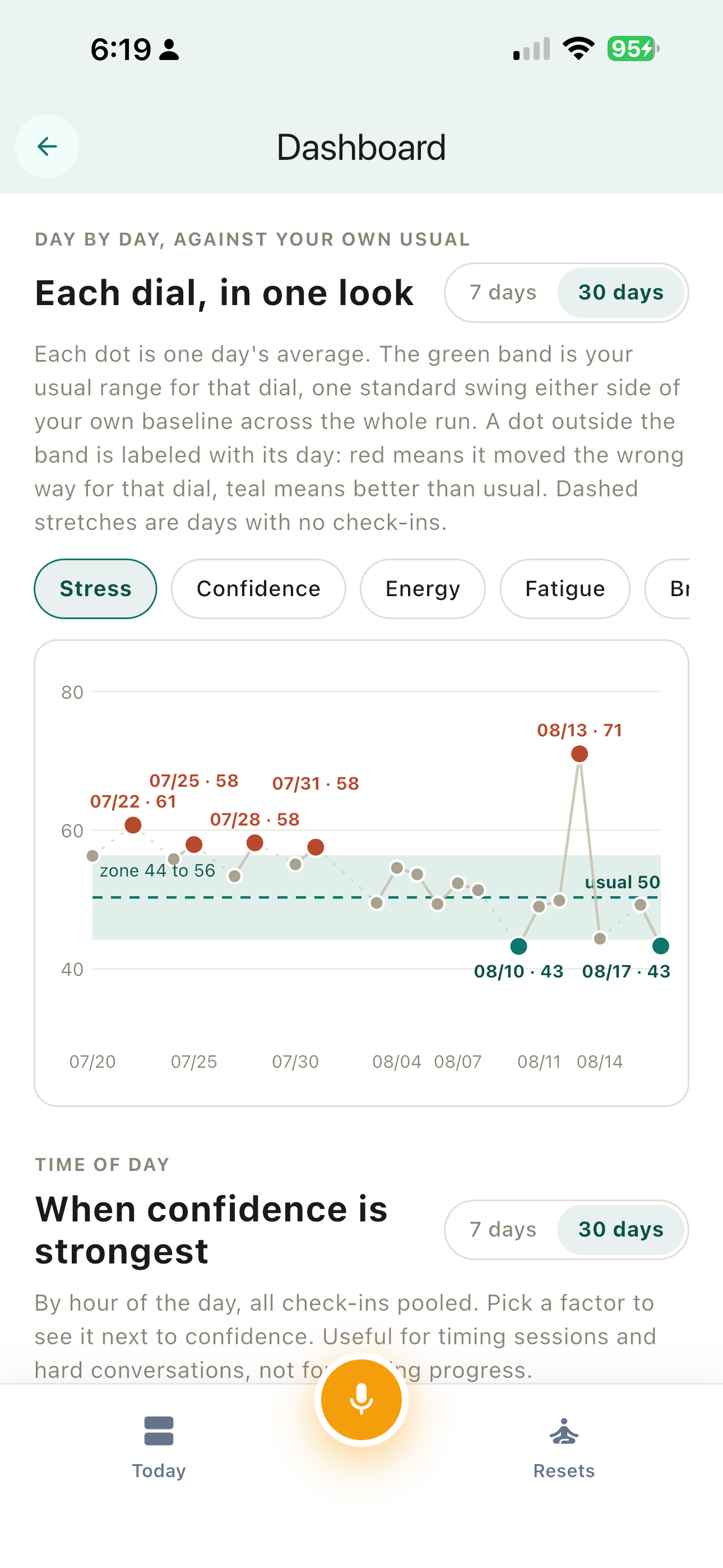
In my own Ontor session history, the day-one comparison shows up as dial-by-dial and day-by-day stress sitting against my personal usual band. Some days land inside the zone. Some days move outside it while calendars and activity still look fine. That private usual-band drift is what sparse live shadowing catches only when someone is listening, and what dial boards never store.
Here is stress across dials / days against my personal usual range, from my own Ontor dashboard and product use. This is the continuous phone-sound early-warning view leaders lack on the dialer. It is not a diagnosis of burnout, and it is not outcome data from your floor:
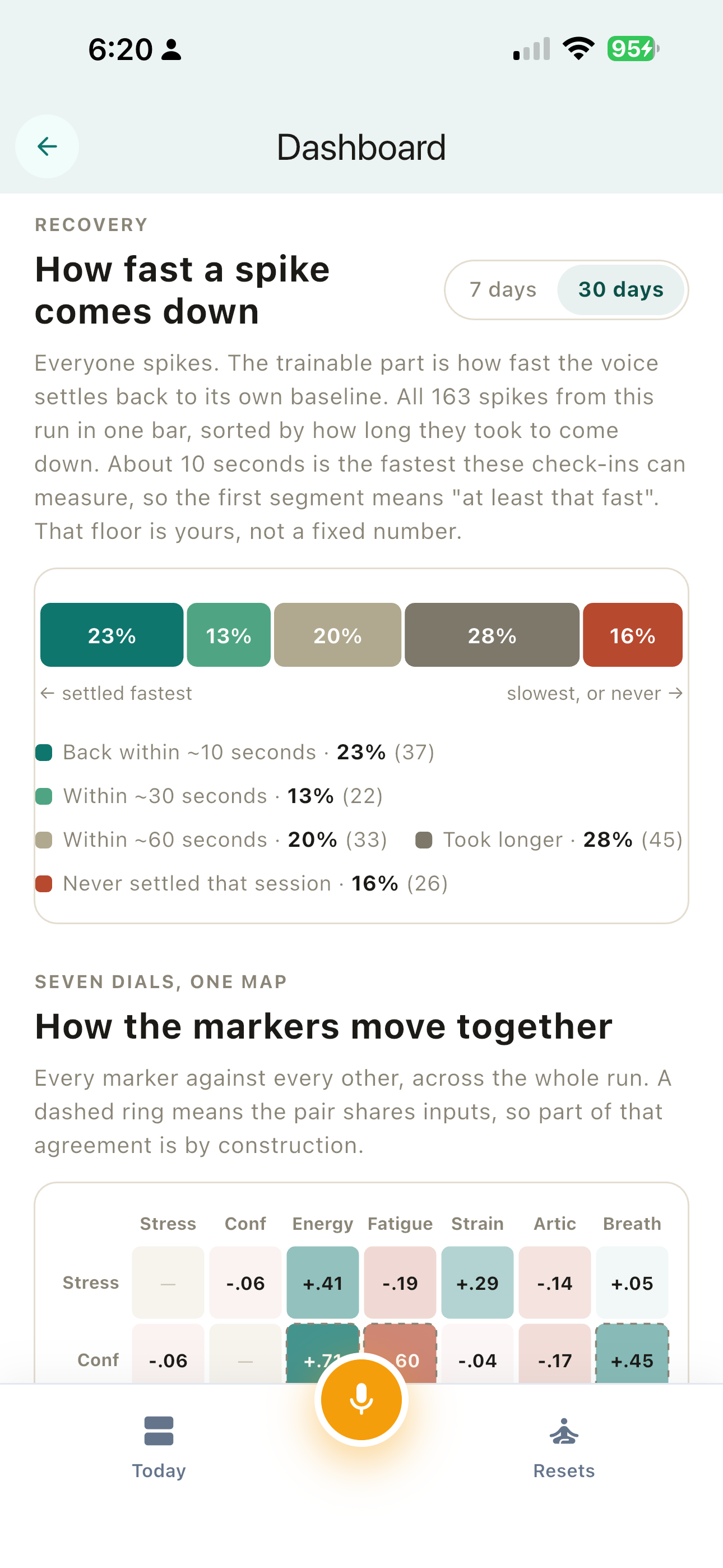
And here is how fast a stress spike came back toward my personal baseline in that same Ontor history. Useful as a private recovery check after a hard stretch. It is not proof that a suggested reset caused recovery, and it is not clinical recovery science:
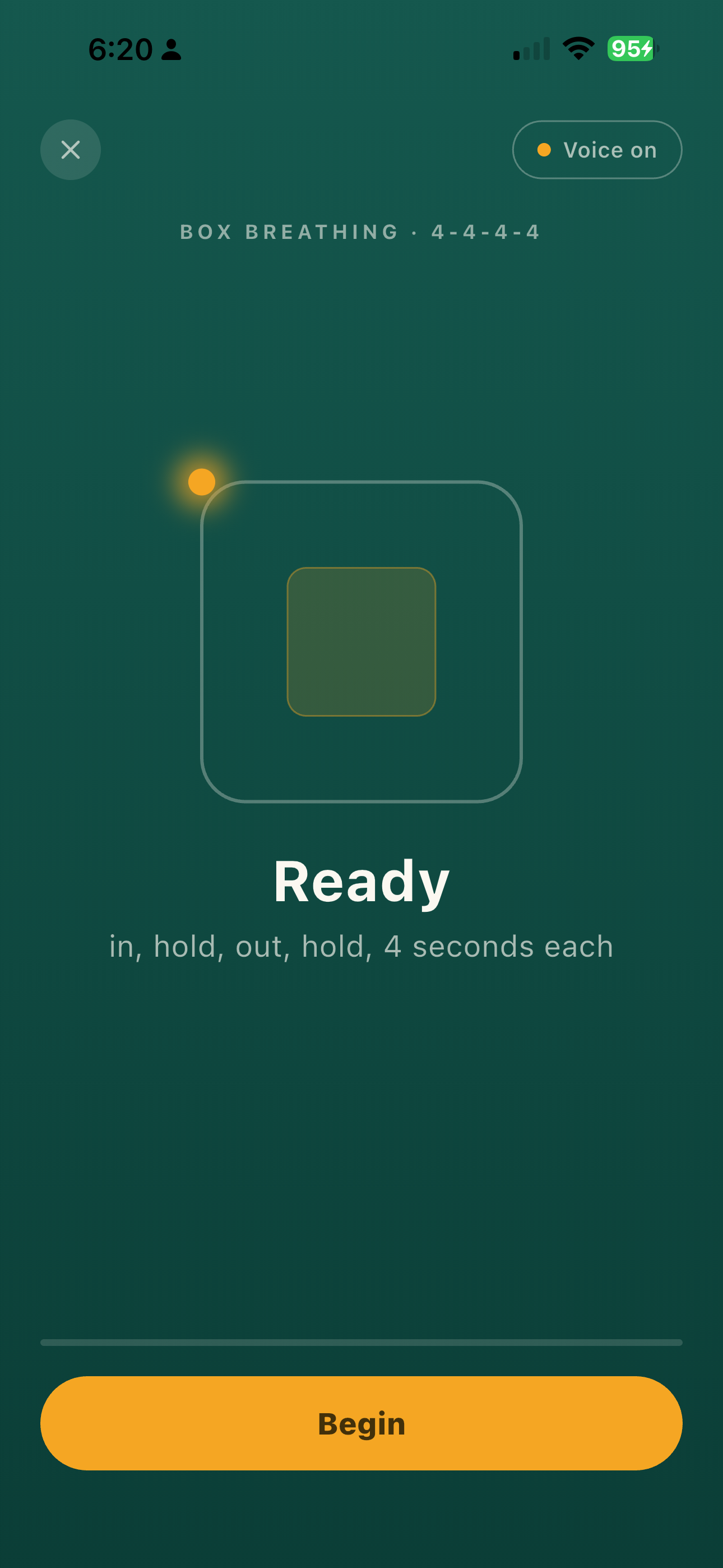
Phoenix-style short resets fit the same loop. When confidence or pressure drifts outside usual range, Ontor can surface a brief private exercise before the next hard connect. Here is a box-breathing reset screen from my own product use. Cap any medical claim. The product point is a short private reset, not a clinical intervention:
Exploratory work on that personal history (one person, not a population study) treats usual range as an empirical personal reference band, not a clinical target. Marker movement toward or away from that band is observed signal change. It does not establish that a reset caused stable recovery, and it does not diagnose health conditions.
This is not a claim that voice markers detect burnout clinically, predict resignation, replace manager judgment, or guarantee retention. The claim stays narrow: when leaders already ask how the floor sounds versus day one, a private continuous usual-range signal can surface drift earlier than sparse shadow-listening, while personal readings stay with the person.
What a measured pilot looks like for mid-market sales leaders
Start narrow.
- Pick one phone-heavy SDR or AE pod (roughly 20-200 seat org scale) where managers already catch tired sound on listen-ins, but only when they have time to shadow.
- Give reps a private way to notice lasting stress, fatigue, confidence, or vocal-strain drift versus their usual range across real dial blocks, and try short resets before the next hard connect when the day allows.
- Keep leaders on aggregate patterns only.
- Decide in advance what you are learning: did people use the signal across a week, did short resets fit real dialer flow, did managers get any earlier team-level read without seeing individuals, and did coaching stay aimed at how people sound versus day one rather than more dials.
Do not promise quota, conversion, or attrition guarantees from a pilot. Measure whether the tool answers the day-one comparison leaders already ask, without turning personal voice state into a scoreboard.
Bottom line
Leaders already ask how the floor sounds versus day one. Salesforce SD managers already prescribe short resets for vocal presence. The only continuous ops way to hear "tired" is still sparse live shadow-listening. Dial and talk-time dashboards never store voice-state versus personal baseline, so teams find out late.
A private, baseline-relative voice signal will not fix a bad list or an impossible dial quota. It can give reps something concrete when how they sound leaves their usual range, and give leaders aggregate context while personal readings stay with the person.
Start a free trial for you and your team. Soft secondary path for a measured pilot: Ontor for teams.
About the author
Sabber Ahamed is the founder of Ontor and an applied ML scientist (PhD in geophysics and signal processing) who builds on-device voice tools. He has shipped production signal and ML systems across radiology AI, healthcare, and manufacturing. Ontor compares how you sound to your own usual ranges and suggests short resets, without claiming clinical or revenue outcomes from marker changes.
References
- Talha Husayn LinkedIn - SDR leaders: how do they sound over the phone vs when they first started
- Phoenix Goodman LinkedIn - cold call fear is usually a lack of a reset ritual
- David Wilkins LinkedIn - quiet attrition behind activity metrics (secondary)
- Why Outbound Sales Reps Burn Out - Readymode (vendor-capped)
- The SDR Outbound Calling Coaching Reboot - Pulse RevOps (vendor-capped)
- A Day in the Life of a BDR/SDR - Rework (tertiary; vendor/enablement)
- How Ontor works
- Ontor for teams
- About the founder - Ontor