
Freight never sleeps. Your voice still has to sound awake at 3AM.
Dial boards count daytime connects. They do not tell you how you sound when a shipper's "quick question" lands at 9PM, a carrier blows up your phone at 2AM, or Friday-to-Monday on-call hands you a tracking escalation after you were already asleep.
Freight brokerage sales leaders already know the pattern. Owners name decision fatigue, quoting errors, and strained communication under always-on pressure. The sharper overnight problem is quieter: when the call that wakes you is also the call where you have to sound ready.
This piece is for VP/Director/Head of Sales, Carrier Sales, Agency Sales, CRO, and brokerage owners who still end up on night escalations. Brokers feel it too. It is not the daytime call-block readiness article. That one is about recovering between dial blocks on the floor. This one is after-hours interrupt voice composure: how you sound versus your own usual range when you have just been woken.
Freight never sleeps. Brokers still have to.
Harvey Roberts (Owner, BKE Logistics) put the industry pressure in plain language on LinkedIn:
"Freight never sleeps, but brokers need to."
"A shipper's "quick question" at 9 PM or a carrier's weekend call can instantly pull you back into work mode"
He argues constant availability does not translate to better brokerage. It often leads to decision fatigue, with more risk of quoting errors, missed carrier-vetting details, and strained communication. Burnout, in his framing, degrades service quality. His practical boundary is a communications cutoff for non-urgent mail and calls so true emergencies still get through without treating every ping as urgent.
In a companion post he rejects burnout as a badge of honor. Decision-making gets sloppy on fumes. Client relationships suffer under constant stress. Carrier trust erodes when you stay reactive. That is owner language about overnight clarity, not a clinical claim.
On the same never-sleeps thread, Brian Gelink (logistics leader) named the voice problem leaders already feel:
"You might always be the final say for the hard questions, but don't let it be the default. Then at 3AM when you are struggling to sound like you didn't just wake up, you'll know its important."
That is the hook dial dashboards miss. Tracking can escalate. Leaders become the night escalation. The shipper or carrier hears the voice first.
Always-on is an ops design choice, not a virtue
Esad Sadikovic (freight and logistics consultant; prior brokerage management roles) describes how "24/7 customer service" morphed into an always-on expectation: tracking apps in bed, at dinner, even while sick, while culture still says push harder. He frames leadership mistaking availability for accountability. Cap any survey percentages he cites as unverified secondary figures. Prefer the mechanism: always-on expectation, mistakes under load, teams that stop growing accounts.
Anonymous brokers on r/FreightBrokers describe the same nights from the seat. Late-night and weekend calls as the hardest part. Tracking teams that inform the broker of a problem instead of solving it. Prior shops with Fri 5PM to Mon 8AM on-call and "pissed off driver calls all night." Another thread: carriers blowing up a personal cell at 2AM to book loads that were not even urgent, until DND and a separate office line became the workaround. Treat Reddit as employee anecdote, not a verified employer case study.
Vendor pages name the same gap from the staffing side. Haulbase describes most brokerages handling nights with "an on-call phone, a prayer, and a Monday morning of damage control," and "the on-call dispatcher: one exhausted person with a phone." Valoroo lists missed after-hours calls and burned-out carrier reps when coverage collapses outside 8AM-6PM. Cap both as vendor marketing. Useful for problem vocabulary only. Their product answers are ops AI or offshore staffing, not voice composure.
What dial dashboards still miss overnight
Typical stack:
- Daytime dials, talk time, and coverage in the CRM
- Load and exception state in the TMS
- Call recordings for what was said
- On-call rotations, after-hours staffing, or "call the owner"
Useful. Incomplete for interrupt readiness. A dial board will not tell a top producer they sound outside their usual range after a sleep interrupt. A transcript will not tell you the voice that just woke up is carrying more fatigue or strain into a hard carrier conversation.
Leaders usually meet the lagging indicators later: softer relationships, quoting misses, another weekend that "almost broke" someone, another owner who is still the default 3AM escalation.
If you already wrote SOPs for after-hours staff, keep them. Prep the desk before EOD. Do not make the leader the default for every night call. That is coverage design. It still leaves a narrower question: when the breakthrough call does land, how does that person notice they are outside their usual voice before the shipper hears it?
A private check against your usual voice (not a night-shift clinical product)
Ontor is a performance tool that reads how you sound, not what you said. While someone speaks, it compares voice signals to that person's own usual range. When a lasting shift shows up (for example stress, fatigue, confidence, vocal strain, or breathing), it can suggest a short reset. People can also compare before and after.
That matches the overnight problem without turning it into medical sleep advice or ENT care. Ontor's public product framing is personal-baseline self-insight: acoustic patterns versus your own rolling usual range, not a population score and not a diagnosis. For teams, leaders see aggregate patterns that can inform workload, coaching, and support. Individual sessions and readings stay with the person.
In my own Ontor session history, the overnight composure gap shows up the same way Gelink named it at 3AM. After a sleep interrupt or a high-stress stretch, how I sound can leave my personal usual range while dial boards and calendars still look fine. That private usual-band drift is the part the after-hours stack does not surface before the shipper or carrier hears the voice.
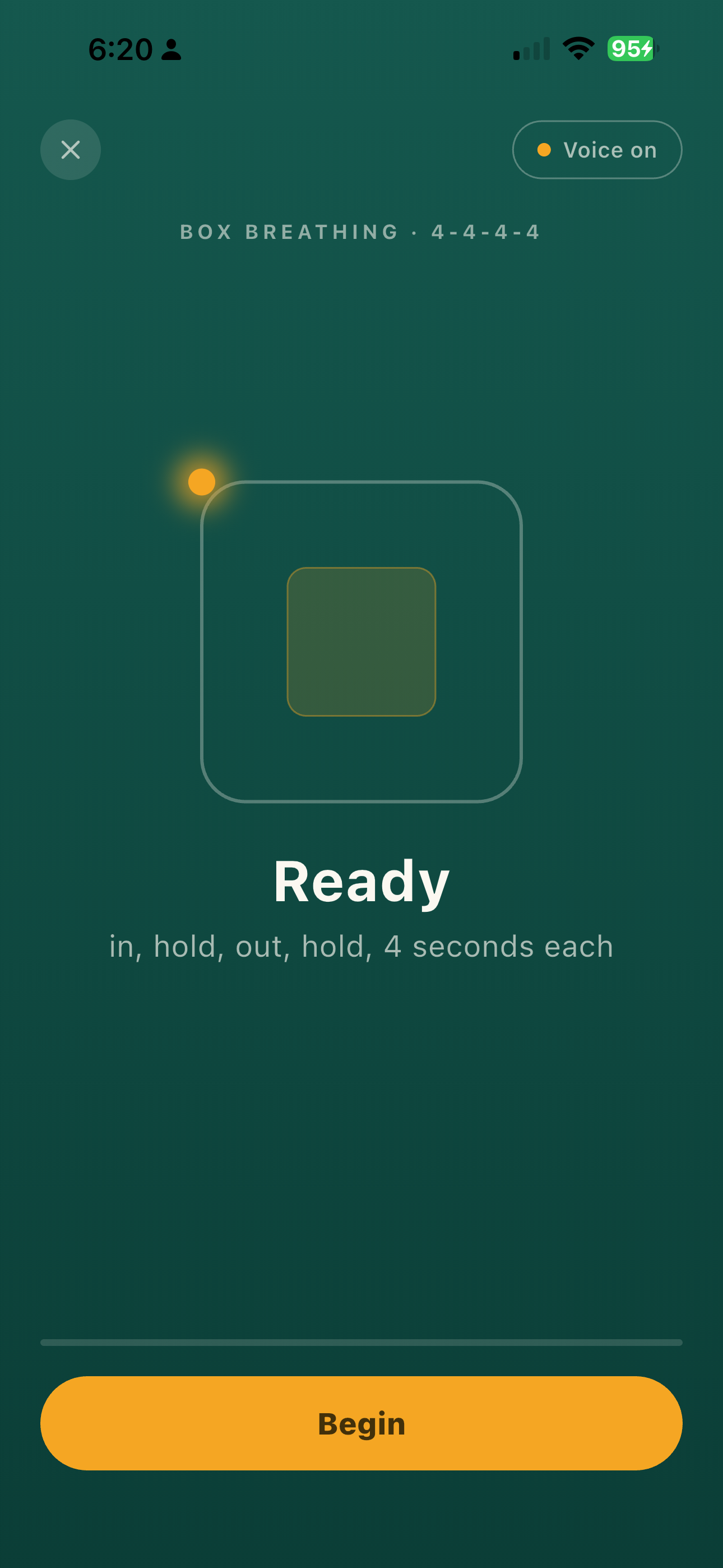
Here is a real Ontor box breathing reset screen from my own product use. When a night call pushes you off your usual voice, this is the short private loop available before the next hard conversation. It is not proof of overnight freight outcomes:
And here is stress day by day against my personal usual band, from my own Ontor dashboard and session history. That personal usual-band check is what dial boards miss after an interrupt. Again, not overnight freight outcome data:
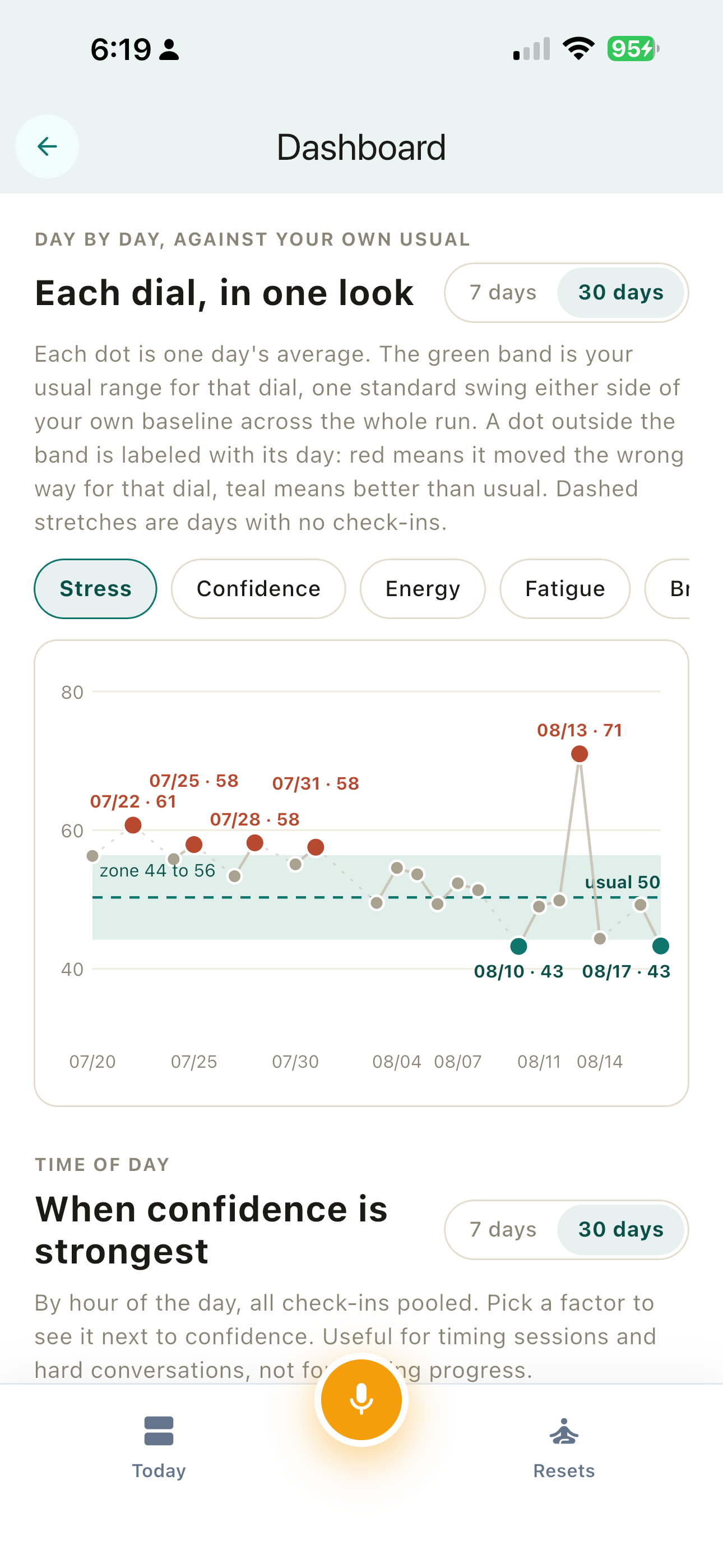
In exploratory work on that same personal Ontor history (one person, not a population study), high-stress episodes often did not show an observed return to my personal median within an hour. That is one reason a private usual-range check after an interrupt matters. It is not evidence that a suggested reset caused recovery.
This is not a claim that voice markers diagnose sleep debt, predict burnout clinically, or guarantee quoting accuracy, retention, or revenue after a reset. Internal exploratory reset analyses also do not establish that a suggested reset caused stable recovery. The claim stays narrow: when an after-hours interrupt pushes how you sound away from your usual range, a private signal plus a short reset is a loop you can run before the next hard conversation.
Prior always-on brokerage coverage writing (including SPI3PL-style after-hours staffing) belongs in the coverage conversation. It is not the lead for this article. Ontor is adjacent: composure and readiness in the voice when the phone still rings at 3AM.
What a measured overnight pilot looks like
Start narrow.
- Pick one after-hours path: owner on-call, carrier-sales night rotation, or a Fri-Mon desk that still escalates hard calls.
- Give those people a private way to notice lasting stress, fatigue, confidence, or strain drift after an interrupt, and try a short reset before the next live connect when the situation allows.
- Keep leaders on aggregate patterns only.
- Decide in advance what you are learning: did people use the signal after night interrupts, did a short reset fit real on-call flow, did managers get any earlier read on team strain without seeing individuals.
Do not promise Monday damage-control reduction or revenue lift from a pilot. Measure whether the tool is usable when the phone wakes someone, and whether people can tell when they left their usual voice.
Bottom line
Freight will keep moving after hours. Dial dashboards will keep counting daytime work. The gap that remains is overnight voice composure: sounding like yourself when the call that wakes you is also the call that matters.
Start a free trial for you and your team. Soft secondary path for a measured pilot: Ontor for teams.
About the author
Sabber Ahamed is the founder of Ontor and an applied ML scientist (PhD in geophysics and signal processing) who builds on-device voice tools. Ontor compares how you sound to your own usual ranges and suggests short resets, without claiming clinical or revenue outcomes from marker changes.
References
- Freight never sleeps, but brokers need to - Harvey Roberts (LinkedIn)
- Comment on Harvey Roberts' post - Brian Gelink (LinkedIn) (3AM "sound like you didn't just wake up")
- Most freight brokers think burnout is just part of the game - Harvey Roberts (LinkedIn)
- How Broker Burnout Affects Performance - Esad Sadikovic (LinkedIn) (survey % capped)
- How do you deal with being on call on the time? - r/FreightBrokers (anonymous employee anecdotes)
- Dispatcher gripes - r/FreightBrokers (anonymous; 2AM wake-ups)
- After-hours freight coverage - Haulbase (vendor-capped)
- Freight Broker Staffing - Valoroo (vendor-capped)
- How Ontor works
- Ontor for teams
- About the founder - Ontor
- Freight sales call-block readiness - Ontor (daytime sibling; different question)