
Leaders treat the minutes between calls as empty. The hangover isn't.
Mid-market phone leaders still measure the connected call. Dials. Talk time. Activity. The minutes around it look empty on the board: a short pause before the next name, a CRM update, an email, a breath that never quite finishes.
On the floor those minutes are unpaid work. Pre-call relationship reconstruction. Post-call notes before the detail evaporates. Coming down from whatever emotional register the last conversation demanded. That tax compounds. By roughly call 10 the rep is not starting fresh. They are starting from a deficit. The next buyer feels it even when sleep and diet look fine.
This piece is for VP / Director / Head of Sales, CROs, and RevOps running roughly 20-200 voice seats (SDR + AE). Sports and ticket phone floors show up here only as a transferable metaphor for phone work that still wins on the line. It is not freight, staffing, or collections content. It is also not the published pieces on parallel-dialer 5-10 second micro-gaps, live resistance tonality, morning first-connect warm-up, or block-length robot fade. The object here is the hangover between connects that activity boards call empty space.
The recovery gap managers treat as empty space
Paul Beirne (sports sales operator; phone floors that still get answered) puts the hangover in buyer language. Transfer the metaphor to mid-market B2B SDR and AE floors; keep sports inventory as color, not as the ICP:
"But the call is not the whole job. The real work often lives around the call."
"Before the call, a good rep has to reconstruct the relationship."
"Then the call happens. That's the only part anyone measures."
"And sometimes, just a minute to come down from whatever emotional register that last conversation demanded."
"We measure call volume. We measure talk time. We measure activity. But we rarely measure the work, the emotional recovery, the planning, that sits between calls."
"And that tax compounds. By call ten, the rep is not starting fresh. They are starting from a deficit."
"It's not empty space. It's the work."
Treat that as operator vocabulary for the unpaid recovery + reconstruction gap, not as Ontor measuring your floor. The spine is simple: managers start the stopwatch when the call connects, then treat the minutes around it as idle. The hangover is the unpaid work and the emotional come-down. By call 10 the next buyer inherits the deficit.
AEs on back-to-back disco and demos already name "calls feel off"
Mor Assouline (ex-VP Sales; now coaching SMB / mid-market AEs) reports the AE version of the same gap. A high-performing AE whose sleep and diet looked fine still said the calls felt off, and that prospects could sense it. Root cause named in the post: back-to-back calls with no reset time between prospects, phone scrolling instead of a real break, busy treated as productive.
"I'm exhausted even though I'm sleeping well and eating healthy. My calls feel… off and I can tell prospects sense it."
"Back-to-back calls with no reset time between prospects"
"What's draining your mental energy between calls?"
Assouline's floor prescriptions are short: a 5-10 minute walk away from the phone, a two-minute journal to clear the last prospect before the next one. Cap any win-rate promise from a coach post. Keep the corroboration: AE disco/demo calendars create the same hangover Beirne names for phone floors, without needing parallel-dialer micro-gaps or a resistance-tonality collapse mid-call. The buyer already feels the state the rep carried in.
Volume can still look fine while pitch quality drifts
Pulse RevOps guidance for 2026 SDR floors (vendor-capped; color only) frames the mid-market activity band around roughly 40-55 calls/day and names a quality cliff language managers already recognize: exhausted reps produce sloppy outreach, and pitch quality is said to degrade after a high call count even when dial boards still look healthy.
Use that only as volume/quality cliff color. Cap the vendor CTA and any third-party data claims as vendor-framed, not as Ontor validation. The point for this article is narrower than dial quotas: activity can stay green while the between-call hangover is already in the next buyer's ear.
Tone on a listen-in is not the whole coaching object
Jason Lalk (ex-VP Sales) ran an interview exercise where sales-manager candidates coached a real cold call. Almost all went straight to tonality ("he sounded desperate") and missed the structural failure underneath. Cap this as coach-tone-only support. Do not lead the article as "just coach tone better."
Tone is what managers notice on the surface in a one-off listen-in. It is not a personal baseline, and it is not a continuous between-call recovery signal. When structure is broken, coaching tone alone wastes cycles. When structure is fine and the voice still lands wrong after a stacked calendar, you are closer to Assouline's hangover than to a script tweak. Ontor's complementary object is voice-state versus that person's usual range across real speech, plus a short reset before the next connect, not a manager scoreboard for tone.
Distinct from micro-gaps, resistance tonality, morning warm-up, and robot fade
Dialer fatigue / afternoon fade answers: what happens in the compressed 5-10 seconds between parallel-dialer connects when rough-call carryover has nowhere to go.
Prospects hear when the voice tightens answers: once the prospect is live, do dashboards show tone collapse under resistance, or only that talk time happened?
First connect shouldn't be the warm-up answers: morning cold-start on the first live connect of the day.
Block-length robot voice answers: how presence thins across a long continuous block until the voice sounds mechanical.
This article answers a fifth question: when leaders treat the minutes between calls as empty, what unpaid recovery and reconstruction work is actually compounding, so that by call 10 the dialer still looks fine while the next buyer already feels the hangover?
Same mid-market beachhead. Different moment. Different ops move. Not freight/staffing call-block readiness, and not a coach-tone-only framing.
Private voice-state drift vs usual range, plus a short reset before the next connect
Ontor is a performance tool that reads how you sound, not what you said. While someone speaks, it compares voice signals to that person's own usual range. When a lasting shift shows up (stress, fatigue, confidence, breathing, vocal strain), it can suggest a short reset. People can also compare before and after.
For teams, Ontor's public framing is aggregate patterns for workload, coaching, and support. Individual sessions and readings stay with the person. Leaders get team-level context. They do not get a personal scoreboard for staffing decisions.
That is the instrumented version of Beirne's empty-space problem and Assouline's between-prospect reset gap. Not a 5-10 second micro-gap timer. Not live resistance-tonality conversion. A private read of voice-state drift versus personal baseline during speech, with a short reset suggestion so call 11 does not inherit call 10's hangover.
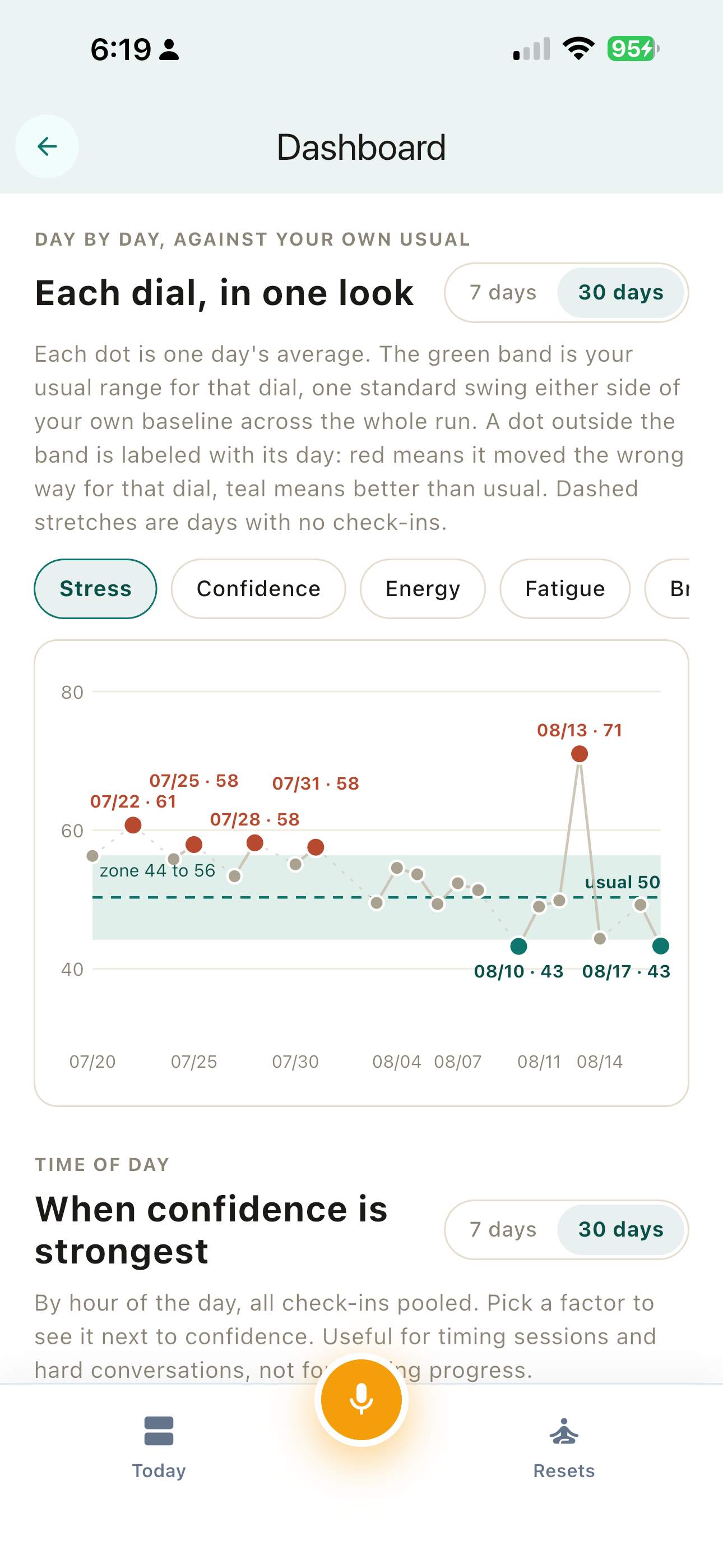
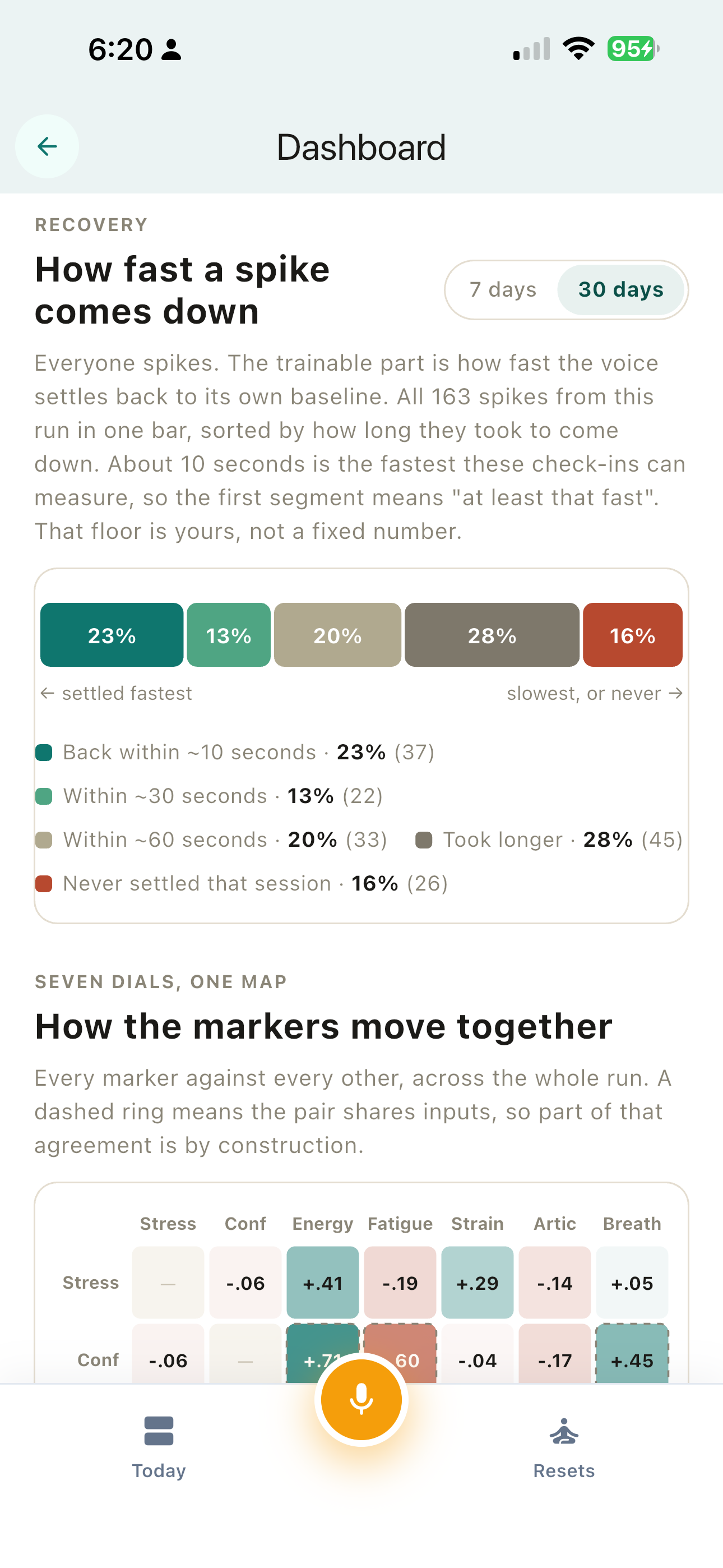
In my own Ontor session history, the between-call hangover shows up as dial-by-dial and day-by-day stress sitting against my personal usual band after hard stretches, plus spikes that take a long time to settle (or never settle in that session) before the next speaking block. Activity would still look fine. The next conversation would still start from whatever state I carried in.
Here is stress across dials / days against my personal usual range, from my own Ontor dashboard and product use. Read it as the private hangover view activity boards miss between connects. It is not a diagnosis, and it is not outcome data from your floor:
And here is how often stress spikes in that same Ontor history settled back toward my personal baseline, including stretches that never settled in-session. Useful as a private recovery check before the next connect. It is not proof that a suggested reset caused recovery, and it is not clinical recovery science:
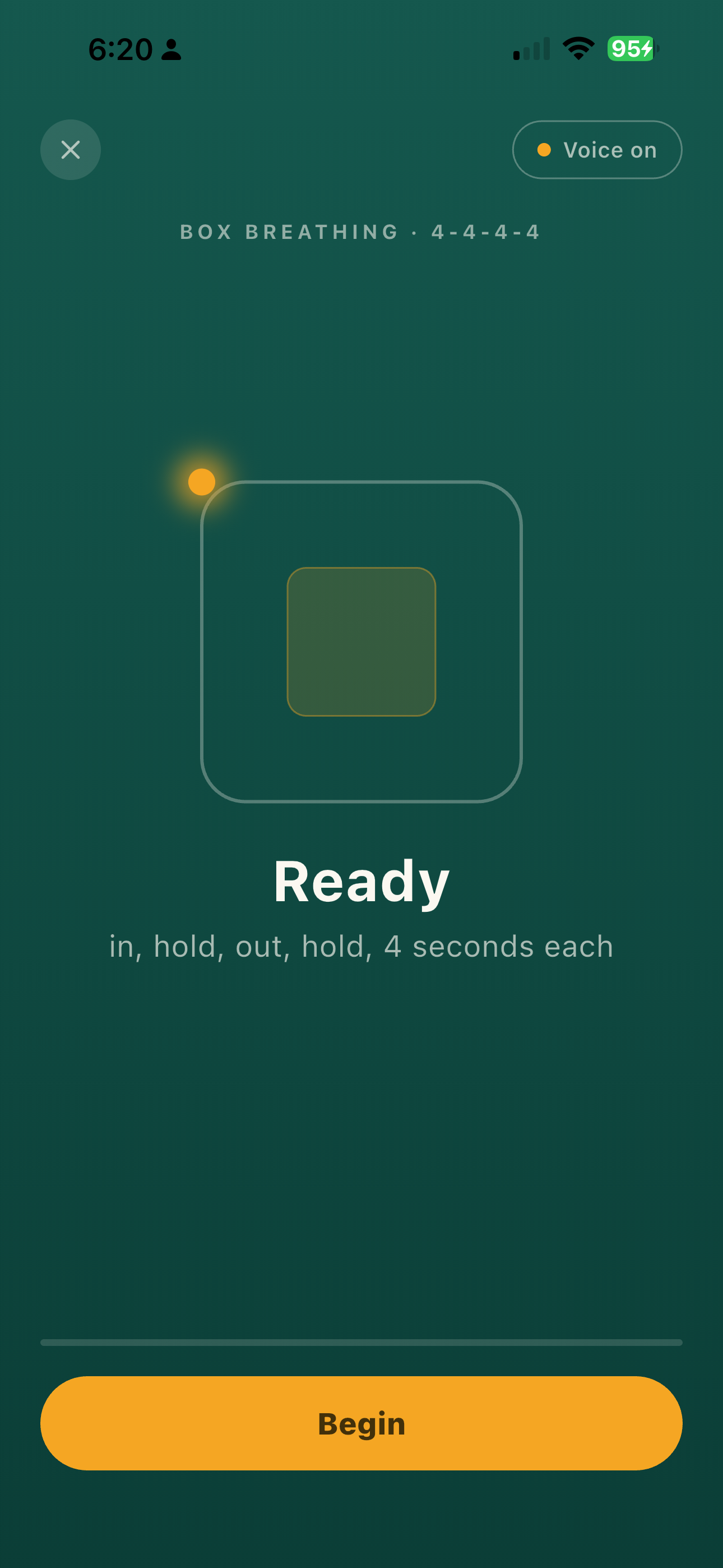
Short resets fit the same loop Assouline coaches between prospects. When confidence or pressure drifts outside usual range, Ontor can surface a brief private exercise before the next hard connect. Here is a box-breathing reset screen from my own product use. Cap any medical claim. The product point is a short private reset so the next buyer does not inherit the last register:
Exploratory work on that personal history (one person, not a population study) treats usual range as an empirical personal reference band, not a clinical target. Marker movement toward or away from that band is observed signal change. It does not establish that a reset caused stable recovery, and it does not diagnose health conditions.
This is not a claim that voice markers detect burnout clinically, predict win rate, replace manager judgment, or guarantee conversion. The claim stays narrow: when leaders treat the minutes between calls as empty, a private baseline-relative voice signal can surface hangover drift earlier than dial boards, while personal readings stay with the person and short resets stay optional and private.
What a measured pilot looks like for mid-market sales leaders
Start narrow.
- Pick one phone-heavy SDR or AE pod (roughly 20-200 seat org scale) where managers already sense "calls feel off" on stacked calendars, but only after the buyer already heard it.
- Give reps a private way to notice lasting stress, fatigue, confidence, or vocal-strain drift versus their usual range across real call blocks, and try short resets before the next connect when the day allows.
- Keep leaders on aggregate patterns only.
- Decide in advance what you are learning: did people use the signal across a week, did short resets fit real between-call admin time, did managers get any earlier team-level read without seeing individuals, and did coaching stay aimed at recovery between connects rather than more dials.
Do not promise quota, conversion, or attrition guarantees from a pilot. Measure whether the tool makes the between-call hangover visible as work, without turning personal voice state into a scoreboard.
Bottom line
Leaders still measure the connected call and treat the minutes around it as empty. The hangover is unpaid recovery and reconstruction work. By call 10 the dialer can still look fine while the next buyer already feels the deficit. AEs on back-to-back disco and demos already say the calls feel off.
A private, baseline-relative voice signal will not fix a bad list or an impossible calendar. It can give reps something concrete when how they sound leaves their usual range between connects, and give leaders aggregate context while personal readings stay with the person.
Start a free trial for you and your team. Soft secondary paths: a research conversation or 14-day pilot via Ontor for teams.
About the author
Sabber Ahamed is the founder of Ontor and an applied ML scientist (PhD in geophysics and signal processing) who builds on-device voice tools. He has shipped production signal and ML systems across radiology AI, healthcare, and manufacturing. Ontor compares how you sound to your own usual ranges and suggests short resets, without claiming clinical or revenue outcomes from marker changes.
References
- Paul Beirne LinkedIn - the unseen work / hangover between calls (buyer_evidence; sports phone-floor metaphor)
- Sport (Business) Science - The Hangover Between Calls - Selling Hope / Paul Beirne (longer form of the same spine)
- Mor Assouline LinkedIn - mental fatigue / calls feel off between prospects (AE corroboration; vendor/coach-capped)
- Jason Lalk LinkedIn - coaching tone is easy but often misses the real fix (coach-tone-only support; do not lead)
- What's the right SDR daily activity volume in 2026? - Pulse RevOps (vendor-capped; volume/quality cliff color only)
- How Ontor works
- Ontor for teams
- About the founder - Ontor