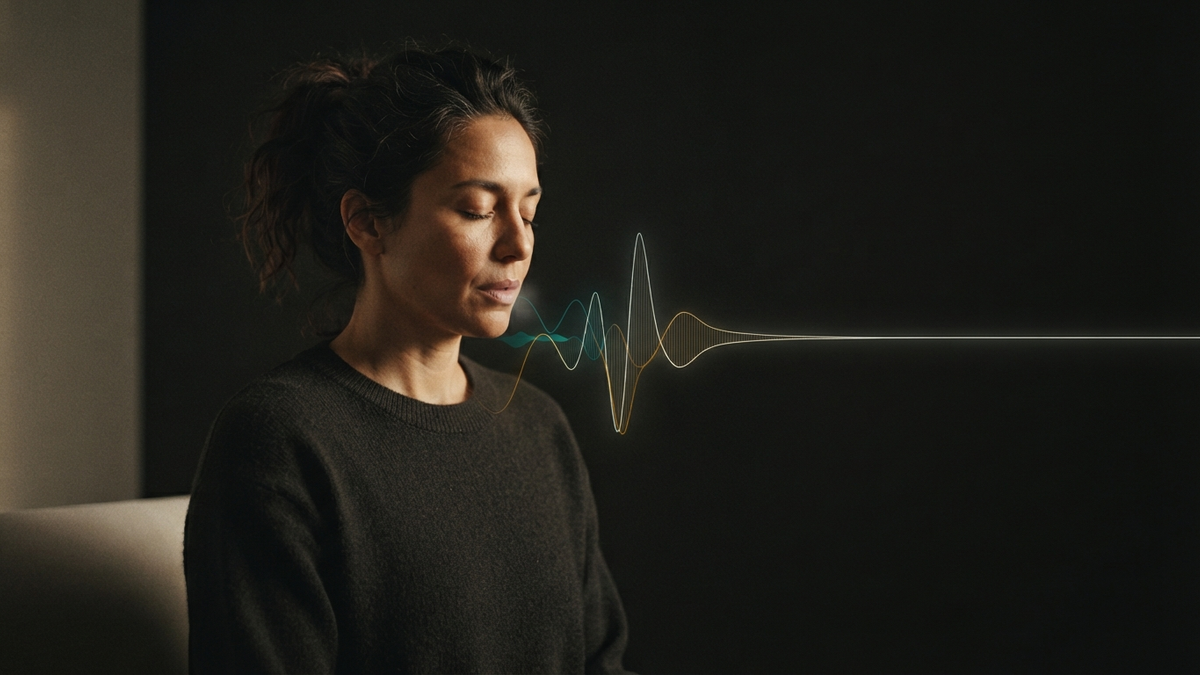
Your whole practice is built on one thing: the state of the client's nervous system. Whether it's regulated or in alarm, whether they can come down, how much load they're carrying before they even walk in. It's the lever everything else moves through. And it's the one thing you've never been able to put a number on. You infer it — from posture, from breath, from how they sound in the first two minutes — and you're usually right. But "usually right, based on a read I can't show anyone" is a hard place to build a practice, prove a protocol, or renew a corporate contract.
The rest of the world is finally catching up to what you've been saying for years. The Global Wellness Summit named nervous-system regulation — vagal tone, felt safety, somatic repair — one of the defining wellness movements of 2026, "the framework the next generation of wellness is building around" (Global Wellness Summit). The demand is here. The measurement isn't.
Start with data, not guesses
Neuroleadership coach Sahar Andrade puts the sequencing plainly: leadership skills fail when they "landed on a nervous system that was already running hot. Under real pressure, the body won." Her prescription for where to begin: "Start with data, not guesses. Most executives do not know their actual nervous system patterns because no one has ever asked them to look." An assessment that maps where regulation breaks down under real demands "gives you a real starting point" (Sahar Andrade, May 2026). Coping, she notes, reduces symptoms temporarily; regulation changes the system that produces them.
That is a coach-buyer framing Ontor can meet honestly: a relative read against the person's own usual range — not a medical diagnosis, and not a claim that marker changes prove leadership skill.
The state you regulate is real — and the client can't feel it
Nervous-system state isn't a metaphor. Sympathetic activation is a physiological event: the system preparing for and responding to load, as opposed to the parasympathetic rest-and-repair side you're trying to help them reach. That much is settled.
The problem is who can perceive it. The clients who most need regulation — the high-functioning ones running hot for months — are often the least able to feel it, and not because they aren't trying. Chronic stress raises the sensory threshold for internal body signals; interoceptive accuracy drops as stress accumulates (Frontiers in Psychology). The nervous system turns down the very alarm that would tell them to stop.
So when a client says "I'm fine," it isn't evasion — they genuinely can't feel the load they're carrying. A skilled coach reads it anyway. What's hard isn't your read in the room — it's that the six days between sessions, when you're not there to hear them, stay dark.
The Tuesday 3pm problem: insight vs implementation under load
Regulation coach Pen King Jr. names the between-sessions failure mode with unusual precision. Clients leave articulate about their patterns, then "return in two weeks having done none of it — not from resistance… but because the week happened at them." "The gap here is usually not insight. It's implementation under load." And: "The window in which a regulation skill matters is a Tuesday afternoon at 3pm, six days after the session that taught it, in a body already running hot. Nothing about a 50-minute appointment can be present in that window" (PKJ Coaching, 2026).
He is also explicit about scope — language Ontor should match: regulation coaching as "a non-clinical, skills-and-practice layer that works in the days between your sessions. It does not diagnose, treat, or replace therapy, psychiatry, or medical care."
The six-to-seven-day window — and the deposits that refill it
Rickard Hultgren sharpens the measurement question coaches already feel: after the session, "The intention has to survive outside that protected environment." What may matter as much as the insight hour is "the following six days, when that insight repeatedly collides with circumstances" — or, as he puts it later, "Perhaps it is the seven days around it" (Rickard Hultgren on LinkedIn, Aug 2026). That is the window an objective between-session read is for — not another Monday reconstruction.
Coach Jason Cook gives clients a capacity metaphor that maps cleanly onto measurable load vs recovery: "your nervous system works like a bank account." "Every stressor, bad sleep, a hard conversation, a deadline, a brutal workout, is a withdrawal. Recovery is the deposit." Many clients, he writes, "have been in overdraft for years without realizing it, because nobody ever told them deposits are part of the plan too." And: "You can't out-discipline an account that never gets refilled" (Jason Cook on LinkedIn, Aug 2026). A relative voice trend does not diagnose overdraft — it makes withdrawals and deposits visible enough to coach against.
Coaches already compare the audio. The live block is still dark.
Sales coaches on the channel are already measuring with their ears. Joe Wanner (Peak Performance Sales Gym) puts it in buyer language: "We measure your nervous system. Not your knowledge." The protocol is simple — "Record a rep at minute 1 of a call. Then record them again at minute 10—after sustained objections." Pace, pitch, defensive language, fillers. And the pass condition: "If a rep sounds the same at minute 10 as they did at minute 1—calm, steady, neutral—that's not knowledge. That's conditioning" (Joe Wanner on LinkedIn, 2026). He is blunt about the gap between knowing and sounding: you can know you should stay calm and still have your voice betray you the moment tension rises. Audio compare is already in the coaching toolkit. What it cannot do is sit with the client on every unsupervised dial between sessions.
Executive voice coach Jimmy Cannon names the same miss from the other side of the mic. Mid-speech fade is not a tired technique problem: "Your voice isn't tired. It's under pressure." Throat tightens, voice fades, pushing starts — and "None of these are vocal faults. They're nervous system patterns." (Jimmy Cannon on LinkedIn, 2026). His Foundation Sprint already sells between-session drills on the phone because technique recall fails when pressure changes state first (Steady State — Foundation Sprint). Coaches who already teach a short reset still cannot see continuous personal-baseline voice-state during the call block when they are not in the room.
ICF-adjacent channel language lands in the same place. Hilary Blair's ICF Los Angeles webinar frames the work as "treating the voice as a barometer of connection" — coaches learning to recognize subtle cues in "tone, rhythm, and energy" and to "stay grounded and self-regulated in coaching conversations" (ICF LA — Hilary Blair, Jun 2026). That is attunement skill for the hour you share. It is not a continuous read across the six days Wanner's minute-1 / minute-10 gap and Cannon's pressure-state framing keep pointing at.
Light corroboration from enablement floors: after a bad batch of calls, Steven Ammer coaches teams off script rewrites and onto how the voice is used — including that "Rushing to fill the gaps will only make an agent sound nervous and weak." (Steven Ammer on LinkedIn, 2026). Same delivery problem. Still post-hoc. Still ear-trained after the block, not during it.
Why the tools you've been offered don't fit
The obvious fix is a wearable, and coaches have mostly said no — for good reasons. A wrist sensor reads the body: heart rate, HRV, sleep. It infers stress from physiology and never hears the person. It also asks every client to buy, wear, and charge a device, which doesn't belong in a practice built on talking and breathing.
And self-report — the client's own account — under-reports the load precisely because they can't feel it. Your trained ear fills much of that gap in session. What's still missing is an objective layer that fits how you work: one that reaches past the hour you're together and gives you something you can show, not only sense — the "data, not guesses" starting point Andrade describes, in the Tuesday-3pm window King describes.
The voice is a direct line to autonomic state
Here's what's been hiding in plain sight. When the sympathetic nervous system activates, it doesn't only change heart rate — it changes the voice. Under stress and cognitive load, researchers see autonomic arousal rise and the acoustic properties of the voice shift with it — vocal effort, clarity, and spectral balance move measurably (PMC). The activation you're reading intuitively in the first two minutes of a session has an acoustic fingerprint.
That's the opening. The voice is the one channel that carries nervous-system state and is already the medium your practice runs on.
What an objective regulation read changes
An objective read isn't meant to sit in your chair — masterful coaching already integrates more signal, in real time, than any device does. It's a second layer beside that judgment, not a substitute for it.
You walk in already knowing the week. Not a Monday-morning reconstruction from someone who couldn't feel most of it.
You can finally prove the protocol. A read the client can compare before and after a breathwork series, a vagus-tone practice, or a reset week turns "I think that helped" into a before-and-after you can show.
It opens the conversation with money attached. HR funds what it can measure. Objective pre/post state across a cohort is the ROI story that gets a corporate wellness program renewed instead of cut.
How it works in practice
It's lighter than a dashboard to manage.
The client does a short voice check-in on their own phone and can share the trend with you. You review the week before the session, and around a protocol you compare the before and after.

That's the idea behind Ontor. It sits in the menu bar as performance intelligence from the voice: it compares how someone sounds with their own usual range across signals such as energy, stress, confidence, fatigue, vocal strain, and breathing, notices lasting shifts, and can suggest a short reset — including before-and-after around a protocol (How Ontor works). Team views keep individual readings personal while showing aggregate patterns (Ontor for teams). Ontor does not determine mood or diagnose a health condition. The point for a coach practice is narrower than another script drill: continuous personal-baseline voice-state during the unsupervised dials your ear cannot attend.
Ontor is a general-wellness, self-awareness tool, not a clinical or diagnostic device. It doesn't measure a medical construct of "regulation," and it doesn't replace your judgment. It adds an objective layer to the state you already track by ear — reaching into the days between sessions, and turning what you sense into something closer to data than guesses.
FAQ
Can you really measure nervous-system state from a voice? The autonomic-arousal side of it has acoustic correlates speech science has documented (PMC). Ontor reads changes against the client's own usual range. It's a relative self-awareness read, not a clinical score (How Ontor works).
Why can't the client just tell me? Chronic stress lowers interoception, so the most dysregulated clients are often the least able to report it (Frontiers). Coaches also describe skills failing under load days after the session that taught them (PKJ).
Why not a wearable or HRV? Those read the body and add hardware that often doesn't fit a talking, breath-based practice. Voice needs nothing but the phone already in the client's hand.
How would I actually use it? The client checks in by voice and shares the trend; you review before the session and compare before and after a regulation protocol.
Does this replace a coach's read? No — and it shouldn't. Ontor is a complementary layer: it extends the read to between sessions and makes a protocol's effect something you can show. It informs your judgment; it doesn't override it.
References
- The Rise of Neurowellness — Global Wellness Summit (2026 Trends)
- Acoustic Measures of Voice and Physiologic Measures of Autonomic Arousal during Speech as a Function of Cognitive Load — PMC
- Interoception and Stress — Frontiers in Psychology (PMC)
- Sahar Andrade — Nervous system regulation before leadership skill
- PKJ Coaching — Regulation coaching between sessions
- Rickard Hultgren — The hardest part of coaching happens after the session (LinkedIn)
- Jason Cook — nervous system bank account (LinkedIn)
- Joe Wanner — We measure your nervous system (LinkedIn)
- Jimmy Cannon — Your voice isn't tired. It's under pressure (LinkedIn)
- Hilary Blair — Voice as a barometer of connection (ICF LA)
- Steven Ammer — After a bad batch, coach tonality not scripts (LinkedIn)
- How Ontor works
- Ontor for teams
Ontor is a general wellness tool for self-awareness. It does not diagnose, treat, or prevent any condition, and it is not a substitute for clinical care or professional judgment.
Curious whether this fits your practice? Download Ontor - 14 days free, no card required
For a coach-channel research call or a 14-day pilot with one client call-heavy team, see also Ontor for teams.