
Your staffing team finally got a live connect. You can hear they're uncomfortable.
Getting recruiters and BD onto the phone is already hard. Getting a live answer is rarer still. Tom Erb, founder of Tallann Resources and a longtime staffing sales coach who listens to large volumes of cold calls, puts the connect rate in plain numbers: about one live person in twenty-five dials on average.
Then the expensive moment arrives. Someone answers. And when coaches listen back, they often hear the salesperson rushing, sounding uncomfortable, feeling like they are wasting the prospect's time, and missing verbal cues that could have opened a real conversation.
Activity boards still celebrate dials, talk time, and fills. They do not store live confidence or voice-state on that rare connect.
This piece is for staffing and recruiting sales leaders: Directors and VPs of Sales, owners, branch managers, and BD leads running agency phone culture. It is not corporate TA. It is also not the published quality-over-volume / dial-quota piece, not the AI denser call-minutes piece, and not the BD-block interruption piece. The question here is narrower: call reluctance that hides in "productive" work, plus audible discomfort when the rare live connect finally happens.
Getting them on the phone is the first failure mode
Derry Holt (OneUp Sales), writing for recruitment agency leaders, names the familiar BD challenge: recruiters often do not like business-development tasks, their strong suit is recruitment not sales, and nobody likes spending the day getting rejected. "This means it can be very hard to actually get them on the phone and call prospects."
Cap the vendor pitch (competitions, leaderboards, blitz blocks). The buyer problem stands without the product CTA: willingness to dial collapses under rejection load before readiness on the connect ever shows up.
TRN's Future of BD analysis with OneUp Labs (~295 agencies) adds the morale layer leaders already feel. BD activity fell 10.4% in a recent quarter while completed meetings per 1,000 BD calls rose from 58.2 to 62.6. Agencies dialed less and converted better when they did call. Derry Holt's commentary still lands on grit at the handset: recruiters who can persevere and still hit the phones come out on top, because the relationships that matter do not live in email or text alone.
That is the buyer companion frame. Morale and hit-the-phones willingness matter. They still leave a second gap: when someone finally answers, how does the salesperson sound?
Call reluctance usually looks productive
KinISO (staffing software; vendor-capped) defines call reluctance as the tendency to avoid, delay, or soften direct conversations that involve uncertainty, rejection, or judgment. In staffing it rarely looks like refusing the phone. It looks busy:
"Call reluctance in staffing usually looks productive. The recruiter is updating records, checking job orders, reviewing resumes, researching accounts and sending messages. They are busy all day. They just are not talking to the people who can change the outcome."
Activity quotas can be satisfied by low-risk dials that were never likely to connect. Coaching that only watches raw dial counts misses the substitution. Cap the automation pitch. Keep the ops vocabulary: productive avoidance hides inside admin, research, and safe numbers.
Agency Leads' BD playbook (vendor-capped) adds the rejection load owners already know: BD is rejection-heavy work; reps hear "no" or "not now" most of the time; without the right culture, even strong reps burn out within about 12 to 18 months. Use that lightly for rejection burn-in, not as a second spine about protecting BD blocks (already covered elsewhere).
Adam Conrad, speaking on The Staffing Show from a former IT staffing ops seat (tertiary only; Great Recruiters vendor context), names the old hammer-the-phone culture as burnout theater. Useful as light corroboration that pure dial grind is already out of fashion. Not the lead of this article.
The rare connect is where coaches hear the rush
Erb's listening note is the Ontor-shaped spine:
"90% of the time, it's the salesperson that is rushing through the call not the prospect. When you listen to it as a third party, you can hear that that sales rep is uncomfortable, they feel like they're wasting that person's time. So, they're rushing through, they're missing some verbal cues, they're missing opportunities to have more of a conversation."
And the connect scarcity that makes the miss expensive:
"one out of every 25 calls, on average, that when we do get a live person"
Cold calling is hard enough when you pick it up. Sociability, Erb argues, is what gets people to pick up the phone over and over. When interaction drains them, dialing and networking both drop. Cap Tallann's training CTA. Treat Erb as operator-adjacent problem language from someone who listens to staffing cold calls for a living, not as Ontor's measurement of your floor.
Leaders already have recordings and activity dashboards. What still stays invisible between listen-ins is a continuous private read of how someone sounds versus their own usual range on the connects that finally go live.
Distinct from quota-shift, AI denser minutes, and BD-block interruption
Quality over volume readiness answers: after dropping 150-dial theater for higher-stakes discovery, can anyone tell if remaining calls still sound ready?
AI call-time surge readiness answers: when AI pushes staffing phone minutes up, how do leaders see readiness across denser conversation days?
Staffing sales call-block readiness answers: when delivery interrupts protected BD blocks, what happens to readiness between blocks?
This article answers a fourth staffing question: when call reluctance hides in productive busywork, and the rare live connect finally lands, can anyone see audible discomfort / confidence drift versus personal baseline, or only that dials happened?
Same staffing beachhead. Different moment. Different ops object.
A private how-you-sound check on the rare connect (not a clinical label)
Ontor is a performance tool that reads how you sound, not what you said. While someone speaks, it compares voice signals to that person's own usual range. When a lasting shift shows up (stress, fatigue, confidence, breathing, vocal strain), it can suggest a short reset. People can also compare before and after.
For teams, Ontor's public framing is aggregate patterns for workload, coaching, and support. Individual sessions and readings stay with the person. Leaders get team-level context (for example, whether a pod sits outside its usual range more often across a week). They do not get a personal scoreboard for staffing decisions.
That is the instrumented version of Erb's listening note. Not a dial-quota redesign. Not denser AI minutes. Not a protected-block calendar fix. A private comparison of how you sound versus your own usual range on the connects that matter, plus short resets before the next hard dial.
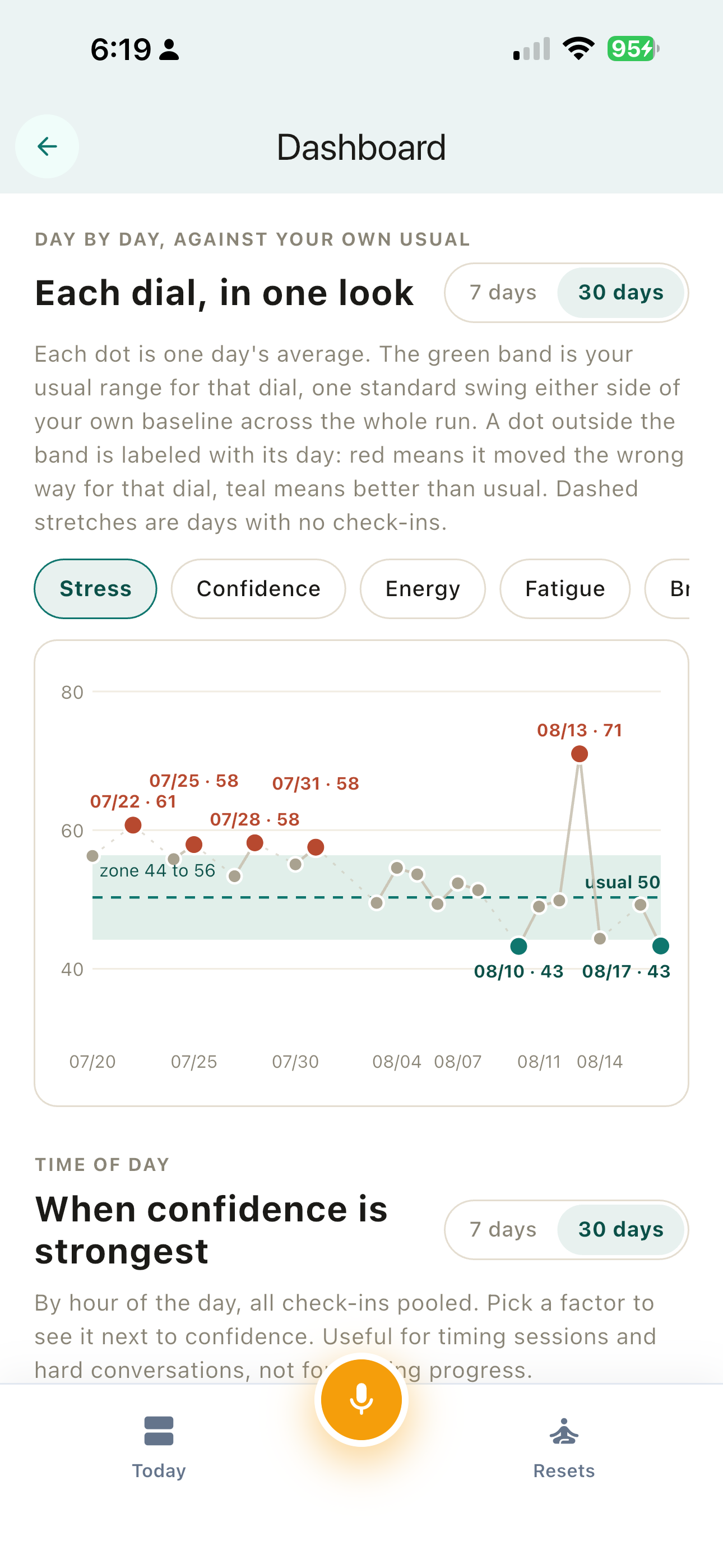
In my own Ontor session history, the call-reluctance gap shows up the same way coaches hear it on a rare staffing connect. After a stretch of hard outreach, how I sound can leave my personal usual range while calendars and activity still look full. Dial-by-dial stress and confidence drift against that private band. That is the voice-state piece activity KPIs never store before the next live answer hears the rush.
Here is stress across dials and days against my personal usual range, from my own Ontor dashboard and product use. Useful as a private read of when voice-state sits outside baseline on hard calling stretches. It is not a diagnosis of call reluctance, and it is not outcome data from your floor:
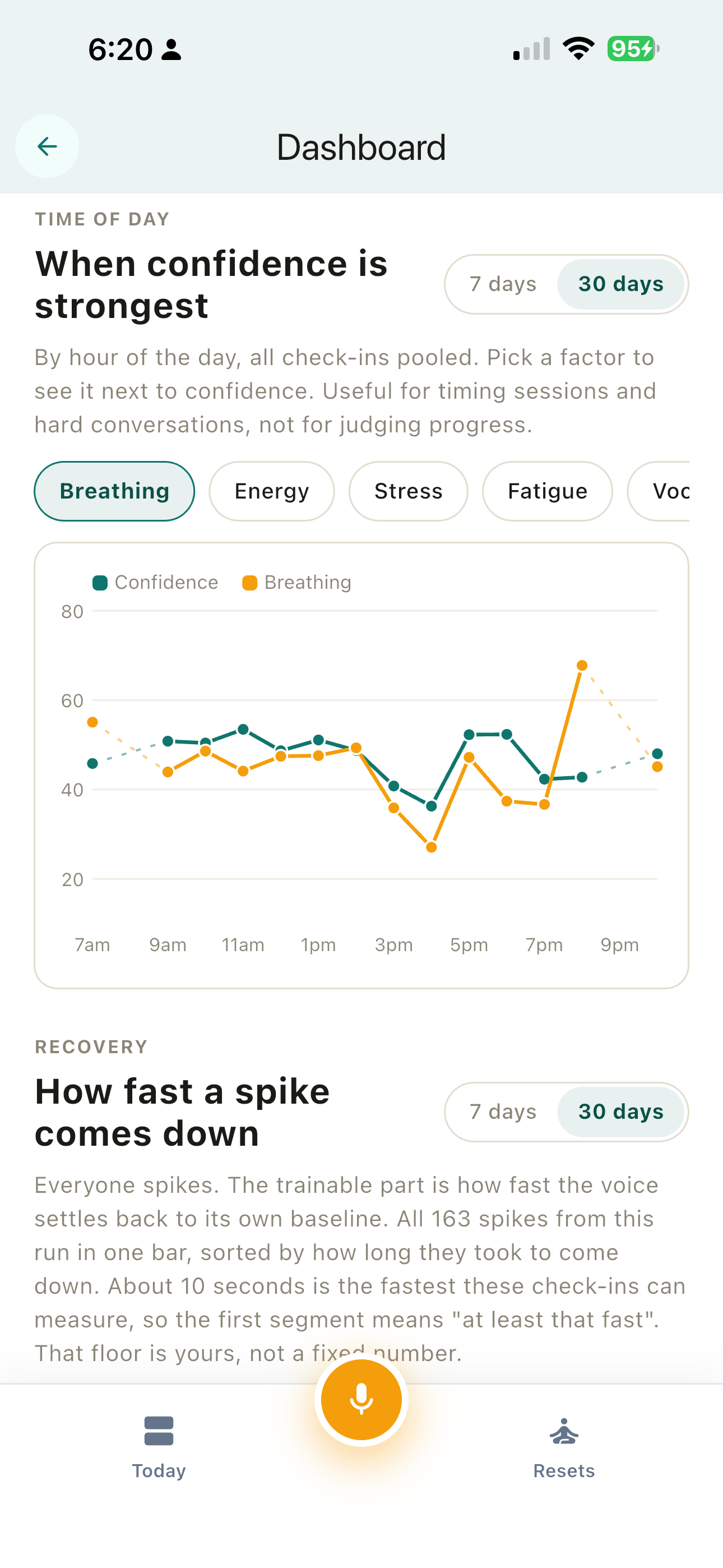
And here is confidence by hour of day beside breathing, from that same Ontor history, plus how fast a spike settles back toward my personal baseline. Useful when the uncomfortable connect is the moment that matters, not the dial count. It is not proof that a suggested reset caused recovery, and it is not clinical recovery science:
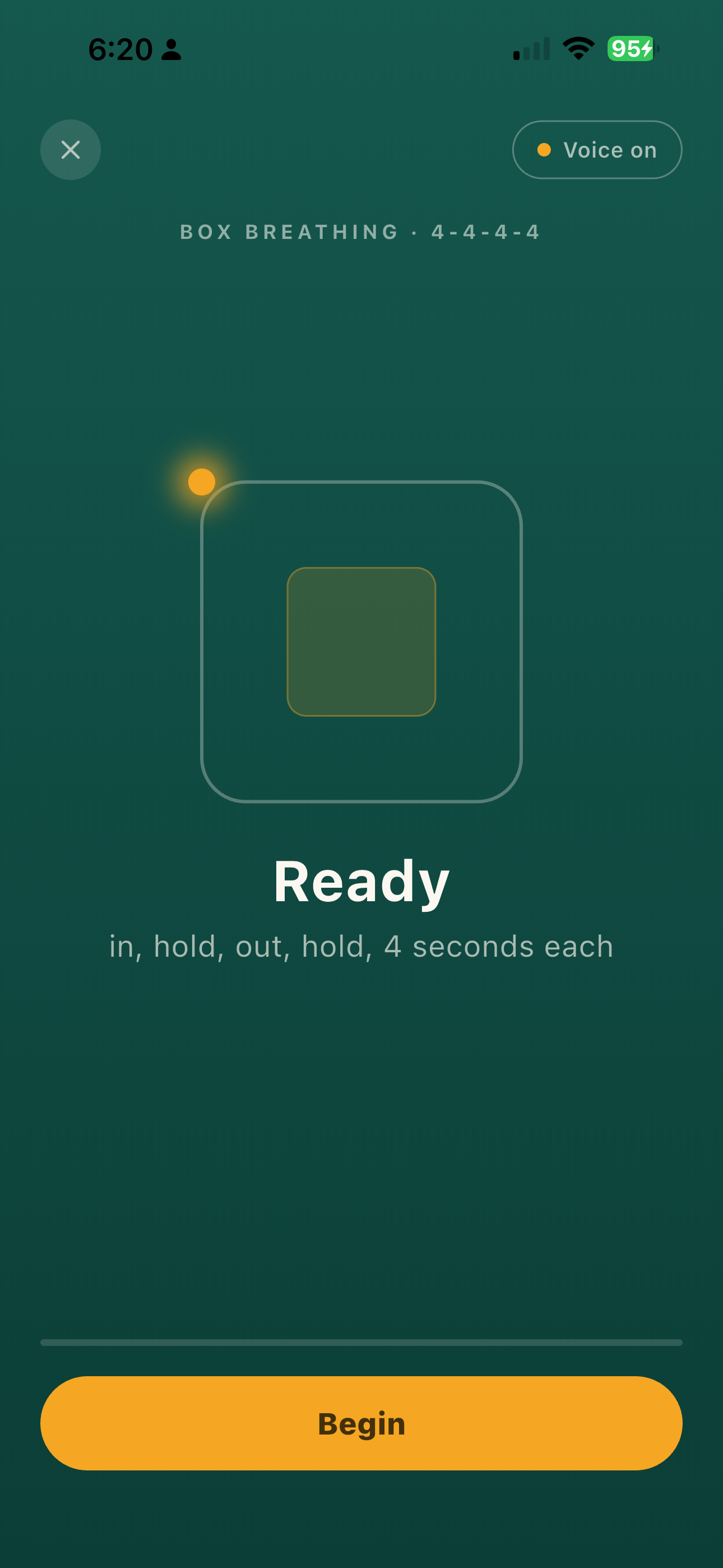
Short resets fit the same loop. When confidence or pressure drifts outside usual range before the next hard dial, Ontor can surface a brief private exercise. Here is a box-breathing reset screen from my own product use. Cap any medical claim. The product point is a short private reset, not a clinical intervention:
Exploratory work on that personal history (one person, not a population study) treats usual range as an empirical personal reference band, not a clinical target. Marker movement toward or away from that band is observed signal change. A temporary stress dip after a short reset has been observed in personal logs; stable early recovery and broad recovery are not established from those sparse events. Marker changes do not prove cognitive improvement, revenue, retention, or health outcomes.
This is not a claim that voice markers detect call reluctance clinically, predict attrition, replace manager judgment, or guarantee more meetings. The claim stays narrow: when leaders already hear discomfort on the rare connect, a private usual-range signal can surface voice-state drift earlier than sparse listen-ins, while personal readings stay with the person.
What a measured pilot looks like for staffing sales leaders
Start narrow.
- Pick one recruiter or BD pod where managers already hear rush or discomfort on listen-ins after a live connect, but only when they have time to shadow.
- Give people a private way to notice lasting stress, confidence, fatigue, or vocal-strain drift versus their usual range across real dial blocks, and try short resets before the next hard dial when the day allows.
- Keep leaders on aggregate patterns only.
- Decide in advance what you are learning: did people use the signal across a week, did short resets fit real BD flow, did managers get any earlier team-level read without seeing individuals, and did coaching stay aimed at how people sound on the rare connect rather than more low-risk dials.
Do not promise placement, meeting, or quota guarantees from a pilot. Measure whether the tool answers the audible-discomfort question leaders already ask after a live connect, without turning personal voice state into a scoreboard.
Bottom line
Getting staffing teams on the phone is hard. Hearing how they sound when someone finally answers is harder. Call reluctance hides in productive admin and low-risk dials. Activity KPIs miss live confidence on the rare connect. Coaches already hear the rush when they listen.
A private, baseline-relative voice signal will not fix a weak list or a broken BD culture. It can give people something concrete when how they sound leaves their usual range before the next hard dial, and give leaders aggregate context while personal readings stay with the person.
Start a free trial for you and your team. Soft secondary path for a measured pilot: Ontor for teams.
About the author
Sabber Ahamed is the founder of Ontor and an applied ML scientist (PhD in geophysics and signal processing) who builds on-device voice tools. He has shipped production signal and ML systems across radiology AI, healthcare, and manufacturing. Ontor compares how you sound to your own usual ranges and suggests short resets, without claiming clinical or revenue outcomes from marker changes.
References
- Winning the Staffing Sales Game with Tom Erb - StaffingHub / The Staffing Show (Tallann CTA capped)
- The Future of BD in Recruitment - TRN / OneUp Labs
- Business Development for Recruitment Firms - OneUp Sales (vendor-capped)
- Detecting Call Reluctance in Staffing - KinISO (vendor-capped)
- BD Playbook 2026 - Agency Leads (vendor-capped)
- Adam Conrad on The Staffing Show - StaffingHub (tertiary; vendor context)
- How Ontor works
- Ontor for teams
- About the founder - Ontor