
We score Empathy & Tone. We still miss when a strong collector drifts off their own baseline.
Collections QA still grades Empathy and Tone as absolute criteria. Calm. Professional. Not robotic. Compliance boxes get heavier weight. What the scorecard almost never shows is whether this collector's voice has drifted off their own morning range by late day.
Borrowers hear that first. Leaders meet it later as softer second pitches, more escalations, or a strong performer who quit without saying they were struggling.
This is not empathy calluses built across months of similar hardship calls. It is not a cool-down after a hostile disposition. It is not early-tenure confidence collapse in the first 60 days, and it is not what happens when AI strips easy contacts and concentrates emotion into the human queue. This piece is about absolute scorecard tone versus personal baseline drift, with late-day and roughly call-60 fade as the supporting mechanism.
What Empathy & Tone scorecards actually grade
Call Coach IQ's 2026 call-center QA checklist puts Empathy and Tone on the card with absolute checks such as "Tone remains calm and professional even if customer is upset" and "Agent does not sound scripted or robotic on empathy language." For collections operations, the same guide tells leaders to weight compliance higher, up to 25 to 30 percent of the score.
Useful for audit and coaching. Incomplete for drift. A collector can still pass calm-tone and empathy-language checks while sounding nothing like their own morning voice. The scorecard grades against a fixed rubric. It does not ask: is this person off their personal baseline right now?
Zoom's contact-center quality guide is explicit about a related blind spot. Its sentiment scores come from transcript analysis and "do not account for other factors like tone, volume, or talk speed." In Zoom's own words, that means sentiment reflects what was said, not how it was said. Words can look fine. Delivery can already be gone.
Kaizo's auto-QA critique (vendor; cap it) shows what happens when absolute empathy language becomes the scored thing. An agent who reads the empathy script verbatim at a furious customer can score 100 while someone who drops the pleasantries, fixes the problem, and sounds human gets marked down for tone. Agents then stop judgment calls and start inserting phrases. Floor language around that pattern is agents being watched by something they cannot reason with, that never asks what happened on the call, and that hands down a number nobody can explain.
That is absolute grading and transcript gaming. It is not a personal-baseline check.
Compliance QA still misses de-escalation under load (vendor, capped)
NCRi, a collections BPO, argues that most Collections Directors treat QA as a compliance audit (FDCPA / Reg F) and miss interaction quality that actually drives recovery. In their framing, "QA in debt collections is a customer experience function, not an audit function." De-escalation quality through avoidance, frustration, hostility, and distress is "almost entirely absent from compliance-oriented QA scorecards." Manual programs that audit 1% to 2% of calls, or three to ten calls per collector per month, do not give a statistically serious read.
Keep that as capped vendor corroboration for a scorecard-scope gap. NCRi's answer is more monitored speech analytics and coaching loops. Ontor is not another hire-or-fire QA layer on every call. The wedge here is private voice-state versus this collector's own usual range, plus short resets the person can run before the next connect.
Strong collectors can hide the drift until they leave
An experienced order-to-cash and collections leader, Selvakumar M., posted publicly about his best collector resigning on a Monday morning. Public search snippets of that post describe a top performer who left despite strong results because she was exhausted and afraid to admit she was struggling under a high-pressure, target-driven culture. His remedies in those snippets are informal check-ins, separating people from the numbers, recognizing effort, and anonymous feedback.
Treat that carefully. LinkedIn blocked full-body retrieval for this scan, so there are no invented quotes. His public profile signals senior receivables and collections leadership experience, including seeking senior O2C roles. Weight it as an experienced-leader anecdote, not a confirmed current U.S. agency Director title.
The ops point still lands next to the QA gap: recovery and scorecard numbers can look healthy while a strong collector's struggle stays private until resignation. A private usual-range signal gives the person a way to notice drift without turning help-seeking into a scored confession.
Supporting mechanism only: late-day and roughly call-60 fade borrowers can hear
Same-shift fade is how absolute tone often fails in practice. It is not the primary claim of this article.
Oravaa (vendor voice-AI marketing; cap it) writes that human collectors handle 80 to 120 calls per day, and that by call 60, voice fatigue, script drift, and emotional exhaustion compound. "Borrowers on the receiving end can hear the difference." Their framing: collections underperformance is often a tone problem more than a dial-volume problem.
Exotel's collections CQA piece (also vendor; cap it) says collection success depends more on how agents talk than on how many calls they make. It names coachable voice behaviors including tone that "drops sharply post-rejection," and it poses "Does early vs. late-day calling impact tone?" as an experiment leaders should run. That implies within-day tone variance is already a live collections performance variable. Their product answer is GenAI conversation quality analysis on more of the book. Again: absolute scoring and monitoring coverage, not personal baseline.
Use late-day and call-60 only as the mechanism that makes absolute Empathy and Tone grades look fine while the person's morning voice is already gone.
Why star performers distrust another scored layer (vendor field note, capped)
A DROS.ai / Vodex field report from ACA International 2026 booth conversations (vendor press; directional, self-selecting sample) says that after compliance Q&A, the stall was often workforce trust: leaders were hesitant to introduce a tool their strongest performers might read as a threat to their role. The same note frames many collections compliance failures as failures of human variance under time pressure.
That trust barrier matters for how you buy voice tooling. If your best collectors already read scorecards and auto-QA as opaque monitoring, another absolute layer will not fix baseline drift. A rep-first loop that stays with the person, with leaders on aggregate patterns only, is a different design.
How this differs from calluses, cool-downs, early tenure, and AI queues
Empathy calluses answer: after dozens of similar hardship conversations under quota and month-end pressure, has cumulative numbness set in while recovery still looks fine?
Cool-downs after hostile calls answer: was this call coded too hot to continue immediately?
Early-tenure confidence answer: is a new collector losing confidence across training, nesting, and production in the first 60 days?
AI emotional queue answer: after deflection, is the remaining human queue an all-hard emotional mix while AHT and occupancy still assume a balanced day?
This article answers a fifth question: when Empathy and Tone QA grades absolute calm, compliance, and transcript words, do you still miss drift versus this collector's own morning or personal baseline, including the late-day fade borrowers can hear?
Same beachhead. Different mechanism. Different ops move.
A private check against usual range (not another QA scorecard)
Ontor is a performance tool that reads how you sound, not what you said. While someone speaks, it compares voice signals to that person's own usual range. When a lasting shift shows up (for example stress, fatigue, confidence, or breathing), it can suggest a short reset. People can also compare before and after.
For teams, Ontor's public framing is aggregate patterns for workload, coaching, and support. Individual sessions and readings stay with the person. Leaders get team-level context. They do not get a personal scoreboard for hire or fire decisions.
That is the product difference from Empathy and Tone scorecards and from transcript-sentiment QA. Absolute cards ask whether tone was calm enough. Ontor asks whether this voice left its own usual band, privately, before the next connect.
In my own Ontor session history, the absolute-versus-baseline gap shows up the same way collections floors describe it. A day can still look "professional" in the ordinary sense while stress, fatigue, or breathing have already left my personal usual range. That private drift is what Empathy and Tone rubrics and transcript sentiment do not surface before the next borrower hears the voice.
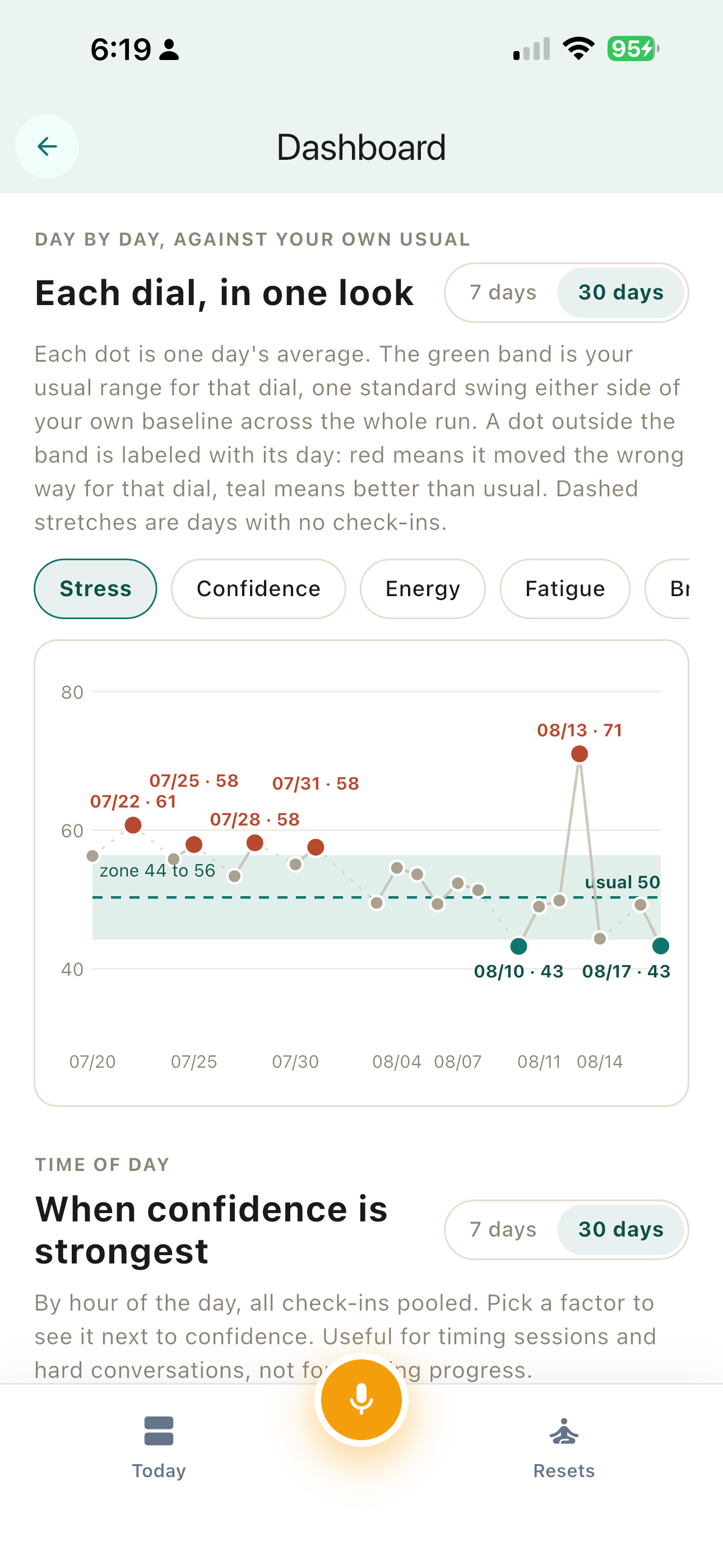
Here is stress day by day against my personal usual band, from my own Ontor dashboard and session history. Absolute QA grades a calm-tone checkbox. This view shows drift versus my own baseline, which is the part scorecards miss when a strong collector's morning voice is already gone. It is not collections QA outcome data:
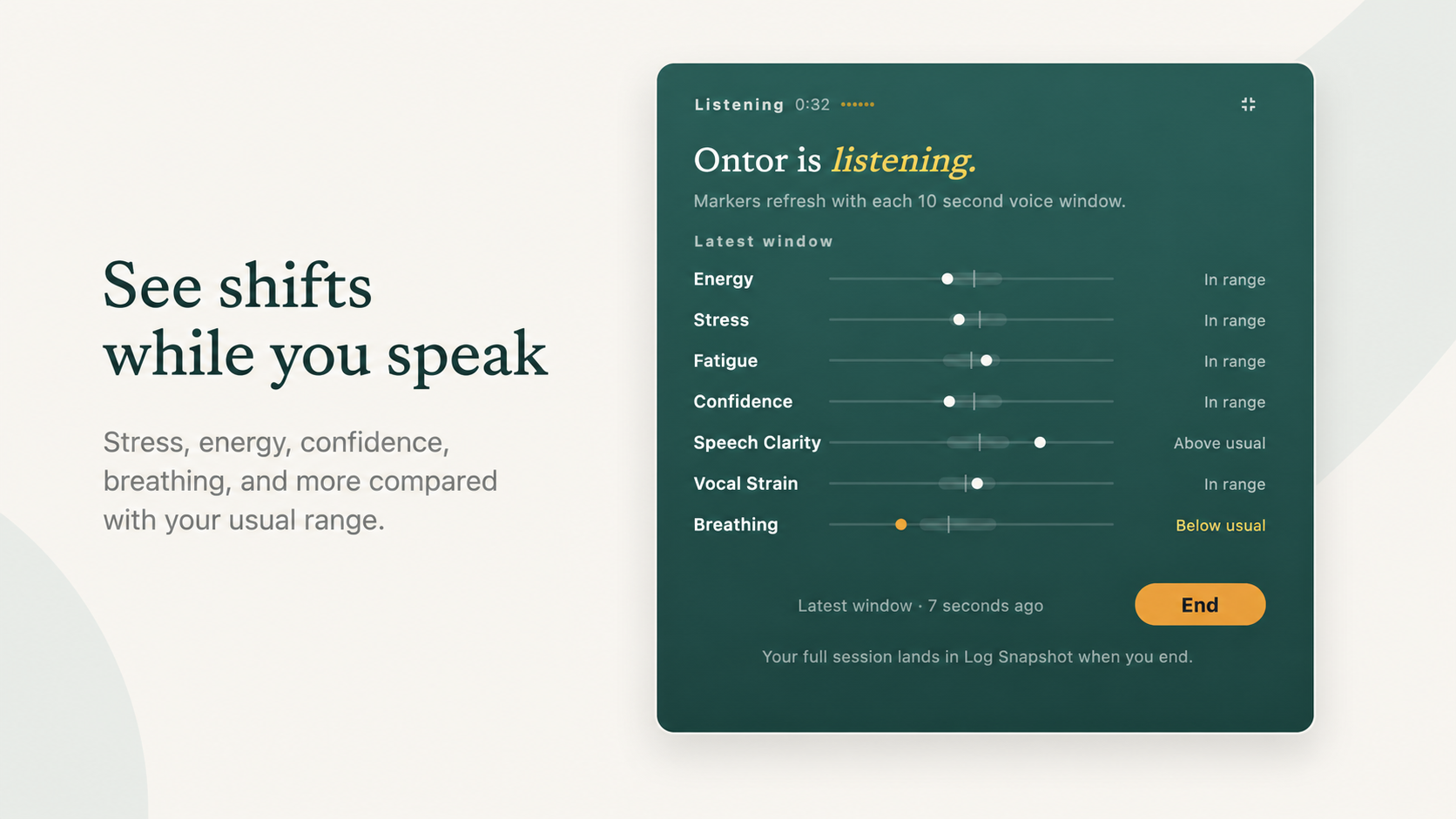
Here is the live listening view from my own Ontor use: markers refresh in short voice windows and sit against my usual range. Speech clarity can sit above usual while breathing sits below usual in the same window. A transcript Empathy score would never show that split. Absolute tone rubrics would still ask only whether the line sounded calm enough:
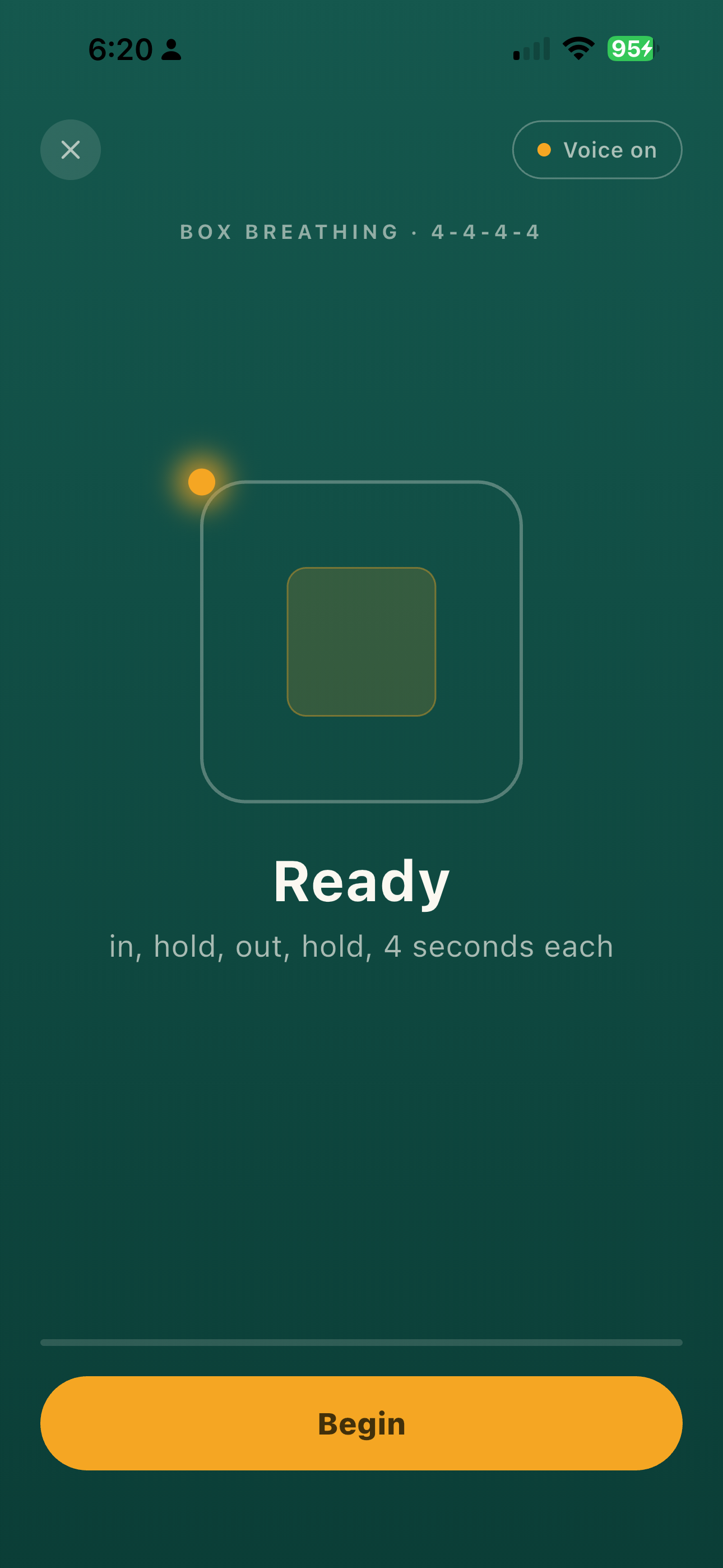
Here is a real Ontor box breathing reset screen from my own product use. When late-day or high-volume work pushes you off your usual voice, this is the short private loop available before the next connect. It complements coaching and structural design. It does not replace QA compliance work, and it is not proof of recovery-rate lift:
In exploratory work on that same personal Ontor history (one person, not a population study), high-stress episodes often did not show an observed return to my personal median within an hour. That is one reason a private usual-range check under same-shift load matters. It is not evidence that a suggested reset caused recovery.
This is not a claim that voice markers diagnose empathy loss, predict attrition clinically, or guarantee recovery-rate, AHT, or retention improvement. The claim stays narrow: when absolute Empathy and Tone QA miss drift versus a collector's own baseline, a private signal plus a short reset is a loop people can run before the next connect, while leaders watch cohort patterns only in aggregate.
What a measured pilot looks like for collections leaders
Start narrow.
- Pick one collections or recovery pod that already scores Empathy and Tone (agency front-end, bank or credit-union recovery, or BPO hardship queue).
- Give people a private way to notice lasting stress, fatigue, confidence, or breathing drift versus their own usual range, and to try short resets between connects.
- Keep leaders on aggregate patterns only (for example, whether the pod sits outside usual range more often in late-shift blocks or after long same-day call strings).
- Decide in advance what you are learning: did people use resets, did resets fit real AHT and wrap-up constraints, did managers get any earlier read on team strain without seeing individuals, and did existing QA still own compliance and absolute rubric work.
Do not promise recovery-rate, occupancy, or attrition guarantees from a pilot. Measure whether the tool fits a floor where Empathy and Tone can still pass while a strong collector's morning voice is already gone.
Bottom line
You already score Empathy and Tone. You may already run transcript sentiment. Neither shows drift versus this collector's own baseline. Late-day and roughly call-60 fade is one way borrowers hear that gap. Ontor adds a private usual-range voice check and short resets. It is not another hire-or-fire QA layer.
Start a free trial for you and your team
If you want a measured pod pilot first, see Ontor for teams or how Ontor works.
References
- Call Coach IQ Team. "Call Center QA Checklist: What to Measure on Every Call." Call Coach IQ, 2026. https://callcoachiq.com/resources/call-center-qa-checklist
- Zoom. "Contact center quality assurance." Zoom Blog, June 4, 2026. https://www.zoom.com/en/blog/contact-center-quality-assurance/
- Kaizo. Auto-QA mistakes piece on empathy-script scoring and opaque scores (vendor; capped). https://kaizo.com/blog/auto-qa-mistakes/
- Umair Shafiq / NCRi. "Why the Best Collections Teams Treat QA as a CX Function." NCRi, 2026 (vendor; capped). https://ncri.com/why-the-best-collections-teams-treat-qa-as-a-cx-function
- Selvakumar M. LinkedIn post theme: "My best collector resigned on a Monday morning." Public search paraphrase only; full body not retrieved this scan. https://www.linkedin.com/in/selvakumarordertocashleader
- Oravaa. "Collections Without the Cringe: How Empathetic Voice AI Is Quietly Reshaping BFSI Recovery." Oravaa (vendor; capped). https://oravaa.ai/blog/voice-ai-collections-bfsi-empathetic
- Himanshi Goyat / Exotel. "How to Improve the Efficiency of Collections Teams with GenAI-powered Conversation Quality Analysis." Exotel (vendor; capped). https://exotel.com/blog/boost-collections-with-genai-powered-conversation-quality-analysis/
- DROS.ai / Vodex via PR Newswire. "Workforce Concerns Are Emerging as a Barrier to AI Adoption in Collections, DROS Field Report Finds." September 10, 2026 (vendor field report; capped). https://www.prnewswire.com/news-releases/workforce-concerns-are-emerging-as-a-barrier-to-ai-adoption-in-collections-dros-field-report-finds-302872470.html
- Ontor. "How it works." https://ontor.ai/how-it-works/
- Ontor. "Ontor for teams." https://ontor.ai/for-teams/
- Ontor. "About the founder." https://ontor.ai/about/