
You already built a midday phone reset. Can anyone tell if it restored readiness?
Staffing and search leaders who still bill on the phone already know the physiology. After a morning of live conversation, you do not "power through lunch" into another cold-call block and expect the same sharpness. Stephanie Maas, Managing Partner at ThinkingAhead Executive Search and host of The Talent Trade, puts the break in clock time:
"After you've had an opportunity for three and a half or four hours of phone time, that's a great time to step away from your desk, take a break, go for a walk, work out... Give yourself a brain break, and then before you jump back into the phone again..."
That is desk design from a paying search-firm partner, not a wellness slogan. The calendar already has the midday disengage. What most ATS and dial boards still cannot answer is narrower: when the afternoon BD or phone block starts, did voice and energy actually come back toward that person's usual range, or did the walk only clear the schedule?
This piece is for staffing and recruiting sales leaders: Managing Partners, full-desk / search partners, Directors and VPs of Sales, and BD leads who already preach protected phone blocks and energy-matched afternoon work. It is not corporate TA.
It is also not the published BD-block interruption piece (delivery eating protected BD windows), not dialer micro-gap afternoon fade (5 to 10 seconds between autodialer connects), and not block-length robot voice (tone flattening inside one continuous IC block). The question here is midday sustained-load reset verification before the next phone block, plus matching afternoon call type to remaining energy.
The physiology leaders already coach: disengage after ~3.5 to 4 hours
On Planning the Perfect Day, Maas describes her own noon hour the same way operators hear it on a full desk:
"from noon to one... By now I've been on the phone for almost four hours, I need to mentally disengage so I don't burn out. I need to use a different part of my brain."
She is not arguing for less phone. In Elevating Your Phone Work she still treats live conversation as the difference-maker for passive candidates ("These are the folks that really are only gonna engage if you get them on the phone") and warns experienced billers that sophomore slump often starts when phone time quietly slips into email, text, and LinkedIn. Cap any firm recruiting CTA. Keep the ops object: protect a real midday cognitive disconnect after a multi-hour morning phone load so the afternoon block is still usable.
Leaders who already run that schedule have solved the calendar half. They still infer recovery from the fact that a walk or workout happened.
Energy-matched afternoon work is already the workaround
Even with the midday break, Maas is blunt about residual fade:
"from three to five, this is where quite frankly, my energy starts to wane a little bit... So the idea of spending another couple hours in, quote unquote, cold call or slightly warm call, my energy is just low. So what I do instead... process calls."
Process calls (pitches, presentations, preps, debriefs) when energy is low. Cold or slightly warm outreach earlier, when energy is higher. "follow your energy, whatever serves you best." That is energy-matched desk design from someone who still puts serious phone hours into a search day.
Useful. Still incomplete. Matching call type to how you feel after lunch is a judgment call. It does not store whether stress, fatigue, energy, or vocal strain actually moved back toward personal baseline before the next block starts. Newer recruiters without enough process inventory still have to keep cold calling into the low-energy window. They get the same calendar advice with even less room to hide a weak reset.
What the stack can see vs what stays invisible
Typical staffing / search sales stack after a designed midday break:
- Calendar shows the walk / workout / admin sandwich happened
- ATS/CRM shows dials, notes, stages, and afternoon process vs outreach mix
- Fill rates, placements, and margin land later
- Conversation tools coach on what was said when someone listens back
Missing for this failure mode: a private, continuous read of how someone sounds versus their own usual range when they re-enter the afternoon phone block. A filled "noon reset" calendar block will not tell you voice still sat outside baseline. A process-call schedule will not tell you whether the morning load left residual strain that the midday break did not clear.
Distinct from protected BD blocks, dialer micro-gaps, and robot-voice fade
Staffing sales call-block readiness answers: when delivery interrupts protected BD blocks, what happens to readiness between blocks?
Dialer fatigue afternoon fade answers: when the dialer leaves only 5 to 10 seconds between connects, where does afternoon fade start?
Block-length robot voice answers: inside one long continuous calling stretch, when does tone flatten into "robot" voice?
Lower overlap, still different spines: live-connect discomfort is audible rush on the rare answer. Quality-over-volume readiness is quota-shift readiness on higher-stakes remaining calls.
This article answers a different staffing question: after leaders already design a mandatory midday cognitive disengage after ~3.5 to 4 hours on the phone, and already match afternoon call type to remaining energy, can anyone tell whether the reset restored readiness versus personal baseline before the next BD/phone block, or only that the calendar said "rest"?
Same beachhead. Different ops object: sustained-load reset verification, not micro-gap dialer fade and not generic protect-BD-blocks.
Optional corroboration (capped): tone and energy as the sales tool
Michelle Flynn, writing for The Global Recruiter (recruitment performance coach; vendor-capped), names the same commercial surface in different words:
"Your State Is Your Biggest Sales Tool... The difference is how you show up. Your tone. Your energy. Your ability to stay composed when things don't go your way. That's what clients and candidates feel."
And the billing hinge leaders already feel:
"Because your ability to bill comes down to: How sharp you are on calls; How you handle objections; How resilient you are after a rejection"
Cap the coaching CTA and sprint/breathing productization. Use Flynn lightly as trade-press corroboration that tone and energy are treated as commercial, not as Ontor's measurement of your floor. Maas remains the primary buyer spine.
A private check: did the midday reset restore readiness?
Ontor is a performance tool that reads how you sound, not what you said. While someone speaks, it compares voice signals to that person's own usual range. When a lasting shift shows up (stress, fatigue, energy, confidence, breathing, vocal strain), it can suggest a short reset. People can also compare before and after.
For teams, Ontor's public framing is aggregate patterns for workload, coaching, and support. Individual sessions and readings stay with the person. Leaders get team-level context (for example, whether a desk sits outside its usual range more often after designed midday breaks). They do not get a personal scoreboard for staffing decisions.
That is the instrumented version of Maas's desk physiology. Not a new calendar template. Not a micro-gap dialer tweak. Not a protected-BD hygiene fix. A private comparison of how you sound versus your own usual range when you re-enter the afternoon phone block, plus short resets when the midday break was not enough.
In my own Ontor session history, the midday-reset gap shows up the same way search partners describe after a multi-hour morning on the phone. After a sustained speaking load, how I sound can still sit outside my personal usual range even when the calendar already shows a break. Stress and energy do not always snap back just because I stepped away. That is the readiness piece calendar design alone never stores before the next BD or process block.
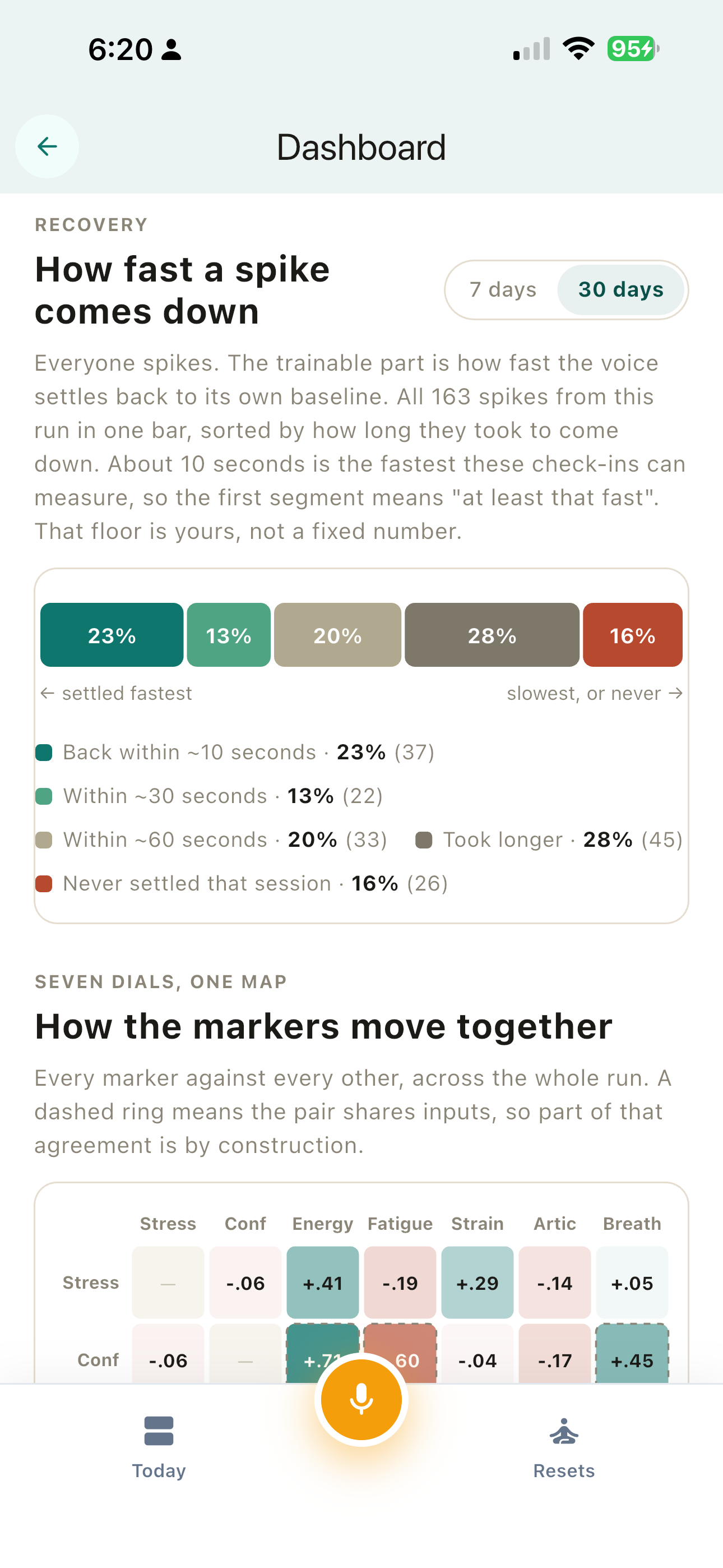
Here is stress recovery toward my personal usual range from my own Ontor dashboard and product use, the before/after view missing when a staffing desk only checks that noon was blocked for a walk. Useful as a private read of whether voice-state settled after load. It is not proof that a midday reset caused recovery, and it is not clinical recovery science:
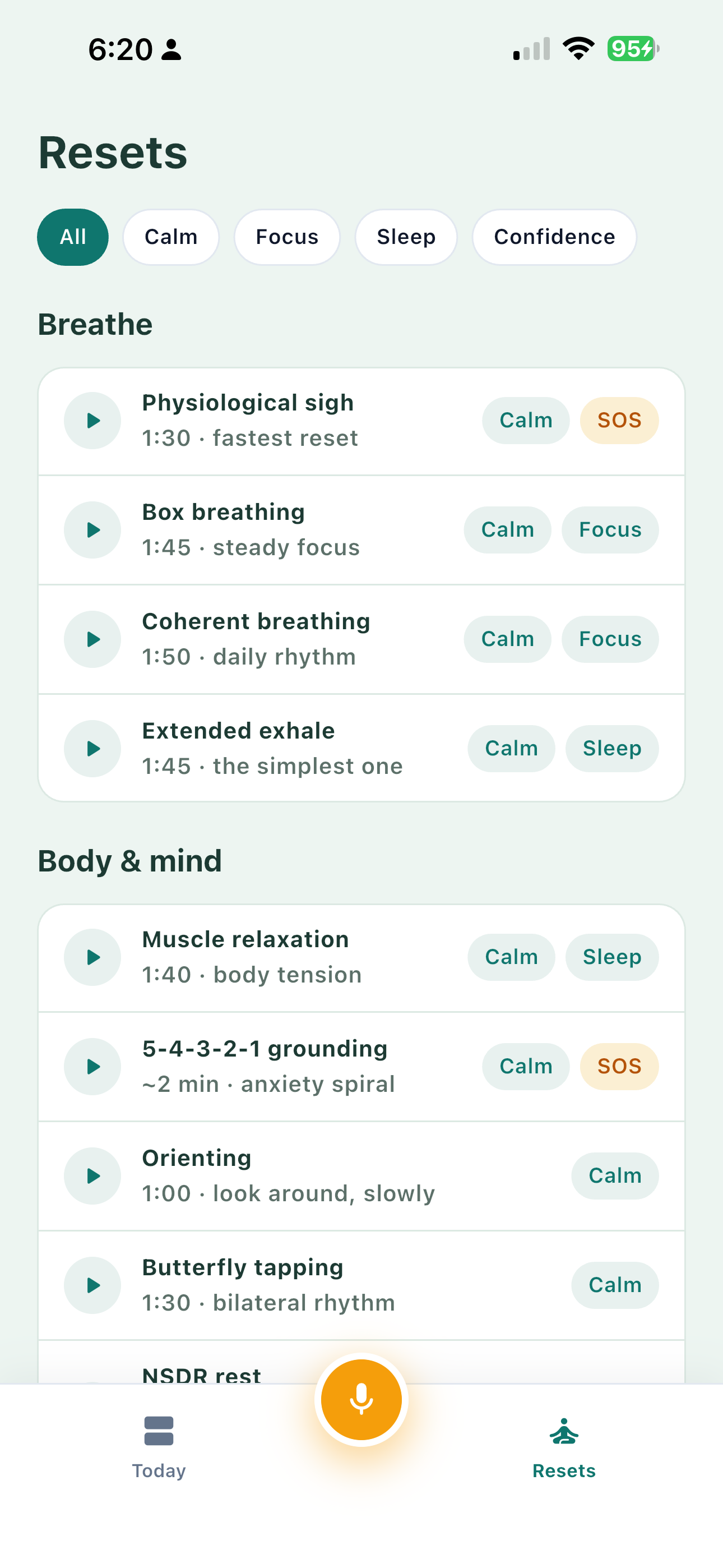
Short private resets fit the same loop when the walk was not enough and afternoon energy still sits low before cold outreach. Here is the reset list from my own Ontor product use. Cap any medical claim. The product point is a short private reset option before the next phone block, not a clinical intervention:
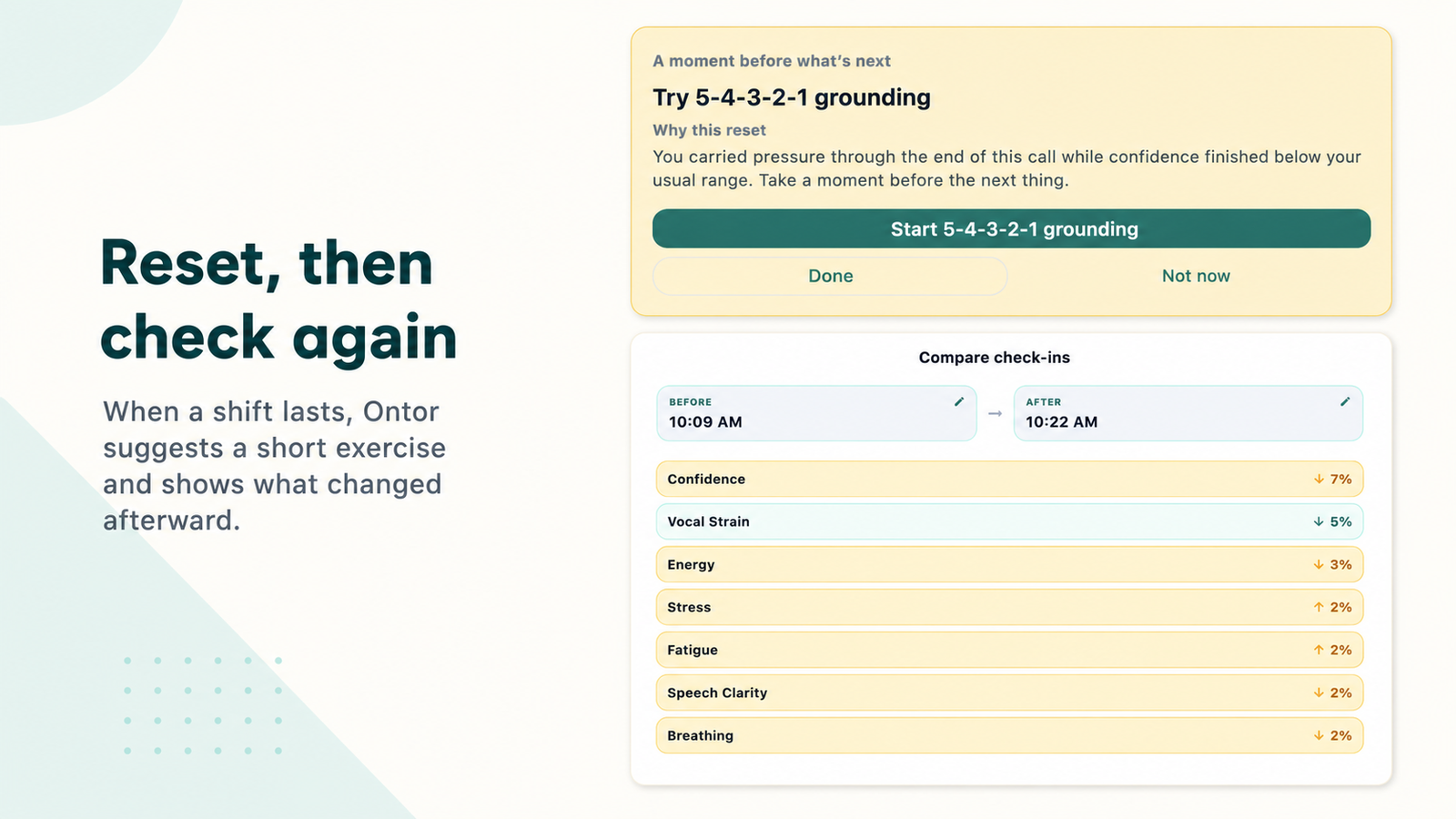
And here is reset-and-compare from that same Ontor history: how signals looked before and after a short reset. Useful when leaders already match afternoon process calls to lower energy but still need a private check on whether voice came back toward baseline. It is not causal proof that the reset restored readiness, and exploratory personal logs do not establish population recovery:
Exploratory work on that personal history (one person, not a population study) treats usual range as an empirical personal reference band, not a clinical target. Marker movement toward or away from that band is observed signal change. Temporary stress dips after short resets have been observed in personal logs; stable early recovery and broad recovery are not established from those sparse events. Marker changes do not prove cognitive improvement, revenue, retention, or health outcomes. Do not read Ontor's reset-effects R&D notes as causal proof that a midday walk restored readiness on your floor.
This is not a claim that voice markers diagnose burnout, predict attrition, replace manager judgment, or guarantee afternoon billings. The claim stays narrow: when leaders already design midday phone resets and energy-matched afternoon work, a private usual-range signal can show whether readiness returned before the next block, while personal readings stay with the person.
What a measured pilot looks like for staffing sales / full-desk leaders
Start narrow.
- Pick one full-desk or BD pod that already preaches a mandatory midday phone disengage after a multi-hour morning, and already routes afternoon process vs cold outreach by energy.
- Give people a private way to notice lasting stress, fatigue, energy, or vocal-strain drift versus their usual range across the morning block, the return after midday, and the afternoon block, and try short resets when the calendar break was not enough.
- Keep leaders on aggregate patterns only.
- Decide in advance what you are learning: did people use the signal across a week, did short resets fit real desk flow after lunch, did managers get any earlier team-level read without seeing individuals, and did coaching stay aimed at whether the midday reset restored readiness rather than adding more cold dials into a low-energy window.
Do not promise placement, meeting, or quota guarantees from a pilot. Measure whether the tool answers the reset-verification question leaders already ask after they built the midday break, without turning personal voice state into a scoreboard.
Bottom line
Paying search partners already name the physiology: mandatory midday cognitive disengage after ~3.5 to 4 hours on the phone, then energy-matched process work when afternoon energy wanes. Calendar design can protect the break. It cannot tell you whether voice and energy actually recovered versus personal baseline before the next BD or phone block.
A private, baseline-relative voice signal will not fix a weak list or a broken phone culture. It can give people something concrete when how they sound leaves their usual range after a designed midday reset, and give leaders aggregate context while personal readings stay with the person.
Start a free trial for you and your team. Soft secondary path for a measured research or pilot with staffing sales or full-desk leaders who already preach midday phone resets: Ontor for teams.
About the author
Sabber Ahamed is the founder of Ontor and an applied ML scientist (PhD in geophysics and signal processing) who builds on-device voice tools. He has shipped production signal and ML systems across radiology AI, healthcare, and manufacturing. Ontor compares how you sound to your own usual ranges and suggests short resets, without claiming clinical or revenue outcomes from marker changes.
References
- Elevating Your Phone Work - The Talent Trade (Stephanie Maas, ThinkingAhead)
- Planning the Perfect Day - The Talent Trade (Stephanie Maas, ThinkingAhead)
- Stephanie Maas, Managing Partner - ThinkingAhead
- High Performance Without Burnout: The Q2 Reset Every Recruiter Needs - The Global Recruiter (Michelle Flynn Coaching) (vendor-capped)
- How Ontor works
- Ontor for teams
- About the founder - Ontor