
Your cold-call voice isn't missing enthusiasm. It's a mode switch off your usual sound.
You know the split. Off the phone, explaining the product to a teammate, you sound like yourself. Clear. Steady. Easy to listen to. The second you "go into call mode," the pitch climbs, the smile gets forced, and the opener starts sounding apologetic or robotic. Prospects hang up early. Managers keep asking for more energy. You already tried that.
This is for individual call-heavy workers: SDRs, BDRs, and other high-volume phone ICs who own their own dial block. Managers can read it as the off-script vs call-mode diagnostic they already use on the floor. It is not the article about voice tightening under live resistance. It is not block-length fade into robot voice. It is not morning first-connect warmup, not between-call hangover, and not collections opening-hello tone. The wedge here is narrower: call-mode activation off your personal baseline, not missing enthusiasm and not a better script.
Download Ontor - 14 days free, no card required
Forced "professional" phone voice raises pitch before the script matters
Justin Deane, writing from a first-person SDR seat (now coaching), named the early-career trap cleanly:
"When I began cold-calling in my first SDR role, I was hyper-focused on sounding what I thought was professional, enthusiastic, and positive. I ended up tripping over my words, speaking with an unnaturally high pitch, and failing to mirror my prospect, resulting in early hang-ups."
That is not a talk-track problem yet. It is a delivery costume. The forced professional or enthusiastic phone voice lifts pitch, trips the opener, and burns the connect before mirroring or discovery can start.
His reset was not more enthusiasm. It was dropping the costume:
"Once I switched to using my authentic voice, I became calmer, listened more, & mirrored my prospect with ease."
"In the end, I became adept at having authentic business conversations, landing meetings, and letting my enthusiasm come naturally."
Treat that as employee anecdote with a clear mechanism, not a verified employer case study. The useful spine is the mode switch: inventing a separate phone voice that prospects reject, then returning toward the voice that already works off-script.
Managers already diagnose the same split: fine off-script, dies in call mode
Kory White, a fractional CRO publishing a tone-coaching playbook for managers, frames the floor diagnostic in almost the same words SDRs feel:
"Most "bad tone" is a confidence and energy problem, not a personality flaw - reps go robotic when they're reading, monotone when they're nervous, and high-pitched when they apologize for interrupting."
Then the test that matters for this article:
"If their tone is great in that moment and dies the second they "go into call mode," it's a skill-and-confidence problem you can coach."
And the apology leak that shows up as pitch:
"You hear "Sorry to bother you" energy in every line."
White's coaching stack (Gong or Chorus review, one variable at a time, smile-on / smile-off A/B) is real manager work. Cap any hire-or-fit framing from that playbook. For Ontor's angle, the diagnostic itself is the product-shaped gap: the same person can sound fine explaining the product off-script, then leave that personal baseline the second call mode turns on. Closing the felt-vs-heard gap is the awareness step. White also asks whether the rep's self-rating now matches the manager's. That gap is exactly what a private usual-range read during speech is built to show the IC, without turning it into a personal scoreboard.
Light corroboration: "pitch voice" and expect-voicemail tone
Cold Call Me (outbound training vendor; capped) names "pitch voice" as the delivery failure managers coach against. Their list is familiar: slow the pace, vary tonality, avoid pitch voice, sound relaxed. Recordings are the self-awareness tool so reps hear the difference themselves. Useful vernacular only. Do not treat their service CTA as the answer here.
On a LinkedIn tip thread, floor peers (including a BDR manager and an insurance sales-floor leader commenting on Benjamin Douablin's post) make the pre-dial expectancy audible:
"Expect them to answer. Reps who expect voicemail sound like it."
"I run an insurance sales floor and the reps who dial expecting a voicemail get exactly that, every time. Expectation sets the tone before a single word lands."
That is adjacent, not the spine. Expect-voicemail tone is another pre-activation of a fake phone mode. Batch warmup (first three dials of a batch sounding different than call seven) overlaps the published morning first-connect piece, so keep it light here.
Mike Williams' 90-second between-call "sound like call one" coaching is hangover corroboration only. It is not this article's spine.
This is not those nearby articles
Prospects hear when the voice tightens is live tonality under resistance during the call.
You start the block sounding like Morgan Freeman is cumulative block-length fade into robot voice by lunch.
Your first connect of the day shouldn't be your warm-up rep is morning cold-start before rhythm locks.
Leaders treat the minutes between calls as empty is between-call hangover carryover.
Tone of voice in the first 10 seconds is a collections opening-hello problem for a different ICP.
This piece is call-mode activation: the moment you leave your authentic / off-script baseline for a forced professional or enthusiastic phone voice, pitch goes high or apologetic, and early hang-ups follow. Same headset. Different failure mode.
Download Ontor - 14 days free, no card required
A private check for the mode switch (not more enthusiasm coaching)
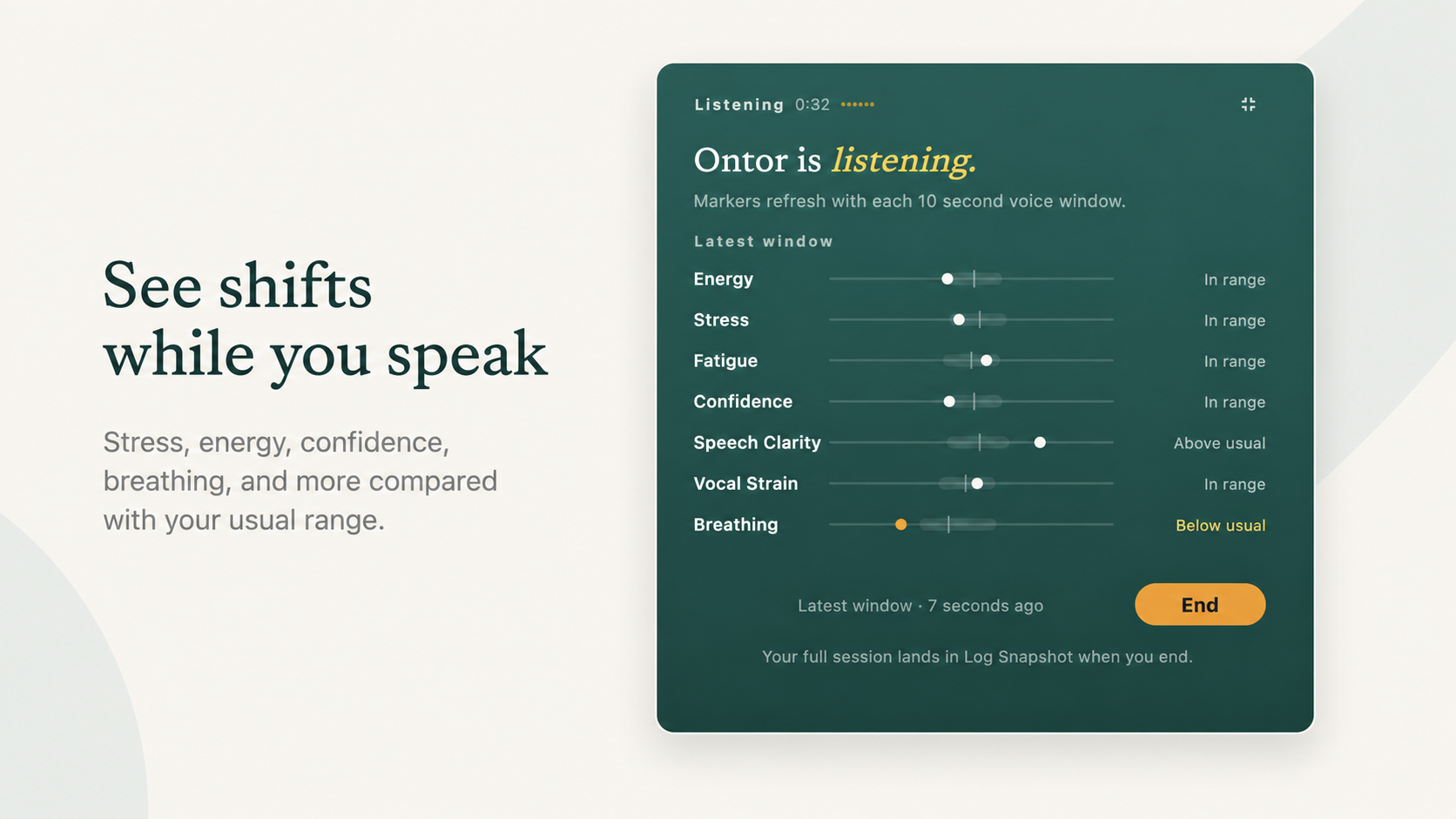
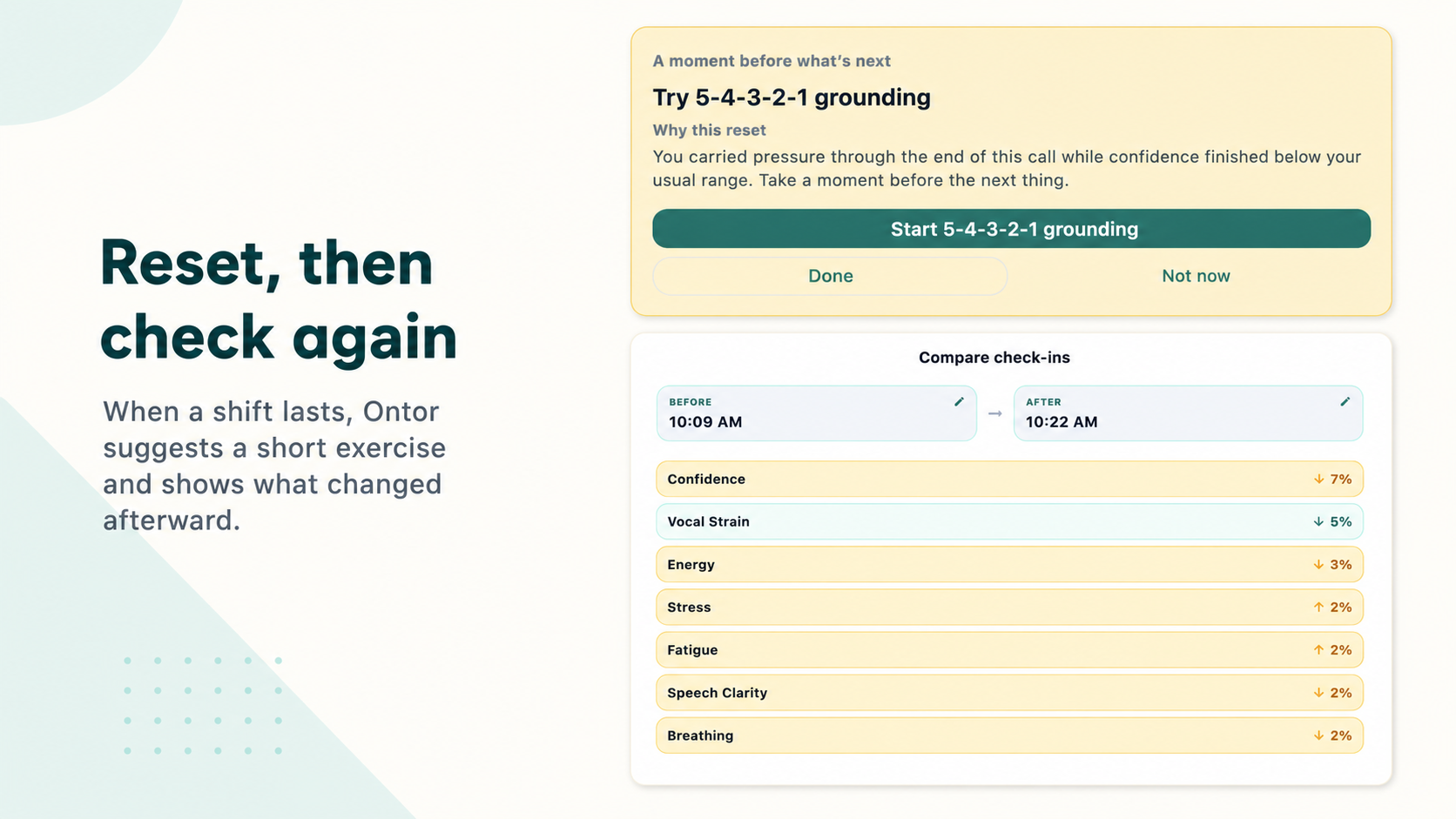
Ontor is a performance tool that reads how you sound, not what you said. While you speak, it compares voice signals to your own usual range. Markers refresh in short voice windows (on the order of about 10 seconds of speech). When a lasting shift shows up (for example stress, confidence, speech clarity, breathing, or vocal strain), it can suggest a short reset. You can also compare before and after.
That matches the call-mode problem without turning it into medical voice care, anxiety treatment, or a manager scoreboard of your dials. Readings and sessions stay with you. The point is narrower than "never sound fake on a cold call." You get a private signal that you left your usual range when call mode turned on, plus a short owned reset, so the next connect can move back toward the voice that already works when you explain the product off-script.
In my own Ontor session history, the call-mode split shows up the same way Deane and White describe it. How I sound can leave my personal usual band the moment I flip into a forced "professional" delivery, even when the words are fine. Off that costume, the same markers sit closer to my usual range. That private usual-band check is what managers are guessing at when they ask you to explain the product off-script, then listen to the cold-call recording.
Here is the live listening view from my own Ontor product use: markers refresh with each short voice window and sit against my usual range. Speech clarity can sit above usual while breathing sits below usual in the same window. That split is the kind of call-mode tell a script coach misses when they only grade the words, and that you miss when you only feel "I should sound more enthusiastic":
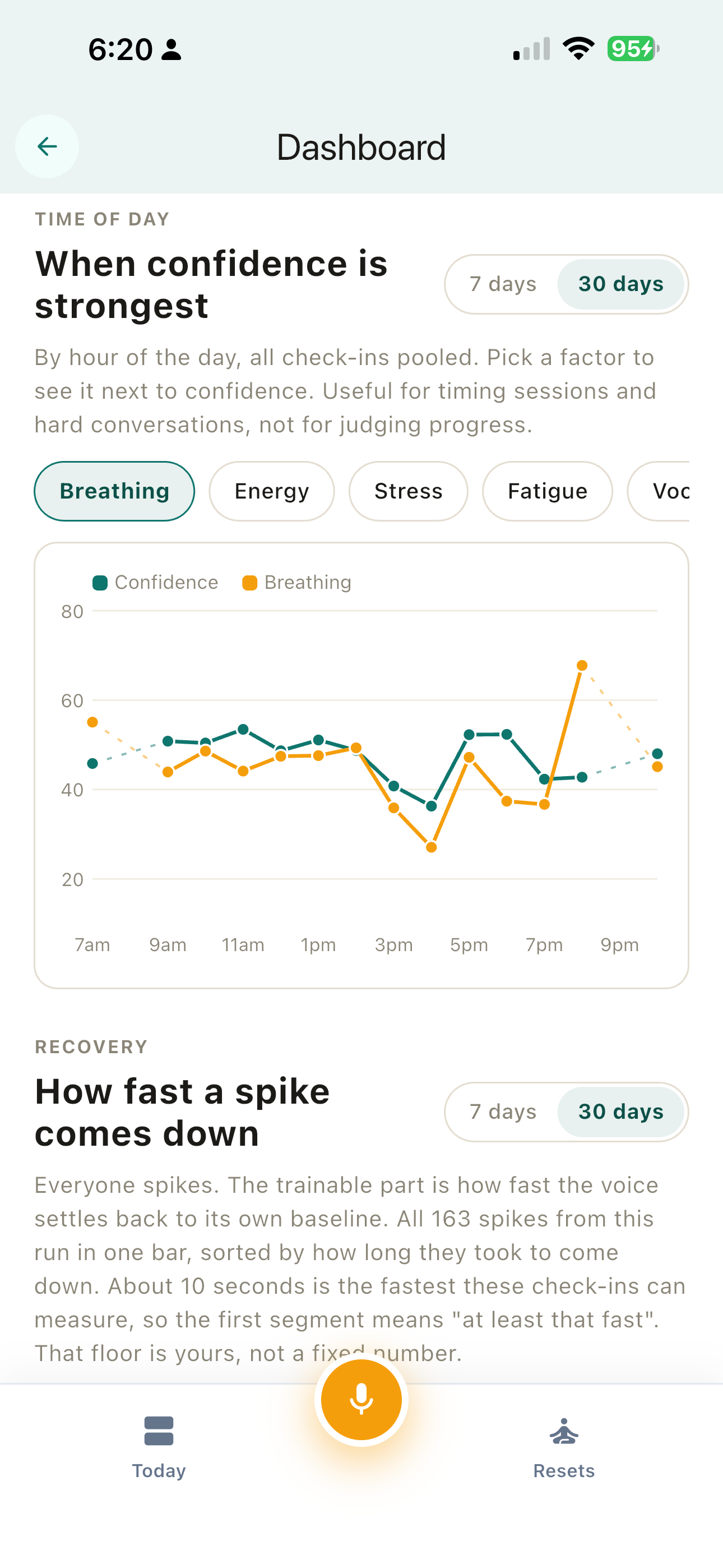
Here is confidence plotted with breathing across the day, from my own Ontor dashboard and session history. Call-mode apology energy and high-pitch effort often travel with confidence and breathing leaving the personal usual band together. This is not proof your connect rate will rise, and it is not a hire-or-fire score:
When that private read says you left usual range after a call-mode block, Ontor can surface a short reset before the next dial. Here is a reset-then-compare view from my own product use. Cap any medical claim. The product point is a short private loop you own so the next opener can move back toward your off-script sound, not a clinical warmup or another enthusiasm drill:
In exploratory work on that same personal Ontor history (one person, not a population study), high-stress stretches often did not show an observed return to my personal median within an hour. That is one reason a private usual-range check at call-mode activation matters. It is not evidence that a suggested reset caused recovery, improved connect rate, or protected quota.
This is not a claim that voice markers diagnose social anxiety, fix pitch clinically, or replace skill coaching. It is narrower: when the same person sounds fine off-script and dies in call mode, a baseline-relative signal plus a short reset is the loop you can run yourself on the next cold-call block.
Try it on the next cold-call block
Download Ontor - 14 days free, no card required
Install it for the dials you already run. Notice how you sound versus your usual range when you flip into call mode, then notice the same markers when you explain the product off-script to a teammate. Take a short reset if call mode pulled you outside usual range. Keep whatever scripts and CRM habits already work. Add a private loop that is yours.
If you manage a pod, the soft path is a research or pilot conversation, or Ontor for teams, with aggregate patterns only. The primary next step for the IC is still the next cold-call block: hear call-mode vs off-script against your own usual range, not another enthusiasm pep talk.
Sabber Ahamed is the founder of Ontor and an applied ML scientist (PhD in geophysics and signal processing) who builds on-device voice tools. He has shipped production signal and ML systems across radiology AI, healthcare, and manufacturing. Ontor compares how you sound to your own usual ranges and suggests short resets, without claiming clinical or revenue outcomes from marker changes. LinkedIn · About
References
- Justin Deane - LinkedIn: forced professional / enthusiastic cold-call voice and unnaturally high pitch (employee anecdote; first-person SDR)
- Kory White / PulseRevOps - How do you coach a rep whose tone kills their cold calls (2026) (buyer / manager coaching playbook; call-mode vs off-script diagnostic)
- Lloyd Hinds / Cold Call Me - How to Train SDRs to Sound Conversational (avoid pitch voice) (vendor-capped)
- Benjamin Douablin + peer commenters - Expect-voicemail tone and batch voice (light corroboration)
- How Ontor works
- Ontor for teams
- About the founder - Ontor
- Install Ontor