
Tone of voice in the first 10 seconds decides if they stay on the phone.
Collections and ARM ops leaders already know the opening matters. Mini-Miranda. Right-party verify. Knowledge of the balance. What still burns the one-shot contact is quieter: whether this collector's voice energy and confidence in the first ~10 seconds matched their own usual hello, or whether it went flat and robotic before the debt facts ever landed.
Consumers decide stay-or-hang in that window. Dialer boards still look fine. Absolute Empathy and Tone still asks whether the line sounded friendly enough.
This is not mid-shift demeanor baseline drift for managers watching silence or overcompensation. It is not absolute Empathy and Tone QA versus a personal morning voice. It is not cumulative empathy calluses across months of hardship work. It is not a cool-down after a hostile disposition, not early-tenure first-60-day confidence collapse, and it is not a freight leader's first 10 seconds when phones blow up after a fire. This piece is the collections opening hello: personal voice energy and confidence versus that collector's usual greeting, so you catch mid-shift robotic or flat drift before the contact is gone.
Download Ontor - 14 days free, no card required
A collections VP puts the gate in plain language: first 10 seconds, tone of voice
Jose Giron, Vice President of Operations at TSI (medical-heavy ARM), answered how a collector gains trust out of the gate on AccountsRecovery.net's One Shot to Connect webinar:
"Tone of voice. If you're gonna talk about those first 10 seconds, your tone is very important."
He is not talking about script compliance three minutes in. He is talking about the opening window itself:
"I think people make decisions right away if they're gonna stay on the phone with you or not, and people unfortunately make those conclusions before they get further in the call."
And he returns to the same gate when he compresses it further:
"I think the very first few seconds, your tone is everything."
When confidence is missing, Giron says leaders already know what those openings sound like:
"When you don't have it, we've all heard those calls. They're not, they're painful to listen to."
Painful openings are not only wrong words. They are audible lack of confidence before payment facilitation even starts. Competitive medical and early-out books feel that as hang-ups and withheld information, not as a later QA score.
"I don't want my collectors to sound like robots from hello"
Mara Morgan, Senior Lead Account Manager at ARSI (~95% medical), put the same opening problem in buyer language on the same panel:
"Tone of voice is going to set the tone for the entire call from the moment you say hello."
Her coaching target is human engagement, not polished robotic delivery:
"I don't like it when someone sounds like a robot, so I don't think other people do either. So I don't want my collectors to sound like robots. I want them to sound like real people trying to engage."
She also names the first ~60 seconds as the window where she has to read whether this consumer needs rapport or stick-to-facts. That flexibility only works if the collector's own audible energy is still human. Medical hardship and grief friction raise the bar. A flat, scripted hello burns the contact before any later flexibility lands.
Leaders already coach "don't sound like a robot." The gap is detecting when a normally human collector drifts robotic or flat on the greeting versus their own usual hello, mid-shift, before the one-shot connect is wasted.
Light salvage note: when the first voice already burned the contact
Jason Koontz, Senior Vice President for Product Development and Collections Infrastructure (US Operations) at Teleperformance, describes mid-call trust loss when agents get frustrated answering the same question three or four times. His salvage pattern, when the first collector's state has already damaged the call, is an interpersonal transfer:
"depending on your cases, sometimes it does take an agent being smart enough to transfer to another agent to reset the conversation."
Morgan names that pattern in two words: "Second voices."
Keep that as a costly live salvage, not the primary answer here. Second-voice transfer is what you reach for after the opening or mid-call state already burned trust. The opening-window question is earlier: can you notice when energy, confidence, or breathing left this collector's usual hello band before the consumer decides to hang up, and before you need a second agent?
Vendor speech-analytics and real-time coaching tools appear on the same industry panels. Cap them as existing stack, not as this article's lead. The unique gap below is personal usual-hello energy versus absolute "sound friendly" QA.
What opening scripts and absolute tone cards still miss
Typical stack:
- Opening script and Mini-Miranda training
- "Be approachable / don't sound like a robot" coaching
- Live monitoring and whisper coaching when a supervisor is on that line
- Absolute Empathy and Tone QA
- Speech analytics / sentiment overlays (vendor-capped)
Useful. Incomplete for Giron's and Morgan's gate. Scripts tell you what to say in the first ten seconds. Absolute tone cards ask whether the greeting sounded calm or friendly enough on a rubric. Occupancy says the seat was busy. None of them continuously asks: did this collector's energy, confidence, or breathing leave their usual hello range in the short speech window when the consumer is deciding whether to stay?
Borrowers hear that first. Leaders often meet it as an early hang-up, a refused engagement, or a "painful" recording in next week's listen-back.
Download Ontor - 14 days free, no card required
How this differs from demeanor drift, QA tone, calluses, cool-downs, and freight first-10s
Demeanor drift answers: if you already live-monitor, do you still miss mid-shift personal demeanor drift (silence, overcompensation) before conflict or a complaint?
Empathy and Tone vs baseline answers: when absolute QA grades calm and transcript empathy language, do you still miss drift versus this collector's morning voice?
Empathy calluses answers: after dozens of similar hardship conversations under quota, has cumulative numbness set in while recovery still looks fine?
Cool-downs after hostile calls answer: was this call coded too hot to continue immediately?
Early-tenure confidence answers: is a new collector losing confidence across training, nesting, and production in the first 60 days?
Freight fires, first 10 seconds answers a different ICP: freight brokerage leaders setting floor tone when phones blow up after a fire. Same "first 10 seconds" phrase. Different buyer, different moment, different ops move.
Between-call hangover and Thrive-style 60-second between-call reset clusters answer unpaid residue between dials. This piece is the opening hello on the next contact, versus that collector's usual greeting.
This article answers a different question: in collections / medical ARM, does opening-window personal voice energy and confidence versus that collector's usual hello decide whether the consumer stays, and can you catch mid-shift robotic or flat drift before the one-shot contact burns?
Same collections beachhead as the ARM pieces above. Different moment. Different ops move. Ontor's personal-baseline read in short speech windows is not another demeanor-silence story, not another absolute Empathy and Tone scorecard, not a cool-down policy, not early-tenure ramp, and not a freight crisis clone.
What Ontor adds on the opening hello (private first)
Ontor is a performance tool that reads how you sound, not what you said. While someone speaks, it compares voice signals to that person's own usual range. Markers refresh in short voice windows (on the order of about 10 seconds of speech). When a lasting shift shows up (for example energy, confidence, stress, speech clarity, or breathing), it can suggest a short reset. People can also compare before and after.
For teams, Ontor's public framing is aggregate patterns for workload, coaching, and support. Individual sessions and readings stay with the person. Leaders get team-level context for when a pod's openings sit outside usual range more often mid-shift. They do not get a personal scoreboard for hire or fire decisions.
That is the product difference from "sound friendly" coaching alone and from absolute Empathy and Tone cards. Absolute QA asks whether the greeting passed a calm/friendly rubric. Live monitoring asks whether a supervisor happened to hear a robotic open. Ontor asks whether this voice left its own usual hello band, privately, in the short window when the consumer is still deciding to stay.
In my own Ontor session history, the opening-hello gap shows up the same way Giron and Morgan named it for collectors. A greeting can still sound "professional" in the ordinary sense while energy or confidence has left my personal usual range and the delivery has gone flat. That private usual-band shift is what consumers hear as robotic or uncertain before any coach joins the line.
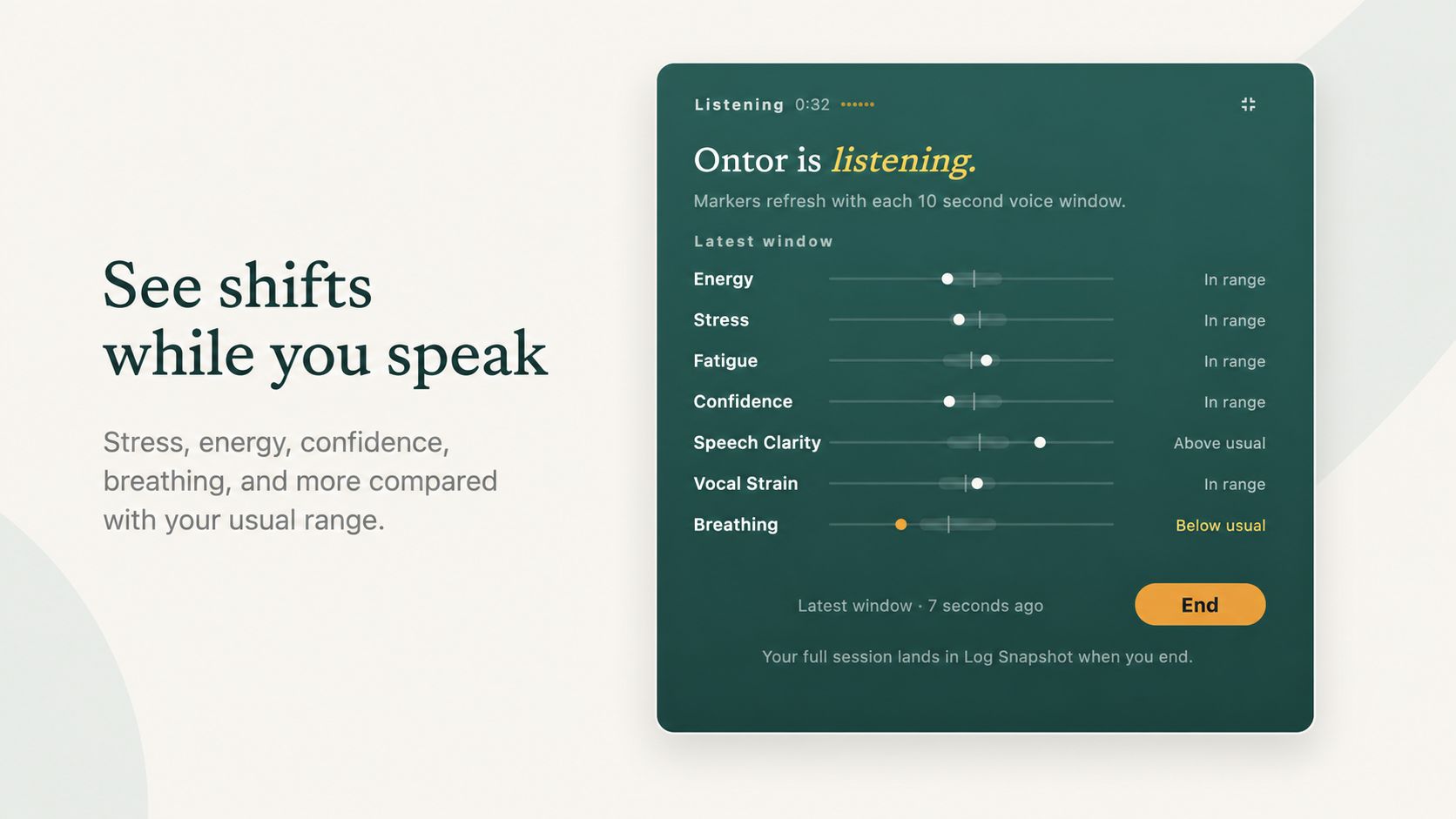
Here is the live listening view from my own Ontor product use: markers refresh with each ~10 second voice window and sit against my usual range. That is the opening-hello check, not a generic "sound friendly" card. Speech clarity can sit above usual while breathing sits below usual in the same short window. Absolute Empathy and Tone would still ask only whether the line sounded calm enough. This is the first-10s personal-hello check leaders miss when they wait for a hang-up or a painful listen-back:
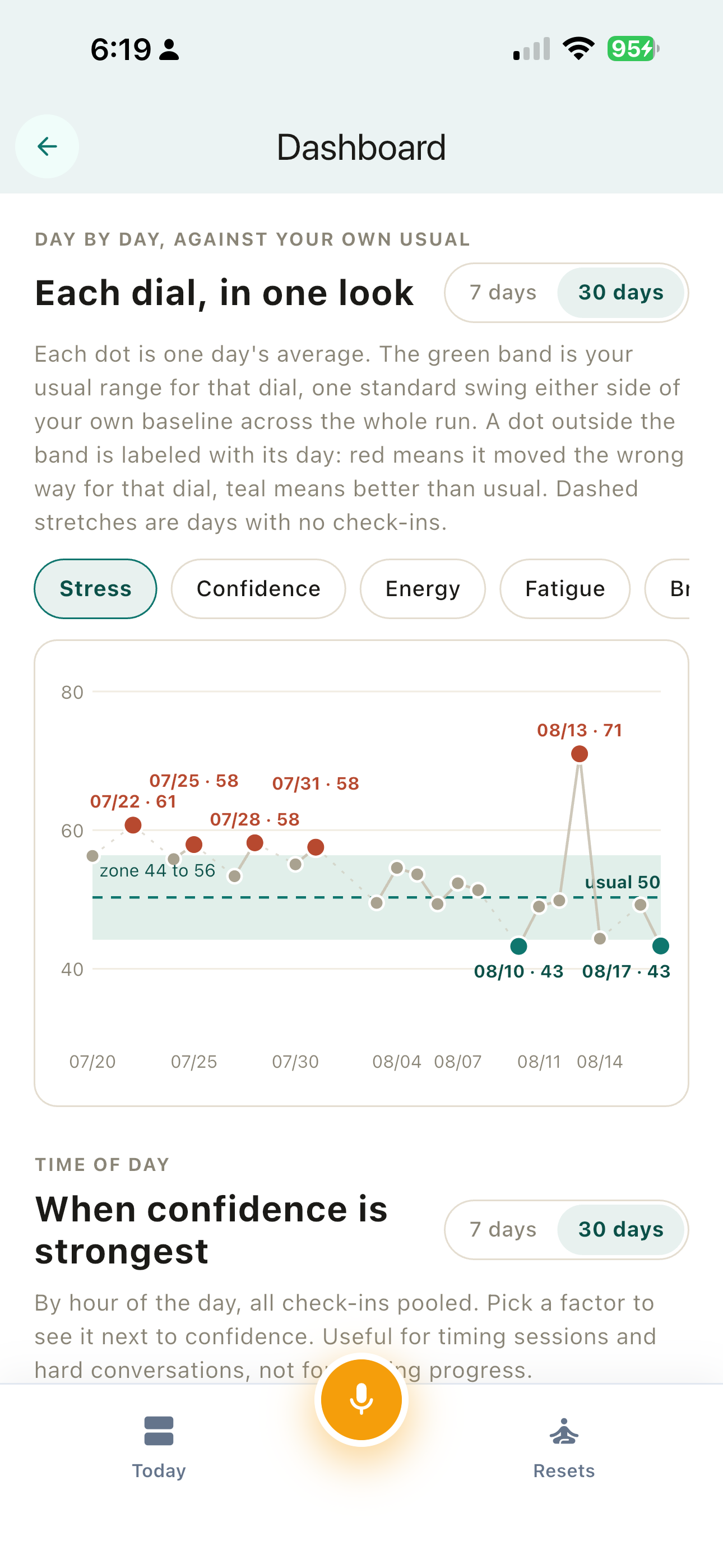
Here is stress day by day against my personal usual band, from my own Ontor dashboard and session history. Red points sit above my usual range. Read it as the private view of how often voice-state leaves the band across dials, including opening windows when a normally steady hello has already gone flat mid-shift. It is not collections outcome data and it is not a hire-or-fire score:
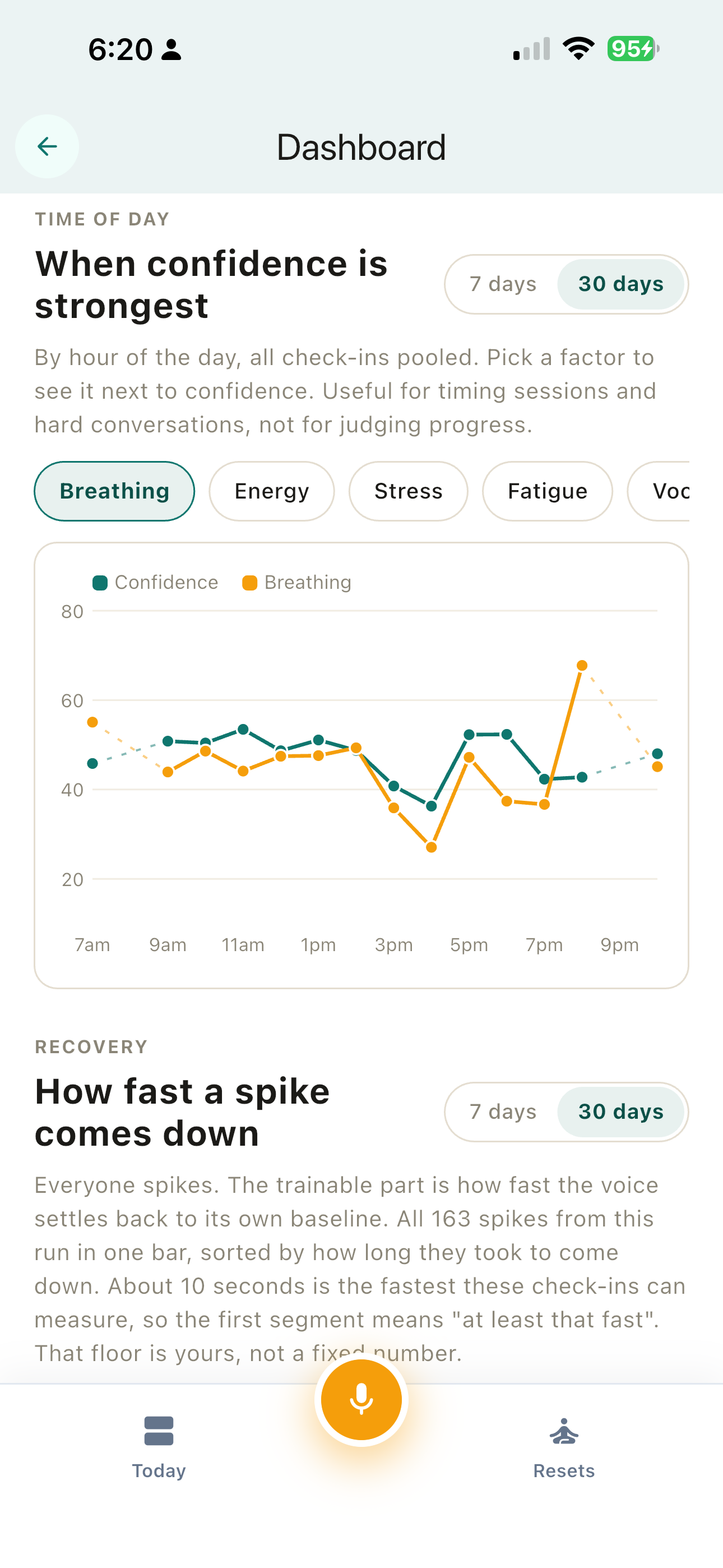
Here is confidence with breathing by hour from that same Ontor history. Useful as a private composure and energy check for when mid-shift openings tend to leave the usual hello band. The product also notes that about 10 seconds is the fastest these check-ins can measure, which matches the opening-window length Giron named. It is not proof that a suggested reset caused recovery, and it is not clinical science:
In exploratory work on that same personal Ontor history (one person, not a population study), high-stress episodes often did not show an observed return to my personal median within an hour. That is one reason noticing lasting opening-window drift early matters. It is not evidence that a suggested reset caused recovery.
This is not a claim that voice markers diagnose trust loss, predict payment rates, replace manager judgment, or guarantee stay-on-phone outcomes after a reset. The claim stays narrow: when absolute tone cards and script coaching miss personal hello drift, a private signal plus a short reset is a loop people can run before the next collections opening, while leaders watch cohort patterns only in aggregate.
What to try on the next collections opening hello
Do not wait for a research committee if you run medical ARM or recovery voice floors.
- Install Ontor on the machine collectors already use for outbound and inbound connects.
- On the next live block, notice the first ~10 seconds of the opening hello. Check whether energy, confidence, stress, clarity, or breathing sit outside that person's usual range before the debt facts start.
- If a lasting shift shows up, take the short suggested reset when wrap-up allows it, then open the next contact from closer to that collector's usual hello instead of pushing another flat greeting into a one-shot window.
- If you lead a pod, keep leaders on aggregate patterns only. Personal readings stay with the person.
Soft secondary path if you are buying for a collections floor and want a measured look later: Ontor for teams, or a research conversation / pilot with collections ops and training leaders on opening-hello blocks.
Do not promise recovery-rate, AHT, or retention guarantees. Measure whether people can tell when the urge to push a robotic hello left their usual voice before the next first contact.
Bottom line
Tone of voice in the first 10 seconds decides if they stay on the phone. Morgan's line still holds: do not let collectors sound like robots from hello. The gap that remains is personal usual-hello energy and confidence in that short window, caught mid-shift before the one-shot contact burns.
Try Ontor on the next collections opening hello / first contact window. Notice the first 10 seconds versus that collector's usual greeting. That is the tool next step, not only a pilot conversation.
Download Ontor - 14 days free, no card required
References
- Jose Giron / Mara Morgan / Jason Koontz. "One Shot to Connect: Building Trust" webinar transcript. AccountsRecovery.net, August 2026. https://www.accountsrecovery.net/wp-content/uploads/2026/08/One-Shot-to-Connect_-Building-Trust_Transcript.pdf
- "One Shot to Connect: Building Trust" summary. AccountsRecovery.net, August 2026. https://www.accountsrecovery.net/wp-content/uploads/2026/08/One-Shot-to-Connect_-Building-Trust_Summary.pdf
- Ontor. "How it works." https://ontor.ai/how-it-works/
- Ontor. "Ontor for teams." https://ontor.ai/for-teams/
- Ontor. "About the founder." https://ontor.ai/about/
- Ontor. "Install Ontor." https://ontor.ai/install/
- Ontor. "You already live-monitor the floor. You still miss when a collector drifts off their own demeanor." https://ontor.ai/blog/collections-demeanor-drift/ (sibling, different question)
- Ontor. "We score Empathy & Tone. We still miss when a strong collector drifts off their own baseline." https://ontor.ai/blog/collections-qa-tone-vs-baseline/ (sibling, different question)
- Ontor. "Collectors develop calluses. Your recovery dashboard never shows it." https://ontor.ai/blog/collections-empathy-calluses/ (sibling, different question)
- Ontor. "When the phones blow up after a freight fire, the first 10 seconds decide the floor." https://ontor.ai/blog/freight-fires-first-10s/ (freight ICP sibling, different industry)