
You call it attitude. ACA calls it Assumption Fatigue.
Your best-tenured collectors still clear dials. Liquidation from that same group dips. On the floor you hear a familiar wrap after "I'm unemployed" or "fixed income." It looks like attitude. ACA's Director of Education names a different mechanism: Assumption Fatigue.
This is not cumulative empathy numbness after months of similar hardship calls. It is not IC robot-voice fade across a long block. It is not absolute Empathy and Tone QA missing personal baseline drift, and it is not a cool-down after a hostile disposition. This piece is about a judgment shortcut: stock objections trigger automatic early exits, so probing dies while recovery boards still look busy.
What ACA already names for the collections floor
Kelli Van Cleave, ACA International's Director of Education, wrote the pattern for Collector magazine. ACA's public news excerpt puts the buyer scene in plain language. A consumer answers with "I'm unemployed," "I'm on a fixed income," or "I have more important obligations." Experienced collectors exit early. They treat that first objection as proof the person "can't pay."
Van Cleave's definition:
"Assumption fatigue is what happens when experience starts deciding the next move. Certain situations trigger automatic conclusions. It's not because collectors don't care, but because their call and training experience has taught them that probing further isn't worth the effort."
And the scale of the leak:
"Multiply that moment by dozens of calls a day, and a pattern emerges: experienced collectors exiting conversations early, making the quick assumption that someone "can't pay" based solely on their initial objection."
ACA's framing is sharp on cause. After the early training window, judgment skills wear down in shops built on speed, repetition, and constant decision-making unless training continues. Van Cleave also notes that a fast exit is sometimes the right call. The failure mode is when fast exits become the routine instead of pausing and working the consumer on the line. Revenue is quietly lost while managers still hear "attitude."
Weight this as buyer-facing trade education from ACA's Director of Education, not as a current agency VP's private ops diary. The primary fix she points toward is continued scenario training and spotting assumption patterns in review. Keep that. It still leaves a live-voice question your dialer and liquidation views do not answer: is this tenured collector's clarity, energy, or confidence already off their own usual range during speech, in the moments before probing dies?
What recovery and attitude reviews still miss
Typical stack:
- Dialer and workforce metrics (occupancy, adherence, AHT, talk time)
- Collections outcomes (promises, payments, right-party contact, liquidation)
- QA on what was said and whether compliance language landed
- Coaching notes that read early exits as attitude or script discipline
Useful. Incomplete for Assumption Fatigue. A recovery dip from your best-tenured people can look like motivation or attitude when the live mechanism is a learned shortcut on stock objections. Occupancy still says the seat was busy. Liquidation says dollars moved, or did not. Neither tells you whether probing still happened after "I'm unemployed," or whether the voice already left that collector's personal usual band before the wrap.
Dashboards show dials and recovery. They miss judgment-shortcut exits from the people you trained longest.
How this differs from calluses, robot voice, QA tone, and cool-downs
Empathy calluses answer: after dozens of similar hardship conversations under quota and month-end pressure, has cumulative numbness set in while recovery still looks fine?
Block-length robot voice answers: across a long IC block, does delivery fade from human to flat script cadence?
QA Empathy and Tone vs baseline answers: when absolute calm-tone and transcript empathy grades pass, do you still miss drift versus this collector's own morning or personal baseline?
Cool-downs after hostile calls answer: was this call coded too hot to continue immediately?
This article answers a different question: when stock objections trigger automatic early exits in your best-tenured people, is that attitude, or Assumption Fatigue, and can you see clarity, energy, or confidence leave that person's usual range during speech before probing stops?
Same beachhead. Different mechanism. Different ops move.
A private check against usual range before the next probe (not hire-or-fire QA)
Ontor is a performance tool that reads how you sound, not what you said. While someone speaks, it compares voice signals to that person's own usual range. When a lasting shift shows up (for example energy, confidence, speech clarity, stress, fatigue, or breathing), it can suggest a short reset. People can also compare before and after.
For teams, Ontor's public framing is aggregate patterns for workload, coaching, and support. Individual sessions and readings stay with the person. Leaders get team-level context for floors where speed and repetition quietly teach premature exits. They do not get a personal scoreboard for hire or fire decisions.
That is the product difference from attitude write-ups and from scorecards that only grade words. Attitude reviews ask whether someone cared enough. Absolute QA asks whether the line sounded calm enough. Ontor asks whether this voice left its own usual band during speech, privately, before the next stock objection lands.
In my own Ontor session history, the Assumption Fatigue gap shows up the same way Van Cleave names it for collectors. A stretch of similar high-pressure conversations can still sound "fine" in the ordinary sense while clarity, energy, confidence, or breathing have already left my personal usual range. That private drift is the part liquidation and attitude notes do not surface before the next early wrap.
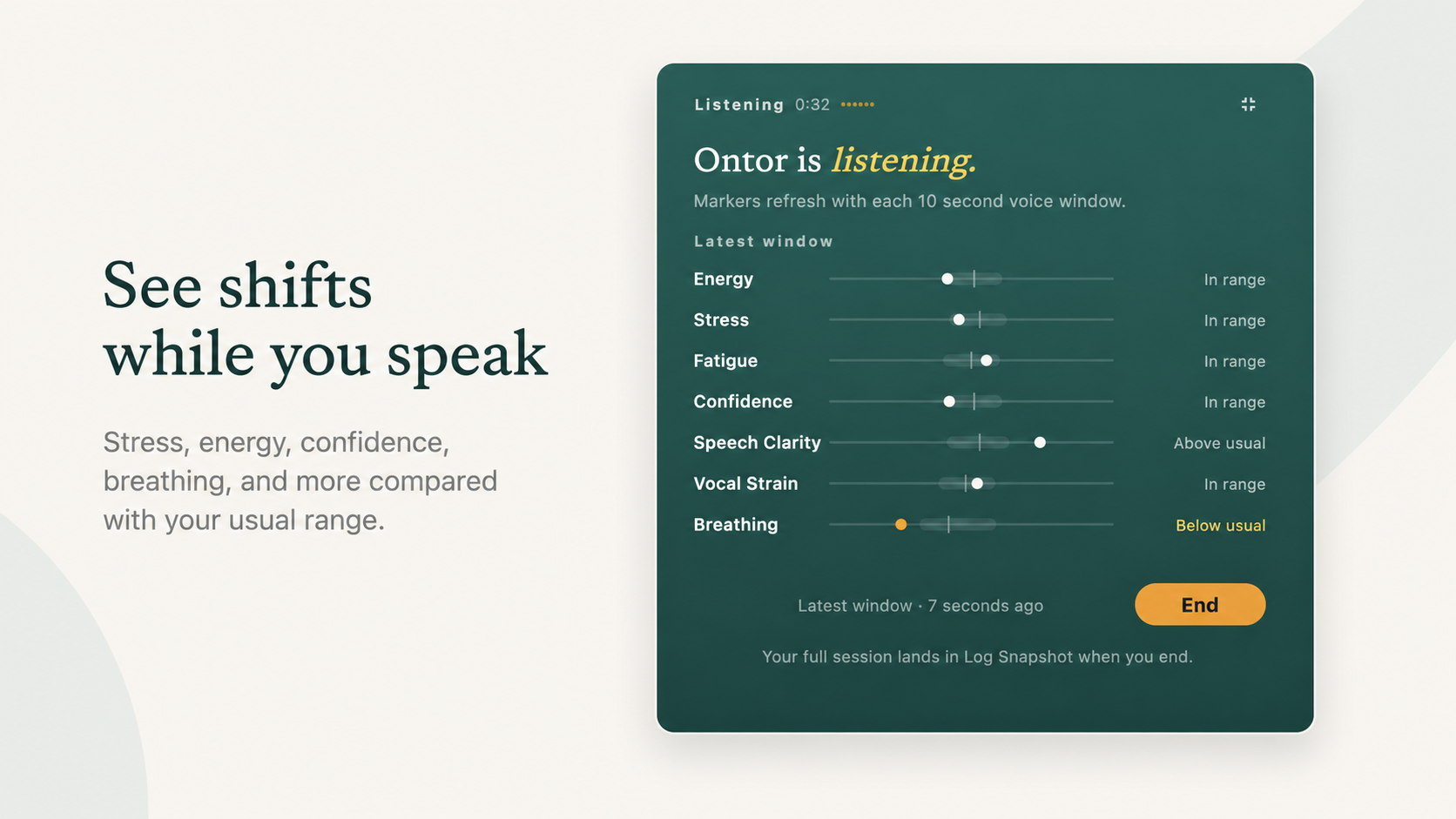
Here is the live listening view from my own Ontor use: markers refresh in short voice windows and sit against my usual range. Speech clarity can sit above usual while breathing sits below usual in the same window. On a collections floor, that is exactly the kind of split attitude reviews miss when a tenured collector still "sounds professional" while judgment is already sliding toward the shortcut exit:
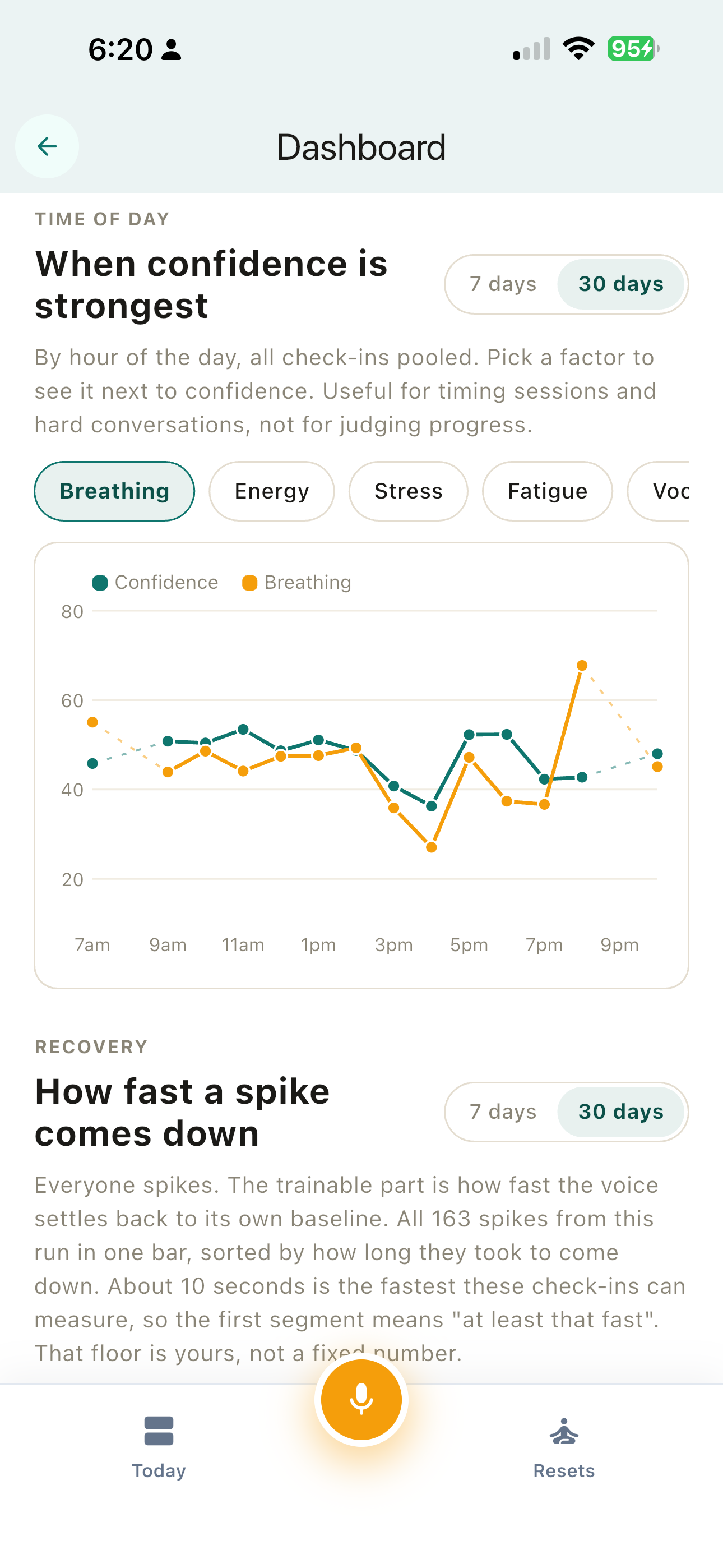
Here is confidence across the day against breathing from that same personal Ontor history. Ontor frames the time-of-day view as useful for timing hard conversations, not for judging progress. For Assumption Fatigue, the point is narrower: confidence and related activation can look steady on a board while another personal marker (here, breathing) has already left the usual pattern. That is a private signal before probing dies on the next stock objection. It is not collections outcome data:
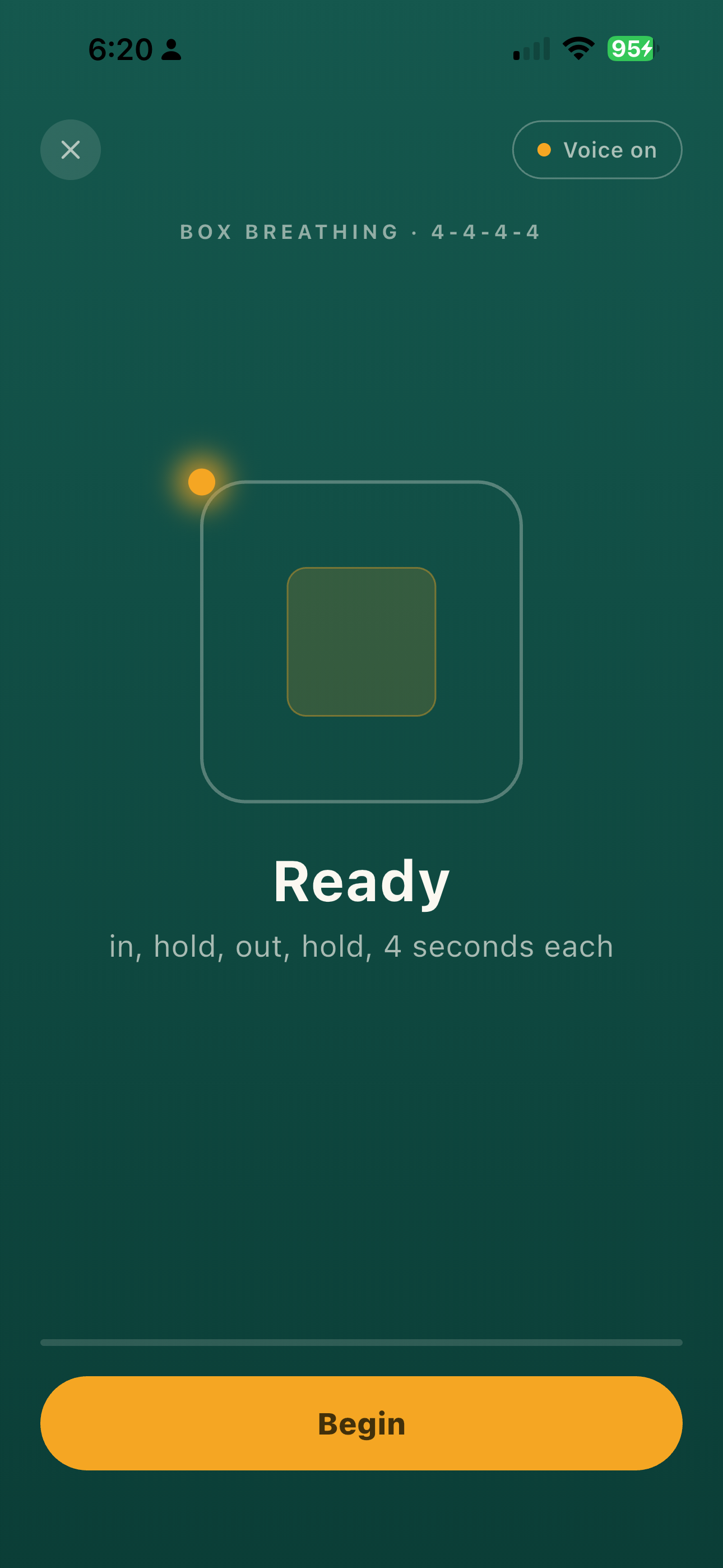
Here is a real Ontor box breathing reset screen from my own product use. When speed and repetition push you off your usual voice, this is the short private loop available before the next connect. It complements continued scenario training and call review. It does not replace ACA-style judgment practice, and it is not proof of liquidation lift:
In exploratory work on that same personal Ontor history (one person, not a population study), high-stress episodes often did not show an observed return to my personal median within an hour. That is one reason a private usual-range check under repetitive stock-objection load matters. It is not evidence that a suggested reset caused recovery.
This is not a claim that voice markers diagnose attitude, predict attrition clinically, or guarantee liquidation, AHT, or retention improvement. The claim stays narrow: when Assumption Fatigue looks like attitude on the floor, a private signal plus a short reset is a loop people can run before the next probe, while leaders watch cohort patterns only in aggregate.
What a measured pilot looks like for collections leaders
Start narrow.
- Pick one experienced collections or recovery pod where liquidation from tenured people has softened and early exits after stock objections already show up in call review (agency front-end, credit-union or bank recovery, or BPO high-emotion queue).
- Give people a private way to notice lasting energy, confidence, clarity, stress, fatigue, or breathing drift versus their own usual range, and to try short resets between connects.
- Keep leaders on aggregate patterns only (for example, whether the pod sits outside usual range more often in high-repetition blocks where assumption shortcuts already appear in QA).
- Decide in advance what you are learning: did people use resets, did resets fit real AHT and wrap-up constraints, did managers get any earlier read on team strain without seeing individuals, and did existing training still own scenario practice on stock objections.
Do not promise liquidation, occupancy, or attrition guarantees from a pilot. Measure whether the tool fits a floor where attitude write-ups still miss judgment-shortcut exits from your best-tenured people.
Bottom line
You call early wraps after "I'm unemployed" attitude. ACA calls the trained shortcut Assumption Fatigue. Recovery boards still miss whether clarity, energy, or confidence left that collector's usual range during speech before probing stopped. Ontor adds a private usual-range voice check and short resets. It is not another hire-or-fire QA layer.
Start a free trial for you and your team
If you want a measured pod pilot or a research conversation first, see Ontor for teams or how Ontor works.
References
- Kelli Van Cleave. "From Collector: Assumption Fatigue." ACA International / Collector magazine excerpt, published on ACA news. https://www.acainternational.org/news/from-collector-assumption-fatigue/
- Ontor. "How it works." https://ontor.ai/how-it-works/
- Ontor. "Ontor for teams." https://ontor.ai/for-teams/
- Ontor. "About the founder." https://ontor.ai/about/