
You trained the words. Consumers still hear the shake.
Collections and ARM leaders teach scripts for the hardest asks. Borrow from family. Confirm a date. Hold the line when the consumer pushes back. You coach after the fact. Pattern-interrupt walks. Post-call rebuilds. NLP drills.
What still lands late is live voice-state when a tenured collector's voice shakes mid-ask. Consumers hear tone and volume first. Recovery dies in that second. Dialer boards still look fine.
This is not first-60-day confidence collapse for new hires. It is not absolute Empathy and Tone QA. It is not a cool-down after a hostile disposition code, and it is not mid-shift demeanor drift that shows up as silence or overcompensation. This piece is about the hard-ask moment itself: a long-tenured collector, the weirdest ask of the shift, and a shaky voice the borrower can hear before any coach joins the line.
Download Ontor - 14 days free, no card required
A CACi president names it: even 25-year collectors get the shaky voice
Roger Weiss, President of CACi (a St. Louis ARM / debt collection agency), put the hard-ask problem in plain language on AccountsRecovery.net's Building Confidence for Collectors webinar:
"A 25 year tenured collector will get weird and get the shaky voice. Oh, could you borrow it from someone? No, and it's done right."
He is not describing nesting week. He is describing tenured people who know the script and still lose delivery when the ask gets weird.
Weiss teaches collectors that once body language is gone on the phone, how you say it carries most of the load. In his session framing (drawing on the familiar Mehrabian split as a teaching model, not as Ontor science), physical cues leave, and tone plus volume become the bulk of what the consumer reads. His ops rule is blunt:
"You can't be shaky voice, you can't be stumbling around words, what have you."
When confidence slumps, his shop still reaches for familiar leadership tools: NLP and script drills, then a pattern interruption. Sometimes that is as simple as pulling someone off the phone for a short walk and a talk.
Useful. Still after the fact, or only when a supervisor already noticed. Scripts fix words. Walks fix aftershocks. Neither continuously compares this collector's stress, confidence, or clarity to their own usual range while the hard ask is happening.
After the hard call, managers rebuild. During the ask, the line is already live.
On the same panel, David Mitchell, Assistant Vice President of Asset Recovery Operations and QA/Compliance at Security Service Federal Credit Union, described what good collections managers do after a brutal connect:
"One of the best collections managers or team leads, supervisors all have that background of being on the phones, right? They've been in the trenches, they've taken the calls. They've been called every name in the book, and like Roger said, something that aren't included in the book, but being able to. To talk from experience to walk their collections agents through difficult calls after the fact, or how to bring them back up after a particularly hard call. Think that all matters."
Keep that post-call rebuild. It is real leadership work.
It does not answer Weiss's mid-ask problem. By the time a trench-experienced supervisor walks someone through what just happened, the consumer already heard the shake on the payment ask.
Tenured people burn out too, and energy still travels through the phone
Sheka Walker, a team / training lead at Williams & Fudge, pushed the same panel past new-hire-only coaching:
"what about tenure reps? What about those people who have been here 1, 2, 3, 4, even 10 years? Sometimes it can cause burnout with them as well, so we also wanna make sure that we're still actually building into them just as well as we're building into those new hires."
She also named live listening and in-the-moment Zoom coaching as how they catch delivery problems, and she stressed that energy is contagious through the phone. Consumers feel it.
Live listen helps when a supervisor is on that call. It does not sit on every hard ask. It does not give the collector a private read against their own baseline when their voice starts to leave their usual band mid-sentence.
Light corroboration: shake it off, and tone is already the outcome variable
Beth Conklin, then Director of Organizational Training and Development at State Collection Service (via a 2022 PDCflow write-up of her CollectorLive! talk), framed the between-call residue problem: feelings from a lost, angry, or refusal-heavy conversation stay with you, especially when remote collectors cannot walk to the next cubicle. Her LOSSING blueprint includes Shake it Off. She also names tone of voice and demeanor as factors that impact call outcomes.
Older source. Use it lightly. It still lands next to Weiss: tone is not decoration. It is part of whether the next ask works.
A vendor LinkedIn diagnosis (Monica W., SafeInside) describes emotional residue carrying into tone of voice and patience on the next contact, even when the words stay correct. Cap that as vendor marketing. Useful for the carryover-into-tone frame. Do not treat her product CTA as the ops answer here.
What script drills and post-call coaching still miss on the hard ask
Typical stack:
- Script and NLP training for the hardest asks
- Live monitoring / whisper coaching when a supervisor is available
- Post-call rebuilds and pattern-interrupt walks after a confidence hit
- Dialer and recovery metrics
- Absolute Empathy and Tone QA
Useful. Incomplete for Weiss's moment. Scripts tell you what to say when you ask someone to borrow from family. Absolute tone cards ask whether the line sounded calm enough. Occupancy says the seat was busy. None of them continuously asks: did this tenured collector's stress, confidence, or speech clarity leave their usual range while the hard ask was in progress?
Borrowers hear that first. Leaders often meet it as a failed arrangement, a complaint, or a strong performer who "just had a bad block."
Download Ontor - 14 days free, no card required
How this differs from early tenure, QA tone, cool-downs, and demeanor drift
Early-tenure confidence answers: is a new collector losing confidence across training, nesting, and production in the first 60 days?
Empathy and Tone vs baseline answers: when absolute QA grades calm and transcript empathy language, do you still miss drift versus this collector's morning voice?
Cool-downs after hostile calls answer: was this call coded too hot to continue immediately?
Demeanor drift answers: if you already live-monitor, do you still miss mid-shift personal demeanor drift (silence, overcompensation) before conflict or a complaint?
This article answers a different question: even after you trained the words, do tenured collectors still get a shaky voice on the hardest ask, and do consumers hear that tone and volume before any coach arrives?
Same beachhead. Different moment. Different ops move. Ontor's personal-baseline read during speech is not another new-hire ramp piece, not another absolute Empathy and Tone scorecard, not another hostile cool-down policy, and not the mid-shift silence/overcompensation story.
What Ontor adds on the hard-ask block (private first)
Ontor is a performance tool that reads how you sound, not what you said. While someone speaks, it compares voice signals to that person's own usual range. Markers refresh in short voice windows (on the order of about 10 seconds of speech). When a lasting shift shows up (for example stress, confidence, speech clarity, or breathing), it can suggest a short reset. People can also compare before and after.
For teams, Ontor's public framing is aggregate patterns for workload, coaching, and support. Individual sessions and readings stay with the person. Leaders get team-level context for when a pod is leaving usual range on hard-ask blocks. They do not get a personal scoreboard for hire or fire decisions.
That is the product difference from script drills alone and from post-call rebuilds alone. Scripts ask whether the words were right. Live monitoring asks whether a human listener caught a stumble. Ontor asks whether this voice left its own usual band, privately, while the hard ask is still running or before the next one.
In my own Ontor session history, the hard-ask gap shows up the same way Weiss named it for tenured collectors. A block can still sound "professional" in the ordinary sense while stress has left my personal usual range and confidence or breathing has tightened. That private usual-band shift is what consumers hear as shake or stumble before a coach walks someone through it afterward.
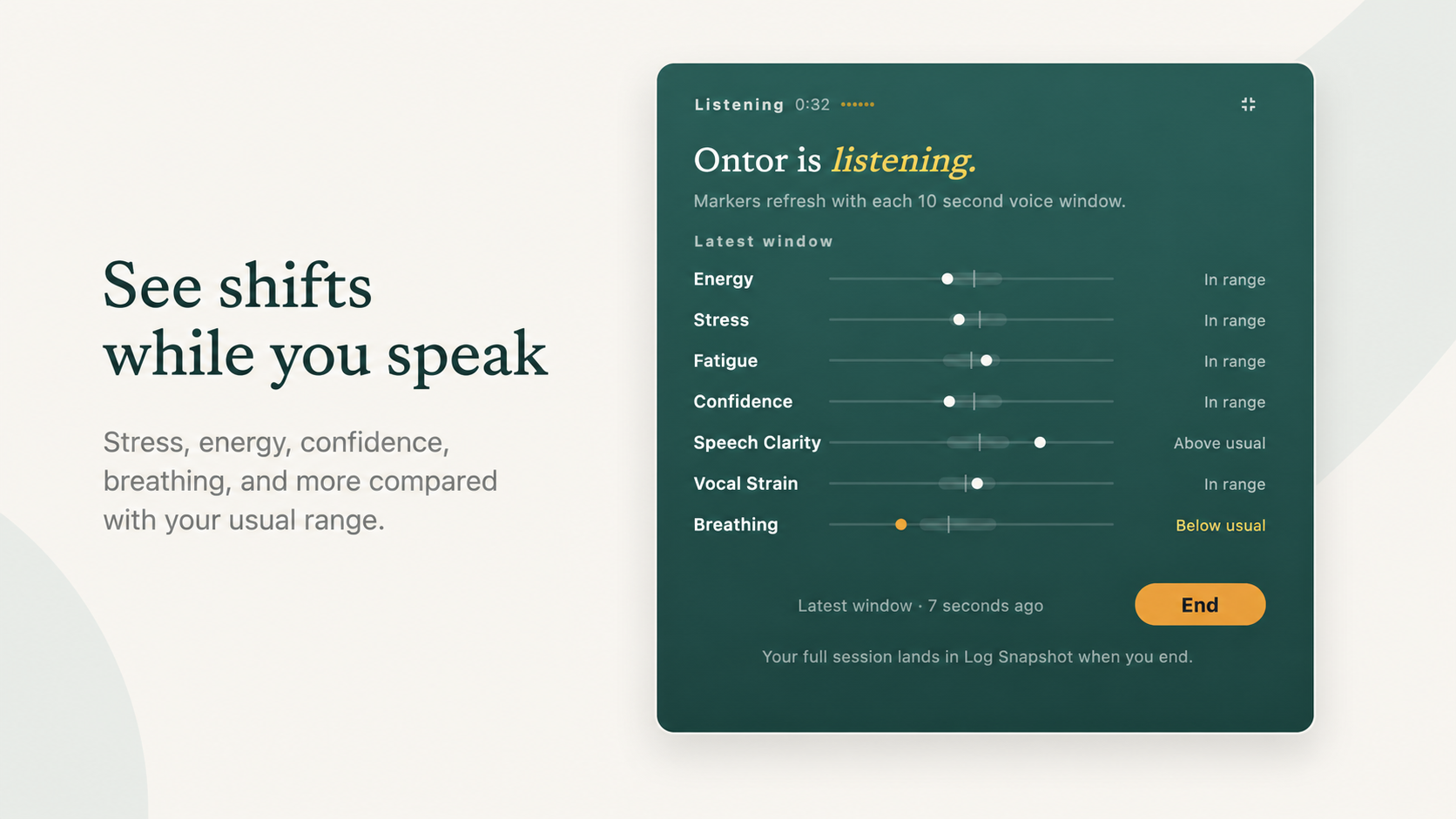
Here is the live listening view from my own Ontor product use: markers refresh with each short voice window and sit against my usual range. Speech clarity can sit above usual while breathing sits below usual in the same window. A supervisor whisper-coaching for script compliance would not see that split. Absolute Empathy and Tone would still ask only whether the line sounded calm enough. This is the hard-ask voice-state check leaders miss when they wait for a failed arrangement or a post-call rebuild:
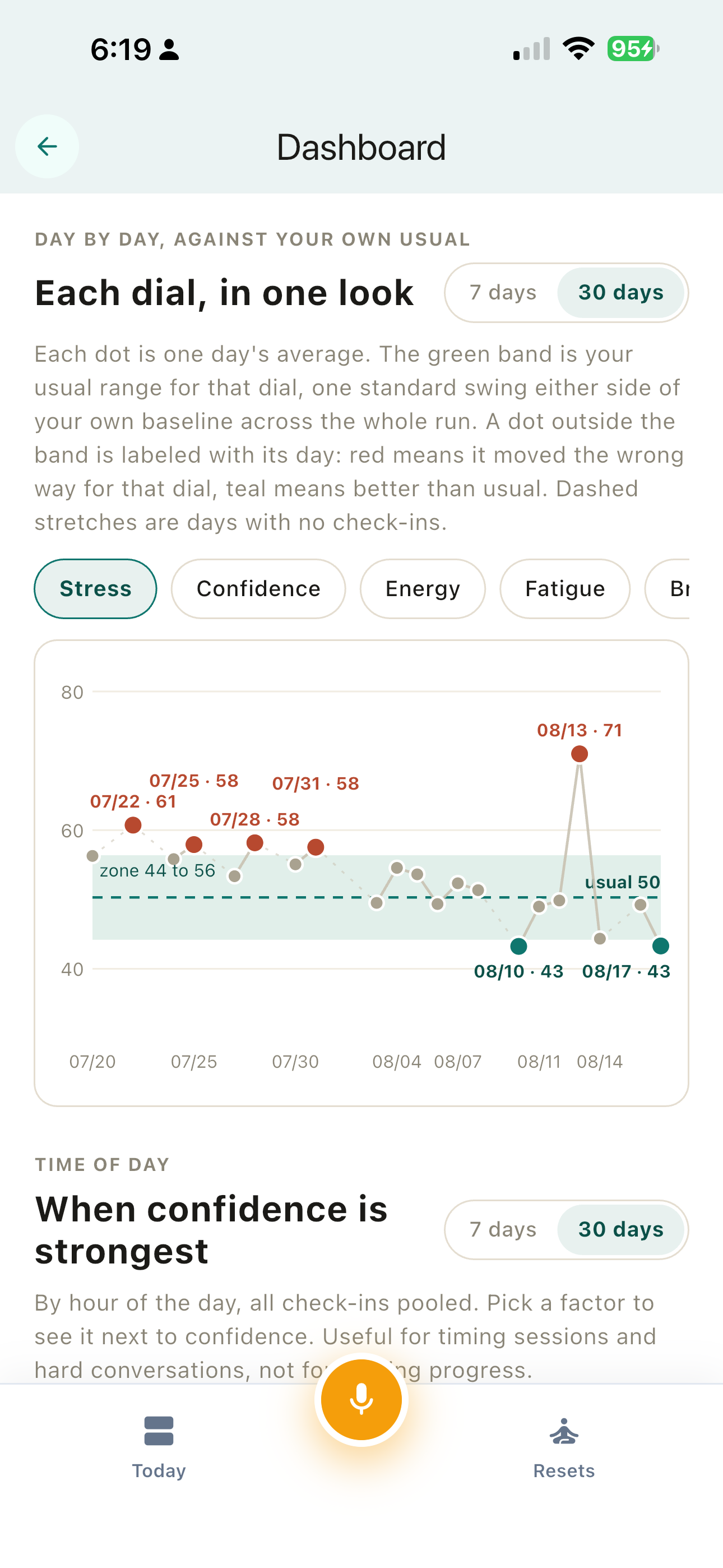
Here is stress day by day against my personal usual band, from my own Ontor dashboard and session history. Red points sit above my usual range. That personal usual-band view is what dialer boards and script scorecards miss when a tenured collector's hard-ask delivery is already off. It is not collections outcome data and it is not a hire-or-fire score:
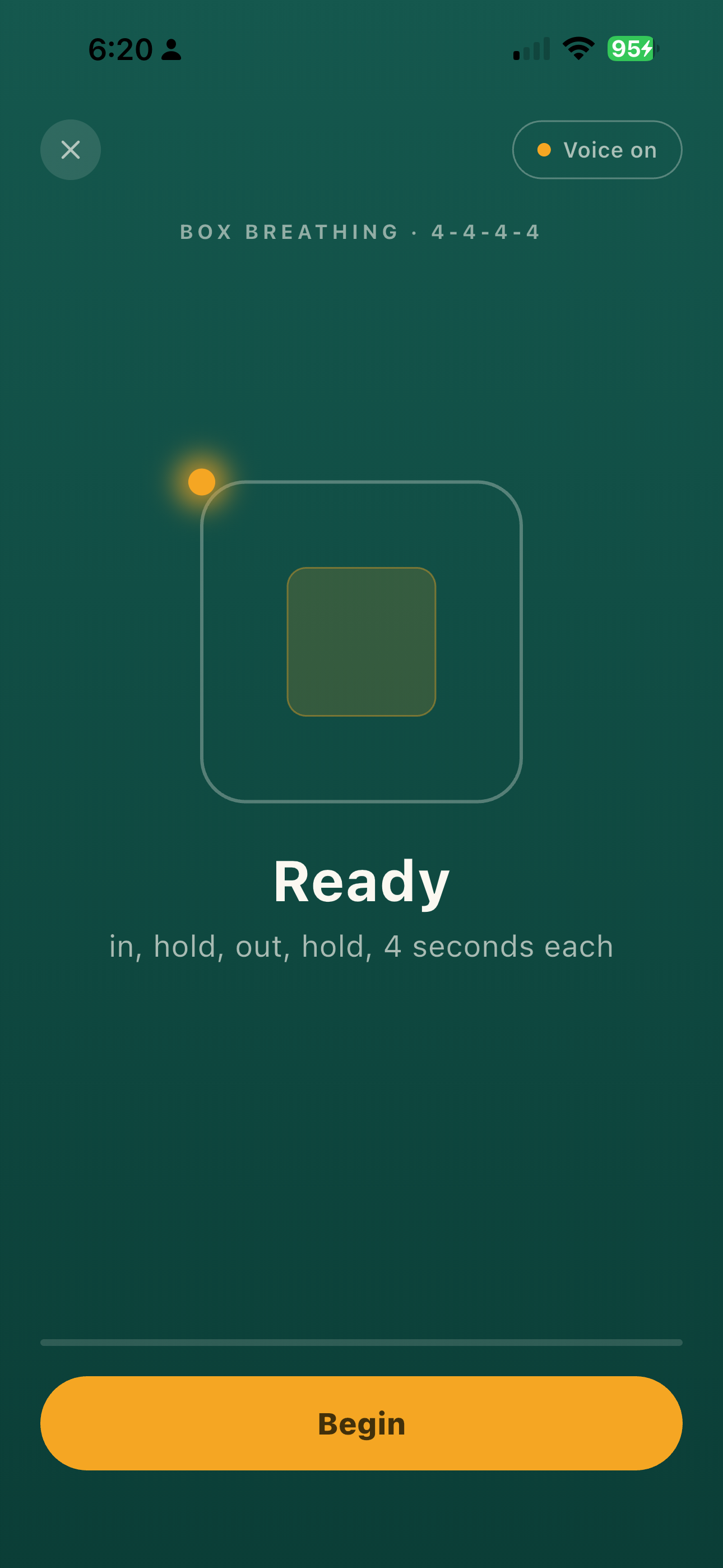
Here is a real Ontor box breathing reset screen from my own product use. When a hard ask or the residue after it pushes you off your usual voice, this is the short private loop available before the next connect. It complements Weiss-style pattern interruptions and Mitchell-style post-call rebuilds. It does not replace live monitoring or scripts, and it is not proof of recovery-rate lift:
In exploratory work on that same personal Ontor history (one person, not a population study), high-stress episodes often did not show an observed return to my personal median within an hour. That is one reason a private usual-range check under hard-ask load matters. It is not evidence that a suggested reset caused recovery.
This is not a claim that voice markers diagnose anxiety, predict payment outcomes, or guarantee recovery-rate, AHT, or retention improvement. The claim stays narrow: when tenured collectors still shake on the hardest ask, a private signal versus their own usual range plus a short reset is a loop people can run on the next hard-ask call block, while leaders watch cohort patterns only in aggregate.
What a measured pilot looks like for collections leaders
Start narrow.
- Pick one experienced pod that already owns the hard asks (agency front-end, credit-union asset recovery, or BPO hardship queue with tenured collectors).
- Give people a private way to notice lasting stress, confidence, speech clarity, or breathing drift versus their own usual range during speech, and to try short resets before the next hard-ask connect.
- Keep leaders on aggregate patterns only (for example, whether the pod sits outside usual range more often on hard-ask blocks than on easier dials).
- Decide in advance what you are learning: did people use resets on real hard-ask blocks, did resets fit wrap-up and AHT constraints, did managers get any earlier read on team strain without seeing individuals, and did scripts plus post-call coaching still own their existing jobs.
Do not promise recovery-rate, promise-to-pay, or attrition guarantees from a pilot. Measure whether the tool fits a floor where tenured people already know the words and consumers still hear the shake.
If you want a design-partner conversation with collections ops or training leaders, start with Ontor for teams. The primary next step is still to try the product on the next hard-ask call block, not only to talk about a pilot.
Download Ontor - 14 days free, no card required
Bottom line
You already trained the words for the hardest asks. You already coach after hard calls. Tenured collectors can still get a shaky voice mid-ask, and consumers hear tone and volume before any rebuild starts. Ontor adds a private usual-range voice check during speech and short resets when shifts persist. It is not a new-hire ramp piece, not another absolute Empathy and Tone card, not a hostile cool-down policy, and not the mid-shift silence story.
Try it on the next hard-ask call block.
References
- Roger Weiss (CACi), David Mitchell (Security Service FCU), Sheka Walker (Williams & Fudge), et al. "Building Confidence for Collectors" webinar transcript. AccountsRecovery.net, March 2026. https://www.accountsrecovery.net/wp-content/uploads/2026/03/Building-Confidence-for-Collectors_Transcript.pdf
- Hannah Huerta summarizing Beth Conklin (State Collection Service). "6 Step Blueprint to Prevent Call Center Burnout and Stress." PDCflow, February 22, 2022. https://www.pdcflow.com/office-operations/6-step-blueprint-to-prevent-call-center-burnout-and-stress/
- Monica W. (SafeInside). LinkedIn post on emotional carryover into tone of voice (vendor marketing; capped). https://www.linkedin.com/posts/monicawashington3_emotional-carryover-in-customer-service-activity-7466973930977943552-ufF9
- Ontor. "How it works." https://ontor.ai/how-it-works/
- Ontor. "Ontor for teams." https://ontor.ai/for-teams/
- Ontor. "About the founder." https://ontor.ai/about/
- Ontor. "Install Ontor." https://ontor.ai/install/