
You already live-monitor the floor. You still miss when a collector drifts off their own demeanor.
Collections and ARM contact-center leaders already live-monitor. Whisper coaching. Side-by-side. Floor walks. Chat check-ins on remote pods. You catch script misses and obvious heat. What still arrives late is mid-shift demeanor drift against that person's own day-to-day range.
Silence from a normally vocal collector. Overcompensation from someone who is usually steady. A strong agent who related too well to a hardship story and is still carrying it into the next dial. Borrowers and peers hear that first. Leaders often meet it as conflict, a complaint, or attrition.
This is not a cool-down policy after a hostile disposition code. It is not absolute Empathy and Tone QA. It is not cumulative empathy calluses across months of similar hardship work, and it is not the mid-market between-call hangover story. This piece is about personal-baseline demeanor drift during the shift, and why managers without that baseline wait for late signals.
Download Ontor - 14 days free, no card required
A collections VP already names the gap: know day-to-day demeanor
Jake Richards, VP of Extended Business Office Operations at State Collection Service, put the early-warning problem in plain language on an AccountsRecovery.net conflict-management webinar for collectors and collections leaders:
"I think it's important that you understand all of your team members kind of day to day demeanor so that you see just a shift in that demeanor."
He is explicit that early signs are not the same for every person. Quiet workers can suffer in silence. Others flip the other way:
"It could even be an over overcompensating demeanor. When something changes usually means there's a reason that something changed and that's the early sign."
Miss that window and the conflict gets harder to untie. Richards' ops answer is engagement plus knowing people, not waiting for a loud blow-up.
He also names the hardship-queue case leaders often under-coach: agents who relate a little too well to a consumer's situation and get overwhelmed. Front-end talk tracks are not enough. He requires hold-and-escalate when dignity and respect are about to fail, then counsel afterward. And he puts the back-end duty in one sentence:
"we need to make sure that we're supporting them on the back end of those phone calls, just the same that we're supporting them and on the front end to be prepared to handle."
Hostile and hardship queues need scripts. They also need capacity mid-shift, and support after the call when someone came off their own rails.
Breathers after back-to-back hardship are the complement, not the whole answer
Irene Hoheusle (ARM Compliance Business Solutions; former collections floor leader), on the same panel, describes what happens after roughly fifteen frustrated-debtor calls in a row. Not everybody can keep assuming good intent and staying nice when the portfolio is back-to-back heat.
Her leadership move is concrete: take the agent off the phone for a short alternate task so they can breathe and clear their mind. Sometimes half an hour of reports or document work. Sometimes longer. Framed as understanding, not punishment, so the person tries harder afterward.
Keep that cool-down and breather design. Cool-downs after hostile calls answer whether a disposition was too hot to continue immediately. Hoheusle's half-hour breather is the same family of ops control.
What neither answers alone is Richards' question: without a personal demeanor baseline, how do you know who needs that breather before silence, overcompensation, peer spillover, or a complaint shows up?
Silence and manager emotion are late leadership signals
On a separate AccountsRecovery.net leadership webinar, David Guy (Enova) gave the line collections managers still quote: make sure people "hear your message and don't walk away with your emotion." Gwen Gullicksen (Sentry Credit) named silence from previously vocal strong employees as an early warning of leadership failure and disengagement, long before resignation.
Weight that as industry-panel corroboration. Silence and emotional contagion matter. They are still late relative to a mid-shift voice drift that started three hard connects ago while live-monitoring was looking at script adherence.
What live-monitor stacks still miss mid-shift
Typical stack:
- Live monitoring and whisper coaching
- Dialer and workforce metrics (occupancy, adherence, AHT)
- Collections outcomes (promises, payments, right-party contact)
- QA on what was said, including absolute Empathy and Tone
Useful. Incomplete for personal demeanor drift. Occupancy tells you the seat was busy. A calm-tone checkbox can still pass while this collector is outside their usual stress, fatigue, or clarity range. Live monitoring catches what a supervisor happens to hear. It does not continuously compare this voice to that person's own baseline in short speech windows.
Dashboards show dials and recovery. They miss whether someone came off their own demeanor rails before the next hardship connect.
How this differs from cool-downs, QA tone, calluses, and hangover
Cool-downs after hostile calls answer: was this call coded too hot to continue immediately?
Empathy and Tone vs baseline answers: when absolute QA grades calm and transcript empathy language, do you still miss drift versus this collector's morning voice?
Empathy calluses answers: after dozens of similar hardship conversations under quota and month-end pressure, has cumulative numbness set in while recovery still looks fine?
Hangover between sales calls answers a mid-market sales question about unpaid residue between ordinary dials, not ARM collections mid-shift demeanor for directors who already live-monitor.
This article answers a different question: if you already live-monitor the floor, do you still miss when a collector drifts off their own day-to-day demeanor mid-shift, before silence, overcompensation, conflict, or a complaint arrives?
Same beachhead. Different mechanism. Different ops move. Ontor's personal-baseline read complements cool-down policy. It is not another absolute Empathy and Tone scorecard piece.
Science note (careful): after-call stress is episodic, and personal baselines matter
A CHI 2026 field study from KAIST / NYU researchers (Lee, Lim, Das Swain, Lee) followed professional call agents through after-call stress in a municipal contact center. Agents described short intervals between calls as especially hard. Residual stress from the previous call could affect the next one. Many used brief non-customer routines (step away, colleague chat, deep breaths) to try to reset.
The paper also found personalized models beat one-size models after enough personal call history, which is a research-side reason individual baselines matter. Authors discuss worker-facing recovery micro-interventions at post-call breakpoints and warn against managerial uses that turn individual inferences into hire-or-fire instrumentation.
Transfer limits matter. The study site is not a U.S. ARM hardship queue, and audio was excluded for privacy. Use it as ethical and scientific corroboration for short recovery windows and personal baselines, not as clinical proof about your collectors, and not as a license to score individuals for discipline.
What Ontor adds for mid-shift demeanor (private first)
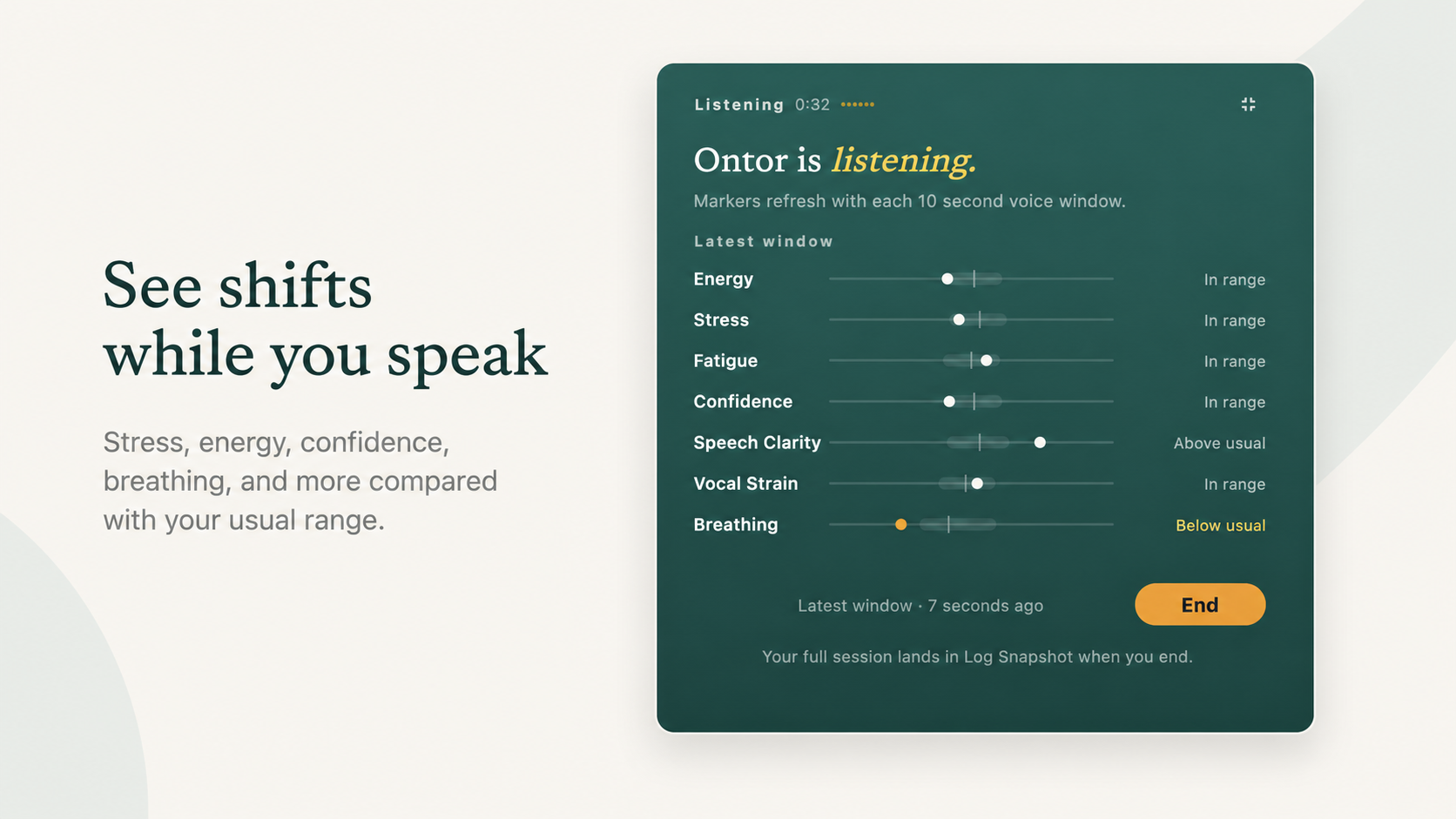
Ontor is a performance tool that reads how you sound, not what you said. While someone speaks, it compares voice signals to that person's own usual range. Markers refresh in short voice windows (on the order of about 10 seconds of speech). When a lasting shift shows up (for example stress, fatigue, confidence, speech clarity, or breathing), it can suggest a short reset. People can also compare before and after.
For teams, Ontor's public framing is aggregate patterns for workload, coaching, and support. Individual sessions and readings stay with the person. Leaders get team-level context for when a pod is drifting mid-shift. They do not get a personal scoreboard for hire or fire decisions.
That is the product difference from live-monitor ears alone and from absolute Empathy and Tone cards. Live monitoring asks whether the line sounds wrong right now to a human listener. Absolute QA asks whether tone was calm enough on the rubric. Ontor asks whether this voice left its own usual band, privately, while the shift is still running.
In my own Ontor session history, the mid-shift demeanor gap shows up the same way Richards named it for collectors. A block can still look "fine" on the floor while stress, fatigue, or breathing have already left my personal usual range. That private usual-band drift is the early warning silence and eye-rolls arrive too late to catch.
Here is the live listening view from my own Ontor product use: markers refresh with each short voice window and sit against my usual range. Speech clarity can sit above usual while breathing sits below usual in the same window. A supervisor whisper-coaching for script compliance would not see that split. Absolute Empathy and Tone would still ask only whether the line sounded calm enough. This is the mid-shift personal-demeanor check managers miss when they wait for silence or overcompensation:
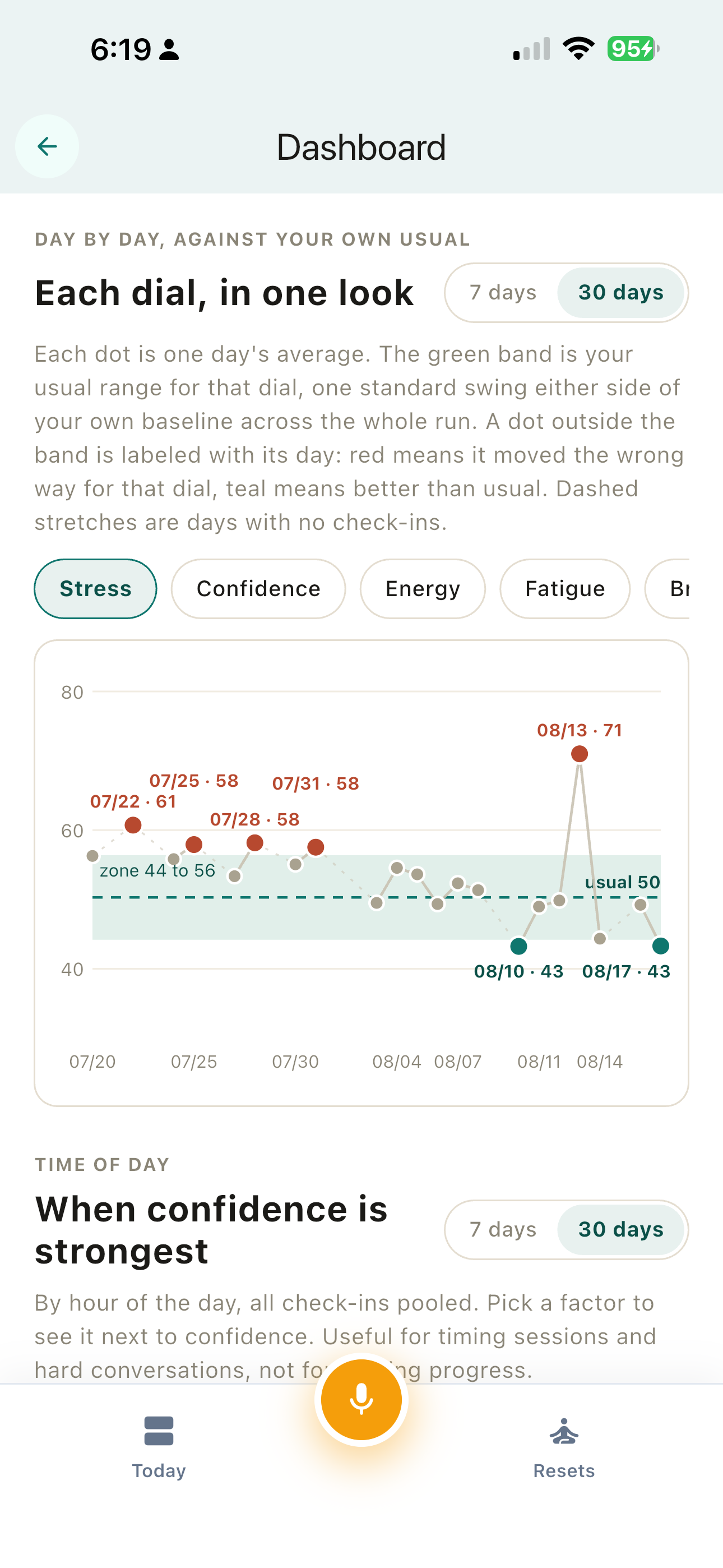
Here is stress day by day against my personal usual band, from my own Ontor dashboard and session history. Red points sit above my usual range. That personal usual-band view is what live-monitor occupancy and recovery boards miss when a collector has already drifted mid-shift. It is not collections outcome data and it is not a hire-or-fire score:
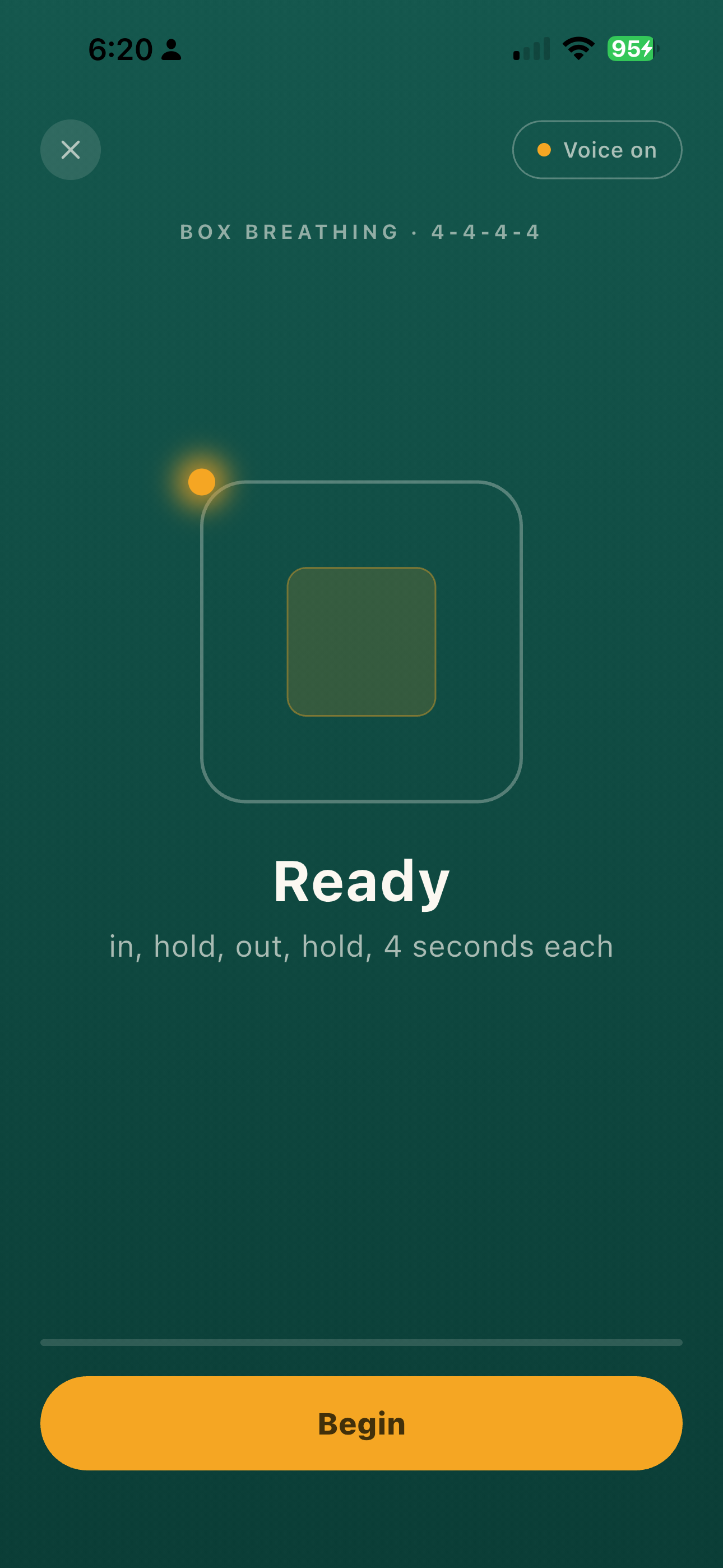
Here is a real Ontor box breathing reset screen from my own product use. When mid-shift hardship work pushes you off your usual voice, this is the short private loop available before the next connect. It complements Hoheusle-style breathers and cool-down policy. It does not replace live monitoring, and it is not proof of recovery-rate lift:
In exploratory work on that same personal Ontor history (one person, not a population study), high-stress episodes often did not show an observed return to my personal median within an hour. That is one reason noticing lasting mid-shift drift early matters. It is not evidence that a suggested reset caused recovery.
This is not a claim that voice markers diagnose overwhelm, predict attrition clinically, or guarantee recovery-rate, AHT, or retention improvement. The claim stays narrow: when live monitoring and absolute tone cards miss personal demeanor drift, a private signal plus a short reset is a loop people can run on the next live collections block or after a hard call, while leaders watch cohort patterns only in aggregate.
Download Ontor - 14 days free, no card required
What to try on the next live collections block
Do not stop at pilot talk.
- Pick one high-friction pod you already live-monitor (frustrated-debtor book, late-stage hardship, escalations).
- Give collectors a private way to notice lasting stress, fatigue, clarity, or breathing drift versus their own usual range during speech, and to try a short reset after a hard call or before the next connect.
- Keep leaders on aggregate patterns only (for example, whether the pod sits outside usual range more often mid-shift or after long hardship strings).
- Keep cool-down / breather policy and absolute QA where they belong. Decide in advance what you are learning: did people use resets on real blocks, did resets fit AHT and wrap-up constraints, did managers get any earlier read on team strain without seeing individuals.
Do not promise recovery-rate, occupancy, or attrition guarantees. Measure whether the tool fits a floor that already live-monitors and still waits for silence, eye-rolls, or a complaint to learn someone came off the rails.
Bottom line
You already live-monitor the floor. You still miss when a collector drifts off their own demeanor mid-shift. Richards' personal baseline, Hoheusle's breathers, and Guy's composure line all point at the same ops gap from different angles. Ontor adds a private usual-range voice check in short speech windows and short resets. It complements cool-down policy. It is not another absolute Empathy and Tone scorecard.
Download Ontor - 14 days free, no card required
Try it on your next live collections block or after a hard call, not only in a slide deck. Soft secondary path for a measured research or pilot with collections ops leaders: Ontor for teams.
References
- Jake Richards / Irene Hoheusle et al. "Conflict Management Skills for Collectors & Collections Leaders" webinar transcript. AccountsRecovery.net, 2026. https://www.accountsrecovery.net/wp-content/uploads/2026/03/Conflict-Management-Skills-for-Collectors-Collections-Leaders_Transcript.pdf
- AccountsRecovery.net. "Employees Don't Quit Jobs, They Quit Managers: Lessons in Leadership" (David Guy / Gwen Gullicksen panel coverage). March 13, 2026. https://www.accountsrecovery.net/2026/03/13/employees-dont-quit-jobs-they-quit-managers-lessons-in-leadership/
- Duri Lee, Heejeong Lim, Vedant Das Swain, Uichin Lee. "Understanding Behind the Smile of Emotion Workers: Detecting After-Call Stress in Call Agents." ACM CHI 2026. https://ic.kaist.ac.kr/publications/papers/lee2026understanding.pdf
- Ontor. "How it works." https://ontor.ai/how-it-works/
- Ontor. "Ontor for teams." https://ontor.ai/for-teams/
- Ontor. "About the founder." https://ontor.ai/about/
- Ontor. "Install Ontor." https://ontor.ai/install/