
Practice holds. Live dials don't. Coaches still can't see the transfer gap in voice.
Sales coaches already know the pattern. Tone and composure look fine in role-play. The paced greeting lands in the practice room. Then the live dial block starts, and something thinner shows up: flat energy, a rushed first sentence, an apologetic pitch, or tension from the last rejection still sitting in the next hello.
The coaching content is not missing. The visibility is. Most diagnosis still arrives as delayed recordings, sparse ride-alongs, or a 60-90 second clip between floor ups. Coaches can teach resets. They cannot see, during the live block, whether practice confidence transferred, or whether post-rejection carry-over cleared, versus that person's own usual range.
This piece is for sales performance coaches, executive coaches, and dealership/BDC trainers who already sell tone, composure, and bounce-back. It is not the published call-block voice-presence piece (scripts fail when the voice still shakes at the pre-block edge). It is not the between-session blind spot piece. It is not the category article on measuring nervous-system regulation. The cut here is narrower: practice holds, live dials do not, and coaches still cannot see that transfer gap in voice while the block is running.
The practice-to-live transfer gap coaches already name
Pulse RevOps (fractional CRO / sales-coaching knowledge) frames bad cold-call tone as confidence and energy, not personality. Voice goes flat, rushed, or apologetic. The tell for coaches is specific:
"If the tone is great when the rep talks off-script and only dies the second they go into call mode, it's a skill-and-confidence problem you can coach."
Their loop is familiar: observe a recording together, name one behavior, model it, role-play it, then measure change on the next batch of live dials over a couple of weeks. Gong and Chorus can surface pace and weak moments so you stop hunting tapes. The human 1:1 still does the diagnosis. Cap the hire/fit fork they mention. The useful buyer problem is the transfer window: practice confidence can hold, live call-mode can still drop, and the only proof coaches get is another sparse batch of recordings later.
That is the gap Ontor is aimed at for this channel. Not another script library. A private usual-range voice signal during live speech, so coaches and clients can see whether the one paced/inflection fix held under live pressure without waiting for the next autopsy clip.
Diagnosis arrives late: delayed clips, not live-block voice
Proactive Training Solutions (30+ year dealership / BDC sales training) documents why tone and confidence coaching dies on real floors. Managers plan a 30-minute review that never appears on a Tuesday with six ups on the board. Best-practice call review gets pushed to "later," and later never comes. What survives is a short clip:
"pull a 60 to 90 second clip of a real call, isolate one moment"
They also name the physical pre-call reset (posture, nasal breaths, deliberate smile) and the rejection carry that managers miss between ups:
"A rep who just ate a rejection on the last ten-minute-old lead carries that tension straight into the next greeting unless something interrupts it."
Cap the commercial 10-minute coaching product. Keep the constraint: channel coaches and floor managers productize clip-listen-one-fix coaching because that is the time they have. They still lack continuous live-block voice-state versus personal baseline while the block is running. Sparse ride-alongs do not fill that hole either. You cannot sit every dial.
Agogee (sales-training vendor; capped) puts the same autopsy language in market terms: recording only exists after the live call is over, so coaching can become an autopsy, useful for diagnosis and weak for prevention. Treat that as corroboration that recording-only stacks already frustrate trainers. Prefer the paying coach and dealership sources above for weight.
Composure gap and rejection stacking: what practice does not show
Andrew Netschay (Warm Steel Consulting), an executive coach who sells composure conditioning for client-facing teams, separates knowledge from state under pressure:
"It's not a knowledge gap. It's a composure gap."
Under pressure people talk too fast, fill silence with reassurance nobody asked for, or overcorrect. Training prepared things to say. The room did not go according to script. Cap the commercial Client Pressure Response packaging. The channel signal is clear: coaches already sell state management as distinct from scripts, and they still lack an objective voice/pace/composure read during the live pressure window between sessions.
We Are Funny Project's Bomb Proof workshop (sales-resilience training sold to Sales Directors, BDR/SDR leaders, CROs, and L&D) names what accumulates across a dial day:
"One rough call bleeds into the next. Tone flattens. Confidence narrows. People become more brittle, more scripted and progressively less effective across the day."
They call emotional stacking under-addressed, sell reset tools for the ten seconds after a rough call, and train what pressure does to voice, thinking, and body language. Cap the comedy-venue packaging and priced workshop CTA. The buyer problem stands: coaches can teach bounce-back and still cannot see whether carry-over actually cleared before the next dial.
State HQ / NEPQ tonality cohorts (vendor-capped, thin) still advertise personalized feedback and "real time training during and after live calls" in groups of four or fewer. Useful only as a weak signal that group vocal coaching still hinges on sitting live calls. Between-cohort live-block voice versus baseline stays invisible without an instrument.
Distinct from call-block presence, between-sessions, and generic NS measurement
| Published Ontor cut | Moment | What this article is not rewriting |
|---|---|---|
| Coach call-block voice presence | Pre-block regulation; scripts fail when the voice still shakes on the first hello | Not the practice→live transfer / delayed-clip measurement gap |
| Coaching between sessions | Blind spot when clients leave the room | Not live-block transfer visibility for coaches on the channel |
| Measure nervous-system regulation | Category problem of measuring regulation | Not the practice-holds / live-dials-don't transfer cut |
Same coaches ICP. Different question: can coaches see practice confidence transfer into live dials, and post-rejection carry-over clear, without sitting every dial or waiting for autopsy clips?
What Ontor can add for coaches on this channel
Ontor is a performance tool that reads how someone sounds, not what they said. While a person speaks, it compares voice signals to that person's own usual range. When a lasting shift shows up (stress, fatigue, confidence, breathing, vocal strain), it can suggest a short reset. People can also compare before and after.
For a coach practice or the sales pods you serve, that can sit next to the routines you already teach: private usual-range voice during live blocks (so practice→live transfer is visible without a delayed clip), and a short reset cue when post-rejection tension is still sitting outside usual range before the next greeting. Individuals keep their own readings. Coaches or leaders can look at aggregate patterns for workload and support only.
This is not a claim that Ontor diagnoses health conditions, replaces 1:1 coaching, replaces role-play, or guarantees booking rates. It is narrower: private usual-range voice during live blocks so coaches see practice→live transfer and post-rejection carry-over without sitting every dial or waiting for autopsy clips.
What shows up in my own Ontor history
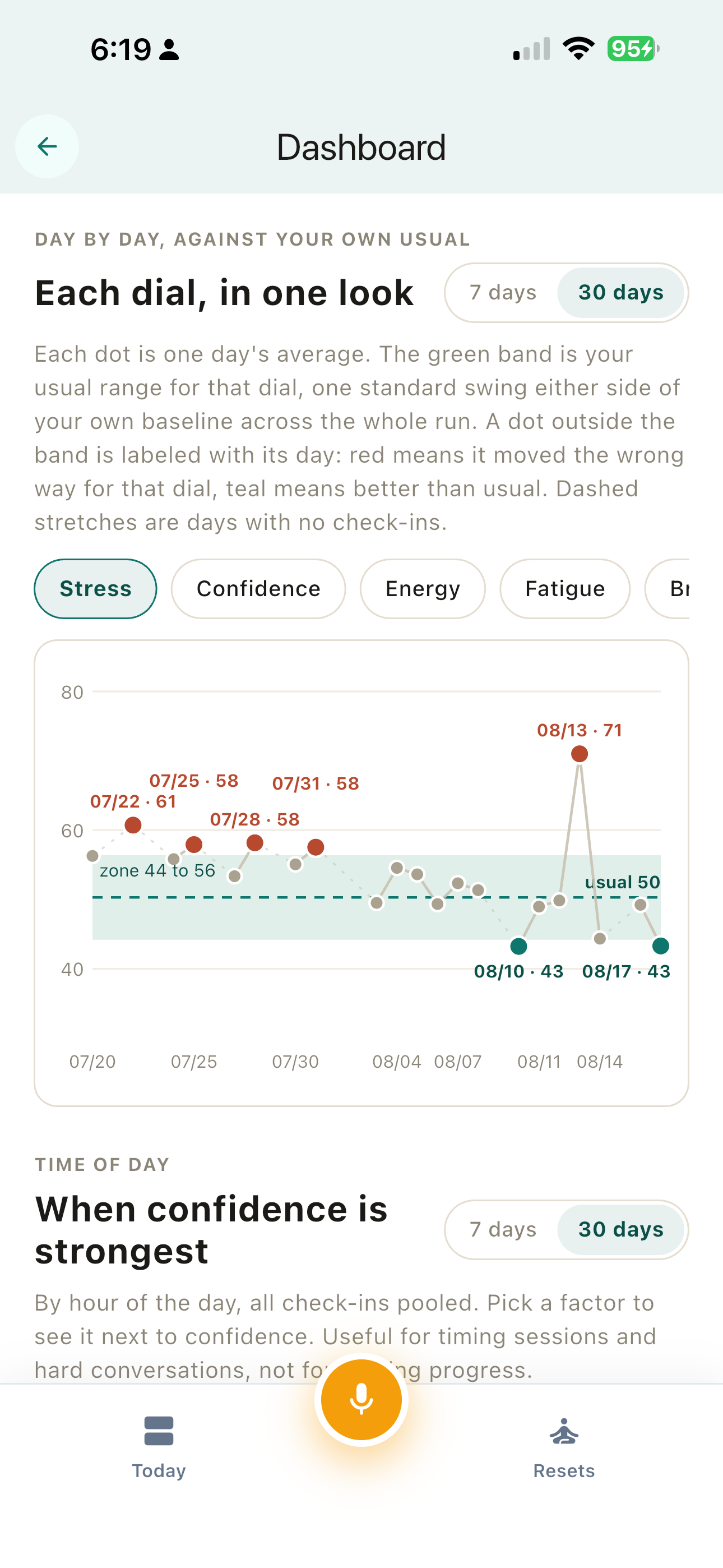
I am Sabber Ahamed, founder of Ontor. I use the product on my own speaking and call-heavy days. In my own Ontor session history, the practice→live transfer gap shows up the same way coaches describe it: tone can hold in a calm practice stretch, then leave my personal usual range once live pressure, rejection, or a hard sequence stacks. Dial-by-dial stress and confidence drift against that private band. Delayed clips would only sample a slice. They would not show whether carry-over cleared before the next dial.
Here is stress across dials and days against my personal usual range, from my own Ontor dashboard and product use. Useful as a private read of when live-block voice-state sits outside baseline, the continuous view delayed 60-90s clips and sparse ride-alongs do not give coaches. It is not a diagnosis of composure failure, and it is not outcome data from your clients' floors:
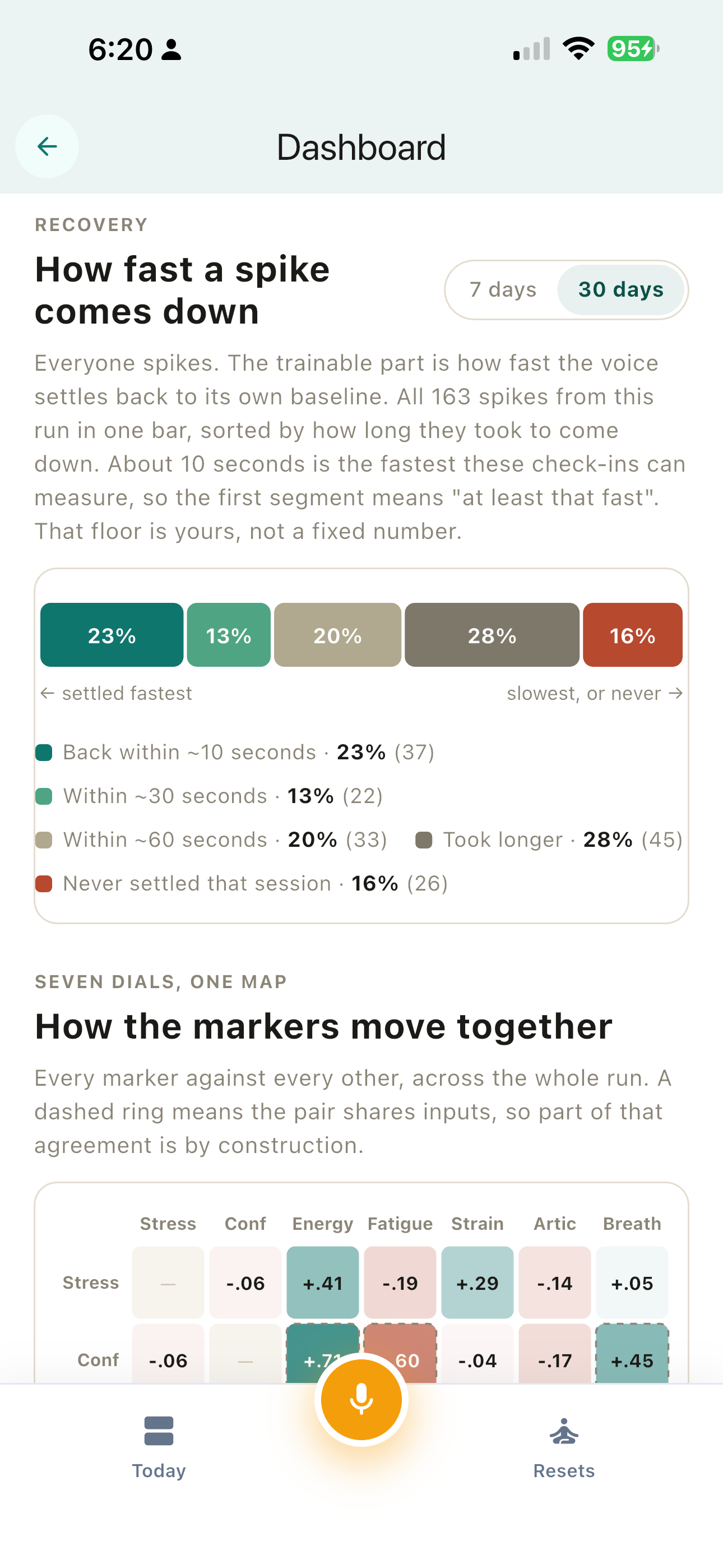
And here is how fast a spike settles back toward my personal baseline after hard stretches, from that same Ontor history. Useful when coaches already teach a ten-second reset after rejection and need to see whether carry-over cleared before the next greeting. It is not proof that a suggested reset caused recovery, and it is not clinical recovery science:
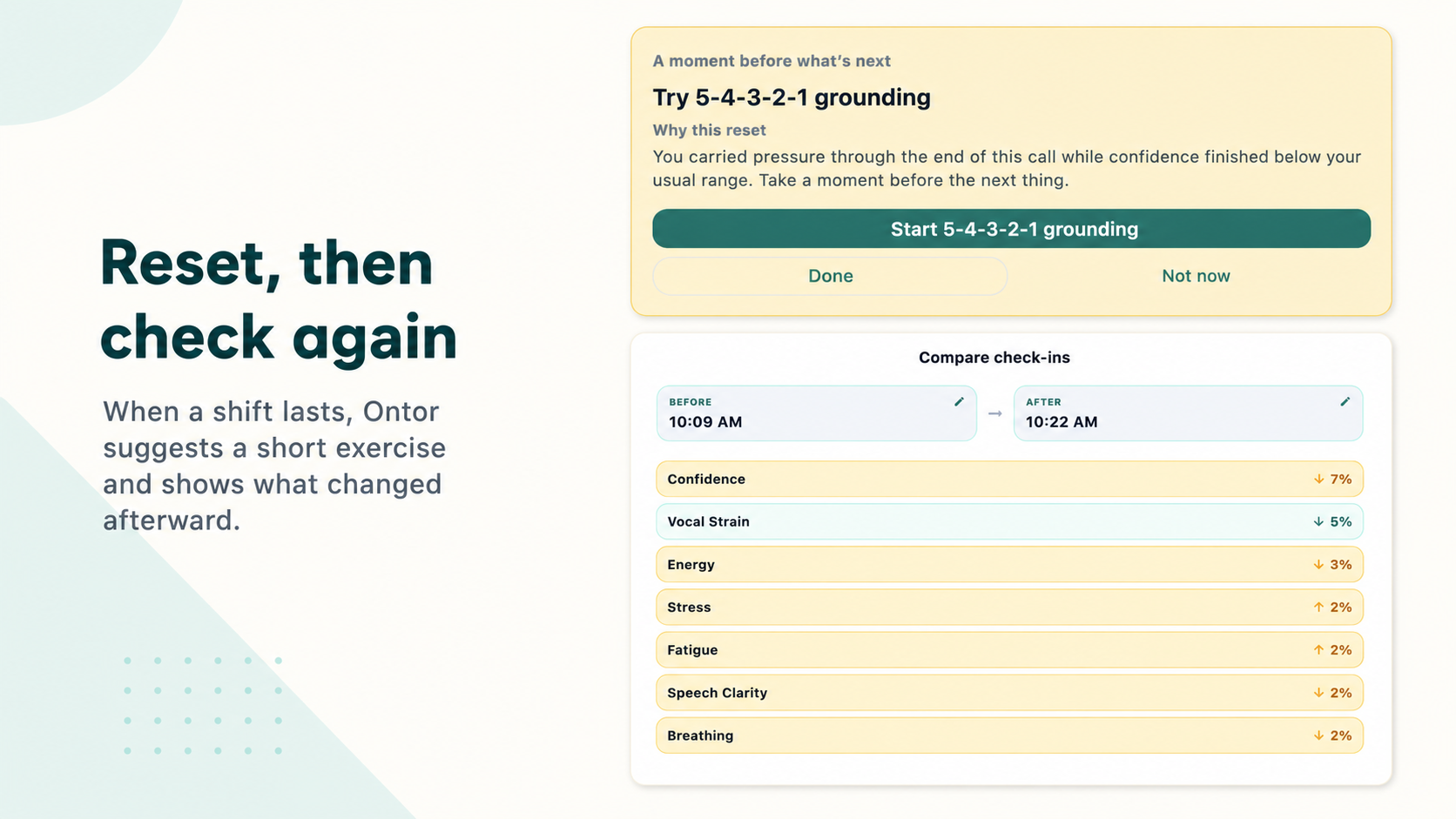
Short resets fit the same loop. When confidence finishes below usual range after a pressured call, Ontor can surface a brief private exercise and a before/after compare before the next dial. Here is that reset-and-compare product UI from my own Ontor product use, including the carry-pressure cue coaches already sell in language. Cap any medical claim. The product point is a short private reset and a compare, not a clinical intervention:
Exploratory work on that personal history (one person, not a population study) treats usual range as an empirical personal reference band, not a clinical target. Marker movement toward or away from that band is observed signal change. A temporary stress dip after a short reset has been observed in personal logs; stable early recovery and broad recovery are not established from those sparse events. Marker changes do not prove cognitive improvement, revenue, retention, or health outcomes.
This is not a claim that voice markers detect call reluctance clinically, predict attrition, replace coach judgment, or guarantee more meetings. The claim stays narrow: when coaches already teach tone, composure, and post-rejection resets, a private usual-range signal can surface practice→live drift and carry-over earlier than delayed clips, while personal readings stay with the person.
A small research pilot for coach practices
Pick one coaching practice, or one sales / BDC pod you already serve, and run a short research pilot. Keep your existing scripts, role-play, clip reviews, and session structure. Add Ontor for people who opt in. Look at before/after across a live dial block, whether short resets get used when voice sits outside usual range after a rough call, and whether practice fixes hold into live call-mode without waiting for the next tape batch. No hire-or-fire framing. No medical claims. Just transfer and carry-over visibility at the moment your coaching already targets.
If you already tell clients that practice confidence is not the same as live dial composure, a private signal about how they sound during the block is the missing feedback loop between the session and the live dial.
Bottom line
Practice can hold. Live dials often do not. Coaches teach tone, composure, and resets, then diagnose with delayed clips or sparse ride-alongs. They still cannot see practice→live transfer or post-rejection carry-over versus personal baseline while the block is running.
A private, baseline-relative voice signal will not replace your coaching craft. It can give clients something concrete when how they sound leaves their usual range under live pressure, and give coaches aggregate context while personal readings stay with the person.
Start a free trial for you and your team. Soft secondary paths: a measured research / pilot conversation via Ontor for teams, or product detail on how Ontor works.
About the author
Sabber Ahamed is the founder of Ontor and an applied ML scientist (PhD in geophysics and signal processing) who builds on-device voice tools. He has shipped production signal and ML systems across radiology AI, healthcare, and manufacturing. Ontor compares how you sound to your own usual ranges and suggests short resets, without claiming clinical or revenue outcomes from marker changes.
References
- How do you coach a rep whose tone kills their cold calls? - Pulse RevOps / Kory White
- Coach Sales Reps on Tone & Confidence in Under 10 Minutes - Proactive Training Solutions
- Bomb Proof: Sales Resilience Under Pressure - We Are Funny Project
- It's not a knowledge gap. It's a composure gap. - Andrew Netschay (LinkedIn)
- Why Sales Call Recording Alone Isn't Enough for Rep Training - Agogee (vendor-capped)
- Tonality and Voice Training - Group Cohorts - State HQ (vendor-capped)
- How Ontor works
- Ontor for teams
- About the founder - Ontor