
Under pipeline pressure, SDRs enter survival mode. Call quality drops while dials still look busy.
Mid-market VP, CRO, Head/Director of Sales, and SDR/BDR managers owning roughly 20-200 voice workers already know the pattern. Pipeline or investor pressure spikes. Targets climb. Activity expectations tighten. The dial board still prints green. Connects keep landing. But the floor sounds different: reps rush instead of staying curious, pitch instead of listen, and the voice goes flat, rushed, or apologetic before activity metrics fall.
Oscar Fung (sales leader; formerly Manager of Sales Development / Outbound Sales at Airwallex, later Country Head HK at Lexagle) managed SDR floors at fintech scale and named it without soft language. Most underperformance is a pressure problem, not a capability problem. Pressure pushes the brain into survival mode. Call quality drops. Discovery becomes shallow. Activity goes up, effectiveness goes down. Pressure changes behaviour before it changes performance. Leaders who rewrite scripts and raise activity first miss the voice leave that prospects already hear.
This is not another block-length robot stamina piece, not hangover between connects, not voice tighten under live resistance, not scoreboard sameness / midday confidence dust, and not call-mode pitch. The unique gap is leadership pressure and survival-mode call quality on quota week and same-day rejection cascades, with a personal usual-range read so managers are not guessing from dashboards or rewriting lines first.
Download Ontor - 14 days free, no card required
Survival mode: rush, pitch, protect yourself
Oscar's posts are buyer language from someone who sat the SDR manager seat. Exact lines:
"Most underperformance isn't a capability problem. It's a pressure problem."
"Instead of curiosity, reps rush. Instead of listening, they pitch. Instead of learning, they protect themselves."
"Under pressure, SDRs stop doing the basics well. Call quality drops. Discovery becomes shallow. Activity goes up, effectiveness goes down."
"Not because they don't care. But because pressure pushes the brain into survival mode."
"Pressure changes behaviour before it changes performance"
His companion coaching question is the same object Ontor is built to make visible in short speech windows:
"Are activity expectations realistic, or do they quietly encourage rushed conversations that erode quality?"
"It observes call patterns, energy levels, and confidence signals before rewriting a single line."
Lead with that. The failure mode is not "hit quota with fewer dials" as a product claim. It is: when pipeline pressure spikes, survival mode shows up in the voice (rush, shallow discovery, pitch instead of listen) while dial dashboards still look busy, and managers who only rewrite scripts or raise activity never catch the personal leave prospects already hear.
Quota week and same-day AM to PM: the voice changes first
Michael G. Williams (phone-sales trainer; Sales Mastery HQ; claims prior manager/director/VP seats) listens to same-rep recordings and names two pressure shapes leaders already recognize. Cap as vendor corroboration under Oscar's spine:
"I've listened to call recordings from the same rep on the same day. Morning calls sharp. Afternoon calls after four rejections - flat, rushed, apologetic."
"That's the one that shows up in the voice. Rep is 80% to quota with a week left. The calls that week sound completely different than the calls in week one. Prospect can't tell you exactly what changed. But they feel it."
"The mental reset between calls is a skill nobody trains for. It's also the difference between a good week and a great one."
Maya Kaufman (IC seller on the same thread) names the audible need leaders coach around without a personal baseline:
"You pitch the same thing for the 17th time today, but you have to sound like it's the first. You can't sound bored. You can't sound tired. You can't sound like you need the deal even when you do."
Same-day rejection cascade. Quota-week neediness. Both land in the voice before the dial board turns red.
Tone first, not script first: nervous and apologetic burns the connect
Saravanan Thendral / Sean (Business Development Manager, Athen Systems; coaches an SDR team) thought the team needed a better script. Reality: they needed better tonality. At roughly 150 dials a day and about 10 live connects, prospects decide in the first five seconds whether to stay.
"I used to think my SDR team needed a better script. Reality? They needed better TONALITY."
"Most reps sound like they're apologizing for existing. That nervous tone kills trust instantly."
"No hype. No pitch voice. Just calm questions that sound real."
"We didn't rewrite the whole script. We rewired how we showed up on the phone."
"If you manage SDRs: don't coach lines first. Coach TONE first."
"if you sound unsure, they hang up fast. Connects turn into hello-click."
Constance Uwandu (SaaS B2B sales / SDR practitioner; dialer/RingCentral user) books a follow-up with a prospect CRM-tagged "Irate, Doesn't want to be called again" only 35 minutes after a prior SDR call. Listening to the RingCentral recording, she hears the first SDR sound nervous and almost apologetic. The prospect's anger tracks that delivery. She calls the same prospect with unchanged script but calm, certain energy and gets a different outcome:
"The SDR sounded nervous Almost apologetic for calling. And the client felt it immediately"
"By the time I called, I changed nothing major about the script I only changed the energy Calm, Certain and In control"
"Same prospect, Different tonality"
"People respond to how you sound before they respond to what you say"
"Tonality positions you before your words do."
Oscar names survival-mode rush and shallow discovery under leadership pressure. Williams names quota-week and same-day AM-sharp / PM-flat-rushed-apologetic from recordings. Sean names tone-first coaching over script rewrite. Constance names nervous apology burning TAM inside half an hour. None of those are solved by another activity contest or a random Gong sample from a green afternoon.
Presence to booking gap managers miss on dial counts
Joe Schneider (CEO, Automatic Appointments; 24 years building phone appointment-setting teams) tracked personal energy 1-10 on every call for three months. Cap as vendor corroboration, not the spine. Attribution stays with his published post:
"When I tracked energy levels on every call for three months, calls made at full presence (9-10 energy) booked appointments at 28%. Calls made while coasting (5-6 energy) booked at 3%. Same script. Same leads. Same hours."
"It's 4:45pm. You've made 97 cold calls... You're tired, your voice is flat, and your energy is somewhere around a 4 out of 10."
"they'll hear it in your voice within three seconds and say "not interested" before you finish your opening line."
"Coasting almost always shows up as rushing. When you slow down, you sound more confident..."
That is the quantified version of what Oscar names qualitatively: dial dashboards look healthy while audible presence collapses. Useful color. The article spine stays leadership pressure and survival-mode call quality, with Sean, Williams, Constance, and Schneider as voice-side corroboration.
What dial boards, script rewrites, and random Gong samples still miss
Typical stack on a mid-market voice floor under pipeline pressure:
- Dial / connect / talk-time scoreboards
- Higher activity expectations when pipeline or investor pressure spikes
- Script and objection rewrites
- "Show more excitement" or "sound more confident" coaching without a personal baseline
- Occasional Gong or call-recording samples
- Between-call tips that never become a personal readiness loop
Useful. Incomplete for survival mode. Dial boards ask whether volume happened. Script rewrites ask whether lines changed. Gong samples ask whether one recording sounded okay to a manager that day.
None of them continuously ask: during this quota week or after this rejection cascade, did this rep's confidence, energy, stress, clarity, or strain leave their own usual range in short speech windows, while the dial board still looked busy? Did they rush and pitch because pressure pushed them into survival mode? Did morning sharpness become afternoon flat-rushed-apologetic while activity still printed green?
Prospects hear that first. Leaders often meet it later as shallow discovery, "rep sounds off," irate DNC notes, or a volume hero who cannot convert on quota week.
How this differs from afternoon fade, hangover, tighten, identical calls, and call-mode
Dialer fatigue / afternoon fade answers: when the dialer leaves only seconds between calls, where does afternoon fade live before the board shows it?
Hangover between sales calls answers: when leaders treat minutes between connects as empty, what unpaid recovery is compounding by call 10?
Prospects hear when the voice tightens answers: once the prospect is live under resistance, do dialers show tone collapse, or only that talk time happened?
Identical calls / confidence dust answers: when a culture scores motion, do leaders still miss near-identical audible calls and midday confidence dust while dials stay green?
Call-mode pitch voice answers: is the cold-call voice a mode switch off the person's usual sound, not missing enthusiasm?
This article answers a different question: when pipeline or investor pressure spikes, do SDRs enter survival mode (rush, pitch, shallow discovery, apologetic / need-the-deal voice) so call quality collapses before activity metrics fall, and can a personal voice baseline catch that leave before managers rewrite scripts and raise dials again?
Same mid-market beachhead. Different object. Leadership pressure and survival-mode / quota-week voice, not block-length robot or between-call hangover alone.
Download Ontor - 14 days free, no card required
What Ontor adds when survival mode shows up in the voice first (private first)
Ontor is a performance tool that reads how you sound, not what you said. While someone speaks, it compares voice signals to that person's own usual range. Markers refresh in short voice windows (on the order of about 10 seconds of speech). When a lasting shift shows up (for example stress, fatigue, confidence, energy, speech clarity, or strain), it can suggest a short reset. People can also compare before and after.
For teams, Ontor's public framing is aggregate patterns for workload, coaching, and support. Individual sessions and readings stay with the person. Leaders can see team-level context for when a pod's confidence, energy, or stress sits outside usual range more often under pipeline pressure. They do not get a personal scoreboard for hire or fire decisions.
That is the product difference from dial boards and random Gong samples. Dial boards ask whether volume happened. Gong asks whether one recording sounded okay. Ontor asks whether this voice left its own usual band, privately, in short windows during the dial block, and whether a short reset is available when survival-mode rush or apologetic neediness would otherwise go unnoticed until a prospect hangs up or books to escape.
It does not claim to raise connect rates, replace tone coaching, or prove that a suggested reset caused a better quota week. The claim stays narrow: buyers already say pressure shows up in the voice before the dashboard. A private usual-range signal plus a short reset is a loop people can run before the next rushed dial.
In my own Ontor session history (founder exploratory data from my own product use, not your floor's outcome data), the survival-mode under pressure pattern shows up the same way Oscar named it for SDRs. A speaking block can still look "fine" as raw activity while confidence, energy, stress, or clarity has left my personal usual range in the short windows during speech. Dial count would still look fine. The next conversation would still start from whatever state I carried in.
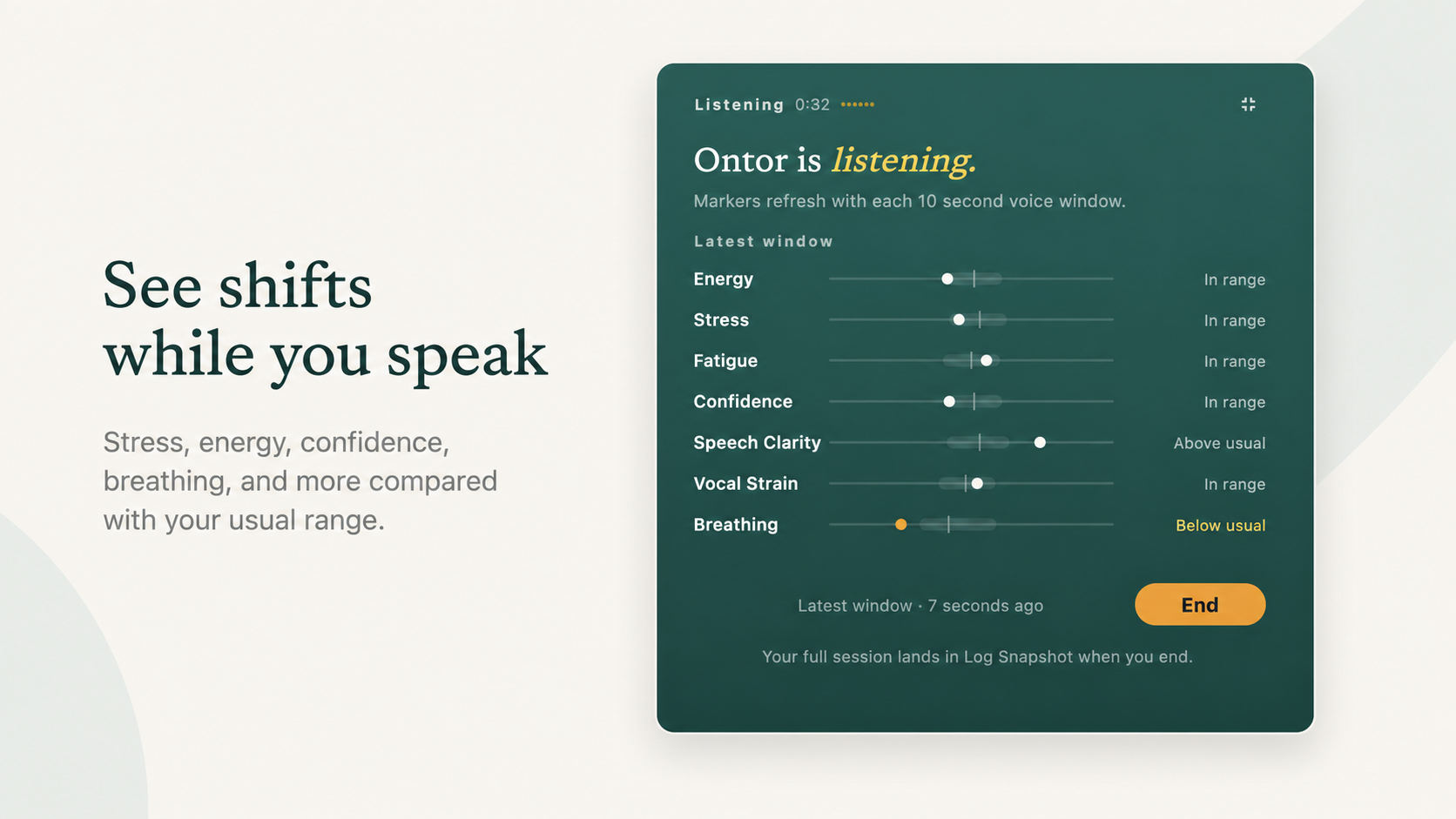
Here is the live listening view from my own Ontor product use: markers refresh with each ~10 second voice window and sit against my usual range. In this window speech clarity sits above usual while breathing sits below usual. That is closer to "my readiness left my band while I kept talking under pressure" than a green dial tally:
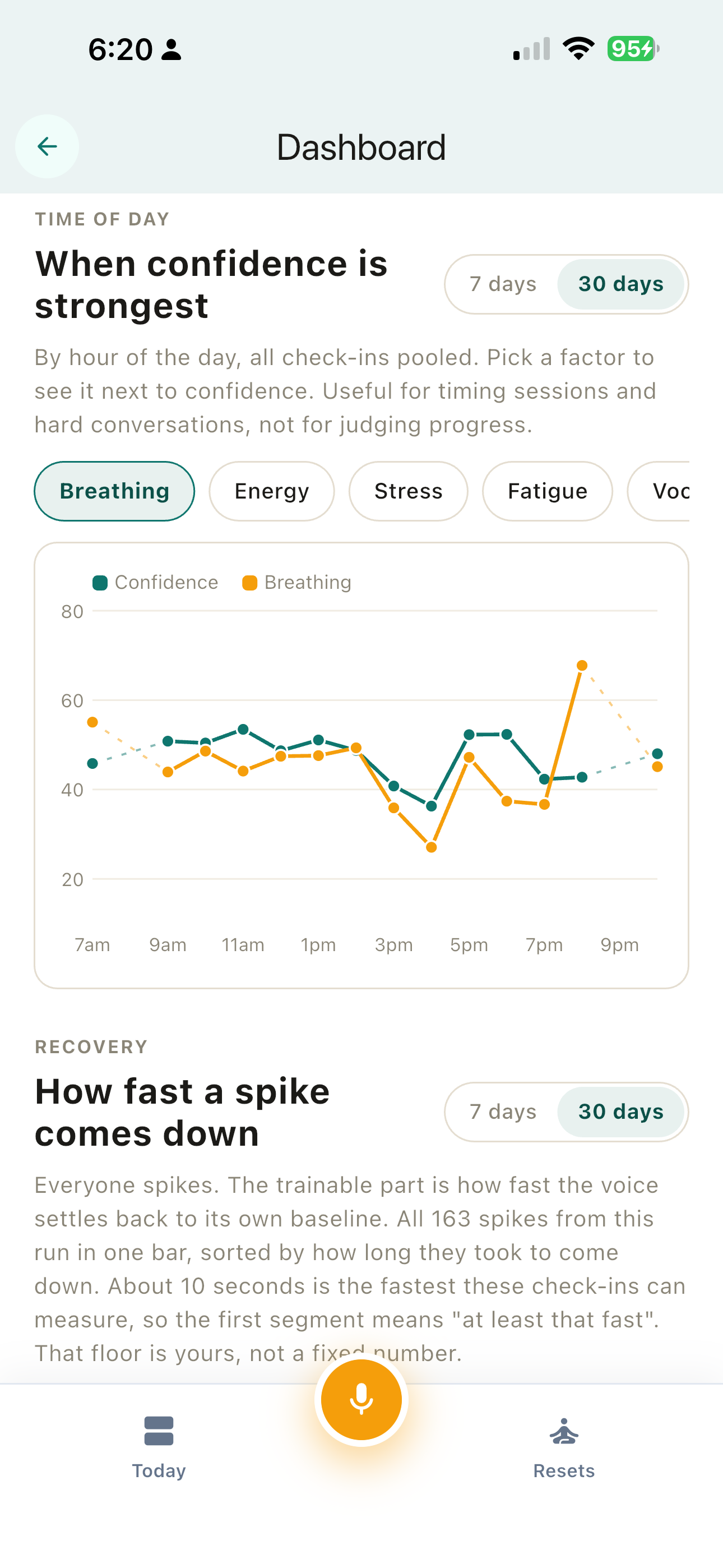
Here is confidence with breathing by hour from that same Ontor history. Confidence peaks late morning, then declines after noon and bottoms in the afternoon in this 30-day pool. Read it as founder exploratory data on personal-baseline confidence / energy leave across a long speaking day, the same shape Williams names for AM-sharp / PM-flat after rejections, not proof of pipeline recovery and not your team's dial board:
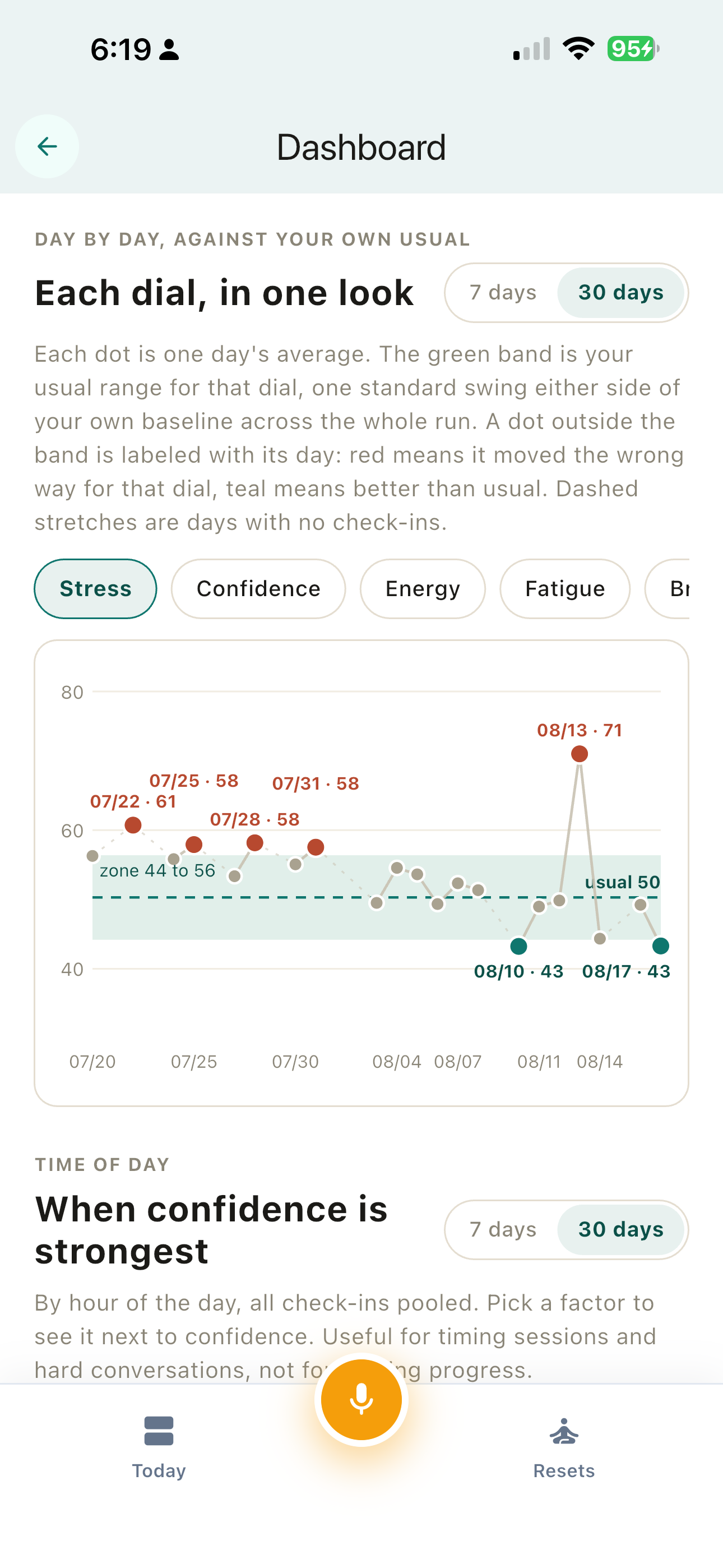
Here is stress day by day against my personal usual band (zone ~44 to 56, usual 50) from the same session history. Red points sit above my usual range. Useful as a private check for how often voice-state leaves the band across dials and days while a motion scoreboard would still print green under pipeline pressure. It is not a hire-or-fire score and it is not proof that a suggested reset caused recovery:
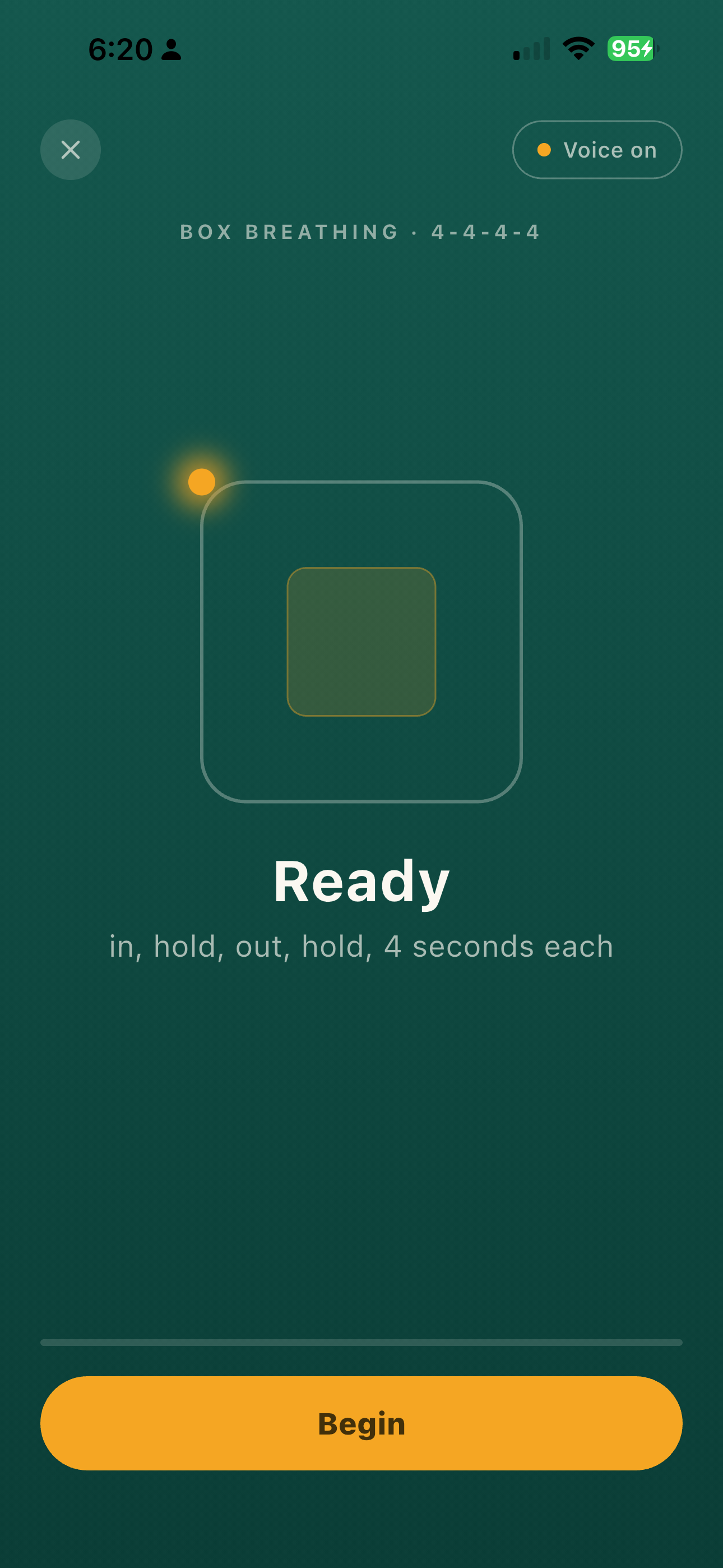
And here is the short reset the product offers when a lasting shift shows up: box breathing, 4-4-4-4. That is the tool form of the between-call mental reset Williams says nobody trains for, and the mid-session recovery Schneider budgets for teams, available privately without a manager guessing from a dashboard. It is not a claim that one cycle restores curiosity on the next dial:
This is not a claim that voice markers diagnose sales skill, predict revenue, replace manager judgment, or guarantee fewer ghosted meetings. The claim stays narrow: when dial boards and script rewrites miss survival-mode rush and quota-week voice leave, a private signal plus a short reset is a loop people can run before the prospect hears neediness or apology, while leaders watch cohort patterns only in aggregate.
What to try on the next quota-week dial block
Do not wait for a research committee if you run a mid-market voice floor that still raises activity when pipeline pressure spikes while calls sound rushed or apologetic.
- Install Ontor on the machine reps already use for outbound dials.
- On the next quota-week dial block (or the afternoon after a rejection cascade), notice whether confidence, energy, stress, clarity, or strain sit outside that person's usual range in the short speech windows, especially when dials can still look green.
- If a lasting shift shows up, or if the rep can already tell they are rushing / pitching / sounding like they need the deal, take the short suggested reset between dials. Then continue instead of stacking more survival-mode motion.
- If you lead a pod, keep leaders on aggregate patterns only for pressure-driven confidence / energy / stress drift. Personal readings stay with the person. Treat Oscar's survival-mode language and Sean's tone-first coaching as performance controls, not only soft skills. Pair with self-listen on one nervous-apologetic opener the way Constance did from a dialer recording, not with another volume contest or script rewrite first.
Soft secondary path if you are buying for a team and want a measured look later: Ontor for teams, or a research conversation / pilot with mid-market sales leaders on personal voice baselines versus activity boards under pipeline pressure.
Do not promise connect-rate, win-rate, retention, or revenue guarantees. Measure whether people can tell when survival-mode rush or apologetic neediness left their usual voice before a prospect names it.
Bottom line
Pipeline pressure shows up in the voice before the dashboard. Oscar watched SDRs enter survival mode: rush instead of curiosity, pitch instead of listen, call quality down while activity up. Williams hears same-day AM sharp turn PM flat-rushed-apologetic after rejections, and quota-week calls that sound different than week one. Sean coaches tone first, not lines first, because nervous apology kills the connect in five seconds. Constance heard that apology burn a prospect into an irate DNC note in 35 minutes. Schneider's tracked presence gap (28% booking at full presence vs 3% while coasting, same script and leads) is the vendor-measured version of dial boards looking healthy while audible presence collapses. The gap that remains is personal usual-range confidence, energy, stress, and clarity in short speech windows, caught while dials still look busy, before the next rushed survival-mode dial.
Try Ontor on the next quota-week dial block. Notice the short voice windows versus that rep's usual range. Take the short reset when a lasting shift shows up. That is the tool next step, not only a pilot conversation.
Download Ontor - 14 days free, no card required
References
- Oscar Fung. LinkedIn post: most underperformance is a pressure problem; survival mode (rush, pitch, protect); call quality drops while activity rises. https://www.linkedin.com/posts/oscarfwh_sdr-bdr-leadershipinsight-activity-7424043934403833856-LrC1
- Oscar Fung. LinkedIn companion post: activity expectations that encourage rushed conversations; observe energy levels and confidence signals before rewriting lines. https://www.linkedin.com/posts/oscarfwh_salesleadership-outboundstrategy-b2bsales-activity-7428267009689276416-3Qio
- Saravanan Thendral (Sean). LinkedIn post: SDR team needed tonality not a better script; nervous/apologetic tone; coach tone first. https://www.linkedin.com/posts/saravanan-thendral_coldcalling-sdr-outboundsales-activity-7409588235137519617-YVZR
- Saravanan Thendral (Sean). LinkedIn companion: sounding unsure turns connects into hello-click. https://www.linkedin.com/posts/saravanan-thendral_sales-sdr-coldcalling-activity-7408764754858741760-xkKI
- Michael G. Williams (comment) / Maya Kaufman (post). LinkedIn: same-day AM sharp / PM flat-rushed-apologetic after rejections; quota-week voice; can't sound like you need the deal. https://www.linkedin.com/posts/maya-kaufman-16513233_sales-isnt-hard-in-the-way-people-think-activity-7442213140102017025-sYon
- Constance Uwandu (Ononuju Aku-Uwandu). LinkedIn post: prior SDR sounded nervous/almost apologetic; same script different energy; tonality before words. https://www.linkedin.com/posts/saasb2bsalesgrowthstrategistononujuaku-uwandu_this-might-be-the-reason-clients-hang-up-activity-7466035729463271424-yWfu
- Joe Schneider / Automatic Appointments. "Coasting Is Killing Your Cold Calling Results" (vendor corroboration): full presence 28% booking vs coasting 3%; flat late-block voice; short resets. https://automaticappointments.com/resources/coasting-killing-cold-calling-results-appointment-setting
- Ontor. "How it works." https://ontor.ai/how-it-works/
- Ontor. "Ontor for teams." https://ontor.ai/for-teams/
- Ontor. "About the founder." https://ontor.ai/about/
- Ontor. "Install Ontor." https://ontor.ai/install/
- Ontor. "Your dialer left 5-10 seconds between calls. That's where afternoon fade starts." https://ontor.ai/blog/dialer-fatigue-afternoon-fade/ (sibling)
- Ontor. "Leaders treat the minutes between calls as empty. The hangover isn't." https://ontor.ai/blog/hangover-between-sales-calls/ (sibling)
- Ontor. "Your dialer counts talk time. Prospects hear when the voice tightens." https://ontor.ai/blog/prospects-hear-voice-tighten/ (sibling)
- Ontor. "190 of 200 dials sounded identical. Confidence was dust by noon." https://ontor.ai/blog/identical-calls-confidence-dust/ (sibling)
- Ontor. "Your cold-call voice isn't missing enthusiasm. It's a mode switch off your usual sound." https://ontor.ai/blog/call-mode-pitch-voice/ (sibling)