
Same words. Clients hear the energy underneath. Staffing sales leaders already A/B it. Dashboards still can't.
Agency sales leaders who run desks (VP Sales, Directors, Managing Partners, owners) already A/B this without calling it that. Two recruiters use the same opener. Same talk track. Same CRM stage. One books the meeting. The other does not. Simon Doherty (Founder and Managing Partner, Tiello; construction / AEC staffing) names the gap in plain language: confidence and energy. Derek Lutz (Founder/CEO, Lean Six Search and Bottle Rocket Search) names the leak people can hear when the phone still feels like a chore. Norm Volsky (Managing Partner, Direct Recruiters) names the late-block brand risk: call #14 still has to sound first-time fresh, and you do not dial until you sound animated and excited.
Dial boards, connect rates, and script compliance still cannot answer whether that person's confidence and energy were still inside their own usual range when the words left their mouth.
This is not another desk-rut / missing tone and excitement piece, not call-block readiness, not quality-over-volume readiness, and not live-connect discomfort. Those answer sustained rut energy leave, protected BD block start readiness, remaining-call quality after dial quotas drop, and first-connect discomfort. The unique wedge here is conversion on identical scripted words: meeting booked versus not because confidence and energy (or chore and avoidance energy) decided the call, plus first-time freshness still required on call #14, while activity KPIs miss the delivery variable.
Download Ontor - 14 days free, no card required
Same words. One booked the meeting. Confidence and energy decided it.
Doherty's recruiter-lessons post is the spine for this article. Exact lines:
"Tone matters more than script"
"I've heard two recruiters say the same thing on the phone - one booked the meeting, the other didn't."
"The difference? Confidence and energy."
"Knowing your numbers means nothing if it doesn't change how you show up tomorrow."
Lead with that. The failure mode is not "everyone must sound theatrical on every BD call" as a product claim. It is: when two people deliver the same scripted words and only one books, leaders who only score dials and talk tracks miss the audible variable that closed (or killed) the meeting.
Staffing sales leaders already hear this on listen-ins. They still cannot verify, continuously, whether confidence and energy sat near that person's ready baseline versus the flat version that loses the meeting.
Chore energy is audible. People can hear it and feel it.
Lutz writes for executive-search and recruitment peers who still treat BD like a box to tick. Keep the audible-energy spine. Exact lines:
"We've all been there...staring at the phone like it's some medieval torture device."
"If you start seeing every call as an opportunity rather than a chore, the energy shifts. People can hear it. They can feel it."
"They want to work with the person who wants to be there, not the one just ticking boxes."
"20 dials mean nothing if you're not having real conversations."
Doherty A/Bs same words to meeting booked versus not. Lutz names why the losing version often sounds the way it does: chore and avoidance energy leaks into the live call before the client or candidate ever sees a face. Activity KPIs still print the dial. They do not print whether the human sounded like they wanted to be there.
Call #14 still has to sound first-time fresh
Volsky on the Elite Recruiter Podcast stacks the pre-dial and late-block half of the same object. Exact lines:
"despite me being awful for the first week on the phones, I was very robotic."
"do not get on the phone until your pitch is something that you sound animated and excited about."
"Unless you have enthusiasm, unless you have excitement and positivity in your voice when pitching your clients, you're almost doing them a disservice."
"it could be your 14th call of the day. That's the first time that person is ever talking to you. And you have to be first time fresh."
Same-words conversion is not only a morning problem. The prospect on call #14 hears you for the first time. Early robotic delivery, burnt-out "I just can't make a call right now," and flat late-block pitches all fail the same commercial test Doherty named: the words can match the script while the energy does not.
Doubt under the voice, and the call that starts before you dial (vendor and desk colour)
Richard Milligan (Recruiting Conversations; recruiting-leader coach) names the same A/B from the coach side. Cap as vendor corroboration under Doherty, not as the buyer spine. Exact lines:
"people hear the hesitation. They feel the doubt underneath your voice, and they react to your tone long before they process a single word you say."
"Two leaders can read the identical words off the identical page, and one fills the room with energy while the other drains it."
"Start flat and the whole call runs flat."
"The voice always tells the truth the words are trying to hide."
Amber Kayrouz (Recruitment Consultant Specialist, Enzo Tech Group; IC desk corroboration) names the pre-dial half leaders already prescribe. Exact lines:
"The Call Starts Before You Dial....."
"Ever noticed how the first 30 seconds of a call can make or break your confidence?"
"Warm up your voice : Sounds silly, but talking out loud to yourself or making a few "test calls" gets your tone flowing."
"The way you sit (or stand) changes the way you sound, and people can hear it."
On that thread, Matthew Otor (commenter) adds the between-call reset leaders already hear in coaching: even 60 seconds to shake out your hands or step outside can keep rough-call energy from carrying into the next speech. Attribute that line to the commenter, not to Kayrouz.
Leaders already coach warm-ups, stand-and-smile, and between-call resets. What they still lack is a continuous signal of whether confidence, energy, or stress returned toward that person's own usual range before the next BD speech starts from the same words that sometimes book and sometimes do not.
What dial boards, scripts, and "be more energetic" still miss
Typical stack on a staffing or recruiting sales desk that already A/Bs outcomes off the same talk track:
- Dial / connect / meeting-booked boards
- Script and opener compliance reviews
- Occasional listen-ins on one good week
- Pep talks: more energy, more positivity, warm up before you dial
- Conversation-count targets instead of dial-only targets
Useful. Incomplete for same-words conversion. Dial boards ask whether motion happened. Script reviews ask whether the words matched. Pep talks ask whether people nodded in the standup.
None of them continuously ask: in the short windows before and during this person's next BD speech, did confidence, energy, clarity, or stress leave their own usual range? Did chore energy leak the way Lutz describes? Did call #14 still sound first-time fresh the way Volsky describes? Did the same scripted words carry the confidence and energy Doherty says book the meeting?
Clients hear that first. Leaders often meet it later as a mysterious conversion gap between two recruiters who "said the same thing."
How this differs from desk rut, call-block readiness, quality-over-volume, and live-connect discomfort
Desk rut / tone and excitement gone answers: when a desk looks busy but is in a sustained rut, with tone and excitement gone and conviction wobbling, do leaders still lack a personal voice baseline before the next BD or client speech?
Staffing sales call-block readiness answers: between protected BD call blocks, do leaders still miss readiness while dials and fills stay visible?
Quality-over-volume readiness answers: after dial quotas drop, can anyone tell if the remaining higher-stakes calls still sound ready?
Live-connect discomfort answers: when a rare live connect finally lands, do coaches still hear rush and discomfort while activity KPIs miss voice-state versus baseline?
This article answers a different question: when two recruiters deliver the same scripted words and only one books the meeting, when chore energy is audible on the call, and when call #14 still has to sound first-time fresh, do agency sales leaders still lack a personal voice baseline that verifies confidence and energy before the next BD speech?
Same staffing beachhead. Different object. Same-words conversion and late-block freshness, not sustained desk rut alone, not dial-block start readiness, not post-quota quality, and not first-connect discomfort.
Download Ontor - 14 days free, no card required
What Ontor adds when the same words win or lose on energy (private first)
Ontor is a performance tool that reads how you sound, not what you said. While someone speaks, it compares voice signals to that person's own usual range. Markers refresh in short voice windows (on the order of about 10 seconds of speech). When a lasting shift shows up (for example energy, confidence, stress, fatigue, speech clarity, or vocal strain), it can suggest a short reset. People can also compare before and after.
For teams, Ontor's public framing is aggregate patterns for workload, coaching, and support. Individual sessions and readings stay with the person. Agency owners and VP Sales can see team-level context for when confidence, energy, or clarity sits outside usual range more often across BD conversations. They do not get a personal scoreboard for hire or fire decisions.
That is the product difference from dial boards and script reviews alone. Dial boards ask whether volume happened. Script reviews ask whether the words matched. Ontor asks whether this voice left its own usual band, privately, in the short windows around the next BD speech, and whether a short reset is available before the next call would otherwise start from chore energy, flat confidence, or late-block staleness.
It does not claim to raise meeting-booked rates, replace BD coaching, or prove that a suggested reset caused a booked meeting. The claim stays narrow: paying leaders already say same words can win or lose on confidence and energy, that chore energy is audible, and that call #14 still has to sound first-time fresh. A private usual-range signal plus a short reset is a loop people can run before the next BD dial.
In my own Ontor session history (founder exploratory data from my own product use, not your agency's meeting-booked rates), the same-words and energy pattern shows up the same way Doherty, Lutz, and Volsky named it for staffing desks. A speaking block can still look "fine" as raw talk time while energy or confidence has left my personal usual range in the short windows before the next high-stakes ask. The words can still match. Dial count would still look fine. The next call would still start from whatever flat or chore-adjacent state I carried in, including later in a block when call #14 still has to sound like call #1 to the person hearing me for the first time.
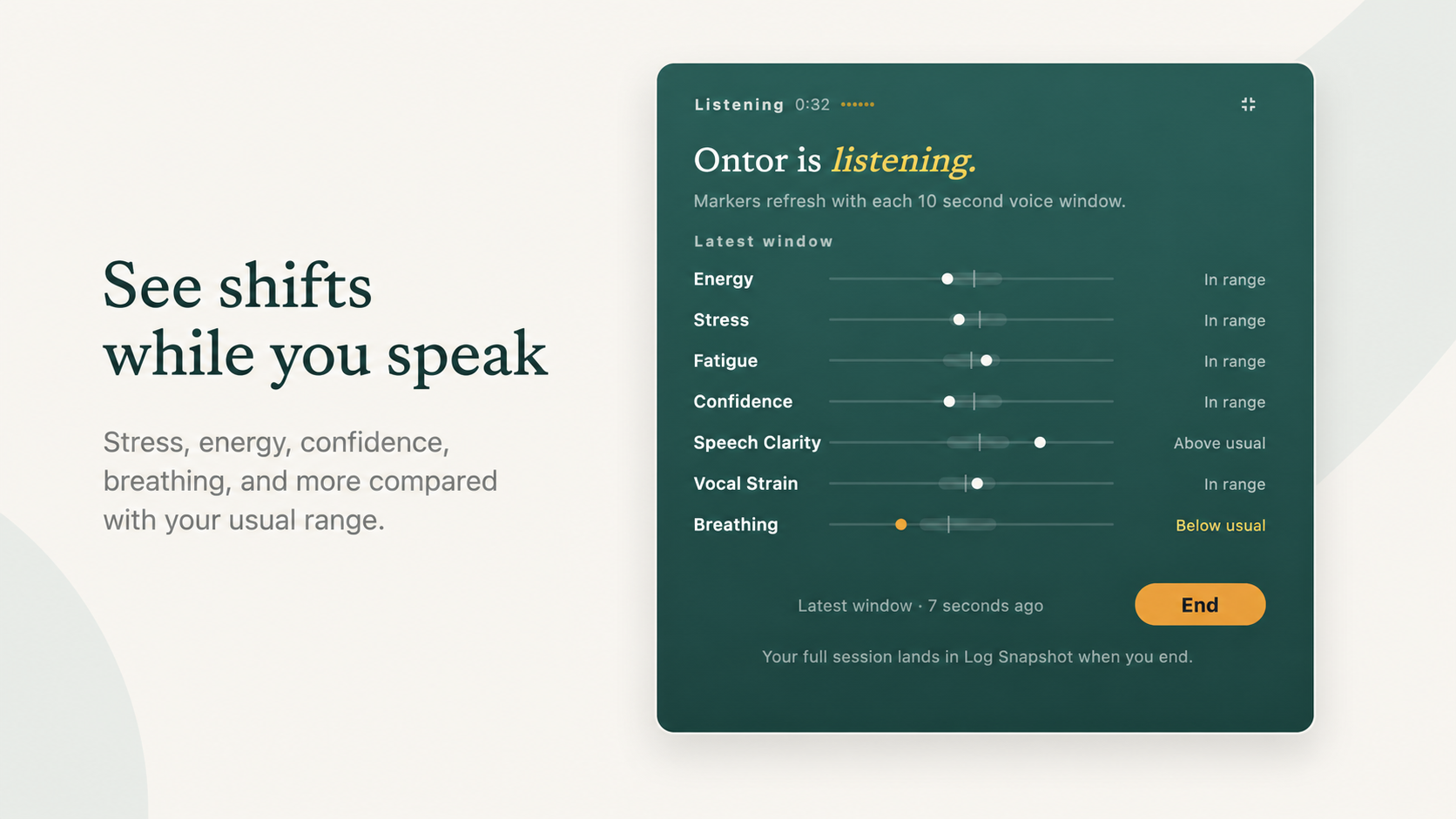
Here is the live listening view from my own Ontor product use: markers refresh with each ~10 second voice window and sit against my usual range. In this window speech clarity sits above usual while breathing sits below usual. That is closer to "my readiness left my band while I kept saying the same words" than a green dial tally:
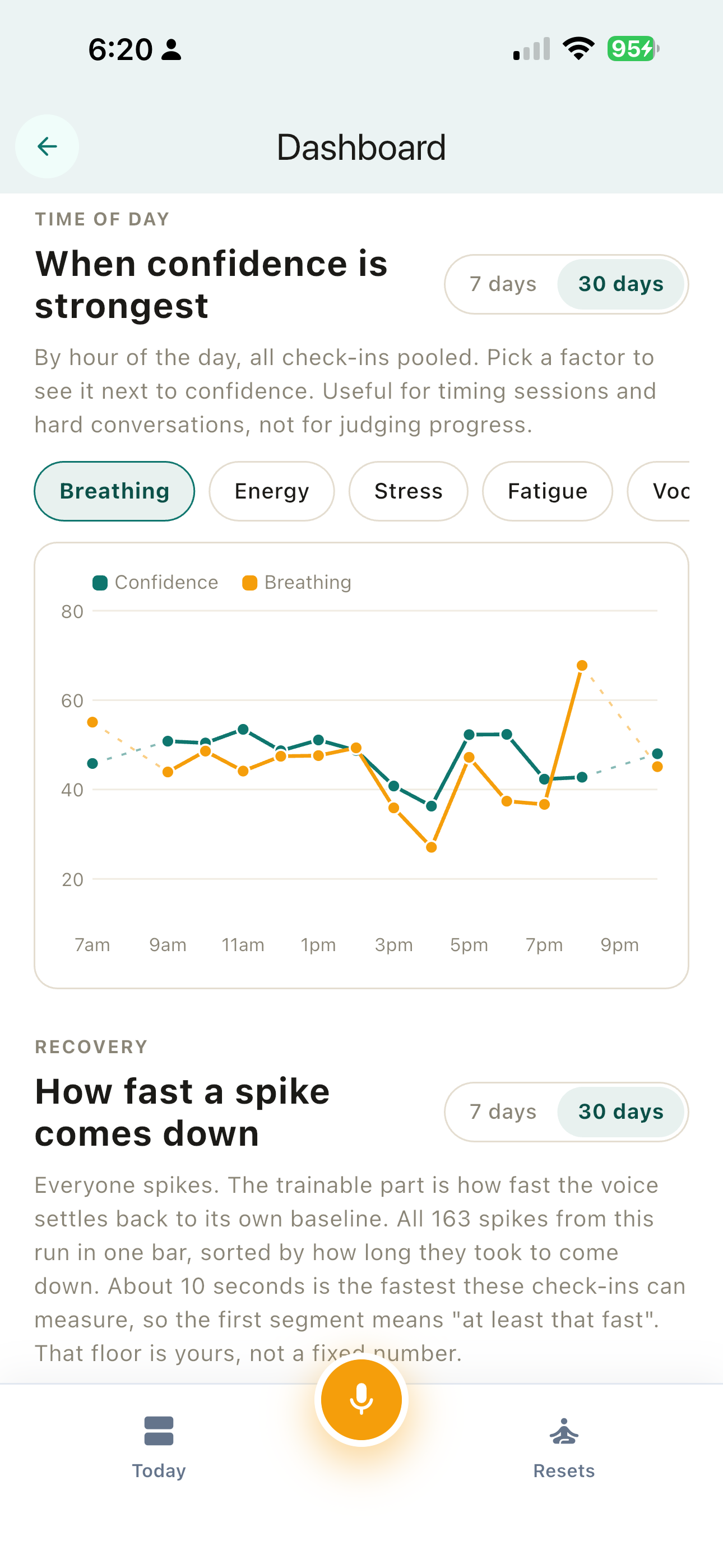
Here is confidence with breathing by hour from that same Ontor history. Confidence peaks late morning, then declines after noon and bottoms in the afternoon in this 30-day pool. Read it as founder exploratory data on personal-baseline confidence leave across a long speaking day, the same shape leaders hear when call #14 no longer sounds first-time fresh while activity still prints green, not proof of meeting-booked rates and not your team's dial board:
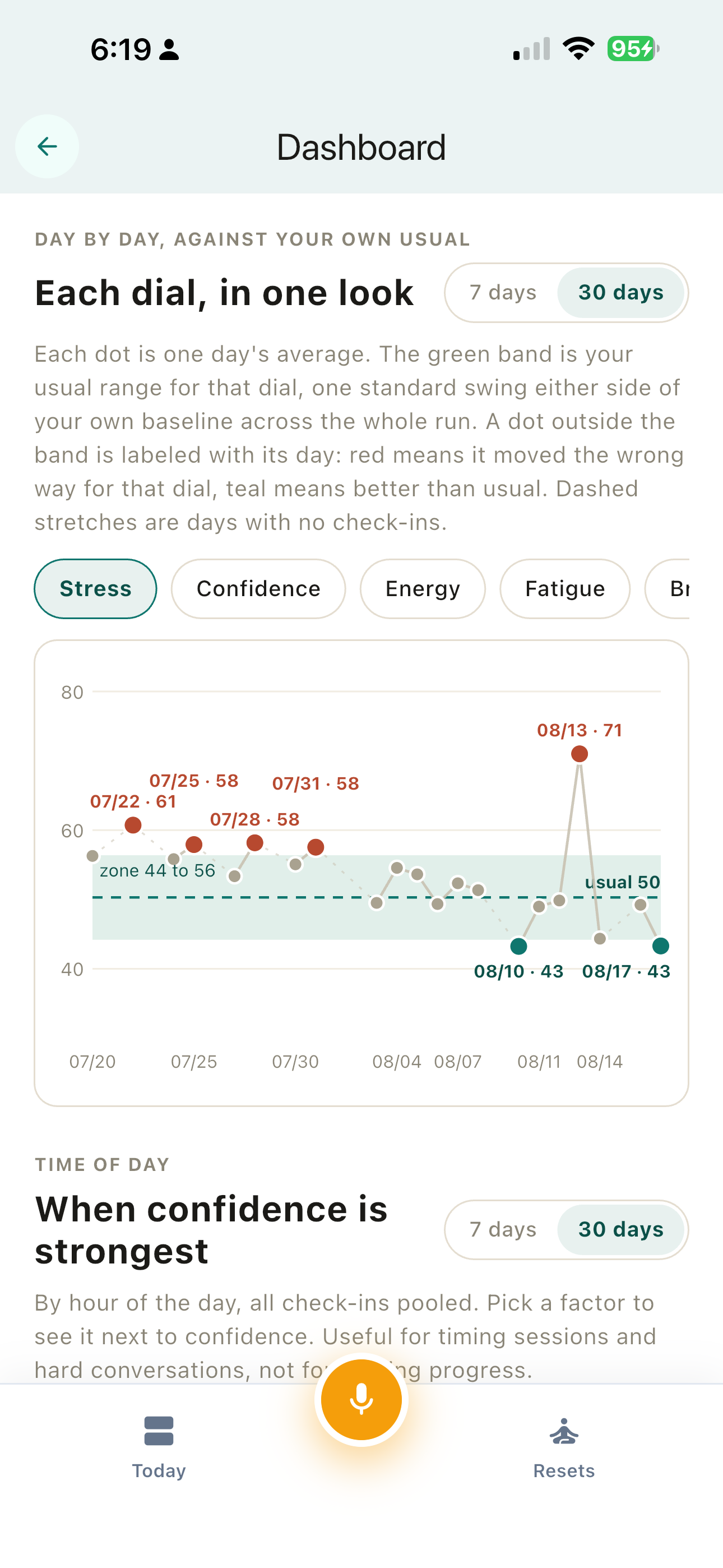
Here is stress day by day against my personal usual band (zone ~44 to 56, usual 50) from the same session history. Red points sit above my usual range. Useful as a private check for how often voice-state leaves the band across dials and days while a motion scoreboard would still print green around two recruiters who said the same thing. It is not a hire-or-fire score and it is not proof that a suggested reset caused a booked meeting:
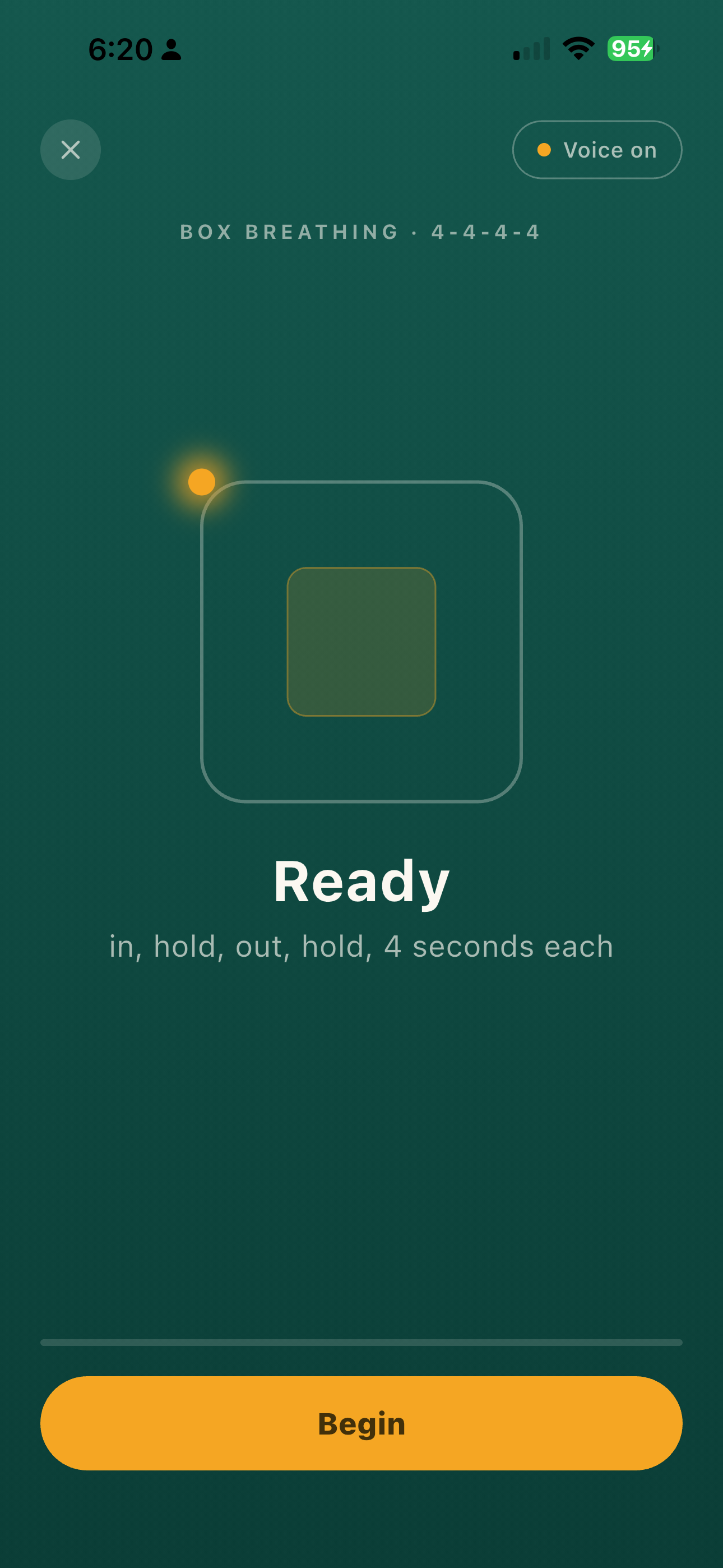
And here is the short reset the product offers when a lasting shift shows up: box breathing, 4-4-4-4. That is the tool form of the between-call reset ritual desk practitioners already prescribe, available privately without a manager guessing from a dashboard. It is not a claim that one cycle restores first-time freshness on the next BD speech:
This is not a claim that voice markers diagnose confidence, predict meetings booked, replace manager judgment, or guarantee higher revenue. The claim stays narrow: when dial boards miss same-words conversion on energy, a private signal plus a short reset is a loop people can run before the next BD call starts from chore energy, flat confidence, or late-block staleness, while leaders watch cohort patterns only in aggregate.
What to try on the next BD call
Do not wait for a research committee if you already A/B two recruiters saying the same thing and only one books.
- Install Ontor on the machine recruiters already use for BD calls.
- On the next BD outreach (especially after a chore-feeling stretch, a rough prior call, or late in a dial block around call #14), notice whether energy, confidence, clarity, stress, or fatigue sit outside that person's usual range in the short speech windows.
- If a lasting shift shows up, or if the person can already tell they do not sound animated yet, take the short suggested reset before the next dial. Then continue instead of stacking another same-words call that starts flat.
- If you lead the desk, keep leaders on aggregate patterns only for energy / confidence / clarity drift across BD conversations. Personal readings stay with the person. Treat Doherty's same-words A/B, Lutz's audible chore energy, and Volsky's first-time-fresh gate as performance controls, not only soft skills.
Soft secondary path if you are buying for a team and want a measured look later: Ontor for teams, or a research conversation / pilot with staffing agency owners and VP Sales on personal voice baselines versus dial boards and script reviews.
Do not promise meeting-booked rates, placement revenue, retention, or ROI guarantees. Measure whether people can tell when confidence and energy left their usual voice before the client names it.
Bottom line
Same words. Clients hear the energy underneath. Staffing sales leaders already A/B it. Dashboards still can't. Doherty watches two recruiters say the same thing and only one book the meeting because confidence and energy decided it. Lutz names chore energy people can hear and feel. Volsky names the pre-dial animated gate and first-time freshness still required on call #14. Milligan and Kayrouz (with Otor's between-call reset comment) already coach doubt-under-the-voice and warm-ups as colour under that spine. The gap that remains is personal usual-range confidence and energy before the next BD speech, caught while dials and scripts still look compliant.
Try Ontor on the next BD call. Notice the short voice windows versus that person's usual range. Take the short reset when a lasting shift shows up, especially before a dial that still has to sound first-time fresh. That is the tool next step, not only a pilot conversation.
Download Ontor - 14 days free, no card required
References
- Simon Doherty. LinkedIn: tone matters more than script; two recruiters said the same thing on the phone, one booked the meeting; the difference is confidence and energy. https://www.linkedin.com/posts/simon-doherty-tiello_recruiter-lessons-ive-learned-from-our-team-activity-7335700744488071168-wy_Y
- Derek Lutz. LinkedIn article: chore versus opportunity mindset; people can hear and feel the energy shift; 20 dials mean nothing without real conversations. https://www.linkedin.com/pulse/stop-complaining-start-closing-bd-candidate-call-mindset-derek-lutz-skhuc
- Norman Volsky. Elite Recruiter Podcast with Benjamin Mena: early robotic week; do not dial until you sound animated and excited; call #14 must be first-time fresh. https://www.eliterecruiterpodcast.com/norm-volsky-recruiting-niche-success/
- Richard Milligan. Recruiting Conversations (vendor corroboration): people feel the doubt underneath your voice; identical words, different energy; start flat and the whole call runs flat. https://www.podscan.fm/podcasts/recruiting-conversations-1/episodes/they-hear-the-doubt-before-you-finish-5-moves-to-a-certain-tone
- Amber Kayrouz. LinkedIn (desk corroboration): the call starts before you dial; warm up your voice; posture changes how you sound. Matthew Otor comment: 60-second between-call reset ritual. https://www.linkedin.com/posts/amber-kayrouz-05956b328_recruitment-sales-confidence-activity-7381274686707617792-mKSv
- Ontor. "How it works." https://ontor.ai/how-it-works/
- Ontor. "Ontor for teams." https://ontor.ai/for-teams/
- Ontor. "About the founder." https://ontor.ai/about/
- Ontor. "Install Ontor." https://ontor.ai/install/
- Ontor. "Your staffing desk can look busy and still be in a rut. Clients hear the missing tone before you do." https://ontor.ai/blog/staffing-desk-rut-tone-excitement-gone/ (sibling)
- Ontor. "Staffing sales leaders can see dials and fill rates. They still miss readiness between BD call blocks." https://ontor.ai/blog/staffing-sales-call-block-readiness/ (sibling)
- Ontor. "Your staffing team dropped the 150-dial quota. Can anyone tell if the remaining calls still sound ready?" https://ontor.ai/blog/staffing-quality-over-volume-readiness/ (sibling)
- Ontor. "Your staffing team finally got a live connect. You can hear they're uncomfortable." https://ontor.ai/blog/staffing-live-connect-discomfort/ (sibling)