
Your staffing desk can look busy and still be in a rut. Clients hear the missing tone before you do.
Agency sales leaders who run desks (VP Sales, Managing Directors, founders) already live inside green boards. Dials happen. Fill rates hold. The calendar stays packed. What those boards still miss is the quieter failure mode Chris Heinz names from the paying search seat: a desk that is in a rut. Activity continues. Tone and excitement leave the voice. Clients hear that leave before the weekly scorecard catches it.
Chris Heinz (Managing Partner, Westport One; executive search / senior living leadership staffing) puts the commercial object in plain language. A rut lacks energy. Without it, tone and excitement are not there. Without that tone, excitement, and energy level, people come across poorly in conversations. Adam Paine (Founder, Evolution Sales Recruitment) names the phone behavior that follows when confidence has drifted from capability: ordinary conversations can feel enormous, and calls get avoided even when the person still knows how to do the job. Sue Southall (agency MD/founder, 25 years) names the other live moment: a client challenge spikes a split-second of self-doubt, and the next speech still has to land with conviction on the phone.
This is not another call-block readiness piece, not quality-over-volume readiness, not live-connect discomfort, not fee-delivery audible wince, and not post-fallout composure. Those answer protected BD blocks, remaining-call quality after dial quotas drop, first-connect discomfort, fee stammer in the silence after the number, and bounce-back after a fallen placement. The unique gap here is a sustained rut or confidence state: audible tone and excitement loss, call avoidance when ordinary conversations feel enormous, and conviction wobble under client challenge, while dashboards cannot verify whether voice and energy returned to that person's baseline before the next BD or client speech.
Download Ontor - 14 days free, no card required
A rut lacks energy. Clients hear the missing tone first.
Heinz's Contributor Wednesday mindset segment (BTG Voice archive; LinkedIn reshare in 2026) is the spine for this article. Exact lines:
"A rut, lacks energy, and energy is a key element of whether we're successful."
"Without it, your tone and excitement just aren't there. Your energy level itself is not there without that tone, excitement, and energy level, you will come across poorly in your conversations, your interactions with peers and potentially with residents."
"A rut is a habit or pattern of behavior that has become dull and unproductive, but is hard to change."
He also coaches breaks every 45 to 48 minutes, mid-day walks, and non-work colleague chat as ways out of the donut-shop monotony that still looks like consistency from the outside. Consistency and a rut are not the same thing. Boards that only print dials and fills treat them as if they were.
Lead with that. The failure mode is not "everyone must sound theatrical on every call" as a product claim. It is: when a desk goes through the motions and energy leaves the voice, clients and candidates hear flat delivery before leaders see a bad week in the CRM.
Confidence and capability are not the same thing. Calls get avoided.
Paine writes as a paying sales-recruitment founder who redesigned his firm against ridiculous call targets. Keep only the phone-behavior spine. Exact lines we reuse:
"I've avoided making calls because anxiety can make an ordinary conversation feel enormous."
"Confidence and capability aren't always the same thing."
"There was a time I would pick up the phone to anyone. Managing Director. CEO. The toughest gatekeepers imaginable. I was relentless."
"My confidence is low… My ability hasn't disappeared."
Heinz names the audible leave when energy is gone. Paine names the behavioral leave when confidence has drifted from capability: the phone stays down, or the conversation that used to feel ordinary now feels enormous. Activity KPIs still print whatever happened elsewhere that hour. They do not print the avoided BD or client call.
When you believe in someone, say it with conviction.
Southall's LinkedIn post is the live client-challenge half of the same object. Exact lines:
"A client sent me an email yesterday that made me panic."
"And for a split second, I doubted myself."
"So I did what I always do when doubt creeps in. I picked up the phone."
"Email creates doubt. Phone calls create clarity."
"When you believe in someone, say it with conviction."
"I've been doing this for 25 years. And I still get moments where I question myself. I don't sit with it."
This is not fee stammer. It is backing a candidate under client pushback. The email challenge spikes doubt. The next speech still has to carry conviction. Leaders celebrate "pick up the phone" culture. They still cannot verify whether conviction actually returned in the voice after that doubt spike versus the person's usual confident baseline.
Low-energy days and busy-as-badge desks (vendor colour only)
The Lone Recruiter (recruitment performance blog; practitioner channel) names the foggy desk day every recruiter already knows. Cap as vendor corroboration under Heinz, not as the buyer spine. Exact lines:
"You're staring at your screen. Your brain feels foggy. Every call feels harder than it should."
"Energy management beats time management - every single time."
"Peak Mode… BD • Influence calls • Negotiation… Anything requiring presence, persuasion or creativity"
Michelle Flynn Coaching in The Global Recruiter (May 2026) names the same between-call gap for agency audiences. Cap as vendor colour. Exact lines:
"Recruitment is one of the few industries where your performance is directly tied to your emotional state."
"Something as small as taking 60 seconds between calls to slow your breathing can help regulate stress levels and improve focus."
"Leaders also need to recognise that teams experience their energy."
Leaders already prescribe Peak Mode for presence work, 10-minute walks, and 60 seconds of slower breathing between calls. What they still lack is a continuous signal of whether tone, excitement, confidence, or energy returned toward that person's own usual range before the next BD or client speech starts from the rut clients already hear.
What dial boards, fill rates, and "be more positive" still miss
Typical stack on a staffing or recruiting sales desk that already looks busy:
- Dial / connect / fill / revenue boards
- Protected BD blocks and "quality over volume" coaching
- Midday walks, breath resets, and "change it up" pep talks
- Occasional call-recording reviews that sample one good week
- Email-first client replies that dodge the live conviction moment
Useful. Incomplete for a sustained rut. Dial boards ask whether motion happened. Fill rates ask whether placements closed. Pep talks ask whether people nodded in the standup.
None of them continuously ask: in the short windows before and during this person's next BD or client speech, did energy, confidence, clarity, or stress leave their own usual range? Did tone and excitement go missing the way Heinz describes? Did ordinary calls start to feel enormous the way Paine describes? Did conviction wobble under challenge the way Southall describes?
Clients hear that first. Leaders often meet it later as a soft week, a desk that "needs more energy," or a founder who redesigned targets without ever getting a personal voice baseline to coach against.
How this differs from call-block readiness, live-connect discomfort, fee wince, and post-fallout
Staffing sales call-block readiness answers: between protected BD call blocks, do leaders still miss readiness while dials and fills stay visible?
Quality-over-volume readiness answers: after dial quotas drop, can anyone tell if the remaining higher-stakes calls still sound ready?
Live-connect discomfort answers: when a rare live connect finally lands, do coaches still hear rush and discomfort while activity KPIs miss voice-state versus baseline?
Fee-delivery audible wince answers: when recruiters state fees with fillers, nervous laughter, or apology energy, do leaders still lack composure in the silence after the number?
Post-fallout composure answers: after a fallen placement, did tone and composure return toward personal baseline before the next client call?
This article answers a different question: when a desk is in a sustained rut or confidence drift, with tone and excitement gone, calls avoided because ordinary conversations feel enormous, and conviction wobbling under client challenge, do agency sales leaders still lack a personal voice baseline that verifies energy returned before the next BD or client speech?
Same staffing beachhead. Different object. Sustained rut and confidence state, not fee stammer, not first-connect discomfort, not dial-block start readiness, and not post-fallout bounce-back.
Download Ontor - 14 days free, no card required
What Ontor adds when the rut is audible before the board turns red (private first)
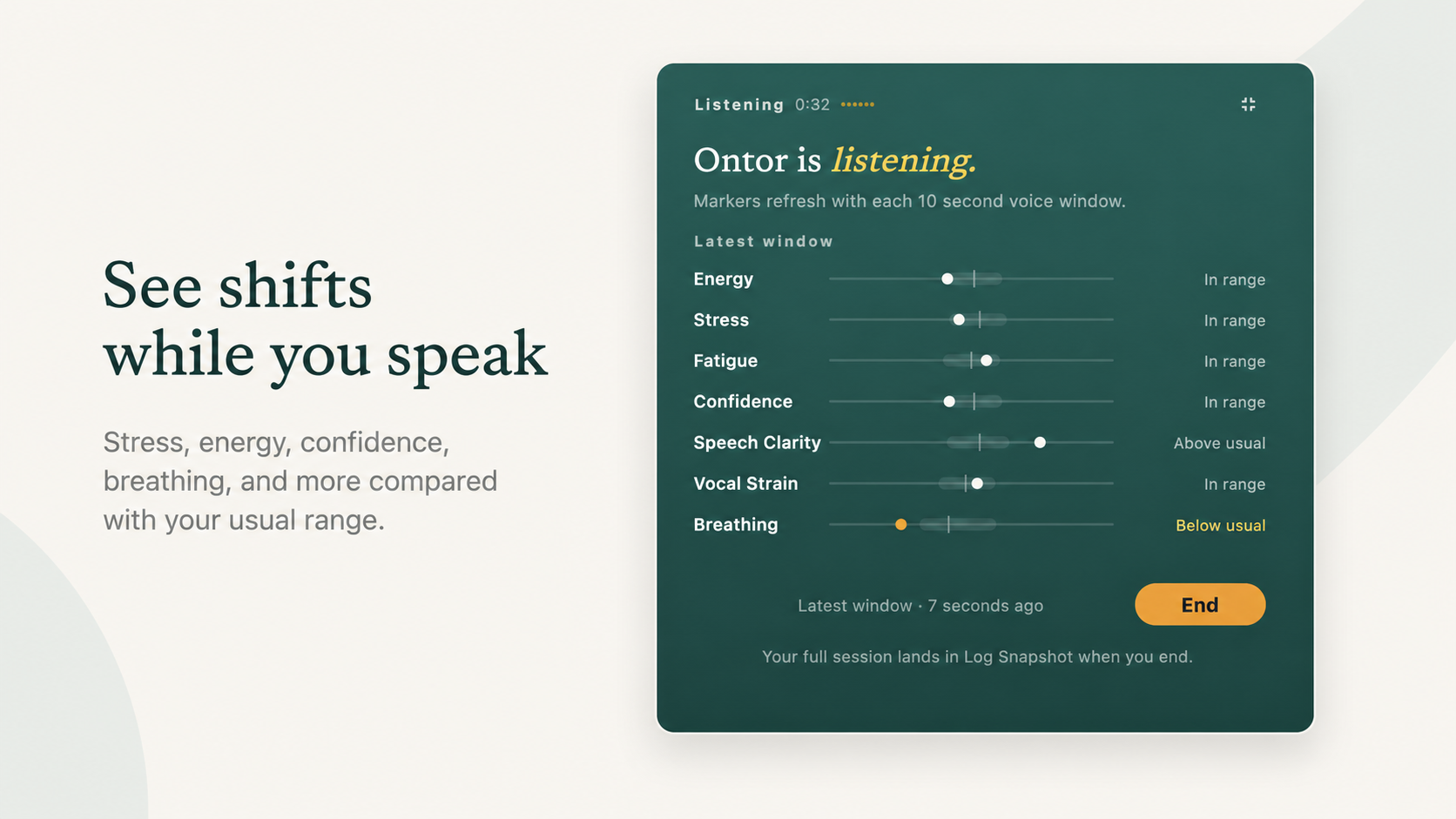
Ontor is a performance tool that reads how you sound, not what you said. While someone speaks, it compares voice signals to that person's own usual range. Markers refresh in short voice windows (on the order of about 10 seconds of speech). When a lasting shift shows up (for example energy, confidence, stress, fatigue, speech clarity, or vocal strain), it can suggest a short reset. People can also compare before and after.
For teams, Ontor's public framing is aggregate patterns for workload, coaching, and support. Individual sessions and readings stay with the person. Agency owners and VP Sales can see team-level context for when a desk's energy, confidence, or clarity sits outside usual range more often across BD and client conversations. They do not get a personal scoreboard for hire or fire decisions.
That is the product difference from dial boards and pep talks alone. Dial boards ask whether volume happened. Pep talks ask whether people promised more energy. Ontor asks whether this voice left its own usual band, privately, in the short windows around the next BD or client speech, and whether a short reset is available before the next call would otherwise start from missing tone, avoided dials, or soft conviction.
It does not claim to raise fill rates, replace BD coaching, or prove that a suggested reset caused a won brief. The claim stays narrow: paying leaders already say a rut kills tone and excitement, that confidence and capability can diverge into call avoidance, and that conviction has to be spoken on the phone after doubt. A private usual-range signal plus a short reset is a loop people can run before the next BD or client call.
In my own Ontor session history (founder exploratory data from my own product use, not your agency's fill rates), the rut and missing-tone pattern shows up the same way Heinz, Paine, and Southall named it for staffing desks. A speaking block can still look "fine" as raw talk time while energy, confidence, or clarity has left my personal usual range in the short windows before the next high-stakes BD or client speech. Dial count would still look fine. The next call would still start from whatever flat or wobbly state I carried in.
Here is the live listening view from my own Ontor product use: markers refresh with each ~10 second voice window and sit against my usual range. In this window speech clarity sits above usual while breathing sits below usual. That is closer to "my readiness left my band while I kept talking through a desk that looked busy" than a green dial tally:
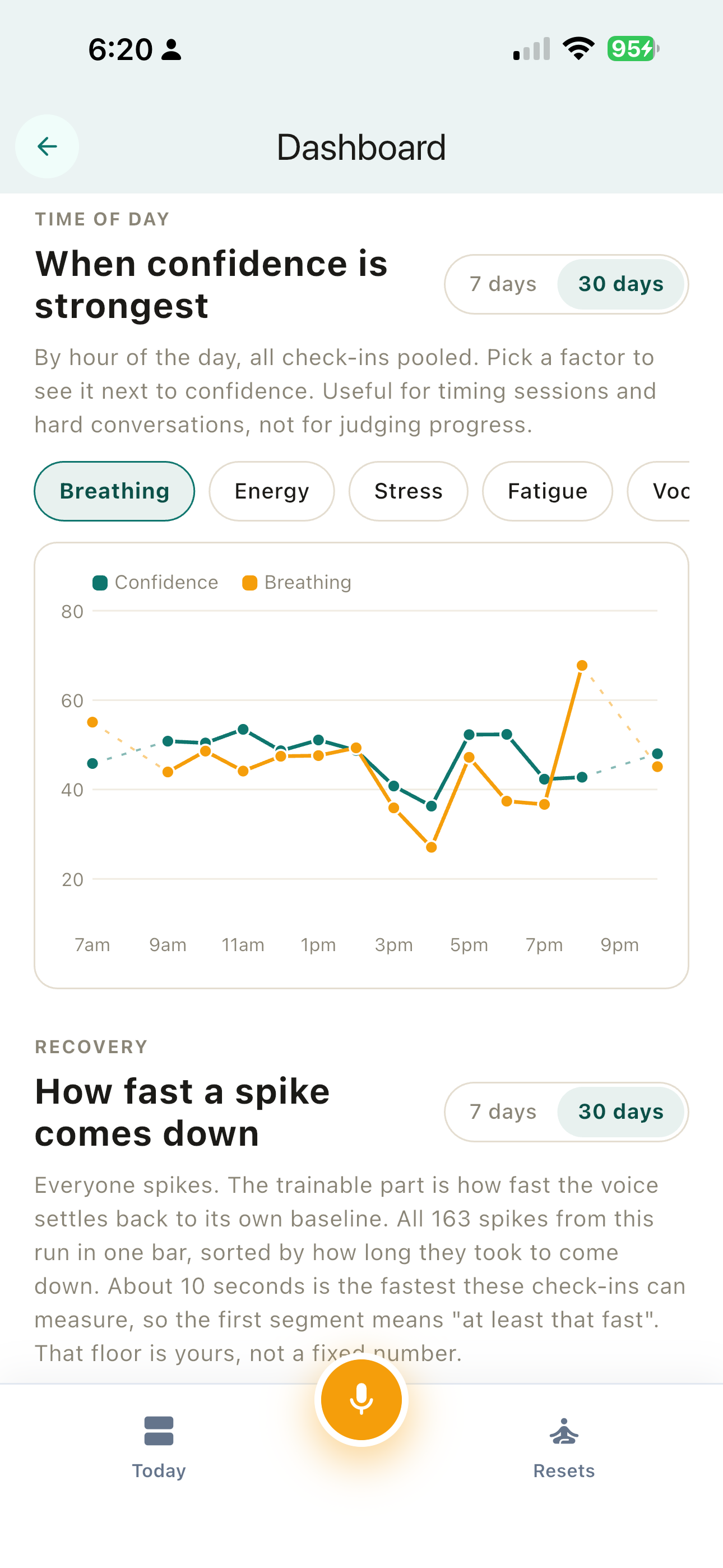
Here is confidence with breathing by hour from that same Ontor history. Confidence peaks late morning, then declines after noon and bottoms in the afternoon in this 30-day pool. Read it as founder exploratory data on personal-baseline confidence leave across a long speaking day, the same shape leaders hear when tone and excitement go missing later in a BD block while activity still prints green, not proof of fill rates and not your team's dial board:
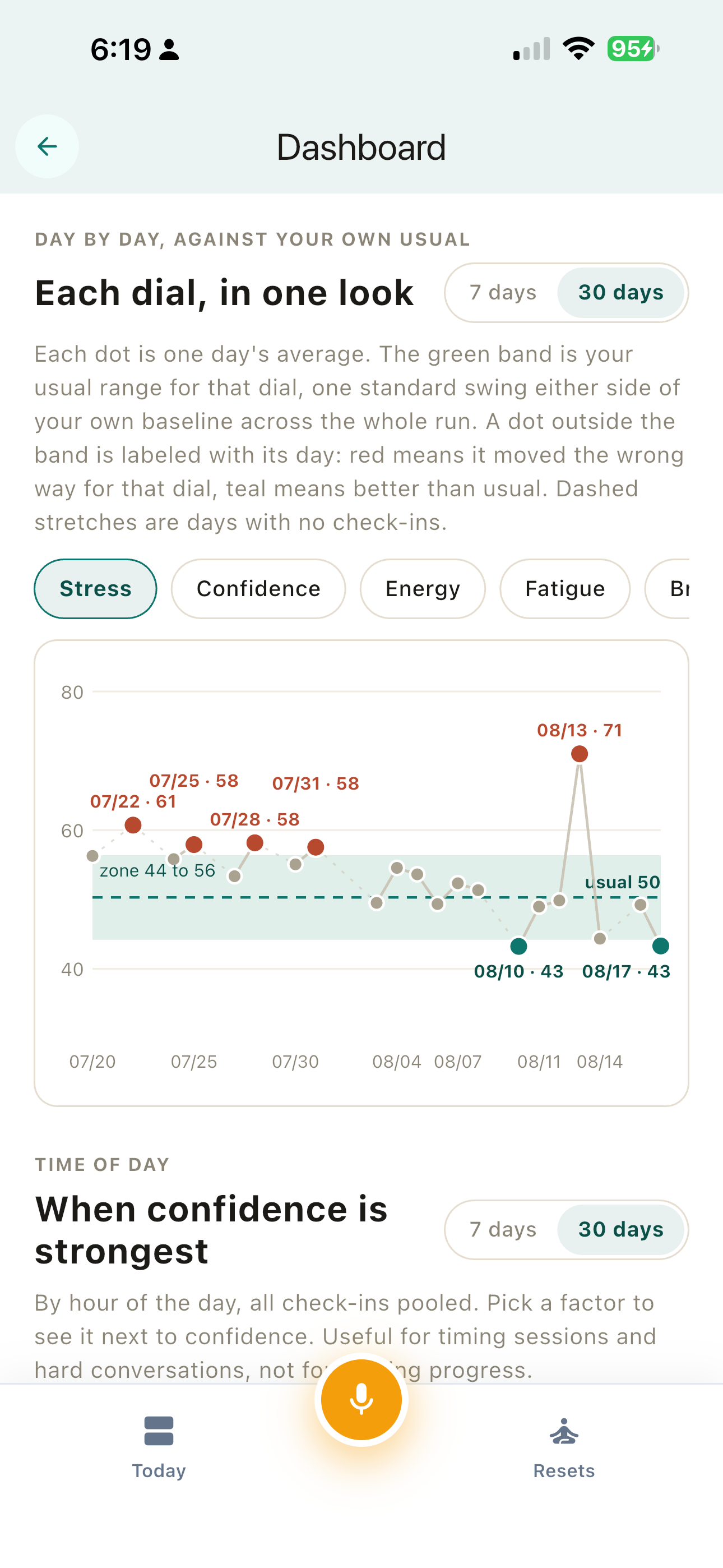
Here is stress day by day against my personal usual band (zone ~44 to 56, usual 50) from the same session history. Red points sit above my usual range. Useful as a private check for how often voice-state leaves the band across dials and days while a motion scoreboard would still print green around a desk that is already in a rut. It is not a hire-or-fire score and it is not proof that a suggested reset caused recovery:
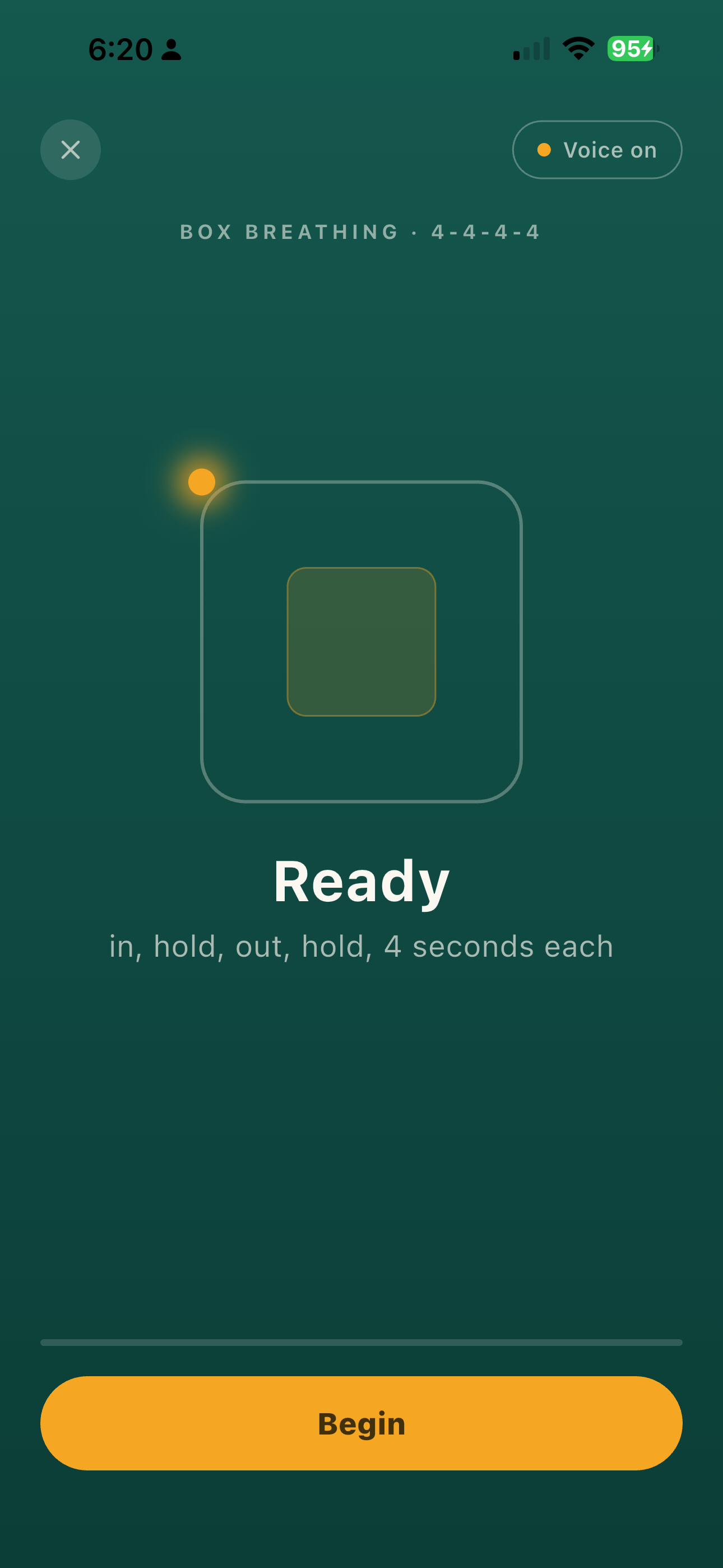
And here is the short reset the product offers when a lasting shift shows up: box breathing, 4-4-4-4. That is the tool form of what Flynn already coaches as 60 seconds between calls, and what Heinz already coaches as a mid-block break, available privately without a manager guessing from a dashboard. It is not a claim that one cycle restores excitement on the next client speech:
This is not a claim that voice markers diagnose confidence, predict placements, replace manager judgment, or guarantee higher revenue. The claim stays narrow: when dial boards miss the audible rut, a private signal plus a short reset is a loop people can run before the next BD or client call starts from missing tone, avoided dials, or soft conviction, while leaders watch cohort patterns only in aggregate.
What to try on the next BD or client call
Do not wait for a research committee if you run a staffing or recruiting sales desk that still looks busy while tone and excitement have left the voice.
- Install Ontor on the machine recruiters already use for BD and client calls.
- On the next BD outreach or client speech (especially after a dull block, a confidence dip, or a challenging email), notice whether energy, confidence, clarity, stress, or fatigue sit outside that person's usual range in the short speech windows.
- If a lasting shift shows up, or if the person can already tell every call feels harder than it should, take the short suggested reset before the next BD or client call. Then continue instead of stacking another flat or avoided conversation.
- If you lead the desk, keep leaders on aggregate patterns only for energy / confidence / clarity drift across the desk. Personal readings stay with the person. Treat Heinz's tone-and-excitement language, Paine's confidence-versus-capability honesty, and Southall's phone-first conviction as performance controls, not only soft skills. Pair with self-listen on one live client challenge the way Southall models, not with another emailed reply that sits with the doubt.
Soft secondary path if you are buying for a team and want a measured look later: Ontor for teams, or a research conversation / pilot with staffing agency owners and VP Sales on personal voice baselines versus dial boards and fill rates.
Do not promise fill rates, placement revenue, retention, or ROI guarantees. Measure whether people can tell when tone and excitement left their usual voice before the client names it.
Bottom line
A staffing desk can look busy and still be in a rut. Clients hear the missing tone before you do. Heinz watches energy leave conversations until tone and excitement are gone. Paine names call avoidance when confidence has drifted from capability and ordinary conversations feel enormous. Southall names conviction under client challenge after a doubt spike, with phone clarity instead of email sitting. Lone Recruiter and Flynn already coach Peak Mode and 60-second between-call breathing as vendor colour. The gap that remains is personal usual-range energy, confidence, and clarity before the next BD or client speech, caught while dials and fills still look green.
Try Ontor on the next BD or client call. Notice the short voice windows versus that person's usual range. Take the short reset when a lasting shift shows up. That is the tool next step, not only a pilot conversation.
Download Ontor - 14 days free, no card required
References
- Chris Heinz. "Recruitment, Teams and Mindset with Chris Heinz" (BTG Voice / Contributor Wednesday): a rut lacks energy; without it tone and excitement aren't there; you come across poorly in conversations. https://www.btgvoice.com/full-episode/cw-118-chris-heinz
- Chris Heinz. LinkedIn reshare of the same mindset segment (2026-01-29). https://www.linkedin.com/posts/chrisheinz_recruitment-teams-and-mindset-with-chris-activity-7419787022707544064-t95d
- Adam Paine. LinkedIn post: avoided making calls because ordinary conversations can feel enormous; confidence and capability aren't always the same thing. https://www.linkedin.com/posts/evotalbrid_confidence-is-a-strange-thing-you-can-spend-activity-7502672507808755713-UuTU
- Sue Southall. LinkedIn post: client email made me panic; email creates doubt, phone calls create clarity; when you believe in someone, say it with conviction. https://www.linkedin.com/posts/connectwithsuesouthall_a-client-sent-me-an-email-yesterday-that-activity-7422556679671775232-iGUM
- The Lone Recruiter. "Recover Faster on Low Energy Days" (vendor corroboration): every call feels harder than it should; Peak Mode for presence/persuasion. https://thelonerecruiter.com/recover-faster-on-low-energy-days/
- Michelle Flynn Coaching / The Global Recruiter. "Do you wear busy as a badge of honour?" (vendor corroboration): 60 seconds between calls to slow breathing; teams experience their energy. https://www.theglobalrecruiter.com/do-you-wear-busy-as-a-badge-of-honour/
- Ontor. "How it works." https://ontor.ai/how-it-works/
- Ontor. "Ontor for teams." https://ontor.ai/for-teams/
- Ontor. "About the founder." https://ontor.ai/about/
- Ontor. "Install Ontor." https://ontor.ai/install/
- Ontor. "Staffing sales leaders can see dials and fill rates. They still miss readiness between BD call blocks." https://ontor.ai/blog/staffing-sales-call-block-readiness/ (sibling)
- Ontor. "Your staffing team dropped the 150-dial quota. Can anyone tell if the remaining calls still sound ready?" https://ontor.ai/blog/staffing-quality-over-volume-readiness/ (sibling)
- Ontor. "Your staffing team finally got a live connect. You can hear they're uncomfortable." https://ontor.ai/blog/staffing-live-connect-discomfort/ (sibling)
- Ontor. "Recruiters talk about fees like admitting to a crime. Clients hear the wince." https://ontor.ai/blog/staffing-fee-delivery-audible-wince/ (sibling)
- Ontor. "The placement fell through. Your next client call still has to sound ready." https://ontor.ai/blog/staffing-post-fallout-composure/ (sibling)