
The call ended 40 minutes ago. Your brain is still in conversation mode.
The hard part is not the Zoom. It is the half hour after. You hang up, headset still warm, and open the work that needs quiet. Instead you drift. Slack. Notes. Tabs. A replay of what someone said. The next block of deep work waits while your head stays in the meeting.
This is for people who talk with clients or customers and then have to do their own thinking: founders, consultants, account managers, advisors, therapists, anyone working as themselves on camera and mic. It is not hangover minutes between sales calls. That piece is how you sound to the next prospect after a prior connect. It is not a claimed mental reset that never checked how you sound. It is not seven hours of back-to-back video with no gap. That sibling is the long day that fries you by 5 PM. The wedge here is narrower. One client video call. Then your own focus trying to come back. Not the sales floor. Not the all-day stack.
Download Ontor - 14 days free, no card required
After the Zoom, not during
A remote knowledge worker on Reddit (u/Disastrous_Roof196; public snapshot around May 2026) put the split in plain words. The problem was not during the meeting. It was after. A 45-minute Zoom call basically killed the next 30 to 60 minutes of their workday. It felt like their brain stayed stuck in "conversation mode" instead of switching back into deep work.
What that looked like on the desk mattered. They opened the laptop and drifted: Slack, reopening notes, staring at tabs, scrolling, replaying the meeting. Focus did not return on its own at the talk-to-screen handoff.
Their own working fix was small. A brain dump. Pick the next tiny task. A 5-minute focus reset. They said it helped more than they expected. Treat that as one person's account, not a clinic note. The useful spine is mechanical: video conversation ends → conversation mode lingers → solo work drifts for a stretch → a short deliberate pause can help the handoff more than people guess.
A commenter on the same thread (u/bokkasattva) added a cost that fits the sticky feeling. On camera you are constantly reading multiple people's body language at once, without the whole picture, and you are also watching yourself. That kind of social load does not shut off the second the Leave button turns green.
Why conversation mode sticks after you hang up
Task research has a name for leftover attention. Sophie Leroy (2009) called it attention residue: thoughts about a prior task that keep running after you have already moved to the next one. Unfinished prior work makes the residue worse and subsequent-task performance suffers. A client call rarely feels "closed" the way a checked-off chore does. You still carry open loops, tone, and what you wish you had said.
Even when people know a switch is coming, residual costs remain. Rogers and Monsell's classic work (summarized in APA's Multitasking: Switching costs overview) showed that preparation reduces switch cost but does not erase it. Prior control settings still carry over. Rubinstein, Meyer, and Evans (2001) measured the same family of costs in lab task alternation: switching takes time, costs rise when rules get more complex, and executive control includes goal shifting plus rule activation. Moving from live multi-person talk to quiet document work is a big rule change, not a tiny toggle.
Video adds its own stickiness. Jeremy Bailenson's 2021 nonverbal-overload argument (Technology, Mind, and Behavior) lists close-up eye gaze, deliberate gesture and framing, self-view evaluation, and limited movement as reasons Zoom-style talk feels expensive. He frames those as arguments grounded in prior research, not finished causal tests of Zoom itself. Stanford's write-up of the same piece is useful for the practical shape: faces staring at faces leave a residue that a calendar end-time does not clear.
A commenter on a separate careerguidance thread about back-to-back video days said the brain does not get the same downtime walking between rooms used to give. That line is corroboration for the missing transition, not a retelling of their all-day fried-by-5pm story. Here the missing walk is after a single meeting: no hallway, no coffee machine, just Leave Meeting and a document that wants your full head.
A short pause is a handoff, not a promise
Leroy and Glomb (2018, Organization Science) tested a brief ready-to-resume plan across four studies. When people expected to return to interrupted work under time pressure, attention residue rose and performance on the interrupting task fell. A short reflect-and-plan pause before the interrupting work reduced that residue. That is lab support for a deliberate handoff, not proof that any product restores deep work.
Wennberg and colleagues (2016, BMJ Open) found that short light walking breaks (about 3 minutes every 30 minutes) lowered self-reported fatigue versus uninterrupted sitting in a small crossover pilot. Cognitive scores did not clearly improve. So the honest background claim is narrow: interrupting a long sit with a short walk can blunt how tired people say they feel in that design. It is not a concentration cure. It is not Ontor's efficacy study.
Put those papers next to the Reddit account carefully. The buyer said a 5-minute focus reset helped more than expected. Science says residue and switch costs are real, and a short deliberate pause can reduce residue in other designs. None of that licenses a claim that focus "comes back," that deep work "resumes," or that a desk tool restores concentration. The useful move is still the same: notice the handoff, take a short pause on purpose, then open the next block.
Download Ontor - 14 days free, no card required
What Ontor can notice at that handoff (and what it will not)
Ontor is a tool that learns from your voice while you talk and from basic computer interaction afterward (typing, clicking, scrolling, pauses), then compares those readings with your personal usual range. On How Ontor works, voice sessions can start when the microphone is in use. Today can show activity time, longest uninterrupted stretch, and current stretch once you are back at the keyboard. When a stretch runs long, or when voice markers leave your usual band, the desktop can surface a snoozable reminder to take a short break or try a guided reset (site copy includes a five-minute break). You can snooze it, move it, or dismiss it.
That fit matches the after-call problem without overclaiming. Voice during the call. Computer activity in the minutes after. A notice when the session sits outside your usual range. A nudge to take a short reset right then, before you pretend the deep-work tab is already working.
What Ontor does not do:
- Promise that focus returns, that deep work resumes, or that concentration is restored
- Diagnose mood or any health condition
- Detect eye strain or headaches, improve vision, or prevent disease
- Use coach-style nervous-system diagnosis language
- Rank you, watch you for a manager, sell ROI, or treat anything medically
If you feel stuck in conversation mode after a client video call, that is your report. Ontor's useful response at that handoff is different: whether how you sounded left your usual range across the talk block, whether the computer stretch afterward looks like drift versus your usual pace, and a snoozable suggestion to take a short reset before you force the next quiet hour.
Sabber after a talk block: session, usual range, then a short reset
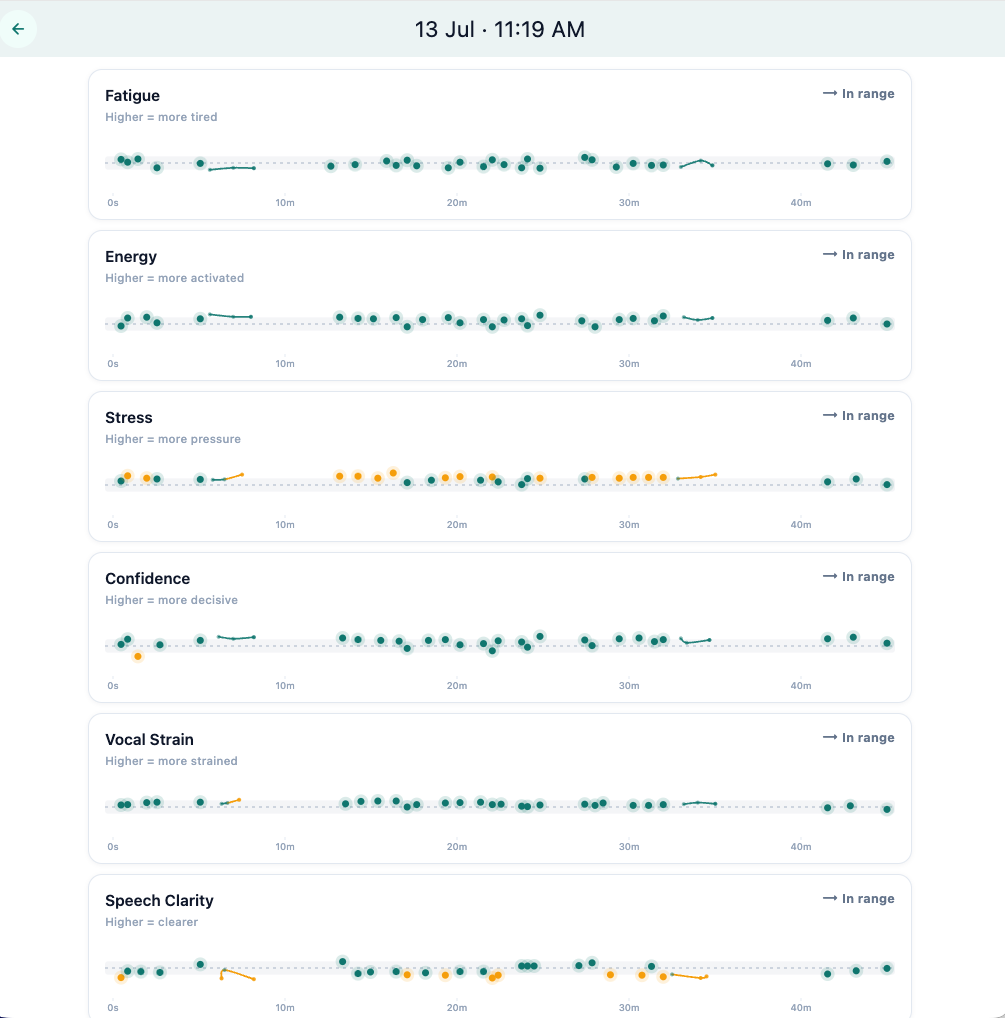
In my own Ontor sessions (founder exploratory data from my own product use, not a picture of the Reddit poster's brain, and not a clinical sample), I use the tool the way this problem actually shows up. After a talk block I check the session against my usual range before I dive into solo work. I look at how I sounded across the meeting, whether markers left my personal band, and whether Today shows a long computer stretch starting right after the call. When a lasting shift shows up, the next step I take is a short reset, not a claim that the product fixed my focus.
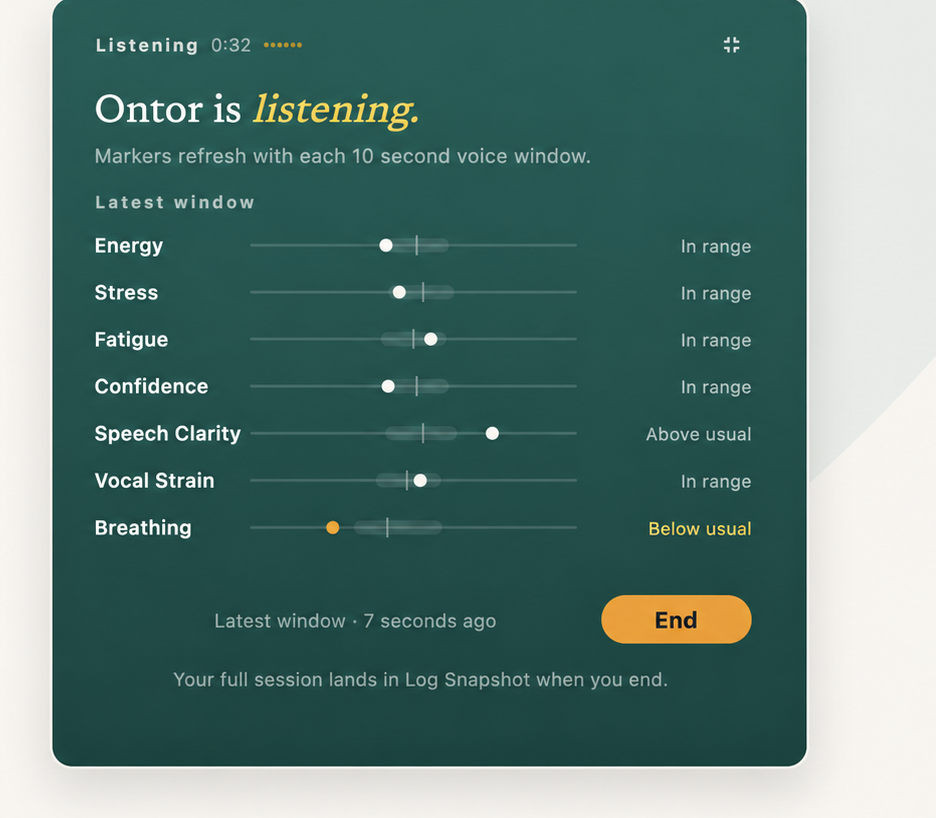
Here is the live listening card from that same exploratory use. Markers refresh in short voice windows against my usual range while a session is open. When a reading leaves the band (for example breathing below usual), the useful next step is still a short break or reset before solo work, not a diagnosis and not a promise that deep work will return on its own.
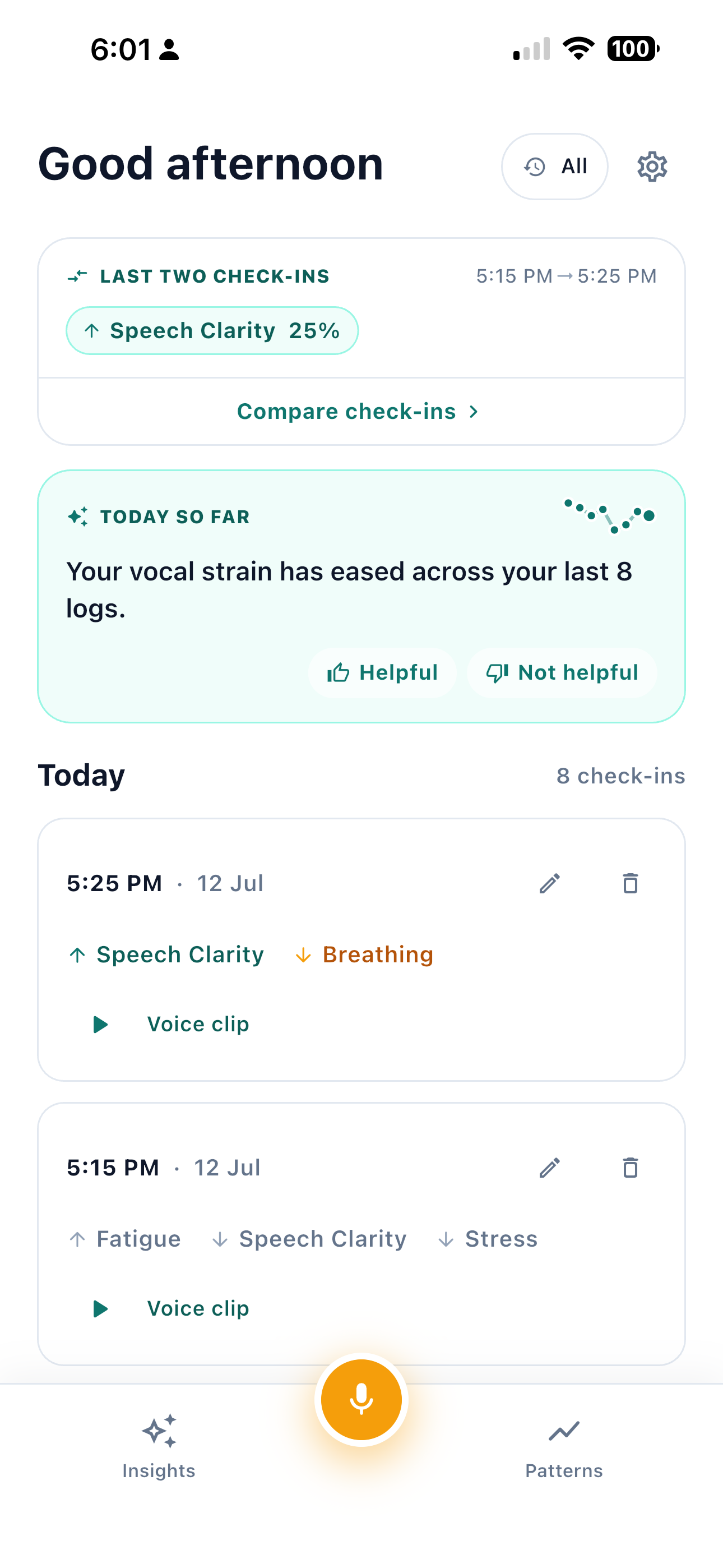
Today is where I look at the post-call stretch itself. After the meeting ends, check-ins and activity sit next to my history so I can see whether the session still looks shifted before I pretend I am already deep in the next document.
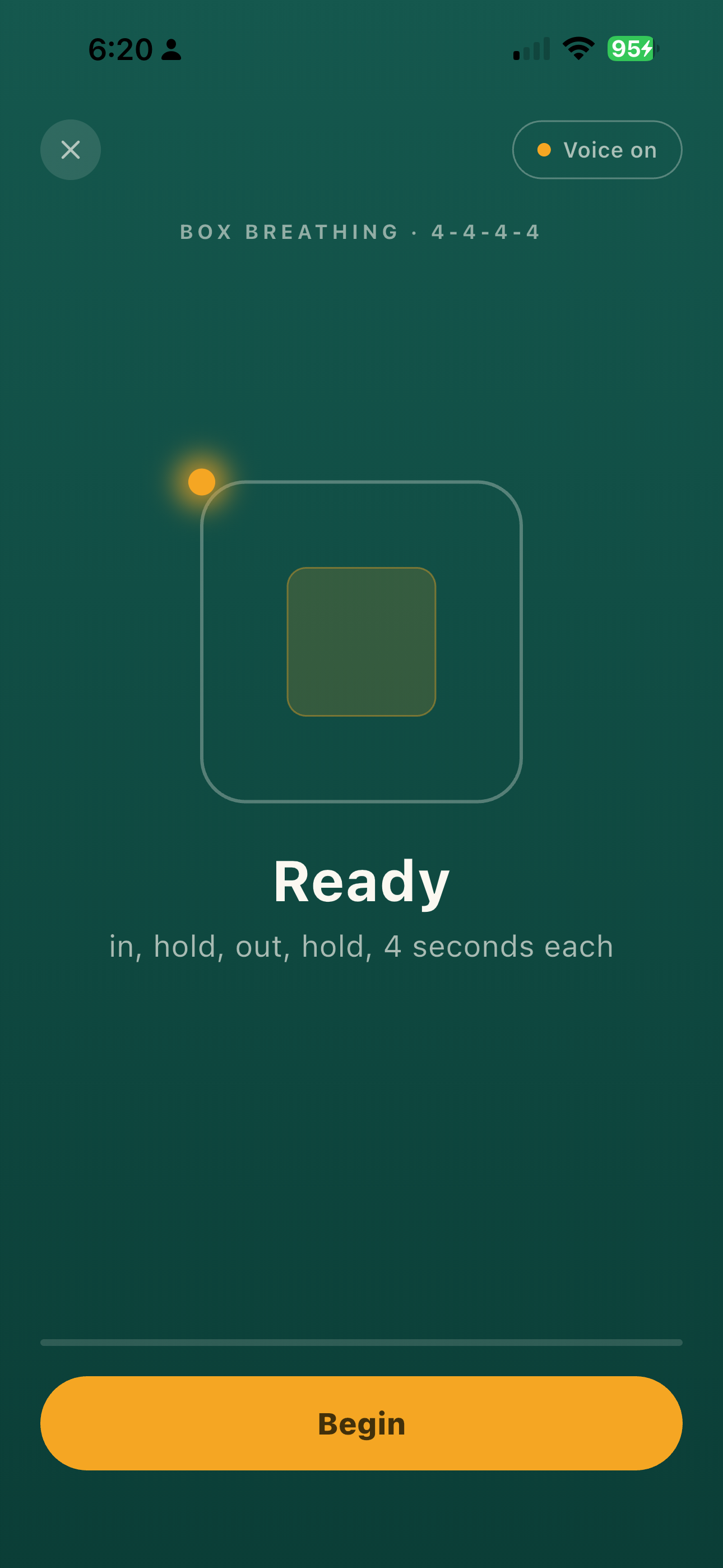
When the handoff needs a pause, box breathing is one short guided reset I can take before opening deep work. It is not treatment. It is a few deliberate minutes between conversation mode and the next quiet block.
Try this after your next client video call
After your next client video call, do not open the deep-work tab for one short beat. Look at whether the session left your usual range. If the snoozable short-reset nudge appears, take it once before you start drifting through Slack and tabs. Then open the next tiny task on purpose. That is a try-on-next-stretch step for your own after-call hour. Not a sales pilot. Not a team rollout pitch.
This is different from hangover-between-sales-calls and from back-to-back-video-eyes-fried-5pm. Those articles are about tone into the next prospect and about an all-day stack with no gaps. This one is about the post-call focus hangover after a single meeting, when conversation mode is still running and the quiet work has not started yet.
Download Ontor - 14 days free, no card required
References and sources
Buyer and peer accounts
- Reddit post (snapshot): lose focus after Zoom / conversation mode (primary buyer evidence; u/Disastrous_Roof196; commenter u/bokkasattva; public snapshot ~May 2026)
- Reddit r/careerguidance: drained after back-to-back video (corroboration only: lost walking-between-rooms downtime)
Science
- Leroy 2009: attention residue when switching between work tasks (OBHDP)
- Leroy and Glomb 2018: ready-to-resume plans and attention residue (Organization Science)
- Rubinstein, Meyer, and Evans 2001: executive control of cognitive processes in task switching
- APA: Multitasking: Switching costs (Rogers and Monsell residual costs overview)
- Bailenson 2021: Nonverbal Overload (Technology, Mind, and Behavior)
- Stanford Report: four causes of Zoom fatigue
- Wennberg et al. 2016: breaking up sitting and fatigue (BMJ Open)
Product and siblings