
You think you reset after the bad call. Your tone didn't.
You hang up mad, or embarrassed, or both. You take the breath. You tell yourself it is over. Then you dial, and the next person gets the voice from the call you just left.
Ian Cobb said that in a comment, not in a keynote. Under a post about leaving the last call where it ended, he wrote:
"One thing I'd add here is to watch what happens to your voice after a bad call. You may think you've reset mentally, but your tone can still carry the frustration into the next conversation."
That is the miss. The reset finished in your head. How you sound on the next dial is a separate question, and you are the last person who gets an honest vote on it while you are still talking.
This is for you if you are the one on the headset. Individual contributor, cold-call floor, the person who has to sound fine on the next dial after the last one went badly. Freight brokerage, staffing, collections, and mid-market leader pieces on this site are about other rooms. They are not this one.
A claimed mental reset is not a voice reset until the next window says how you sound is back toward your usual range.
Download Ontor - 14 days free, no card required
The 60 seconds can feel finished while the tone is not
The post Cobb commented on is from Future Of Sales, Leave the last call where it ended. It is a tip account. Treat it as advice people already pass around, not as a study.
"Leave the last call where it ended."
"A bad call followed by another bad call is a choice to carry something that does not belong in the next conversation."
"Give yourself 60 seconds after a tough call. Feel it, name it, put it down."
"Your next prospect deserves the same energy as your first call of the day."
Read the 60 seconds literally. Feel it, name it, put it down. That sequence can end while you still sound like the hang-up. Put it down is something you do in your head and maybe with your body: stand, walk, get water. None of those steps includes a check on the voice the next person will hear.
Yonathan Levy, on the same thread, adds a line that matches the order a prospect actually gets:
"your state enters the conversation before your script does."
That is his wording. It is not a lab timing result. It is a peer saying the opener is late. The script can be clean and still arrive second.
Cobb is the spine because he names the false finish. You may think you have reset mentally. Your tone can still carry the frustration. No recording sits under that sentence. It is a practitioner comment, and it is the thing this article is willing to stand on.
Hurry-up is a different leak. It can still ride the next dial.
Richard Moore, writing about calls he lost at 23, describes a separate failure that lives on the same seconds. A CEO would say hurry up. Moore would speed up.
"I'd speed up."
"I'd rush through the whole thing and match their impatience with my own nervousness."
"And they could feel it."
From his post. Pitch memorized, structure fine, hung up in seconds anyway. His point is pace under pressure, not a between-call ritual. He is not the lead.
He matters here only as a way the next dial stays contaminated after you think you are calm. You put the bad call down. The new prospect sounds impatient. You match them. Now two things are in the voice: whatever the last hang-up left, and the rush you just added. Moore says they could feel it. That is his memory of buyers. It is not an Ontor result. He sells training off the back of the story. The early-career part is the part worth keeping. The course pitch is not.
What the voice research actually supports
Cobb's line is a floor observation. The papers are narrower, and a few of them cut against an easy version of the story.
When people rate emotion in speech, prosody and the words both carry it, and listeners do not fully shut either one off when told to attend to only one. That is Ben-David, Multani, Shakuf, Rudzicz, and van Lieshout, "Prosody and Semantics Are Separate but Not Separable Channels in the Perception of Emotional Speech" (Journal of Speech, Language, and Hearing Research, 2016). It fits the idea that a prospect is not grading your script alone. It does not clock the percept as before the words. Levy's line stays his sentence.
A 2025 systematic review of healthy adults is the best current map of which acoustics show up with negative emotion, stress, and cognitive load. Schewski, Magimai Doss, Beldi, and Keller pooled 39 studies in PLOS One. Prosodic features were the ones most often tied to those states. Anger, across the studies they included, tended to come with higher fundamental frequency, more volume, and a faster rate. Stress tended to come with higher fundamental frequency and intensity, and shorter speech duration, with real exceptions. Fear and anxiety did not have a consistent acoustic pattern. The review's own quality average was moderate, most of the work is lab or simulated stress, and workplace calls are scarce in the set.
So do not walk away with "leftover frustration raises your pitch." Frustration is not a category they isolated. Anxiety, which is closer to how a bad call feels for a lot of people, did not settle into one signature. What you can say is smaller. High-arousal states such as anger and stress often leave a trace in pitch, loudness, or rate. A prospect can be reacting to that trace. Which feature moved on your last dial, and whether it is the previous call still in the voice, is not something this review can name.
The same review is useful as a warning about listeners versus measures. Discussing Streeter, Macdonald, Apple, Krauss, and Galotti (Journal of the Acoustical Society of America, 1983), Schewski and colleagues note no consistent trend from the automated analysis, while human raters still perceived a pitch-related and intensity change and more fundamental-frequency variability. A person can hear stress the pitch tracker did not settle, and a tracker can move when a listener would not tell the same story. "They heard the frustration" is Cobb's claim about prospects. It is not a measurement law.
Speakers and listeners also do not always weight the same cues, even when they mostly agree. McKenna and Stepp had 26 vocally healthy adults produce a short syllable at graded effort and compared self-ratings with inexperienced listeners (Journal of the Acoustical Society of America, 2018). Average agreement was high (mean r = 0.86). In the combined model, listeners' ratings were also predicted by mean fundamental frequency and one relative-fundamental-frequency offset that did not significantly predict the speakers' own ratings. This is not "you go numb after a bad call." It is a smaller crack: on a lab syllable, a listener can be using a timing cue your own effort rating did not track. It is not proof that a mental reset failed, and it is not a cold-call task.
There is a direct counterpoint if you try to rename Cobb's miss as vocal fatigue. In the clinical literature, vocal fatigue is a perceived increase in phonatory effort over time, sometimes with a drop in function. Speakers who are vocally tired often can feel it. Solomon's review is the citation (PubMed 20840041). Cobb is describing the opposite shape: you feel done, and the tone may still be carrying the last call. Do not import vocal fatigue as the name for that, and do not treat a voice tool as a test for it.
Why a personal comparison, instead of a generic "calm rep" target. Hunter and colleagues argued that the field had been sloppy with vocal effort, vocal load, and vocal fatigue, and they split the task (vocal demand) from how that person answers it (vocal demand response) (Journal of Speech, Language, and Hearing Research, 2020). The response is the talker's. That supports looking at your own usual range when you ask whether a reset landed. It does not validate a product, and nobody in that paper timed a 60 second sales ritual.
Two lab papers from the same group show why "I handled it" and "my voice changed" are not the same lever. Tomassi, Turashvili, Williams, Walsh, Stephen, and Stepp recorded autonomic arousal in 30 adults during a Stroop task (Journal of Speech, Language, and Hearing Research, 2025). Higher cognitive load went with higher sound pressure level. Higher autonomic arousal went with lower cepstral peak prominence, a voice-quality measure. People did not all move the same way. Their conclusion is individual physiological variability, not a between-call recipe. A companion paper with the same authors, again 30 adults, found autonomic arousal related to a shallower second-formant slope during sentences, while the cognitive-load factor itself was not a significant driver of those acoustic metrics (Journal of Speech, Language, and Hearing Research, 2025). Body state showed up in the speech movement when the task label did not. That is as far as I will take it. Those papers also mention order effects inside an auditory-feedback adaptation task. That is an experimental sequence. It is not proof that frustration rides from one cold call into the next, and I am not using it that way.
One limit on the 60 second pause itself. After a two-hour oral reading task, Hunter and Titze described recovery on the order of hours in 86 adults, about 90 percent within 4 to 6 hours and a fuller return later, on the order of 12 to 18 hours (Annals of Otology, Rhinology & Laryngology, 2009). That is vocal loading from reading aloud. It is not a bad cold call, and it is not a rule for how long you should wait before you dial. It does say a short pause has not been shown to snap a loaded voice back in that protocol. Your 60 seconds can still be worth doing. It is not, by itself, evidence the next opener matches your usual sound.
Ontor's own early reset checks, five attempts from one speaker, do not show a reliable return to that person's baseline after a short reset. At the first follow-up inside two hours, one of three moved closer overall. That is a refusal of a success rate, not a finding you can quote as resets work or resets fail. A marker move is not a clinical outcome, and it is not proof the next conversation went better.
What the other posts already cover
Same phone, different moment. If one of these is your actual problem, read that one. This piece stays on a single mistake: you believe the mental reset worked.
- Leaders treat the minutes between calls as empty. The hangover isn't. is for people who manage the gap and treat it as dead air. You are not that reader. You already used the gap. You think it worked.
- A bad cold call should last 30 seconds. Why does yours last all day? is about how long the bad call is allowed to keep running. This one starts after you have already decided it stopped.
- The deal closed. Your nervous system didn't. Why the next call still sounds sharp. is the call after a win, tired and wired. This one is the call after a loss you think you put down.
- Your voice cracked mid-call. The prospect heard the shake. is a crack while you are still in the conversation. This one is the dial you have not started.
- You Coach the Nervous System. You've Never Been Able to Measure It. is for a coach. The nervous-system wording in that piece stays over there.
- You already built a midday phone reset. Can anyone tell if it restored readiness? asks whether a staffing team's midday reset restored readiness. This asks whether your own between-call reset changed how you sound, before the next number.
- You QA Mini-Miranda. You still miss when a collector isn't themselves after a rough open. and Your remote collectors don't have a hallway. Dials still act like they do. are collections floors. Different job, different room.
- Around call sixty, delivery flattens before you can feel it. is a count, about sixty polite nos, and a flatten you cannot feel. Different moment. Not the minute after one bad hang-up.
A separate practitioner note about a 90 second gap before the next dial, and a short no-scroll pause, overlaps those hangover and 30 second posts enough that it does not get its own spine here. There is no published Ontor article under that 90 second frame. This piece does not retell the ritual. It asks whether the reset you already trust showed up in your voice.
Capped color. Do not lead with it.
Sam Anders, a coach, names a shaky voice before high-stakes speaking and gives it a mechanical cause. From his post:
"Shaky voice: breath sitting high and shallow in the chest, so there is nothing under the sound."
Vendor post. Useful if your problem is breath height on the first sentence of a hard room. It is not evidence that a mental reset failed between cold calls, and it is not the lead.
Hugo Munktell writes about hating a recording of himself. The post:
"It sounded thin. Flat. Awkward. Not at all how I thought I sounded in my head."
That is bone conduction versus the air path everyone else hears. It explains why playback surprises you. It does not explain leftover frustration after a call you think you finished. Do not staple the two together.
Catherine Zugwai Luka names a mid-call freeze, and she adds a correction that cuts the other way. From her post:
"Sometimes the prospect probably didn't even notice it as much as I did."
Different moment. The words vanished while she was still on the call, and she thinks she scored herself harder than the prospect did. Cobb's worry is the reverse shape on tone: you feel fine, they still get the last call. Both can be true on different days. Neither one licenses a rule that prospects always hear what you miss, or that you always hear what they miss.
What you can check before the next dial
Ontor compares how you sound with your own history, not with a floor average and not with the rep next to you. On the public product page, energy is how activated your voice sounds through pace and vocal effort. The same page lists stress, focus, energy, fatigue, vocal strain, speech clarity, and hesitation as estimates from voice. They are context for your own experience. They do not diagnose a health condition. A point outside your usual band is a reason to check in with yourself, including when you feel done and you are about to dial anyway.
A voice session can suggest a short reset when the voice change persists. You can look before and after. Use that as a private check on the question Cobb asked: did the reset you believe you finished bring how you sound back toward your usual range. Do not read a marker move as proof the frustration left, and do not read it as proof the next person will stay on the line.
What this does not do:
- It does not replace the 60 seconds, the walk, or the water. It checks whether how you sound moved, after whatever you already did.
- It does not tell you the prospect heard frustration. Cobb said they can. The papers say prosody often carries high-arousal states, with the gaps above.
- It does not diagnose fatigue, stress, or any health condition.
- Your sessions stay with you. A later look across people, if anyone takes one, is aggregate patterns only.
- A marker change is not evidence the next conversation went better.
In my own Ontor sessions (founder exploratory data from my own product use, not your floor, and not a picture of Cobb's or Moore's calls), the useful check is the one I can make after I think I have put a hard stretch down and before I speak again. The screens below are that check, tied to this problem. They are not a tour, and they are not your outcome.
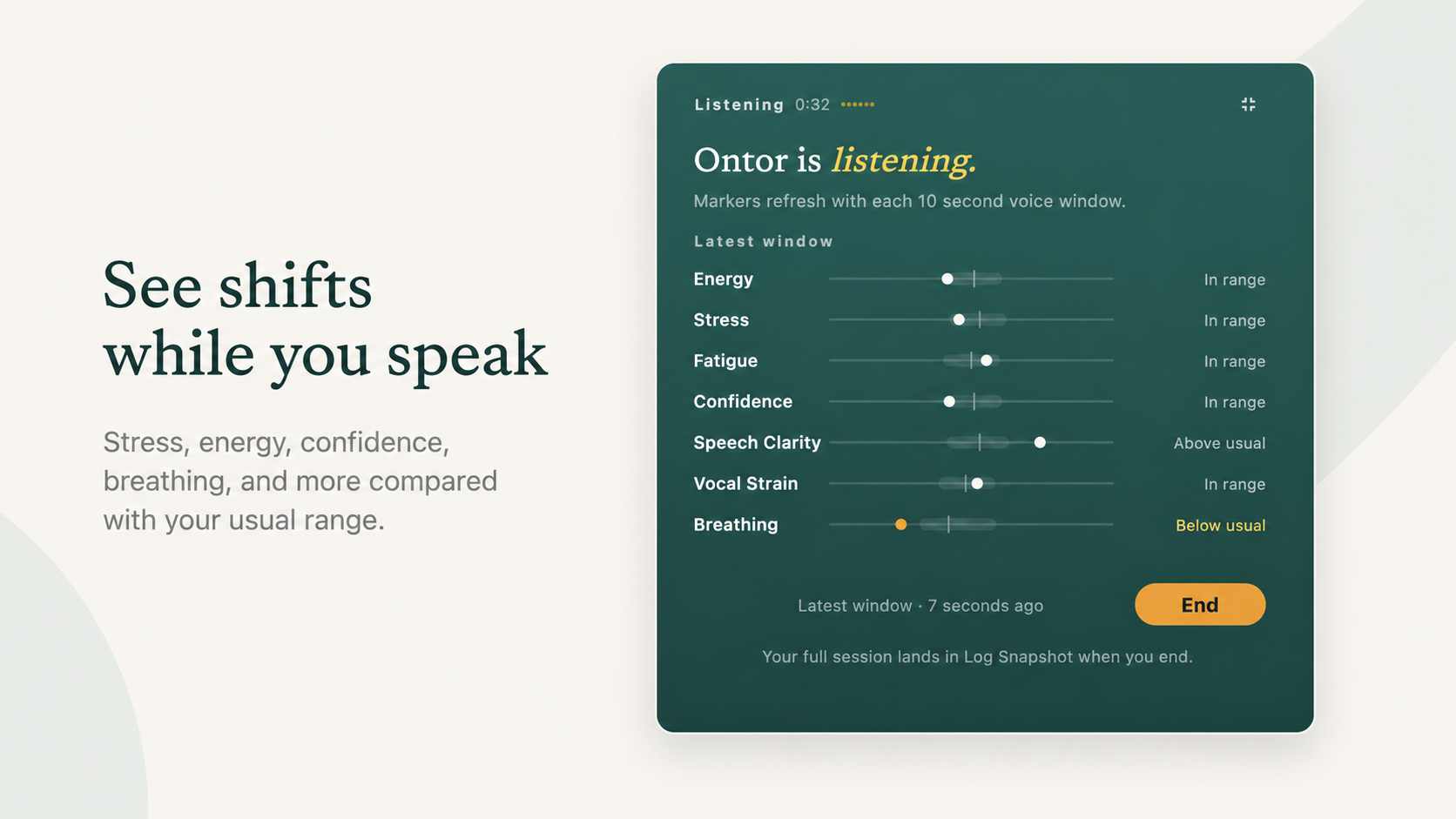
The listening card is the close-in view. The words on it say markers refresh with each 10 second voice window, against my usual range. Energy and confidence are on that card. On this particular window, breathing sits below my usual while several other markers sit in range. That is a reason for me to look again before I trust that I sound like myself. It is my session. It is not a recording of the bad call in this article, and a single below-usual marker is not a failed reset by itself:
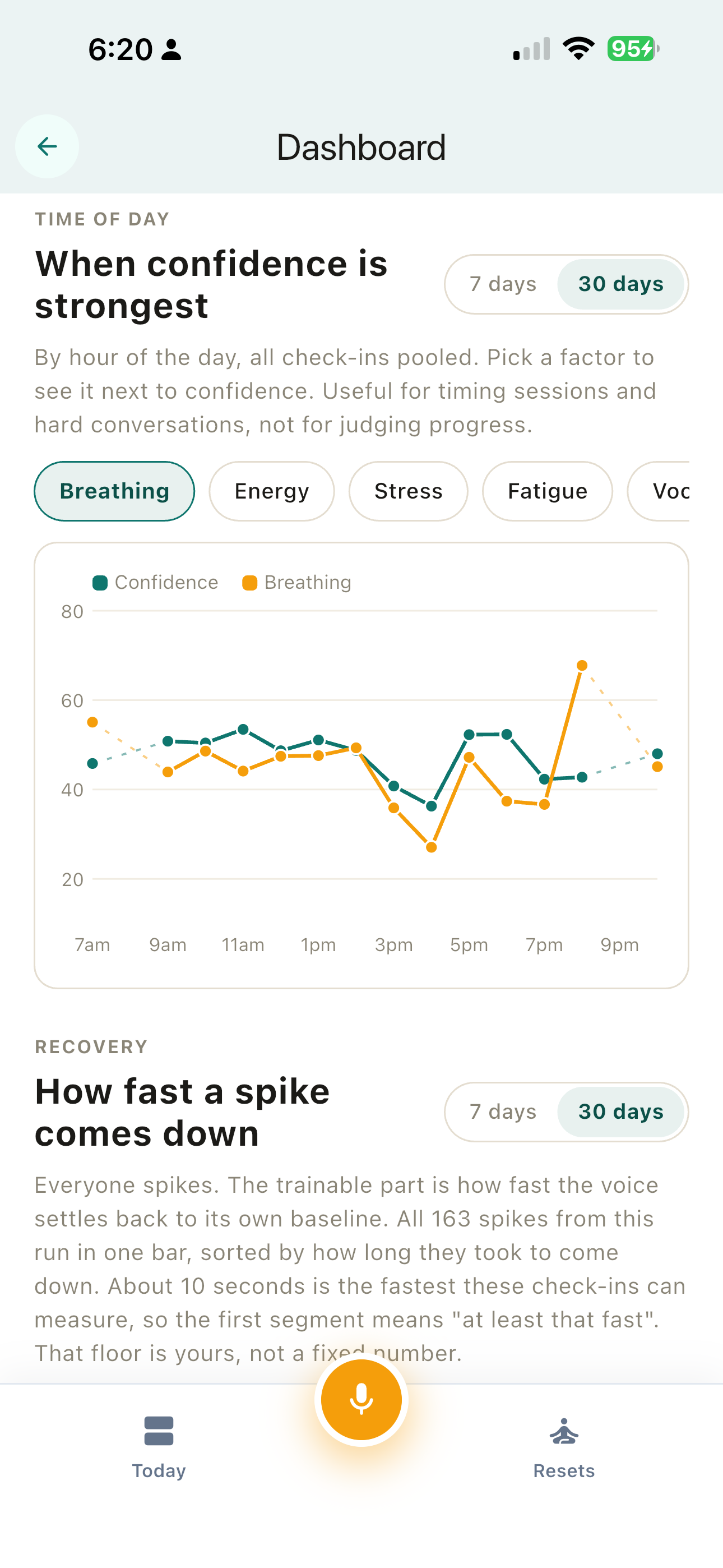
The next screen is two panels from the same view, and only one of them is the between-call question. Up top, confidence sits next to breathing by hour. The copy on the screen says that pool is for timing sessions and hard conversations, not for judging progress. An afternoon dip can show that one part of my speaking day is not like another. It cannot tell me whether the minute after a bad hang-up brought me back. That hour chart is too coarse for this problem.
Under it, the panel that does match is labeled "How fast a spike comes down." The screen says the trainable part is how fast the voice settles back to its own baseline. It also says about 10 seconds is the fastest these check-ins can measure, so the first segment means "at least that fast," and that floor is yours, not a fixed number. The 163 spikes are the count on this run of my data, not a sample of cold callers. Read it as: after a spike, did my voice settle toward my baseline, at the resolution the check-in actually has. It is not a stopwatch that proves a 60 second ritual worked.
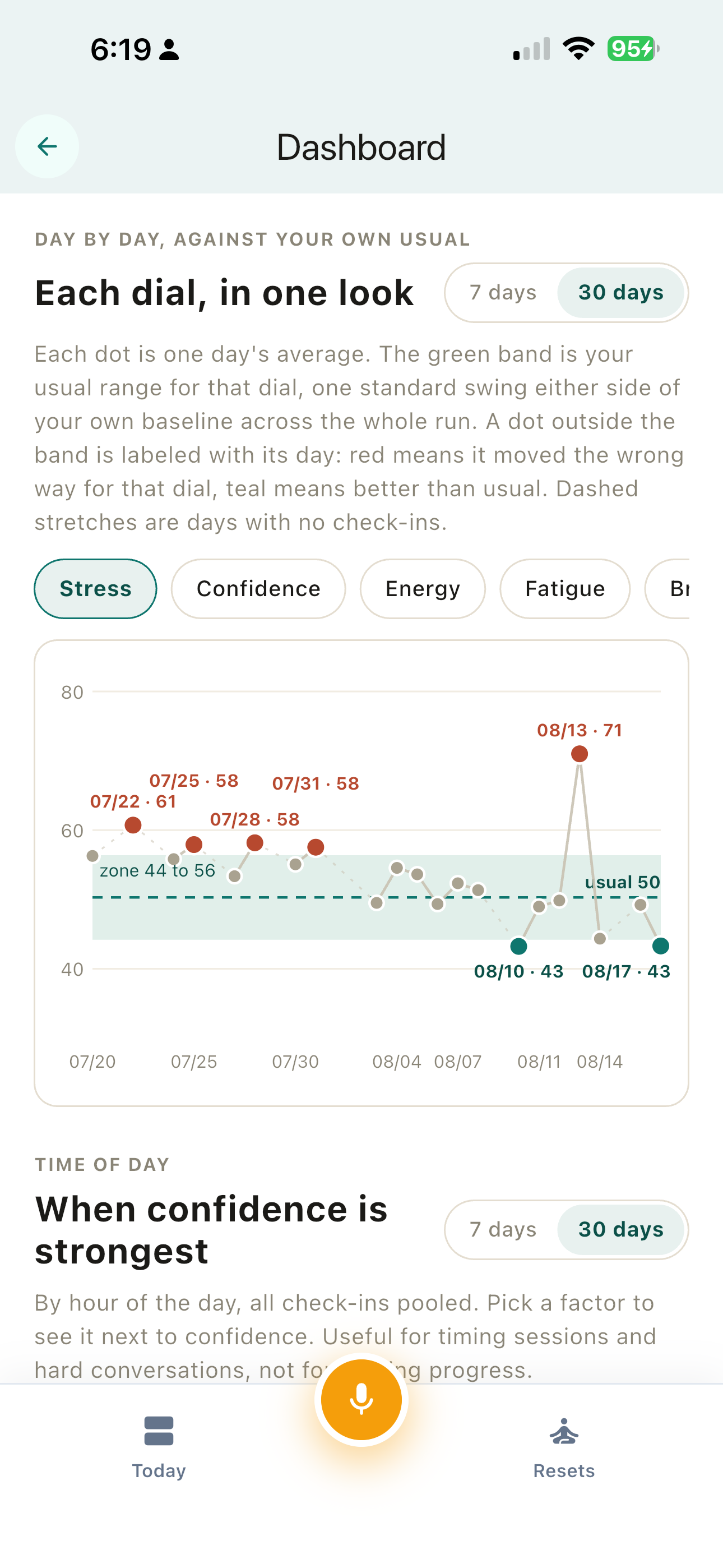
The day view is later still, and the heading is easy to misread. It says "Each dial, in one look." The sentence under that says each dot is one day's average, against my own usual band for that dial. On stress, the band shown is a zone of 44 to 56 around a usual of 50. A day average is hindsight. It will not tell me, before the next number, whether a claimed reset brought this voice back. It is my days, not a list of reps:
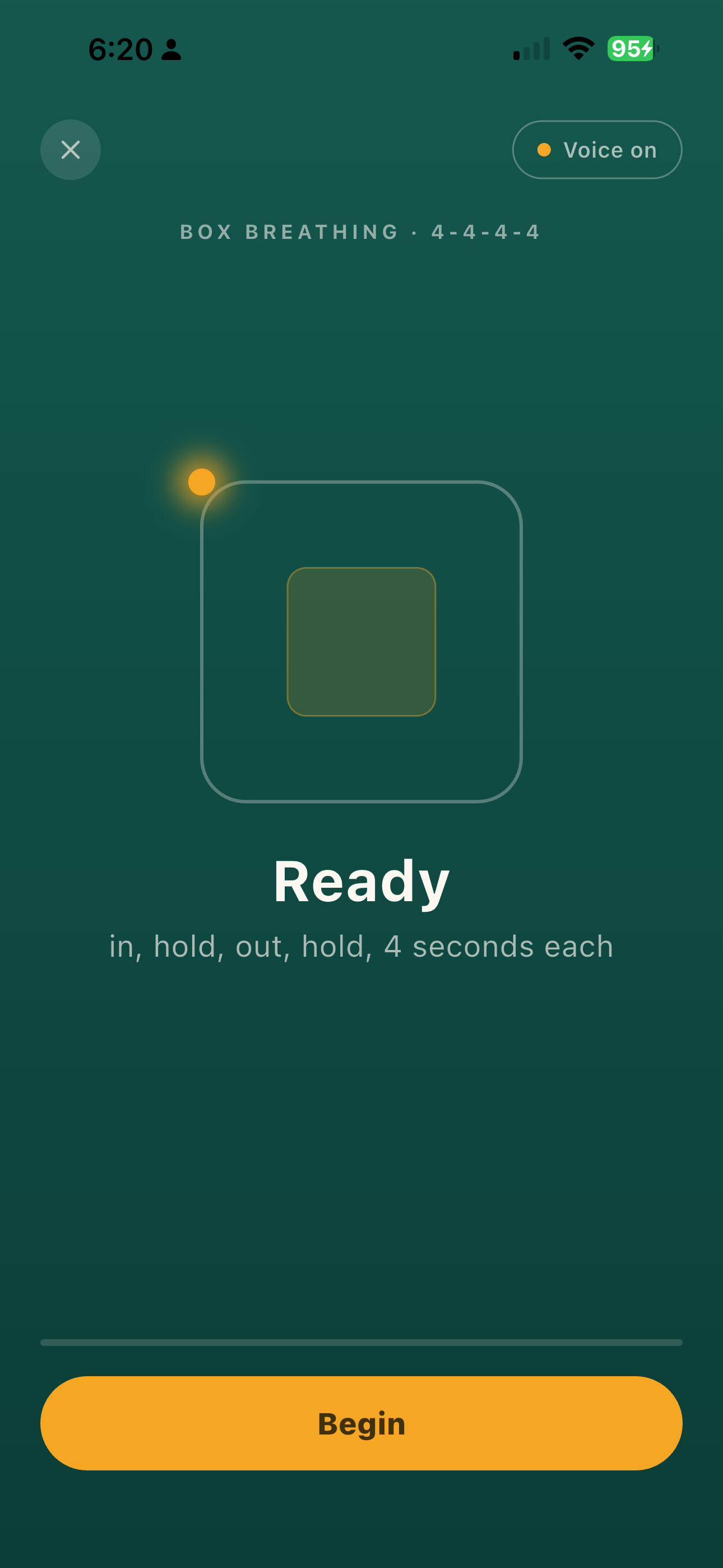
The short reset on offer, if the latest window is still off, is box breathing, 4-4-4-4. In, hold, out, hold, 4 seconds each. I would use it only after I already think I put the last call down and the window still disagrees, and then I would look at the next window before I dial. It is not a medical protocol. Nothing on this screen shows that a reset cleared the previous call:
Download Ontor - 14 days free, no card required
What to try on the next call {#try-on-next-call}
Do this on the next bad one, not as a team pilot.
- Install Ontor on the machine you already use for dials.
- After the bad call, do the reset you already trust. The 60 seconds, the walk, the water. Whatever you actually do when you tell yourself you are fine.
- Before you dial, look at the latest 10 second window against your own usual range. You are checking whether how you sound came back. Not whether you feel done. Not a floor average. Not whether the opener was the right sentence.
- If the window is still off your usual range, take the short reset or wait for one more window, then look again. Then dial. A marker move is not proof the next person will stay on the line. Moore's hurry-up still applies once they pick up: if they rush you, slowing down is a choice, and the window will not make it for you.
If someone who runs the floor finds this later, the light secondary path is Ontor for teams. Install stays the only real ask. Your read stays yours.
Bottom line
Cobb's comment still stands on its own. You may think you have reset mentally, and your tone can still carry the frustration into the next conversation. The 60 second ritual can feel finished without checking that. Moore's speed-up is a second way the next dial picks up a state the buyer can feel, and it is not the spine. The lab work supports a narrower claim: prosody often carries high-arousal states, people differ, and your own usual range is the comparison that makes sense. It does not prove a mental reset failed, and it does not prove a short reset fixed the voice.
Try it on the next bad dial. Do the reset you already believe in. Look at the window before you dial again.
Download Ontor - 14 days free, no card required
About the author
Sabber Ahamed is the founder of Ontor and an applied ML scientist (PhD, geophysics and signal processing) who builds on-device voice tools. Ontor compares how you sound with your own usual ranges and can suggest a short reset. Marker changes are not clinical outcomes, and they are not proof a conversation went better.
References
- Ian Cobb, comment on Future Of Sales, "Leave the last call where it ended." LinkedIn. Spine. https://www.linkedin.com/posts/future-of-sales67_leave-the-last-call-where-it-ended-a-bad-activity-7496512678681673728-exvd
- Yonathan Levy, comment on the same thread. State before script. Not a lab timing result. https://www.linkedin.com/posts/future-of-sales67_leave-the-last-call-where-it-ended-a-bad-activity-7496512678681673728-exvd
- Richard Moore. Early-career hurry-up and nervous speed-up. LinkedIn. Corroboration, not the spine. https://www.linkedin.com/posts/richardjamesmoore_richtips-activity-7496204443974127616-TWpR
- Sam Anders. Shaky voice and high breath. LinkedIn. Vendor, capped. https://www.linkedin.com/posts/sam-anders_cold-hands-dry-mouth-shaky-voice-three-activity-7501681758141276160-eKau
- Hugo Munktell. Recorded voice sounded thin and flat versus the voice in his head. LinkedIn. Capped. Not frustration carryover. https://www.linkedin.com/posts/hugomunktell_do-you-hate-the-sound-of-your-own-voice-activity-7377306127564357632-9AlH
- Catherine Zugwai Luka. Mid-call freeze, and the prospect may have noticed less than she did. LinkedIn. Capped. Different moment. https://www.linkedin.com/posts/luka-catherine-resume-writer_freezing-during-sales-calls-is-a-real-thing-activity-7479806436882182144-eN7n
- Ben-David, B. M., Multani, N., Shakuf, V., Rudzicz, F., and van Lieshout, P. H. H. M. "Prosody and Semantics Are Separate but Not Separable Channels in the Perception of Emotional Speech: Test for Rating of Emotions in Speech." Journal of Speech, Language, and Hearing Research, 2016. https://pubs.asha.org/doi/10.1044/2015_JSLHR-H-14-0323
- Schewski, L., Magimai Doss, M., Beldi, G., and Keller, S. "Measuring negative emotions and stress through acoustic correlates in speech: A systematic review." PLOS One, 2025. https://journals.plos.org/plosone/article?id=10.1371/journal.pone.0328833
- Streeter, L. A., Macdonald, N. H., Apple, W., Krauss, R. M., and Galotti, K. M. "Acoustic and perceptual indicators of emotional stress." Journal of the Acoustical Society of America, 1983. Discussed in Schewski et al. for the listener-versus-automated split. https://pubmed.ncbi.nlm.nih.gov/6853847/
- McKenna, V. S., and Stepp, C. E. "The relationship between acoustical and perceptual measures of vocal effort." Journal of the Acoustical Society of America, 2018. https://pmc.ncbi.nlm.nih.gov/articles/PMC6167228/
- Solomon, N. P. "Vocal fatigue and its relation to vocal hyperfunction." Review indexed at PubMed 20840041. Counterpoint: clinical vocal fatigue is something speakers often perceive. https://pubmed.ncbi.nlm.nih.gov/20840041/
- Hunter, E. J., and colleagues. "Toward a Consensus Description of Vocal Effort, Vocal Load, Vocal Loading, and Vocal Fatigue." Journal of Speech, Language, and Hearing Research, 2020. https://pubmed.ncbi.nlm.nih.gov/32078404/
- Tomassi, N. E., Turashvili, D. M., Williams, A., Walsh, B., Stephen, E. P., and Stepp, C. E. "Investigating Cognitive Load and Autonomic Arousal During Voice Production and Vocal Auditory-Motor Adaptation." Journal of Speech, Language, and Hearing Research, 2025. https://pubs.asha.org/doi/10.1044/2024_JSLHR-24-00601
- Tomassi, N. E., Turashvili, D. M., Williams, A., Walsh, B., Stephen, E. P., and Stepp, C. E. "Autonomic Arousal During Speech Production and Sensorimotor Adaptation." Journal of Speech, Language, and Hearing Research, 2025. https://pmc.ncbi.nlm.nih.gov/articles/PMC12806056/
- Hunter, E. J., and Titze, I. R. "Quantifying vocal fatigue recovery: dynamic vocal recovery trajectories after a vocal loading exercise." Annals of Otology, Rhinology & Laryngology, 2009. https://pubmed.ncbi.nlm.nih.gov/19663377/
- Ontor. "How it works." https://ontor.ai/how-it-works/
- Ontor. "Ontor for teams." https://ontor.ai/for-teams/
- Ontor. "About the founder." https://ontor.ai/about/
- Ontor. "Install Ontor." https://ontor.ai/install/
- Ontor. "Leaders treat the minutes between calls as empty. The hangover isn't." https://ontor.ai/blog/hangover-between-sales-calls/
- Ontor. "A bad cold call should last 30 seconds. Why does yours last all day?" https://ontor.ai/blog/bad-cold-call-should-last-30-seconds/
- Ontor. "The deal closed. Your nervous system didn't. Why the next call still sounds sharp." https://ontor.ai/blog/post-deal-tired-wired-next-call-sharp/
- Ontor. "Your voice cracked mid-call. The prospect heard the shake." https://ontor.ai/blog/mid-call-voice-crack-prospect-hears/
- Ontor. "You Coach the Nervous System. You've Never Been Able to Measure It." https://ontor.ai/blog/measure-nervous-system-regulation/
- Ontor. "You already built a midday phone reset. Can anyone tell if it restored readiness?" https://ontor.ai/blog/staffing-midday-reset-verification/
- Ontor. "You QA Mini-Miranda. You still miss when a collector isn't themselves after a rough open." https://ontor.ai/blog/collections-compliance-hangover-self-reset/
- Ontor. "Your remote collectors don't have a hallway. Dials still act like they do." https://ontor.ai/blog/collections-remote-no-hallway-reset/
- Ontor. "Around call sixty, delivery flattens before you can feel it." https://ontor.ai/blog/midmarket-call-sixty-delivery-flatten/