
You didn't decide to sit for five hours. Your calendar did.
You sat down with a coffee before the first client call. You look up and it's mid-afternoon. Same chair, same spot, and somewhere in there you talked to a string of clients. You never chose to sit for five hours. The calendar chose it, one accepted invite at a time, and nothing in the day told you the hours were going by.
If you set a timer to fix that, you probably know what happens next. It goes off during a call with a client, you hit dismiss, and that's the end of it.
This piece is for people who spend the day at a computer and talk a lot with clients or customers: founders, consultants, account managers, advisors, CTOs who are on camera all afternoon. People working as themselves. It isn't about eyes that hurt by 5 PM after a wall of video, a throat that's tired after three client calls, a brain still in conversation mode after the call ends, or the afternoon fade on a sales dialer. It's about something earlier and quieter: the hours you didn't notice, and why the fixed alarm you set to catch them keeps losing.
Download Ontor - 14 days free, no card required
"Like 5 hours, surviving on coffee"
A remote worker on r/remotework described the moment most of us know. The thread is from around May 2025. Their handle wasn't captured in our research note, and the quotes below come from public search highlights because the page itself was blocked. "there are times that I realize I've been sitting in the same spot for like 5 hours, surviving on coffee and glued to my screen." Then the question: "What’s your go-to way to get moving when you’re in the middle of back-to-back calls?"
The replies weren't about willpower. One person said: "once I sit down on my seat, I end up working nonstop. 90% of the time, I get up because either I'm super hungry, need a biobreak, or it's time to pickup the kids." Hunger, the bathroom, or school pickup ended the stretch. A decision never did.
Then the line that matters most for this article: "Setting alarms doesn't work. I just end up dismissing them."
A commenter in a phone-heavy role described the talking version. "I’ll just keep on answering the phone once call after the other and forget to put myself in the right code so I can go on break." The stretch only ended when their mouth got so dry that "it clicks that I’ve been talking for hours on end."
That thread is older than I'd like and it's a handful of voices, so treat it as a pattern people recognize, not a measurement. But the pattern is consistent: hours go by unnoticed, the fixed reminder gets swatted, and in the end something physical forces the break.
A CTO on the meeting wall
Gilles Crofils, a hands-on CTO, wrote about his own workday on his personal blog in March 2026. Mornings are loose. "08:30 is still yours. Then the calendar sets like concrete and it’s 11:00 to 17:00 in back-to-back calls, camera on, brain on, body… not invited."
He's blunt about what that does: "i can work a full day without eating, drinking, or moving, which sounds impressive until you notice the costs."
His post is framed around drinking water in meetings, and that's his experience to write about. The sentence I keep coming back to is a different one: "The meeting wall deletes the tiny transition moments where habits normally live." He argues the six-hour block usually isn't the real bottleneck. The zero-buffer transitions between calls are.
That's a scheduling explanation, not a character flaw. It also explains why the Reddit thread sounds the way it does.
Why the hours don't register
When your attention is on a client, a deck, and the next question, very little of it is left for the clock. Block, Hancock, and Zakay pooled 117 experiments on cognitive load and time judgments (Acta Psychologica, 2010). When people knew in advance they'd be asked how long something took, heavier mental load made the interval feel shorter. Looking back afterward, without that warning, the effect ran the other way. These are lab tasks, not consulting days. Still, the in-the-moment result fits what the Reddit poster described: busy attention and a shrinking sense of how long you've been in the chair.
Our guesses about sitting are also noisy. A 2020 meta-analysis compared self-reported sedentary time with device measures across 123 studies and 55,199 participants (Prince and colleagues, International Journal of Behavioral Nutrition and Physical Activity). On average, self-report came in about 1.74 hours a day lower than the devices. For time at work specifically, self-reports ran about 40 minutes higher, and individual studies swung by up to 6 hours a day. So I won't claim you always underestimate. The honest version is that a guess at the end of the day isn't a reliable count in either direction.
The transitions were doing the reminding
Psychologists define a habit as an action triggered automatically by a context cue that's been paired with it. Gardner, Lally, and Wardle give the example of putting on a seatbelt after getting into the car (British Journal of General Practice, 2012). The cue does the work so you don't have to remember.
In an office, the walk to a meeting room, the end of a meeting, and the hallway back were cues like that. A calendar with zero buffer removes them. You go from one video window to the next without standing, so the cue that used to say "get up" never fires. That's Crofils' point about transition moments, put in habit terms.
Why the fixed alarm keeps losing
Break prompts can work. Evans and colleagues gave office workers software that reminded them to stand every 30 minutes, plus a short education session, and compared them with education alone (American Journal of Preventive Medicine, 2012). It was small, 14 people per group over five workdays, measured with thigh-worn activPAL monitors. The prompt group cut the number and length of sitting bouts over 30 minutes compared with the control group. Total sitting time didn't change significantly. Swartz and colleagues found something similar with hourly prompts: average sitting bouts got shorter by 16 to 19 percent (Preventing Chronic Disease, 2014).
So reminders can shorten long sits. The open question is whether you act on one when it fires.
A fixed timer fires whether or not anything changed. On a call-heavy day, that means it often fires in the middle of a client call, which is exactly when you'll dismiss it. Research on alert fatigue in a very different setting points the same way. Ancker and colleagues looked at clinicians' responses to electronic health record reminders (BMC Medical Informatics and Decision Making, 2017). The likelihood of accepting a reminder dropped about 30 percent for each additional reminder in a visit, and about 10 percent for each five-point rise in the share of repeated reminders. They did not find a slow decline over time for newly deployed reminders. Volume and repetition were what hurt. Doctors aren't founders, so take that as a parallel, not proof.
Behavioral researchers have a name for the alternative. A just-in-time adaptive intervention tries to give support at the right moment by adapting to a person's changing state and context, instead of on a fixed schedule (Nahum-Shani and colleagues, Annals of Behavioral Medicine, 2018). That paper is a design framework. It doesn't prove any particular product works.
As background only: the WHO's 2020 guidelines recommend that adults reduce sedentary time, while noting the evidence wasn't strong enough to set a specific threshold (Bull and colleagues, British Journal of Sports Medicine, 2020). This article isn't making any health outcome claim beyond that. The narrower problem here is that the hours go unnoticed and the alarm gets dismissed.
Download Ontor - 14 days free, no card required
What Ontor does with a long stretch
Ontor runs on your Mac or Windows desktop. Alongside voice readings during calls, it looks at basic computer interaction (typing, clicking, scrolling, and pauses) to describe the pace of your work. It doesn't save what you type, which keys you press, or what you click on. The Today view shows your total activity time for the day, your longest uninterrupted stretch, and your current stretch, so the five hours are a number on the screen instead of a surprise.
The reminder logic is the part that matters for the dismissed-alarm problem. Per How Ontor works, for computer work Ontor considers time without a break and whether your work rhythm has stayed below your usual level. A long uninterrupted stretch can also prompt a reminder. So the nudge is tied to how your own pattern is drifting from your usual range, not only to a clock. When it shows up, the desktop suggests something simple like a five-minute break. You can move it, snooze it, or dismiss it. You can also answer "Are you feeling tired?" with Yes or No, and that feedback helps personalize later work-rhythm readings.
To be straight about it: you can still dismiss an Ontor reminder. What changes is that snooze is a real option mid-call, so you can push it past the client instead of killing it, and the reminder has a reason behind it that's about your day rather than the half hour.
What Ontor does not do:
- Measure how much water you drink or anything about hydration
- Prevent disease, or make any claim about weight, heart health, or diabetes
- Diagnose emotional state or any health condition
- Detect eye strain or change your vision
- Diagnose your nervous system
- Rank you, report on you to a manager, or promise ROI
My own calendar, in my own screens
These are from my own Ontor use as the founder. They're founder exploratory data, not a customer and not a study. I picked them because they show the problem in this article, not because they're pretty. One gap to be upfront about: I don't have a clean capture of the desktop activity panel (activity time, longest uninterrupted stretch, current stretch) for this post, so I've described that panel above from the How it works page instead of showing a mock.
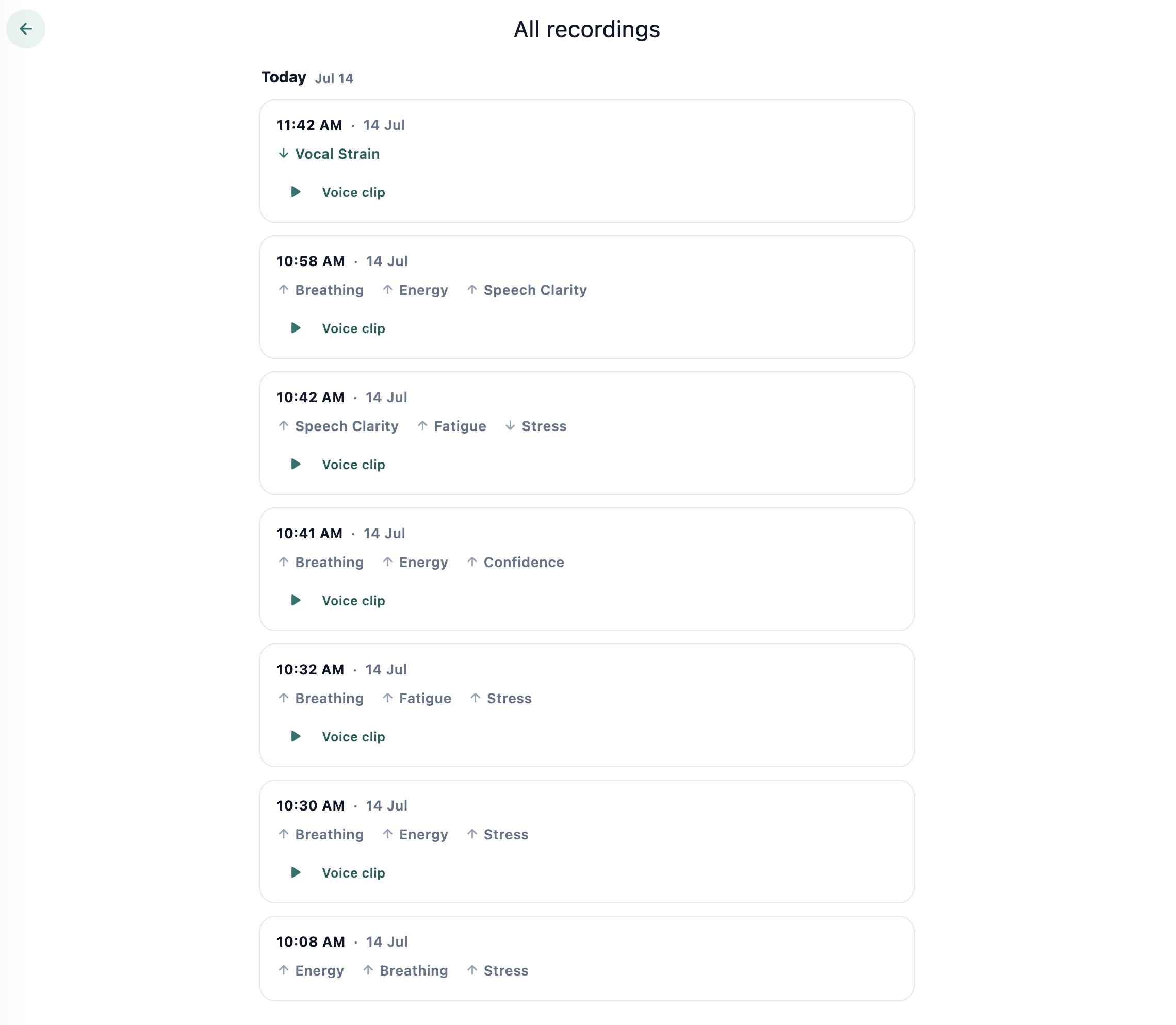
The first is a list of voice sessions from one July morning. Sessions started at 10:08, 10:30, 10:32, 10:41, 10:42, 10:58, and 11:42. That's seven starts in about an hour and a half. Nobody plans a morning like that in one decision. It builds up one accepted invite at a time. The list can't tell you whether I stood up between them. That's exactly why the activity side of Today, with the longest uninterrupted stretch, is the number I care about on days like this.
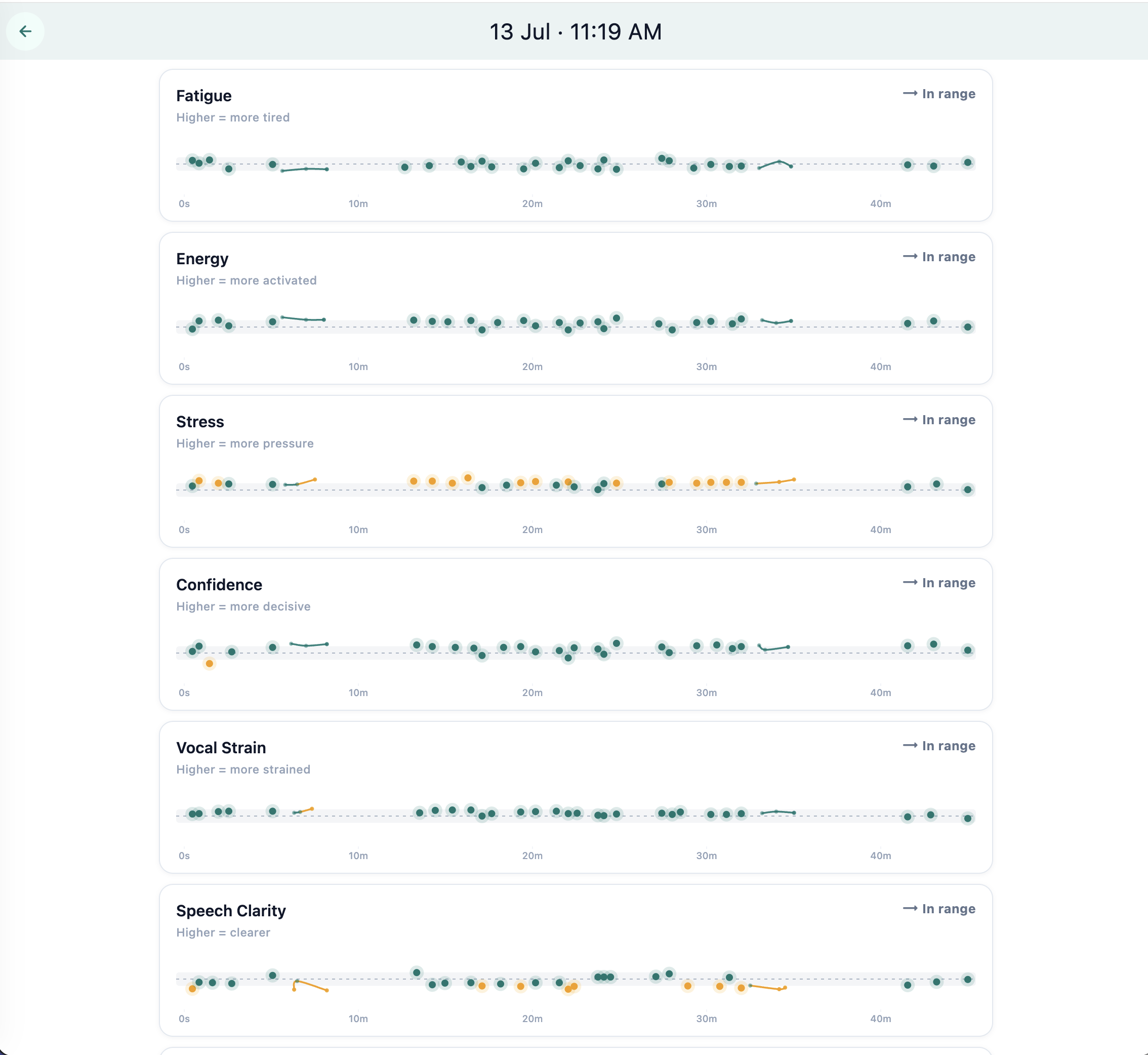
The second is one roughly 45-minute call from the day before. Every marker card in view reads "In range." I'm including it because it's the honest picture. A long stretch doesn't announce itself in your voice, and voice readings are not a sitting alarm. The stretch and the work rhythm are what drive the break reminder.
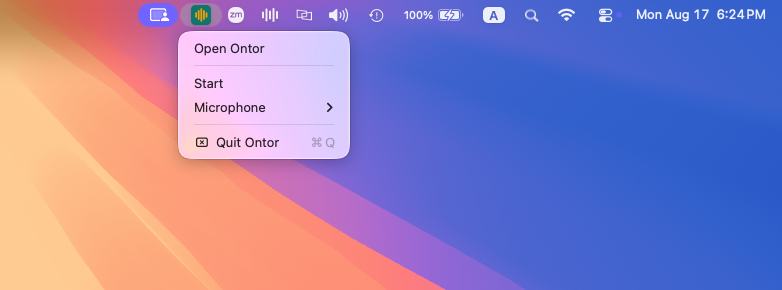
Third, where it lives. Ontor sits in my menu bar next to Zoom, and sessions can start automatically when the microphone is in use. For a problem that's about forgetting, a tool that needs you to remember to switch it on would be useless.
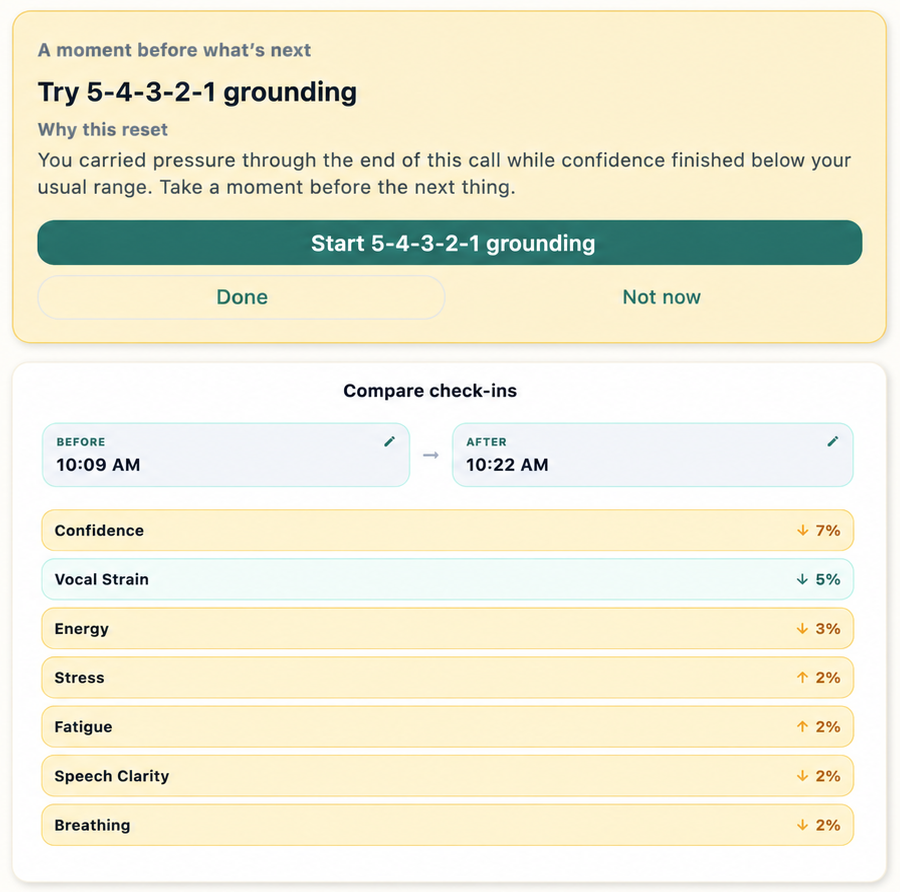
The last one is a reset suggestion from my own use, cropped from a screenshot we prepared for our beta listing. This one was triggered by a voice session, not by the work-rhythm break reminder, so it isn't the five-minute-break card itself. I'm showing it for the shape. It says why it's showing up (pressure through the end of a call, confidence finishing below my usual range), and it has a "Not now" button. A reason tied to my own range plus a way to defer it is the opposite of an alarm I'd dismiss without reading.
Try it on your next call-heavy day
This is a try-on-next-stretch experiment, not a sales pilot. Pick the next day where your calendar is mostly client calls.
Keep whatever timer you already use. Each time you dismiss it, make a tick on a sticky note. At the end of the day, write down how long you think your longest stretch in the chair was. Then open Today and compare that guess with the longest uninterrupted stretch Ontor shows, next to your tick count.
During the day, when the snoozable nudge appears (because your work rhythm drifted below your usual range, or the stretch ran long), don't dismiss it. If you're mid-call, snooze it. At the next gap between calls, take the five-minute break once. One day is enough to see whether the stretch your calendar built is longer than you'd have guessed.
Download Ontor - 14 days free, no card required
References and sources
- Reddit r/remotework. "Remote workers, how do you actually remember to..." OP and commenters on sitting about 5 hours, dismissed alarms, and realizing hours of talking (about May 2025, public search highlights, handles not captured). https://www.reddit.com/r/remotework/comments/1keth48/remote_workers_how_do_you_actually_remember_to/
- Crofils, G. Stop getting punished for drinking water in back-to-back meetings. Personal blog, 2026-03-06. https://www.crofils.com/2026/03/06/stop-getting-punished-for-drinking-water-in-back-to-back-meetings.html
- Block, R. A., Hancock, P. A., and Zakay, D. How cognitive load affects duration judgments: A meta-analytic review. Acta Psychologica, 2010. https://pubmed.ncbi.nlm.nih.gov/20403583/
- Prince, S. A., and colleagues. A comparison of self-reported and device measured sedentary behaviour in adults: a systematic review and meta-analysis. International Journal of Behavioral Nutrition and Physical Activity, 2020. https://pubmed.ncbi.nlm.nih.gov/32131845/
- Gardner, B., Lally, P., and Wardle, J. Making health habitual: the psychology of habit-formation and general practice. British Journal of General Practice, 2012. https://pubmed.ncbi.nlm.nih.gov/23211256/
- Evans, R. E., and colleagues. Point-of-choice prompts to reduce sitting time at work: a randomized trial. American Journal of Preventive Medicine, 2012. https://pubmed.ncbi.nlm.nih.gov/22898122/
- Swartz, A. M., and colleagues. Prompts to disrupt sitting time and increase physical activity at work, 2011 to 2012. Preventing Chronic Disease, 2014. https://pubmed.ncbi.nlm.nih.gov/24784909/
- Ancker, J. S., and colleagues. Effects of workload, work complexity, and repeated alerts on alert fatigue in a clinical decision support system. BMC Medical Informatics and Decision Making, 2017. https://pubmed.ncbi.nlm.nih.gov/28395667/
- Nahum-Shani, I., and colleagues. Just-in-Time Adaptive Interventions (JITAIs) in Mobile Health: Key Components and Design Principles for Ongoing Health Behavior Support. Annals of Behavioral Medicine, 2018. https://pubmed.ncbi.nlm.nih.gov/27663578/
- Bull, F. C., and colleagues. World Health Organization 2020 guidelines on physical activity and sedentary behaviour. British Journal of Sports Medicine, 2020. https://pubmed.ncbi.nlm.nih.gov/33239350/
- How Ontor works. https://ontor.ai/how-it-works/
- About the founder. https://ontor.ai/about/
- Install Ontor. https://ontor.ai/install/
- Back-to-back video, eyes fried by 5 PM (sibling). https://ontor.ai/blog/back-to-back-video-eyes-fried-5pm/
- Three client calls in, your throat already knows (sibling). https://ontor.ai/blog/three-client-calls-throat-already-knows/
- After Zoom, brain still in conversation mode (sibling). https://ontor.ai/blog/after-zoom-brain-still-in-conversation-mode/
- Dialer fatigue afternoon fade (sibling). https://ontor.ai/blog/dialer-fatigue-afternoon-fade/