
Three client calls in, your throat already knows.
By the third client call of the day, a lot of solo talkers already feel it in the throat. Not dramatic. Just that scratch, that thinner edge, that sense that the voice you started with is not the voice you have now. Across a Monday to Friday stack of sessions, demos, and catch-ups, the same tiredness can pile up.
This is for people who work as themselves on camera and on mic and talk a lot with clients or customers: founders, consultants, account managers, advisors, therapists, sales engineers. It is not how a seller sounds to buyers across a dial block. It is not body-to-voice flat on a dial floor by call 30. It is not a mid-call crack the prospect hears or voice tightening that shows up on the other end of a dialer. Those pieces are about how you sound to someone else on a sales floor. It is also not seven hours of back-to-back video that fries you by 5 PM or the focus hangover after one Zoom. The wedge here is narrower. Your own physical voice tiredness after a few client calls. Noticed early versus your usual range. Then a quiet break or a five-minute walk before the next one.
Download Ontor - 14 days free, no card required
Three calls, and the throat reports first
Matt Barker, a writer and consultant who also runs client catch-ups and paid consulting calls, put it in plain LinkedIn language. He said he does not know how people spend 20-plus hours a week on calls. He finds it tiring. He is not built to talk that much. His throat literally hurts when he is on three calls in a single day. He still likes chatting with clients and peers. He is a writer first.
Commenters on that post filled in the same shape without being asked. One said they literally lose their voice after two long calls. Another described a week of recruitment with dozens of near back-to-back calls and still looking for the piece of themselves they lost. Someone else had eleven networking calls in one week and felt wiped at the end of each day. Another said calls drain them faster than writing ever does.
Treat those as first-person accounts, not clinic notes. The useful spine is mechanical: a few talk-heavy client calls in a day → physical voice cost the talker can name → end-of-day wipeout when the week is call-dense. The problem shows up in the throat before the calendar looks "unreasonable."
Sales engineers and therapists name the same load
A sales engineer on Reddit (r/salesengineers; handle not captured in the research note; public search snippet) asked whether others get a raspy or sore throat after presenting all day or running multiple demos back to back. Peers answered with pacing, not heroics. Mute and take sips while the customer talks. On long demo days, avoid fizzy, cold, or sour drinks. A fully remote SE checks room humidity because dry air makes a raspy throat easier. One commenter suggested stress can push volume up and wear the voice.
Therapists talking about their own voice (not session content, not client states) report weekly accumulation. One clinician (r/therapists; handle not captured; public search snippet) said that after a long week of clients and talking, their voice was going out, and they need it for talk therapy. Peers suggested no-talking windows at lunch or after work, quiet time after a long week, water in every session, and seeing an ENT if it keeps happening. One peer said they lost their voice entirely in their first year (true laryngitis for a few days) and now sip water every session and try to talk less. That illness story is their history. It is not an Ontor claim and not the product's job.
A lighter corroboration only: career coach Kacie Bail wrote on LinkedIn that late last year, after three back-to-back coaching sessions, she started losing her voice. She first thought allergies. It got worse in her busiest week. She frames part of that stretch as getting sick. Cap that thread. Do not lead with it. Do not treat illness as an Ontor problem. Barker, the sales engineer, and the therapists already carry the talk-load spine without the confound.
What "vocal fatigue" means in the literature (and what it does not license)
In clinical writing, vocal fatigue is usually something the speaker can feel: a perceived rise in phonatory effort over time, sometimes with a drop in how the voice works. Solomon's review frames it that way (PubMed 20840041). That matches how Barker and the demo SE talk about their throats. It does not mean a desk tool diagnoses laryngitis, nodules, or any voice disorder. It does not mean Ontor is voice therapy or medical treatment. It does not mean Ontor prevents voice loss.
Hunter and colleagues (2020) argued the field had been sloppy with vocal effort, vocal load, vocal loading, and vocal fatigue. They split the speaking task (vocal demand) from how that person answers it (vocal demand response) (Journal of Speech, Language, and Hearing Research). The response is the talker's. That supports comparing you with your usual range when talk volume rises across a day. It does not validate a product. Nobody in that paper counted client calls to three.
One more limit on the break itself. After a two-hour oral reading load, Hunter and Titze tracked recovery in 86 adults and described about 90 percent of tracked recovery within 4 to 6 hours, with fuller recovery later, on the order of 12 to 18 hours (Annals of Otology, Rhinology and Laryngology, 2009). That is reading aloud in a study, not a consulting day. It says a short pause is not an instant snap-back to the pre-load voice in that protocol. A quiet break or a five-minute walk can still be worth doing between calls. It is not proof your voice is "fixed."
Wennberg and colleagues (2016, BMJ Open) found that short light walking breaks (about 3 minutes every 30 minutes) lowered self-reported fatigue versus uninterrupted sitting in a small crossover pilot. Cognitive scores did not clearly improve. So the honest background claim is narrow: interrupting a long sit with a short walk can blunt how tired people say they feel in that design. It is not a throat study. It is not Ontor's efficacy trial.
Public-health caution, separate from any product: if hoarseness lasts more than about two weeks, that is a reason to see a clinician. MedlinePlus lists lasting hoarseness (about two to three weeks in an adult, among other red flags) as a reason to contact a provider (MedlinePlus: Hoarseness). Ontor does not diagnose that. Ontor does not replace that visit.
Download Ontor - 14 days free, no card required
What Ontor can notice after a talk stretch (and what it will not)
Ontor is a tool that learns from your voice while you talk, then compares those readings with your personal usual range in short voice windows (on the order of about 10 seconds of speech). Markers that can show up in that personal comparison include vocal strain, energy, and fatigue. When a lasting shift shows up versus your usual band, the desktop can surface a snoozable reminder to take a short break or try a guided reset (site copy includes a five-minute break, and a quiet pause or short walk fits the same slot). You can snooze it, move it, or dismiss it.
That fit matches the three-calls problem without overclaiming. Voice during the talk stretch. A notice when vocal strain, energy, or fatigue leaves your usual range. A nudge to take a quiet break or five-minute walk before the next client call starts.
What Ontor does not do:
- Diagnose laryngitis, nodules, illness, or any health condition
- Act as voice therapy or medical treatment
- Prevent voice loss
- Diagnose mood
- Detect eye strain, improve vision, or prevent disease
- Use coach-style nervous-system diagnosis language
- Rank you, watch you for a manager, sell ROI, or treat anything medically
- Read therapy-session content (therapist sources here are about the clinician's own voice, not clients)
If your throat already knows after three client calls, that is your report. Ontor's useful response is different: whether vocal strain, energy, or fatigue left your usual range across the talk stretch, and a snoozable suggestion to take a quiet break or short walk before you open the next one.
Sabber after a stretch of talk: usual range, then a short reset
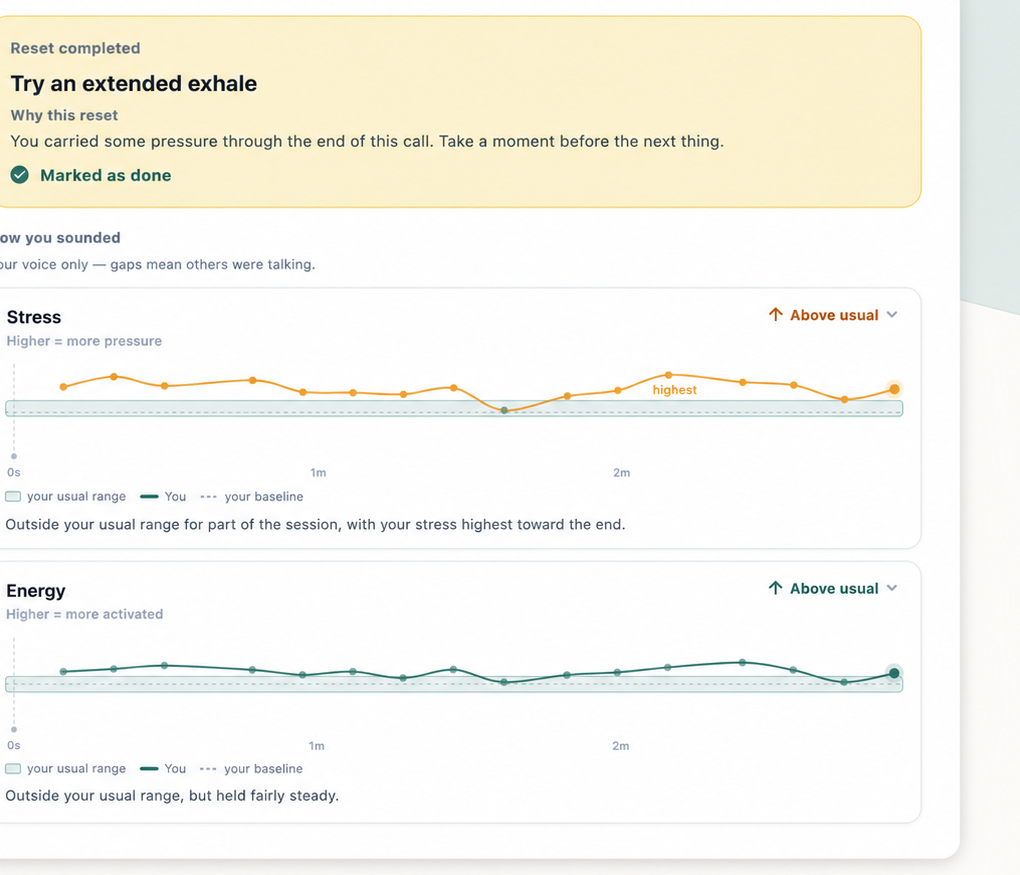
In my own Ontor sessions (founder exploratory data from my own product use, not a picture of Barker's throat, and not a clinical sample), I use the tool the way this problem actually shows up. After a stretch of talk I check how my voice sits versus my usual range before the next client call. I look at vocal strain, energy, and fatigue in short windows. When a lasting shift shows up, the next step I take is a short break or guided reset, not a claim that the product treated my voice.
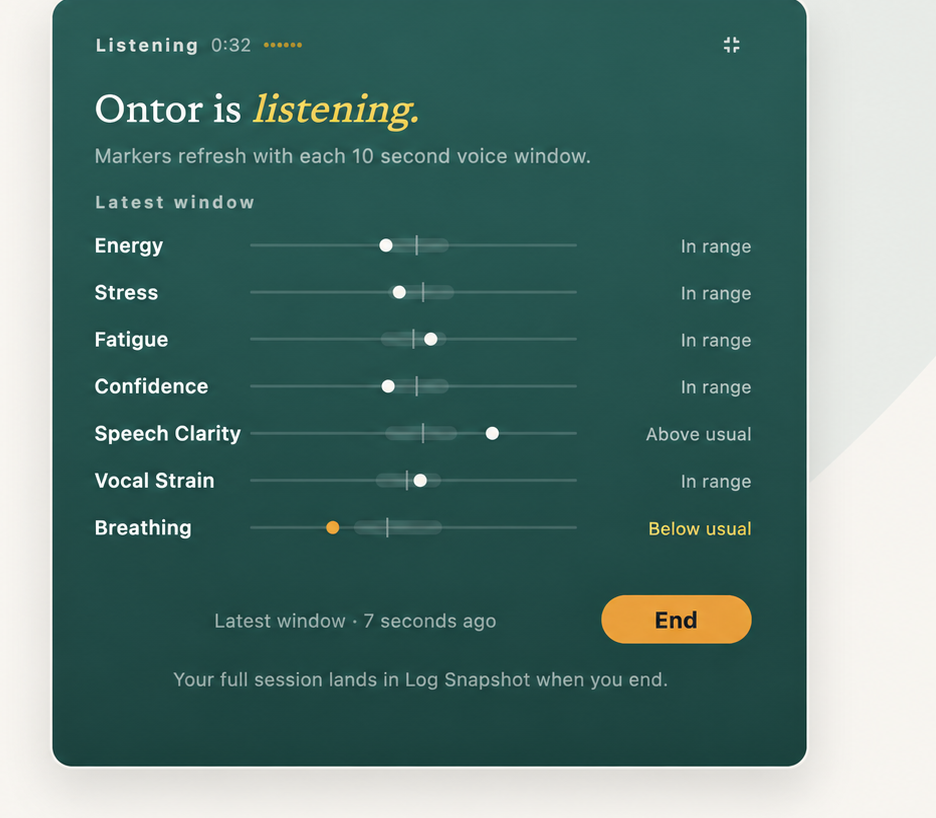
Here is a session view from that same exploratory use. Markers across a talk block sit next to my personal history so I can see whether the stretch left my usual band before I jump into the next call.
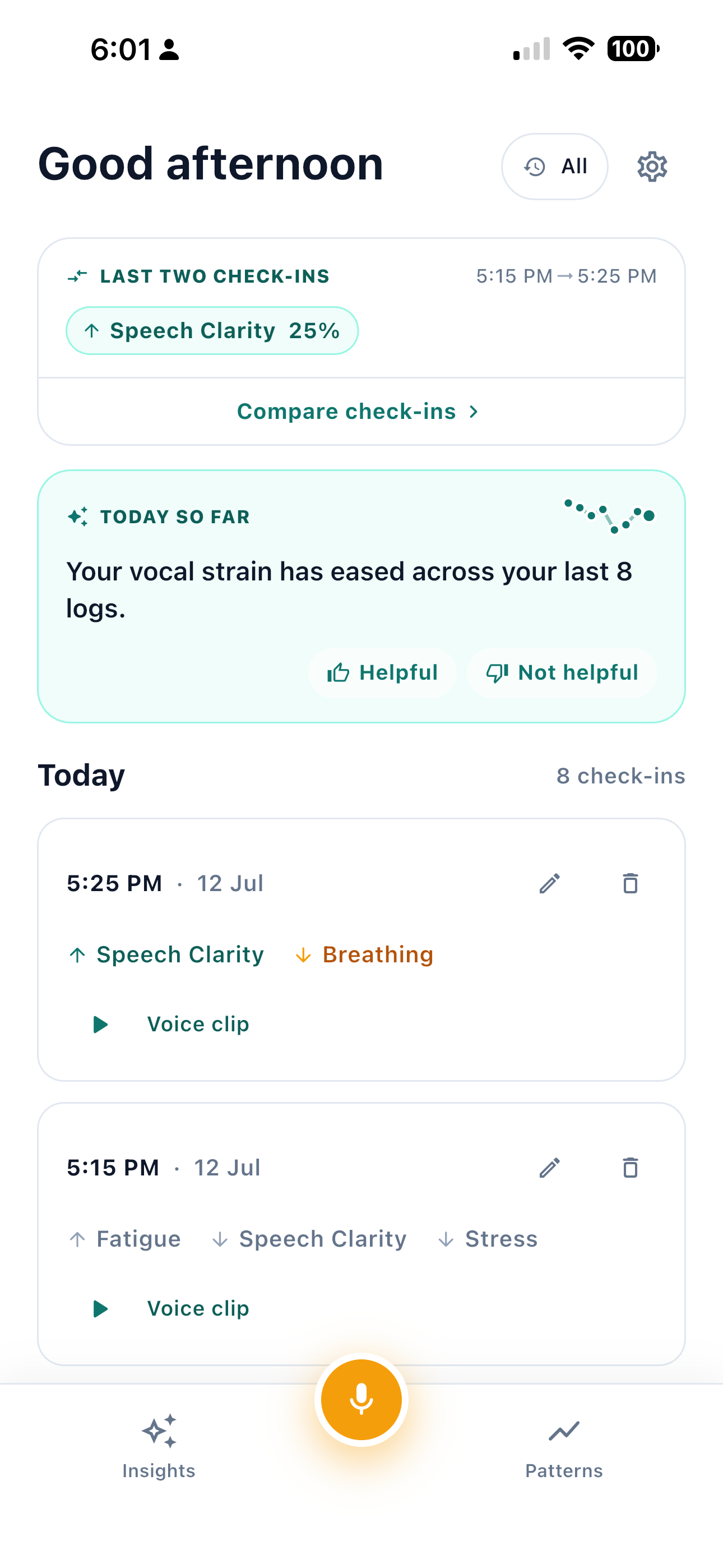
Today is where I look at how the day is stacking. Check-ins and session shifts sit next to my history so I can see whether vocal tiredness is accumulating Monday to Friday before I pretend the next call starts from zero.
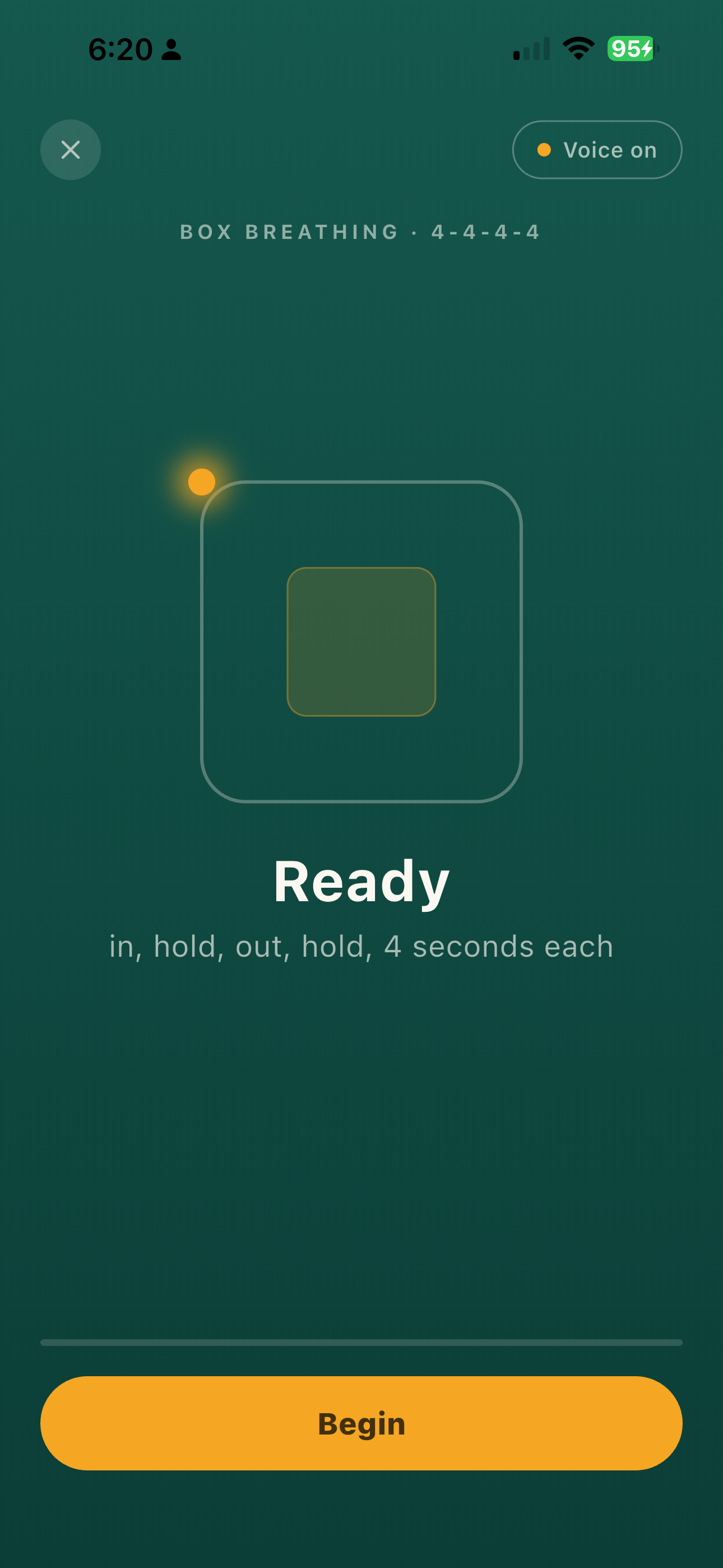
When the stretch needs a pause, box breathing is one short guided reset I can take between calls. It is not treatment. It is a few deliberate minutes of quiet before the next client hears me.
Try this after your next two or three client calls
After your next two or three client calls, do not open the next one on autopilot. Look at whether vocal strain, energy, or fatigue left your usual range. If the snoozable break nudge appears, take a quiet break or a five-minute walk once before you start talking again. That is a try-on-next-stretch step for your own voice load. Not a sales pilot. Not a team rollout pitch.
This is different from block-length-robot-voice, call-30-sit-sink-afternoon-flat, mid-call-voice-crack-prospect-hears, and prospects-hear-voice-tighten. Those articles are about how you sound to buyers on a dial floor. It is also different from back-to-back-video-eyes-fried-5pm and after-zoom-brain-still-in-conversation-mode. Those are about all-day screen stack and post-call focus hangover. This one is about the solo pro's physical voice tiredness after a few client calls, noticed early versus personal usual range, with a quiet break before the next stretch.
Download Ontor - 14 days free, no card required
References and sources
- Matt Barker (LinkedIn). Throat hurts on days with three calls; commenters on voice loss after long calls and call-dense weeks. https://www.linkedin.com/posts/mattjbarker1_i-dunno-how-people-spend-20-hoursweek-on-activity-7389208658703822848-X6lN
- Reddit r/salesengineers. Raspy or sore throat after back-to-back demos (public search snippet). https://www.reddit.com/r/salesengineers/comments/1vlzaoo/any_tips_for_a_worn_out_throat/
- Reddit r/therapists. Voice going out after a long week of clients; peers on no-talking windows (public search snippet; clinician's own voice). https://www.reddit.com/r/therapists/comments/1vnreml/how_do_you_protect_your_voice/
- Kacie Bail (LinkedIn). Lost voice after three back-to-back sessions (capped; partly illness). https://www.linkedin.com/posts/kaciebail_last-year-my-business-nearly-stopped-because-activity-7430691218331701248-ZtQV
- Solomon, N. P. Vocal fatigue and its relation to vocal hyperfunction. Review indexed at PubMed 20840041. https://pubmed.ncbi.nlm.nih.gov/20840041/
- Hunter, E. J., and colleagues. Toward a Consensus Description of Vocal Effort, Vocal Load, Vocal Loading, and Vocal Fatigue. Journal of Speech, Language, and Hearing Research, 2020. https://pubmed.ncbi.nlm.nih.gov/32078404/
- Hunter, E. J., and Titze, I. R. Quantifying vocal fatigue recovery: dynamic vocal recovery trajectories after a vocal loading exercise. Annals of Otology, Rhinology and Laryngology, 2009. https://pubmed.ncbi.nlm.nih.gov/19663377/
- Wennberg, P., and colleagues. Breaking up sitting and fatigue. BMJ Open, 2016. https://bmjopen.bmj.com/content/6/2/e009630
- MedlinePlus. Hoarseness (when to contact a medical professional). https://medlineplus.gov/ency/article/003054.htm
- How Ontor works. https://ontor.ai/how-it-works/
- About the founder. https://ontor.ai/about/
- Install Ontor. https://ontor.ai/install/
- Block-length robot voice (sibling). https://ontor.ai/blog/block-length-robot-voice/
- Call 30 sit sink afternoon flat (sibling). https://ontor.ai/blog/call-30-sit-sink-afternoon-flat/
- Mid-call voice crack prospect hears (sibling). https://ontor.ai/blog/mid-call-voice-crack-prospect-hears/
- Prospects hear voice tighten (sibling). https://ontor.ai/blog/prospects-hear-voice-tighten/
- Back-to-back video eyes fried by 5pm (sibling). https://ontor.ai/blog/back-to-back-video-eyes-fried-5pm/
- After Zoom brain still in conversation mode (sibling). https://ontor.ai/blog/after-zoom-brain-still-in-conversation-mode/