
A pressured voice can sound anxious or robotic. Coaches still treat them as different problems.
Sales coaches, voice coaches, and executive-presence coaches hear both complaints from the floors and rooms they serve. One client gets "too anxious" on the hard call: pitch climbs, the first sentence rushes, warmth drops out. Another gets "robotic": flat, narrow, no arc, like they put on a safety costume. Managers ask for more confidence. Technique coaches ask for more inflection. The same person can get both notes in the same week.
The channel already names the mechanism. The usual diagnosis still splits the symptom.
This piece is for coaches who sell voice, presence, and composure into call-heavy teams. It is not the category article on measuring nervous-system regulation. It is not block-length fade into robot voice. It is not voice tightening under live resistance. It is not pre-block shake when scripts fail. It is not practice holds, live dials don't. And it is not call-mode costume pitch-voice. The wedge here is narrower: one pressured state, two audible failure modes, and a live window when the coach is absent.
Download Ontor - 14 days free, no card required
One cascade. Two sounds coaches keep splitting.
Gina Razón (GROW Voice), a paying voice and communication coach who works with leaders and corporate rooms, put the dual failure mode in plain coach language:
"Under sympathetic nervous system activation, pitch rises and the arc narrows - which is why a pressured voice can sound either too anxious or robotic. Neither communicates authority."
Same upstream cascade. Pitch climbs. The phrase arc narrows. Downstream, the room hears anxiety or robot delivery depending on how that narrowed instrument shows up. Coaches who only coach "more energy" for the flat client, or "slow down / warmer" for the anxious client, are treating two outputs of one state as two different skill holes.
Razón's longer essay on the same cascade (why the voice changes when stakes go up) walks the order: breath shortens first, larynx compensates, rate accelerates. The dual-mode line sits inside the pitch-and-arc layer. Cap any clinical packaging. For this channel, the buyer phrase that matters is already on the page: pressured voice can sound either too anxious or robotic, and you are "communicating a nervous system state."
"You are not just communicating information when you speak - you are communicating a nervous system state."
"It does not matter that you took an elite leadership workshop, because this is not a confidence problem. It is not a preparation problem. It is a physiological cascade"
That is the misdiagnosis Ontor is aimed at for coaches. Not another workshop tip. A way to see whether the pressured state is still running in unsupervised live windows, before you decide the fix was confidence, technique, or both.
Corroboration: shake, tighten, poker tell under the same pressure
Krystal Diaz (Voice Empowerment Coach, 18 years with speakers and leaders under pressure) names the practice-to-live version coaches already feel:
"You can rehearse something a hundred times in private and still hear your voice shake when it really matters."
"You haven't suddenly "lost" your technique. Your survival response has simply taken over, and a steady sound can't travel on unsteady breath."
That is not a separate "anxiety product." It is the same pressured state showing up as audible shake after technique looked fine in the room.
Matthew Di Donato (Accent Clarity Coaching) hears the stakes version in nearly every diagnostic:
"Their speed increases. Their voice tightens. Their message becomes harder to follow."
"They think it's a confidence problem. Or a vocabulary problem. Or a practice problem. It isn't. It's a physiological rhythm problem."
Again: confidence vs technique vs practice. The coach is being invited into the wrong fork. Rhythm collapse under pressure is closer to Razón's cascade than to another vocabulary drill.
Hilary Blair (ARTiculate: Real & Clear), on a Voice Month podcast, names the tell coaches already hear in session:
"our voice is a total poker tell on what's going on with us"
"when nerves come in, nerves will always come in, they usually interrupt breath. And breath is the sole thing that powers our voice."
She describes how interrupting breath removes warmth and the lower register so the voice sounds higher and tighter, then shrill if it goes further. Poker-tell language is useful for the channel. Cap "take a deep breath" debates. The product-shaped gap is what happens between sessions: the coach can hear the tell in the room, then cannot see whether anxious-mode or robot-mode is still running on the unsupervised call block.
Distinct from the nearby Ontor cuts
| Published Ontor cut | Moment | What this article is not rewriting |
|---|---|---|
| Measure nervous-system regulation | Category problem of measuring regulation | Not the dual failure mode (anxious OR robotic) under one pressured cascade |
| Block-length robot voice | Cumulative fade into robot voice by lunch | Not same-pressure dual mode; not coach misdiagnosis of confidence vs technique |
| Prospects hear voice tighten | Live tonality under resistance during the call | Not anxious-vs-robotic as two outputs of one cascade for the coaches channel |
| Coach call-block voice presence | Pre-block regulation; scripts fail when the voice still shakes | Not dual audible modes under the same pressured state after the block starts |
| Practice holds, live dials don't | Practice→live transfer / delayed-clip gap | Not the anxious-OR-robotic dual-mode spine |
| Call-mode pitch voice | Forced professional phone costume off personal baseline | Not leading with call-mode costume; dual failure under one pressured cascade |
Same coaches ICP as several of those. Different question: when pressure hits, why does the same client sound anxious or robotic, and how do you see which mode is running when you are not in the room?
Download Ontor - 14 days free, no card required
What Ontor can add when the coach is absent
Ontor is a performance tool that reads how someone sounds, not what they said. While a person speaks, it compares voice signals to that person's own usual range. Markers refresh in short voice windows (on the order of about 10 seconds of speech). When a lasting shift shows up (for example stress, energy, speech clarity, vocal strain, or breathing), it can suggest a short reset. People can also compare before and after.
For a coach practice serving call-heavy teams, that sits next to the work you already sell. You still teach the interruption tools. Clients still own their readings. What you gain is a private usual-range view during unsupervised live speech: whether the pressured cascade is still pulling markers outside usual range in the anxious direction (higher activation, tighter delivery) or the robotic direction (narrowed energy/clarity against the same pressure), without waiting for the next sparse ride-along or autopsy clip.
This is not a claim that Ontor diagnoses health conditions, proves workshop transfer clinically, replaces 1:1 coaching, or guarantees booking rates. It is narrower: short live windows against personal usual range so coaches and clients can see whether the same pressured state is still audible as anxious or robotic when the coach is not there.
What shows up in my own Ontor history (anxious vs robotic under the same pressure)
I am Sabber Ahamed, founder of Ontor. I use the product on my own speaking and call-heavy days. In my own Ontor session history, the dual failure mode shows up the way Razón names it. Under the same kind of pressure, my markers can leave my personal usual range in more than one audible direction. Sometimes stress and energy climb together while breathing or clarity sit off my usual band (the activated, "anxious" sound). Sometimes the same hard stretch leaves energy, clarity, or strain narrowed against that pressure (the flatter, "robotic" sound). It is not two different personalities. It is one pressured state with two outputs against my own baseline.
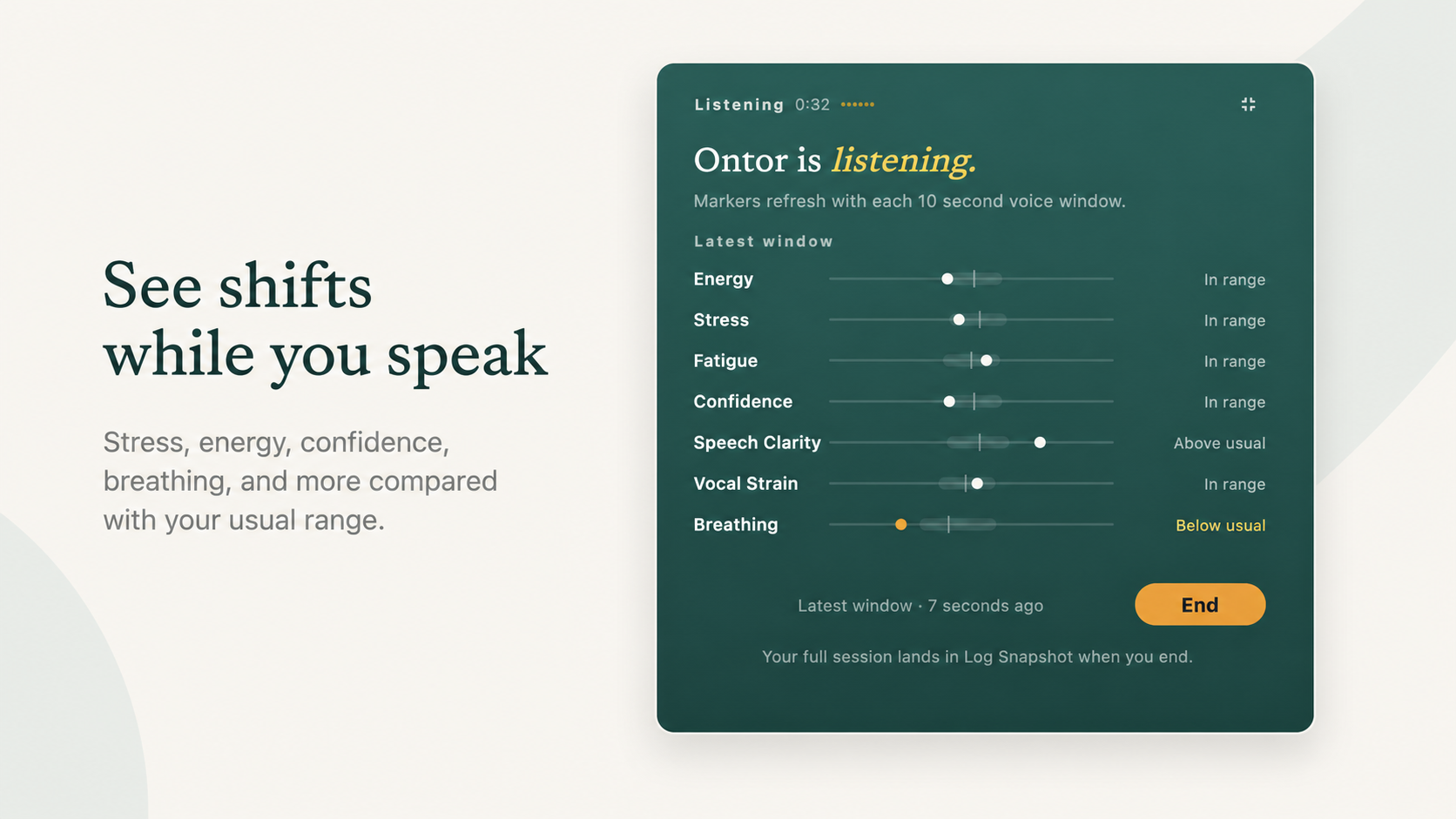
Here is the live listening view from my own Ontor product use: markers refresh with each short voice window and sit against my usual range. In one window, stress or energy can sit above usual while breathing or speech clarity sit below usual. That split is the kind of dual-mode tell a confidence tip or an inflection drill misses when they only grade one symptom:
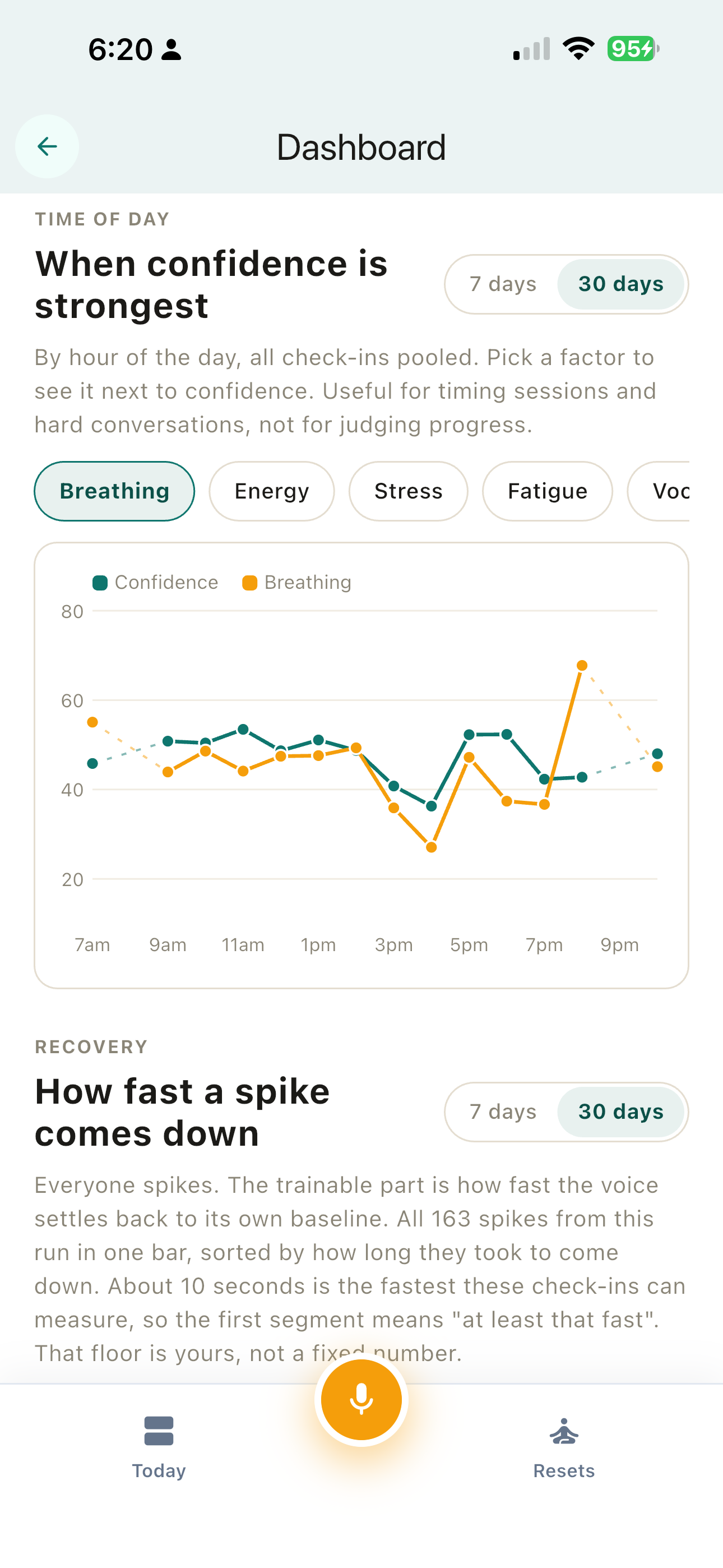
Here is confidence plotted with breathing across the day, from my own Ontor dashboard and session history. Under pressured stretches, confidence and breathing often leave the personal usual band together. That is closer to the poker-tell / breath-interrupt pattern coaches already teach than to "show more energy." It is not proof a client's close rate will rise, and it is not a hire-or-fire score:
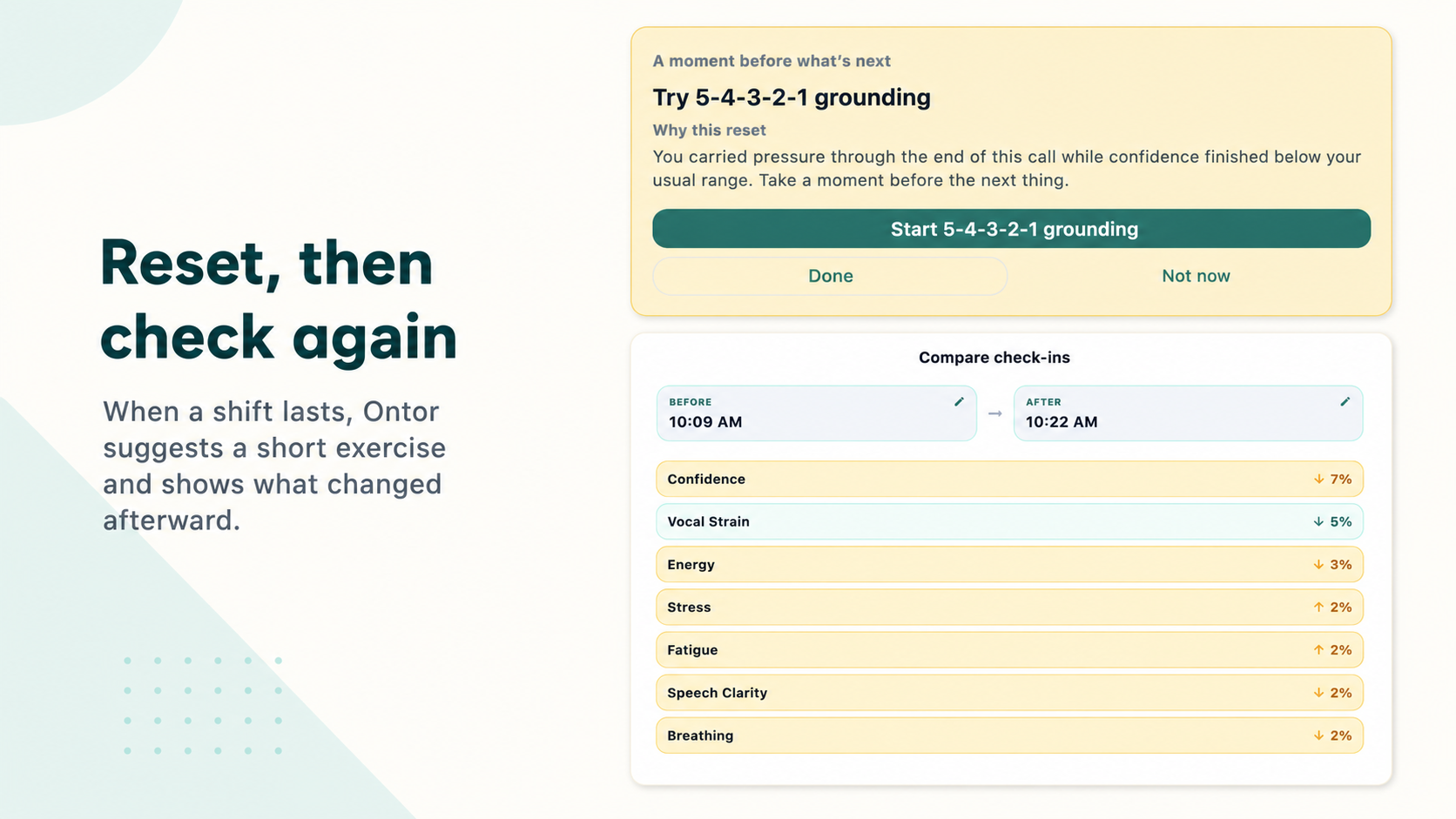
When that private read says I left usual range after a pressured block, Ontor can surface a short reset before the next dial or room. Here is a reset-then-compare view from my own product use. Cap any medical claim. The product point is a short private loop you own so the next live window can move back toward usual range, not a clinical intervention and not another workshop tip:
In exploratory work on that same personal Ontor history (one person, not a population study), high-stress stretches often did not show an observed return to my personal median within an hour. Activation and depletion also did not always move together. That is one reason a private usual-range check during unsupervised live speech matters for the anxious-OR-robotic problem. It is not evidence that a suggested reset caused recovery, improved coaching outcomes, or protected revenue.
Try it on the next call block your client runs without you
Download Ontor - 14 days free, no card required
Install it for a real unsupervised block, not another role-play. Ask the client to notice how they sound versus their usual range when pressure hits: does the window look more anxious (activation up, breath/clarity off usual) or more robotic (narrowed energy/clarity under the same pressure)? Take a short reset if they left usual range. Keep the tools you already teach. Add a private loop that shows which failure mode is running when you are not in the room.
If you sell into pods or teams, the soft path is a research or pilot conversation, or Ontor for teams, with aggregate patterns only. The primary next step for this coaches channel is still the next live block: hear anxious vs robotic against personal usual range, not another confidence-vs-technique fork.
Sabber Ahamed is the founder of Ontor and an applied ML scientist (PhD in geophysics and signal processing) who builds on-device voice tools. He has shipped production signal and ML systems across radiology AI, healthcare, and manufacturing. Ontor compares how you sound to your own usual ranges and suggests short resets, without claiming clinical or revenue outcomes from marker changes. LinkedIn · About
References
- Gina Razón - LinkedIn: pressured voice can sound either too anxious or robotic (sympathetic activation, pitch up, arc narrows) (buyer evidence; GROW Voice)
- Gina Razón / GROW Voice - Why Your Voice Changes When the Stakes Go Up (same cascade; Voltage of Voice packaging on growvoice.com)
- Krystal Diaz - LinkedIn: rehearse a hundred times, voice still shakes when it matters (buyer evidence; Voice Empowerment Coach)
- Matthew Di Donato - LinkedIn: under rising stakes, speed increases and voice tightens (physiological rhythm, not confidence) (buyer evidence; Accent Clarity Coaching)
- Hilary Blair - Dancing in the Discomfort Zone: Your Voice Is Betraying You (voice as poker tell) (buyer evidence; ARTiculate)
- How Ontor works
- Ontor for teams
- About the founder - Ontor
- Install Ontor