
You got through Mini-Miranda and RPC. Collectors still freeze: afraid to ask, feel bad.
Collections and contact-center ops leaders (VP Ops, Head of QA, Dir L&D) at agencies and first-party recovery floors already score Mini-Miranda, verification, and right-party contact. Voice analytics can prove those boxes passed. Conversion still dies in the next beat: the payment ask never lands.
Brian Answeeney, VP of Operations at CBE Companies, names it after a clean RPC. Bettina Hagey, Head of QA at Credit Control Corporation, names the emotional version: collectors who feel bad asking, especially when medical or children's-hospital framing makes the ask feel invalid.
This is not another "train the ask script" piece. It is not first-60-day confidence collapse for new hires. It is not the tenured hard-ask shaky-voice moment, not energy-match under mid-call hostility, and not a cool-down after a coded-hostile disposition. This piece is the post-RPC ask freeze: compliance still looks fine, and the ask never happens because the collector is afraid, feels bad, or freezes.
Download Ontor - 14 days free, no card required
A CBE VP Ops names it: clean RPC, then afraid to ask
On AccountsRecovery.net's webinar The 98% You Never Hear: Why Manual QA Sampling Is Now a Liability, Brian Answeeney talks about what voice analytics surface when the front half of the call is already clean:
"Sometimes they're afraid to ask the question. Sometimes, they're just, they're lost in the content."
He walks the sequence leaders already celebrate:
"You're getting through the meeting Miranda. You're asking, you're, they're verifying. You got an RPC. That's 50%, that's 60% of a call. What do we have to do next to turn this into money?"
That is effectiveness coaching, not another disclosure checklist. He also warns what happens when bonuses and scorecards hyper-focus on QA results: agents forget what they were supposed to say, and the call quality gets worse, not better. Empathy, rebuttals, and asking for payment have to sit in the same coaching stack as Mini-Miranda. Otherwise you celebrate a verified RPC that never asked.
Credit Control's Head of QA corroborates: "I feel bad"
Bettina Hagey, on the same panel, puts the freeze in collector language:
"Sometimes they don't even feel valid in collecting them. The early one, it's just "I can't even ask them for money. I feel bad." And throw it in at the children's hospital to boot and, and it and it becomes emotionally complicated."
She also watches ask intensity across the floor. Softening shows up as agents not pushing back as often or as hard. Dead air longer than two minutes is scored. Analytics can show the group is not even asking 50 to 60 percent of the time. Her ops question is blunt: how aggressively are your agents even asking for payments?
Keep that as a culture and coaching signal. Do not turn Ontor into a hire-or-fire ask-rate scoreboard. The useful read for this article is personal: when confidence or strain leaves that collector's usual range in the window before or during the ask, the freeze can start while compliance checkboxes still look fine.
Light support: hard-ask shake is adjacent, not the same spine
Roger Weiss, President of CACi, already named a related failure on AccountsRecovery.net's Building Confidence for Collectors webinar: even a 25-year collector can get a shaky voice on the hardest ask (asking someone to borrow from family). That published hard-ask shaky-voice piece covers audible shake when the ask is in progress.
Answeeney and Hagey are one step earlier or sideways. The ask never gets said, or it gets whispered past, because the person is afraid or feels bad after a clean RPC. Weiss is delivery failing under the weirdest ask. Different moment. Different coaching move.
Ken Aldrich (Dir L&D, Harris & Harris) adds that live-phone stress makes classroom skills decay the moment pressure rises. Stacey Sexton (ARS National Services) reminds training leaders that on the phone you only have tone and word choice. Useful corroboration that delivery and state matter. Neither replaces the Answeeney/Hagey post-RPC freeze spine.
Naomi Smith's Contact Centre Helper piece on a formal Time Out AUX after a difficult call is research-only here: a tracked recompose window with leader check-in. It overlaps cool-down themes. It is not this article's primary answer.
What compliance QA, ask scripts, and ask-rate dashboards still miss
Typical stack:
- Mini-Miranda / disclosure QA
- Verification and RPC confirmation
- Scripted payment-ask language
- Absolute Empathy and Tone cards
- Ask-rate or dead-air analytics across the floor
- Live monitoring when a supervisor happens to be listening
- Post-call coaching when conversion failed
Useful. Incomplete for Answeeney and Hagey's gap. Disclosure QA proves the first 50 to 60 percent of the call. Scripts tell people what to say when they ask. Floor ask-rate charts show culture softening after the fact. Live monitoring catches what a coach overheard on that one line.
None of them continuously ask: in the short speech windows right before or during the payment ask, did this collector's confidence, stress, energy, speech clarity, or breathing leave their own usual range, and did they notice the freeze in time for a short private reset?
Borrowers experience a non-ask or a soft ask. Leaders often meet it later as a clean RPC that never converted, a "feel bad" coaching note, or a pod whose ask intensity quietly drifted.
Download Ontor - 14 days free, no card required
How this differs from early tenure, hard-ask shake, energy match, and cool-downs
Early-tenure confidence answers: is a new collector losing confidence across the first 60 days?
Hard-ask shaky voice answers: do consumers still hear the shake when a tenured collector's hardest ask is already in progress?
Energy match under hostility answers: mid-hostile flat-collapse or leaked upset versus personal usual energy/stress range.
Cool-downs after hostile calls answer: was this call coded too hot to continue immediately?
Compliance hangover self-reset answers: after a rough open, does "I'm not myself" go unnoticed before the next speech window carries compliance risk?
This article answers a different question: after Mini-Miranda, verification, and a clean RPC already passed, do collectors still freeze on the ask (afraid / feel bad), while compliance checkboxes still look fine, and do leaders have a personal confidence/strain baseline plus a short private reset before the ask lands?
Same collections beachhead. Different moment. Different ops move.
What Ontor adds on the post-RPC ask window (private first)
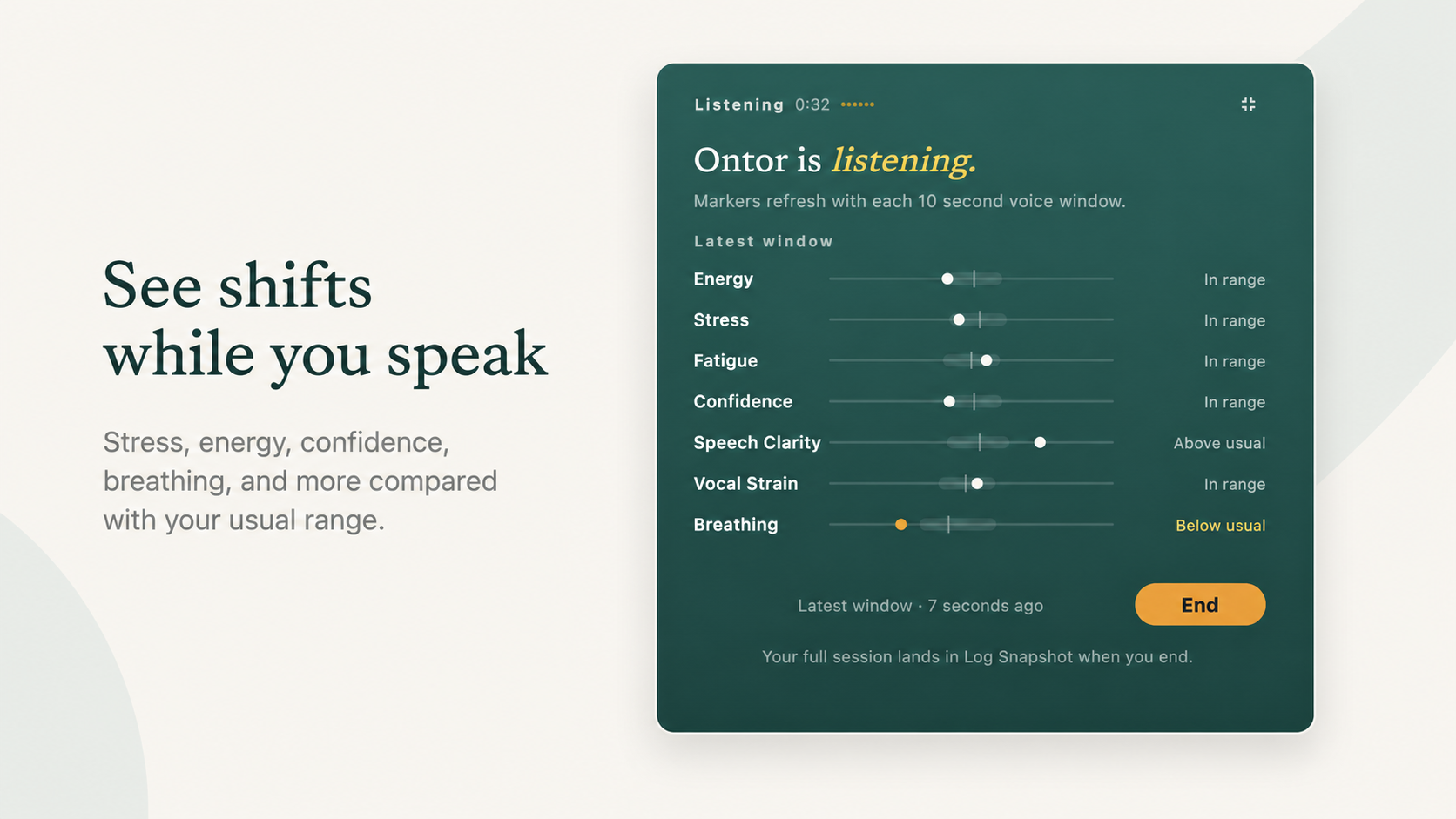
Ontor is a performance tool that reads how you sound, not what you said. While someone speaks, it compares voice signals to that person's own usual range. Markers refresh in short voice windows (on the order of about 10 seconds of speech). When a lasting shift shows up (for example confidence, stress, energy, speech clarity, breathing, or vocal strain), it can suggest a short reset. People can also compare before and after.
For teams, Ontor's public framing is aggregate patterns for workload, coaching, and support. Individual sessions and readings stay with the person. Leaders can see team-level context for when ask-intensity softening (Hagey's floor signal) sits next to pods leaving usual confidence or strain range more often on post-RPC blocks. They do not get a personal scoreboard for hire or fire decisions.
That is the product difference from disclosure checkboxes alone and from ask-script drills alone. Absolute QA asks whether Mini-Miranda landed. Scripts ask whether the words were available. Ontor asks whether this voice left its own usual band, privately, in the window where the ask has to happen.
It does not claim to prevent FDCPA violations, replace compliance training, or prove that a suggested reset caused a payment. The claim stays narrow: leaders already say fear and feel-bad freeze kill conversion after a clean RPC. A private usual-range signal plus a short reset is a loop people can run on the next RPC block.
In my own Ontor session history, the post-RPC ask-freeze pattern shows up the same way Answeeney and Hagey named it for collectors. A block can still sound "fine" and checkbox-complete in the ordinary sense while confidence, stress, breathing, or clarity has left my personal usual range in the short windows right before or during a hard ask. That private usual-band shift is the freeze notice disclosure QA on the front half of the call never sees.
Here is the live listening view from my own Ontor product use: markers refresh with each ~10 second voice window and sit against my usual range. In this window speech clarity can sit above usual while breathing sits below usual. A compliance scorer grading Mini-Miranda on the same call would still mark the disclosure. This is the confidence/strain self-check for the ask window:
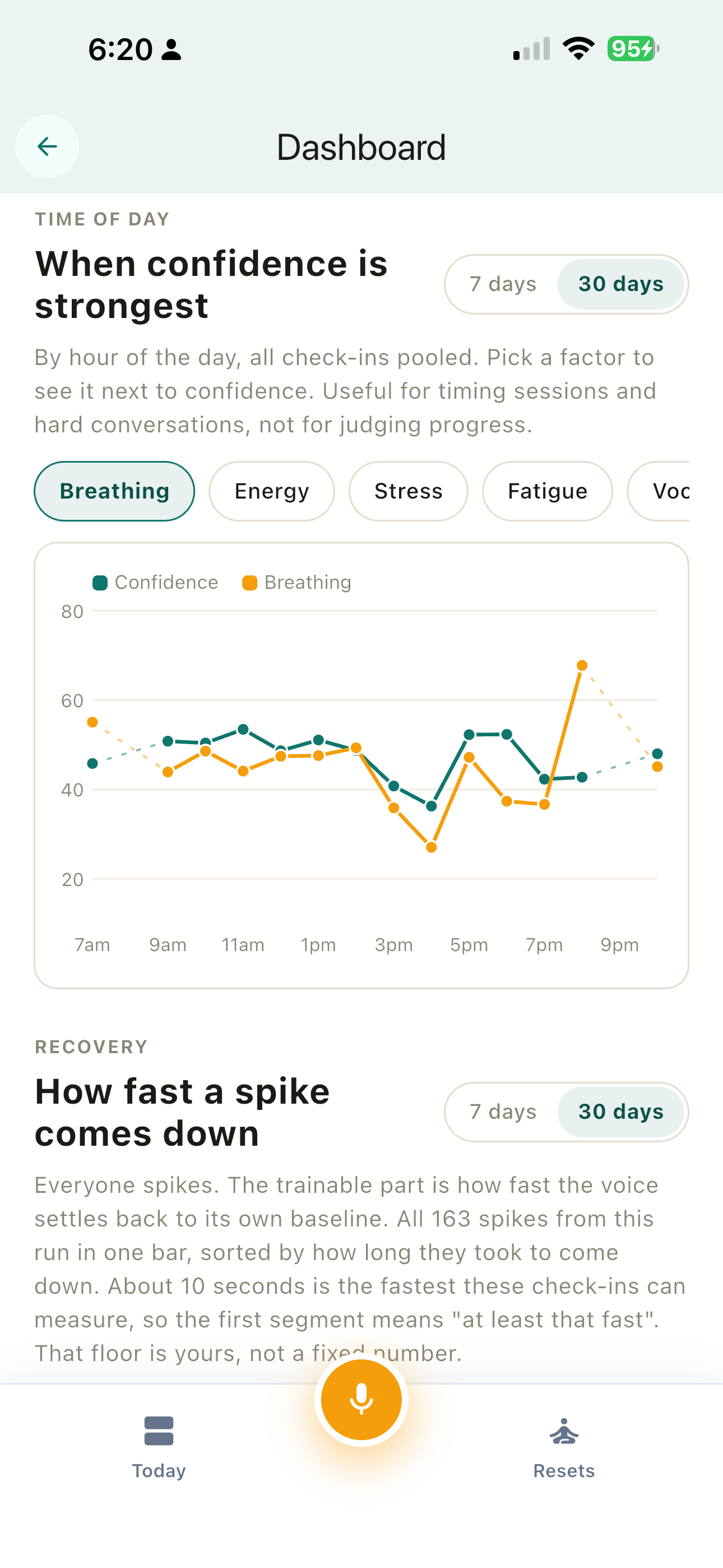
Here is confidence with breathing by hour from that same Ontor history. Breathing drops through the afternoon versus my personal usual and bottoms near 4 pm in this 30-day pool. Read it as founder exploratory data on personal-baseline voice drift across a long speaking day, not collections floor outcome data and not proof that Ontor lifts liquidation. It is the private view of charged-state drift in the window where a payment ask has to land:
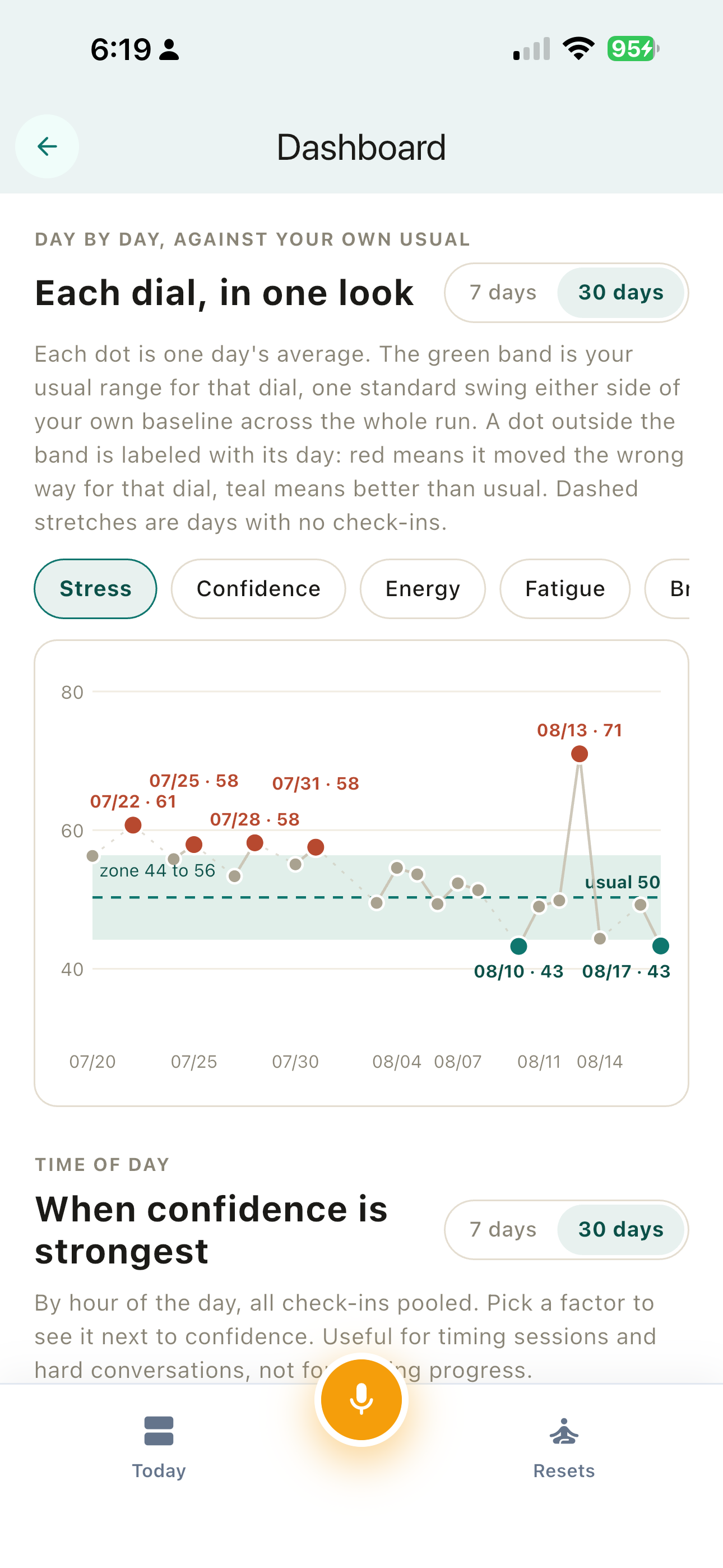
Here is stress day by day against my personal usual band from the same session history. Red points sit above my usual range. Useful as a private check for how often voice-state leaves the band across dials, including windows that sit after a clean open and before a hard ask. It is not a hire-or-fire score and it is not proof that a suggested reset caused a payment:
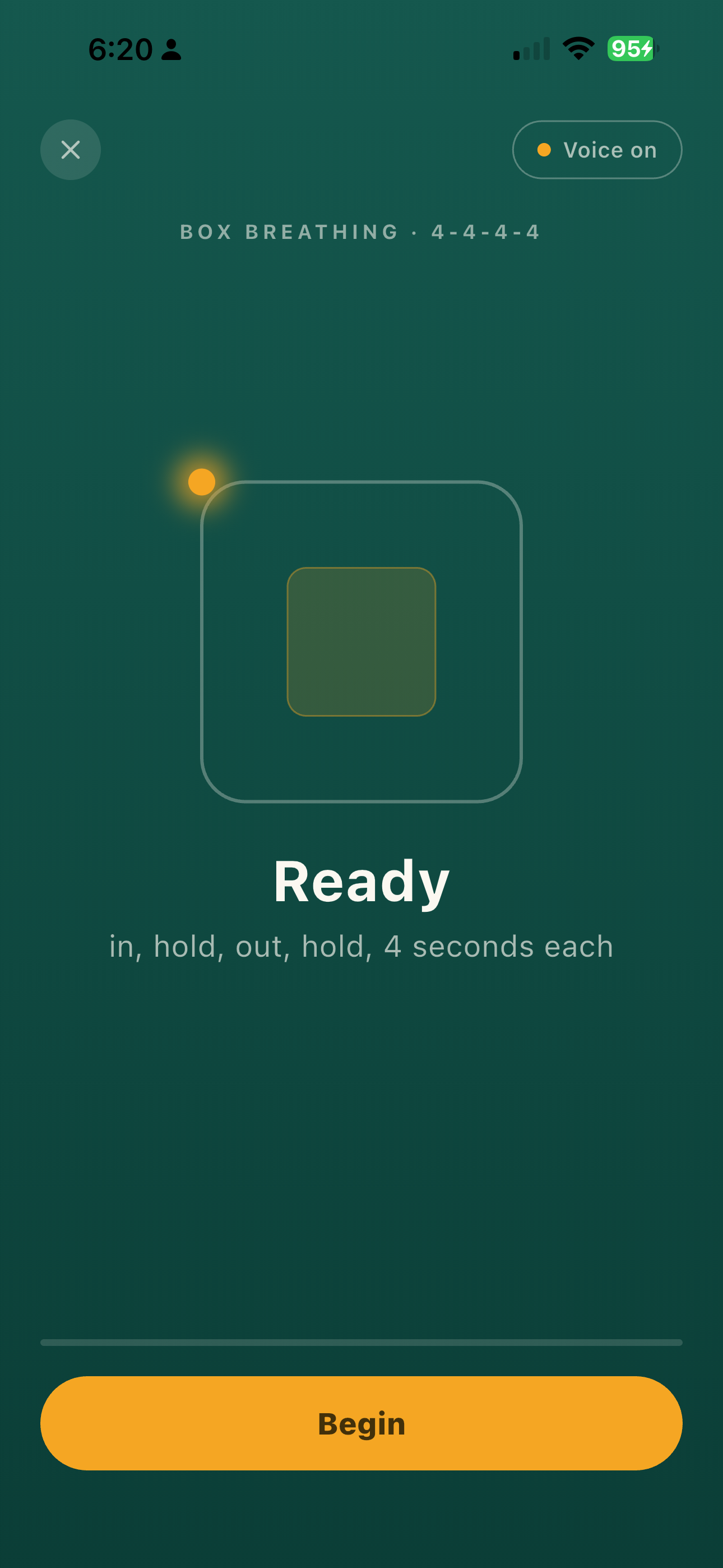
And here is the short reset the product offers when a lasting shift shows up: box breathing, 4-4-4-4. That is the tool form of noticing the freeze before the ask, private, without waiting for a failed arrangement or a supervisor whisper. It does not replace ask scripts, empathy coaching, or compliance training:
In exploratory work on that same personal Ontor history (one person, not a population study), high-stress episodes often did not show an observed return to my personal median within an hour. That is one reason a private usual-range check in the ask window matters. It is not evidence that a suggested reset caused recovery.
This is not a claim that voice markers diagnose anxiety, predict payment outcomes, prove cognitive improvement, or guarantee recovery-rate, AHT, or retention improvement. The claim stays narrow: when collectors freeze after a clean RPC, a private signal versus their own usual range plus a short reset is a loop people can run on the next RPC block, while leaders watch cohort ask-intensity patterns only in aggregate.
What a measured pilot looks like for ops and QA leaders
Start narrow.
- Pick one pod that already clears Mini-Miranda and RPC reliably but still under-asks (agency front-end, medical ARM, credit-union recovery, or BPO hardship queue).
- Give people a private way to notice lasting confidence, stress, energy, speech clarity, or breathing drift versus their own usual range in the short windows before and during the payment ask, and to try short resets when the shift persists.
- Keep leaders on aggregate patterns only (for example, whether the pod sits outside usual range more often on post-RPC blocks that fail to ask, next to Hagey-style ask-intensity softening).
- Decide in advance what you are learning: did people notice freeze before the ask, did short resets fit wrap-up and AHT constraints, did managers get any earlier read on team strain without seeing individuals, and did compliance QA plus ask-script coaching still own their existing jobs.
Do not promise recovery-rate, promise-to-pay, or attrition guarantees from a pilot. Measure whether the tool fits a floor where checkboxes already pass and the ask still freezes.
If you want a design-partner conversation with collections ops or QA leaders, start with Ontor for teams. The primary next step is still to try the product on the next RPC block, not only to talk about a pilot.
Download Ontor - 14 days free, no card required
Bottom line
You already clear Mini-Miranda, verification, and RPC. Collectors can still freeze on the ask: afraid to ask, feel bad, compliance checkboxes still green. Answeeney names the conversion gap after a clean RPC. Hagey names the feel-bad freeze and floor ask-intensity softening. Ontor adds a private usual-range confidence/strain check in short speech windows and a short reset when the shift persists. It is not a new-hire ramp piece, not hard-ask shaky-voice alone, not energy-match under hostility, and not a cool-down policy.
Try it on the next RPC block. Notice whether confidence or strain left that person's usual range before the ask. Reset if the shift persists. Then ask.
References
- Brian Answeeney (CBE Companies), Bettina Hagey (Credit Control Corporation), Tonia Brown (EverChain), et al. "The 98% You Never Hear: Why Manual QA Sampling Is Now a Liability" webinar transcript. AccountsRecovery.net, approx. June 2026. https://www.accountsrecovery.net/wp-content/uploads/2026/06/The-98-You-Never-Hear_-Why-Manual-QA-Sampling-Is-Now-a-Liability_Transcript.pdf
- Roger Weiss (CACi) et al. "Building Confidence for Collectors" webinar transcript. AccountsRecovery.net, March 2026. https://www.accountsrecovery.net/wp-content/uploads/2026/03/Building-Confidence-for-Collectors_Transcript.pdf
- Ken Aldrich (Harris & Harris) et al. "Building a Playbook for Lasting Collector Performance." AccountsRecovery.net, September 19, 2025. https://www.accountsrecovery.net/2025/09/19/building-a-playbook-for-lasting-collector-performance/
- Naomi Smith (Worcester Bosch). "How a "Time Out" AUX Code Builds Resilience." Call Centre Helper, April 24, 2026. https://www.callcentrehelper.com/out-aux-code-builds-resilience-272936.htm
- Ontor. "How it works." https://ontor.ai/how-it-works/
- Ontor. "Ontor for teams." https://ontor.ai/for-teams/
- Ontor. "About the founder." https://ontor.ai/about/
- Ontor. "Install Ontor." https://ontor.ai/install/