
You QA Mini-Miranda. You still miss when a collector isn't themselves after a rough open.
Collections and ARM agency owners, VP / Dir Ops, and training directors already score Mini-Miranda delivery, recovery rates, and QA cards. What still slips past is quieter and personal: after a rough open, a collector's state drifts off their own usual range. They do not always notice "I'm not myself." The next speech window is where unintentional compliance paraphrase and tone collapse show up.
This is not another 60-second cool-down-after-abuse piece. It is not the mid-market sales hangover between connects. It is not mid-shift demeanor silence or overcompensation alone, not dialer afternoon fade from missing micro-breaks, not a shaky hard-ask, not schedule break-window distraction, and not the first-10-seconds opening hello. This piece is compliance-grade self-baseline notice: when collectors miss that they are off their own rails after a rough open, the next dial carries FDCPA and script risk that Mini-Miranda QA scored on a different call will never catch.
Download Ontor - 14 days free, no card required
A paying ARM owner names Reset / Reboot when you are not feeling yourself
Courtney Reynaud, President and CEO of Creditors Bureau USA (Fresno ARM; later ACA International President), taught this at Collector Live 2020 in a session summarized by PDCflow. She sets a scene every collections floor recognizes: an unpleasant opening collection call snowballs into a day of negative comments and bad encounters.
For debt collection teams, that hangover is not only soft skills. The summary states her warning directly: frustration can lead to serious consequences like unintentional non-compliance during a call. Her prescribed control is self-awareness plus a short Reset / Reboot, not waiting for next week's QA listen-back.
Labeled steps from that summary (Reynaud via Huerta / PDCflow):
Self-Reflection - When you notice you're not feeling yourself, pay attention to this feeling. Don't ignore it!
Reset or Reboot - As soon as you notice this mood, step away and take a moment to refocus yourself.
She also biases attention toward wins versus negatives, and smiling as de-escalation for upset consumers. The line attributed to her in the same write-up:
"You're not going to be successful 100% of the time. But when you are, love it."
Lead with that buyer phrasing. The unique gap is not "take a break after abuse." It is: if the collector never notices they are not themselves, the Reset / Reboot never fires before the next speech window where Mini-Miranda, script discipline, and tone all have to hold.
Corroboration: mid-afternoon fade and audible pitch-rise under emotion
Maaz Ansari (Co-founder and CRO, Oriserve), writing in Fortune India as a voice / AI collections vendor, describes the shift-level failure mode in BFSI contact centres. Treat this as vendor_marketing corroboration, not buyer proof and not an AI-replacement brief:
"Early in the day, agents begin with energy and intent. By mid-afternoon, many have absorbed hours of verbal hostility, raised voices, and emotional distress from financially strained customers. By the end of a 100-call shift, cognitive fatigue is no longer an exception; it is the norm."
"Human behaviour degrades under sustained stress. Tone shifts. Patience shortens. Scripts are paraphrased. Guardrails are unintentionally crossed. Not from malice, but from exhaustion."
That is the same family of risk Reynaud names after a rough open: tone and language discipline leave the person's composed band, and compliance paraphrase arrives without malice. Keep Ansari as mid-shift / end-of-day fade corroboration. Do not let the vendor CTA (replace humans with AI voice) become this article's answer.
Liz Peterson, a speech-language pathologist coaching debt collectors and AR teams (summarized on PDCflow), adds an audible signal under emotional load. Also vendor_marketing / coach, cite carefully:
"When a call gets emotional, your pitch can rise. Intentionally lowering your tone of voice stops calls (and emotions) from getting out of hand."
Pitch-rise is one way "not myself" becomes audible before the next payment ask. It is not therapy. It is a performance tell managers already try to train in role-play.
Together: Reynaud names the compliance hangover and Reset / Reboot when you notice you are not feeling yourself. Ansari adds mid-afternoon and end-of-day tone / script fade under sustained hostility. Peterson adds pitch rising when emotion lands. None of those are Mini-Miranda checkboxes on a sampled recording from earlier in the day.
What Mini-Miranda QA, recovery boards, and one-off listen-backs still miss
Typical stack:
- Mini-Miranda and disclosure QA
- Dial / connect / recovery boards
- Absolute Empathy and Tone cards
- Live monitoring when a supervisor happens to be on that line
- Hostile-disposition cool-down policies
- Speech analytics / sentiment overlays already on the floor
Useful. Incomplete for Reynaud's gap. Mini-Miranda QA scores whether the required language landed on the calls you sampled. Recovery boards show money in. Live monitoring catches what a coach overheard. Hostile cool-downs answer whether a coded call was too hot to continue immediately.
None of them continuously ask: after this rough open, did this collector's energy, stress, confidence, clarity, breathing, or pitch leave their own usual range in the short speech windows before the next dial, and did they notice "I'm not myself" in time to Reset / Reboot?
Borrowers hear that first. Leaders often meet it later as a compliance near-miss, a paraphrased disclosure, a tone complaint, or a "bad call" that looks like attitude.
How this differs from cool-downs, sales hangover, demeanor drift, afternoon fade, and related pieces
Cool-downs after hostile calls answer: was this call coded too hot to continue immediately? Post-abuse recovery policy.
Hangover between sales calls answers: mid-market sales recovery and reconstruction work between connects. Not collections compliance.
Demeanor drift answers: if you already live-monitor, do you still miss mid-shift personal demeanor drift (silence / overcompensation) before conflict?
Dialer afternoon fade answers: did parallel dialers erase the 5 to 10 second micro-break where afternoon fade starts after a rough rejection?
Hard-ask shaky voice answers: do consumers still hear the shake when the ask lands?
Break-window fatigue answers: schedule-tied pre-break focus drop and post-break linger.
Tone in the first 10 seconds answers: does opening-window personal voice energy versus that collector's usual hello decide whether they stay?
This article answers a different question: on US collections / medical ARM voice floors that already QA Mini-Miranda and recovery, do leaders still miss when a collector is not themselves after a rough open, so the next speech window carries unintentional compliance paraphrase and tone collapse, and does coaching treat Reset / Reboot as a compliance control when "I'm not myself" is noticed?
Same collections beachhead. Different moment. Different ops move.
Download Ontor - 14 days free, no card required
What Ontor adds after a rough open (private first)
Ontor is a performance tool that reads how you sound, not what you said. While someone speaks, it compares voice signals to that person's own usual range. Markers refresh in short voice windows (on the order of about 10 seconds of speech). When a lasting shift shows up (for example energy, fatigue, stress, confidence, speech clarity, or breathing), it can suggest a short reset. People can also compare before and after.
For teams, Ontor's public framing is aggregate patterns for workload, coaching, and support. Individual sessions and readings stay with the person. Leaders can see team-level context for when a pod's post-rough-open dials sit outside usual range more often. They do not get a personal scoreboard for hire or fire decisions.
That is the product difference from Mini-Miranda sampling alone and from absolute Empathy and Tone cards. Absolute QA asks whether one recording passed a rubric. Cool-down policies ask whether a disposition was too hot. Ontor asks whether this voice left its own usual band, privately, in the short windows after a rough open and before the next speech, and whether a short Reset / Reboot is available when "I'm not myself" would otherwise go unnoticed.
It does not claim to prevent FDCPA violations, replace compliance QA, or prove that a suggested reset caused recovery. The claim stays narrow: leaders already say unnoticed personal-state drift precedes compliance and tone risk. A private usual-range signal plus a short reset is a loop people can run before the next dial.
In my own Ontor session history, the after-rough-open "not myself" pattern shows up the same way Reynaud named it for collectors. A block can still sound "fine" in the ordinary sense while stress, confidence, breathing, or clarity has left my personal usual range in the windows right after a hard exchange. That private usual-band shift is the self-baseline notice Mini-Miranda QA on a different call never sees.
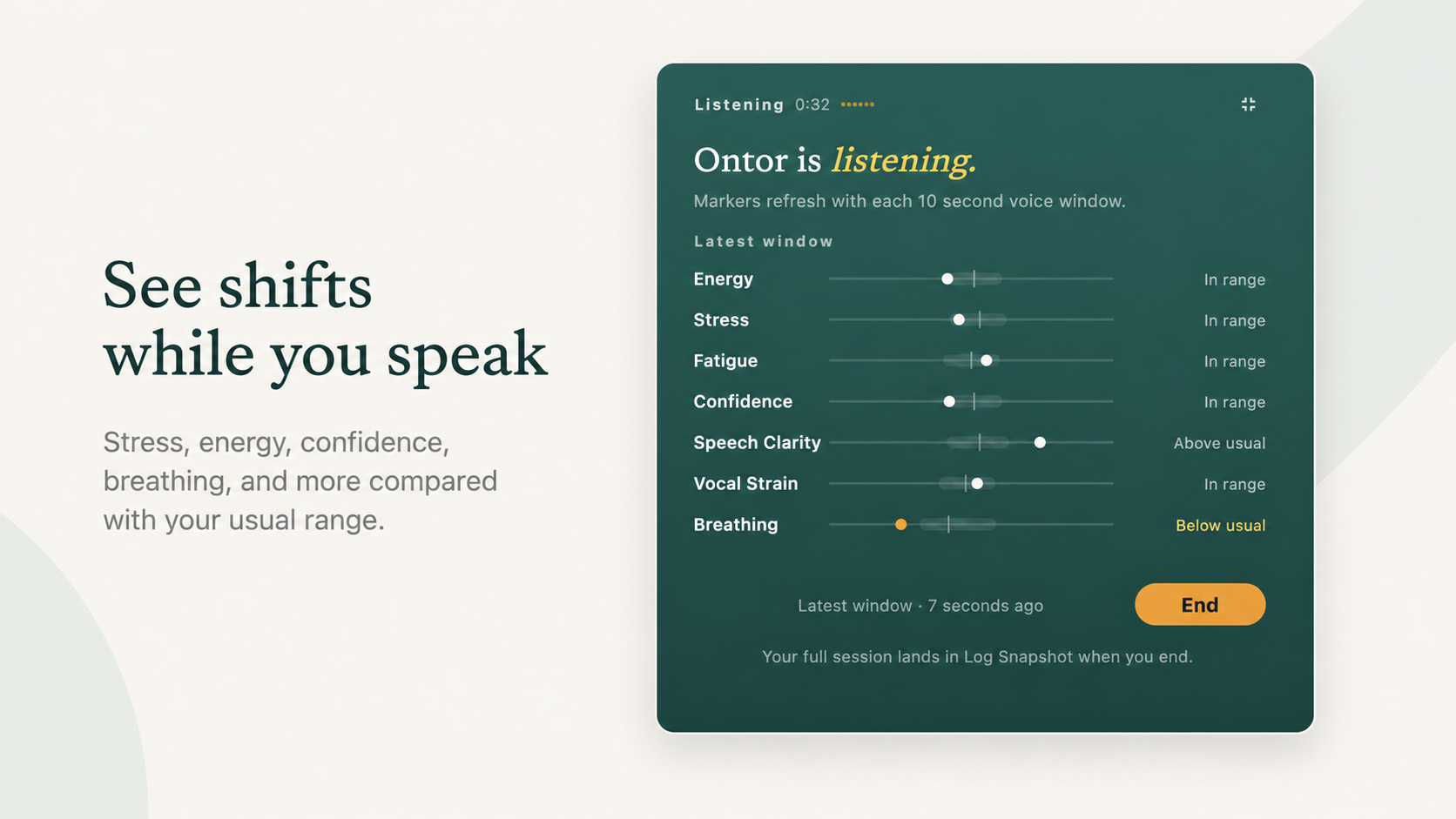
Here is the live listening view from my own Ontor product use: markers refresh with each ~10 second voice window and sit against my usual range. In this window speech clarity sits above usual while breathing sits below usual. That is closer to "I'm not myself" before the next speech than a Mini-Miranda checkbox on yesterday's sample:
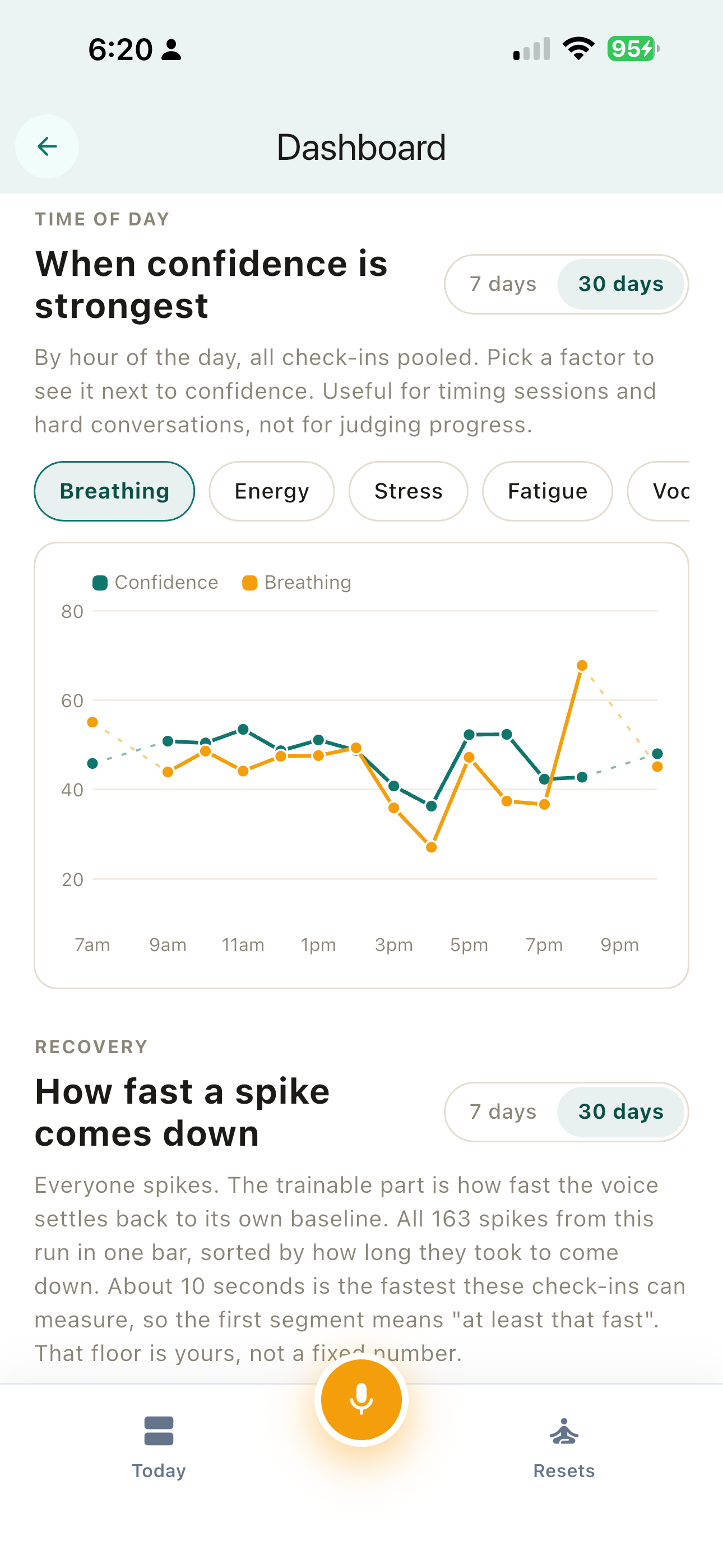
Here is confidence with breathing by hour from that same Ontor history. Breathing drops through the afternoon versus my personal usual and bottoms near 4 pm in this 30-day pool. Read it as founder exploratory data on personal-baseline voice drift across a long speaking day, not collections floor outcome data and not proof of FDCPA risk reduction. It is the private view of mid-shift fade Ansari describes and the self-notice Reynaud requires before Reset / Reboot:
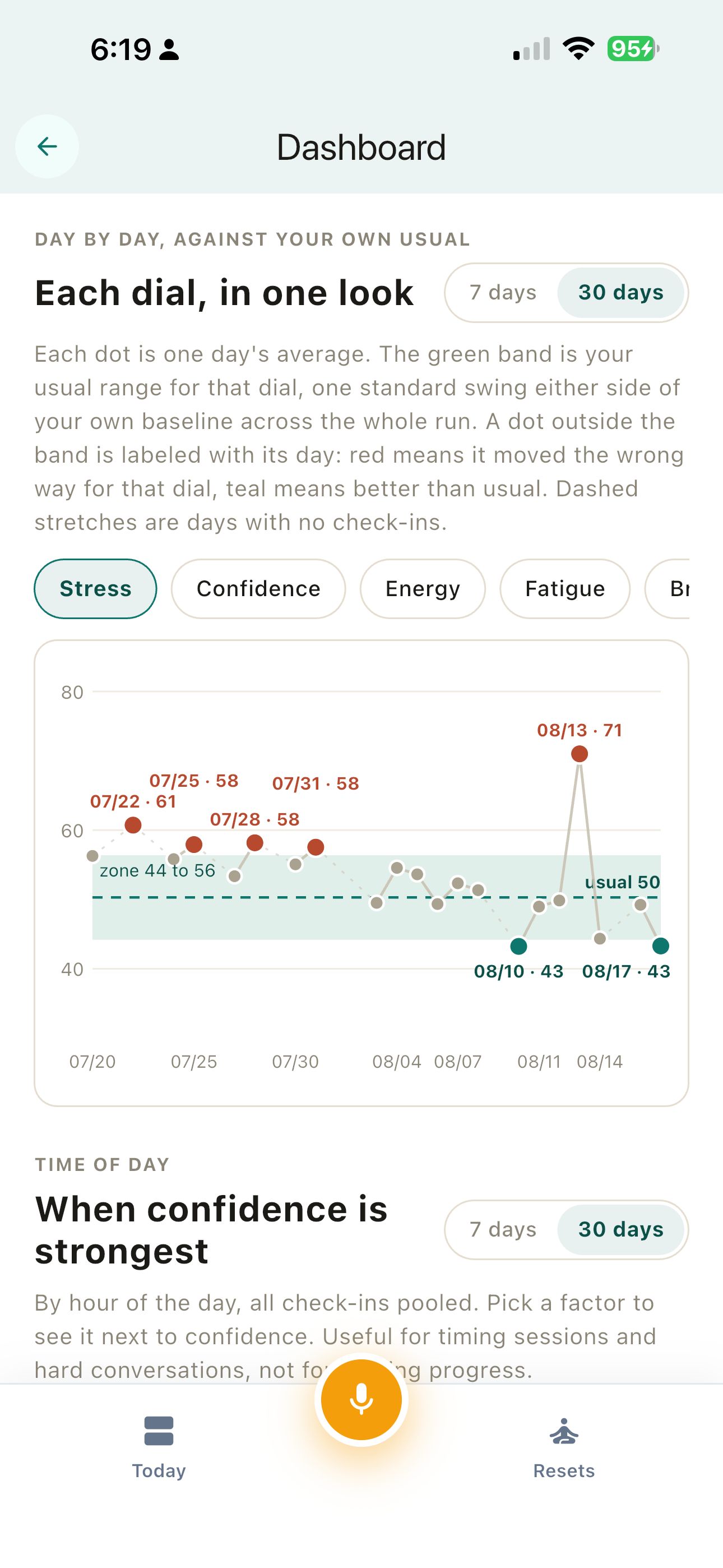
Here is stress day by day against my personal usual band (zone ~44 to 56, usual 50) from the same session history. Red points sit above my usual range. Useful as a private check for how often voice-state leaves the band across dials, including windows that sit right after a rough open. It is not a hire-or-fire score and it is not proof that a suggested reset caused recovery:
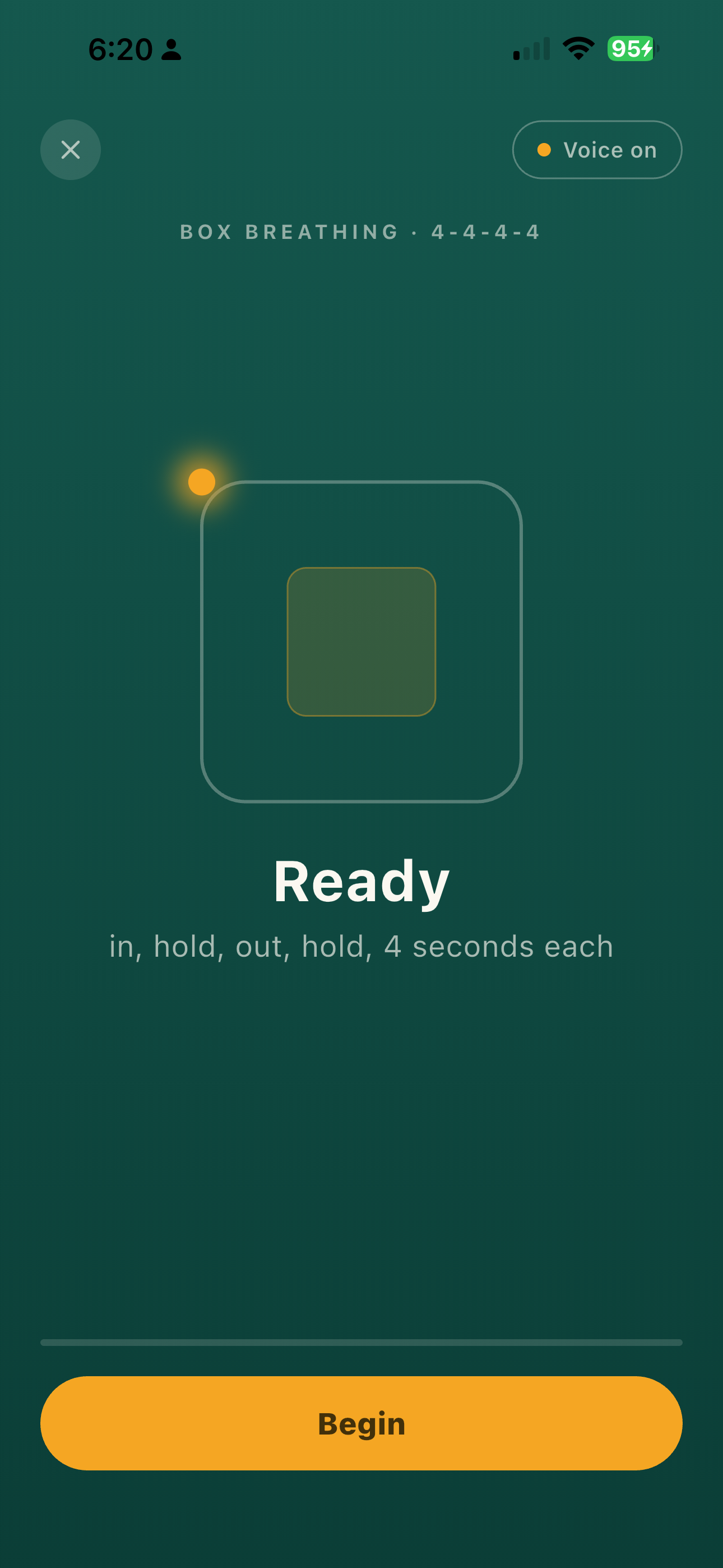
And here is the short reset the product offers when a lasting shift shows up: box breathing, 4-4-4-4. That is the tool form of Reynaud's Reset / Reboot after you notice you are not yourself, not a claim that one cycle prevents a compliance paraphrase on the next dial:
This is not a claim that voice markers diagnose compliance risk clinically, predict recovery rates, replace manager judgment, guarantee cleaner Mini-Miranda on the next call, or prevent FDCPA violations. The claim stays narrow: when Mini-Miranda QA and recovery boards miss after-rough-open personal drift, a private signal plus a short reset is a loop people can run before the next speech window, while leaders watch cohort patterns only in aggregate.
What to try after the next rough open, before the next dial
Do not wait for a research committee if you run medical ARM or recovery voice floors that already QA Mini-Miranda and recovery.
- Install Ontor on the machine collectors already use for outbound and inbound connects.
- After the next rough open (hostile, baiting, hardship overload, or any call that left the person off), notice whether energy, fatigue, stress, confidence, clarity, breathing, or pitch sit outside that person's usual range in the short speech windows before the next dial.
- If a lasting shift shows up, or if the collector can already tell they are not feeling themselves, take the short suggested Reset / Reboot when wrap-up allows it. Then open the next contact instead of paraphrasing through the hangover.
- If you lead a pod, keep leaders on aggregate patterns only for post-rough-open drift. Personal readings stay with the person. Train the self-notice language Reynaud uses ("not feeling yourself") as a compliance control, not only a wellness tip.
Soft secondary path if you are buying for a collections floor and want a measured look later: Ontor for teams, or a research conversation / pilot with collections ops and training leaders on after-rough-open blocks.
Do not promise recovery-rate, AHT, retention, or FDCPA-prevention guarantees. Measure whether people can tell when "I'm not myself" left their usual voice before the next speech window.
Bottom line
You QA Mini-Miranda. You still miss when a collector isn't themselves after a rough open. Reynaud names Reset / Reboot when you notice you are not feeling yourself, because frustration can drive unintentional noncompliance on later calls. Ansari adds mid-afternoon and end-of-day tone and script fade under sustained hostility. Peterson adds audible pitch-rise when emotion lands. The gap that remains is personal usual-range voice drift in the windows after that rough open, caught before the next speech burns.
Try Ontor after the next rough open, before the next dial. Notice the short voice windows versus that collector's usual range. Take the short Reset / Reboot when a lasting shift shows up. That is the tool next step, not only a pilot conversation.
Download Ontor - 14 days free, no card required
References
- Hannah Huerta summarizing Courtney Reynaud (Creditors Bureau USA; Collector Live 2020). "Education and Motivation for your Debt Collection Team" (Remaining Compliant Through Difficult Calls and Celebrating the Wins). PDCflow, January 28, 2020. https://www.pdcflow.com/debt-collection/education-and-motivation-for-your-debt-collection-team/
- Maaz Ansari. "How AI is powering smarter collections and renewals." Fortune India, February 19, 2026. https://www.fortuneindia.com/opinion/how-ai-is-powering-smarter-collections-and-renewals/130552 (vendor_marketing corroboration; problem statement on mid-afternoon tone / script fade, not Ontor CTA)
- Hannah Huerta summarizing Liz Peterson (speech-language pathologist). "How Tones of Voice Influence Payment Collection." PDCflow, July 17, 2025. https://www.pdcflow.com/office-operations/payment-collection-how-to-use-your-voice-tool-of-persuasion/ (vendor_marketing / coach corroboration on pitch-rise under emotion)
- Ontor. "How it works." https://ontor.ai/how-it-works/
- Ontor. "Ontor for teams." https://ontor.ai/for-teams/
- Ontor. "About the founder." https://ontor.ai/about/
- Ontor. "Install Ontor." https://ontor.ai/install/
- Ontor. "Collections leaders can see dials and recovery rates. They still miss readiness after a hostile call." https://ontor.ai/blog/collections-cool-down-between-hostile-calls/ (sibling, different question)
- Ontor. "Leaders treat the minutes between calls as empty. The hangover isn't." https://ontor.ai/blog/hangover-between-sales-calls/ (sibling, sales not compliance)
- Ontor. "You already live-monitor the floor. You still miss when a collector drifts off their own demeanor." https://ontor.ai/blog/collections-demeanor-drift/ (sibling, different question)
- Ontor. "Your dialer left 5-10 seconds between calls. That's where afternoon fade starts." https://ontor.ai/blog/dialer-fatigue-afternoon-fade/ (sibling, different question)
- Ontor. "Collectors sound distracted around breaks. Dial boards and QA scores still miss it." https://ontor.ai/blog/collections-break-window-fatigue/ (sibling, different question)