
They teach energy match so you don't go flat under hostility. Collectors still leak upset they think they're hiding.
Collections and contact-center ops and training leaders (VP / Dir / Head / CCO, ACA-adjacent) already coach tone under angry consumers. Some floors train energy match: meet intensity, then guide it down. Others train absolute stay-calm so the consumer matches you. Both camps still miss the same mid-call failure: the collector goes flat/robotic, or leaks upset they believe they are hiding, and the consumer hears it before negotiation recovers.
This is not the first-10-seconds opening hello. It is not absolute Empathy and Tone QA versus personal baseline across a shift. It is not cool-down policy between hostile dispositions. It is not compliance hangover after a rough open, and it is not schedule break-window distraction. This piece is mid-hostile-call personal energy and stress versus that collector's usual range: catch flat-collapse or leaked-upset in short speech windows before the consumer calls it out or a supervisor has to whisper in.
Download Ontor - 14 days free, no card required
ACA education names the failure: flat/robotic under upset consumers
Kelli Van Cleave, Director of Education at ACA International (Owner, Athena Tactical Solutions; Master Certification NLP; 28+ years ARM training), said this on Career Path with Katalina. She challenges the classic customer-service line that you should stay calm when the consumer is upset. On a collection call, going flat and overly calm can land as more triggering, not less.
Exact lines from that episode:
"you don't want to yell back, but you don't want to, you don't want to be calm. Like was what we've always been told to do."
"if they're, if they're upset, you raise your volume a bit and go, I can tell, I can tell you're really upset about this. You're not like yelling back, but you're at least getting in it with them"
The host restates her move as matching energy, not hostility: meet them where they are, then guide intensity down. The episode write-up puts the failure mode in the same buyer words floors already use:
"If someone's yelling, you don't yell back - but you also don't go flat and robotic. You raise your energy to let them know you're with them. Then, once you've met them where they are, you can guide the conversation to where it needs to go."
Van Cleave also puts phone performance on how you sound, not only the script:
"the words are only 7 % of our communication, right? Like 36 % of what we say is conveyed through our tone of voice."
"What really matters when you're on the phone is how you sound."
Lead with that. The unique gap is not "teach energy match once in new-hire week." It is: mid-hostile speech, does this collector still have audible presence versus their own usual energy and stress band, or did they collapse flat / leak charged state while they think they are hiding it?
Corroboration: consumers hear the upset collectors think they're hiding
Irene Hoheusle (Compliance Advisor, ARM Compliance Business Solutions; former VP Collections and Education at Account Recovery Specialists; ACA Certified Instructor) said this on the AccountsRecovery.net Conflict Management Skills panel. Collectors in an emotional state get upset on the phone. When they think they are hiding it, consumers still hear it, and being called out makes them more upset.
"it's easy for a person to take it in an emotional state and get upset."
"Have you ever had anybody ask you if you're upset, when you don't really feel like you're doing such a good job of hiding it, or they tell you, oh, you must be hangry."
"it makes you more upset."
That is mid-call audible self-blindness. Not only a between-call breather after stacked frustrated debtors. The consumer names the leak before QA does.
Live whisper and EI trigger tools already admit the same mid-call gap
Ken Peck, Chief Compliance Officer at Lockhart Morris & Montgomery, prefers live monitoring over post-call calibrations alone for hostile-consumer conflict. Supervisors can jump in mid-call:
"I love live monitoring. Because you can prevent them from going off the rails, by jumping in, whispering into their call, Hey, you're taking this person, take a breath, step back. Hey, listen to what they're saying."
"sometimes that agent could be going through something and not realize"
"there's only so many mistakes that they can make before they don't have a job. So it's our job to really keep them on the rails."
That is a paying CCO naming the salvage window inside the live interaction. The tradeoff floors already feel: the whisper works, and it also puts a supervisor in the collector's ear.
Ed Lovallo, Director of Operations at Alliant Capital Management (ACA / RMAI member agency), puts the same family of control into emotional conduct training: recognize your own emotional triggers, then use practical stress techniques such as deep breathing and short breaks so collectors stay grounded on tough calls where nothing seems to go right.
"Collections can be a stressful job, so it's essential that collectors learn to manage their own emotions and respond appropriately to the emotions of others."
"Emotional Intelligence (EI), where collectors should understand the basics of EI, such as recognizing their own emotional triggers and managing them effectively"
"Stress Management Techniques, where practical strategies for managing stress, such as deep breathing, short breaks, or even internal support systems, can help maintain mental well-being"
Together: Van Cleave names flat/robotic under hostility as the energy-match failure. Hoheusle names leaked upset consumers already hear. Peck names mid-call breath/step-back via live whisper. Lovallo names trigger recognition plus breath and short breaks. None of those are an absolute "sound calm" QA score on a sampled recording from earlier in the day.
Careful contrast: Petro trains stay-calm so the consumer matches you
Jenna Petro, Vice President of Operations at First Financial Resources (medical collections), teaches a different opener tactic on the AccountsRecovery.net First 30 Seconds panel. Match pace when the consumer talks fast. When they start combative and angry, stay calm, cool, and collected so they come down and match your tone.
"when speaking with a consumer, you have to first match their pace. If they're very quick talking, you have to match that. But also on the flip side, if they're starting combative and angry, you have to stay calm, cool, and collected, and then you will see them come down and match your. Tone, so to speak."
Cite that as industry split, not as this article's spine. Van Cleave and Petro disagree on absolute calm versus energy match. Both still need the same missing piece Ontor addresses: mid-hostile windows, is this collector's energy, stress, and confidence still inside their own usual range, or did flat-collapse / leaked-upset already start before either tactic can land?
What absolute calm QA, live whisper, and cool-downs still miss
Typical stack:
- Absolute Empathy and Tone / "sound calm" cards
- Energy-match or stay-calm role-play in training
- Live monitoring with supervisor whisper
- Hostile-disposition cool-down policies
- Between-call breathers and break-window rules
- Speech analytics / sentiment overlays already on the floor
Useful. Incomplete for the mid-hostile personal-baseline gap. Absolute calm QA asks whether one recording passed a rubric. Energy-match training asks whether the collector practiced meeting intensity. Live whisper catches what a coach overheard in that moment. Cool-downs answer whether a coded call was too hot to continue immediately.
None of them continuously ask: during this hostile speech, did this collector's energy, stress, confidence, clarity, or breathing leave their own usual range in short voice windows, and did they notice flat-collapse or leaked-upset before the consumer said "are you upset?" or a supervisor had to whisper take a breath?
Borrowers hear that first. Leaders often meet it later as a dead negotiation, a tone complaint, or a "bad call" that looks like attitude.
How this differs from first-10s, QA-tone, cool-downs, compliance hangover, and break-window pieces
Tone in the first 10 seconds answers: does opening-window personal voice energy versus that collector's usual hello decide whether they stay?
QA tone vs baseline answers: Empathy and Tone scorecards still miss when a strong collector drifts off their own usual demeanor band across dials.
Cool-downs after hostile calls answers: was this call coded too hot to continue immediately? Post-abuse recovery policy.
Compliance hangover self-reset answers: after a rough open, did the collector notice "I'm not myself" before the next speech window carries unintentional compliance paraphrase?
Break-window fatigue answers: schedule-tied pre-break focus drop and post-break linger.
Demeanor drift answers: if you already live-monitor, do you still miss mid-shift personal demeanor drift (silence / overcompensation) before conflict?
This article answers a different question: on US collections / contact-center voice floors that already teach energy match or stay-calm under hostility, do leaders still miss mid-hostile flat-collapse or leaked-upset versus that collector's personal usual energy and stress range, before the consumer calls it out or a supervisor whispers in?
Same collections beachhead. Different moment. Different ops move. Not Petro absolute stay-calm as the product answer.
Download Ontor - 14 days free, no card required
What Ontor adds mid-hostile call (private first)
Ontor is a performance tool that reads how you sound, not what you said. While someone speaks, it compares voice signals to that person's own usual range. Markers refresh in short voice windows (on the order of about 10 seconds of speech). When a lasting shift shows up (for example energy, fatigue, stress, confidence, speech clarity, or breathing), it can suggest a short reset. People can also compare before and after.
For teams, Ontor's public framing is aggregate patterns for workload, coaching, and support. Individual sessions and readings stay with the person. Leaders can see team-level context for when a pod's mid-hostile windows sit outside usual range more often. They do not get a personal scoreboard for hire or fire decisions.
That is the product difference from absolute "sound calm" QA and from supervisor whisper alone. Absolute QA asks whether one recording passed a rubric. Live whisper asks whether a coach overheard the leak in time. Ontor asks whether this voice left its own usual band, privately, in short mid-hostile windows, and whether a short reset is available when flat-collapse or leaked-upset would otherwise go unnoticed until the consumer names it.
It does not claim to prevent FDCPA violations, replace compliance or energy-match training, or prove that a suggested reset caused recovery. The claim stays narrow: leaders already say flat/robotic and leaked upset kill negotiation mid-hostile call. A private usual-range signal plus a short reset is a loop people can run before the consumer calls them out or a supervisor has to jump in.
In my own Ontor session history, the mid-hostile flat-collapse / leaked-upset pattern shows up the same way Van Cleave and Hoheusle named it for collectors. A block can still sound "fine" in the ordinary sense while energy, stress, confidence, or breathing has left my personal usual range in the short windows during charged speech. That private usual-band shift is the self-notice absolute calm QA on a different call never sees, and it is the cue Peck's whisper tries to supply from outside the headset.
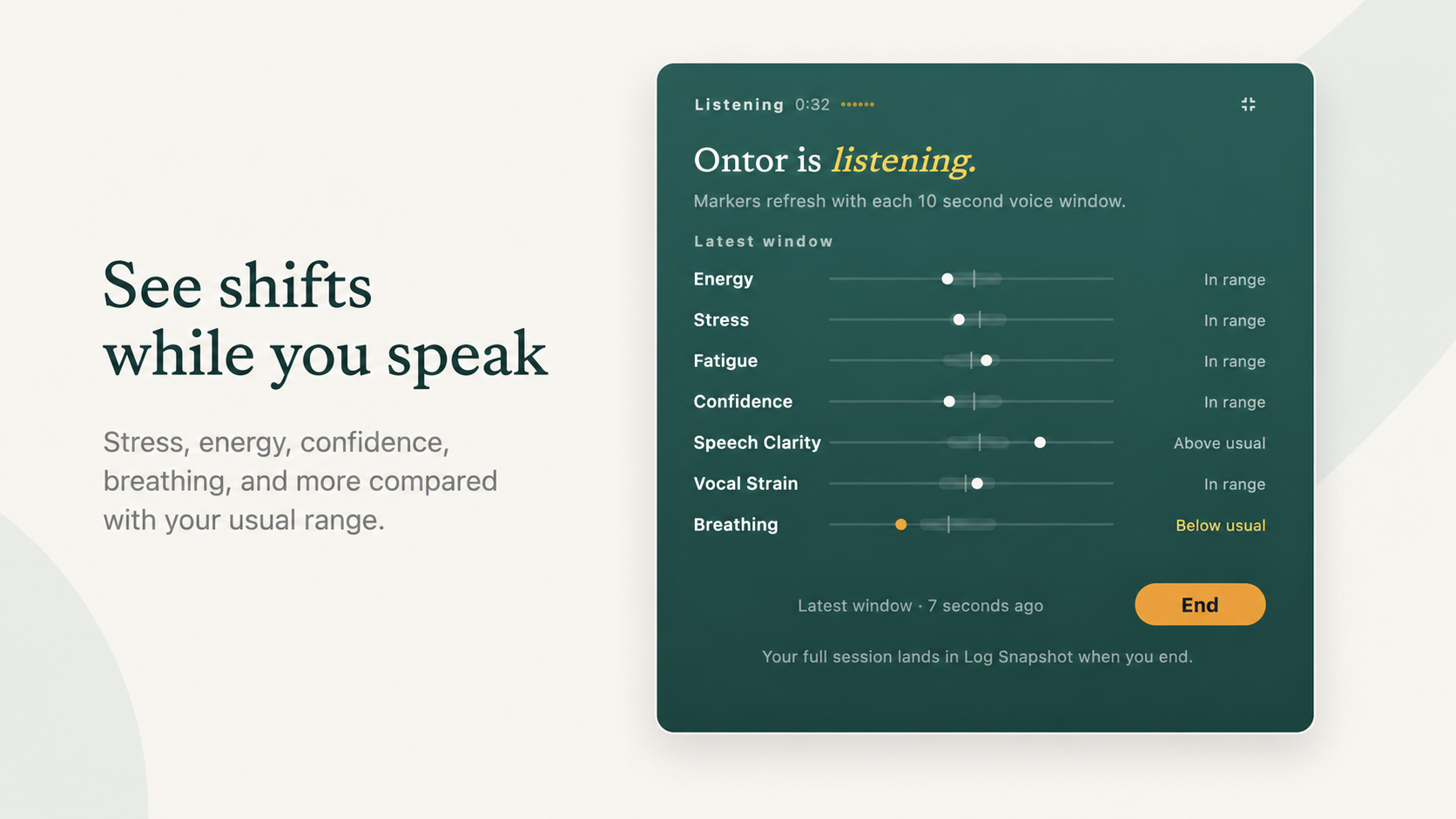
Here is the live listening view from my own Ontor product use: markers refresh with each ~10 second voice window and sit against my usual range. In this window speech clarity sits above usual while breathing sits below usual. That is closer to "my energy/stress left my band mid-charged speech" than an absolute Empathy and Tone checkbox:
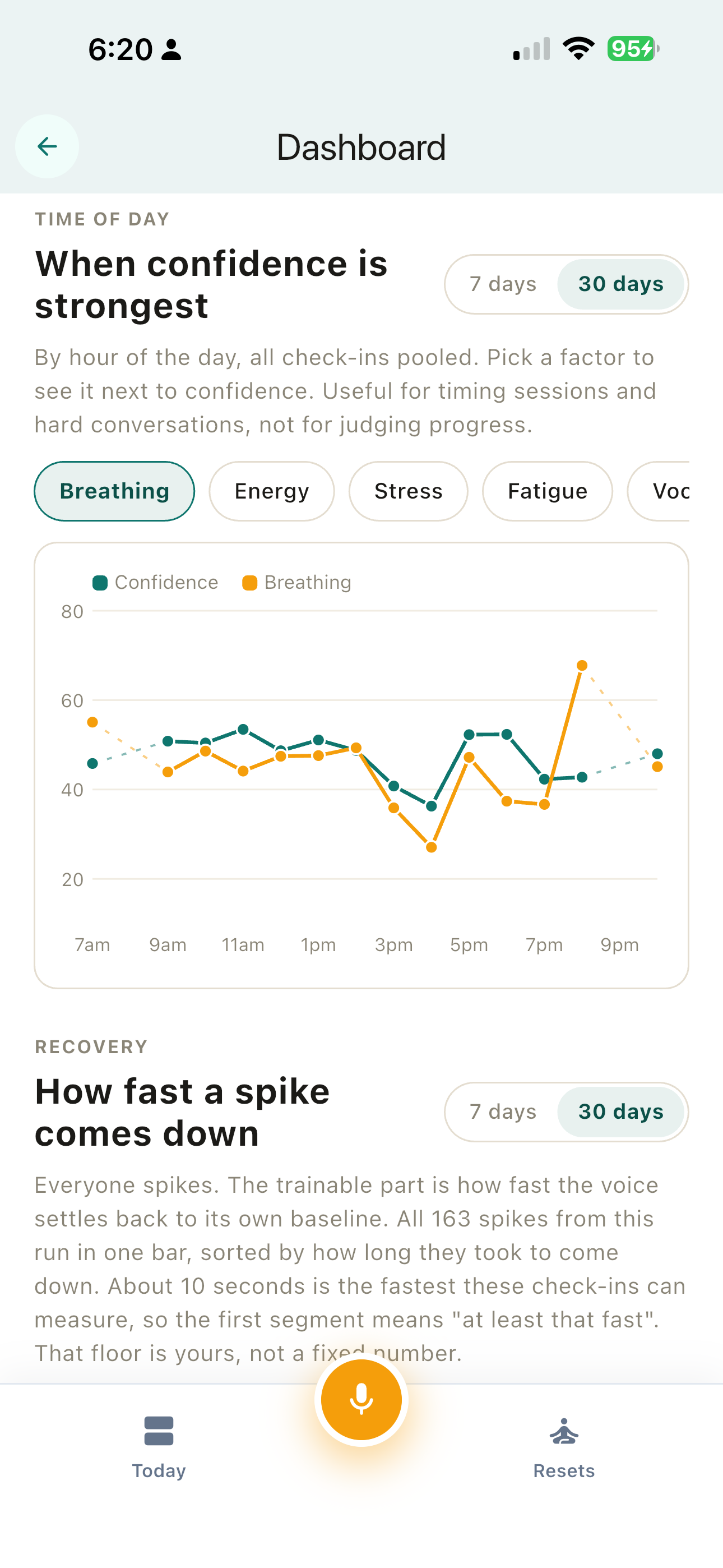
Here is confidence with breathing by hour from that same Ontor history. Breathing drops through the afternoon versus my personal usual and bottoms near 4 pm in this 30-day pool. Read it as founder exploratory data on personal-baseline voice drift across a long speaking day, not collections floor outcome data and not proof of negotiation recovery. It is the private view of the charged-state leave that Hoheusle says consumers already hear:
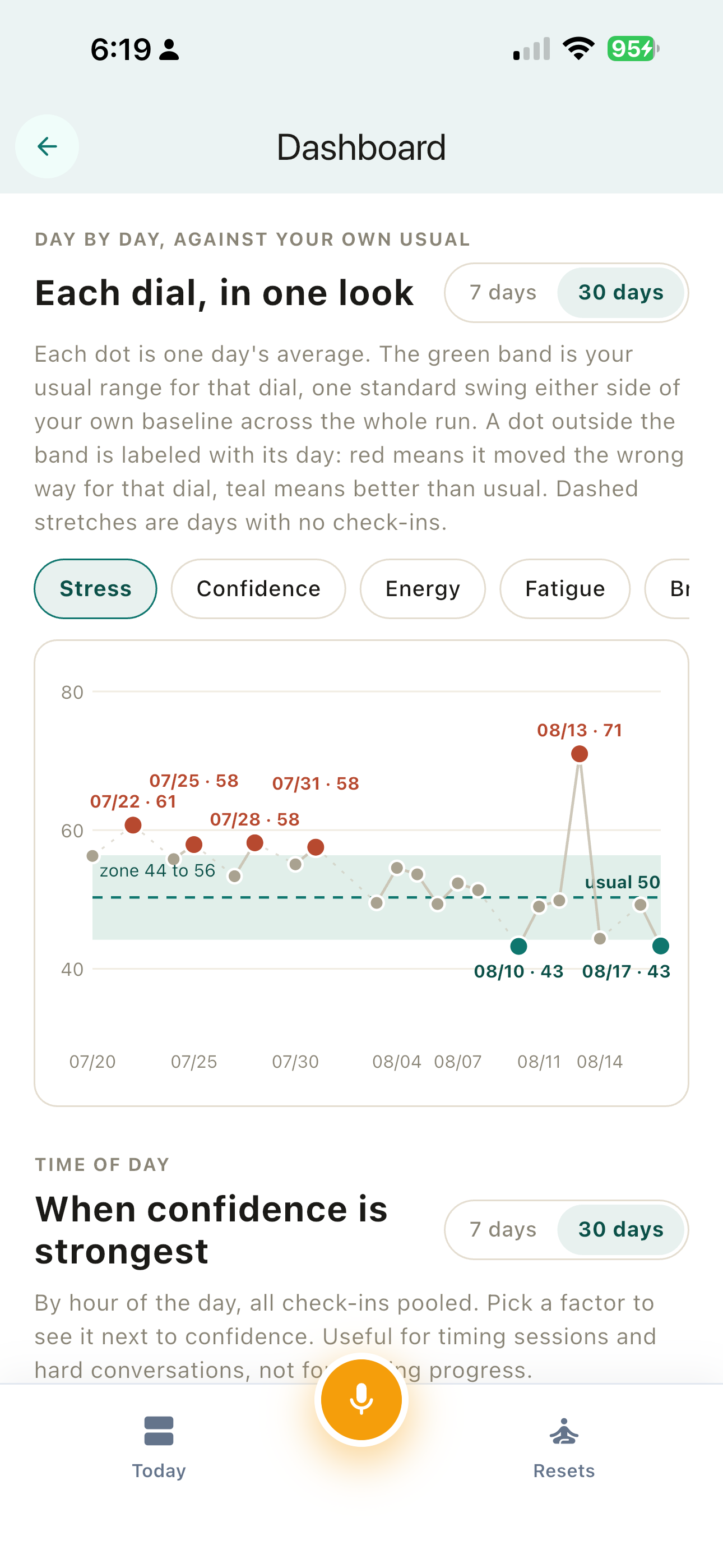
Here is stress day by day against my personal usual band (zone ~44 to 56, usual 50) from the same session history. Red points sit above my usual range. Useful as a private check for how often voice-state leaves the band across dials, including windows that sit inside hostile speech. It is not a hire-or-fire score and it is not proof that a suggested reset caused recovery:
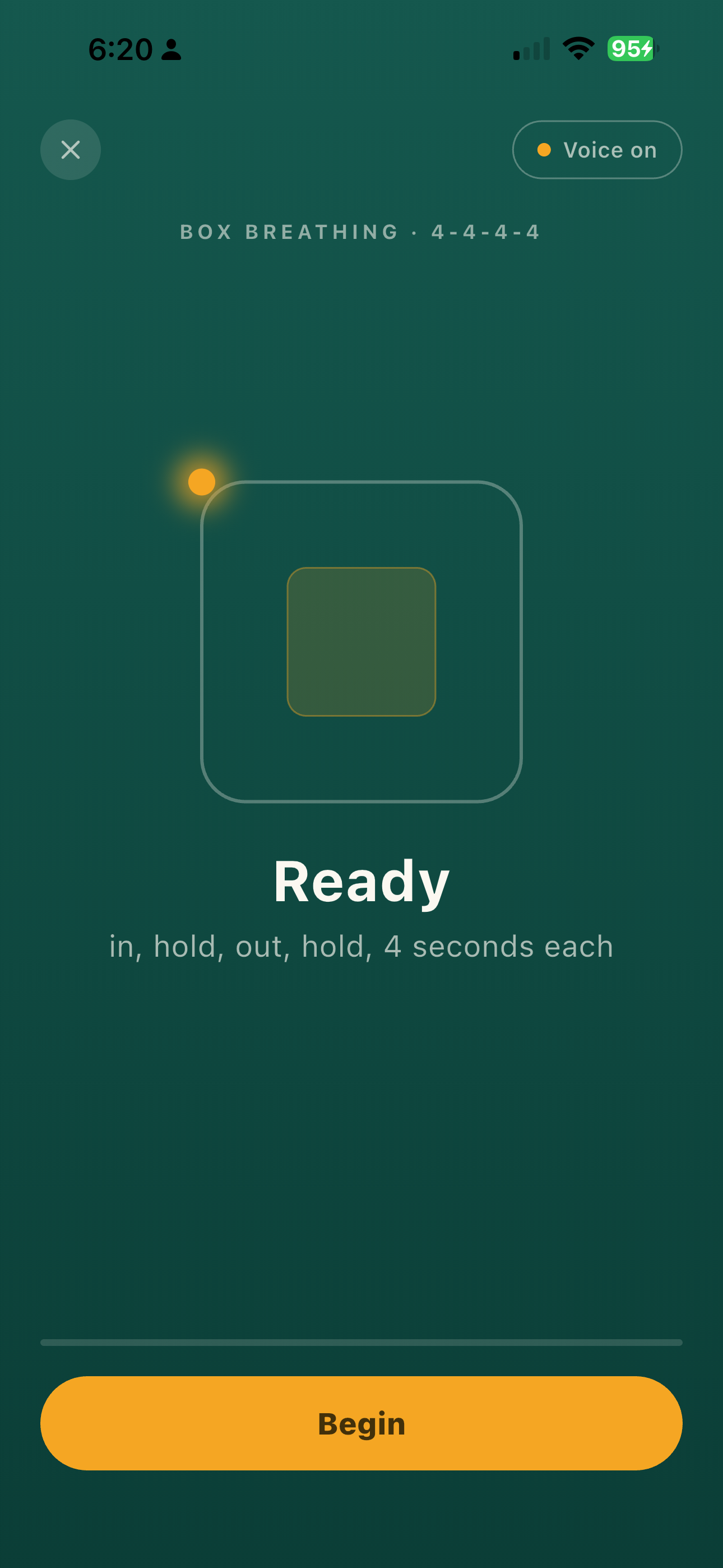
And here is the short reset the product offers when a lasting shift shows up: box breathing, 4-4-4-4. That is the tool form of Peck's "take a breath, step back" and Lovallo's deep-breathing / short-break trigger management, available privately without a supervisor in the ear. It is not a claim that one cycle restores energy-match presence on the next sentence:
This is not a claim that voice markers diagnose conflict clinically, predict recovery rates, replace manager judgment, guarantee cleaner energy match, or prevent FDCPA violations. The claim stays narrow: when absolute calm QA and live whisper miss mid-hostile personal drift, a private signal plus a short reset is a loop people can run before the consumer names the leak, while leaders watch cohort patterns only in aggregate.
What to try on the next hostile call
Do not wait for a research committee if you run collections or contact-center voice floors that already teach energy match or stay-calm under hostility.
- Install Ontor on the machine collectors already use for outbound and inbound connects.
- On the next hostile or charged consumer, notice whether energy, stress, confidence, clarity, breathing, or pitch sit outside that person's usual range in the short speech windows while the conflict is still live.
- If a lasting shift shows up, or if the collector can already tell they went flat or are leaking upset, take the short suggested reset when wrap-up or a brief mute allows it. Then continue the negotiation instead of collapsing robotic or getting called out.
- If you lead a pod, keep leaders on aggregate patterns only for mid-hostile drift. Personal readings stay with the person. Treat Van Cleave's energy-match language and Hoheusle's "can't hide upset" as performance controls, not only soft skills.
Soft secondary path if you are buying for a collections floor and want a measured look later: Ontor for teams, or a research conversation / pilot with collections ops and training leaders on mid-hostile energy windows.
Do not promise recovery-rate, AHT, retention, or FDCPA-prevention guarantees. Measure whether people can tell when flat-collapse or leaked-upset left their usual voice before the consumer names it.
Bottom line
They teach energy match so you don't go flat under hostility. Collectors still leak upset they think they're hiding. Van Cleave names flat/robotic under upset consumers and trains meeting energy, then guiding intensity down. Hoheusle names the audible leak consumers already hear. Peck prefers live breath/step-back whispers to keep people on the rails. Lovallo budgets EI trigger recognition plus deep breathing and short breaks. Petro trains the opposite absolute stay-calm opener so consumers match you. Cite that split carefully. The gap that remains is personal usual-range energy and stress in short mid-hostile windows, caught before the consumer calls it out or a supervisor has to jump in.
Try Ontor on the next hostile call. Notice the short voice windows versus that collector's usual range. Take the short reset when a lasting shift shows up. That is the tool next step, not only a pilot conversation.
Download Ontor - 14 days free, no card required
References
- Career Path with Katalina. "Unlocking Negotiation Power" featuring Kelli Van Cleave (Director of Education, ACA International). Episode 7 transcript and write-up. https://careerpathpodcast.com/kelli-van-cleave-unlocking-negotiation-power-aca-international-career-path-with-katalina-ep-7/
- AccountsRecovery.net. "Conflict Management Skills for Collectors & Collections Leaders" webinar transcript (Irene Hoheusle; Ken Peck). March 2026. https://www.accountsrecovery.net/wp-content/uploads/2026/03/Conflict-Management-Skills-for-Collectors-Collections-Leaders_Transcript.pdf
- Ed Lovallo (Director of Operations, Alliant Capital Management). "Developing a Debt Collection Team." Alliant Capital, September 16, 2024. https://alliantcapital.net/2024/09/16/developing-a-debt-collection-team-ed-lovallo-interview/
- AccountsRecovery.net. "The First 30 Seconds: A Look at What Predicts Successful Consumer Engagement" webinar transcript (Jenna Petro, First Financial Resources). https://www.accountsrecovery.net/wp-content/uploads/2025/12/The-First-30-Seconds_-A-Look-at-What-Predicts-Successful-Consumer-Engagement_Transcript-1.pdf (contrast only; stay-calm opener tactic)
- Ontor. "How it works." https://ontor.ai/how-it-works/
- Ontor. "Ontor for teams." https://ontor.ai/for-teams/
- Ontor. "About the founder." https://ontor.ai/about/
- Ontor. "Install Ontor." https://ontor.ai/install/
- Ontor. "Tone of voice in the first 10 seconds decides if they stay on the phone." https://ontor.ai/blog/collections-first-10s-tone/ (sibling, different question)
- Ontor. "We score Empathy & Tone. We still miss when a strong collector drifts off their own usual range." https://ontor.ai/blog/collections-qa-tone-vs-baseline/ (sibling, different question)
- Ontor. "Collections leaders can see dials and recovery rates. They still miss readiness after a hostile call." https://ontor.ai/blog/collections-cool-down-between-hostile-calls/ (sibling, different question)
- Ontor. "You QA Mini-Miranda. You still miss when a collector isn't themselves after a rough open." https://ontor.ai/blog/collections-compliance-hangover-self-reset/ (sibling, different question)
- Ontor. "Collectors sound distracted around breaks. Dial boards and QA scores still miss it." https://ontor.ai/blog/collections-break-window-fatigue/ (sibling, different question)