
Your playbook did not make them sound desperate. Quarter-end did.
Mid-market VP, CRO, Head of Sales, and SDR managers already hear it in late-quarter listen-ins. The playbook still says consultative. The floor starts sounding needy. Soft check-ins. Over-follow-ups. Over-discounts. Buyers clock the desperation before the pitch finishes. Leaders blame the script, or the rep. Often the system trained the sound.
Matt Kay (VP Sales, GridEdge) named the mechanism without softening it: EoQ pressure forces a different job than the playbook taught, and the voice follows.
Download Ontor - 14 days free, no card required
Kay: EoQ pressure trains desperate sound
Kay's post opens on the training failure, not on a bad hire:
"A lot of Sales teams accidentally train their Reps to sound desperate. Not confident - desperate."
How leadership language does it, in his words:
"Just get the deal over the line" / "Can you bring this forward?" / "Do whatever it takes"
Reps answer with their defaults under pressure: over-explaining, over-following up, over-discounting, being "nice" instead of consultative. Conversations then carry soft lines buyers already translate as neediness:
"Hope this makes sense!" "Just checking in…" "Happy to jump on another call!" "Shall we catch up tomorrow?"
Kay's read of the buyer:
"Buyers don't see this as being nice - they see the desperation immediately."
The EoQ wedge is the system flip:
"When you've told reps to do one thing, then forced them to do something else when you think it's squeaky bum time at EoQ."
That is the spine. Leadership pressure at quarter-end trains a desperate sound. The playbook did not invent the soft lines. The forced switch did. Kay's contrast for what good sounds like:
"Successful salespeople don’t sound "nice". They sound certain."
Certainty lines he lists: Here’s what we do / who it works for / where it doesn’t / How do you see this fixing that problem? The system behind that, in his framing, needs clear ICP, clear qualification, and a clear definition of what good looks like.
"Hope isn't a Sales strategy. Desperate is a terrible strategy."
What this article is not answering
Published Ontor mid-market pieces already cover nearby voice moments. Overlap sits near 45 percent on "how you sound versus your own usual range under pressure." The spine here is different.
- Under pipeline pressure, SDRs enter survival mode answers activity boards that still look busy while call quality drops into survival-mode rush and protect. This piece starts earlier in the leadership chain: EoQ pressure trains soft, needy delivery buyers hear as desperation, even when the playbook still says consultative.
- When you're off your game you rush and over-explain answers personal off-game state (low conviction, missing pre-call regulate). This piece is not that personal-state object. It is the system that forces a different job at squeaky-bum EoQ and trains the desperate sound.
- When anxiety shows up as tonality answers managers who hear thin tonality on listen-ins, miss the confidence spiral, and crush the baseline with wrong-frame tone notes. This piece is not the manager-feedback spiral. It is leadership pressure language ("bring this forward," "whatever it takes") training needy delivery before the next coaching cycle.
Same beachhead (mid-market call-heavy sales, roughly 20-200 voice seats). Different object: EoQ system trains desperate sound. Leadership pressure to soft/needy delivery buyers hear. Not survival-mode activity boards alone. Not off-game over-explain as personal state. Not manager wrong-frame spiral after listen-ins.
Corroboration: exhaustion, rush, and the first seven seconds
Three buyer-facing posts corroborate that prospects hear delivery leave before content recovers. None of them replace Kay's EoQ system spine.
Alex Opacic (ex cold-calling IC across three companies; founder, A2B) names rejection fatigue as the tone killer after a long dial block:
"The actual killer is rejection fatigue after 30-40 cold dials."
"It drains energy and kills tone. The prospect on the other end hears that exhaustion immediately."
Useful as corroboration that exhaustion is audible. Under EoQ pressure the same leave can stack with Kay's soft, needy lines. Opacic's object is bounce-back after dials. Kay's object is leadership pressure training desperation. Keep them stacked, not swapped.
Tony Brophy (cold caller) puts the delivery rule in plain language for long blocks:
"slow down and don’t sound like a desperate sales rep trying to shove meetings down their throat"
That matches Kay's buyer-side read without claiming Brophy wrote the EoQ system story. Slow and certain across a long block is the opposite of "whatever it takes" soft chasing.
Suji Goetzke (SDR coach voice) puts the decision window on the voice, not the opener:
"If you sound robotic, nervous, or like you're reading from a script, it doesn't matter how good your opener is. You're done."
"People buy from people they like. And they decide if they like you in the first 7 seconds."
"That decision has nothing to do with your words. It's all in the voice."
Under EoQ pressure, Kay's soft check-in lines land inside that same early window. Buyers decide on sound before they debate fit.
Vendor color only: tonality takes months (cap)
Kevin Ngam (SDR trainer) names a training-time gap many floors already feel. Cap it as practitioner color, not your floor's evidence for EoQ coaching ROI.
"I've trained over 50 SDRs in the last three years. Objection handling takes a week. Script memorization takes two days. Tonality takes months."
"You can't hand someone a document about tonality or give them a checklist. You have to record calls, play them back, and make them hear themselves."
Useful only as market language that tonality is slow to coach from documents alone. Do not treat a trainer post as proof that Ontor shortens months of tonality work, and do not swap Ngam for Kay's EoQ spine.
What dials, playbooks, and EoQ war rooms still miss
The stack these leaders already run:
- Clear playbook and certainty lines (Kay's “here’s what we do / who it works for”)
- ICP and qualification definitions on paper
- EoQ forecast calls, bring-forward pressure, and "whatever it takes" language
- Activity boards and connect counts that still look busy
- Recording review and tone notes after the fact
Useful. Incomplete for the audible leave while the rep is still speaking. A playbook does not show whether confidence, stress, energy, clarity, strain, or breathing left that person's own usual range in the short speech windows after a "bring this forward" push. Forecast color does not restore certain delivery mid-block. Recording review is hindsight. Soft "just checking in" lines already landed.
Buyers hear the desperation first. Leaders meet it later as a late-quarter coaching ticket, a discount stack, or a floor that sounds hopeful instead of certain.
What Ontor adds on the EoQ block (private first)
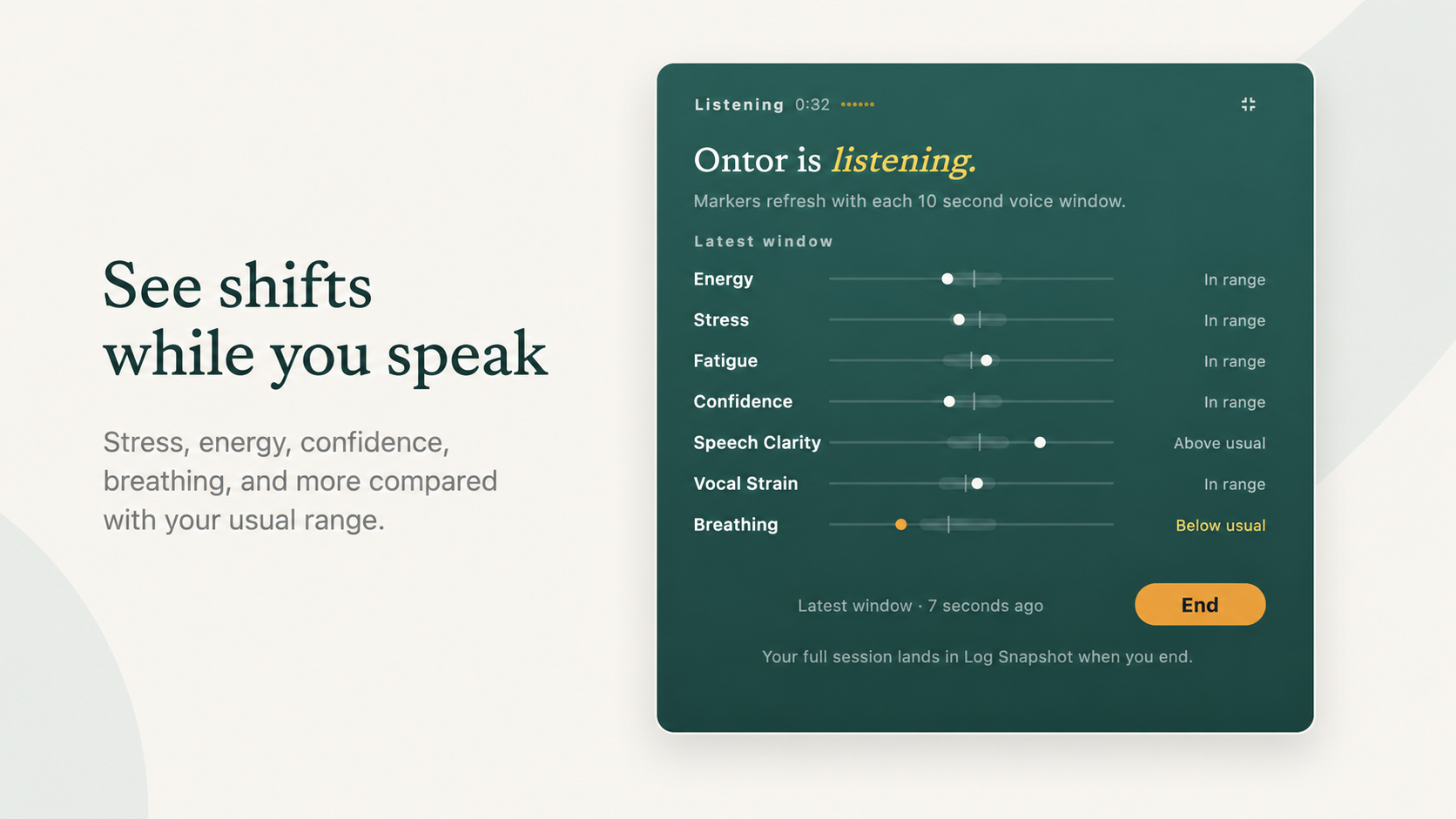
Ontor reads how you sound, not what you said. While someone speaks, it compares voice signals with that person's own usual range. It does not react to every unusual second. It looks for a lasting shift. Signals on the public product page are energy, stress, fatigue, confidence, speech clarity, vocal strain, and breathing. Each one is how the voice sounds versus your own usual range, not a population grade. When a lasting shift shows up, Ontor can suggest a short reset. You can compare before and after.
The live listening view refreshes markers with each 10 second voice window. That is the product's own label, not a clinical sampling claim.
Boundaries, said plainly:
- Ontor does not replace Kay's clear ICP, qualification, or playbook certainty lines.
- Ontor does not diagnose anxiety, burnout, or a health condition, and a marker move is not a clinical outcome.
- Ontor does not claim that a marker change proves fewer discounts, higher win rates, or better retention.
- For teams, leaders see aggregate patterns that can inform workload, coaching, and support. Individual sessions and readings stay with the person. That is not a hire or fire score. Soft secondary path only: Ontor for teams.
In my own Ontor session history (founder exploratory data from my own product use, not your floor's outcome data), the EoQ desperate-sound leave shows up the same way Kay describes. After I have been pushed to "bring something forward" or "just get it over the line," soft check-in energy creeps in. Confidence, stress, or energy can sit outside my usual band in the short windows while I keep talking. I cannot hear that leave the way a buyer hears it in the first seconds. A private usual-range cue during speech, plus a short reset when the shift persists, is the tool step back toward certain delivery. It is not a claim that one cycle fixes quarter-end forecast pressure.
Here is live listening from my own Ontor session. Markers refresh with each 10 second voice window and sit against my usual range. Read it as a private check for EoQ pressure-tone leave and desperate-sound delivery, not as a QA score:
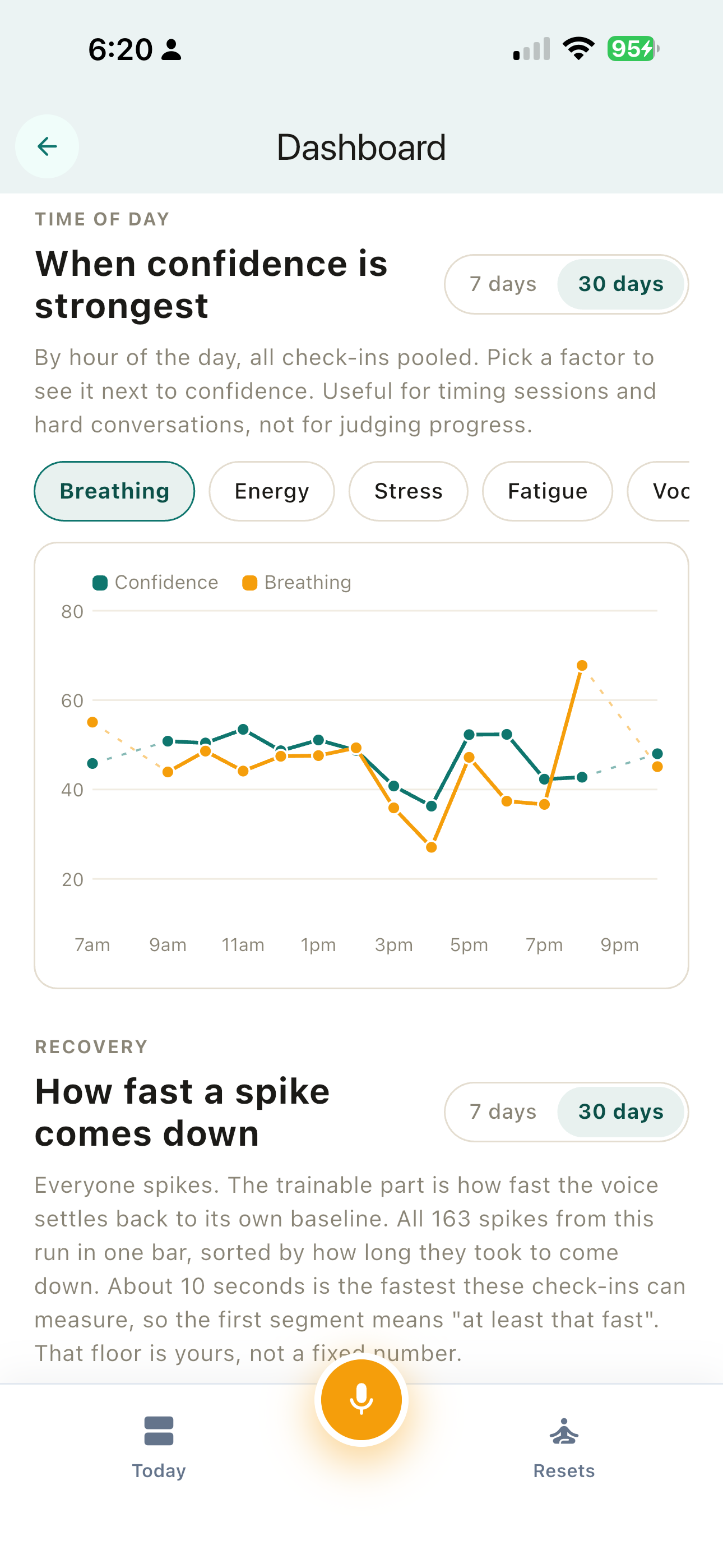
Here is confidence beside breathing by hour from that same session history. The screen is for timing hard conversations, and it says it is not for judging progress. Read the shape as founder exploratory data on how confidence and breathing move across a speaking day, including windows where "bring it forward" pressure would pull delivery toward soft, needy lines:
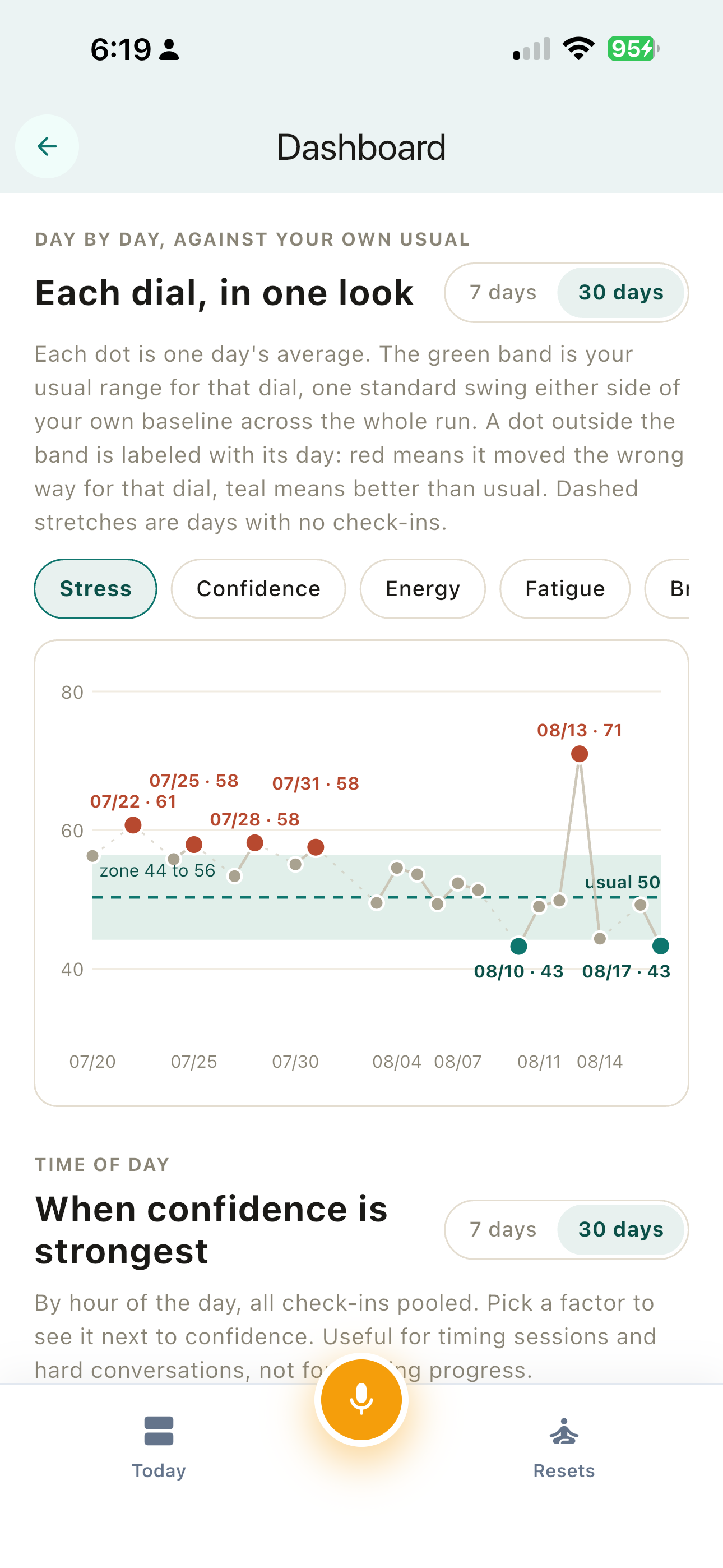
Here is stress day by day against my own usual band. The screen labels a zone of 44 to 56 around a usual of 50, and it marks days that sit outside that band. Useful as a private view of how often voice-state leaves the band across calls when quarter-end pressure stacks. It is not a rep ranking, and it is not proof that a reset caused certain delivery:
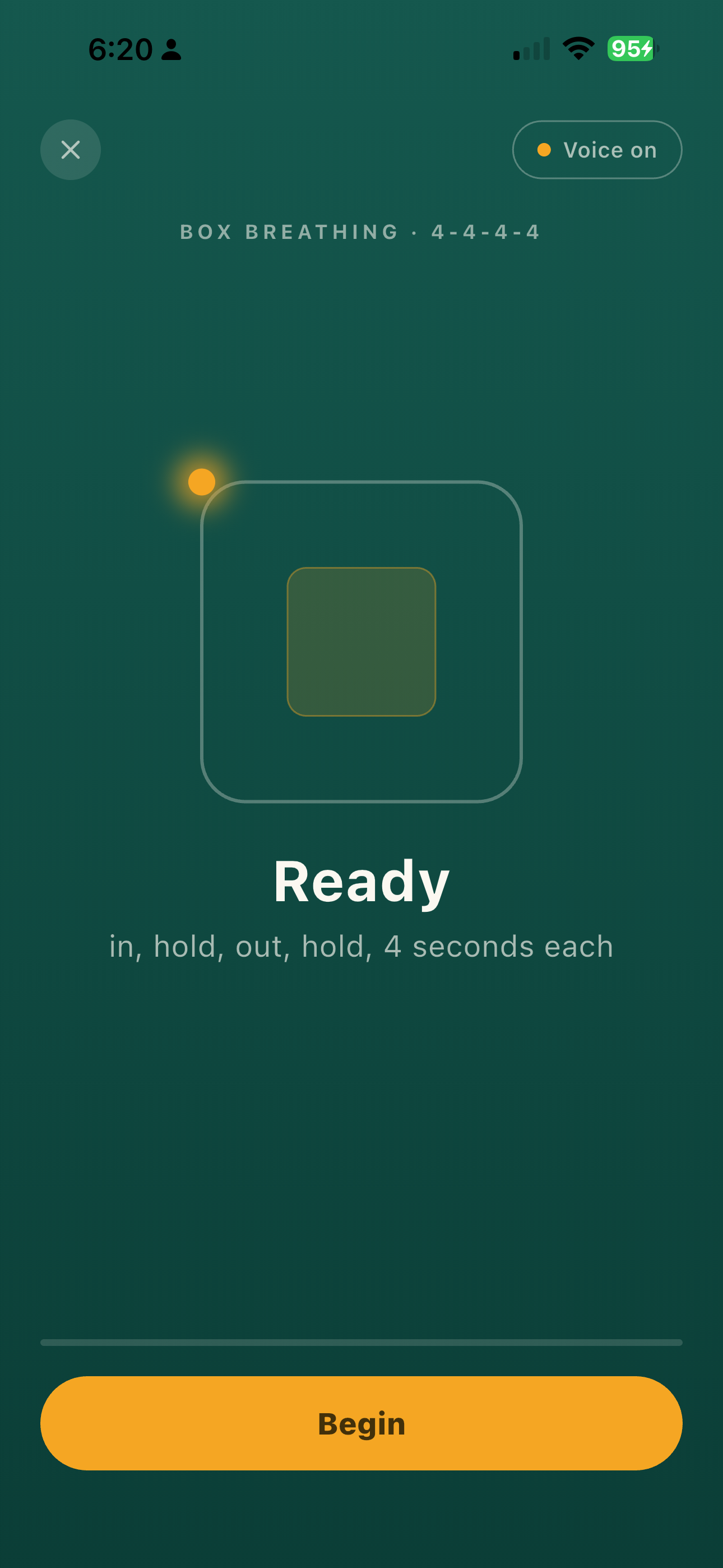
And the short reset the product offers when a lasting shift shows up: box breathing, 4-4-4-4. That is a private pause you can take after a lasting confidence or stress shift on an EoQ block, before you stack another soft "just checking in." It is not a medical protocol, and it is not a substitute for Kay's playbook certainty or clear qualification:
The claim stays narrow. When EoQ pressure has trained soft, needy delivery and confidence or stress left the usual range, a private usual-range cue plus an optional short reset is a loop the rep can run before the next desperate-sounding line. Leaders, if they look at all, look at cohort patterns only.
Download Ontor - 14 days free, no card required
What to try on the next EoQ call block
Do not wait for another forecast call if you already hear soft check-ins and over-follow-ups when leadership says bring it forward.
- Install Ontor on the machine you already use for sales dials.
- On the next live dial in an EoQ or bring-forward block, notice whether confidence, stress, energy, or clarity sit outside your own usual range in the short speech windows when you reach for "just checking in" or "happy to jump on another call." Listen for how you sound against your personal baseline. Not against a floor average, and not against whether the deal "could still close."
- If a lasting shift shows up, take the short suggested reset before you stack another soft follow-up or over-discount. Return to Kay's certainty lines: what you do, who it works for, where it does not, and how they see the fit. Do not treat a new discount path as proof the desperate sound is fixed.
- If you lead a mid-market pod, keep personal readings with the person. Use aggregate patterns only if you later want a cohort view of strain across EoQ blocks. Do not turn Ontor into a desperation QA score or a hire-fire tool.
If you run a floor and want a measured team look later, the light secondary path is Ontor for teams. The primary step is still install, on the next call block.
Do not promise fewer discounts or higher win rates. Measure whether you can tell when delivery left your usual range under EoQ pressure, before buyers hear the desperation.
Bottom line
Your playbook did not make the floor sound desperate. Quarter-end pressure did. Matt Kay names the training failure: leadership says "bring this forward" and "do whatever it takes," reps default to soft, needy lines, and buyers hear desperation immediately. Opacic's rejection-fatigue tone leave, Brophy's slow-not-desperate rule, and Suji's first-seven-seconds voice decision corroborate that prospects hear delivery before content. Ngam's "tonality takes months" is capped vendor color only. Ontor does not replace clear ICP, qualification, or certainty playbooks. It shows audible confidence, stress, energy, and breathing against your own usual range in short voice windows, and it can offer a short reset before the next soft chase.
Try it on the next EoQ call block. Notice how you sound versus your personal baseline when bring-forward pressure lands. Take the short reset if a lasting shift shows up, then return to certain delivery.
Download Ontor - 14 days free, no card required
About the author
Sabber Ahamed is the founder of Ontor and an applied ML scientist (PhD, geophysics and signal processing) who builds on-device voice tools. He has shipped production signal and ML systems across radiology AI, healthcare, and manufacturing. Ontor compares how you sound with your own usual ranges and can suggest a short reset. Marker changes are not clinical outcomes and they are not revenue proof.
References
- Matt Kay. LinkedIn post: sales teams accidentally train reps to sound desperate under EoQ pressure. https://www.linkedin.com/posts/mkay1_a-lot-of-sales-teams-accidentally-train-their-activity-7452310992333705216-B-Zj
- Alex Opacic. LinkedIn post: rejection fatigue after 30-40 cold dials kills tone; prospect hears exhaustion. https://www.linkedin.com/posts/alexopacic_spent-9-years-cold-calling-across-3-companies-activity-7502500888540811264-vdLP
- Tony Brophy. LinkedIn post: slow down and don’t sound like a desperate sales rep across long call blocks. https://www.linkedin.com/posts/tonybrophy1_unsexy-tips-for-dominating-your-cold-calling-activity-7496230826486026240-jrTD
- Suji Goetzke. LinkedIn post: first ~7 seconds decided by voice; robotic or nervous loses regardless of opener. https://www.linkedin.com/posts/suji-goetzke_sales-coldcalling-sdrleaders-activity-7470603480630575104-bFVo
- Kevin Ngam. LinkedIn post: tonality takes months (vendor/practitioner color only). https://www.linkedin.com/posts/kevinngam_ive-trained-over-50-sdrs-in-the-last-three-activity-7449600583298211841-unjB
- Ontor. "How it works." https://ontor.ai/how-it-works/
- Ontor. "Ontor for teams." https://ontor.ai/for-teams/
- Ontor. "About the founder." https://ontor.ai/about/
- Ontor. "Install Ontor." https://ontor.ai/install/
- Ontor. "Under pipeline pressure, SDRs enter survival mode..." https://ontor.ai/blog/sdr-survival-mode-under-pipeline-pressure/
- Ontor. "When you're off your game you rush and over-explain..." https://ontor.ai/blog/over-explain-when-off-your-game/
- Ontor. "When anxiety shows up as tonality..." https://ontor.ai/blog/sales-anxiety-tonality-manager-spiral/