
Your voice cracked mid-call. The prospect heard the shake.
You remember the words. The prospect remembers how you sounded when they broke. Voice crack. Audible shake. A mid-call collapse that sounded like your voice left the room. Managers call it nerves. Peers call it first-call jitters. The delivery failure is narrower: under live pressure, pitch break, shake, or vocal collapse is what the buyer hears, not a private feeling you can hide behind the script.
This piece is for individual call-heavy employees: SDRs, AEs, BDRs, anyone on live dials who has already felt a crack, stutter, or mid-call voice leave land in the prospect's ear. The object is mid-call / first-live vocal instability as an audible how-you-sound event. It is not your first connect of the day shouldn't be your warm-up rep (morning cold-start rhythm before the instrument is ready). It is not prospects hear when the voice tightens (tone tighten under resistance on a mid-market floor). It is not your voice sounds anxious because you're breathing like someone who is (shallow chest breath writing a full stress fingerprint even when you feel fine). Also do not collapse it into hangover between sales calls, call-mode pitch-voice, or block-length robot flat. Unique wedge here: crack, shake, or mid-call vocal collapse is what the prospect hears under live pressure.
Download Ontor - 14 days free, no card required
Trenton Reed: voice cracked, stuttered, prospect heard the shake
Trenton Reed (SDR; first-person LinkedIn self-report on a first cold call) put the failure in buyer-facing language:
"My first cold call was a disaster"
"My voice cracked"
"I stuttered"
"And I'm pretty sure the prospect heard me shaking"
He does not remember who he called or what he said. He remembers the crack, the stutter, and the belief that the prospect heard him shaking. Treat that as employee anecdote, not an Ontor case study and not a clinical claim. The useful spine is the mechanism ICs already name: first-live pressure produced audible pitch break and shake, and the IC attributes the damage to what the prospect heard, not only to how nervous he felt inside.
That is different from "I was nervous." Nervous is private. Crack and shake are public. The hang-up relief, when it comes, often tracks the audible leave more than the talk track.
Daniel Goerner: voice left mid cold call under live pressure
Daniel Goerner (SDR / cold caller; LinkedIn post written in a comic "Cryin Dialin Dan" framing) named the mid-call collapse in the same how-you-sound register:
"I lost my voice on a cold call yesterday, sounded like I'd just hit puberty."
"Gasping, trying to speak, even my eyes watered, it was awful."
He jokes about pity converting the prospect into an email ask. Keep the mechanism. Strip the satire for product writing. Do not turn a comic post into a medical or ENT claim. Ontor does not diagnose voice loss, treat throat conditions, or invent clinical explanations for why a voice left mid-sentence. The IC-useful object is narrower: under live dial pressure, the voice can break, gasp, or collapse mid-call, and that broken delivery is what the prospect hears while you are still trying to speak.
Reed and Goerner sit in one cluster. Reed is first-live crack/shake. Goerner is mid-call collapse under pressure. Both are audible instability events during speech, not between-call hangover and not flat robot mode across a block.
QUOTA (capped vendor): under pushback, pitch rises, pace quickens, volume drops
Stefano Sechi / QUOTA Training (AI role-play sales coaching vendor blog; capped vendor corroboration, not the handoff spine) maps the same audible-doubt pattern when a buyer pushes back:
"Then a buyer says, "We don't have budget," and your voice betrays you."
"Your pitch rises. Your pace quickens. Your volume drops. And the buyer hears exactly what you didn't want them to hear: doubt."
Use QUOTA only as corroboration that pitch, pace, and volume leave under live pressure, and that buyers hear doubt in that leave. Do not reuse their role-play conversion percentages as Ontor proof. Cap the vendor CTA. The spine stays Reed/Goerner employee how-you-sound failure: crack, shake, mid-call collapse. QUOTA adds the pushback triad (pitch up, pace up, volume down) as a related audible-retreat pattern, not a second spine.
Supporting color only: Gina EOD flatten; Joab felt-stutter vs strong tone
Gina Razon / GrowVoice (vendor blog; supporting color only) names end-of-day voice after back-to-back calls: by about 4:30pm the voice can sound rougher, flatter, and more effortful. Cap tightly. That is late-day flatten and effort, useful as adjacent how-you-sound color. It is not this article's mid-call crack/shake/collapse spine.
Joab Francois (Senior SDR, Deel; LinkedIn role-play observation; supporting only) names the felt-versus-heard gap: someone felt they stuttered and bombed, while from his seat their tone, pace, and delivery were strong. Useful as a reminder that internal self-score can mismatch external how-you-sound. Do not lead this piece as a felt-stutter article. Reed's crack/shake and Goerner's mid-call leave stay the employee spine.
Distinct from first-connect warmup, voice-tighten, breath-fingerprint, hangover, call-mode
Published Ontor pieces already cover nearby voice moments. Overlap on "voice versus your own usual range" is real. The spine here is different.
- First connect shouldn't be warmup answers: morning cold-start burns real prospects while you are still finding rhythm. Object is first-connect readiness / warmup reps. Not crack, shake, or mid-call vocal collapse as the audible event the prospect hears.
- Prospects hear voice tighten answers: mid-market talk-time boards miss the second tone tightens under resistance and discovery flips to desperation. Adjacent live pressure, different object: tighten/pace under pushback for sitting leaders, not IC first-live crack/shake or mid-call collapse.
- Voice reports your breathing, not your feelings answers: shallow chest breath writes a sonic fingerprint of stress (tight pitch, clipped phrases, air-starved rushes) even when you feel fine. Different mechanism: breath pattern overall, not crack/shake/collapse mid-call.
- Hangover between sales calls answers: rejection or rough-call carryover into the next dial. Not mid-speech pitch break while you are still on the live connect.
- Call-mode pitch-voice answers: forced professional phone costume off your usual conversation sound. Not audible crack or shake under live pressure.
Same call-heavy world. Different mechanical object: mid-call / first-live vocal instability (crack, shake, collapse) as what the prospect hears. Ontor shows stress, confidence, strain, clarity, and related markers versus personal usual range in short speech windows, plus an optional short reset when lasting shifts show.
What "just dial through it," pep talks, and post-call self-listen still miss
Typical stack for an IC who already knows a crack or shake landed:
- Keep dialing / reps will fix it
- "Be more confident" before the next pickup
- Warmup rituals that help morning rhythm but do not catch a mid-call break once you are live
- Post-call recording review after the crack already wrote into the take
- Objection scripts that ignore pitch rise, pace spike, and volume drop under pushback
Useful. Incomplete for live audible instability. More reps do not show whether stress, confidence, strain, or clarity left your personal usual range in the short windows where the crack or shake happened. A pep talk does not catch lasting leave before the next live connect inherits the same shake. Self-listen after the fact catches one recording. It does not catch mid-call collapse while you are still speaking.
None of those continuously ask: on this live dial, did stress, confidence, strain, clarity, or related markers leave my own usual range in the windows where my voice cracked, shook, or collapsed? Ontor does not replace dialing reps, Joab-style external feedback, Gina-style end-of-day care, or QUOTA-style objection delivery craft. It reads how you sound versus your personal usual range while you speak, and can offer a short reset when a lasting shift shows up.
Download Ontor - 14 days free, no card required
What Ontor adds for mid-call crack / shake / collapse (private first)
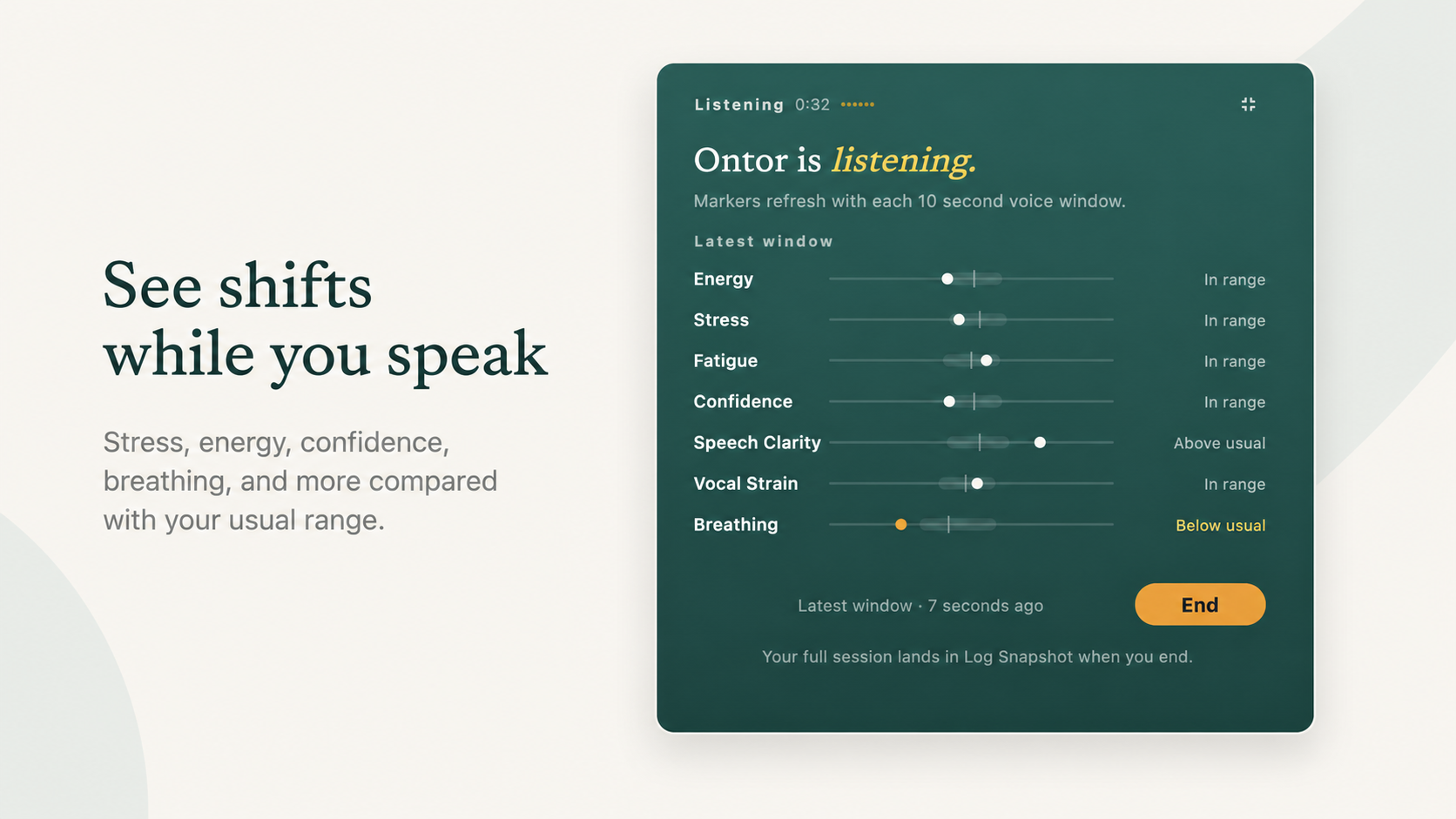
Ontor is a performance tool that reads how you sound, not what you said. While someone speaks, it compares voice signals with that person's own usual range. Markers refresh in short voice windows (on the order of about 10 seconds of speech). It does not react to every unusual second. It looks for a lasting shift. Signals on the public product page include energy, stress, fatigue, confidence, speech clarity, vocal strain, and breathing. Each one is how the voice sounds versus your own usual range, not a population grade. When a lasting shift shows up, Ontor can suggest a short reset. You can compare before and after.
Boundaries, said plainly:
- Ontor does not replace dialing practice, buddy warmups, Joab-style external listen-ins, or QUOTA-style objection delivery drills.
- Ontor does not diagnose voice loss, treat ENT conditions, or turn Goerner's comic mid-call collapse into a medical claim.
- Ontor does not claim that marker changes prove quota lift, retention, cognitive improvement, or clinical recovery.
- Ontor is a tool / product / platform (not an "app" in our outward copy). It is not a hire/fire scoreboard. Individual sessions and readings stay with the person.
The claim stays narrow: when crack, shake, or mid-call vocal collapse is already what the prospect hears, a private personal-baseline cue for stress, confidence, strain, clarity, and related markers in short windows, plus an optional short reset when lasting shifts show, gives you a way to notice the leave before the next live connect inherits it. Soft secondary path if you later buy for a pod: Ontor for teams.
What shows up in my own Ontor history (crack / shake risk as personal-baseline leave)
I am Sabber Ahamed, founder of Ontor (about; LinkedIn). I use the product on my own speaking and call-heavy days. In my own Ontor session history (founder exploratory data from my own product use, not your floor's outcome data), the Reed/Goerner mid-call instability object shows up as personal-baseline leave in stress, confidence, strain, and clarity-adjacent markers during live speech windows, not as a separate "stage fright personality" problem. I can still feel mostly fine until a window leaves my band. Delivery drifts toward the tighter, shakier, higher-strain leave buyers hear as doubt or break. That is the mid-call crack/shake object this article is about: audible leave against my own usual range while I am still on the live connect.
Here is the live listening view from my own Ontor product use: markers refresh with each ~10 second voice window and sit against my usual range. Read it as a private check for whether stress, confidence, strain, or clarity left my band in the windows where a crack or shake would otherwise land in the prospect's ear:
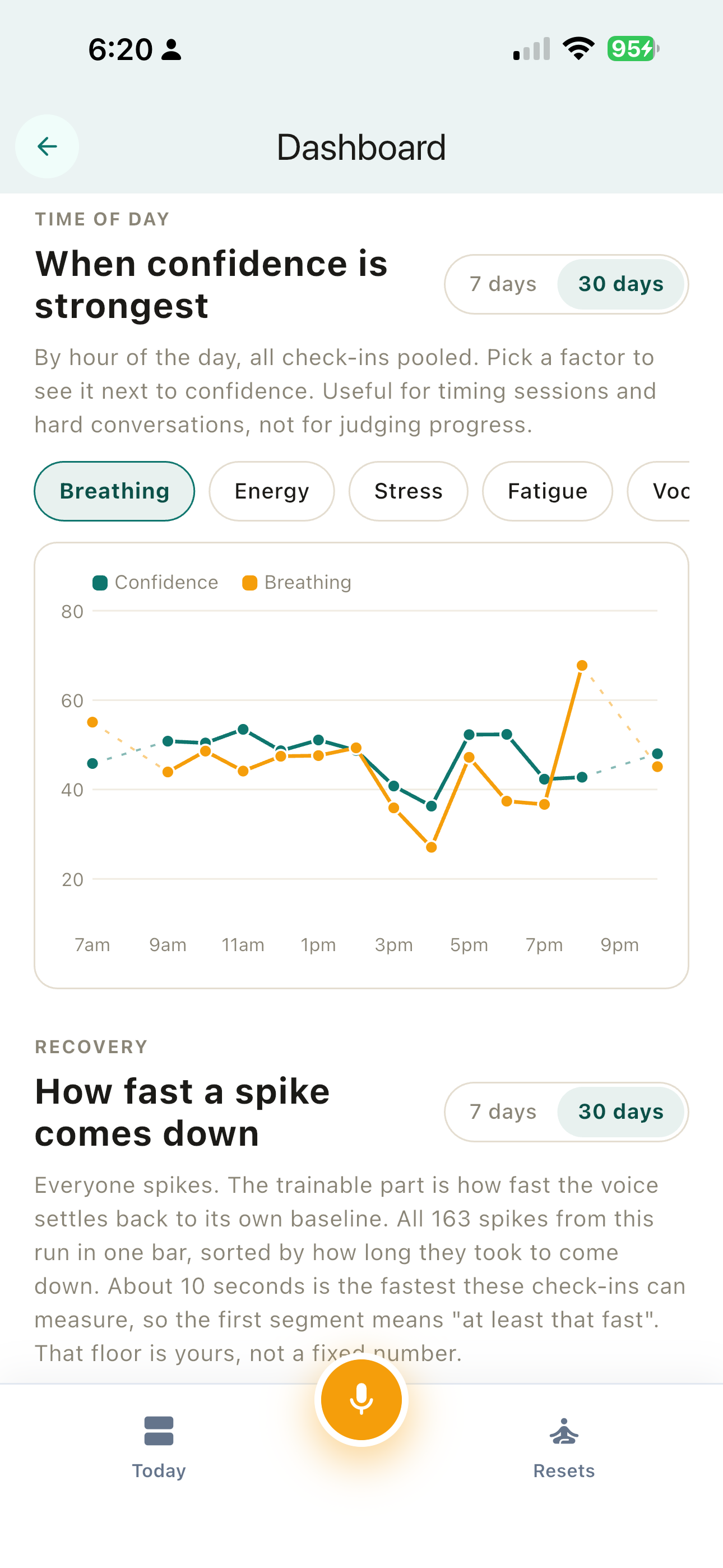
Here is confidence with breathing by hour from that same Ontor history. Confidence can sit near usual early, then leave later when the speaking day gets longer and support thins. Read it as founder exploratory data on personal-baseline drift across a call-heavy day, not proof of quota outcomes and not a claim that Ontor diagnosed a throat condition:
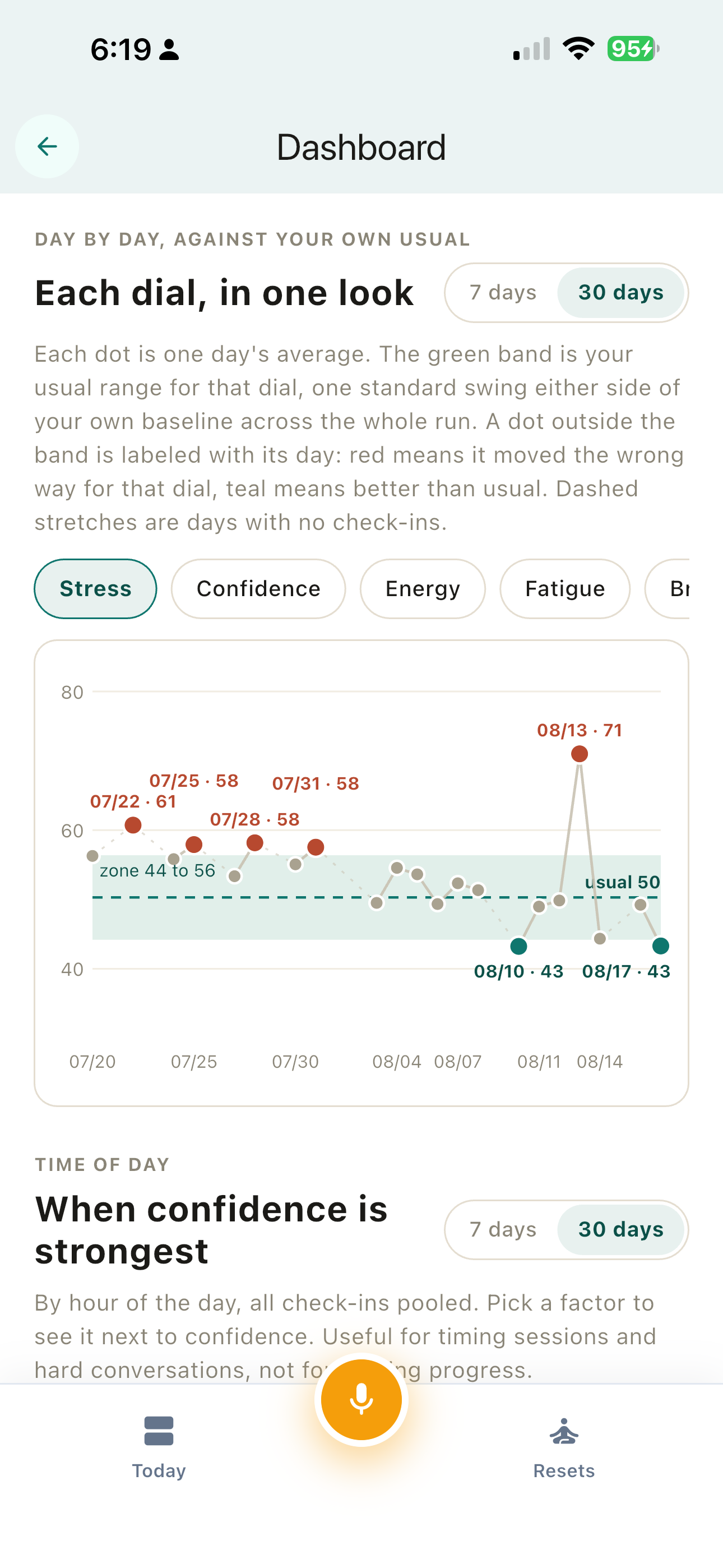
Here is stress day by day against my personal usual band (zone ~44 to 56, usual 50) from the same session history. Red points sit above my usual range. Useful as a private check for how often voice-state leaves the band across calls when a mid-call crack or shake risk is highest. It is not a hire-or-fire score and it is not proof that a suggested reset caused clinical improvement:
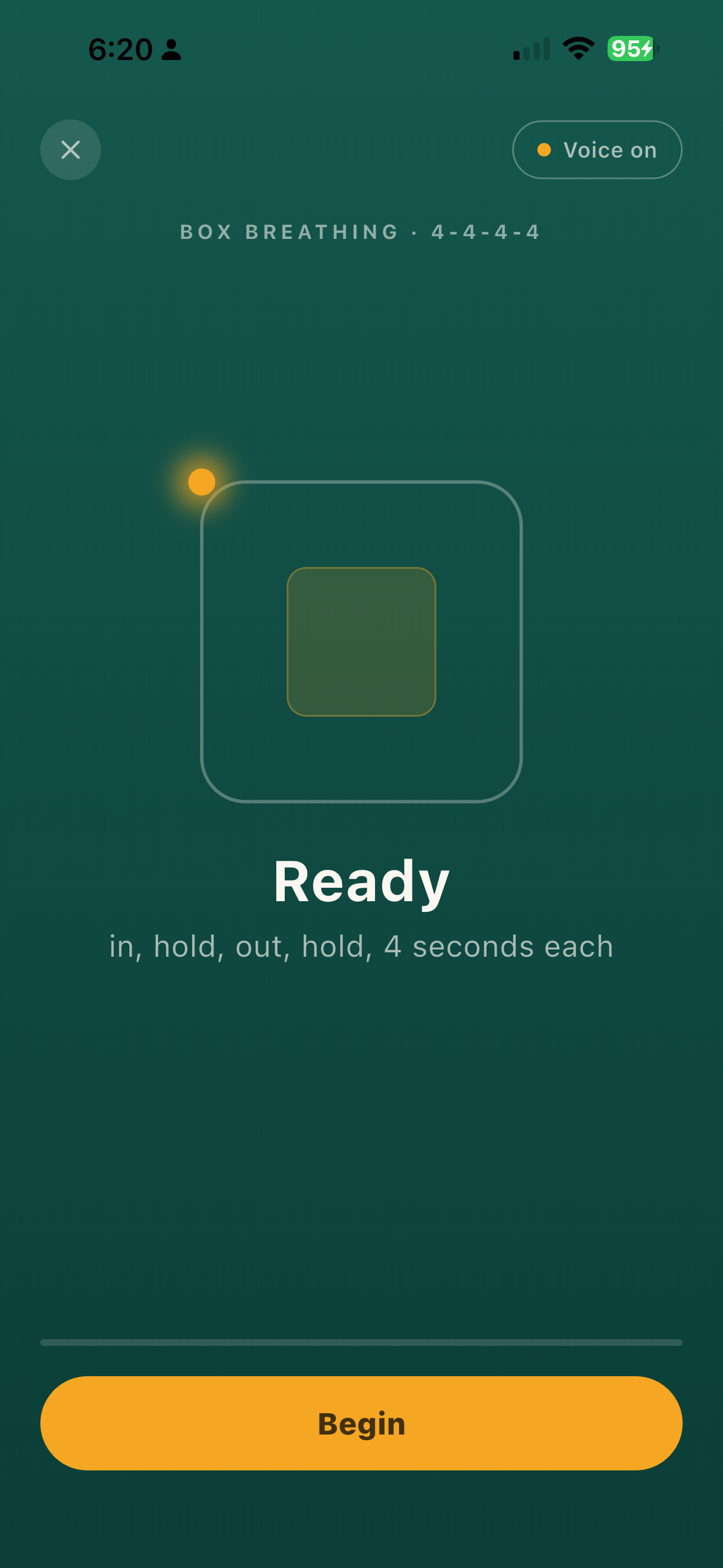
And here is the short reset the product offers when a lasting shift shows up: box breathing, 4-4-4-4. That is a private between-dial tool when stress, confidence, strain, or clarity leave your band before stacking another live connect after an audible break. It is not a medical protocol and it is not a claim that one cycle prevents every crack:
Claim-safe science note from Ontor's internal reset-effects and founder longitudinal work (exploratory n=1, not population proof): short resets can show temporary movement in stress-related voice markers in some recorded cases, and lasting recovery is not established as a general rule. High-stress stretches in founder exploratory data often do not show an observed return to personal median within an hour. Do not leap from those notes to medical voice treatment. Ontor compares how you sound to your personal usual ranges and can suggest a short optional reset when lasting shifts show. Marker changes are not clinical outcomes.
What to try on your next live dial
Do not wait for a research committee if you are an IC who already knows a crack, shake, or mid-call voice leave landed in a prospect's ear.
- Install Ontor on the machine you already use for cold calls, discovery, and demos.
- On the next live dial, notice stress, confidence, strain, and clarity versus your personal usual range in the short speech windows, especially under first-live pressure or mid-call pushback where crack/shake risk is highest.
- If a lasting shift shows up, or if the shake / pitch break / volume retreat persists across windows, take the short suggested reset (or a brief breath-support reset between dials). Then continue.
- If you coach a pod later, keep leaders on aggregate patterns only for stress / confidence / strain drift under live-dial pressure. Personal readings stay with the person. Treat Reed's crack/shake and Goerner's mid-call leave as performance controls, not medical labels. Pair with a quick self-listen after a hard connect. Do not treat Ontor as a script coach or a hire-fire tool.
Concrete try-on-next-call step: on your next live dial, notice whether stress, confidence, strain, or clarity left your personal usual range in the windows where your voice would crack, shake, or collapse; if lasting shifts persist, take a short reset before the following pickup.
Soft secondary path if you lead mid-market coaching on how people sound and want a measured look later: Ontor for teams.
Do not promise win-rate, retention, or revenue guarantees. Measure whether people can tell when mid-call stress, confidence, strain, or clarity left their usual voice before a prospect names the shake.
Bottom line
Your voice cracked mid-call. The prospect heard the shake. Trenton Reed named first-live crack, stutter, and audible shake. Daniel Goerner named mid-call voice leave under live pressure (mechanism only; comic post, no medical claim). QUOTA (capped vendor) maps pitch rise, pace spike, and volume drop under pushback into buyer-heard doubt. Gina EOD flatten and Joab felt-versus-heard stay supporting color. The gap that remains is personal usual-range stress, confidence, strain, and clarity in short speech windows, caught while you are still on the live connect, before the next dial inherits the same audible leave.
Try Ontor on your next live dial. Notice the short voice windows versus your usual range for stress, confidence, strain, and clarity. Take the short reset when a lasting shift shows up. Let the next prospect hear a voice that stayed inside your band, not the crack you already know they can hear.
Download Ontor - 14 days free, no card required
References
- Trenton Reed (SDR; employee_anecdote). LinkedIn: first cold call disaster; voice cracked; stuttered; prospect heard me shaking. https://www.linkedin.com/posts/trentonreed360_my-first-cold-call-was-a-disaster-i-don-activity-7330209045628223490-ukuX
- Daniel Goerner (SDR; employee_anecdote, comic framing). LinkedIn: lost voice mid cold call; sounded like puberty; gasping, trying to speak. Mechanism only; no medical/ENT claim. https://www.linkedin.com/posts/daniel-goerner-a44158166_i-lost-my-voice-on-a-cold-call-yesterday-activity-7468764413882343424-2GlA
- Stefano Sechi / QUOTA Training (vendor_marketing, capped corroboration). "Objection Handling Tonality": under pushback pitch rises, pace quickens, volume drops; buyer hears doubt. Do not reuse vendor conversion % as Ontor proof. https://quota.training/blog/objection-handling-tonality-voice-converts-pushback
- Gina Razon / GrowVoice (vendor_marketing, supporting color only). "Your Voice At End Of Day": ~4:30pm rougher/flatter/more effort after back-to-back calls. https://www.growvoice.com/post/your-voice-at-the-end-of-the-day
- Joab Francois (Senior SDR, Deel; employee_anecdote, supporting only). LinkedIn role-play: felt stuttered vs strong external tone/pace/delivery. https://www.linkedin.com/posts/joabfrancois_i-was-in-a-role-play-recently-where-someone-activity-7472371172668678146-C1_Q
- Ontor. "How it works." https://ontor.ai/how-it-works/
- Ontor. "Ontor for teams." https://ontor.ai/for-teams/
- Ontor. "About the founder." https://ontor.ai/about/
- Ontor. "Install Ontor." https://ontor.ai/install/
- Ontor. Sabber Ahamed LinkedIn. https://www.linkedin.com/in/sabber-ahamed
- Ontor. "Your first connect of the day shouldn't be your warm-up rep." https://ontor.ai/blog/first-connect-shouldnt-be-warmup/ (sibling, morning warmup)
- Ontor. "Your dialer counts talk time. Prospects hear when the voice tightens." https://ontor.ai/blog/prospects-hear-voice-tighten/ (sibling, voice tighten under resistance)
- Ontor. "Your voice sounds anxious because you're breathing like someone who is." https://ontor.ai/blog/voice-reports-your-breathing-not-your-feelings/ (sibling, breath fingerprint)
- Ontor. "Leaders treat the minutes between calls as empty. The hangover isn't." https://ontor.ai/blog/hangover-between-sales-calls/ (sibling, between-call hangover)
- Ontor. "Your cold-call voice isn't missing enthusiasm. It's a mode switch off your usual sound." https://ontor.ai/blog/call-mode-pitch-voice/ (sibling, call-mode)