
Your voice sounds anxious because you're breathing like someone who is
You can feel fine and still sound tight on a live dial. Pitch climbs. Phrases clip. You run out of air mid-sentence and rush the rest. Managers call it nerves. Peers call it helium pitch or cold-call voice. The mechanical story is simpler: shallow chest breathing produces the sonic fingerprint of stress whether or not you feel anxious inside. Your voice is reporting your breathing, not your feelings.
This piece is for individual call-heavy employees: ICs, AEs, SDRs, anyone on live dials who keeps getting "you sounded nervous" after a block that felt fine. The object is breath mechanics to audible stress markers. It is not when anxiety shows up as tonality / manager feedback spiral, not call-mode pitch-voice, not coaches: anxious or robotic under the same pressure, and not freight cold calls that die as a pace dump. Also do not collapse it into silence-fill, off-game over-explain, thin-tight everyday baseline, hangover between calls, or prospects hearing the voice tighten under live resistance. Unique wedge here: breath pattern → sonic fingerprint of stress even when you "feel fine."
Download Ontor - 14 days free, no card required
Paul Mascetta: voice reports breathing, not how confident you feel inside
Paul Mascetta (voice coach / Influence Academy; vendor and coach framing, not an Ontor clinical claim) named the mechanism in buyer language:
"Your voice sounds anxious because you're breathing like someone who is."
"Even when you're not nervous, shallow chest breathing creates the exact vocal markers of stress: tight pitch, clipped phrases, hesitation that reads as uncertainty."
"Your audience hears anxiety whether you feel it or not."
The chain he walks is mechanical, not motivational:
"When you breathe high in the chest, your vocal cords tense. The pitch climbs. Your breath runs out mid-sentence, so you rush to finish the thought. You pause in weird places, not for emphasis, but because you're out of air."
"It doesn't matter how confident you feel internally. Your breathing pattern is producing the sonic fingerprint of anxiety."
"The fix isn't positive thinking. It's mechanical."
"If you drop into diaphragmatic breathing 60 seconds before you speak, you'll sound like a different person. Same content. Different physiology."
"Your voice isn't lying about your state. It's reporting your breathing."
Treat Paul as a coach/vendor naming a delivery mechanism. Ontor does not turn his language into a medical diagnosis, a clinical anxiety label, or proof that one breathing drill cures anything. The IC takeaway is narrow: felt fine ≠ sounded fine when high-chest breath is already writing the tight pitch, the clipped phrase, and the mid-sentence air starve into the recording.
IC corroboration: helium pitch, head-on-desk vibes, out-of-breath nerves
Bogomil Georgiev (first-person sales caller reflecting on early tonality mistakes, with peer comments from John Attar, Jayesh Tikode, and Luke Ross) named the how-you-sound mistake ICs invent when they try to "sound better" without a breath lever:
"Initially, I thought the higher-pitched I sounded, The better I'll be perceived. Kind of like a helium balloon"
"But listening back on those calls a few years ago.. yeah. You just sound weird. No one talks like that in real life."
What unlocked depth for him was chest voice projected from the diaphragm, not the throat:
"What actually helped me? Two words: Chest Voice. Projected from your diagram, not your throat!"
"Your voice gains more depth, making you sound more confident."
"It naturally slows down your delivery, so no gasping or racing."
Peer John Attar added standing calls and public-event speaking posture versus sitting tired in the chair. Peer Luke mentioned relaxing like coffee with a friend. Cap that as IC craft color. The spine for this article stays breath → resonance → no gasping/racing, not another stand-only tip.
Sarah Brazier (former SDR/AE, President's Club; writing for 30MPC with Orum toolkit sponsorship noted) named how body state between dials and nerves on pickup leak into voice:
"When you do cold call, your discomfort will be audible to your prospect"
"you'll be shocked how different you sound on a cold call versus in real life"
"If you've ever caught yourself running out of breath on a cold call due to nerves, this is something you should start doing."
"if you're sitting down, laying your head on your desk while you listen to dial tones, you'll feel despondent, bored, and sad. And when a prospect picks up? They'll hear those negative vibes in your voice."
"A lot of times, when we're nervous, we talk faster. When we've said the same thing repeatedly, we also talk faster."
"Even though we've said these lines 10 times today, our prospect is probably hearing it for the first time."
Sarah's idle desk-collapse and out-of-breath nerves are employee corroboration for the same breath-to-voice leave Paul names. Distinct from hangover-between-sales-calls (rejection emotion carryover): here the between-dial object is idle wait-state body collapse into audible delivery, plus nerves that starve air mid-pitch.
Light Reddit color from an r/sales thread on cold-call voice (hospitality→outbound sellers): drop the chipper customer-service tone and return to everyday conversation tone; avoid uptalk that ends every sentence upward because it reads as unfamiliarity or lack of confidence; prospects judge tone in the first few seconds. Cap it. High thematic overlap with published call-mode pitch-voice. Use only as IC language that fake "sales voices" and uptalk are audible uncertainty tells, not as this article's spine.
Vendor corroboration (capped): adrenaline, shallow breath, hyperspeed
Mia Kosoglow / Hyperbound (sales AI vendor blog diagnosing why SDRs speak too fast; capped vendor_marketing, not the handoff spine) maps pickup adrenaline into audible delivery. Attribute their physiology language to them. Ontor does not invent clinical claims from vendor copy.
They frame fight-or-flight on pickup as increased heart rate, shallow breathing, tension in vocal cords, and racing thoughts that naturally speed speech. An SDR confession they cite: talking too fast forces repeats and stacked questions. They put ideal speaking rate around 140-160 words per minute and say faster creates a comprehension gap. Antidotes in that post include diaphragmatic / box breathing, stand / smile / posture, deliberate pauses, and recording to find where pace spikes.
Use Hyperbound as corroboration that shallow breath and vocal-cord tension sit upstream of hyperspeed. Cap the vendor CTA. Do not lead this article as another "slow down your WPM" piece. That object already lives near freight cold call talk too fast. Unique object here remains Paul's breath → sonic fingerprint of anxiety even when you feel fine, with IC chest-voice and out-of-breath corroboration.
Distinct from manager spiral, call-mode, anxious-or-robotic, and pace dump
Published Ontor pieces already cover nearby voice moments. Overlap on "voice versus your own usual range" is real. The spine here is different.
- Sales anxiety tonality / manager spiral answers: managers hear anxiety as tonality, then wrong-frame feedback fuels a confidence spiral that crushes the next dial. Object is coaching safety for sitting leaders. Not breath mechanics writing stress markers while you feel fine.
- Call-mode pitch-voice answers: forced professional phone costume off your usual conversation sound. Not shallow chest breath producing tight pitch and air-starved rushes.
- Coaches: anxious or robotic under the same pressure answers: one pressured cascade with two audible failure modes for the coaches channel. Not the IC felt-fine / sounded-anxious breath gap.
- Freight cold call talk too fast answers: pickup becomes a pace dump that kills the early connect. Adjacent to hyperspeed, different beachhead and object; not the breath-reports-feelings wedge.
Also avoid collapsing this into silence-fill, over-explain when off your game, thin-tight everyday baseline, hangover between sales calls, or prospects hear voice tighten. Those are different triggers. Unique object here: shallow chest breathing → sonic fingerprint of stress (tight pitch, clipped phrases, mid-sentence air starve → rush) even when you feel fine; voice reports breathing, not feelings.
Same call-heavy world. Different mechanical object. Protect the personal baseline while you still coach delivery.
What "be more confident," self-listen, and stand tips still miss
Typical stack for an IC who already knows they sound tight on playback:
- Manager notes: warmer, slower, more confident
- Peer rituals: stand, smile, chest voice, lose the CS tone
- Pre-call pep talk or positive thinking
- Post-call recording review after the air starve already wrote the rush into the take
- Pace coaching that says "slow down" without a breath lever
Useful. Incomplete for the felt-fine / sounded-anxious gap. "Be more confident" does not change high-chest breath. A stand tip helps some people and still does not show whether stress, confidence, pace, strain, or breathing left your personal usual range in short speech windows while you still felt fine inside. Self-listen after the fact catches one recording. It does not catch lasting shifts across short windows before the next pickup inherits the same air-starved rush.
None of those continuously ask: on this dial, while I still feel fine, did pitch climb, phrases clip, pace rush, strain rise, or breathing leave my own usual range because I was breathing high in the chest? Ontor does not replace chest-voice craft, diaphragmatic drills Paul names, or stand tips Sarah and Bogomil's peers use. It reads how you sound versus your personal usual range while you speak, and can offer a short reset when a lasting shift shows up.
Download Ontor - 14 days free, no card required
What Ontor adds for the breath → voice leave (private first)
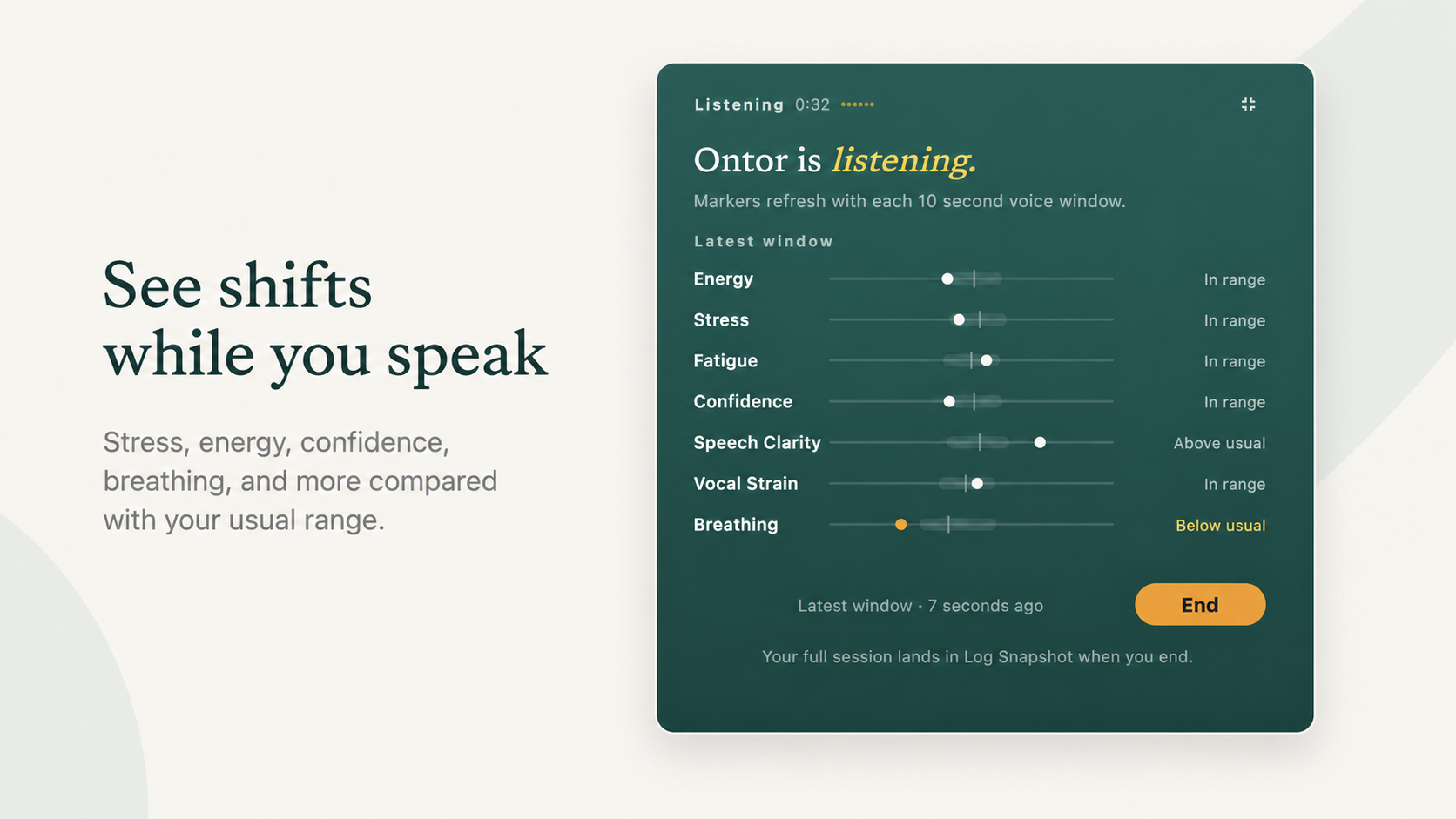
Ontor is a performance tool that reads how you sound, not what you said. While someone speaks, it compares voice signals with that person's own usual range. Markers refresh in short voice windows (on the order of about 10 seconds of speech). It does not react to every unusual second. It looks for a lasting shift. Signals on the public product page include energy, stress, fatigue, confidence, speech clarity, vocal strain, and breathing. Each one is how the voice sounds versus your own usual range, not a population grade. When a lasting shift shows up, Ontor can suggest a short reset. You can compare before and after.
Boundaries, said plainly:
- Ontor does not replace Paul's diaphragmatic pre-speak drill, Bogomil's chest-voice craft, Sarah's stand / smile / record-and-fix-one-thing coaching, or Hyperbound-style pace tips.
- Ontor does not diagnose anxiety, treat medical conditions, or turn coach/vendor phrases about anxious vocal markers into clinical labels.
- Ontor does not claim that marker changes prove quota lift, retention, cognitive improvement, or clinical recovery.
- Ontor is a tool / product / platform (not an "app" in our outward copy). It is not a hire/fire scoreboard. Individual sessions and readings stay with the person.
The claim stays narrow: when you feel fine but shallow chest breathing is already writing tight pitch, clipped phrases, and air-starved rushes into the call, a private personal-baseline cue for stress, confidence, energy, pace, strain, and breathing-related voice markers in short windows, plus an optional short reset when lasting shifts show, gives you a way to notice the leave before the next dial inherits it. Soft secondary path if you later buy for a pod: Ontor for teams.
What shows up in my own Ontor history (breath / pace / strain while I still feel "fine")
I am Sabber Ahamed, founder of Ontor (about; LinkedIn). I use the product on my own speaking and call-heavy days. In my own Ontor session history (founder exploratory data from my own product use, not your floor's outcome data), Paul's felt-fine / sounded-anxious gap shows up as personal-baseline leave in breath-adjacent markers, not as a separate "voice personality" problem. I can still feel fine inside. Stress, confidence, pace, strain, or breathing can already sit outside my usual band in the short speech windows. Delivery drifts toward the tighter, clipped, air-starved leave coaches hear as anxious tonality. That is the breath-reports-breathing object this article is about: audible leave against my own usual range while I would still swear I felt fine.
Here is the live listening view from my own Ontor product use: markers refresh with each ~10 second voice window and sit against my usual range. Read it as a private check for whether energy, confidence, strain, stress, pace, or breathing left my band when high-chest breath would otherwise write the sonic fingerprint of stress into the next dial:
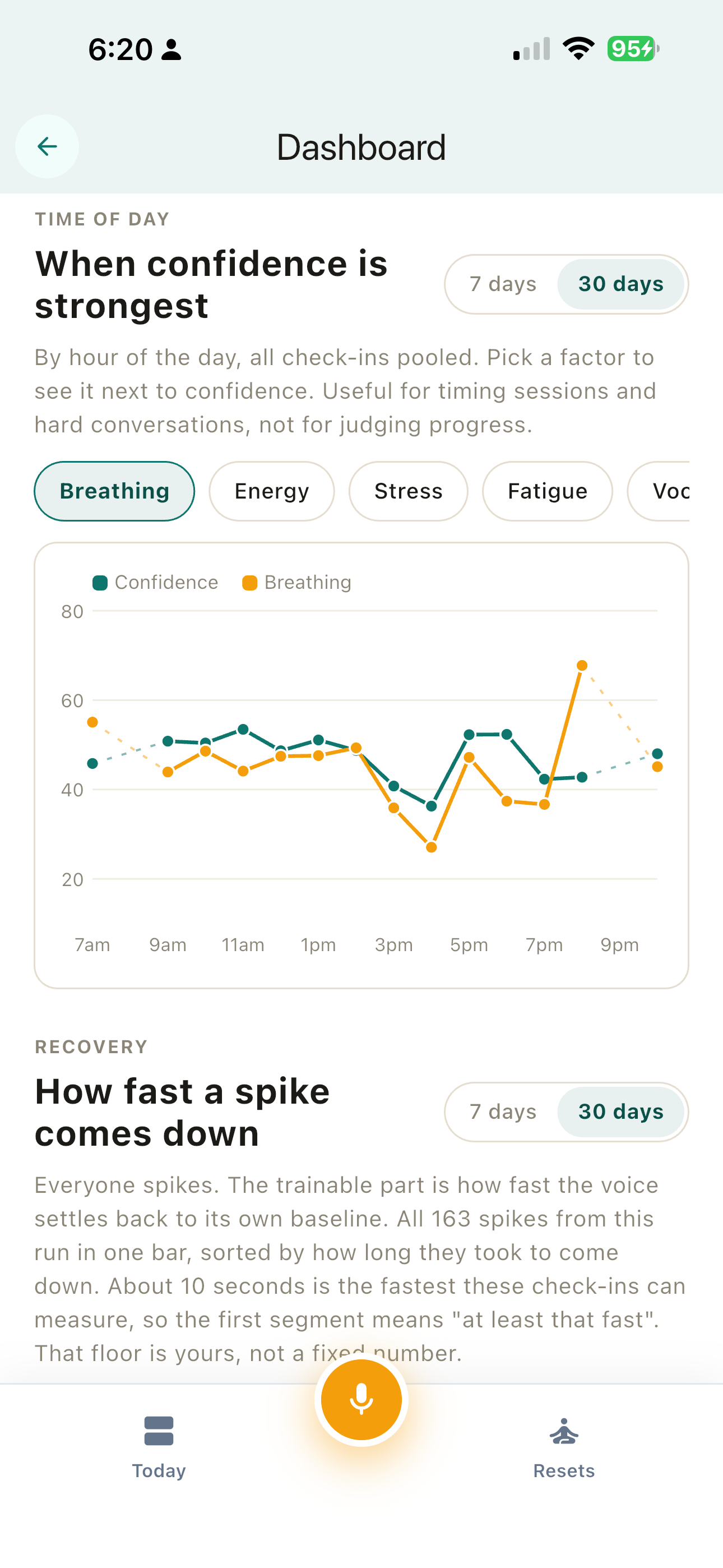
Here is confidence with breathing by hour from that same Ontor history. Confidence can sit near usual early, then leave later when the speaking day gets longer and breath support thins. Read it as founder exploratory data on personal-baseline drift across a call-heavy day, not proof of quota outcomes and not a claim that Ontor diagnosed anxiety:
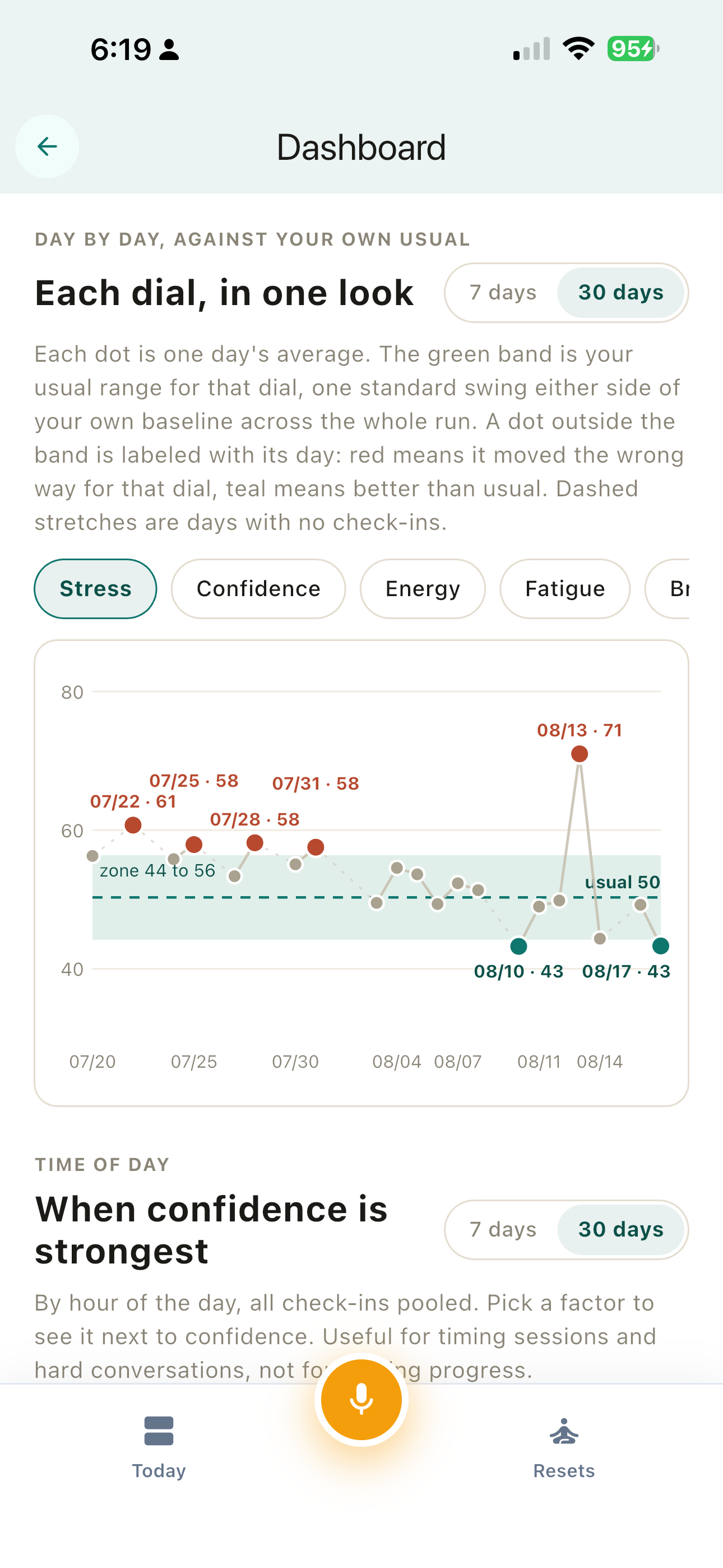
Here is stress day by day against my personal usual band (zone ~44 to 56, usual 50) from the same session history. Red points sit above my usual range. Useful as a private check for how often voice-state leaves the band across calls when shallow breath would push tight pitch and rush. It is not a hire-or-fire score and it is not proof that a suggested reset caused clinical improvement:
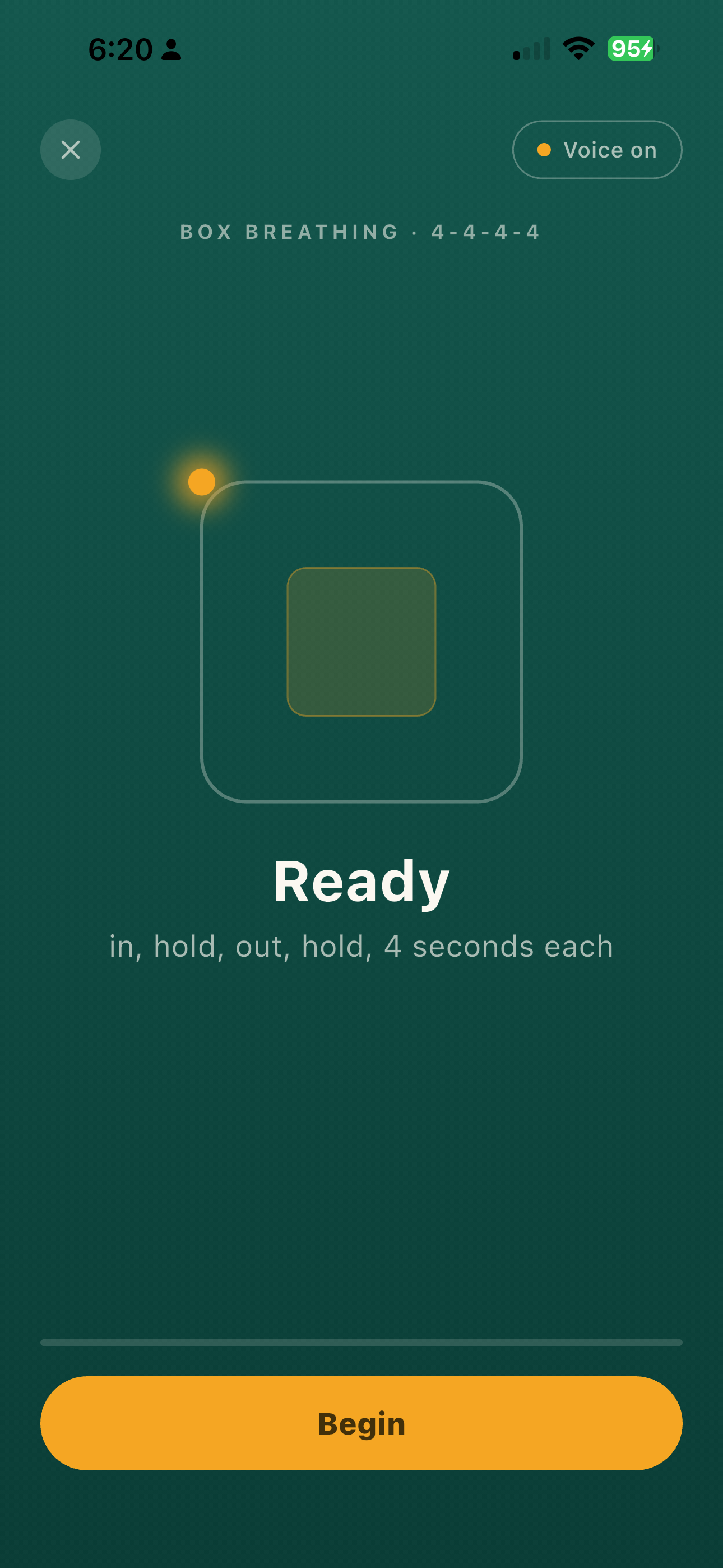
And here is the short reset the product offers when a lasting shift shows up: box breathing, 4-4-4-4. That is the tool form of Paul's mechanical pre-speak idea, available privately when pace, strain, or breathing leave your band before or between dials. It is not a medical protocol and it is not a claim that one cycle makes every prospect hear calm:
Claim-safe science note from Ontor's internal reset-effects and founder longitudinal work (exploratory n=1, not population proof): short resets can show temporary movement in stress-related voice markers in some recorded cases, and lasting recovery is not established as a general rule. High-stress stretches in founder exploratory data often do not show an observed return to personal median within an hour. Do not leap from those notes to clinical anxiety treatment. Ontor compares how you sound to your personal usual ranges and can suggest a short optional reset when lasting shifts show. Marker changes are not clinical outcomes.
What to try on your next live dial
Do not wait for a research committee if you are an IC who already feels fine inside and still hears tight pitch, clipped phrases, or mid-sentence air starve on playback.
- Install Ontor on the machine you already use for cold calls, discovery, and demos.
- On the next live dial, notice breath, pace, and strain versus your personal usual range in the short speech windows, especially when you still feel fine and would otherwise shrug off "you sounded nervous."
- If a lasting shift shows up, or if the air starve / pitch climb persists across windows, take the short suggested reset (or a brief diaphragm-style breath support reset between dials, the mechanical form coaches already name). Then continue.
- If you coach a pod later, keep leaders on aggregate patterns only for energy / confidence / strain drift under live-dial breath pressure. Personal readings stay with the person. Treat Paul's breath-reports-breathing frame and Bogomil / Sarah IC corroboration as performance controls, not medical labels. Pair with a quick self-listen after a hard block. Do not treat Ontor as a script coach or a hire-fire tool.
Concrete try-on-next-call step: notice breath, pace, and strain versus your personal baseline on the next dial; if lasting shifts persist, take a short diaphragm-style reset before the following pickup.
Soft secondary path if you lead mid-market coaching on how people sound and want a measured look later: Ontor for teams.
Do not promise win-rate, retention, or revenue guarantees. Measure whether people can tell when breath, pace, and strain left their usual voice before a prospect names the anxious sound.
Bottom line
Your voice sounds anxious because you're breathing like someone who is. Paul named the sonic fingerprint: tight pitch, clipped phrases, air-starved rushes, even when you feel fine. Bogomil named helium pitch versus chest/diaphragm voice that slows gasping and racing. Sarah named head-on-desk vibes and out-of-breath nerves on pickup. Hyperbound (capped vendor) maps shallow breath and vocal-cord tension into hyperspeed. Reddit color on CS voice and uptalk stays light. The gap that remains is personal usual-range stress, confidence, energy, pace, strain, and breathing in short speech windows, caught while you still feel fine, before the next dial inherits the same fingerprint.
Try Ontor on your next live dial. Notice the short voice windows versus your usual range for breath, pace, and strain. Take the short reset when a lasting shift shows up. Let the voice report a breathing pattern you chose, not the high-chest default.
Download Ontor - 14 days free, no card required
References
- Paul Mascetta (voice coach / Influence Academy; vendor_marketing). LinkedIn post: your voice sounds anxious because you're breathing like someone who is; shallow chest breathing creates tight pitch, clipped phrases, hesitation; voice reports breathing, not internal confidence; diaphragmatic breath ~60 seconds before speaking. https://www.linkedin.com/posts/paul-mascetta-201a7135_why-you-sound-anxious-even-when-youre-not-activity-7477360324237725696-SaIB
- Bogomil Georgiev (+ peers John Attar, Jayesh Tikode, Luke Ross). LinkedIn post: helium-balloon high pitch fail; chest voice from diaphragm not throat; slows gasping/racing; stand vs tired chair (peer). https://www.linkedin.com/posts/bogomilgeorgiev_everyone-talks-about-tonality-on-cold-calls-activity-7396881620735148032-YZLH
- Sarah Brazier (30MPC / Dimmo; Orum toolkit sponsorship noted). "How to act like an actual human being on a cold call": discomfort audible; head on desk → negative vibes on pickup; out of breath from nerves; repetition speed creep. https://www.30mpc.com/newsletter/how-to-act-like-an-actual-human-being-on-a-cold-call
- Mia Kosoglow / Hyperbound (vendor_marketing, capped corroboration). "Why You're Speaking Too Fast (And How It's Killing Your Deals)": adrenaline → shallow breathing, vocal-cord tension, hyperspeed; SDR confession; ~140-160 WPM band. https://www.hyperbound.ai/blog/slow-down-speech-cold-calling
- r/sales thread (employee_anecdote, light color only). "What's your favorite voice to use on cold calls": lose CS/hospitality tone; avoid uptalk; first ~5 seconds tone judge. https://www.reddit.com/r/sales/comments/1ilgr5v/whats_your_favorite_voice_to_use_on_cold_calls/
- Ontor. "How it works." https://ontor.ai/how-it-works/
- Ontor. "Ontor for teams." https://ontor.ai/for-teams/
- Ontor. "About the founder." https://ontor.ai/about/
- Ontor. "Install Ontor." https://ontor.ai/install/
- Ontor. Sabber Ahamed LinkedIn. https://www.linkedin.com/in/sabber-ahamed
- Ontor. "When anxiety shows up as tonality. Managers hear the voice, miss the spiral..." https://ontor.ai/blog/sales-anxiety-tonality-manager-spiral/ (sibling, manager spiral)
- Ontor. "Your cold-call voice isn't missing enthusiasm. It's a mode switch off your usual sound." https://ontor.ai/blog/call-mode-pitch-voice/ (sibling, call-mode)
- Ontor. "A pressured voice can sound anxious or robotic. Coaches still treat them as different problems." https://ontor.ai/blog/coaches-anxious-or-robotic-same-pressure/ (sibling, coaches channel)
- Ontor. "Freight cold calls die when the pickup becomes a pace dump." https://ontor.ai/blog/freight-cold-call-talk-too-fast/ (sibling, pace dump)