
Around call sixty, delivery flattens before you can feel it.
Jason Hazel, Head of Sales and Business Development at Lead Engine, puts the day on a count. Around call sixty, enough polite nos have stacked that delivery starts to flatten. The words stay identical. The energy behind them does not. Prospects hear that energy long before they hear the words. A break only moves the problem to call seventy. The hard hours are hard because you cannot feel them happening, so you have to plan around them instead of waiting to notice.
Sixty is his number, from high-volume outbound. It is not a lab cutoff. Ontor has not measured "call sixty" on your floor.
This piece is for mid-market dial floors: heads of sales, BD leads, and the reps still on the phone when the nos have piled up. Freight brokerage, staffing, and collections are earlier markets. They are not the subject here.
What this adds, which the five posts linked below do not: the day-deciding moment is a call count, about sixty, not lunch and not the gap your dialer left. You cannot feel the flatten in time to do anything about it. Switching the work (follow-ups, or a vertical where that pitch is not the one you have already said fifty times) is a different move from a break.
Download Ontor - 14 days free, no card required
Hazel: around sixty the words stay and the energy does not
Hazel wrote this on LinkedIn, The part of the day that actually determines the day is around call sixty:
"The part of the day that actually determines the day is around call sixty."
"Around sixty is where enough polite no's have stacked up that delivery starts to flatten."
"The words are identical. The energy behind them isn't."
"And prospects hear energy long before they hear words."
That is the spine. Script review will not catch it. The sentences can still be the same opener. What changed is the energy a prospect hears first.
Treat sixty as his operational count from the floors he runs, not as a universal law and not as an Ontor statistic.
A break moves the cliff. Changing the work is a different move.
Hazel is explicit that rest, by itself, does not fix the flatten:
"The fix isn't a break. A break just moves the problem to call seventy."
"It's changing what you're doing, switch from cold dials to follow-ups, or to a different vertical where the pitch isn't the one you've said fifty times already."
Read that distinction literally. A pause that drops you back into the same cold pitch relocates the flatten. Follow-ups, or a vertical where you have not already worn that pitch out, give the next dial a different job. Those are not the same intervention. A short reset inside the same cold-call block is closer to the break he is rejecting than to the switch he is recommending. It can still be useful as a pause you chose because you saw the drift. It is not a substitute for changing the work, and it is not evidence the next conversation will go better.
The hard hours are the ones you cannot feel in time
The line that makes this an in-the-moment problem, not a coaching-after-lunch problem:
"The hard hours aren't hard because they're hard. They're hard because you can't feel them happening."
"So you plan around them instead of trying to notice them."
Playback will confirm the flatten. So will a manager who only hears it on a later listen. Both are late. His ask is to plan the switch before noticing is even available. That only works if something other than gut feel marks the drift while the words still sound "fine" to the person saying them.
What voice research supports here, and where it stops
Hazel's "they hear energy first" and "you can't feel it" are floor observations. The lab work is narrower, and some of it cuts the other way. Worth keeping the two apart.
When listeners rate emotion in speech, prosody outweighs the words, and people cannot fully ignore one channel even when told to. That is the finding in Ben-David, Multani, Shakuf, Rudzicz, and van Lieshout, "Prosody and Semantics Are Separate but Not Separable Channels in the Perception of Emotional Speech" (Journal of Speech, Language, and Hearing Research, 2016). It fits the idea that a prospect is not grading the script alone. It does not time the percept to "before the words," and it is not a cold-call study. Hazel's "long before" stays his line.
Listeners and speakers also do not always use the same acoustic cues when judging vocal effort. McKenna and Stepp had 26 vocally healthy adults produce a short syllable at graded effort, then compared self-ratings with inexperienced listeners (Journal of the Acoustical Society of America, 2018). In the combined model, listeners' ratings were also predicted by mean fundamental frequency and one relative-fundamental-frequency offset measure. Those two did not significantly predict the speakers' own ratings. Average agreement was still high (mean r = 0.86). So this is not "reps go numb." It is a smaller claim: a listener can be using timing cues that the speaker's own effort rating did not track, on a lab syllable, in people who were asked to push. It is not proof that a dial floor misses call sixty.
There is a direct counterpoint if you try to turn Hazel into a fatigue diagnosis. In the clinical literature, vocal fatigue is defined by symptoms the speaker does perceive. Solomon's review puts it as a perceived increase in phonatory effort over time, sometimes with a drop in function (PubMed 20840041). People who are vocally tired often can feel effort. Hazel's point is different. On his floors the delivery energy drops while the person is still saying the script, and the feel arrives too late to plan. Do not import "vocal fatigue" as the name for that, and do not treat Ontor as a test for it.
A separate line of work is why a personal comparison beats a floor average. Hunter and colleagues reviewed how loosely the field used "vocal effort," "vocal load," "vocal loading," and "vocal fatigue," and they proposed two cleaner terms: vocal demand (what the speaking task asks) and vocal demand response (how that person answers) (Journal of Speech, Language, and Hearing Research, 2020). A later review describes that response as unique to the talker, shaped by the person and by the room, the task, and the day (Calvache and colleagues, Folia Phoniatrica et Logopaedica, 2024). That supports comparing someone with their own usual range when you talk about voice under load. It does not validate a product, and nobody in those papers counted sales calls to sixty.
One more limit on the break. After a two-hour oral reading task, Hunter and Titze tracked recovery in 86 adults and described about 90% recovery within 4 to 6 hours, with fuller recovery later, on the order of 12 to 18 hours (Annals of Otology, Rhinology & Laryngology, 2009). That is reading aloud in a study, not a dial block, and it is not a test of switching from cold calls to follow-ups. It does say a short pause is not an instant return to the pre-loading voice in that protocol. It is not a prescription for how long your floor should break, and it is not evidence for or against Hazel's vertical switch.
Ontor's own early reset checks (a handful of sessions, one speaker) do not show a reliable return to baseline after a short reset. They are not in this article as proof. A suggested reset is an optional next step you can compare before and after. A marker move is not a clinical outcome.
Ross: match the energy of your own ordinary best call
Luke Ross, ex Head of Delegate Sales and sales manager (now founder of Modern Seller AI), argues the miss is delivery, not the script, in You're not booking meetings. And it's not your script. It's how you sound. His line about booking meetings is his argument. It is not an Ontor result.
The part that belongs next to Hazel is the personal mirror. Record normal calls, not highlight reels. Find the one that did not rush, did not turn statements into questions, and did not sit on one flat tone. Then:
"Play that call back before your next dial. Match that version of you. Not the words. The energy."
"You don't sound like you think you sound."
He names the flat version in the same post:
"Are you stuck on one flat tone the whole time? - Zero energy variation sounds like a robot. People hang up on robots."
That is corroboration for comparing someone with their own better sound, not with a pep talk and not with someone else's opener. Two limits. He sells tone tools now, so read the sales-manager history first and the vendor role second. And playback before the next dial is still hindsight on the last block. It does not mark the flatten while call sixty is happening. Hazel's problem is the in-time miss. Ross is the baseline idea. They are not the same tool.
What the live posts already cover
Same mid-market phone problem, different object. Overlap on "how you sound versus your own usual range" is real. The spine here is the count, the unfelt timing, and the break-versus-switch distinction.
- You start the block sounding like Morgan Freeman. By lunch you sound like a robot. is about block length and robot voice by lunch. This piece is a call count, about sixty, not the clock hitting noon.
- Your dialer left 5-10 seconds between calls. That's where afternoon fade starts. is the micro-gap and afternoon fade. This piece is not the 5 to 10 seconds between connects.
- Leaders treat the minutes between calls as empty. The hangover isn't. is carryover in the minutes between calls. This piece is the stacked nos inside the dial count, not the gap.
- Your cold-call voice isn't missing enthusiasm. It's a mode switch off your usual sound. is the switch into a cold-call voice. This piece assumes you are already dialing, and asks what happens when that voice flattens near a count you cannot feel.
- Your playbook did not make them sound desperate. Quarter-end did. is quarter-end pressure training a desperate sound. This piece is an ordinary high-count day, not the end of the quarter.
Capped color. Do not lead with it.
Chris Russo, an inside sales team lead at Care Access, describes an earlier failure mode: he sounded like a robot because he was too fast, and he had mistaken speed for confidence. His line, from this post:
"Your tone and pace tell the prospect everything before your words do."
Useful as a team-lead anecdote that pace leaks before the sentence lands. It is not a head-of-sales account of call sixty, and it is not the spine.
Josh Braun, a cold-call trainer, has a separate post about a sales voice that shows up when you need the call to go well: You ever notice how your sales voice sneaks in.
"You ever notice how your sales voice sneaks in when you really want a call to go well?"
Trainer post, not a floor leader. It is about one call you need to go well, not the sixtieth polite no.
Brandon Bornancin, founder and CEO of Seamless.ai, describes yet another split: one voice with friends and family, and a stiff, miserable call-center voice on cold calls (his post).
"A lot of reps have one voice when they're hanging out with friends and family."
"And then when they get on a cold call, and they sound stiff, miserable, like they're at a call center hating life."
That is vendor marketing. The mode switch already has a home in call-mode pitch voice. It explains a voice you put on at dial one. It does not explain a flatten that shows up around dial sixty inside a day you could not feel.
What Ontor can show while the words still seem fine
Ontor compares how you sound with your own history, not with a floor average. On the public product page, energy is how activated your voice sounds through pace and vocal effort. The same page lists stress, focus, energy, fatigue, vocal strain, speech clarity, and hesitation as estimates from voice. They are context for your own experience. They do not diagnose a health condition. A point outside your usual band is a reason to check in with yourself.
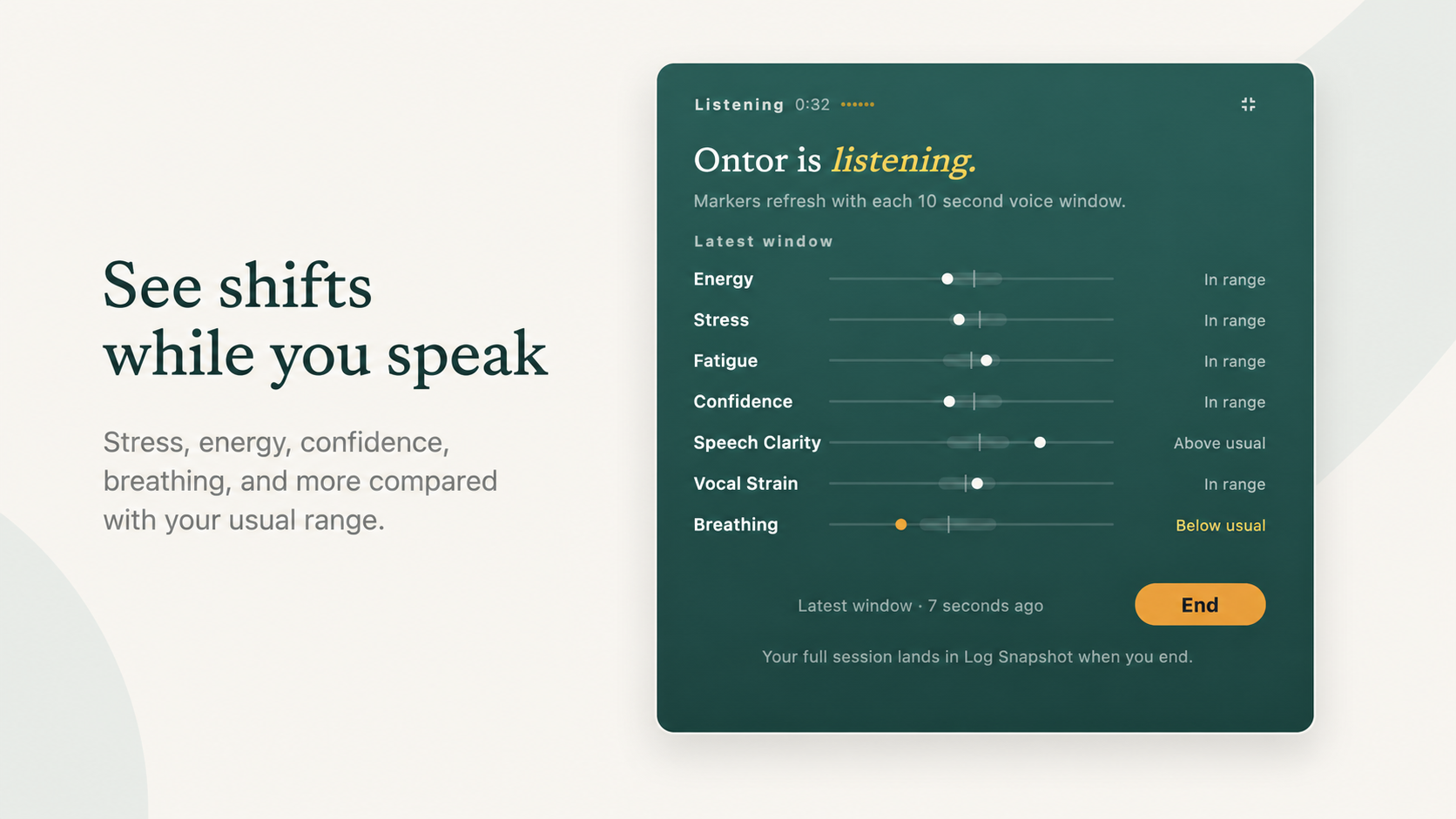
The listening view I use refreshes markers with each 10 second voice window. That sentence is the product's own label on the screen below. It is not a clinical sampling claim.
A voice session can suggest a short reset when the voice change persists. You can look before and after. Use that only as a private cue to plan Hazel's actual fix (change the work) or to take a short reset you chose on purpose. Do not read a marker move as proof the flatten reversed, and do not read it as proof the next dial went better.
What this does not do:
- It does not replace a switch from cold dials to follow-ups or to a different vertical.
- It does not diagnose fatigue, effort, or any health condition. Solomon's symptom definition stays in the clinic. It is not an Ontor output.
- Individual sessions stay with the person. If a leader looks later, they are looking at aggregate patterns only, not a comparison across people.
- A marker change is not evidence the next conversation went better.
In my own Ontor sessions (founder exploratory data from my own product use, not your floor, and not a picture of call sixty), the unfelt flatten is the part I cannot hear while I am still talking. A coach hears it on playback. I often do not, in the minute it leaves. The screens below are that private check, tied to this problem. They are not a tour of the product, and they are not your team's outcome.
The listening card is the in-time view. Markers refresh with each 10 second voice window and sit against my usual range. Energy and confidence are on that card. That is the surface for a drift you cannot feel yet, while the words can still be the same sentences. Read the sliders as my session, not as a mid-market rep at dial sixty:
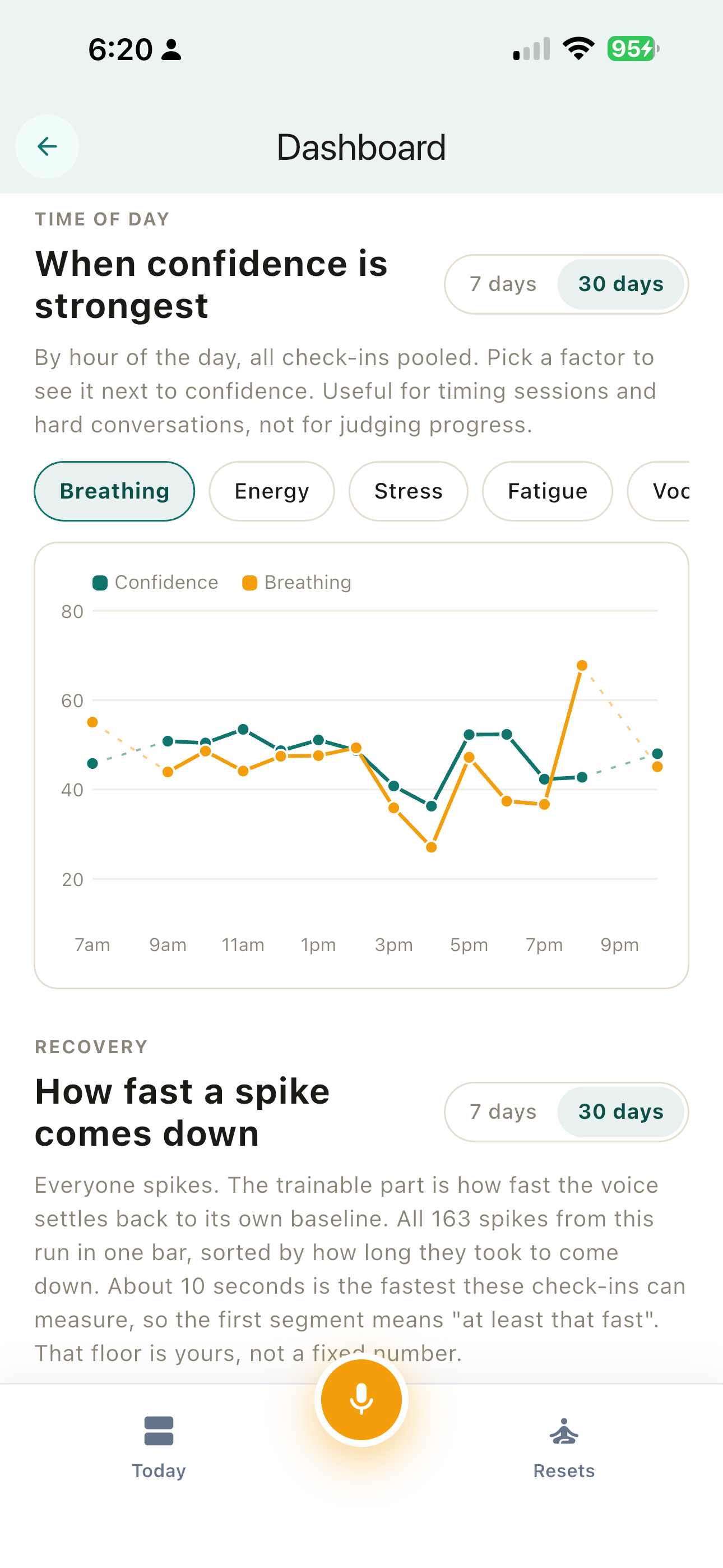
The hour view is coarser than Hazel's count. It pools check-ins by hour and puts confidence next to breathing. The screen says it is for timing sessions and hard conversations, not for judging progress. A mid-afternoon dip on that chart is still not call sixty. It can show that one part of my speaking day is not like another. It cannot tell me the polite nos just stacked:
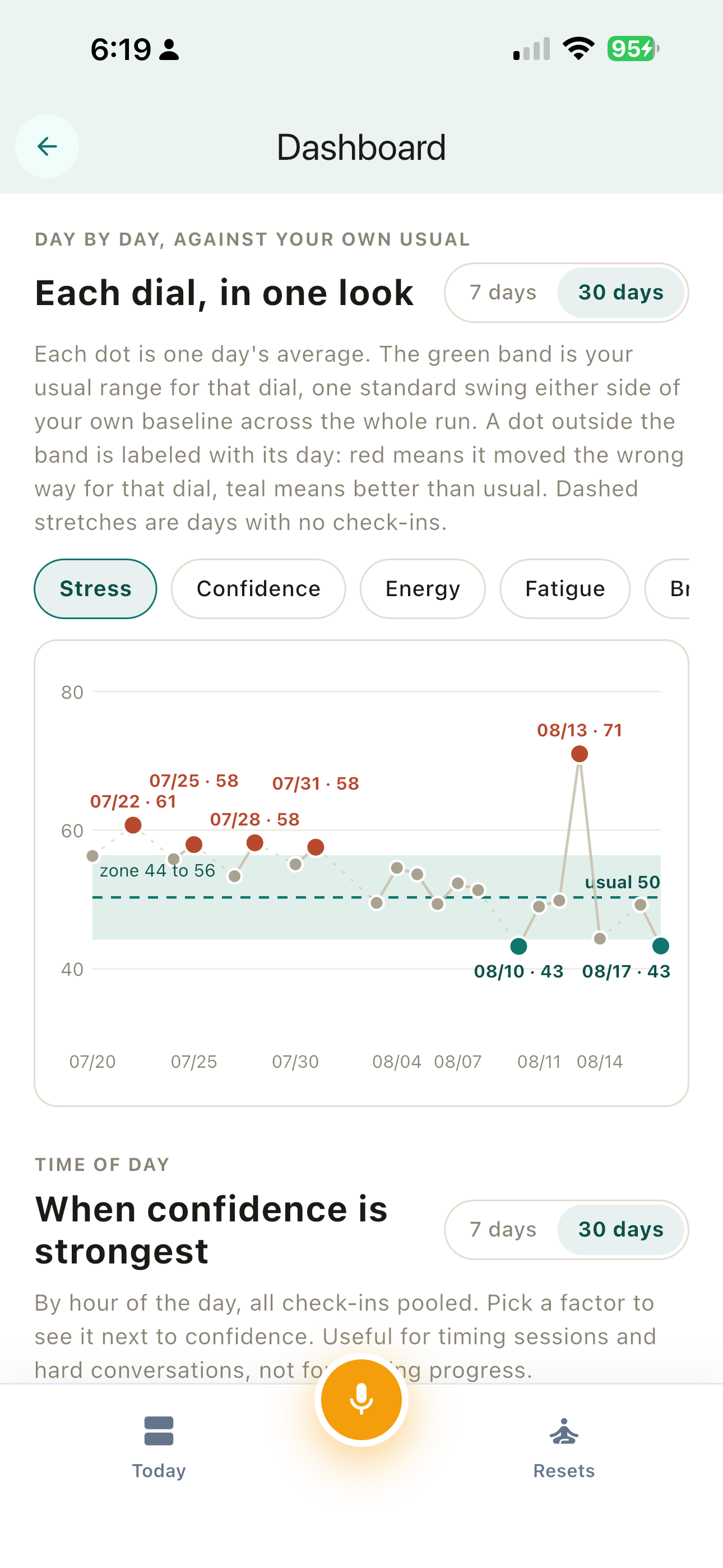
The day-by-day view is later still. Each dot is one day's average against my own usual band. On stress, that screen shows a zone of 44 to 56 around a usual of 50, and it marks days outside the band. A day average is the hindsight Hazel is trying to get ahead of. It will not flag an unfelt flatten inside the sixtieth call. It is my days, not a rep list:
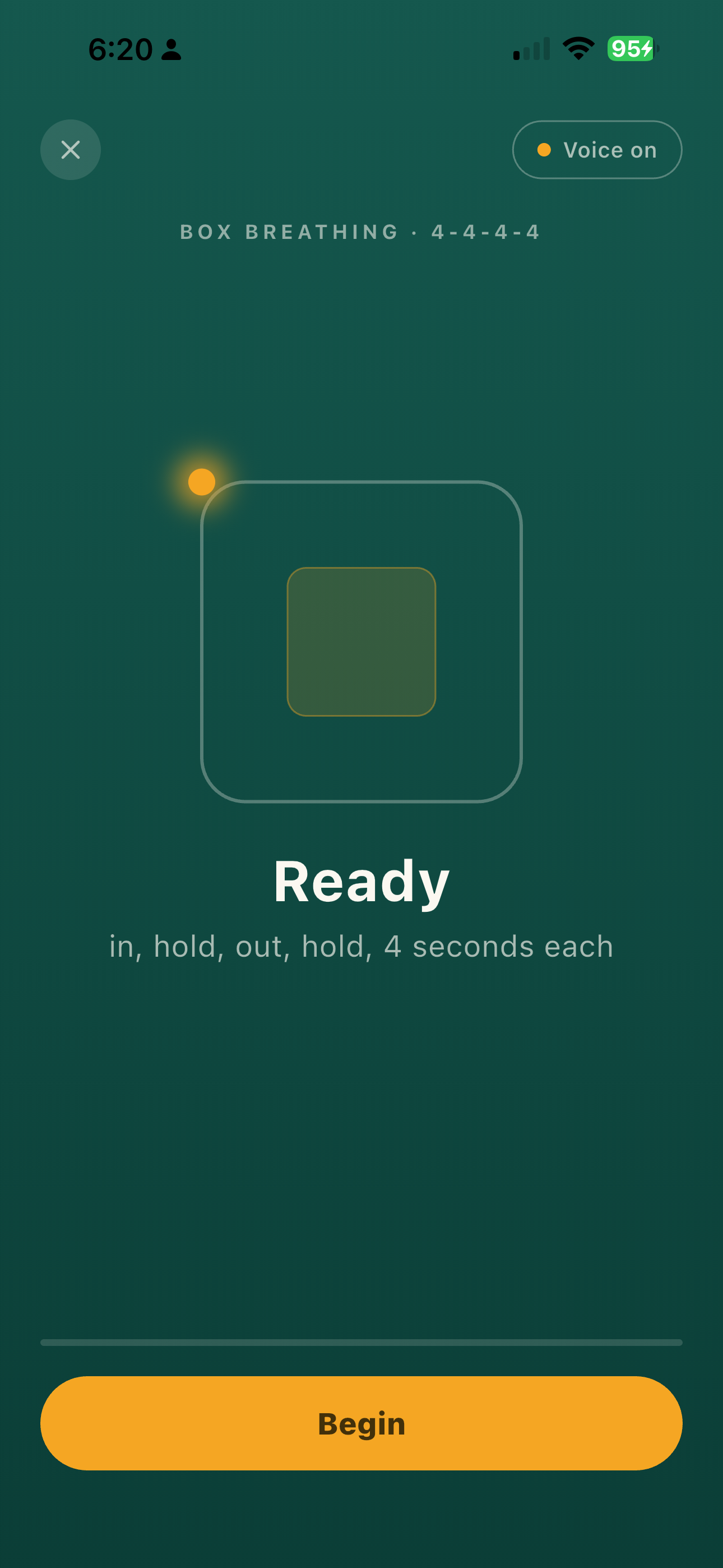
The short reset on offer is box breathing, 4-4-4-4, in, hold, out, hold, 4 seconds each. I would use it only after a lasting shift, if I am about to keep speaking, and then I would look at the next window. Hazel's fix is still to change the work. This is not that switch. It is not a medical protocol. Nothing on this screen shows that a reset stopped a later flatten:
Download Ontor - 14 days free, no card required
What to try on the next call {#try-on-next-call}
Do not wait for the block to feel hard if sixty is where your floor usually goes flat.
- Install Ontor on the machine you already use for dials.
- On the next block, watch energy and confidence against your own usual range in the 10 second windows as the polite nos stack. You are listening for a leave from your baseline while the words are still the script. Not a floor average. Not whether the opener was "correct."
- If a lasting shift shows up before you would have noticed it, change the work the way Hazel describes: follow-ups, or a different vertical where that pitch is not the one you have said fifty times. A short reset is optional if you are about to keep the same kind of call. It is not the same move as the switch. A break that drops you back into the same cold pitch is the move he says only gets you to call seventy.
- If you lead the floor, leave each session with the person. A cohort view can wait. The install on the next block is the step that matters.
If you later want a measured look across the team, the light secondary path is Ontor for teams. Install stays the primary step.
Do not promise a better connect rate. Notice whether you can see the energy leave your usual range before the flatten is the only thing a prospect can hear.
Bottom line
Hazel's count still stands on its own. Around call sixty the words can be identical and the energy is not, a break only moves that to call seventy, and you cannot feel the hard hours in time to notice them. Ross's useful addition is the comparison: your own ordinary best-call energy, from playback, which arrives late. Ontor is the in-time cue, energy and confidence against your usual range in about 10 second windows, so you can change the work or take a short reset before the flatten is all a prospect hears. The cue is not the switch. A marker move is not proof the next call went better.
Try it on the next block. Watch the window. If energy leaves your usual range before the day feels hard, change the work, or take the short reset and look again.
Download Ontor - 14 days free, no card required
About the author
Sabber Ahamed is the founder of Ontor and an applied ML scientist (PhD, geophysics and signal processing) who builds on-device voice tools. Ontor compares how you sound with your own usual ranges and can suggest a short reset. Marker changes are not clinical outcomes, and they are not proof a conversation went better.
References
- Jason Hazel. "The part of the day that actually determines the day is around call sixty." LinkedIn. https://www.linkedin.com/posts/jasonandrewhazel_the-part-of-the-day-that-actually-determines-activity-7486081487046443008-wWbl
- Luke Ross. "You're not booking meetings. And it's not your script. It's how you sound." LinkedIn. https://www.linkedin.com/posts/thelukeross_youre-not-booking-meetings-and-its-not-activity-7434559983091859456-VRBf
- Chris Russo. Inside sales note on pace, nerves, and natural voice. LinkedIn. Employee anecdote, not the spine. https://www.linkedin.com/posts/chrisrusso922_sdr-bdr-sales-activity-7447627274234875904-SyOk
- Josh Braun. "You ever notice how your sales voice sneaks in when you really want a call to go well?" LinkedIn. Trainer, capped. https://www.linkedin.com/posts/josh-braun_you-ever-notice-how-your-sales-voice-sneaks-activity-7385269924816011264-PO3D
- Brandon Bornancin. Friends-and-family voice versus stiff cold-call voice. LinkedIn. Vendor, capped. https://www.linkedin.com/posts/brandonbornancin_a-lot-of-reps-have-one-voice-when-theyre-activity-7343627788324663297-BaNk
- Ben-David, B. M., Multani, N., Shakuf, V., Rudzicz, F., and van Lieshout, P. H. H. M. "Prosody and Semantics Are Separate but Not Separable Channels in the Perception of Emotional Speech: Test for Rating of Emotions in Speech." Journal of Speech, Language, and Hearing Research, 2016. https://pubs.asha.org/doi/10.1044/2015_JSLHR-H-14-0323
- McKenna, V. S., and Stepp, C. E. "The relationship between acoustical and perceptual measures of vocal effort." Journal of the Acoustical Society of America, 2018. https://pmc.ncbi.nlm.nih.gov/articles/PMC6167228/
- Solomon, N. P. "Vocal fatigue and its relation to vocal hyperfunction." Review indexed at PubMed 20840041. Counterpoint: clinical vocal fatigue is something speakers often perceive. https://pubmed.ncbi.nlm.nih.gov/20840041/
- Hunter, E. J., and colleagues. "Toward a Consensus Description of Vocal Effort, Vocal Load, Vocal Loading, and Vocal Fatigue." Journal of Speech, Language, and Hearing Research, 2020. https://pubmed.ncbi.nlm.nih.gov/32078404/
- Calvache, C., and colleagues. "Systematic Review of Literature on Vocal Demand Response: Understanding Physiology, Measurements, and Associated Factors." Folia Phoniatrica et Logopaedica, 2024. https://pubmed.ncbi.nlm.nih.gov/37393892/
- Hunter, E. J., and Titze, I. R. "Quantifying vocal fatigue recovery: dynamic vocal recovery trajectories after a vocal loading exercise." Annals of Otology, Rhinology & Laryngology, 2009. https://pubmed.ncbi.nlm.nih.gov/19663377/
- Ontor. "How it works." https://ontor.ai/how-it-works/
- Ontor. "Ontor for teams." https://ontor.ai/for-teams/
- Ontor. "About the founder." https://ontor.ai/about/
- Ontor. "Install Ontor." https://ontor.ai/install/
- Ontor. "You start the block sounding like Morgan Freeman. By lunch you sound like a robot." https://ontor.ai/blog/block-length-robot-voice/
- Ontor. "Your dialer left 5-10 seconds between calls. That's where afternoon fade starts." https://ontor.ai/blog/dialer-fatigue-afternoon-fade/
- Ontor. "Leaders treat the minutes between calls as empty. The hangover isn't." https://ontor.ai/blog/hangover-between-sales-calls/
- Ontor. "Your cold-call voice isn't missing enthusiasm. It's a mode switch off your usual sound." https://ontor.ai/blog/call-mode-pitch-voice/
- Ontor. "Your playbook did not make them sound desperate. Quarter-end did." https://ontor.ai/blog/eoq-pressure-trains-desperate-sound/