
Recruiters talk about fees like admitting to a crime. Clients hear the wince.
Staffing and recruiting agency owners, Managing Partners, and VP/Director of Sales who coach BD on fee and terms-of-business calls already know the soft-market script. Hold the fee. Defend value. Do not panic-discount to win the brief. What dial boards and fill rates still miss is how the fee lands in the voice: fillers, nervous laughter, almost apologising, or hiding the number in email so the live conversation never happens. When the hiring manager winces, mental arithmetic on how low to go starts before they speak. That pause before hold-or-fold is where margin is won or lost, and dashboards never show the wince.
Craig Rosecrans (staffing/sales leader; Jobot Executive/Recruiting Manager track; prior VP Division Director Permanent IT Search, Robert Half) frames the commercial spine without soft language. Soft-market agencies panic-drop fees to win business and thereby show the client exactly how they negotiate. Discounting does not build trust. Confidence does. If you cannot defend your own value in a negotiation, how can a client trust you to defend theirs?
Sam Slade (conversation-intel vendor to recruitment agencies; Co-founder/CRO ryvr.ai, ex-CRO Hinterview) names the audible failure mode leaders already recognise on fee calls. Cap as vendor colour under Rosecrans. Recruiters talk about fees like admitting to a crime. Fillers. Nervous laugh. Hedging. The client can smell the fear. If you wince when you say your price, you do not believe in it yourself. His prescription for the delivery moment is simple: say the fee, then stop talking. Do not fill the silence.
This is not another live-connect discomfort piece, not voice tighten under live resistance, not identical calls / midday confidence dust, and not rejection-delivery, post-fallout, or call-block readiness. The unique gap is fee-delivery audible confidence: composure in the silence after the number, versus personal baseline, when scripts and ROI framing alone do not stop the wince clients already hear.
Download Ontor - 14 days free, no card required
Soft-market fee panic vs confidence that holds
Rosecrans writes from the agency sales seat. Exact lines:
"Because in a soft market, some agencies panic. They drop their fee to “win” the business."
"They’re not just lowering price - they’re showing the client exactly how they negotiate."
"would you rather work with a partner who stands firm on what they’re worth… or one who gives away their services to avoid a tough conversation?"
"Discounting doesn’t build trust. Confidence does."
"If you can’t defend your own value in a negotiation, how can a client trust you to defend theirs?"
Lead with that. The failure mode is not "always charge 25% and never negotiate scope" as a product claim. It is: when agencies preach fee confidence but only score dials and fills, they never see the audible leave that invites the discount. Clients hear desperation and hedging before they hear the ROI story.
Admitting to a crime: fillers, nervous laugh, silence after the number
Slade's post is the Ontor voice hook for this article. Cap as vendor corroboration. Exact lines:
"You ever notice how recruiters talk about their fees like they’re admitting to a crime?"
"So… uh… yeah, our fee is… hehe… you know, somewhere around… uh… 20%… but open to discussion, obviously! Haha!"
"And the client? They can smell the fear."
"if you wince when you say your price, you don’t even believe in it yourself."
"Shut up after saying your price. Say your fee. Then stop talking. Do not fill the silence."
The trainable object is not another fee script alone. It is composure in the short window after the number leaves the mouth: fillers, nervous laugh, strain, clarity, confidence versus that person's own usual range. Dial boards never catch that wince. Neither does a Friday call-review sample that already skipped the fee ask.
Almost apologising, or hiding the fee in email
Stew Wilson (Performance Director, Retain Train Recruit; coach/L&D for boutique agencies) asks why recruiters are not proud of their fees, and why they send them over email instead of discussing them on the phone. Cap as vendor corroboration. Exact lines:
"Recruiters - Why aren’t you proud of your fees?"
"Why do you send them over email and not discuss them over the phone?"
"recruiters who aren’t confident in their fees… who find themselves almost apologising that they charge a fee."
Commenter Simon Leach names the avoidance pattern: lack of confidence leads people to hide behind email and messaging. The live fee conversation never happens, or it happens with apology energy that trains the hiring manager to push hard on percentage.
The pause before hold-or-fold
Daniel Bryant (Founder, Kolvera; also Founder Zionic Group; ex-Managing Partner, HJ Recruitment) writes the fee-pushback pause agency operators already live. Cap as vendor corroboration. Exact lines:
"You present your fee, the hiring manager winces, and before they've said a word you've already started doing the mental arithmetic on how low you're willing to go."
"That moment, the pause before you hold or fold, is where most recruitment revenue is won or lost."
"The worst response to a fee challenge is silence followed by capitulation."
Rosecrans names confidence over panic discounting. Slade names fillers, nervous laugh, and shut-up-after-the-number. Wilson names almost apologising and email hide. Bryant names the wince and the mental arithmetic in the pause. Same fee-delivery object. Different seats. None of those are solved by another ROI slide deck if the voice still sounds like a crime confession.
"Better on the phone" is useless coaching without a baseline
CoRecruit (AI call coaching vendor for recruiting/staffing teams) names the manager gap boutique agencies already feel. Cap as vendor corroboration on the coaching hole only. Do not treat their product pitch as the answer here.
"Every recruiting team has that one consultant doing 30% of the billings. Most managers know who it is. Very few can tell you why."
"It's usually a gut feeling, "she's just better on the phone", which is a completely useless coaching insight for the other seven people on the team."
Leaders already know fee and BD phone quality matter. Sparse Friday listening still produces a hunch. What they lack is a continuous how-you-sound versus personal usual range during the fee ask and the silence after it.
What dial boards, fee scripts, and Friday samples still miss
Typical stack in a staffing agency sales org under soft-market fee pressure:
- Dial / connect / fill / revenue boards
- Fee scripts and ROI framing ("cost of vacancy")
- "Be more confident" coaching without a personal baseline
- Occasional call-recording reviews that rarely include the fee ask itself
- Email terms packages that dodge the live fee conversation
Useful. Incomplete for fee delivery. Dial boards ask whether volume happened. Scripts ask whether the ROI line was said. Gong-style samples ask whether one recording sounded okay to a manager that week.
None of them continuously ask: in the short window after this recruiter stated the fee, did confidence, strain, clarity, or energy leave their own usual range? Did fillers and nervous laughter show up before the client answered? Did apology energy invite the discount before the hold-or-fold decision was even spoken?
Clients hear that first. Leaders often meet it later as a panic fee cut, a ghosted email terms pack, or a BD rep who "needs more confidence training" with no personal signal to coach against.
How this differs from live-connect discomfort, voice tighten, and identical calls
Staffing live-connect discomfort answers: when a rare live connect finally lands, do coaches still hear rush and discomfort while activity KPIs miss voice-state versus baseline?
Prospects hear when the voice tightens answers: once the prospect is live under resistance, do dialers show tone collapse, or only that talk time happened?
Identical calls / confidence dust answers: when a culture scores motion, do leaders still miss near-identical audible calls and midday confidence dust while dials stay green?
Sibling staffing pieces on rejection-delivery carryover, post-fallout composure, and call-block readiness answer different objects: the no that sits with you, recovery after a fallen placement, and readiness between protected BD blocks.
This article answers a different question: when recruiters state fees with fillers, nervous laughter, or apology energy (or hide the fee in email), and when the hiring manager winces and mental arithmetic starts in the pause, do agency leaders still lack a personal voice baseline for composure in the silence after the number?
Same staffing beachhead. Different object. Fee-delivery audible wince and silence-after-number composure, not first-connect discomfort or scoreboard sameness alone.
Download Ontor - 14 days free, no card required
What Ontor adds when the fee lands in the voice first (private first)
Ontor is a performance tool that reads how you sound, not what you said. While someone speaks, it compares voice signals to that person's own usual range. Markers refresh in short voice windows (on the order of about 10 seconds of speech). When a lasting shift shows up (for example confidence, strain, speech clarity, energy, or stress), it can suggest a short reset. People can also compare before and after.
For teams, Ontor's public framing is aggregate patterns for workload, coaching, and support. Individual sessions and readings stay with the person. Agency owners and VP Sales can see team-level context for when a desk's confidence, strain, or clarity sits outside usual range more often around fee and TOB conversations. They do not get a personal scoreboard for hire or fire decisions.
That is the product difference from dial boards and fee scripts alone. Dial boards ask whether BD volume happened. Scripts ask whether the ROI line was said. Ontor asks whether this voice left its own usual band, privately, in the short window after the fee was stated, and whether a short reset is available before the next fee or TOB call would otherwise start from apology energy or filler talk.
It does not claim to raise placement fees, replace negotiation training, or prove that a suggested reset caused a held percentage. The claim stays narrow: buyers already say clients hear the wince and smell the fear. A private usual-range signal plus a short reset is a loop people can run before the next fee ask.
In my own Ontor session history (founder exploratory data from my own product use, not your agency's fee outcomes), the fee-delivery composure pattern shows up the same way Slade and Bryant named it for recruiters. A speaking window can still look "fine" as raw talk time while confidence, strain, or clarity has left my personal usual range in the short windows right after a hard number leaves my mouth. Dial count would still look fine. The silence after the number would still start from whatever state I carried in.
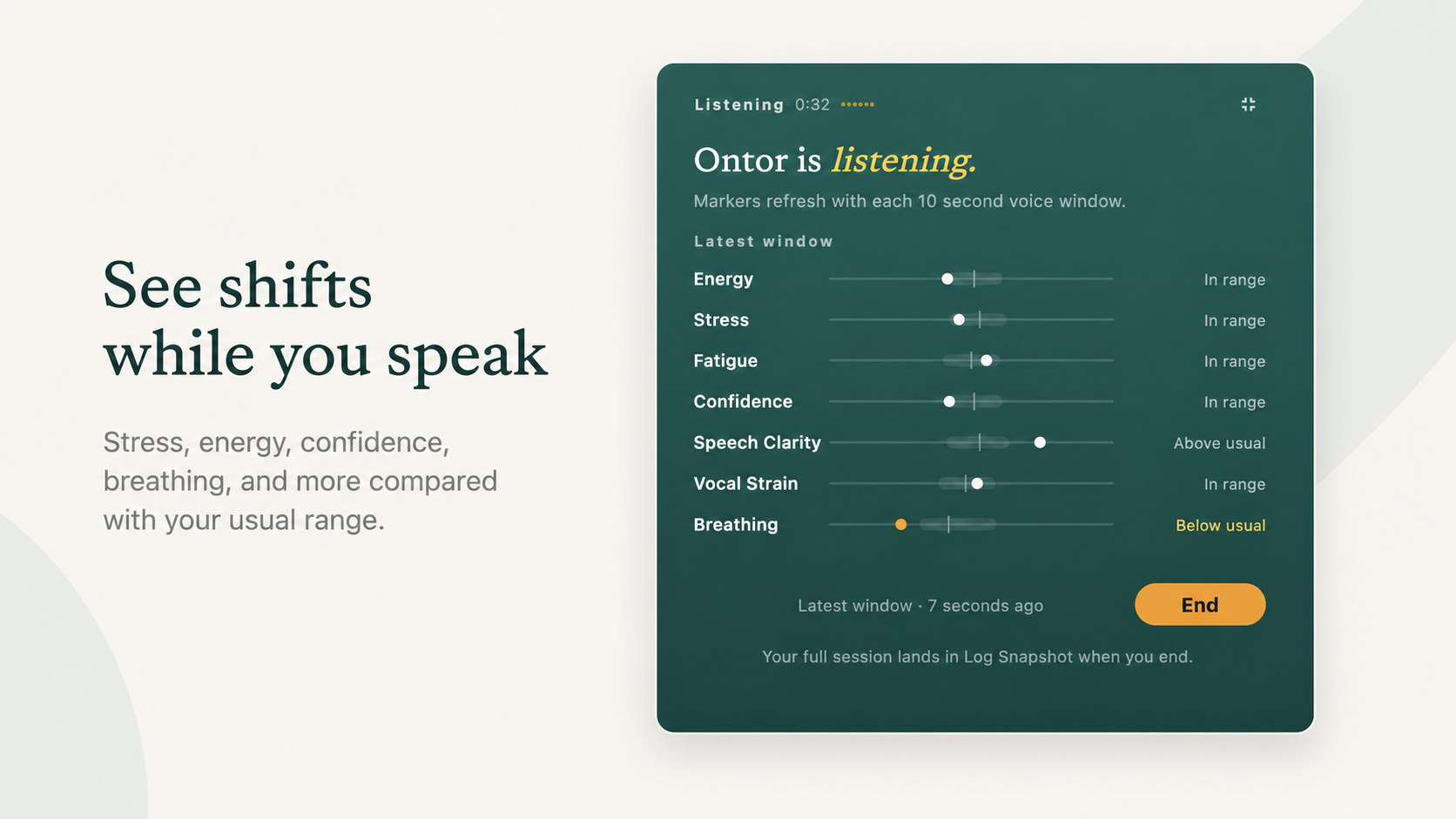
Here is the live listening view from my own Ontor product use: markers refresh with each ~10 second voice window and sit against my usual range. In this window speech clarity sits above usual while breathing sits below usual. That is closer to "my readiness left my band while I kept talking through a high-stakes ask" than a green dial tally:
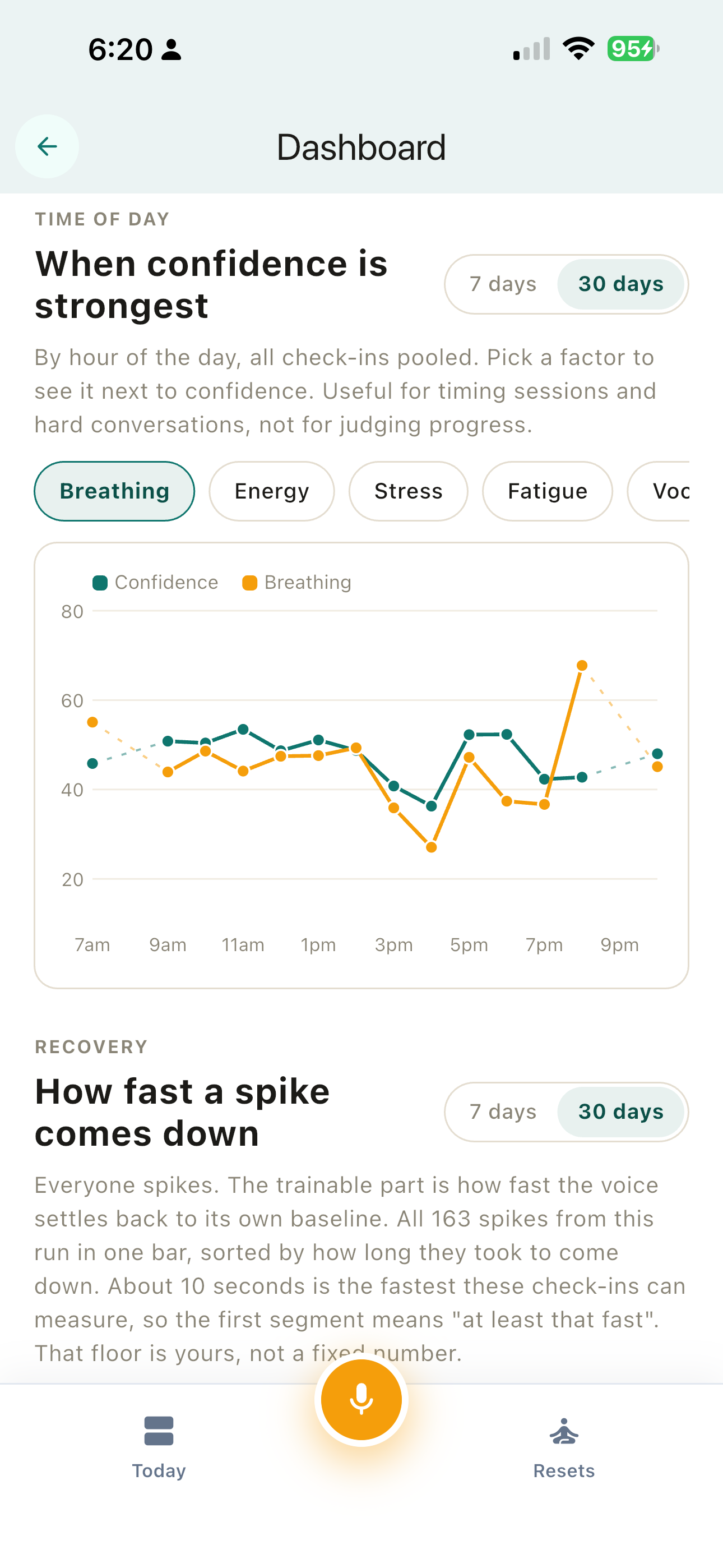
Here is confidence with breathing by hour from that same Ontor history. Confidence peaks late morning, then declines after noon and bottoms in the afternoon in this 30-day pool. Read it as founder exploratory data on personal-baseline confidence leave across a long speaking day, the same shape leaders hear when fee asks land flatter later in a BD block, not proof of fee hold rates and not your team's dial board:
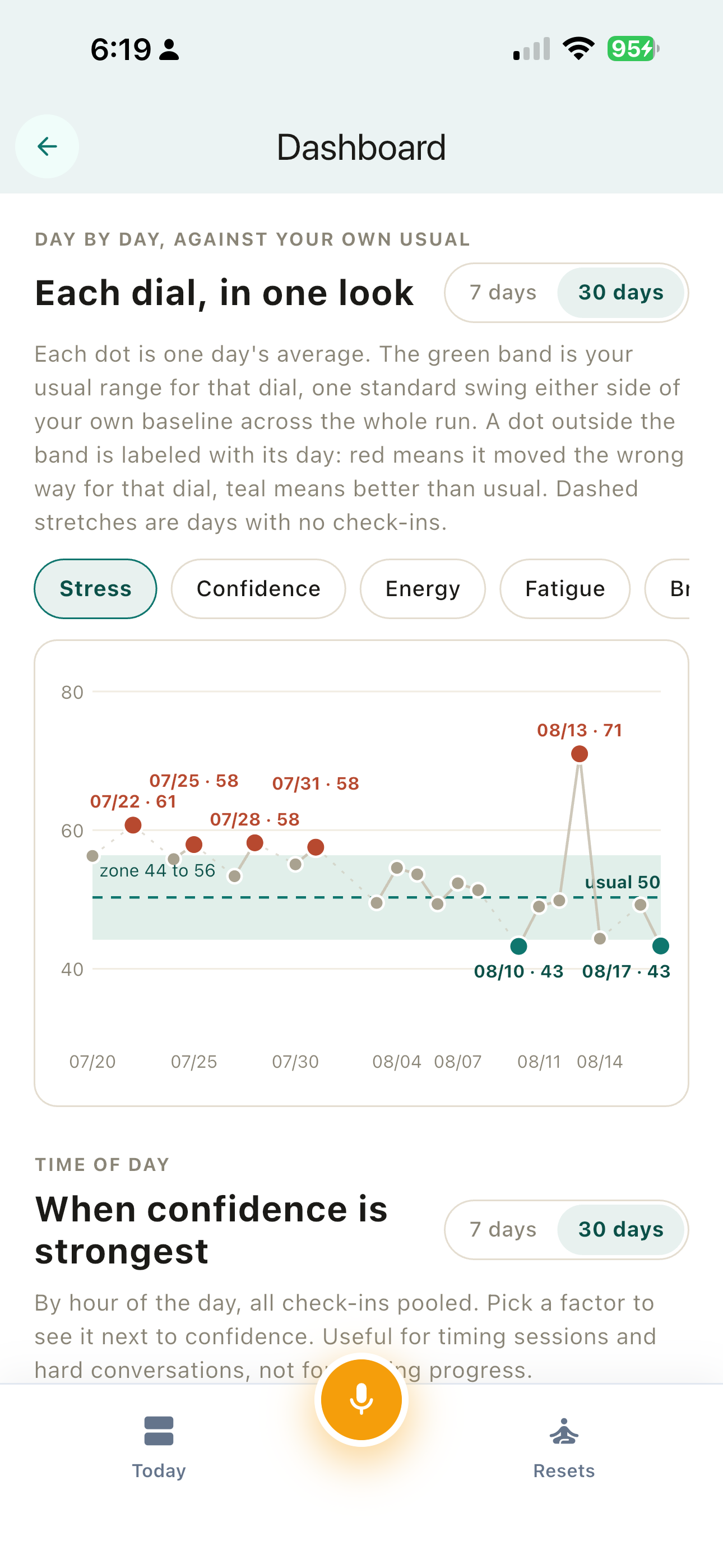
Here is stress day by day against my personal usual band (zone ~44 to 56, usual 50) from the same session history. Red points sit above my usual range. Useful as a private check for how often voice-state leaves the band across dials and days while a motion scoreboard would still print green around fee and TOB work. It is not a hire-or-fire score and it is not proof that a suggested reset caused recovery:
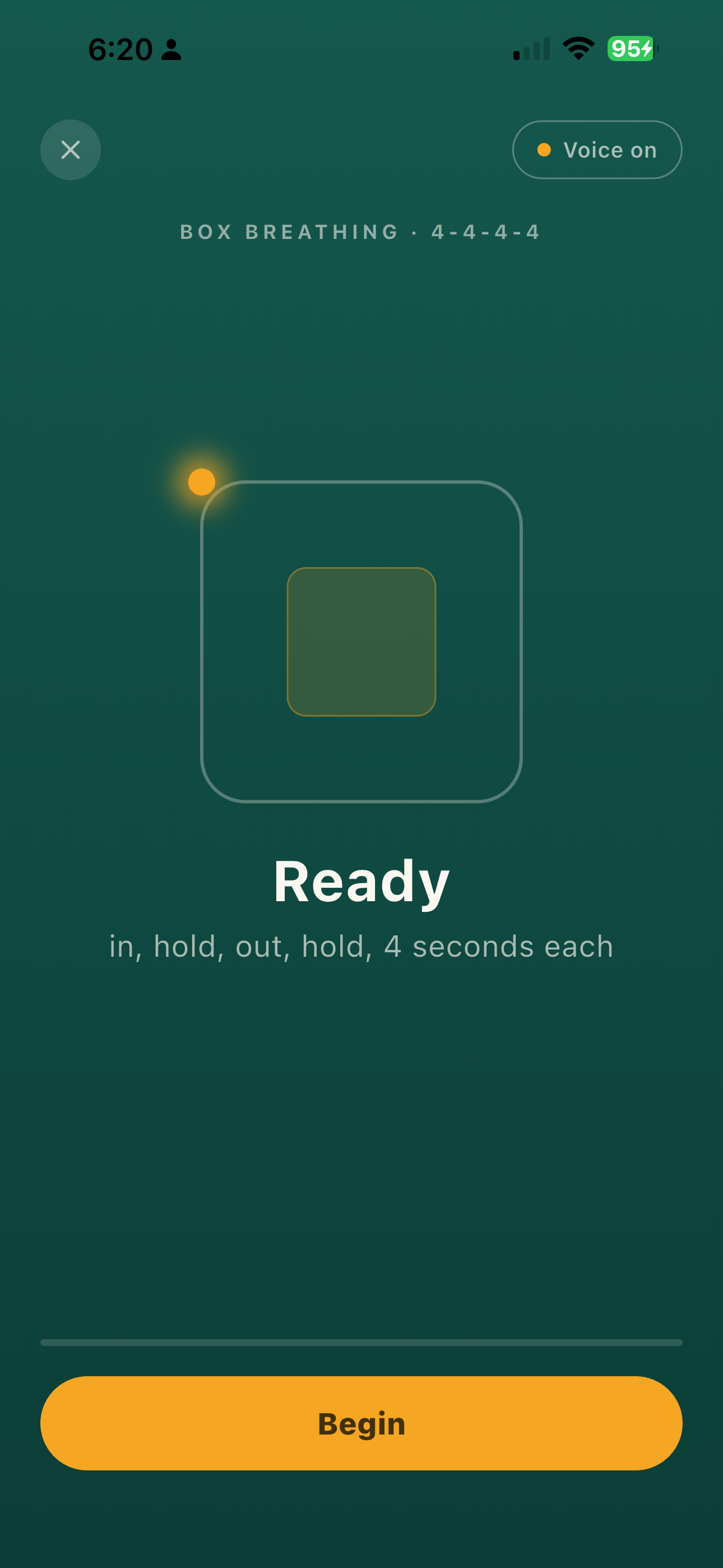
And here is the short reset the product offers when a lasting shift shows up: box breathing, 4-4-4-4. That is the tool form of composure before the next fee or TOB call, available privately without a manager guessing from a dashboard. It is not a claim that one cycle restores fee pride on the next ask:
This is not a claim that voice markers diagnose negotiation skill, predict fee retention, replace manager judgment, or guarantee higher margins. The claim stays narrow: when dial boards and fee scripts miss the audible wince and the silence after the number, a private signal plus a short reset is a loop people can run before the client smells fear, while leaders watch cohort patterns only in aggregate.
What to try on the next fee or TOB call
Do not wait for a research committee if you run a staffing or recruiting sales desk that still coaches fee confidence while boards only show dials and fills.
- Install Ontor on the machine recruiters already use for BD and fee calls.
- On the next fee or terms-of-business conversation, notice whether confidence, strain, clarity, energy, or stress sit outside that person's usual range in the short speech windows, especially in the silence after the number.
- If a lasting shift shows up, or if the recruiter can already tell they filled the silence, laughed nervously, or almost apologised, take the short suggested reset before the next fee or TOB call. Then continue instead of stacking another apology-energy ask.
- If you lead the desk, keep leaders on aggregate patterns only for fee-ask confidence / strain / clarity drift. Personal readings stay with the person. Treat Rosecrans confidence language and Slade's shut-up-after-the-number as performance controls, not only soft skills. Pair with self-listen on one fee ask the way Wilson wants fees discussed live, not with another emailed terms pack first.
Soft secondary path if you are buying for a team and want a measured look later: Ontor for teams, or a research conversation / pilot with staffing agency owners and VP Sales on personal voice baselines versus fee scripts and dial boards.
Do not promise fee-hold rates, placement revenue, retention, or ROI guarantees. Measure whether people can tell when the wince left their usual voice before the client names it.
Bottom line
Fee defense is not only script and ROI framing. Clients hear the wince. Rosecrans watches soft-market agencies panic-discount and show how they negotiate; confidence builds trust that discounting does not. Slade hears recruiters state fees like admitting to a crime: fillers, nervous laugh, hedged percentages, and a client who smells fear; say the fee, then stop talking. Wilson sees almost apologising and email hide where the live fee conversation should be. Bryant names the hiring-manager wince and the mental arithmetic in the pause before hold-or-fold. CoRecruit names the coaching hole: "better on the phone" stays a gut feeling without evidence. The gap that remains is personal usual-range confidence, strain, and clarity in the short window after the number, caught while dials still look busy, before the next fee ask starts from apology energy.
Try Ontor on the next fee or TOB call. Notice the short voice windows versus that person's usual range. Take the short reset when a lasting shift shows up. That is the tool next step, not only a pilot conversation.
Download Ontor - 14 days free, no card required
References
- Craig Rosecrans. LinkedIn post: soft-market fee panic vs confidence; discounting shows how you negotiate; confidence builds trust. https://www.linkedin.com/posts/craig-rosecrans-3881352b_sales-staffing-recruiting-activity-7409249329951137792-xk2F
- Sam Slade. LinkedIn post: recruiters talk about fees like admitting to a crime; fillers/nervous laugh; say fee then stop talking (vendor corroboration). https://www.linkedin.com/posts/samsladehinterview_you-ever-notice-how-recruiters-talk-about-activity-7305508568852516864-EgqN
- Stew Wilson. LinkedIn post: why aren't you proud of your fees; email hide; almost apologising (vendor corroboration). https://www.linkedin.com/posts/stewrtr_recruiters-why-arent-you-proud-of-your-activity-7416758438728450048-8rwg
- Daniel Bryant / Kolvera. "Pricing Psychology for Recruitment Fees: Stop Discounting" (vendor corroboration): hiring manager winces; pause before hold-or-fold; silence then capitulation. https://www.kolvera.io/blog/pricing-psychology-recruitment-fees-stop-discounting
- CoRecruit. "AI Call Coaching for Recruiters" (vendor corroboration on coaching gap only): "she's just better on the phone" is a useless coaching insight. https://corecruit.com/post/ai-call-coaching-recruiters
- Ontor. "How it works." https://ontor.ai/how-it-works/
- Ontor. "Ontor for teams." https://ontor.ai/for-teams/
- Ontor. "About the founder." https://ontor.ai/about/
- Ontor. "Install Ontor." https://ontor.ai/install/
- Ontor. "Your staffing team finally got a live connect. You can hear they're uncomfortable." https://ontor.ai/blog/staffing-live-connect-discomfort/ (sibling)
- Ontor. "Your dialer counts talk time. Prospects hear when the voice tightens." https://ontor.ai/blog/prospects-hear-voice-tighten/ (sibling)
- Ontor. "190 of 200 dials sounded identical. Confidence was dust by noon." https://ontor.ai/blog/identical-calls-confidence-dust/ (sibling)
- Ontor. "You delivered the no. It can sit with you all evening." https://ontor.ai/blog/staffing-rejection-delivery-carryover/ (sibling)
- Ontor. "The placement fell through. Your next client call still has to sound ready." https://ontor.ai/blog/staffing-post-fallout-composure/ (sibling)
- Ontor. "Staffing sales leaders can see dials and fill rates. They still miss readiness between BD call blocks." https://ontor.ai/blog/staffing-sales-call-block-readiness/ (sibling)