
You delivered the no. It can sit with you all evening. The next client call still has to sound ready.
You already made the hard call. Candidate out of work for months. Mortgage. Kids. Client went with someone else. You picked up the phone and delivered the no. Then the evening still had you.
That is not a placement that fell through on the fee forecast. It is not a midday phone disengage after a 3.5 to 4 hour morning. It is not collections cool-down between hostile recovery calls, and it is not the mid-market hangover between SDR connects. It is rejection-delivery labor on a staffing desk: the emotional residue after you deliver the no, then the next client or BD conversation that still has to sound ready.
Agency owners, Managing Directors, founders, and BD / sales leaders already admit these calls sit with them all evening and never get easier. They prescribe make the call anyway, give honest feedback, and regroup. What most ATS boards and activity dashboards still cannot answer is narrower: before that next high-stakes client or candidate conversation, did stress, fatigue, energy, and confidence come back toward that person's usual range, or is last night's rejection-delivery still riding in the voice?
Download Ontor - 14 days free, no card required
Leaders already name the evening carryover. The dashboard never checks composure.
Sue Southall, Founder and Managing Director of MSP Talent Bridge (UK IT services / MSP specialist staffing agency, founded 2009), put rejection-delivery evening carryover in public language after a candidate she had worked with for weeks did not get the role:
"I made a call yesterday that sat with me all evening."
"They don't see the calls where someone goes quiet on the other end of the line."
"They don't hear the pause before they say "okay, thanks for letting me know.""
"They don't feel the weight of knowing that person is going home to tell their partner it's another no."
"I've been doing this for 25 years. These calls never get easier."
"The day I stop feeling these calls is the day I stop doing this job properly."
"To every recruiter who dreads these conversations but makes them anyway, you're doing the right thing."
That is buyer language from a paying agency MD who still makes the calls. The prescription she names is operational and humane: deliver bad news clearly, give honest feedback, keep the door open, prefer a quick honest no over silence. Useful. Still incomplete for the next client or BD conversation. A completed rejection call and a night of carryover do not store whether stress, energy, confidence, or fatigue still sit outside personal baseline when the next high-stakes conversation hears you.
The rejection call is named as the hard labor, not just the miss
A medium corroboration from the desk (not the spine): Tim Spindlove, Manager of Recruitment Training and Onboarding at DMC Recruitment Group (ex-Director of Recruitment, Randstad Engineering), names the rejection call as harder than cold outreach or ghosting:
"For me, it's the rejection call."
"That call is brutal."
"Because I know what that candidate has emotionally invested. Because I believed in them. Because I asked them to trust me."
"Because we're not just managing resumes. We're managing people."
Cap that as emotional-load corroboration after heavy investment in a candidate. It is not Managing Director proof on its own. It does name the delivery labor itself: the call where you tell someone no after you asked them to trust you.
Light same-day carry corroboration only (corporate TA, not an agency sales buyer): Jen Hulme, Head of Talent Acquisition at BPP, describes blocks of rejection delivery and the residue that follows:
"I've done 20 rejection calls back to back."
"The silence after you say "unfortunately." The voice that drops. The "okay, thanks for letting me know" that's clearly holding back disappointment."
"if you've ever received a rejection call that was handled with care, that recruiter probably carried it with them for the rest of the day"
Use Hulme only as same-day carry color. Do not treat in-house TA volume as staffing agency MD proof. The spine remains Southall's evening carryover after delivering the no.
What this article is not answering
Four published Ontor pieces already cover adjacent moments:
- Staffing post-fallout composure answers fallen placement / next-opportunity composure after a deal dies. Different trigger: placement fallout, not rejection-delivery labor.
- Collections cool-down between hostile calls answers cool-down between hostile recovery calls. Different vertical.
- Hangover between sales calls answers mid-market between-connect hangover on SDR / AE floors. Different ICP and object.
- Staffing midday reset verification answers whether a designed midday break after ~3.5 to 4 hours of phone restored readiness before the afternoon block. Different ops object: sustained-load break, not evening residue after delivering a no.
This article answers a different question: after you deliver the rejection call, when leaders already admit it can sit with them all evening and never gets easier, how do you notice stress, fatigue, energy, and confidence have left your personal usual range before the next client or BD conversation inherits the residue?
Same staffing recruiting sales-leader beachhead. Different trigger. Different ops object.
Activity dashboards show the call happened. They do not show whether composure came back.
Typical staffing / search sales stack after rejection delivery:
- ATS/CRM shows the candidate stage closed, notes, and the next outreach scheduled
- Call recordings show what was said on the rejection call
- Leaders coach "make the call anyway" and honest feedback
- Monday regroups and activity restarts show up later
Missing for this failure mode: a private read of how someone sounds versus their own usual range on the first high-stakes client or BD conversation after evening carryover. A completed rejection script will not tell you voice still sat outside baseline. An evening that "felt heavy" will not tell you whether composure recovered before the next connect.
A private usual-range check after rejection delivery, before the next BD call
Ontor is a performance tool that reads how you sound, not what you said. While someone speaks, it compares voice signals to that person's own usual range. When a lasting shift shows up (for example stress, fatigue, energy, confidence, vocal strain, or breathing), it can suggest a short reset. People can also compare before and after.
That fits Southall's make-the-call-anyway honesty without turning it into medical advice, revenue theater, or a ranking instrument. Ontor's public product framing is personal-baseline self-insight: acoustic patterns versus your own rolling usual range, not a population score and not a diagnosis. For teams, leaders see aggregate patterns that can inform workload, coaching, and support. Individual sessions and readings stay with the person.
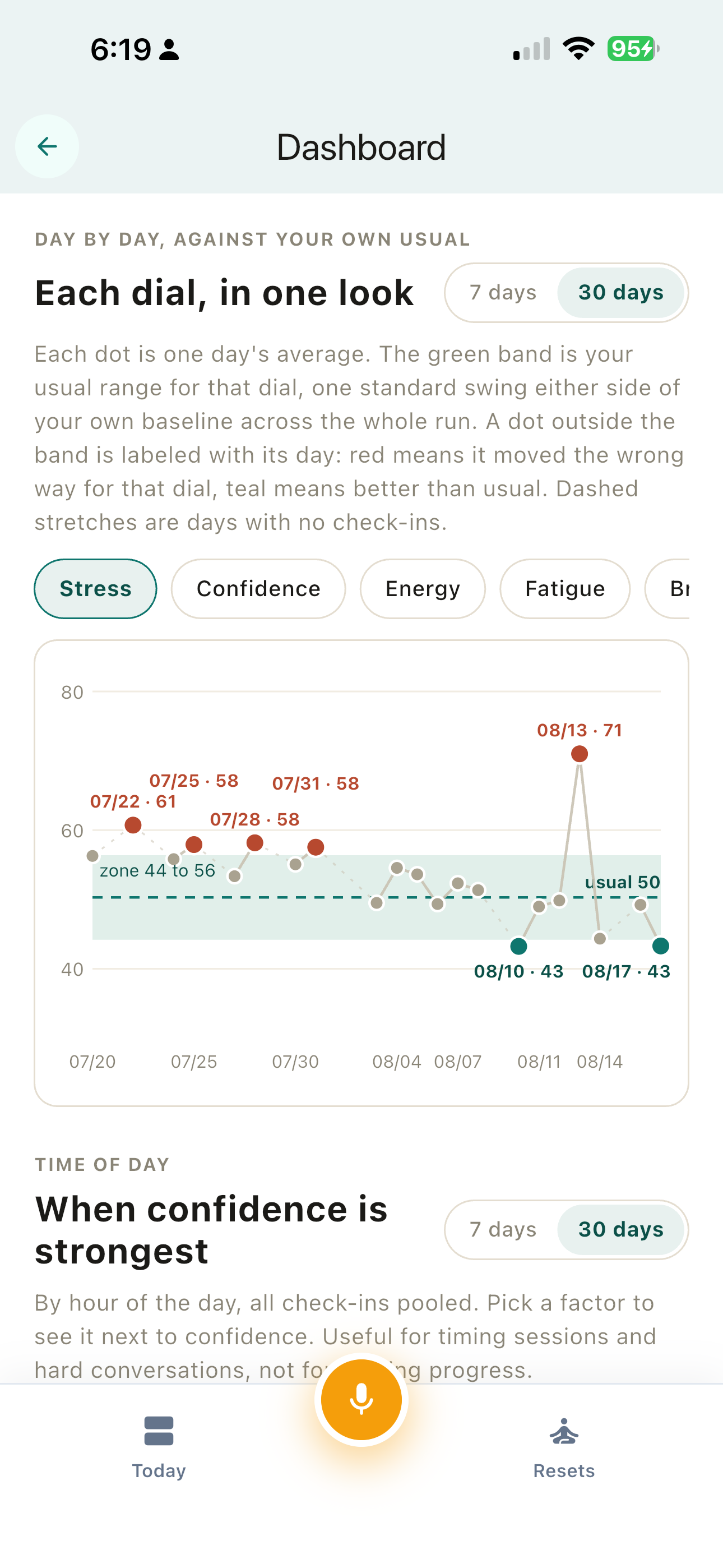
In my own Ontor session history, the rejection-delivery evening-carryover gap looks like this: after a hard conversation that felt like delivering difficult news, stress and energy can sit outside my personal usual band into the evening and into the next high-stakes stretch, while the next BD-style conversation still has to start. Activity boards would still look like "call completed, next dial scheduled." The private usual-band drift is what "make the call anyway" does not surface before the next client hears the voice.
Here is stress across dials against my personal usual range, from my own Ontor dashboard and session history. Read it as the private rejection-delivery carryover view after a hard no, before the next client or BD conversation. It is not a diagnosis, and it is not outcome data from your staffing floor:
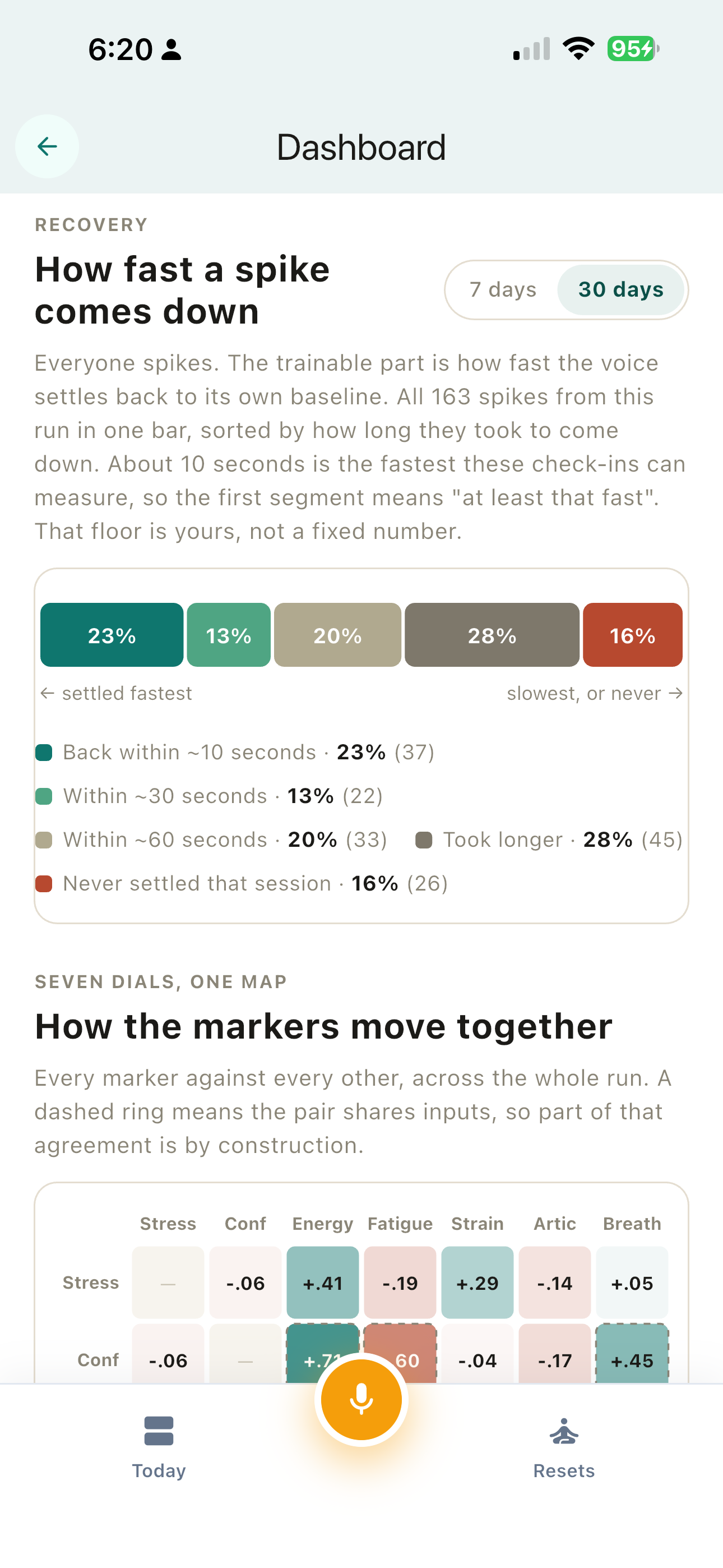
And here is how often stress spikes in that same Ontor history settled back toward my personal baseline, including stretches that never settled in-session. Useful as a private composure check after evening carryover before the next client conversation. It is not proof that a suggested reset caused recovery, and it is not clinical recovery science:
Download Ontor - 14 days free, no card required
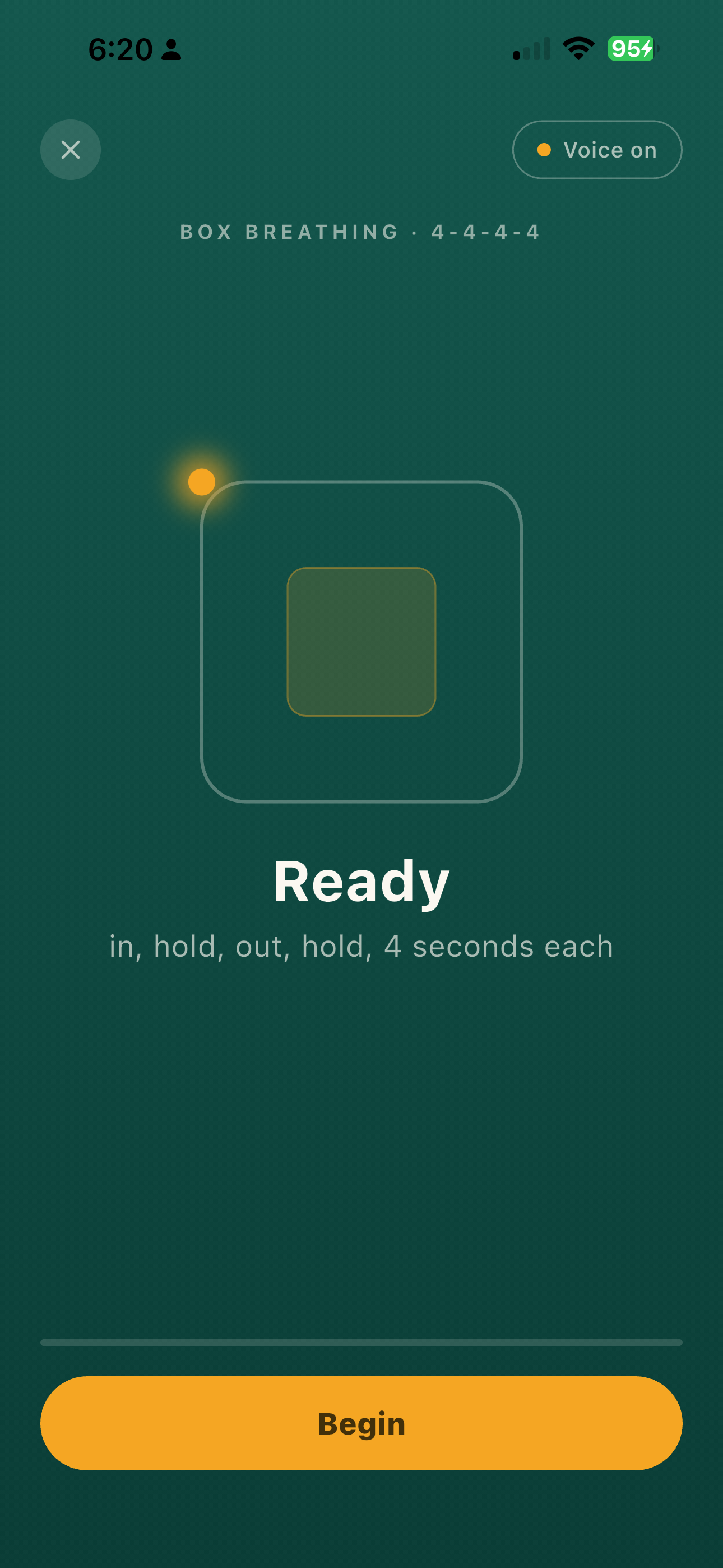
Short resets fit the same loop leaders already preach after a hard no: deliver clearly, then show up for the next conversation. When stress, fatigue, energy, or confidence drift outside usual range after rejection delivery, Ontor can surface a brief private exercise before the next client or BD conversation. Here is a box-breathing reset screen from my own product use. Cap any medical claim. The product point is a short private reset so the next client call does not inherit last evening's rejection-delivery register:
In exploratory work on that same personal Ontor history (one person, not a population study), high-stress episodes often did not show an observed return to my personal median within an hour. That is one reason a private usual-range check after evening carryover matters. It is not evidence that a suggested reset caused recovery.
This is not a claim that voice markers diagnose distress, predict placements, replace manager judgment, or guarantee the next win after a reset. The claim stays narrow: when rejection-delivery labor pushes how you sound away from your usual range into the evening, a private signal plus a short reset is a loop you can run before the next client or BD conversation.
What to try after the next rejection-delivery call
Do not wait for a research committee if you are the person who still makes the next client and BD calls.
- Install Ontor on the machine you already use for recruiting and BD conversations.
- After the next rejection-delivery call that sits with you into the evening or the rest of the day, check whether stress, fatigue, energy, or confidence sit outside your usual range before you dial the next client or candidate conversation.
- If a lasting shift shows up, take the short suggested reset when the desk allows it, then make the next client or BD call.
- If you lead a pod, keep leaders on aggregate patterns only. Personal readings stay with the person.
Soft secondary path if you are buying for a staffing sales or BD desk and want a measured team look later: Ontor for teams, or a research conversation / 14-day pilot with sales leaders' own desks.
Do not promise placement speed, fee recovery, or revenue lift from a trial. Measure whether you can tell when rejection-delivery residue left your usual voice before the next connect.
Bottom line
Rejection-delivery never gets easy. Leaders will keep making the call anyway. The gap that remains is evening carryover composure: whether stress, energy, and confidence actually came back toward personal baseline before the next high-stakes client or BD conversation.
Try Ontor after the next rejection-delivery call, before the next client conversation. That is the tool next step, not only a research conversation.
Download Ontor - 14 days free, no card required
About the author
Sabber Ahamed is the founder of Ontor and an applied ML scientist (PhD in geophysics and signal processing) who builds on-device voice tools. Ontor compares how you sound to your own usual ranges and suggests short resets, without claiming clinical or revenue outcomes from marker changes.
References
- Sue Southall - The Weight of No (rejection call sat with me all evening). LinkedIn. https://www.linkedin.com/posts/connectwithsuesouthall_i-made-a-call-yesterday-that-sat-with-me-activity-7468564794820734976-q9To
- MSP Talent Bridge - About Us (Sue Southall, Founder). https://msptalentbridge.com/about-us/
- Tim Spindlove - Want to know the hardest part of recruitment? (rejection call). LinkedIn. https://www.linkedin.com/posts/timspindlove_want-to-know-the-hardest-part-of-recruitment-activity-7339290463805284352-apsP
- Jen Hulme - 20 rejection calls back to back (corporate TA corroboration only). LinkedIn. https://www.linkedin.com/posts/jen-hulme_the-hardest-part-of-working-in-talent-acquisition-activity-7490663571949965312-av97
- How Ontor works. https://ontor.ai/how-it-works/
- Ontor for teams. https://ontor.ai/for-teams/
- Install Ontor. https://ontor.ai/install/
- About the founder - Ontor. https://ontor.ai/about/
- Staffing post-fallout composure - Ontor. https://ontor.ai/blog/staffing-post-fallout-composure/
- Collections cool-down between hostile calls - Ontor. https://ontor.ai/blog/collections-cool-down-between-hostile-calls/
- Hangover between sales calls - Ontor. https://ontor.ai/blog/hangover-between-sales-calls/
- Staffing midday reset verification - Ontor. https://ontor.ai/blog/staffing-midday-reset-verification/