
Same BD script. The first 30 seconds of energy still decide the meeting.
Staffing and recruiting sales leaders already know the script is not the whole game. Adam Tiberius (U.S. General Manager, Zenopa) had UK cold-call math that worked: about 10% of cold calls to meetings, about 50% of meetings to new accounts. He took the same process, same structure, and same energy into the U.S. Conversion tanked. The fix was not a new talk track. It was opener delivery in the first ~30 seconds: a softer approach, smiling on the phone, sounding happier instead of blunt, and sounding like he wanted to be there. About 90% of the call stayed identical. Conversion recovered.
That is market and opener calibration of delivery energy, not a full-script rewrite. Ben Miller (Take Two Brothers) narrated the UK→U.S. story on LinkedIn. Sam Miller corroborated the same object: entire sales script kept exactly the same, only more upbeat and happy for American prospects.
This is not the same-words / energy A/B across the call piece (Doherty spine: two recruiters say the same thing, one books because confidence and energy decide the whole conversation). Overlap on the Ontor wedge is real, about 45 percent, and the object here is different: first-~30s opener energy calibrated to market, with ~90% of the process left alone. It is also not desk rut / tone and excitement gone, not call-block readiness, and not live-connect discomfort.
Dial boards and script reviews still cannot answer whether this person's opener energy sat inside their own usual range in those first short windows.
Download Ontor - 14 days free, no card required
UK math worked. Same process tanked in the U.S. until the opener changed.
Ben Miller's LinkedIn post on Tiberius is the spine. Exact lines from that narration:
"10% conversion rate from cold call to meeting. 50% from meeting to new account."
"Same process. Same structure. Same energy."
"Turns out the problem wasn't his process. It was the first 30 seconds."
"His blunt, direct UK approach - "This is a cold call, hang up now or give me 30 seconds" - wasn't working."
"A softer approach in the US was much better"
"He started "smiling on the phone""
"He sounded "happier" instead of blunt"
""Sound like you want to be there""
"90% of his call stayed identical. Same problems, same questions, same close."
"Just a different energy in the opener."
"His conversion rates shot back up."
Sam Miller's corroborating post keeps the same object. Exact lines:
"He kept the entire sales script EXACTLY THE SAME"
"But instead, he tried to sound more upbeat and happy when calling American prospects"
"This ONE subtle change started landing him deals in the US"
Lead with that. The failure mode for agency owners and VP Sales is not "rewrite the whole BD process for every market." It is: when process and structure travel, and conversion still dies, leaders who only score dials and talk-track compliance miss the audible variable that lived in the first half-minute.
Staffing sales leaders already hear opener energy on listen-ins. They still cannot verify, continuously, whether confidence and energy sat near that person's ready baseline in the short windows where the market hears them first.
Nervous sounds nervous. Own voice beats scripted hardness.
Rob Scott (Managing Director, Aaron Wallis Sales Recruitment) names why opener energy is hard to fake. Exact lines from Aaron Wallis's cold-calling attitude guidance:
"If you are nervous, you will sound it!"
"You can't expect the person at the end of the phone to have confidence in what you are saying if you sound hesitant and unsure!"
"It's impossible to fake it convincingly!"
Scott's pre-dial stack matches what Tiberius changed in the open: stand and change physiology, breathe as if confident, put a smile on your face because happiness is transparent even over the phone. Leaders already coach that. Activity KPIs still do not print whether it landed in the first 30 seconds.
Emily Audibert (firm owner, EA Associates) names own-voice energy versus scripted hardness on The Elite Recruiter Podcast. Exact lines:
"And some people like, what's your voice? What does your voice sound like?"
"Because like my voice and who I am, like I. I really flourish in the more laid back flow energy. That's where I thrive."
"I don't thrive in the very strict you must follow these rules way."
On the Recruitment Coach writeup of the same arc she says she did not have her own voice, then leaned into a softer approach that fit her. That is the same commercial object Tiberius hit when blunt UK opener energy tanked in the U.S.: market-calibrated delivery, not a harder script.
Floor color and vendor color (capped)
Lorena Bugden (employee / floor color, not leadership spine) names how staffing already judges energy on phone screens. Cap as floor color only. Exact lines:
"Your voice is your first impression. Your energy is your product"
"If I'm the recruiter and I can't even feel a spark on a screening call… How am I meant to believe you can sell to a client?"
"They're the ones who actually sound like they want the job."
Benjamin Mena / Elite Recruiter (vendor color only) names night-before list prep so morning energy lands on delivery. Cap as vendor color under Tiberius, not as the buyer spine. Exact lines from the Elite Recruiter cold-call scripts post:
"planning your call list the night before eliminates morning friction."
"You spend zero time wondering who to call and 100 percent of your energy delivering your script with confidence."
Useful rituals. Incomplete for market/opener calibration. Prep and pep talks ask whether people nodded before dial. They do not continuously ask whether opener energy left that person's usual range in the first short speech windows of the live call.
What dial boards and "be more energetic" still miss
Typical stack on a staffing or recruiting sales desk that already moved a proven process into a new market:
- Dial / connect / meeting-booked boards
- Script and opener compliance reviews
- Occasional listen-ins on one good week
- Pep talks: smile more, soften the open, sound like you want to be there
- Night-before list prep and warm-up rituals
Useful. Incomplete for first-30s opener energy. Dial boards ask whether motion happened. Script reviews ask whether the words matched. Pep talks ask whether people agreed in standup.
None of them continuously ask: in the short windows that make up the first ~30 seconds, did confidence, energy, clarity, or stress leave this person's usual range? Did blunt UK-style opener energy land in a market that needed softer and happier? Did the person sound like they wanted to be there before the prospect decided?
Prospects hear that first. Leaders often meet it later as a mysterious conversion gap after a process that still looked identical on paper.
How this differs from same-words A/B, desk rut, and adjacent voice pieces
Same words / energy meeting booked (Doherty spine) answers: when two recruiters deliver the same scripted words across the call and only one books, when chore energy is audible, and when call #14 still has to sound first-time fresh, do leaders still lack a personal voice baseline for confidence and energy? That piece is same-words A/B across the conversation. This piece is opener/market calibration in the first ~30 seconds (UK→U.S. delivery change; ~90% of the script identical). About 45 percent shared Ontor wedge. Different object.
Desk rut / tone and excitement gone answers sustained rut energy leave when the desk looks busy. Different object.
Call-block readiness, quality-over-volume readiness, and live-connect discomfort answer protected BD start readiness, remaining-call quality after dial quotas drop, and first-connect discomfort. Not first-30s market/opener energy calibration.
Doubt-under-the-voice coaching (Milligan color inside the same-words article) sits adjacent at maybe ~30 percent topical overlap if you stretch it. The object here is still Tiberius opener calibration, not doubt-under-voice as the spine.
Download Ontor - 14 days free, no card required
What Ontor adds when the opener sounds wrong before the pitch starts (private first)
Ontor is a performance tool that reads how you sound, not what you said. While someone speaks, it compares voice signals to that person's own usual range. Markers refresh in short voice windows (on the order of about 10 seconds of speech). When a lasting shift shows up (for example energy, confidence, stress, fatigue, speech clarity, or vocal strain), it can suggest a short reset. People can also compare before and after.
For teams, Ontor's public framing is aggregate patterns for workload, coaching, and support. Individual sessions and readings stay with the person. Agency owners and VP Sales can see team-level context for when confidence, energy, or clarity sits outside usual range more often across BD openers. They do not get a personal scoreboard for hire or fire decisions.
That is the product difference from dial boards and script reviews alone. Dial boards ask whether volume happened. Script reviews ask whether the words matched. Ontor asks whether this voice left its own usual band, privately, in the short windows that make up the first ~30 seconds, and whether a short reset is available before the next opener would otherwise start blunt, flat, or unlike "I want to be there."
It does not claim to raise meeting-booked rates, replace BD coaching, or prove that a suggested reset caused a booked meeting. The claim stays narrow: paying leaders already say process can travel while opener energy kills conversion in a new market. A private usual-range signal plus a short reset is a loop people can run before the next BD dial.
In my own Ontor session history (founder exploratory data from my own product use, not your agency's UK→U.S. conversion rates), the first-30s opener-energy leave shows up the same way Tiberius's story describes. A speaking block can still look "fine" as raw talk time while energy or confidence has left my personal usual range in the short windows that open the call. The rest of the talk track can still match. Dial count would still look fine. The prospect still heard the opener first.
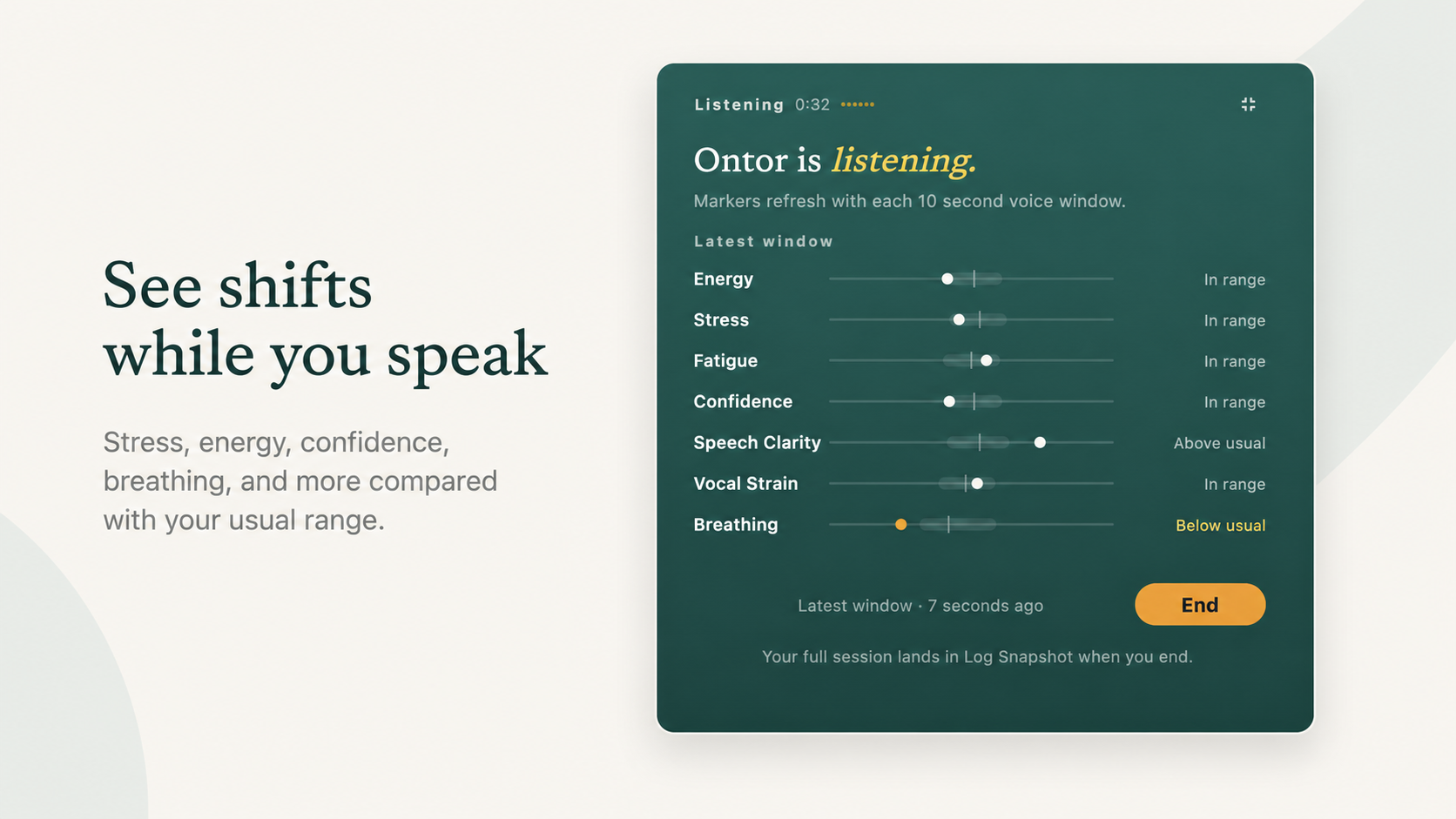
Here is the live listening view from my own Ontor product use: markers refresh with each ~10 second voice window and sit against my usual range. In this window speech clarity sits above usual while breathing sits below usual. That is closer to "my opener energy left my band in the first short windows" than a green dial tally:
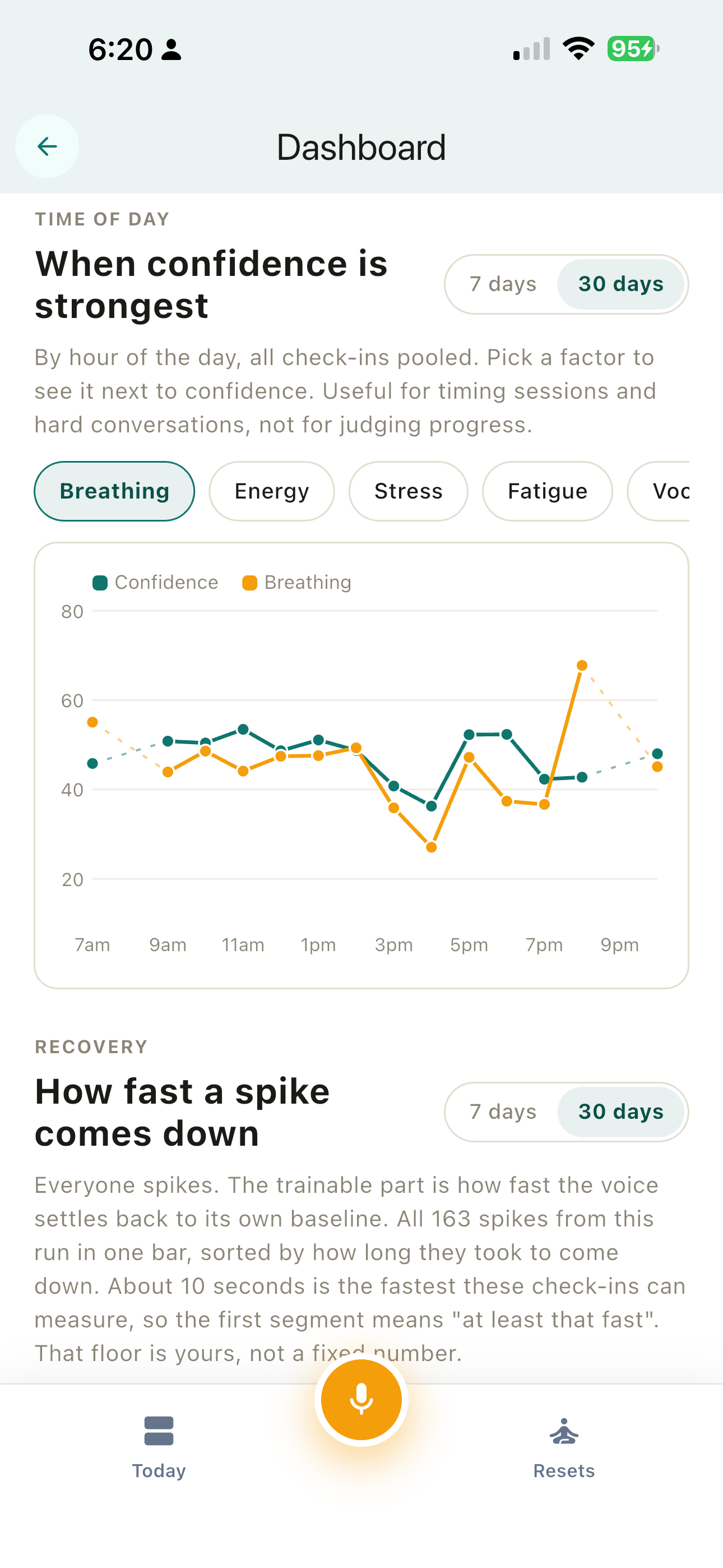
Here is confidence with breathing by hour from that same Ontor history. Confidence peaks late morning, then declines after noon and bottoms in the afternoon in this 30-day pool. Read it as founder exploratory data on personal-baseline confidence leave across a long speaking day, the same shape leaders hear when afternoon openers no longer sound like "I want to be there" while activity still prints green, not proof of meeting-booked rates and not your team's dial board:
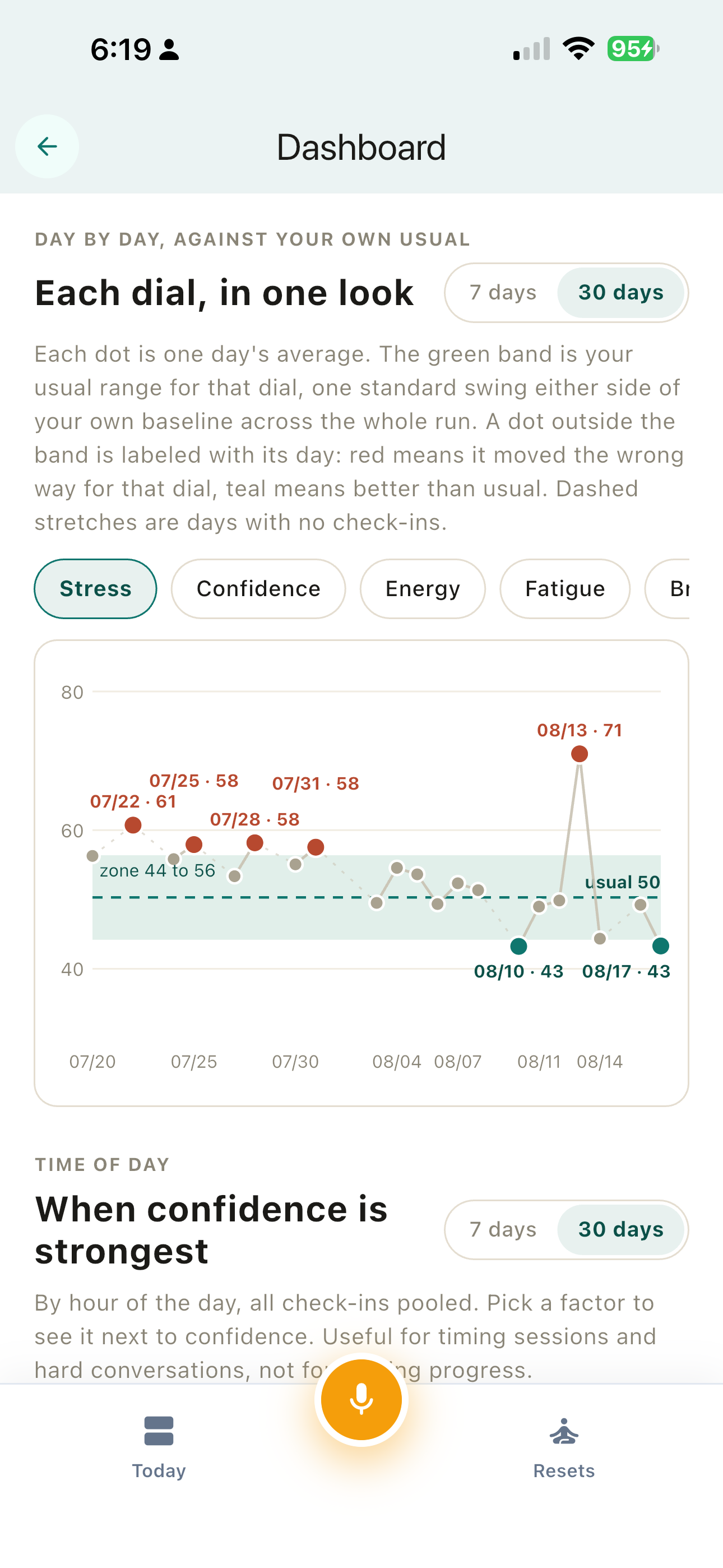
Here is stress day by day against my personal usual band (zone ~44 to 56, usual 50) from the same session history. Red points sit above my usual range. Useful as a private check for how often voice-state leaves the band across dials and days while a motion scoreboard would still print green around a process that "should" work. It is not a hire-or-fire score and it is not proof that a suggested reset caused a booked meeting:
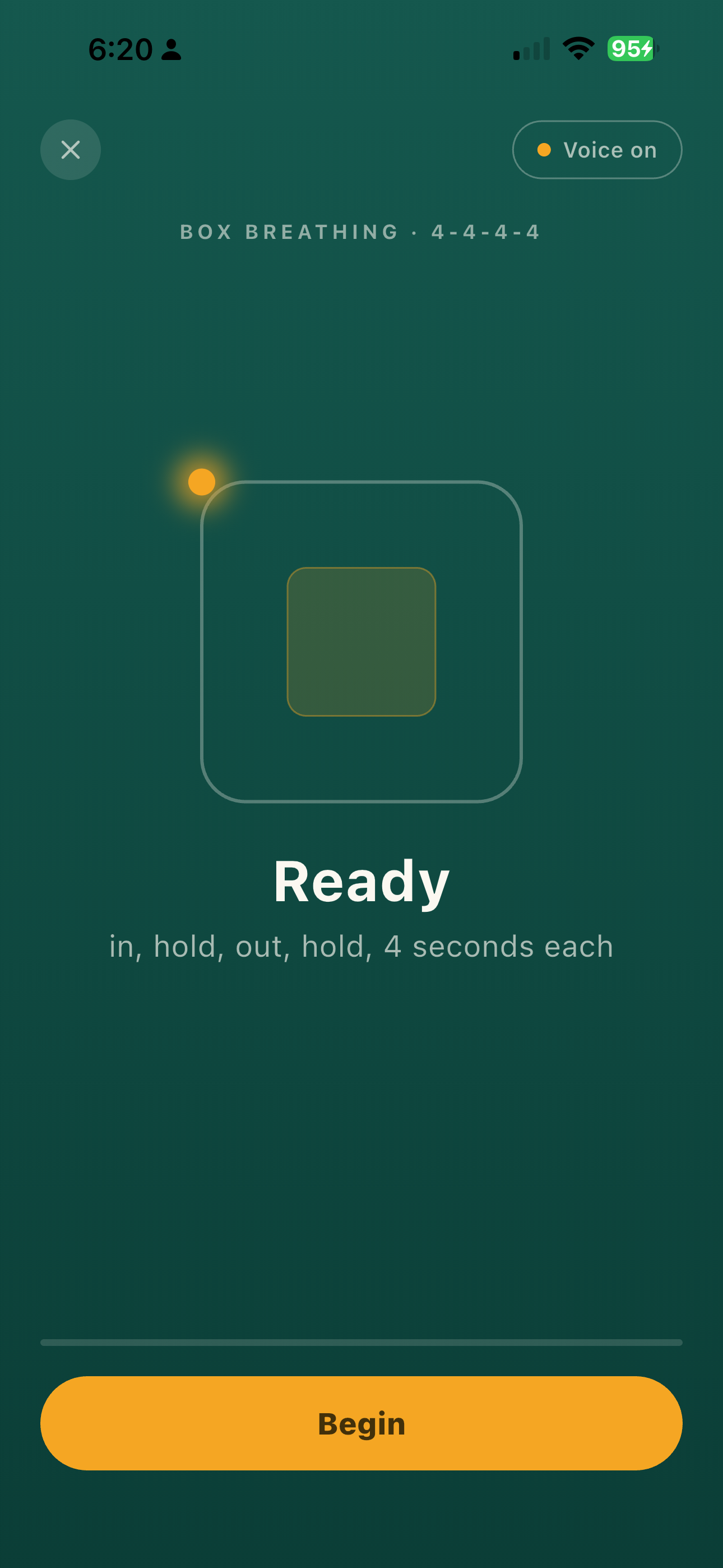
And here is the short reset the product offers when a lasting shift shows up: box breathing, 4-4-4-4. That is the tool form of the stand-breathe-smile ritual Scott and desk practitioners already prescribe, available privately without a manager guessing from a dashboard. It is not a claim that one cycle restores "want to be there" energy on the next opener:
This is not a claim that voice markers diagnose confidence, predict meetings booked, replace manager judgment, or guarantee higher revenue. The claim stays narrow: when dial boards miss opener-energy leave in the first ~30 seconds, a private signal plus a short reset is a loop people can run before the next BD call starts blunt, flat, or market-mismatched, while leaders watch cohort patterns only in aggregate.
What to try on the next BD call
Do not wait for a research committee if you already moved a proven BD process into a new market and conversion still died in the open.
- Install Ontor on the machine recruiters already use for BD calls.
- On the next BD outreach (especially the first dial into a market that needs softer or happier opener energy, or after a nervous/flat stretch), notice whether energy, confidence, clarity, stress, or fatigue sit outside that person's usual range in the short speech windows that make up the first ~30 seconds.
- If a lasting shift shows up, or if the person can already tell they do not sound like they want to be there yet, take the short suggested reset before the next dial. Then continue instead of stacking another identical script that opens blunt.
- If you lead the desk, keep leaders on aggregate patterns only for energy / confidence / clarity drift across BD openers. Personal readings stay with the person. Treat Tiberius's first-30s opener calibration, Scott's audible nervousness, and Audibert's own-voice energy as performance controls, not only soft skills.
Soft secondary path if you are buying for a team and want a measured look later: Ontor for teams, or a research conversation / pilot with staffing agency owners and VP Sales on personal voice baselines versus dial boards and script reviews.
Do not promise meeting-booked rates, placement revenue, retention, or ROI guarantees. Measure whether people can tell when opener energy left their usual voice before the prospect names it.
Bottom line
Same BD script. The first 30 seconds of energy still decide the meeting. Tiberius's UK math traveled; blunt opener energy did not. Softer, smiling, happier delivery recovered conversion while ~90% of the call stayed identical. Scott names why nervous sounds nervous. Audibert names own-voice energy versus scripted hardness. Bugden and Mena (floor / vendor color only) already talk energy-as-product and night-before prep. The gap that remains is personal usual-range confidence and energy in the first short windows, caught while dials and scripts still look compliant.
Try Ontor on the next BD call. Notice the short voice windows versus that person's usual range in the opener. Take the short reset when a lasting shift shows up, especially before a dial that still has to sound like you want to be there. That is the tool next step, not only a pilot conversation.
Download Ontor - 14 days free, no card required
References
- Ben Miller (Take Two Brothers). LinkedIn: Adam Tiberius UK→U.S. opener story; first 30 seconds; softer, smiling, happier; 90% of call identical; conversion recovered. https://www.linkedin.com/posts/taketwobrothers_this-uk-recruiter-closed-100-new-accounts-activity-7360593452100722688-e4kR
- Sam Miller (Take Two Brothers). LinkedIn corroboration: entire sales script kept exactly the same; more upbeat and happy for U.S. prospects. https://www.linkedin.com/posts/samtaketwobrothers-ttb_i-interviewed-a-recruiter-doing-15m-in-activity-7360950979757826048-aE5e
- Adam Tiberius. Zenopa U.S. General Manager profile. https://zenopa.com/us/team/adam-tiberius-1
- Rob Scott (Managing Director, Aaron Wallis). "Get Into the Attitude for Cold Calling": if you are nervous you will sound it; smile; physiology before dial. https://www.aaronwallis.co.uk/candidates/advice/sales-training-and-sales-career-advice/cold-calling-tips/how-to-cold-call/
- Emily Audibert. Elite Recruiter Podcast with Benjamin Mena: what's your voice / what does your voice sound like; laid-back flow energy vs strict scripted rules. https://www.eliterecruiterpodcast.com/emily-audibert-mindset-rpo-strategy-success/
- Emily Audibert. Recruitment Coach episode writeup: finding own voice; softer approach. https://recruitmentcoach.com/podcast/how-to-bill-1-29-million-without-sacrificing-family-life/
- Lorena Bugden. LinkedIn (floor color): energy is your product on phone screens. https://www.linkedin.com/posts/lorenabugden_everyone-says-they-want-a-job-in-sales-activity-7442912902967218176-MaEk
- Benjamin Mena / Elite Recruiter (vendor color). Night-before list prep so 100% of energy delivers the script with confidence. https://www.eliterecruiterpodcast.com/blog/recruiting-cold-call-scripts-market-intel/
- Ontor. "How it works." https://ontor.ai/how-it-works/
- Ontor. "Ontor for teams." https://ontor.ai/for-teams/
- Ontor. "About the founder." https://ontor.ai/about/
- Ontor. "Install Ontor." https://ontor.ai/install/
- Ontor. "Same words. Clients hear the energy underneath. Staffing sales leaders already A/B it. Dashboards still can't." https://ontor.ai/blog/staffing-same-words-energy-meeting-booked/ (sibling)
- Ontor. "Your staffing desk can look busy and still be in a rut. Clients hear the missing tone before you do." https://ontor.ai/blog/staffing-desk-rut-tone-excitement-gone/ (sibling)
- Ontor. "Staffing sales leaders can see dials and fill rates. They still miss readiness between BD call blocks." https://ontor.ai/blog/staffing-sales-call-block-readiness/ (sibling)
- Ontor. "Your staffing team dropped the 150-dial quota. Can anyone tell if the remaining calls still sound ready?" https://ontor.ai/blog/staffing-quality-over-volume-readiness/ (sibling)
- Ontor. "Your staffing team finally got a live connect. You can hear they're uncomfortable." https://ontor.ai/blog/staffing-live-connect-discomfort/ (sibling)