
The polished stage voice dies on the first board interruption
Coaches and enablement buyers still buy stage and public-speaking voice training that produces a fuller, more resonant sound on prepared material. Then they watch that voice die on the first live interruption. A sharp chair question. A challenge in Q&A. An unscripted pushback in a board or investor room.
The failure is audible and mostly self-invisible: a small upward pitch drift, a pace spike, throat compression. The speaker often does not hear it. The room does. Transfer is not only something you judge in the next coaching appointment.
This piece is for coaches and enablement buyers who sell or buy voice, presence, and composure into senior rooms and pitch environments. It is not practice holds, live dials don't. It is not pre-block shake when scripts fail. It is not call-mode costume pitch-voice. And it is not anxious or robotic under the same pressure. The wedge here is narrower: the wrong curriculum (stage / polished prepared voice) collapses on the first live interruption.
Download Ontor - 14 days free, no card required
Paying coaches already name the prepared-vs-interrupted split
Mary Beth Hazeldine (Owner and Managing Director, Winning Presentations; ex-JPMorgan / PwC / RBS / Commerzbank presentation coach for senior decision audiences) documented the channel failure with a client she calls Tomás. Eleven months of excellent drama-school stage coaching. Fuller, more resonant voice on prepared speech. Then the board:
"Tomás came out of the coaching with a fuller, more resonant voice that landed beautifully when he was reading a prepared speech. It did not survive a board meeting. The first time the chair interrupted him with a sharp question, his voice went back to where it had been a year earlier. The second time, the same. By the fourth interruption his voice had thinned again and the case unravelled in front of him. The coaching had given him a stage voice. The boardroom had asked for something different and he did not have it."
That is not "needs more rehearsal." It is two voices after expensive stage work:
"The result is that an executive who has spent six or twelve months in stage-style voice coaching often comes out with two voices. A polished one for prepared material, where the new training shows up beautifully. And a tense, slightly compressed one for unscripted, high-stakes moments, where the new training has done nothing for them."
The most common senior failure she names is small and self-invisible:
"The most common voice failure in senior settings is a small upward drift in pitch when the speaker is interrupted, challenged, or asked a difficult question. The drift is typically only a few Hz. The speaker does not notice it. The room reads it instantly - not as nerves, but as uncertainty about the case."
Pace and resonance move with it. Under stress the voice retreats into the throat and sounds thinner and tighter. Most senior speakers, she writes, run at 160 to 170 words per minute under pressure, while the pace that reads as deliberate in senior rooms is often closer to 140 to 150. The client phrase she hears over and over:
"the coaching helps when I am in control of the material, and falls apart when I am not."
Hazeldine already sells senior-context rehearsal for that gap: interruption recovery, answer-then-pause, a micro-breath before a sentence that will be challenged. Fundamentals from good general coaches still transfer. The curriculum gap is the live-challenge layer, and that layer is still appointment-bound for unsupervised windows.
Corroboration: practice still loses the room; symptom fixes still fail under pressure
Assumpta Munsi (Founder, The VoiceShop; opera-trained coach for founders, accelerators, and executives) hears the same mis-attribution from paying clients:
"When people come to me with pitch or presentation struggles, they usually think the problem is nerves. Or that they just need more practice."
"You can practice your pitch a hundred times and still lose the room. You can manage your nerves and still feel like something's off. Because if you're not present, if you've disconnected from yourself while you're speaking, your audience disconnects too."
"When you're nervous or rushing, your breathing gets shallow. Shallow breath = shaky voice, racing thoughts, and that feeling of spiraling."
Her site line lands the same transfer problem in one sentence: most founders lose the room before they finish their first sentence, not because the idea is weak, but because delivery was never trained. Practice and nerve-management still matter. Presence during live delivery is the missing piece between sessions.
Daidree Tofano, PCC (Founder, Impact Voice Coaching; Masters Vocal Performance; ex-McKinsey / Bloomberg / Bank of America / Genomics England) names why surface voice tips fail the boardroom:
"Voice, body, and breath. Exactly what tends to fail under pressure in high-stakes moments."
"Most communication coaching tries to correct symptoms. Stop fidgeting. Lower your pitch. Don't say "um." That kind of fix doesn't hold up when the stakes get high."
From her about page, after a decade watching capable people stand up in grey corporate rooms:
"Their content was usually fine. Sometimes dull, often excellent. But their body, their voice, their presence… none of it was amplifying the message. Sometimes it was actively undercutting it."
"Most communication coaching focuses on content. I work on the instrument: the voice, body, and breath that delivers it. And the instrument is usually where things fall apart. Especially under pressure."
Channel coaches already sell durable under-pressure voice and presence. The Ontor-shaped gap is what happens between appointments: private noticing of pitch, pace, strain, breathing, and clarity versus that person's usual range during live unsupervised speech, in short windows, with a short reset when a shift lasts.
Distinct from nearby Ontor coaches cuts
| Published Ontor cut | Moment | What this article is not rewriting |
|---|---|---|
| Practice holds, live dials don't | Practice→live dial transfer / delayed-clip gap | Not stage curriculum collapse on board interruption / challenged Q&A |
| Coach call-block voice presence | Pre-block regulation; scripts fail when the voice still shakes | Not prepared stage polish dying on the first live interruption |
| Call-mode pitch voice | Forced professional phone costume off personal baseline | Not stage-vs-boardroom curriculum; not cold-call mode switch |
| Anxious or robotic under the same pressure | One pressured cascade, two audible modes (anxious OR robotic) | Not dual-mode misdiagnosis; interruption-killed stage voice |
Same coaches channel as several of those. Different question: when stage / public-speaking voice training builds a polished prepared voice, why does it still die on the first live interruption, and how do you notice pitch/pace/strain vs personal usual range when the coach is not in the room?
Download Ontor - 14 days free, no card required
What Ontor can add between coaching appointments
Ontor is a performance tool that reads how someone sounds, not what they said. While a person speaks, it compares voice signals to that person's own usual range. Markers refresh in short voice windows (on the order of about 10 seconds of speech). When a lasting shift shows up (for example stress, energy, speech clarity, vocal strain, or breathing), it can suggest a short reset. People can also compare before and after.
For a coach practice serving boards, pitches, and executive rooms, that sits next to the interruption tools you already teach. Clients still own their readings. What you gain is a private usual-range view during unsupervised live speech: whether pitch-adjacent activation, pace pressure, throat-side strain, or breathing left their usual band after the first challenge, without waiting for the next sparse appointment or autopsy clip.
This is not a claim that Ontor diagnoses health conditions, proves workshop transfer clinically, replaces 1:1 coaching, or guarantees board outcomes. It is narrower: short live windows against personal usual range so coaches and clients can see whether the prepared voice is still holding when interruption hits and the coach is absent.
What shows up in my own Ontor history (prepared stretch vs live pressure)
I am Sabber Ahamed, founder of Ontor. I use the product on my own speaking and meeting-heavy days. In my own Ontor sessions, the prepared-vs-interrupted pattern shows up as markers that look fine in an early window, then leave my personal usual range when live pressure or challenge arrives mid-block. Stress can climb above my usual band while speech clarity or vocal strain move with it. That is closer to Hazeldine's "helps when I am in control of the material, and falls apart when I am not" than to another polish tip.
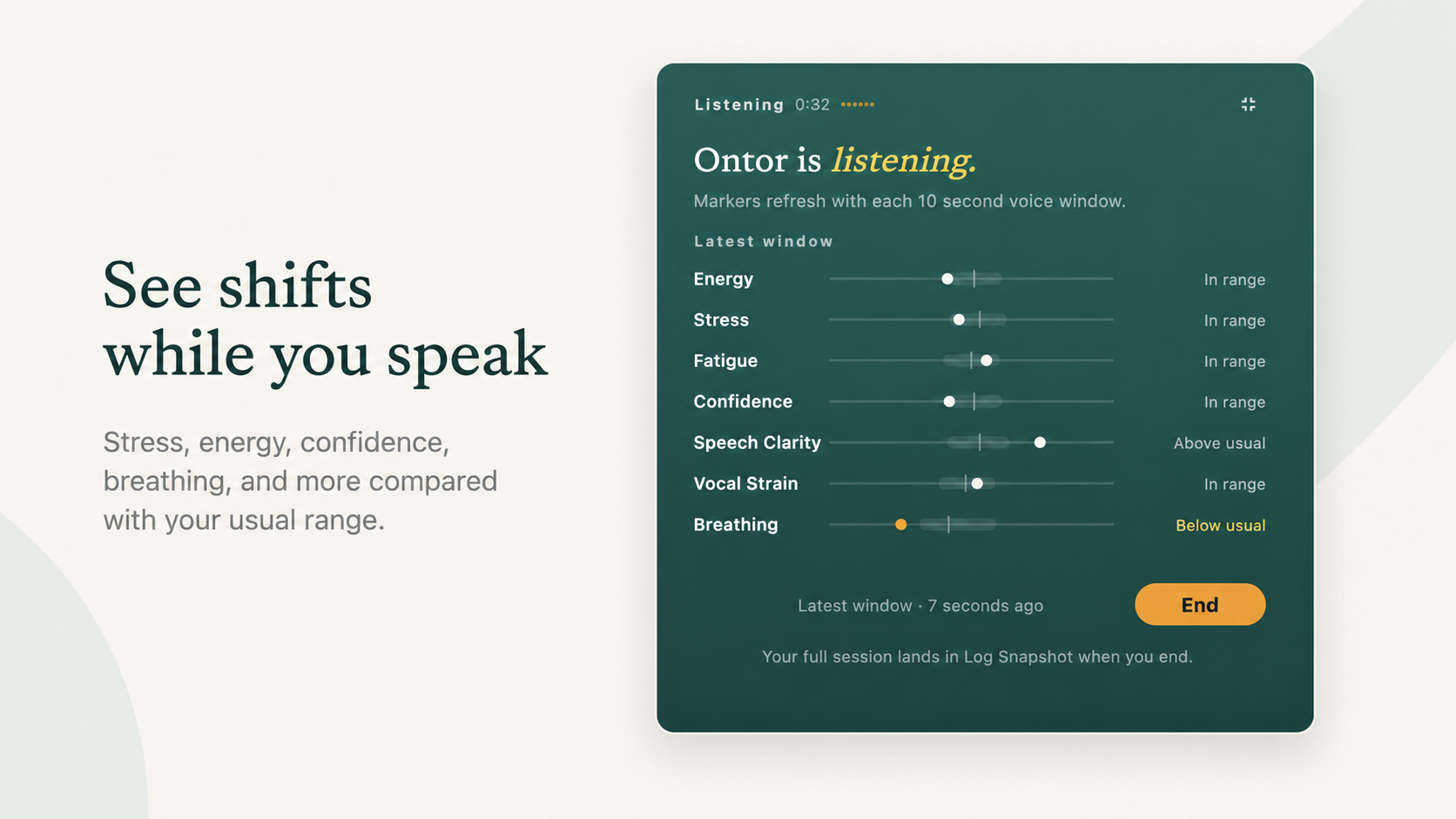
Here is the live listening view from my own Ontor product use. Markers refresh with each short voice window and sit against my usual range. In one window, breathing can sit below usual while other markers stay in range. That is the kind of self-invisible shift a stage read-through misses when the only test was prepared material:
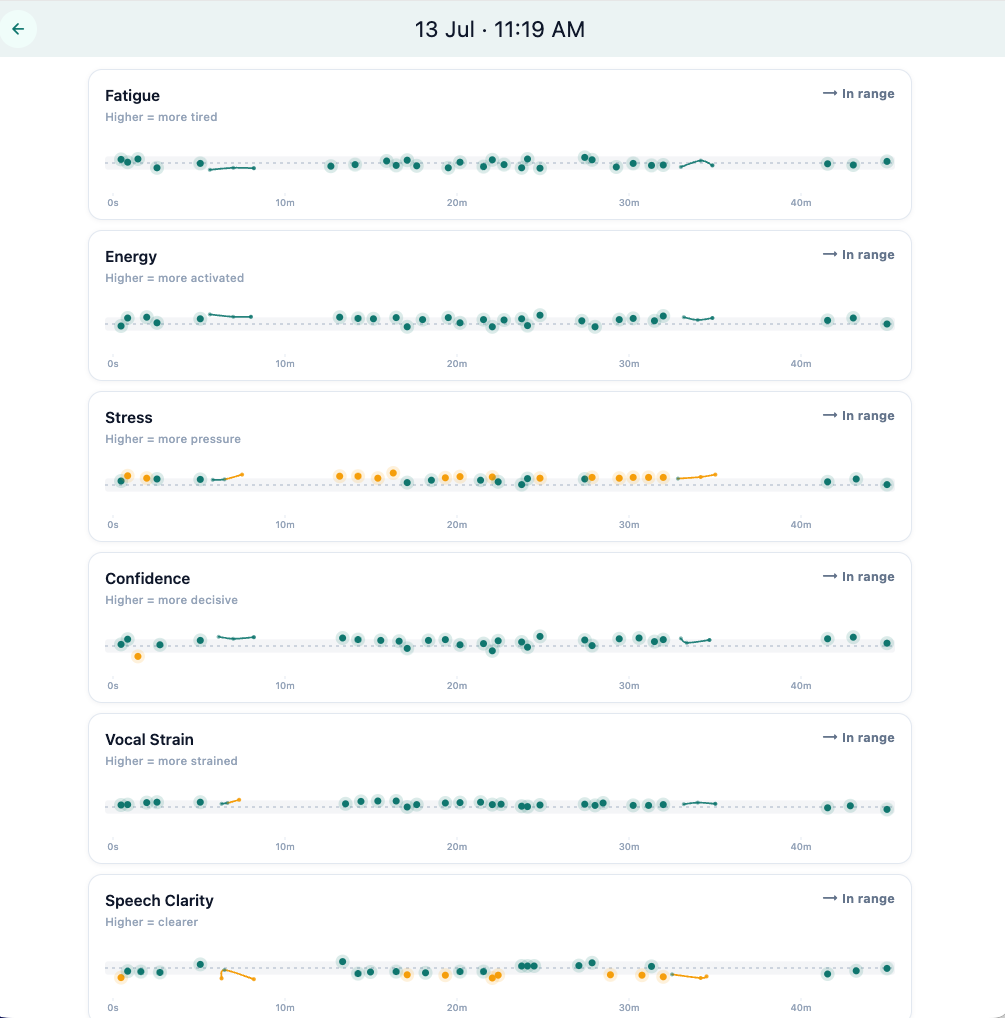
Here is a full meeting analysis from my own Ontor session history (one personal meeting block). Stress leaves my usual band in amber clusters mid-session. Vocal strain and speech clarity also show brief windows off usual. Early windows can look calm; the live middle of the block is where the collapse shows. Cap any clinical claim. This is one person's usual-range history, not proof a client's board outcome will improve:
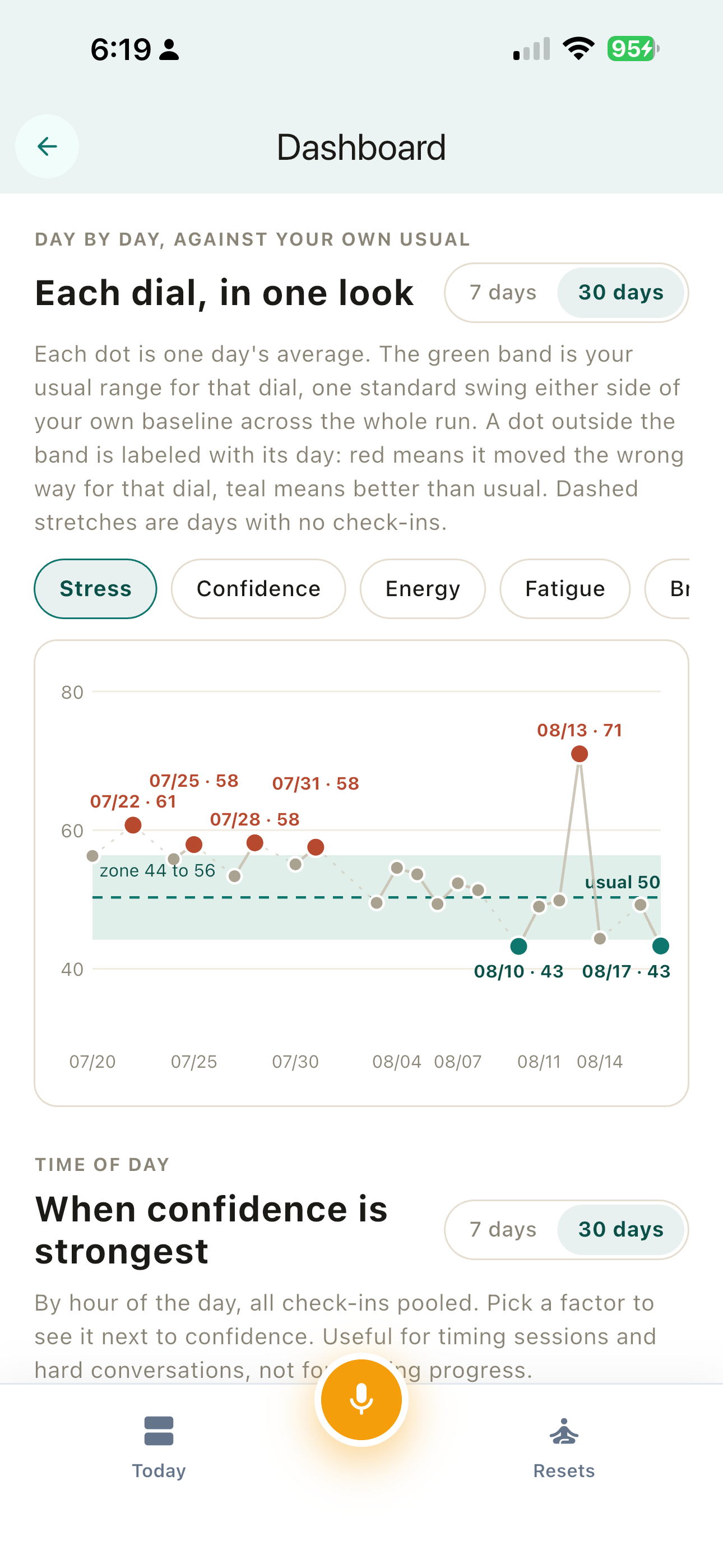
Across dials and days, my own Ontor dashboard also keeps stress against a personal usual zone (for me, roughly mid-40s to mid-50s on that run, with spikes well above usual on hard days). That private band is what makes a "few Hz pitch drift" style failure usable as a tool signal: not a population average, your range:
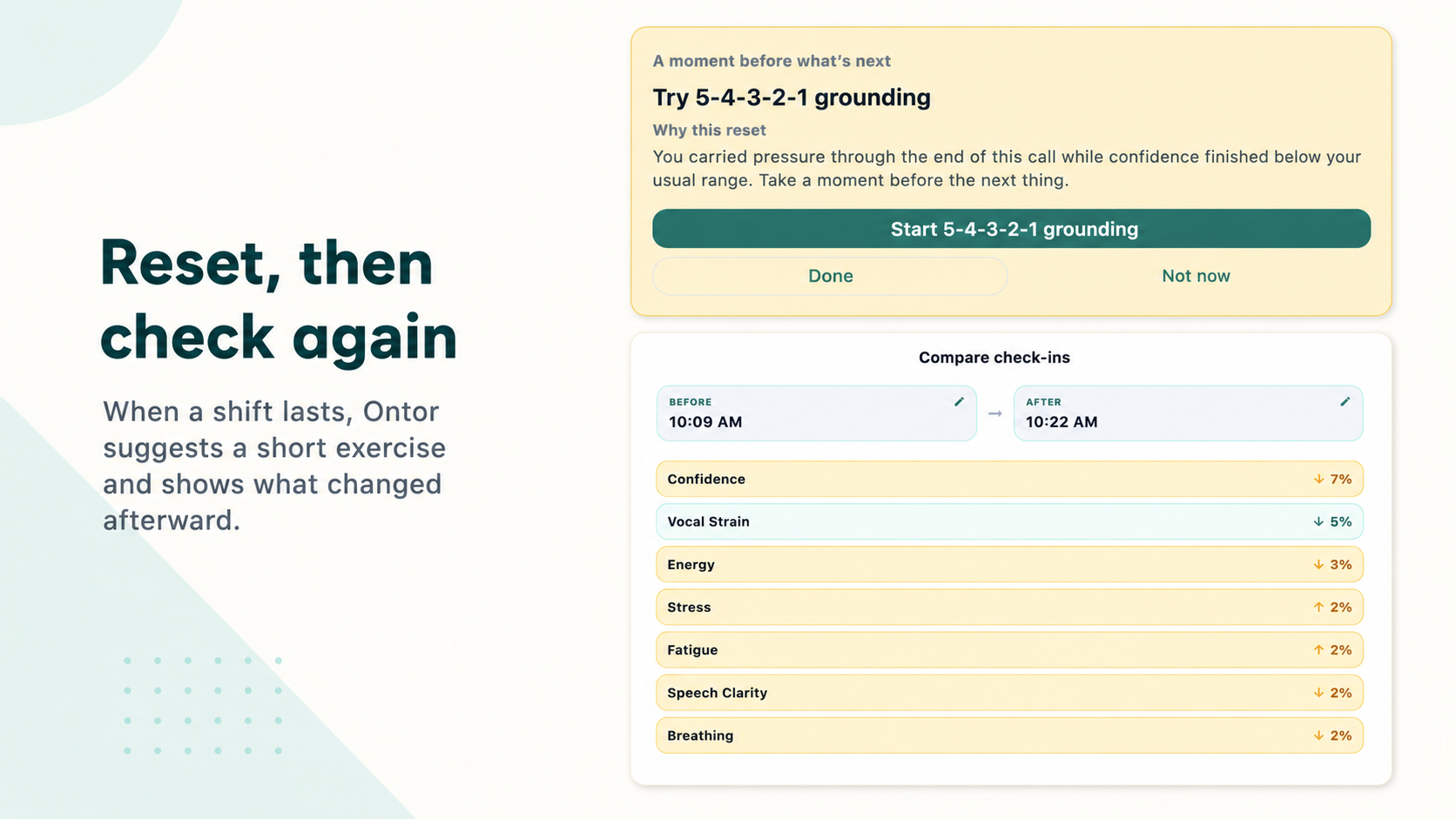
When that private read says I left usual range after a pressured stretch, Ontor can surface a short reset before the next room. Here is a reset-then-compare view from my own product use. Cap any medical claim. The product point is a short private loop you own so the next live window can move back toward usual range, not a clinical intervention and not another stage tip:
Try it on the next live block your client runs without you
Download Ontor - 14 days free, no card required
Install it for a real unsupervised board, pitch, or challenged Q&A block, not another prepared read-through. Ask the client to notice how they sound versus their usual range in the first minutes after an interruption: did stress, strain, breathing, or clarity leave their personal band while the polished prepared voice was supposed to hold? Take a short reset if the shift lasted. Keep the interruption tools and senior-context rehearsal you already teach. Add a private loop that shows whether the stage voice survived the live challenge when you are not in the room.
If you sell into pods or leadership teams, the soft path is a research or pilot conversation, or Ontor for teams, with aggregate patterns only. The primary next step for this coaches channel is still the next live interrupted block: hear prepared-vs-live collapse against personal usual range, not another polished rehearsal.
Sabber Ahamed is the founder of Ontor and an applied ML scientist (PhD in geophysics and signal processing) who builds on-device voice tools. He has shipped production signal and ML systems across radiology AI, healthcare, and manufacturing. Ontor compares how you sound to your own usual ranges and suggests short resets, without claiming clinical or revenue outcomes from marker changes. LinkedIn · About
References
- Mary Beth Hazeldine / Winning Presentations - Voice Coaching for Senior Executives: Why It Differs From Public Speaker Training (buyer evidence; stage voice dies under board interruption)
- Assumpta Munsi - LinkedIn: practice a pitch a hundred times and still lose the room (buyer evidence; The VoiceShop)
- Assumpta Munsi / The VoiceShop - founders lose the room before the first sentence (site corroboration)
- Daidree Tofano / Impact Voice Coaching - voice, body, and breath fail under pressure (buyer evidence)
- Daidree Tofano - About: instrument fails under pressure; content can still be fine (buyer evidence)
- How Ontor works
- Ontor for teams
- About the founder - Ontor
- Install Ontor