
By call 30 you're sinking into the chair. Afternoon flat is a body-to-voice problem.
You know the afternoon tell. Morning dials still have bounce. By call 30 you have slowly sunk into the chair. Breath gets shallower. Your voice carries less. High volume feels heavier. The person on the other end hears it even if they cannot name why.
This is for individual call-heavy AEs and SDRs (and managers coaching afternoon flat or soft objection energy). It is not between-call hangover. It is not call-mode pitch voice. It is not notes-while-talking presence. It is not block-length robot stamina. It is not dialer-gap afternoon fade. It is not over-explaining when you are off your game. The wedge here is narrower: call-30 sit-sink as a body-to-voice leave across a seated block, standing that holds talk time and objections, and a mid-call gear-shift when real interest shows (sit, lower pace, listen more).
Download Ontor - 14 days free, no card required
Call 30 is when the chair starts winning
Nikola Vracevic (cold-calling IC, first-person LinkedIn tip) named the seated fade in buyer language:
"And somehow it's way easier to dial 100 people on my feet than it is sitting down, slowly sinking into the chair by call number 30."
He treats a standing desk as a how-you-sound upgrade, not a productivity gadget:
"Sounds like nothing, but it changed how I sound on the phone."
"I'm more energetic standing up. My voice carries better."
Why that matters on a voice-only channel:
"They can't see you, so your voice is doing all the work. And your voice changes when your body does."
"Standing up, you breathe better, you sound more awake, more sure of yourself. The person on the other end hears that, even if they can't tell why."
And the afternoon self-test:
"If your calls feel flat by the afternoon, try standing for a week. Might surprise you."
Treat that as employee anecdote, not a verified employer study and not a medical claim about standing desks. The useful spine is mechanical: seated block → gradual chair sink by ~call 30 → flatter afternoon sound. Dial boards still count the attempt. They do not show that energy, clarity, or pace left your personal usual range while your body slumped.
Floor peers hear the same leave: standing holds talk time and objections
Chris D. (SDR / cold-calling practitioner) puts the high-volume slump in the same family:
"Don't just slump in your chair grinding through your 100th call of the day."
"When you sell over the phone, you lose body language. All you've got is what you say and how you say it."
"And trust me, the person on the other end can absolutely hear the difference."
"Energy transfers. Even down a phone line."
Floor peer Phoenix Floris adds the operational color managers already care about:
"We've tested it on the floor, standing reps hold better talk time and handle objections cleaner"
Another peer (Samuel) notes projection, tonality, and energy differences that faded as headset culture stayed seated. Cap the floor test as peer anecdote, not a controlled trial. Prefer Nikola's call-30 chair-sink as the named mechanism. Standing here is a body-to-voice lever during the dial block, not a pre-dial-only warm-up tip and not a claim that standing cures afternoon fatigue clinically.
Mid-call gear-shift: when interest shows, sit and lower your pace
Felix Göbel (IC cold caller) adds the piece that keeps this article from collapsing into "just stand more":
"I rarely sit still during cold calls. I stand up. Walk around. Use my hands."
"Your conversations instantly sound more dynamic and less robotic."
Smile as an instantaneous how-you-sound change:
"Smiling changes your voice instantly. You sound warmer, more positive, more approachable."
Then the novel mid-call move:
"The moment real interest shows up, I switch gears. I sit down. Lower my pace. Listen more than I talk."
"That change in body language and tonality builds trust fast."
Peer Derya adds color that body state leaks into voice (best cold calls when she was out of breath after running upstairs). Cap breathless-peak as color only. Do not turn it into a cardio prescription. The Ontor-shaped object is the gear-shift itself: energy and pace should not stay locked on "stand and push" once real interest appears. Sit. Slow. Listen. That is a mid-conversation baseline change, not another enthusiasm drill.
What this article is not answering
Six published Ontor pieces already cover adjacent how-you-sound moments:
- Leaders treat the minutes between calls as empty answers between-call hangover carryover.
- Your cold-call voice isn't missing enthusiasm answers forced call-mode pitch off your usual sound.
- Notes while talking kill presence answers typing/notes presence loss mid-sentence.
- You start the block sounding like Morgan Freeman answers cumulative block-length robot stamina by lunch.
- Dialer afternoon fade answers mid-market ops in the parallel-dialer micro-gap.
- You over-explain when you're off your game answers content dump when composure already left.
Adjacent pre-dial stand tips (sit → shallow → flatten before dial one) stay next door. Mention them only as neighbors. This piece owns call-30 sit-sink during a seated block, standing that holds talk time and objections, and the mid-call sit-and-slow gear-shift when interest shows.
Same headset. Different failure mode: body posture and pace drift across the block, audible as afternoon flat and soft objection energy, not hangover, not Disney call-mode, not notes presence, not robot stamina alone, not dialer-gap fade.
Download Ontor - 14 days free, no card required
What scripts, stand-up pep talks, and "sound more energetic" still miss
Typical stack for an IC or a manager coaching afternoon flat:
- "Stand up / walk around / smile" tips without a personal baseline
- Script and objection trees so the next line is ready
- Post-call recording review after the prospect already heard the sink
- Activity targets that still count dials while posture and pace have already left
- One-size "more energy" coaching that ignores Felix's sit-and-slow gear-shift
Useful. Incomplete for the how-you-sound leave. A standing tip does not tell you, in the moment, that energy, clarity, or pace left your personal usual range by call 30. A manager saying "you sounded flat this afternoon" does not give you a private usual-range read across short speech windows. Self-listen after the fact catches one recording, not lasting shifts across a seated block before the next push, and it rarely catches mid-call gear-shift timing when interest suddenly shows.
None of those continuously ask: across this seated dial block, did energy, fatigue, speech clarity, pace-adjacent confidence, strain, or breathing leave your own usual range while you sank into the chair, and again when interest showed and your delivery should have slowed?
What Ontor adds on a long seated dial block (private first)
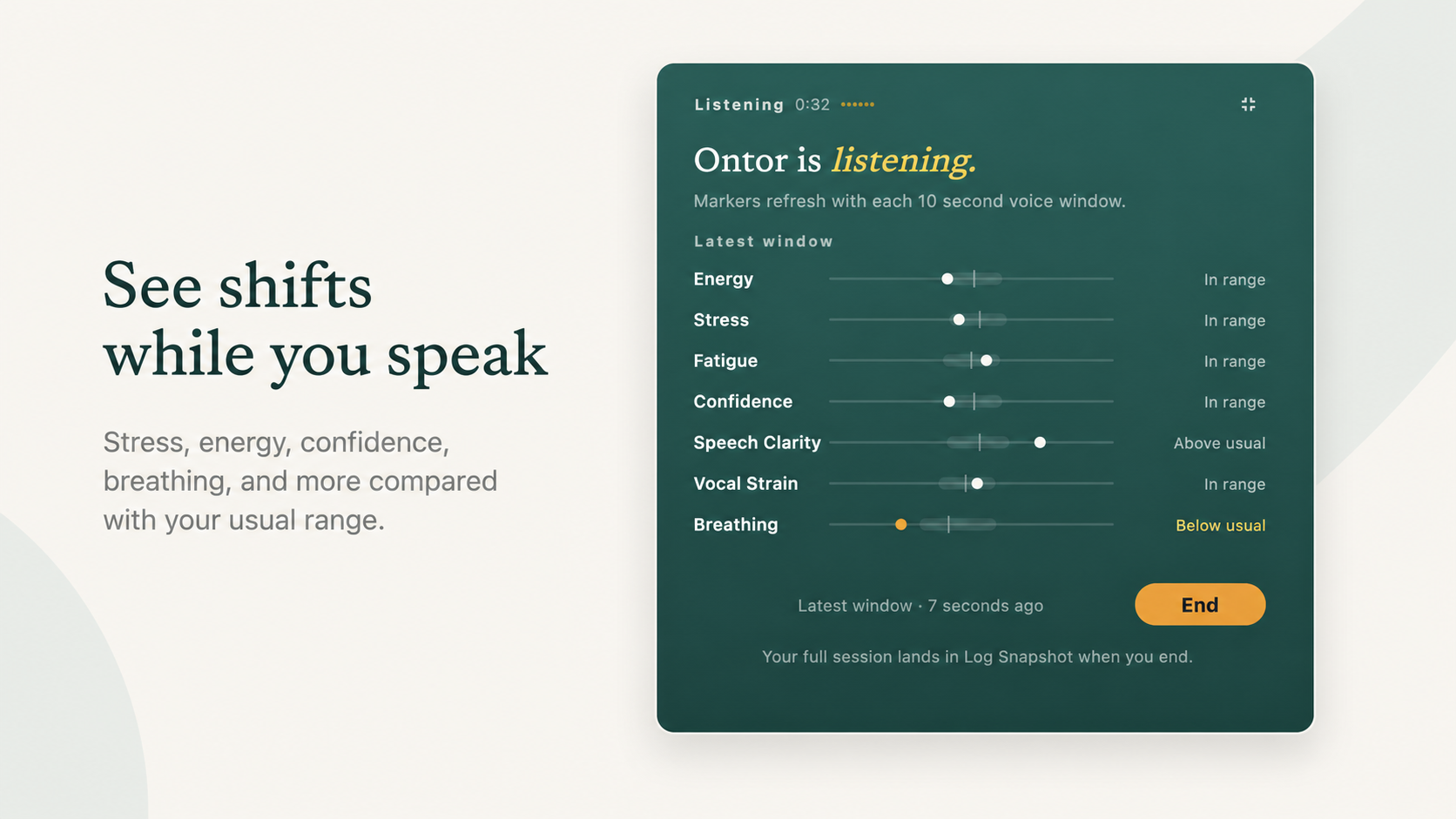
Ontor is a performance tool that reads how you sound, not what you said. While you speak, it compares voice signals to your own usual range. Markers refresh in short voice windows (on the order of about 10 seconds of speech). When a lasting shift shows up (for example energy, fatigue, stress, confidence, speech clarity, vocal strain, or breathing), it can suggest a short reset. You can also compare before and after.
Explicit boundaries for this topic:
- Ontor does not claim that standing desks cure afternoon flat, fatigue, or any medical condition.
- Ontor does not claim ROI, connect-rate lift, talk-time lift, or quota outcomes from marker changes.
- Ontor does not turn individual readings into hire-or-fire scoreboards.
- Ontor is a tool / product / platform, not an "app" substitute for coaching.
- The claim stays narrow: personal baseline drift (energy / clarity / pace) across a seated block; optional short posture or pace reset before the next dial, or a mid-conversation gear-shift cue when interest shows.
For teams, Ontor's public framing is aggregate patterns for workload, coaching, and support. Individual sessions and readings stay with the person. Managers coaching afternoon flat can watch cohort-level energy or confidence drift. They do not get a personal ranking of who slumped hardest after call 30. Soft secondary path: Ontor for teams.
In my own Ontor session history (founder exploratory data from my own product use, not your floor's outcome data), the call-30 sit-sink / afternoon-flat pattern shows up the same way Nikola, Chris, and Felix name it. Across a long seated dial block, energy, clarity, or pace can leave my personal usual range in the short windows while I am still "ready" on the talk track. Delivery is already flatter before the next push. When interest suddenly shows and I keep pushing at cold-call pace, the same markers stay outside the band that would match a sit-and-slow gear-shift. A short posture or pace reset before the next dial, or a mid-conversation cue to lower pace when interest appears, is the tool form of that body-to-voice loop. It is not a claim that one cycle fixes afternoon flat for your whole pod.
Here is the live listening view from my own Ontor product use: markers refresh with each ~10 second voice window and sit against my usual range. Read it as a private check for whether energy, clarity, strain, or breathing left my band across a seated block when the chair starts winning:
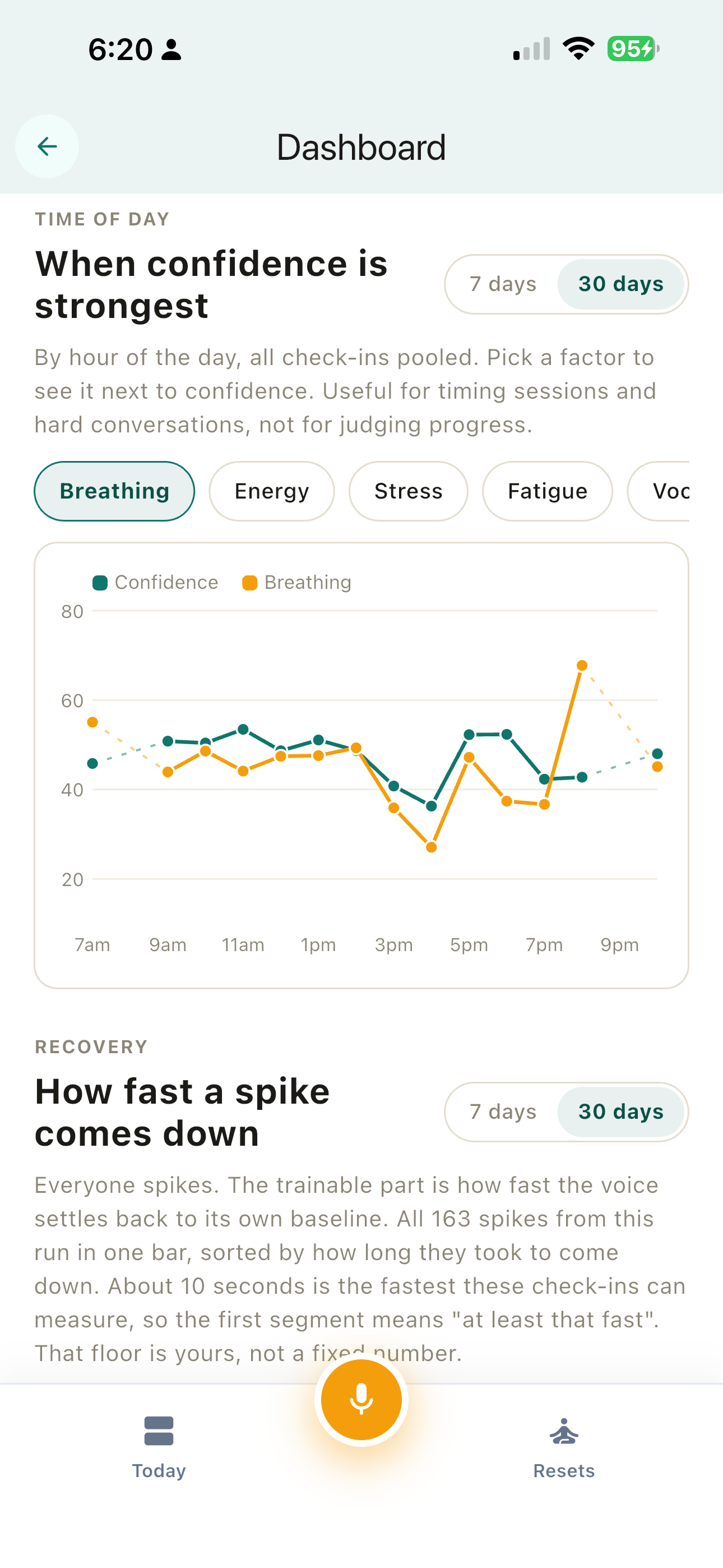
Here is confidence with breathing by hour from that same Ontor history. Confidence can sit fine early, then leave my personal usual later when the seated block runs long and afternoon flat shows up in how I sound. Read it as founder exploratory data on personal-baseline drift across a call-heavy day, not proof of booked meetings and not a claim that Ontor measured "chair sink" as a label:
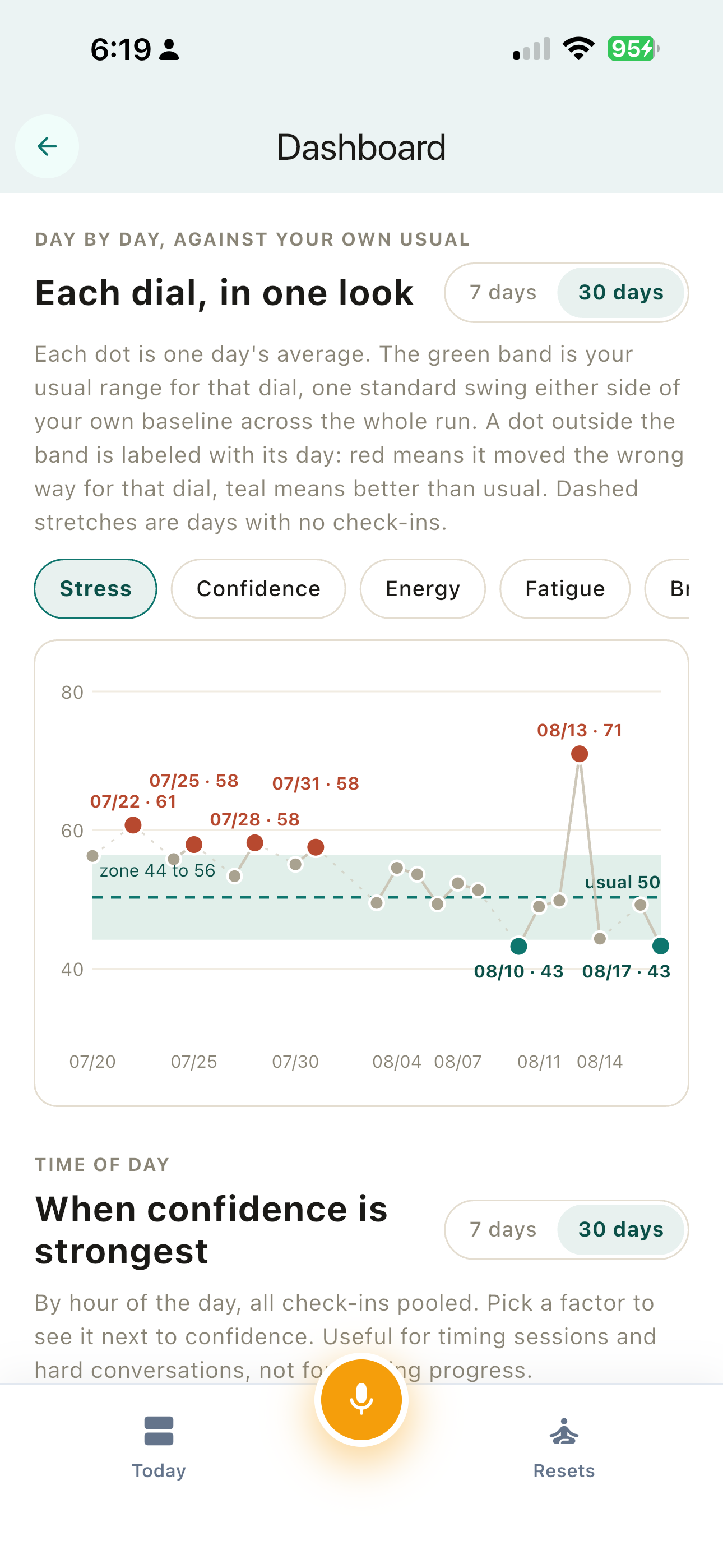
Here is stress day by day against my personal usual band from the same session history. Useful as a private check for how often voice-state leaves the band across calls when a seated grind would soften objection energy. It is not a hire-or-fire score and it is not proof that a suggested reset caused cleaner objections:
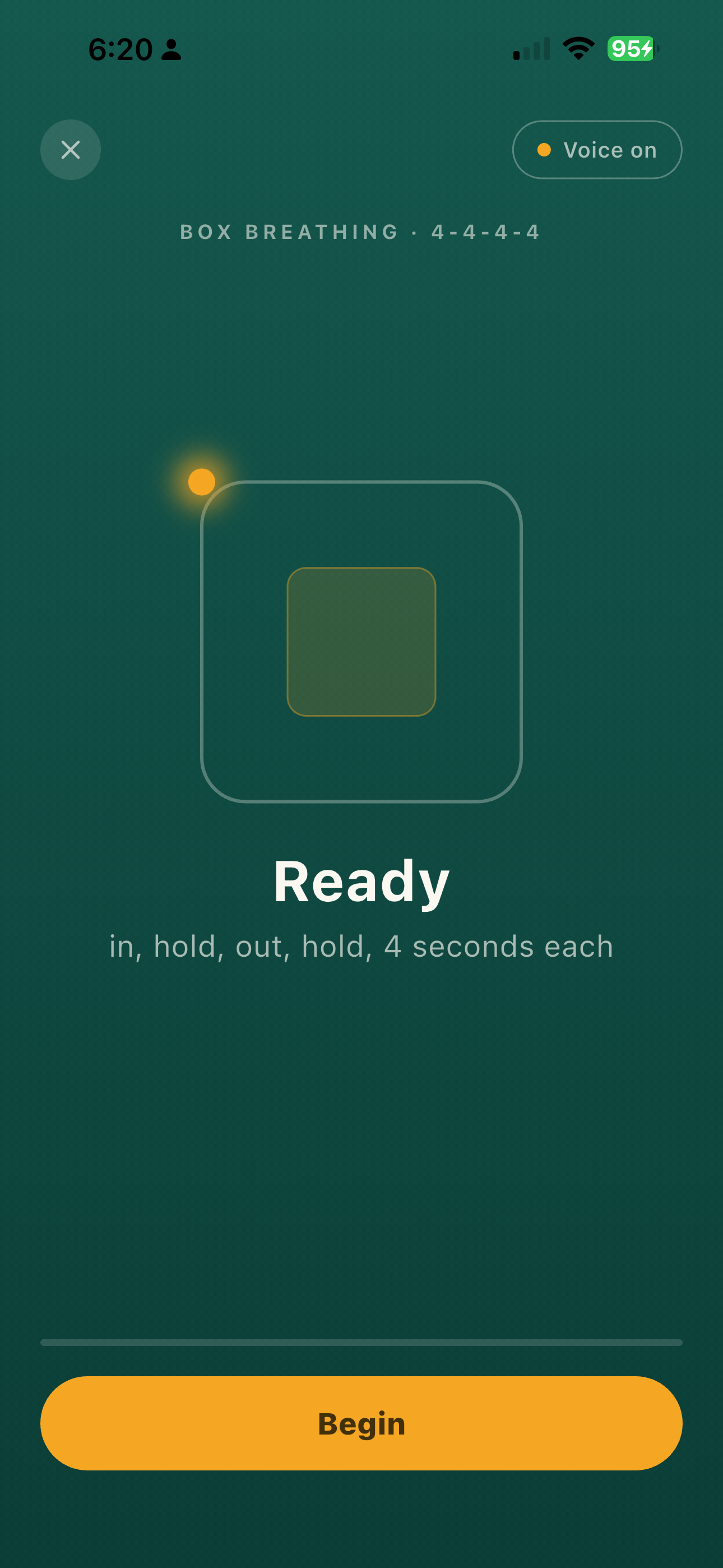
And here is the short reset the product offers when a lasting shift shows up: box breathing, 4-4-4-4. That is the tool form of a posture or pace reset before the next dial, or before you keep pushing cold-call energy after interest already showed. It is not a medical protocol and it is not a claim that one cycle restores talk time:
In exploratory work on that same personal Ontor history (one person, not a population study), high-stress stretches often did not show an observed return to my personal median within an hour without an intentional break. That is one reason a private usual-range check mid-block matters. It is not evidence that a suggested reset caused recovery, improved talk time, or protected quota.
This is not a claim that voice markers diagnose fatigue medically, prove cognitive improvement, predict revenue, or replace manager judgment. The claim stays narrow: when scripts and "stand up more" miss the call-30 sit-sink leave, a private signal plus a short reset (or a mid-call pace gear-shift) is a loop people can run before the next push, while leaders watch cohort patterns only in aggregate.
What to try on your next seated dial block
Download Ontor - 14 days free, no card required
Do not wait for a research committee if your afternoon dials already feel flat, or if you coach ICs whose objection energy softens after a long seated morning.
- Install Ontor on the machine you already use for your dial block.
- On the next seated block, notice whether energy, fatigue, confidence, speech clarity, strain, or breathing sit outside your usual range in the short speech windows, especially around the call-30 window Nikola names and again when real interest shows.
- If a lasting shift shows up, take the short suggested reset before your next dial. Optionally stand, walk, or smile for the next push. When interest shows mid-call, switch gears the way Felix does: sit, lower pace, listen more than you talk.
- Compare before and after across the same block. Keep whatever scripts and CRM habits already work. Add a private body-to-voice loop that is yours.
If you manage a pod, the soft path is a research or pilot conversation, or Ontor for teams, with aggregate patterns only. The primary next step for the IC is still the next seated dial block: hear call-30 sit-sink and the mid-call gear-shift against your own usual range, not another generic "sound more energetic" pep talk.
Sabber Ahamed is the founder of Ontor and an applied ML scientist (PhD in geophysics and signal processing) who builds on-device voice tools. He has shipped production signal and ML systems across radiology AI, healthcare, and manufacturing. Ontor compares how you sound to your own usual ranges and suggests short resets, without claiming clinical or revenue outcomes from marker changes. LinkedIn · About
References
- Nikola Vracevic - LinkedIn: standing desk changed how I sound; sinking by call 30 (employee anecdote; cold-calling IC)
- Chris D. + Phoenix Floris - LinkedIn: stand up; standing reps hold talk time and objections (employee / floor peer anecdote)
- Felix Göbel + Derya - LinkedIn: smile/movement + mid-call sit-and-slow gear-shift (employee anecdote)
- How Ontor works
- Ontor for teams
- About the founder - Ontor
- Install Ontor
- Hangover between sales calls (sibling)
- Call-mode pitch voice (sibling)
- Notes while talking presence (sibling)
- Block-length robot voice (sibling)
- Dialer fatigue afternoon fade (sibling)
- Over-explain when off your game (sibling)