
You trained Feel-Felt-Found. When the same tool repeats, it becomes a checkbox.
Collectors learn empathy tools for a reason. Feel-Felt-Found. Labeling. Paraphrase. The frameworks land when they sound like that person, on that call. Then the same tool gets used again and again. Delivery dulls. The phrase still clears QA. The consumer hears a checkbox. Mid-call, when several issues stack into one vent, you can hear pressure rise and confidence drop even while the words stay polite.
This is for collections and contact-center buyers (ops directors, training EVPs, floor managers, QA leads) whose users are call-heavy collectors. The object is empathy-tool authenticity burnout under repetition, plus audible confidence collapse when a multi-issue vent hits. Not career calluses, not first-10s stay-or-hang, not call-bait hypersensitivity, and not energy-match versus flat under hostility.
Download Ontor - 14 days free, no card required
Nye: the same empathy tools get dull and become a checkbox
Christopher Nye (EVP of recruitment and training, Radius Global Solutions) said it plainly on AccountsRecovery's Feel-Felt-Found and Other Tools to Communicate with Empathy webinar (May 2026):
"And you affect the burnout period at the agent level as well, too, 'cause if you're repetitionally doing the same thing over and over again, it's hard enough that we need to make phone calls and contact people and get them on the phone, get a live p- a live person to begin with, right? And keep them captive throughout a conversation. If you're starting to use the same tools over and over again, they get dull, they get boring, and it becomes a check the box, as I said earlier, just another check the box. Oh, okay, I did it, but they didn't bite on it. It wasn't genuine. It didn't come across like it should have from that standpoint."
That is the lead wedge. The tool phrase can still be present. The delivery is no longer genuine. Consumers do not bite. Agents feel the burnout period too.
Nye also names why scripted "I understand" fails:
"we really wanna get away from the scripting piece of it, right? Because you don't wanna sound like robotic, you don't wanna sound like it's a check the box. I understand, okay."
Training still teaches Feel-Felt-Found and related frameworks. Nye's point is overuse and sameness, not abandoning empathy. Absolute QA can score that the phrase was said. It still misses whether the voice still sounds like that collector's usual range while saying it.
First ~60 seconds: pace and tone already branch which tool to use
On the same panel, Nye describes how early pace, tone, and words set the branch before the collector commits to a tool:
"In the first, minute or so of a phone call, you're gonna be able to tell based upon any kind of conversation happening back and forth, the pace, the tone the words that are being utilized, h- how it's all coming across, that initial 60-second feel, we kinda call it, in that first 60 seconds there, it kinda sets the tone for what is going to happen next as we go forward."
He ties that early read to tool choice:
"What we learn in that first 30 seconds or so in the beginning part of the phone call really sets the tone of what's going to happen next and where we're gonna spl- place our time and what tools we will use along the way"
Leaders already coach collectors to read the consumer's vocal state early so they pick empathy versus all-business. That is different from first-10s opener coaching about whether the collector's own hello keeps someone on the line. Here the early window is a branch model for which empathy tool fits. The gap Ontor can close is quieter: when the collector's own pace, tone, confidence, or clarity leaves their usual range under stack pressure, they may pick the right tool card and still deliver it as a checkbox.
Franklin: tactical empathy has to convey emotion, not only words
Justin Franklin (Director of Communications and Engagements / Sr Director of Operations, Cedar Financial) frames the same demand as trained emotion in the channel, not a soft aside, in a Nextiva customer story:
"Empathy, or what we call tactical empathy, is crucial in our business. We train our agents to convey emotion in their communications, and Nextiva's tools have made this easier, allowing us to focus on enhancing the customer experience."
Cedar already invests in teaching agents to convey emotion so interactions feel personalized and heard. That sits next to Nye: if the empathy tool is present as words but the conveyance has gone dull, the consumer still hears the checkbox. Franklin's quote is buyer language for emotion-in-voice as an ops skill. It is not a claim that a contact-center platform alone restores authenticity after repetition.
Supporting color (not US ARM proof): Achando on vent-stack confidence drop
Slyvia Achando (Collections Lead, Solar Panda; Kenya solar collections, not a US ARM agency) describes the audible mid-call failure when a customer vents multiple issues at once, in her LinkedIn post Handling the Overwhelm in Collections:
"I've also heard the other extreme - where the agent gets overwhelmed the moment the customer starts venting. You can hear the pressure building, confidence dropping and the call loses direction."
Cap this as supporting color. It is medium evidence from a collections lead outside the US ARM beachhead. Do not treat it as US beachhead proof. Use it for the vent-stack shape: pressure up, confidence down, call loses direction, while the agent is still speaking. Achando also trains pause-and-summarize, emotional-regulation role-play before live discovery, and QA that scores whether every issue was acknowledged, not only tone and PTPs. Useful market language. The US spine stays Nye and Franklin.
What this article is not answering
Published Ontor collections pieces already cover nearby voice moments. Overlap on "voice versus your own usual range, and dials or QA miss it" is real. The spine here is different.
- Collectors develop calluses answers empathy numbness from repeated hardship conversations (career hardening). This piece is about a trained empathy tool going checkbox from over-repetition, then authenticity burnout, not calluses-as-hardening.
- First 10 seconds of tone answers opener tone that decides stay-or-hang. This piece uses Nye's first ~60s pace/tone feel as a branch for which tool to use, and then asks whether the collector's own delivery stayed fresh when the tool repeated.
- After the call-baiting session, confidence wanes answers post-baiting hypersensitivity when ordinary questions get treated as bait. This piece is confidence drop under a multi-issue vent plus checkbox empathy-tool delivery, not bait awareness.
- Energy match vs flat under hostility answers matching energy so you do not go flat when the consumer is hostile. This piece is not that coaching fight. Vendor color below that says "don't match" is capped as the opposite advice and is not collapsed into energy-match.
Same beachhead. Different object: repeated empathy TOOL becomes a checkbox (authenticity burnout), and confidence drops when a multi-issue vent hits.
Rough overlap versus those four live siblings is about 45-55% on personal-baseline / short-reset product language. Under 70%. The spine quotes and problem object stay distinct.
Vendor corroboration only: flat/clipped irritation is not this spine
One vendor coaching post names flat, clipped delivery as audible irritation even when words are polite, and coaches lowering the voice a notch under hostility rather than matching energy (C&M Coaching on past-due payment asks). Cap it there. That "don't match" line is the opposite of Van Cleave-style energy-match already covered in energy match vs flat under hostility. Useful only as market language that tone can leak irritation while words stay polite. Do not treat a dealership/captive-finance vendor seat as your floor's proof for Feel-Felt-Found checkbox burnout, and do not collapse this article into the energy-match debate.
What training, QA, and dials still miss
The stack these leaders already run:
- Empathy frameworks (Feel-Felt-Found, labeling, paraphrase) and "be genuine" coaching (Nye)
- First-minute feel / branch models for which tool to use (Nye)
- Tactical empathy training so agents convey emotion, not only words (Franklin)
- Role-play for pressure and QA that scores issue acknowledgment (Achando, supporting)
- Live monitoring and recording review that still depend on a human ear catching dull checkbox delivery or mid-vent confidence leave
Useful. Incomplete for the audible leave while the collector is still speaking. A QA checkbox that Feel-Felt-Found was used does not show whether confidence, stress, energy, clarity, or strain left that person's own usual range after the tenth identical tool run, or in the short windows after a multi-issue vent starts. Recording review is hindsight. Script refresh helps variety. It does not cue the person mid-call that their delivery just went dull.
Consumers hear the checkbox first. Leaders meet it later as failed empathy landings, complaint risk when scripted "I understand" pushes frustration higher (Nye), or calls that lose direction under a vent stack.
What Ontor adds mid-call (private first)
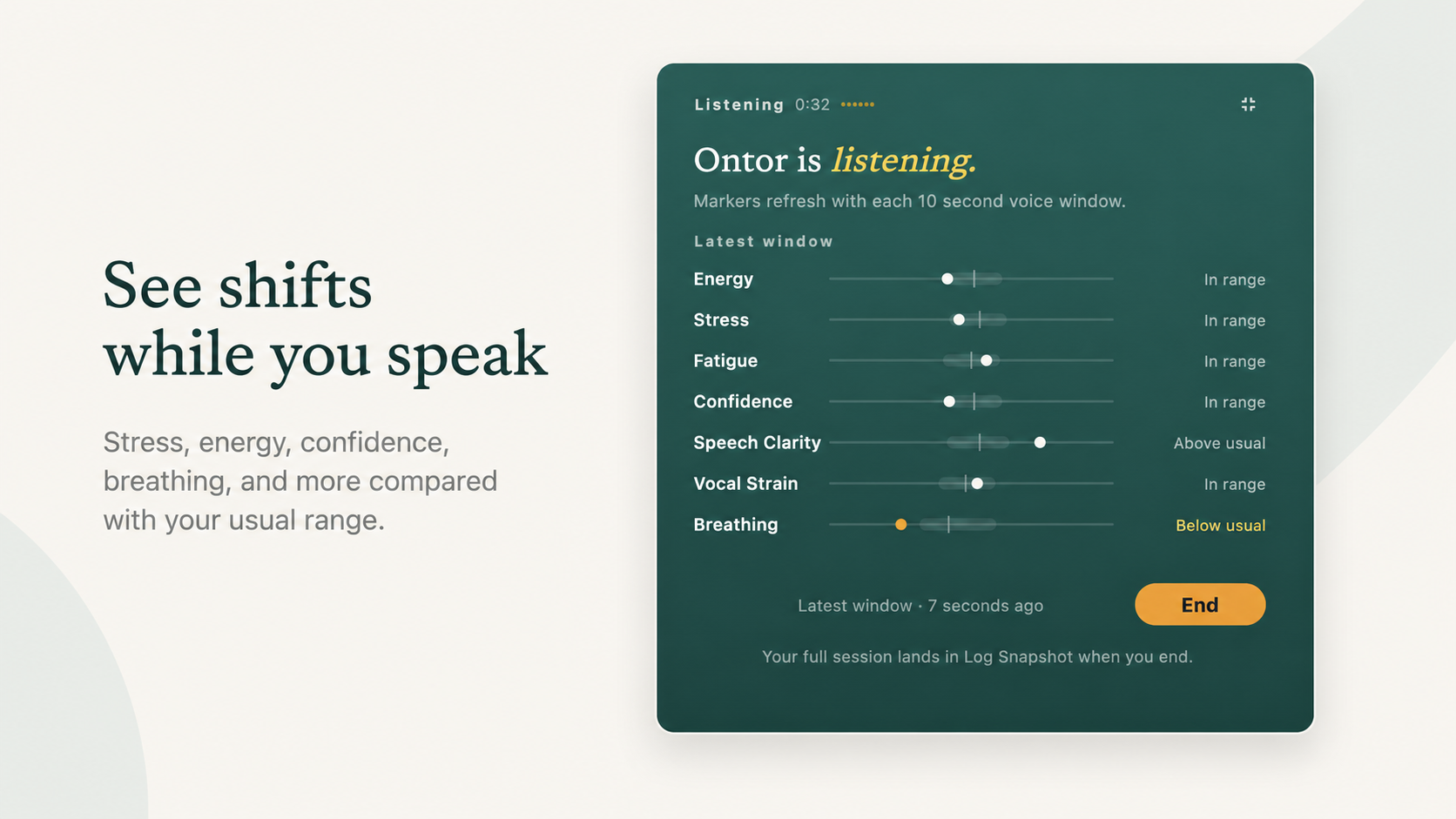
Ontor reads how you sound, not what you said. While someone speaks, it compares voice signals with that person's own usual range. It does not react to every unusual second. It looks for a lasting shift. Signals on the public product page are energy, stress, fatigue, confidence, speech clarity, vocal strain, and breathing. Each one is how the voice sounds versus your own usual range, not a population grade. When a lasting shift shows up, Ontor can suggest a short reset. You can compare before and after.
The live listening view refreshes markers with each 10 second voice window. That is the product's own label, not a clinical sampling claim.
Boundaries, said plainly:
- Ontor does not replace Feel-Felt-Found training, Nye's genuineness coaching, Franklin's tactical empathy, or vent-stack structure drills.
- Ontor does not diagnose burnout, anxiety, or a health condition, and a marker move is not a clinical outcome.
- Ontor does not claim that a marker change proves fewer complaints, higher recoveries, or better retention.
- For teams, leaders see aggregate patterns that can inform workload, coaching, and support. Individual sessions and readings stay with the person. That is not a hire or fire score. Soft secondary path only: Ontor for teams.
In my own Ontor session history (founder exploratory data from my own product use, not your floor's outcome data), the empathy-tool checkbox problem and the vent-stack confidence drop show up the same way Nye and Achando describe from the floor. After I have repeated the same acknowledgment pattern across a speaking block, delivery can sit outside my usual band for confidence, clarity, or strain even while the words still sound "correct." When several issues land at once, stress can rise and confidence can leave in the short windows while I keep talking. I cannot hear that leave the way a coach hears it on playback. A private usual-range cue during speech, plus a short reset when the shift persists, is the tool step back toward genuine delivery before the next identical tool run. It is not a claim that one cycle fixes empathy-tool burnout on a floor.
Here is live listening from my own Ontor session. Markers refresh with each 10 second voice window and sit against my usual range. Read it as a private check for checkbox empathy delivery and mid-vent confidence leave, not as a QA score:
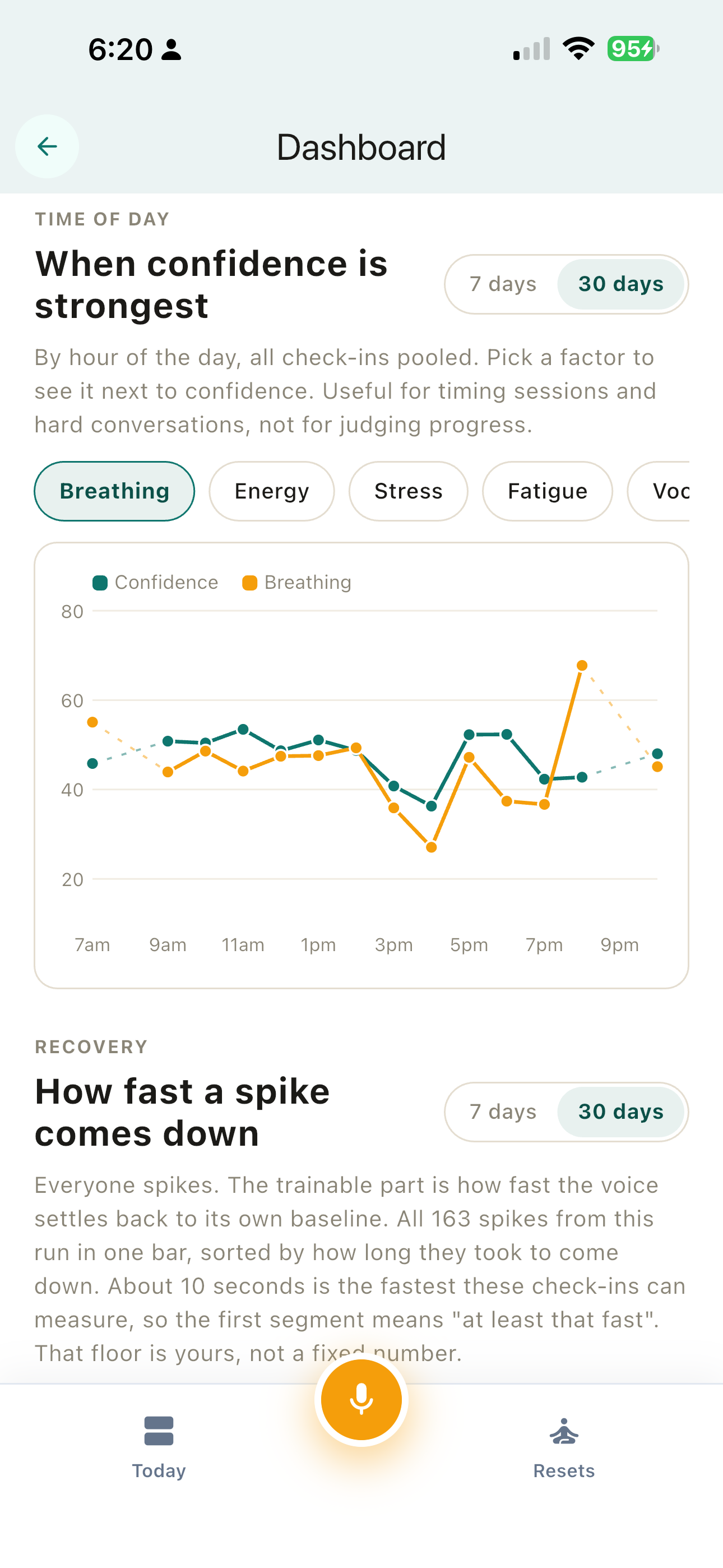
Here is confidence beside breathing by hour from that same session history. The screen is for timing hard conversations, and it says it is not for judging progress. Read the shape as founder exploratory data on how confidence and breathing move across a speaking day, including windows where repeated empathy phrasing or a multi-issue vent can pull confidence off the band:
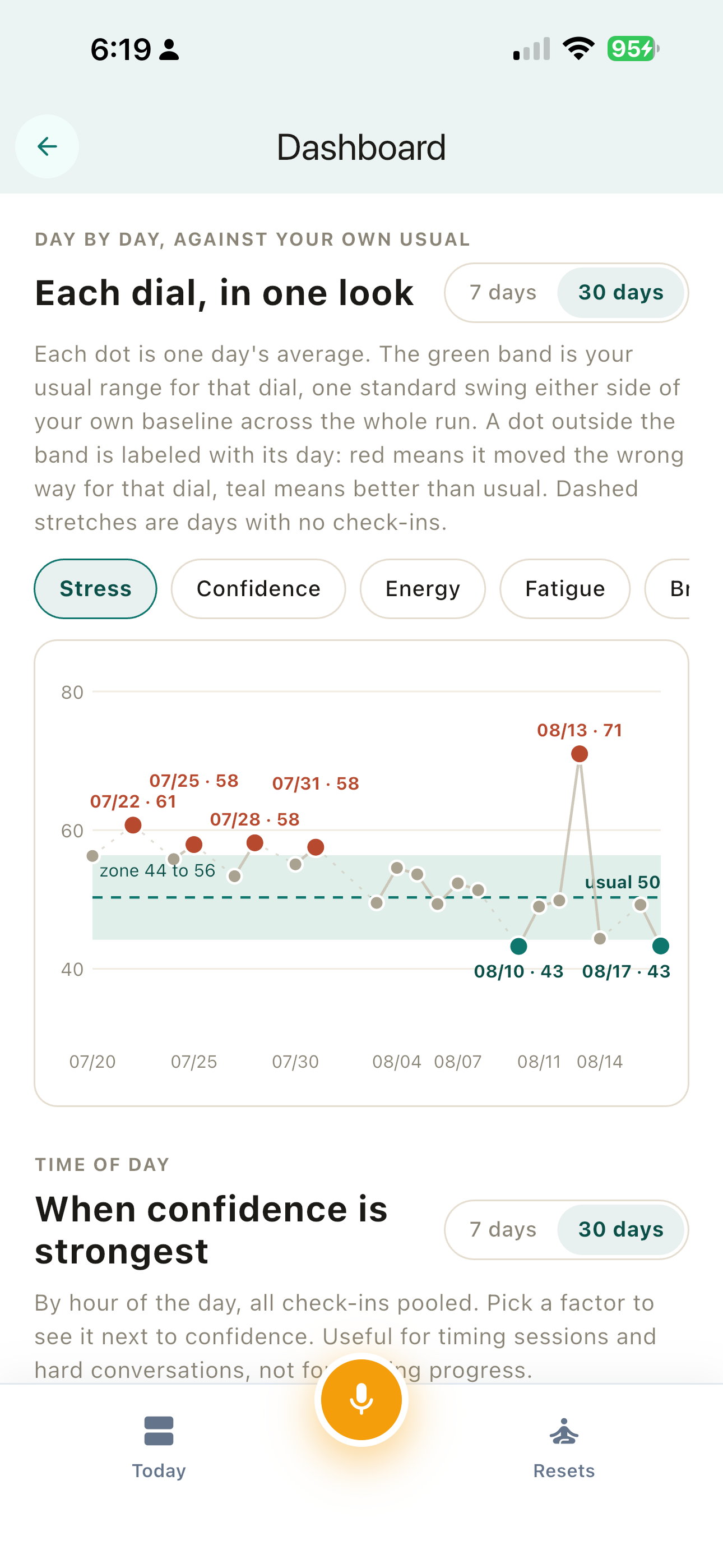
Here is stress day by day against my own usual band. The screen labels a zone of 44 to 56 around a usual of 50, and it marks days that sit outside that band. Useful as a private view of how often voice-state leaves the band across calls. It is not a collector ranking, and it is not proof that a reset caused more genuine Feel-Felt-Found delivery:
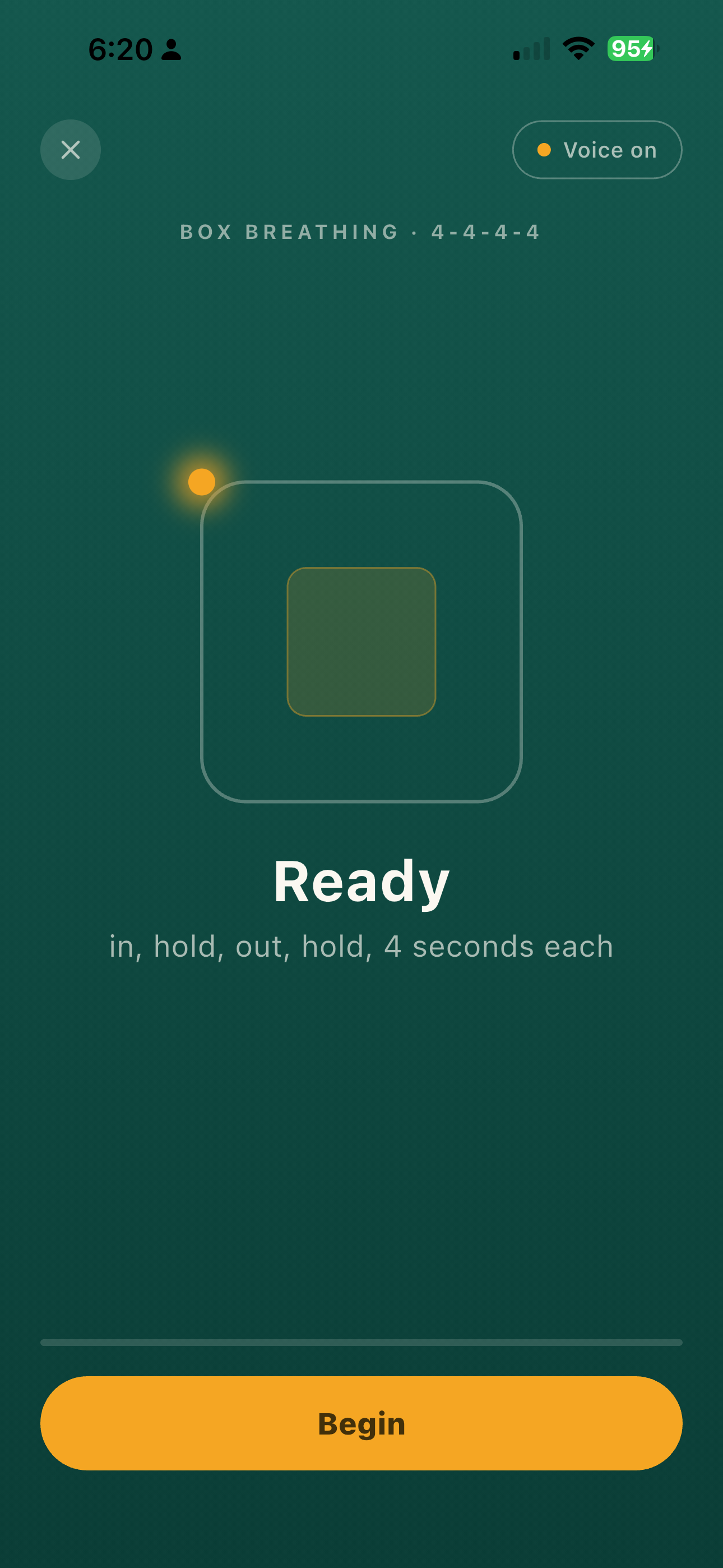
And the short reset the product offers when a lasting shift shows up: box breathing, 4-4-4-4. That is a private pause you can take after a lasting confidence or stress shift mid-call, before you run the same dull tool again. It is not a medical protocol, and it is not a substitute for Nye's "be genuine" coaching or Franklin's tactical empathy:
The claim stays narrow. When the same empathy tool has gone checkbox, or when a multi-issue vent pulled confidence off the usual range, a private usual-range cue plus an optional short reset is a loop the collector can run before the next identical delivery. Leaders, if they look at all, look at cohort patterns only.
Download Ontor - 14 days free, no card required
What to try on the next call {#try-on-next-call}
Do not wait for another empathy refresh block if you already know Feel-Felt-Found is landing as a checkbox, or if multi-issue vents are knocking confidence mid-call.
- Install Ontor on the machine you already use for collections calls.
- On the next dial, notice whether confidence, stress, energy, clarity, or strain sit outside your own usual range in the short speech windows after you run a familiar empathy tool, or after the consumer stacks several issues into one vent. Listen for how you sound against your personal baseline. Not against a floor average, and not against whether the tool phrase was present.
- If a lasting shift shows up, take the short suggested reset before you repeat the same dull tool. Return to genuine delivery for the tool that fits the first ~60s feel. Do not treat a new script mid-call as proof authenticity is back.
- If you lead ops or training, keep personal readings with the person. Use aggregate patterns only if you later want a cohort view of strain after heavy empathy blocks or vent-heavy queues. Do not turn Ontor into an empathy QA score or a hire-fire tool.
If you run a floor and want a measured team look later, the light secondary path is Ontor for teams. The primary step is still install, on the next call.
Do not promise fewer complaints or higher recoveries. Measure whether you can tell when empathy delivery left your usual range under repetition, or when confidence left under a vent stack, before the next checkbox.
Bottom line
You trained Feel-Felt-Found. Christopher Nye (Radius Global Solutions) names what happens when the same empathy tools repeat: they get dull, become a checkbox, stop sounding genuine, and feed agent burnout. The first ~60s pace/tone feel already branches which tool to use. Justin Franklin (Cedar Financial) adds that tactical empathy must convey emotion, not only words. Supporting color from Slyvia Achando (Kenya solar collections, not US ARM) describes audible pressure-up and confidence-down when a multi-issue vent hits. Ontor does not replace that coaching. It shows audible confidence, stress, energy, clarity, and breathing against your own usual range in short voice windows, and it can offer a short reset before the next identical dull delivery.
Try it on the next call. Notice how you sound versus your personal baseline when the familiar empathy tool repeats, or when the vent stack lands. Take the short reset if a lasting shift shows up, then return to genuine delivery.
Download Ontor - 14 days free, no card required
About the author
Sabber Ahamed is the founder of Ontor and an applied ML scientist (PhD, geophysics and signal processing) who builds on-device voice tools. Ontor compares how you sound with your own usual ranges and can suggest a short reset. Marker changes are not clinical outcomes and they are not revenue proof.
References
- Christopher Nye and panel. "Feel-Felt-Found and Other Tools to Communicate with Empathy" webinar transcript. AccountsRecovery.net, May 2026. https://www.accountsrecovery.net/wp-content/uploads/2026/05/Feel-Felt-Found-and-Other-Tools-to-Communicate-with-Empathy_Transcript.pdf
- Justin Franklin. Quoted in "Cedar Financial Streamlines Operations and Boosts Productivity by 471% with Nextiva." Nextiva customer story. https://www.nextiva.com/customer-story/cedar-financial
- Slyvia Achando. "Handling the Overwhelm in Collections." LinkedIn, approx. March 2026. https://www.linkedin.com/posts/slyvia-achando_handling-the-overwhelm-in-collections-i-activity-7433926483477229568-ZTuH
- C&M Coaching. "How to Ask for Past Due Payment Without Damaging the Relationship." July 2026. Vendor corroboration only. https://candmcoaching.com/2026/07/04/how-to-ask-for-past-due-payment-without-damaging-relationship/
- Ontor. "How it works." https://ontor.ai/how-it-works/
- Ontor. "Ontor for teams." https://ontor.ai/for-teams/
- Ontor. "About the founder." https://ontor.ai/about/
- Ontor. "Install Ontor." https://ontor.ai/install/
- Ontor. "Collectors develop calluses. Your recovery dashboard never shows it." https://ontor.ai/blog/collections-empathy-calluses/
- Ontor. "Tone of voice in the first 10 seconds decides if they stay on the phone." https://ontor.ai/blog/collections-first-10s-tone/
- Ontor. "After the call-baiting session, confidence wanes. Ordinary questions get treated as bait." https://ontor.ai/blog/collections-call-bait-confidence-wane/
- Ontor. "They teach energy match so you don't go flat under hostility. Collectors still leak upset they think they're hiding." https://ontor.ai/blog/collections-energy-match-vs-flat-under-hostility/