
After the call-baiting session, confidence wanes. Ordinary questions get treated as bait.
Collectors leave a call-baiting or compliance-sensitivity session more alert. That is the point. Then on live dials, ordinary consumer questions start sounding like traps. Confidence drops mid-call. In a normal slump they reinvent technique instead of returning to what already worked for them. Leaders hear the wane. Collectors often cannot hear themselves in the moment.
This is for collections ops leaders (Director of Ops, floor managers, QA and compliance leads) whose users are call-heavy collectors. The object is post-baiting hypersensitivity, ordinary questions treated as bait, mid-call confidence leave, and overcorrection versus a return to personal fundamentals.
Download Ontor - 14 days free, no card required
Jeselnik: confidence issues after the baiting session
Michael Jeselnik (20+ year ARM veteran; former Georgia Collectors Association president) put the post-training spike in plain numbers on AccountsRecovery's Building Confidence for Collectors webinar (March 2026):
"with seven collectors, I think I've gotten no fewer than five confidence issues on calls after the call baiting session"
The trigger is not always real bait. It is sensitivity to anything that sounds unusual:
"when they hear something that is out of the ordinary and they're sensitive to it. That is when the confidence wanes"
That is the wedge. Training that heightens bait awareness can leave collectors over-reading ordinary consumer questions. The voice leaves their own confident band mid-call, even when the question was innocent.
Overcorrect a normal slump, or return to fundamentals
Jeselnik also names what happens when confidence is already down and the collector tries to fix it live by inventing a new approach:
"I see collectors, overcorrecting, what would otherwise just be a normal slump? Try to reinvent the wheel or maybe even change how they're doing things, which only serves to prolong the agony"
His own recovery path is shorter:
"Whenever I get in a slump, I try to get back to my fundamentals. Or just get back to the basics of what made me successful in the first place."
Ops leaders already teach procedures for true bait (get off the phone, escalate). Procedure alone does not restore vocal confidence while the collector is still speaking. Reinventing the ask mid-call prolongs the slump. Returning to personal fundamentals is the shorter loop, if the collector can notice they left their usual range in the first place.
Muir and Barton: keep game on, stay calm long enough to sort the fire
Kathleen Muir (Director of Operations, Professional Credit) frames the same job demand under constant rejection on AccountsRecovery's Stop Firefighting panel:
"You gotta get yourself up in the morning, you gotta keep your, game on, you gotta keep learning. You gotta keep growing. I think definitely self-discipline really helps"
She also names that emotional load is not optional soft talk for this floor:
"And it's everybody's different. That, like you said there's some people are not cut out for, the emotional part of it. Some people need to, put a check on their emotions, right?"
Dennis Barton (Owner, Barton Law Group) ties calm under pressure to correct triage, not toughness theater:
"A lot of this is about emotional regulation. A problem has happened, and we have to figure out is this a fire or it's not, and you have to stay calm under pressure and deal with it and then say, "Okay, how big a deal is it? Do I deal with it now? Do I have to put a Band-Aid on it or can I do a more long-term fix?""
"if we think emotional regulation is a barrier to people doing their job, I think we ought to get on it."
After a baiting session, the "is this a fire?" check is exactly the hypersensitivity problem. An ordinary question gets sorted as bait. Confidence wanes. Game-on collapses mid-call. Calm long enough to sort fire from not-fire is the same job skill Jeselnik is describing from the confidence side.
What this article is not answering
Published Ontor collections pieces already cover nearby voice moments. Overlap on "voice versus your own usual range, and dials or QA miss it" is real. The spine here is different.
- Post-RPC ask freeze answers collectors who freeze after Mini-Miranda and right-party contact (afraid to ask / feel bad). This piece starts after baiting sensitivity training, when ordinary questions get over-read as bait and confidence wanes mid-call.
- Hard ask, shaky voice answers trained words that still shake on the ask (Weiss). Not post-baiting hypersensitivity.
- Nice-day closing tone leak answers the compliant closing phrase with outcome-contingent tone. Not mid-call confidence after bait awareness.
- Cool-down between hostile calls answers readiness after a hostile disposition. Not ordinary questions misread as bait.
- QA tone versus baseline answers Empathy and Tone scores that miss a strong collector drifting off their own baseline. Not the baiting-session confidence spike.
- First 10 seconds of tone answers opener tone that decides whether someone stays. Not mid-call hypersensitivity.
- Assumption fatigue answers ACA Assumption Fatigue. Not this.
- Dialer afternoon fade answers short between-call gaps and afternoon fade. Not baiting-session confidence leave.
- Recoveries look fine; complaints say how they said it and Remote, no hallway reset are adjacent complaint and remote-floor pieces. Not this spine.
Same beachhead. Different object: post-call-baiting hypersensitivity, ordinary questions treated as bait, mid-call confidence wane, overcorrect versus return to personal fundamentals, and collectors who often cannot hear that leave in the moment.
Vendor color only: rejection needs a box (cap)
One vendor piece on the same Stop Firefighting panel names daily rejection load. It is not the buyer spine.
Greg Reffner (Abstrakt) said collectors are rejected exponentially more than they are accepted, and that there has to be a level of resiliency to compartmentalize or process that load so it does not leak into the next interaction (Stop Firefighting transcript). Useful as market language that rejection stacks into the next speech window. Cap it there. Do not treat a vendor seat as your floor's evidence for baiting-session confidence coaching.
Light leadership climate only: David Lee Richardson (Harris & Harris) argues people reproduce what they see produced, and that psychological safety has to marry emotional intelligence in how leaders show up. If managers model charged hypersensitivity after bait training, the floor will copy that climate. Soft secondary context only. The spine stays Jeselnik.
What dials, bait procedures, and coaching still miss
The stack these leaders already run:
- Call-baiting / compliance sensitivity training
- Procedures for true bait (get off phone, escalate)
- Mentoring and call-recording review after the fact
- "Keep game on" / emotional-regulation talk from ops and owners (Muir, Barton)
- Live monitoring that still depends on a human ear catching mid-call confidence leave
Useful. Incomplete for the audible leave while the collector is still speaking. A baiting quiz does not show whether confidence, stress, energy, or clarity left that person's own usual range in the short speech windows after an ordinary question. Recording review is hindsight. Procedure covers true bait. It does not restore personal fundamentals mid-call when the collector has already started reinventing the wheel.
Consumers hear the wane first. Leaders meet it later as a confidence coaching ticket, a prolonged slump, or five confidence issues after one baiting session.
What Ontor adds mid-call (private first)
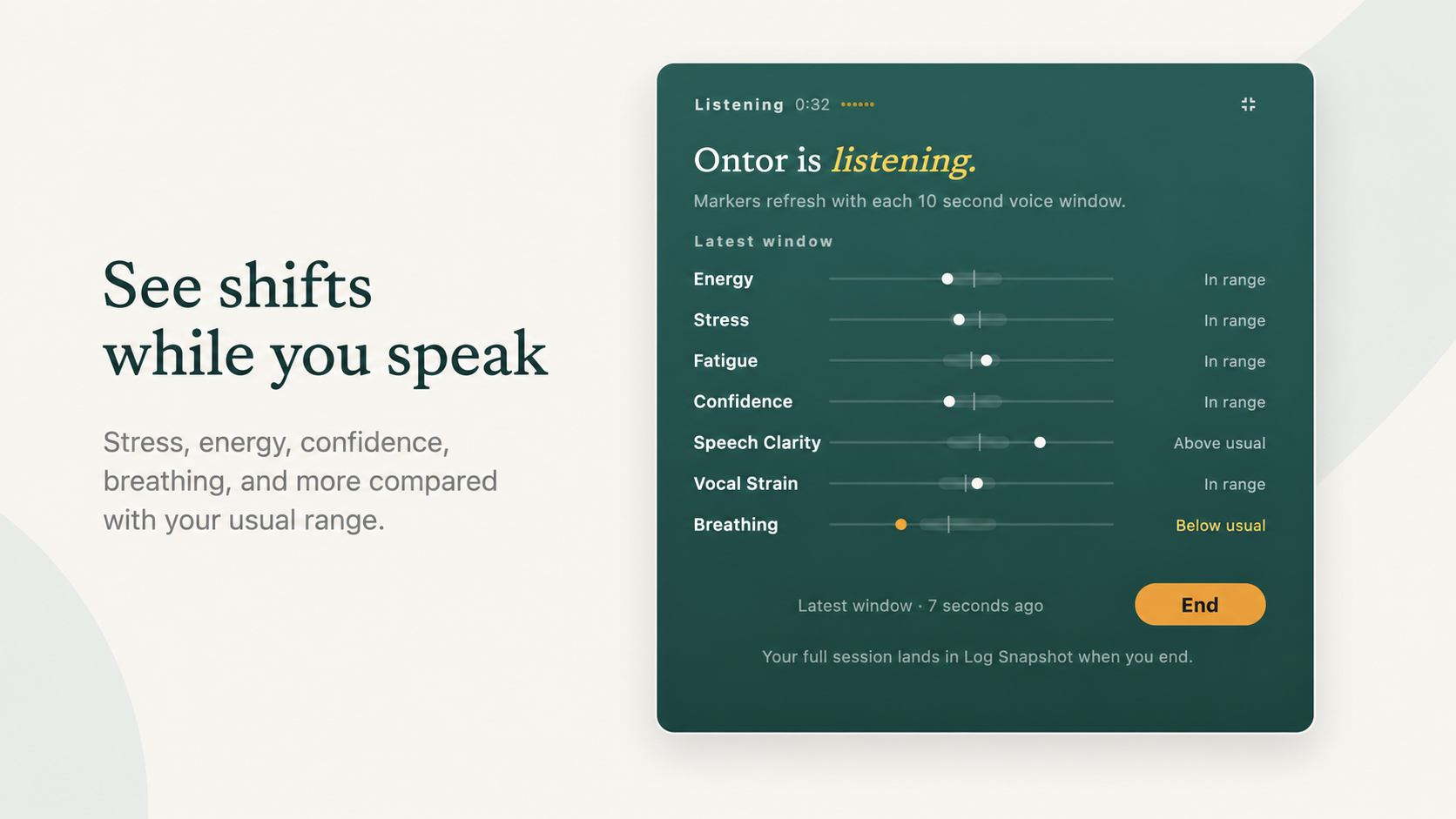
Ontor reads how you sound, not what you said. While someone speaks, it compares voice signals with that person's own usual range. It does not react to every unusual second. It looks for a lasting shift. Signals on the public product page are energy, stress, fatigue, confidence, speech clarity, vocal strain, and breathing. Each one is how the voice sounds versus your own usual range, not a population grade. When a lasting shift shows up, Ontor can suggest a short reset. You can compare before and after.
The live listening view refreshes markers with each 10 second voice window. That is the product's own label, not a clinical sampling claim.
Boundaries, said plainly:
- Ontor does not replace baiting training, true-bait procedures, Muir's game-on coaching, or Barton's calm-under-pressure triage.
- Ontor does not diagnose anxiety, burnout, or a health condition, and a marker move is not a clinical outcome.
- Ontor does not claim that a marker change proves fewer confidence tickets, higher recoveries, or better retention.
- For teams, leaders see aggregate patterns that can inform workload, coaching, and support. Individual sessions and readings stay with the person. That is not a hire or fire score. Soft secondary path only: Ontor for teams.
In my own Ontor session history (founder exploratory data from my own product use, not your floor's outcome data), the post-hypersensitivity confidence leave shows up the same way Jeselnik describes mid-call wane. After I have been primed to watch for traps, an ordinary question still lands as "is this bait?" Stress and confidence can sit outside my usual band in the short windows while I keep talking. I cannot hear that leave the way a coach hears it on playback. A private usual-range cue during speech, plus a short reset when the shift persists, is the tool step back toward personal fundamentals. It is not a claim that one cycle fixes baiting-session confidence tickets.
Here is live listening from my own Ontor session. Markers refresh with each 10 second voice window and sit against my usual range. Read it as a private check for mid-call confidence leave after hypersensitivity, not as a QA score:
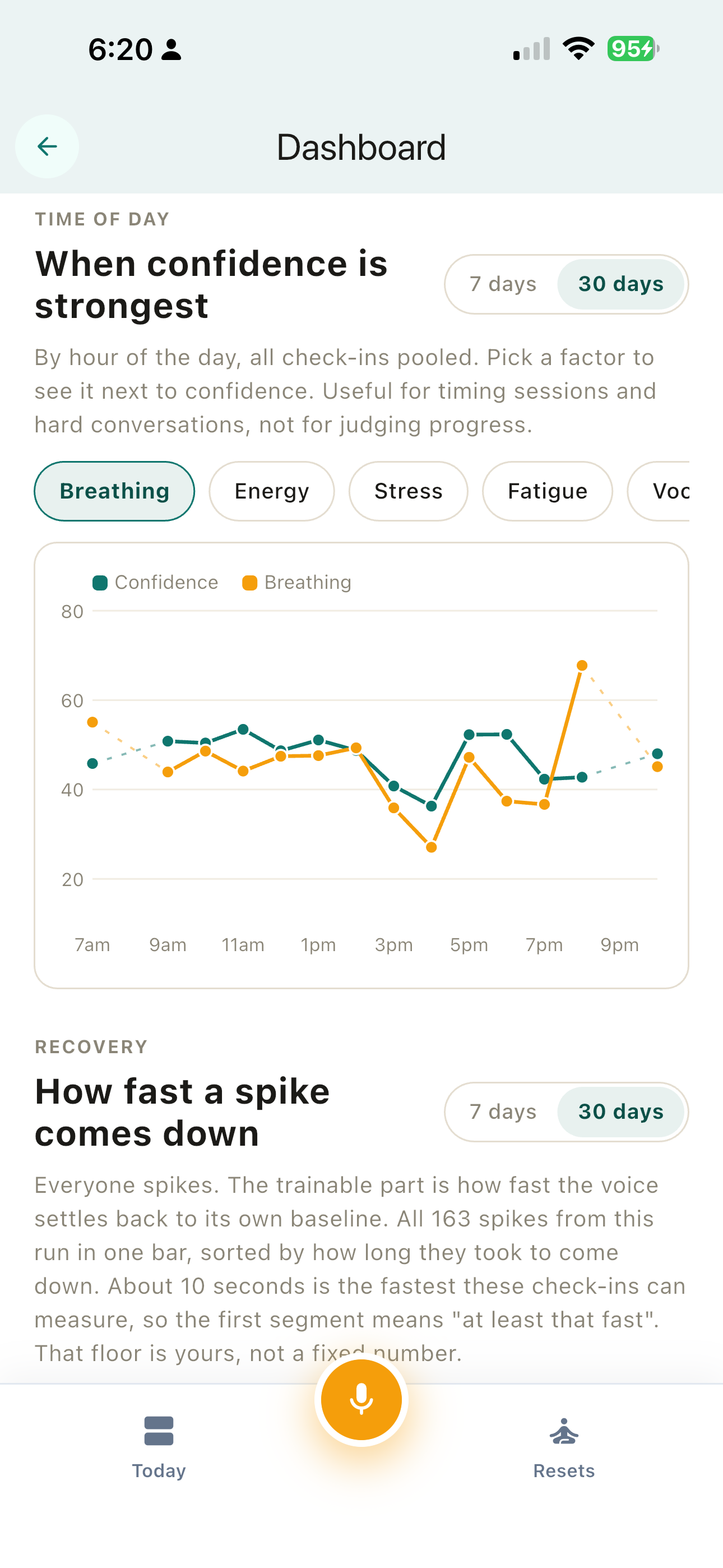
Here is confidence beside breathing by hour from that same session history. The screen is for timing hard conversations, and it says it is not for judging progress. Read the shape as founder exploratory data on how confidence and breathing move across a speaking day, including windows where ordinary questions still pull confidence off the band:
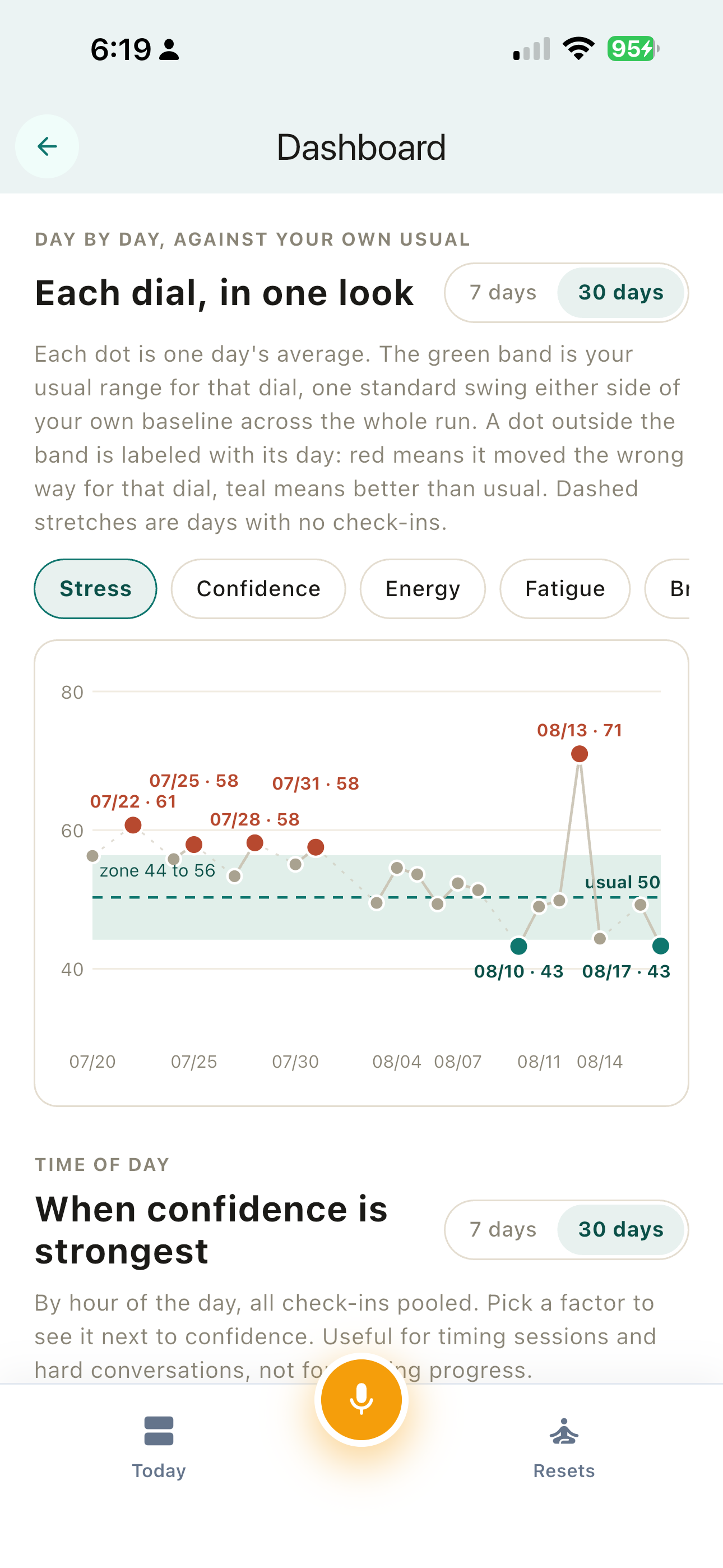
Here is stress day by day against my own usual band. The screen labels a zone of 44 to 56 around a usual of 50, and it marks days that sit outside that band. Useful as a private view of how often voice-state leaves the band across calls. It is not a collector ranking, and it is not proof that a reset caused a calmer return to fundamentals:
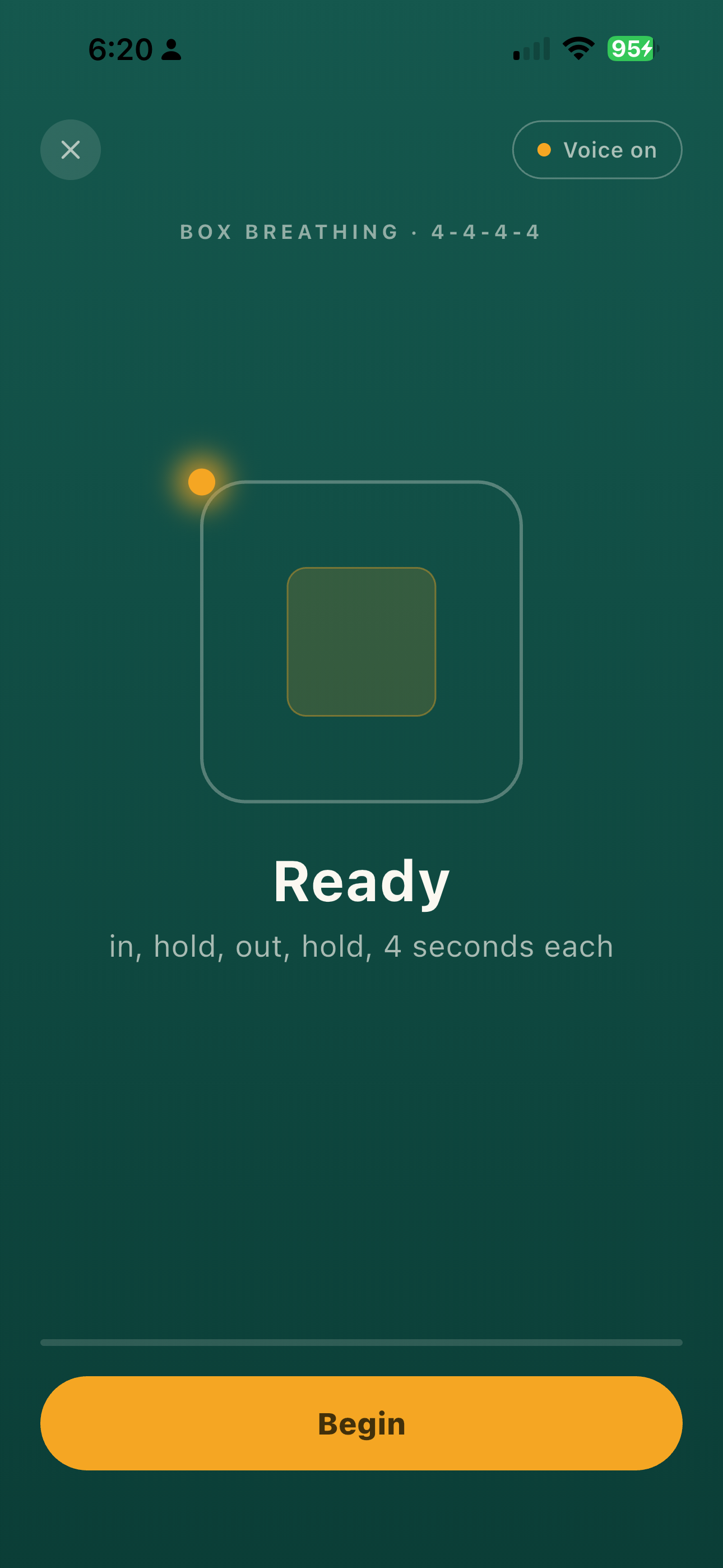
And the short reset the product offers when a lasting shift shows up: box breathing, 4-4-4-4. That is a private pause you can take after a lasting confidence or stress shift mid-call, before you invent a new technique. It is not a medical protocol, and it is not a substitute for Jeselnik's return to fundamentals or Barton's calm triage:
The claim stays narrow. When bait awareness is high and confidence left the usual range on an ordinary question, a private usual-range cue plus an optional short reset is a loop the collector can run before overcorrecting. Leaders, if they look at all, look at cohort patterns only.
Download Ontor - 14 days free, no card required
What to try on the next call after a baiting session
Do not wait for another coaching cycle if you already know ordinary questions are getting treated as bait and confidence is leaving mid-call.
- Install Ontor on the machine you already use for collections calls.
- On the next dial after baiting or compliance-sensitivity training, notice whether confidence, stress, energy, or clarity sit outside your own usual range in the short speech windows when the consumer asks something ordinary. Listen for how you sound against your personal baseline. Not against a floor average, and not against whether the question "could have been" bait.
- If a lasting shift shows up, take the short suggested reset before you reinvent the ask. Return to your personal fundamentals. Do not treat a new technique mid-slump as proof the confidence leave is fixed.
- If you lead ops or QA, keep personal readings with the person. Use aggregate patterns only if you later want a cohort view of strain after baiting blocks. Do not turn Ontor into a confidence QA score or a hire-fire tool.
If you run a floor and want a measured team look later, the light secondary path is Ontor for teams. The primary step is still install, on the next call.
Do not promise fewer confidence tickets or higher recoveries. Measure whether you can tell when confidence left your usual range after hypersensitivity, before you overcorrect.
Bottom line
After a call-baiting session, collectors can treat ordinary questions as bait and lose confidence mid-call. Michael Jeselnik heard no fewer than five confidence issues on seven collectors after one baiting session, and he names the overcorrect trap: reinventing the wheel prolongs a normal slump, while returning to fundamentals shortens it. Kathleen Muir's "keep game on" and Dennis Barton's calm-under-pressure fire sort sit on the same job demand. Ontor does not replace that coaching. It shows audible confidence, stress, energy, and breathing against your own usual range in short voice windows, and it can offer a short reset before the next overcorrection.
Try it on the next call after a baiting session. Notice how you sound versus your personal baseline when an ordinary question lands. Take the short reset if a lasting shift shows up, then return to your fundamentals.
Download Ontor - 14 days free, no card required
About the author
Sabber Ahamed is the founder of Ontor and an applied ML scientist (PhD, geophysics and signal processing) who builds on-device voice tools. Ontor compares how you sound with your own usual ranges and can suggest a short reset. Marker changes are not clinical outcomes and they are not revenue proof.
References
- Michael Jeselnik and panel. "Building Confidence for Collectors" webinar transcript. AccountsRecovery.net, March 2026. https://www.accountsrecovery.net/wp-content/uploads/2026/03/Building-Confidence-for-Collectors_Transcript.pdf
- Kathleen Muir, Dennis Barton, David Lee Richardson, Greg Reffner, and panel. "Stop Firefighting: Help Managers Get Ahead of the Chaos" webinar transcript. AccountsRecovery.net, August 2026. https://www.accountsrecovery.net/wp-content/uploads/2026/08/Stop-Firefighting_-Help-Managers-Get-Ahead-of-the-Chaos_Transcript.pdf
- Ontor. "How it works." https://ontor.ai/how-it-works/
- Ontor. "Ontor for teams." https://ontor.ai/for-teams/
- Ontor. "About the founder." https://ontor.ai/about/
- Ontor. "Install Ontor." https://ontor.ai/install/
- Ontor. "You got through Mini-Miranda and RPC. Collectors still freeze." https://ontor.ai/blog/collections-post-rpc-ask-freeze/
- Ontor. "You trained the words. Consumers still hear the shake." https://ontor.ai/blog/collections-hard-ask-shaky-voice/
- Ontor. "Same words, wrong tone. Collectors say "have a nice day." Leaders hear the hangover." https://ontor.ai/blog/collections-nice-day-closing-tone-leak/
- Ontor. "Collections leaders can see dials and recovery rates. They still miss readiness after a hostile call." https://ontor.ai/blog/collections-cool-down-between-hostile-calls/
- Ontor. "We score Empathy & Tone. We still miss when a strong collector drifts off their own baseline." https://ontor.ai/blog/collections-qa-tone-vs-baseline/
- Ontor. "Tone of voice in the first 10 seconds decides if they stay on the phone." https://ontor.ai/blog/collections-first-10s-tone/
- Ontor. "You call it attitude. ACA calls it Assumption Fatigue." https://ontor.ai/blog/collections-assumption-fatigue/
- Ontor. "Your dialer left 5-10 seconds between calls. That's where afternoon fade starts." https://ontor.ai/blog/dialer-fatigue-afternoon-fade/
- Ontor. "Recoveries look fine. Complaints say how they said it." https://ontor.ai/blog/collections-recoveries-fine-how-they-said-it/
- Ontor. "Your remote collectors don't have a hallway." https://ontor.ai/blog/collections-remote-no-hallway-reset/