
Not every client call needs a screen.
Some days are almost nothing but conversations. One-on-ones, check-ins, status calls, the quick follow-up that somehow runs twenty minutes. You stay in the chair for the whole stack because Zoom is already open and the next invite is already accepted. Plenty of those calls never needed a deck. Nothing had to be shared. The screen was habit, not a requirement.
This piece is a follow-on to the calendar that decided you sit for five hours. That article was about unnoticed hours and the fixed break alarm you keep dismissing when the meeting wall deletes your transitions. This one is narrower. Which client calls can leave the desk. When nothing must be on screen, a walking or standing 1:1 is a real option, not a productivity stunt.
It is not seven hours of video with eyes fried by 5 PM. It is not the mid-call plug pull after twenty sharp minutes. It is not how a dial-floor seller's body sinks into the afternoon voice. Audience here is people who live on a computer and talk a lot with clients or customers: founders, consultants, account managers, remote sales leaders, advisors, people working as themselves.
Download Ontor - 14 days free, no card required
Six remote 1:1s. No Zoom.
Jeremy Seltzer, a remote sales leader at Movable Ink whose week often runs 8 to 15 one-on-ones, posted about this on LinkedIn on 2026-09-10. "I did six remote 1:1s yesterday. No Zoom."
The rule he uses is simple. "Whenever I can, I walk. My brain works better when I'm moving. I'm more focused. I have more energy during the conversation and after it. And it's certainly better than another hour sitting at my desk."
He is not anti-screen. "If we need to review a spreadsheet, deck, or something else on screen, I sit down and open up Zoom." For the rest, he takes notes on action items on his phone and executes them when he gets back to his seat. A commenter said the walking call was much better than sitting at a desk with poor posture.
Treat that as one talk-heavy professional's practice, not a clinic. The useful spine is mechanical: days of conversations → default sit for the whole stack → many 1:1s need no shared artifact → walk or stand those → sit only when a deck or sheet must be on screen.
Other people already leave the chair for talk
John Boots, founder and CEO at Expedition Group, called the walking meeting or walking phone call the closest thing he has found to actual multitasking. His useful line for this article is the reminder, not a fitness pitch: "you don't need to be at a desk or table to have a great work day." (His post also mentions steps and longevity. Those stay his framing. They are not Ontor claims and they are not advice here.)
Saddam Hasan wrote that every single day he closes his laptop and takes most of his calls while walking. Non-negotiable. "The clarity I get on a walk is sharper than anything I get sitting at my desk." Duncan Kreeger takes Teams calls walking and walks between meetings. He listed clearer thinking, better conversations, less noise. He used to think productivity looked like speed. Now it looks like rhythm.
None of those posts is a controlled study. Together with Seltzer they are the same buyer pattern: talk-heavy days, a filter for "does this need a screen," and a body that leaves the chair when the answer is no.
What short walks actually change in the lab
A short walk is not magic and it is not longevity medicine. It does have a measurable effect on certain kinds of thinking.
Oppezzo and Schwartz (2014, Journal of Experimental Psychology: Learning, Memory, and Cognition) ran four experiments on walking versus sitting. Walking, on a treadmill or outdoors, raised divergent creative ideation for most participants. Many people kept a residual boost after they sat back down. Convergent, single-answer puzzles did not get the same lift. These were lab tasks, not client 1:1s. The transferable point is narrow: a short walk can open idea flow during and shortly after the walk. That matches why people report clearer conversation when the call itself is the walk.
Bergouignan and colleagues (2016, International Journal of Behavioral Nutrition and Physical Activity) put 30 sedentary adults through a randomized crossover day: six hours of uninterrupted sitting, the same day with one morning 30-minute walk, or the same day with six hourly five-minute moderate walking microbouts. Both activity days raised self-perceived energy and vigor versus all-day sitting. The hourly five-minute pattern, not the single morning bout, also improved mood, lowered end-of-day fatigue, and reduced food cravings. Cognitive test scores did not change significantly. That five-minute scale is useful background for a snoozable short-walk nudge. It is not a disease claim and it is not a product study.
A small Walking Meeting Pilot (Klingensmith and colleagues, 2021, Journal of Occupational and Environmental Medicine) had 18 white-collar workers wear accelerometers and replace some seated meetings with walking meetings across two weeks. Moderate occupational activity went up, and that increase correlated with some productivity-related self-reports. Small sample. Feasibility color only. Not a guarantee that walking your next 1:1 will "raise productivity."
Torres and colleagues (2024, Journal of the American Heart Association) compared sitting with standing, stepping, or walking workstations in a randomized crossover of 44 people. Reasoning, memory, and concentration scores were not lower on the active stations than while sitting. Typing speed dipped a little. Accuracy did not. So walking while you work need not cost the cognitive skills a talk needs. That is the opposite of "you have to sit to be sharp." It is still not a claim about weight, heart disease, or lifespan.
Download Ontor - 14 days free, no card required
What Ontor can show on a talk-heavy day (and what it will not)
Ontor is a tool that learns from your voice while you talk and from basic computer interaction (typing, clicking, scrolling, pauses), then compares those readings with your personal usual range. On How Ontor works, Today can show total activity time, longest uninterrupted stretch, and current stretch once you are back at the keyboard. For computer work, reminders consider time without a break and whether your work rhythm stayed below your usual level. A long uninterrupted stretch can also prompt a reminder. Site copy includes a simple action such as a five-minute break. You can move it, snooze it, or dismiss it.
That fit is about noticing the desk stack, not booking your calendar for you. On a day of 1:1s, the longest uninterrupted stretch is the number that tells you the chair is winning by default. When the stretch climbs, a snoozable five-minute-walk nudge is a practical interrupt. You still decide which upcoming call needs no deck, and you still take that one standing or walking. Ontor does not schedule walking calls. It does not mark invites as "walkable." It does not claim the walk will make you live longer, hit a step goal, lose weight, or protect your heart.
What Ontor does not do:
- Schedule walking calls or choose which meetings leave the screen
- Count steps, track longevity, or make weight, heart, or disease-prevention claims
- Track water or hydration
- Diagnose mood, detect eye strain, improve vision, or prevent disease
- Use coach-style nervous-system diagnosis language
- Rank you, watch you for a manager, sell ROI, or treat anything medically
Sabber on a talk stack: long stretch, then a short walk option
These are from my own Ontor use as the founder. They're founder exploratory data, not a customer and not a study. I picked them because they match this problem: a talk-heavy day where the desk stretch keeps growing, and a snoozable nudge when a five-minute walk is the right next move for a call that does not need a screen. Ontor did not schedule those walking calls for me. I still had to notice which 1:1s needed no deck.
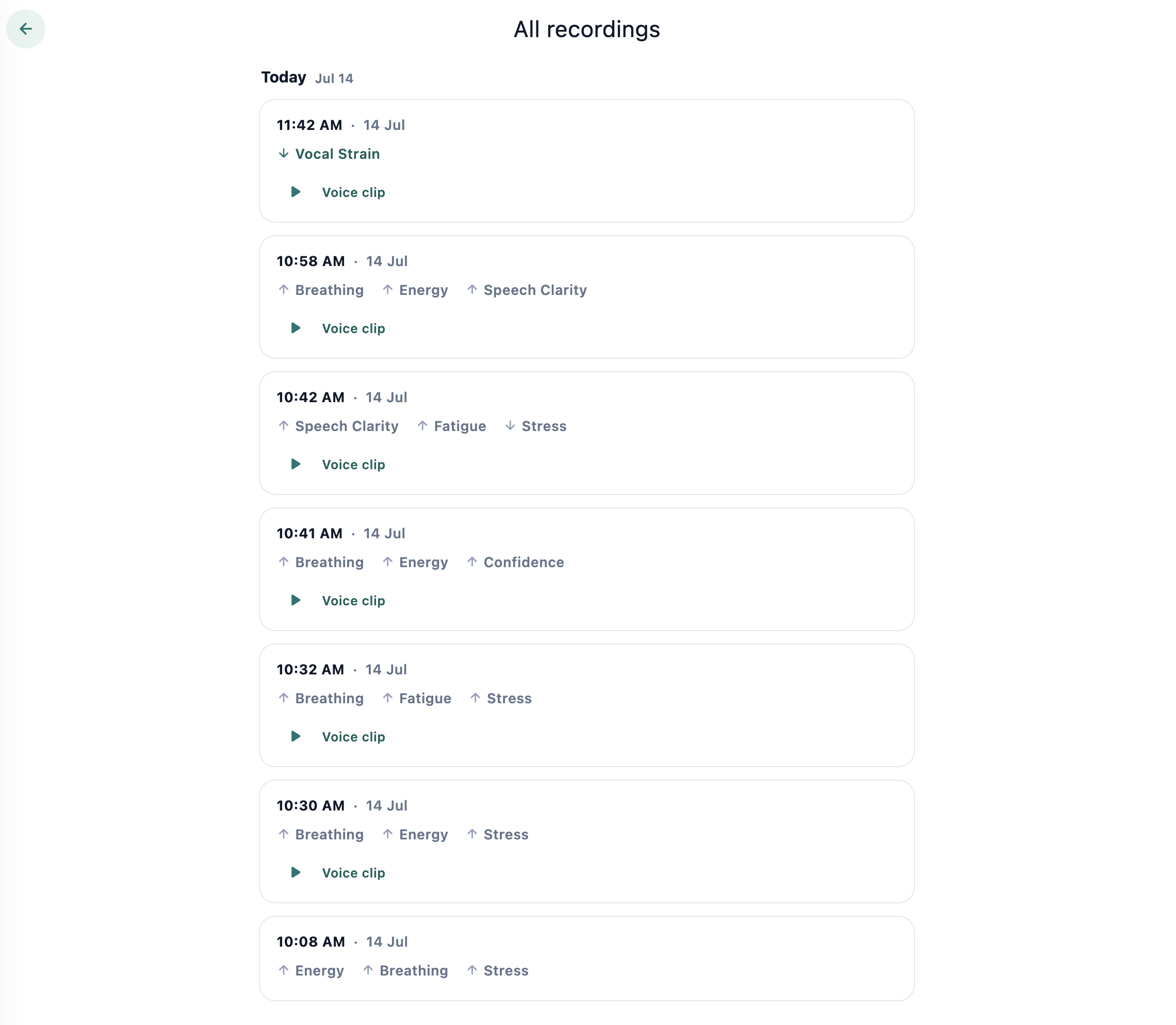
First, a morning of stacked voice sessions from my own desktop. Starts at 10:08, 10:30, 10:32, 10:41, 10:42, 10:58, and 11:42. Seven starts in about an hour and a half. That is the calendar filling the chair by default. On mornings like this I ask a blunt question before each block: does this one need a shared screen? If not, that is the one that can leave the desk.
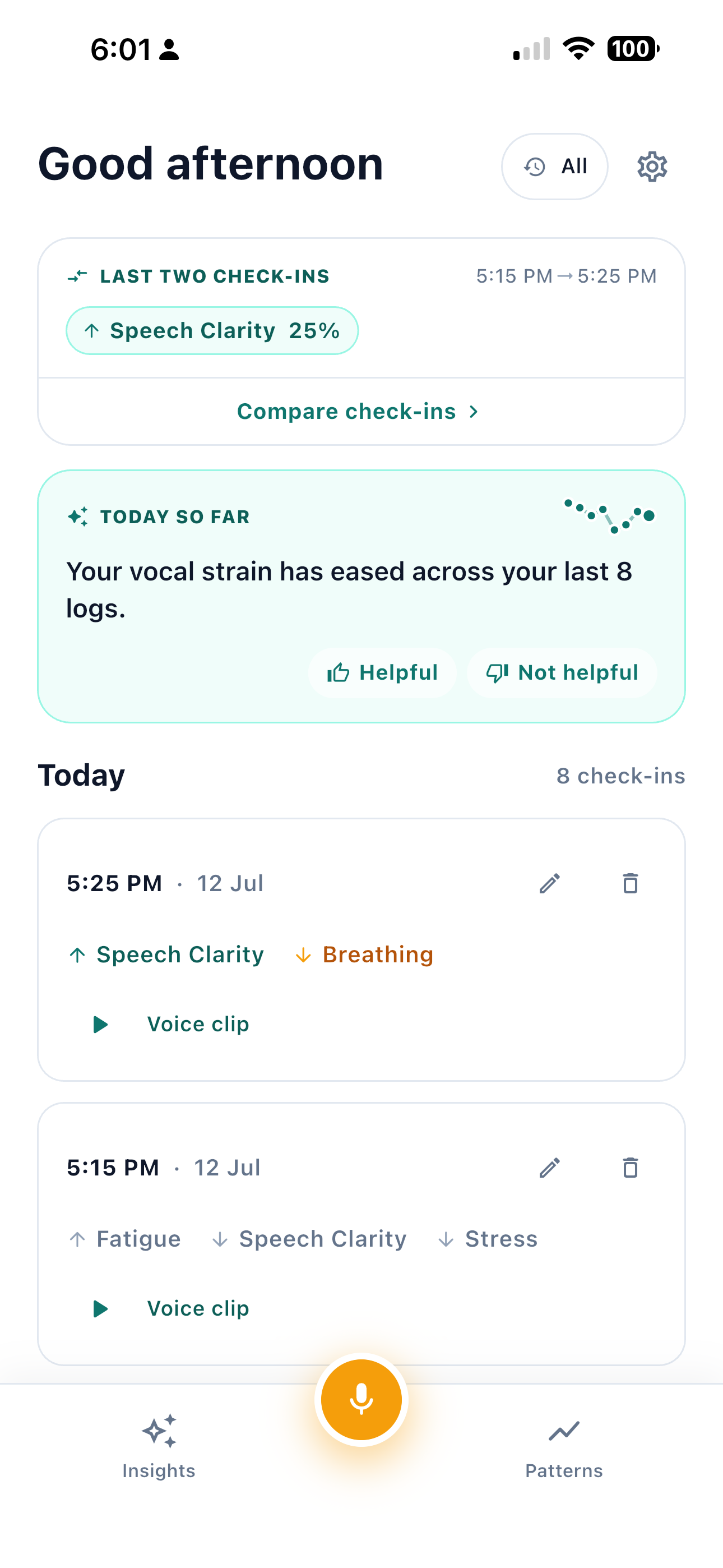
Today is where I look at how the talk day is accumulating. On a heavy day the check-ins stack up. I use that as a prompt to open the activity side of Today and read the longest uninterrupted stretch. When that number climbs, the default sit is winning, and the next no-deck 1:1 is the one I take standing or walking.
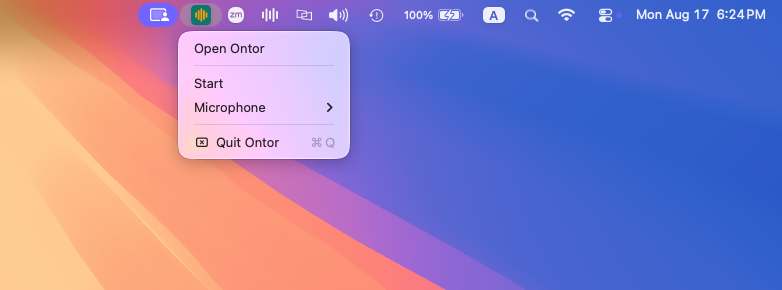
Ontor sits in the menu bar next to Zoom, and sessions can start when the microphone is in use. That matters on walking-call days too. The tool can keep reading while I talk. It still does not book the walk.
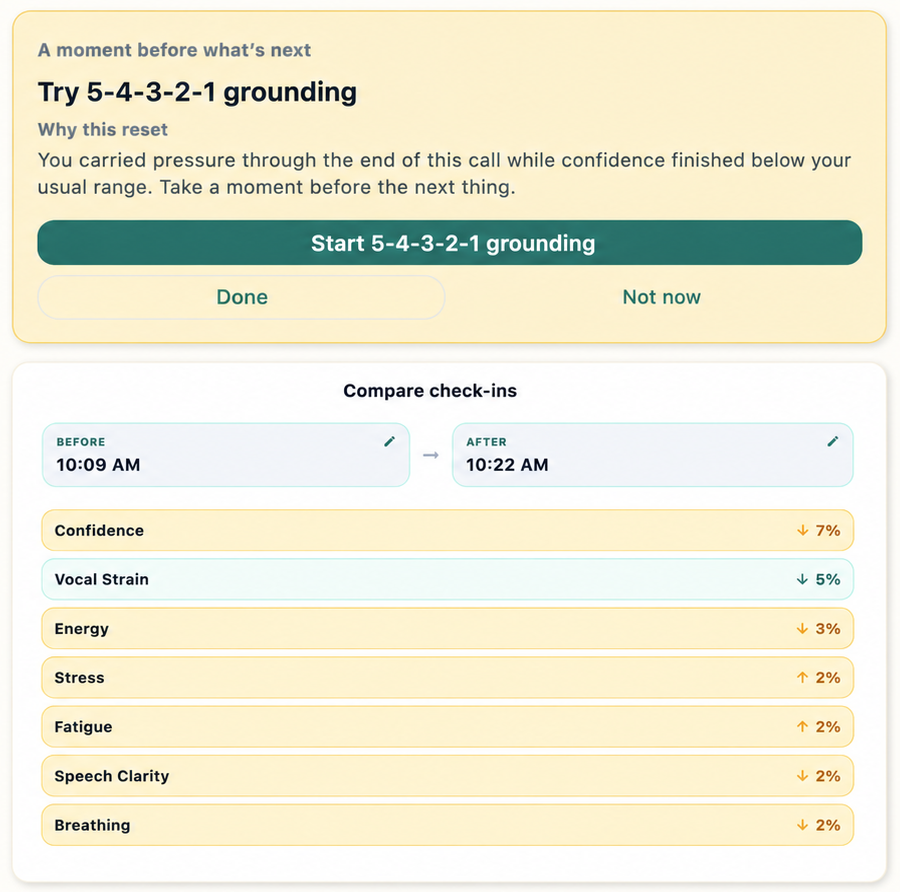
When a short reset suggestion appears, I care about the "Not now" path as much as Start. Mid-call is the wrong time to force a break. Snooze or Not now pushes it past the conversation. Then, at the next gap, or on the next 1:1 that needs no deck, I take the five-minute walk. Fair warning: the card below was triggered by a voice session (grounding after confidence finished below my usual range), not by the work-rhythm five-minute-break reminder itself. I'm showing it for the deferral shape. There is no separate "schedule a walking call" screen in the product, and I am not inventing one.
Try this on your next stack of 1:1s
This is a try-on-next-stretch experiment, not a sales pilot.
On the next day that is mostly client one-on-ones, open the calendar before the first call. Mark every block that needs a deck, a spreadsheet, or a shared doc. Everything unmarked is a candidate to leave the screen.
Take at least one of those unmarked calls standing or walking. Phone notes are enough. Sit down only when something must be on screen.
Keep Ontor open in the menu bar. When the longest uninterrupted stretch climbs and the snoozable five-minute-walk nudge appears, do not kill it mid-call. Snooze it. Use the next unmarked 1:1, or the next real gap, as the walk. One stack of 1:1s is enough to see whether the chair was a habit or a requirement.
Download Ontor - 14 days free, no card required
References and sources
- Seltzer, J. LinkedIn post on six remote 1:1s with no Zoom / walking when no screen is needed (2026-09-10). https://www.linkedin.com/posts/jeremyseltzer_i-did-six-remote-11s-yesterday-no-zoom-activity-7503799017722527744-xCMV
- Boots, J. LinkedIn post on walking meetings / walking phone calls (2026-04-16). Longevity and step framing capped; not used as Ontor claims. https://www.linkedin.com/posts/johnboots_the-closest-thing-i-have-found-to-actual-activity-7450567192498257920-n74Z
- Hasan, S. LinkedIn post on closing the laptop and walking most calls (2026-06-23). https://www.linkedin.com/posts/saddamhasan_every-single-day-i-close-my-laptop-and-take-activity-7475235997287460864-TDhk
- Kreeger, D. LinkedIn post on taking Teams calls walking / productivity as rhythm (2026-04-20). https://www.linkedin.com/posts/duncankreeger_ive-spent-years-obsessed-with-speed-porsche-activity-7452100887071756288-bUT1
- Oppezzo, M., and Schwartz, D. L. Give your ideas some legs: the positive effect of walking on creative thinking. Journal of Experimental Psychology: Learning, Memory, and Cognition, 2014. https://pubmed.ncbi.nlm.nih.gov/24749966/
- Bergouignan, A., and colleagues. Effect of frequent interruptions of prolonged sitting on self-perceived levels of energy, mood, food cravings and cognitive function. International Journal of Behavioral Nutrition and Physical Activity, 2016. https://pubmed.ncbi.nlm.nih.gov/27809874/
- Klingensmith, and colleagues. Walking Meeting Effects on Productivity and Mood Among White-Collar Workers: Evidence From the Walking Meeting Pilot Study. Journal of Occupational and Environmental Medicine, 2021. https://pubmed.ncbi.nlm.nih.gov/33234872/
- Torres, and colleagues. Effect of Active Workstations on Neurocognitive Performance and Typing Skills: A Randomized Clinical Trial. Journal of the American Heart Association, 2024. https://www.ahajournals.org/doi/10.1161/JAHA.123.031228
- How Ontor works. https://ontor.ai/how-it-works/
- About the founder. https://ontor.ai/about/
- Install Ontor. https://ontor.ai/install/
- Calendar decided you sit five hours (sibling). https://ontor.ai/blog/calendar-decided-you-sit-five-hours/
- Back-to-back video, eyes fried by 5 PM (sibling). https://ontor.ai/blog/back-to-back-video-eyes-fried-5pm/
- Sharp for 20 minutes, then the plug pulls (sibling). https://ontor.ai/blog/sharp-for-twenty-minutes-then-the-plug-pulls/
- Call-30 sit sink afternoon flat (sibling). https://ontor.ai/blog/call-30-sit-sink-afternoon-flat/