
Sharp for 20 minutes, then the plug pulls.
The first stretch of a client call can feel fine. You track the brief. You catch the names. You sound like yourself. Then something drops and you do not mark the moment. A question from the start of the call comes back later and you have nothing. You already agreed to a follow-up you barely heard. The day is still wall to wall, so the next call starts before you notice what left.
This is for people who talk with clients or customers while they also live on a computer: founders, consultants, account managers, PR and comms leads, advisors, anyone working as themselves on mic and screen. It is not the after-Zoom hangover when conversation mode sticks into solo work. That piece is after you hang up. It is not notes-while-talking presence. That one is about typing while you listen. It is not a mid-call voice crack the prospect hears. It is not seven hours of video with no gap by 5 PM. It is not the calendar that erased your break transitions. The wedge here is narrower. Mid-call. Your own focus, clarity, hesitation, and energy against your usual range. The plug pulls about twenty minutes in, and you often miss it.
Download Ontor - 14 days free, no card required
Wall-to-wall client calls, then the plug
A comms lead at a mid-size tech firm wrote about this on r/PublicRelations (handle not captured in the research snapshot; post id 1s4xsq3; search-snippet quotes). Their days were wall to wall client calls. The first 20 minutes they were sharp. After that it was like someone pulled a plug.
What that looked like in practice was concrete. They lost track of what was said. They missed follow-ups. After the call they realized they had committed to things they did not hear. One week a client asked about something from the start of the call and they had zero memory of it. They said "yeah that's right" and moved on. They were careful about the label: not absent-minded. They hit a wall after sustained focus and did not even realize it was happening.
Commenters recognized the shape. One said they get the exact same thing: sharp at the start, then at some point their brain just quietly leaves the room. Another suggested leaving at least 10 minutes, ideally 15, between calls to gather thoughts and shift topics.
Treat that thread as buyer language, not a clinic. Snippet quotes only. The useful spine is mechanical: long client talk → sharp early → unnoticed drop mid-call → missed details and soft commitments → gaps between calls as a practical counter, not a cure.
Listening stretches wander for other people too
A weaker corroboration sits outside PR. On r/getdisciplined (post id 1uyg8aq; snippet-only), someone described the same listening drift in plain terms. Whenever they had to listen for an extended period, their mind would eventually wander. A meeting, a lecture, a podcast, an audiobook, a training session, even a long conversation. When they were just listening, their mind eventually started looking for something else to do.
That is not a client-call diary. It is a second first-person account of sustained listening eventually leaving the room. Keep it as mechanism color, not a second spine.
Meeting and message load show up elsewhere as problem context too. One senior professional on r/BrainFog (snippet-only; health-forum post, not a diagnosis claim) noticed that more emails, messages, and meetings in a day made fog more likely. Use that only as load context. Ontor does not diagnose brain fog or any condition.
Sustained attention drops with time on task
Lab vigilance work has a long record for this shape. N. H. Mackworth's 1948 clock-test work (Quarterly Journal of Experimental Psychology) showed detection falling during prolonged watch, with a marked early decline in the first half hour of monitoring. That founding study is about rare signals on a display, not a client Zoom. The transferable point is narrow: staying alert across a long stretch is hard, and performance can fall while the person is still "on."
See, Howe, Warm, and Dember (1995, Psychological Bulletin) meta-analyzed sensitivity decrements across 42 vigilance studies. The decline in perceptual sensitivity was substantial, and it varied with discrimination type, event rate, and sensory versus cognitive task features. Again, these are lab monitoring tasks. They do not prove a twenty-minute client-call wall. They do support reading an unnoticed mid-stretch drop as something humans already show under sustained demand.
Warm, Parasuraman, and Matthews (2008, Human Factors) reviewed converging behavioral, neural, and subjective evidence that vigilance is hard mental work and stressful, not a sleepy underload job. That framing matches the buyer line better than boredom. The plug pull is effort wearing down, not a person who stopped caring.
None of this is ADHD framing. None of it diagnoses anyone in the Reddit thread. It is background science for why sustained talk and listening can leave the room without a neat inner alarm.
Short gaps help in the lab. They are not a product promise.
Ariga and Lleras (2011, Cognition) found that brief, rare switches that deactivated and reactivated the vigilance goal could preempt the usual decrement in their design. Helton and Russell (2015, Cognition) compared interruption types and found post-interruption vigilance best after a complete rest and worst when people kept doing the same vigilance task. Ross, Russell, and Helton (2014, Experimental Brain Research) saw a rest break reverse a linear sensitivity decline after the first break in their line-length task, with less clear help from a second break and no clear help from goal switches alone.
Put those papers next to the PR thread carefully. Commenters wanted 10 to 15 minute gaps between calls. Science says real rest can blunt or reverse some vigilance declines in lab designs. That is not proof that any desktop tool restores focus mid-call. It is not proof that attention "comes back." The honest practical move stays small: notice where your own drop tends to land, and put a short gap between long client talks on purpose.
Download Ontor - 14 days free, no card required
What Ontor can show on long talk days (and what it will not)
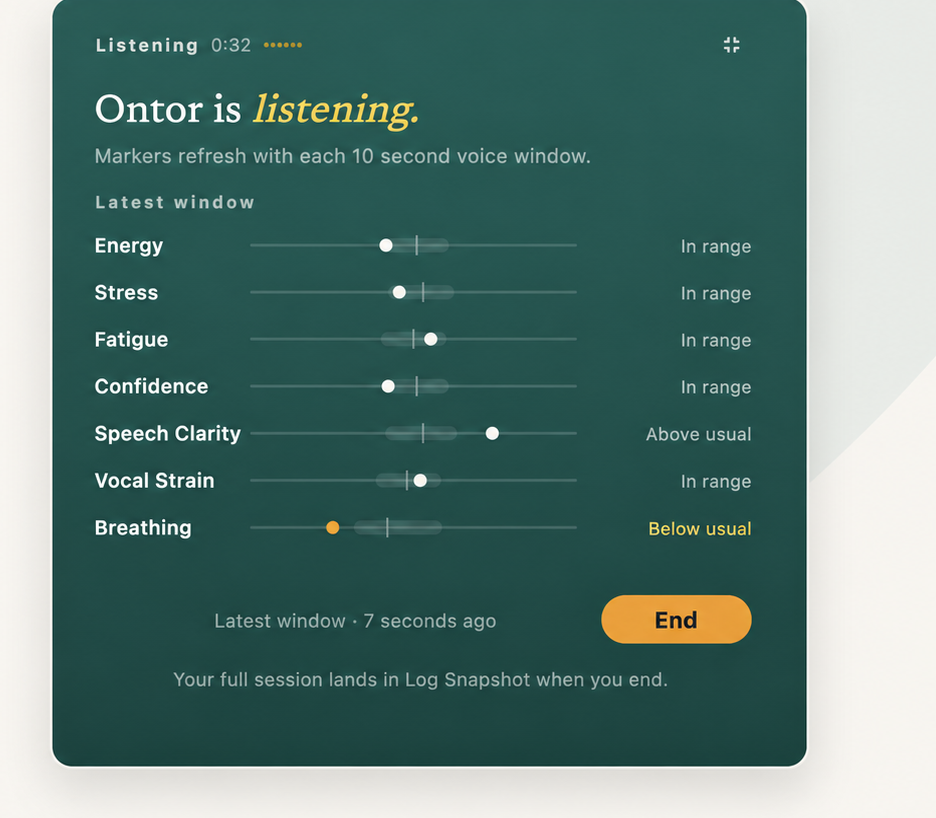
Ontor is a tool that learns from your voice while you talk and from basic computer interaction (typing, clicking, scrolling, pauses), then compares those readings with your personal usual range. On How Ontor works, voice sessions can start when the microphone is in use. Focus, hesitation, speech clarity, energy, and related markers update in short voice windows. Today can show activity time, longest uninterrupted stretch, and current stretch once you are back at the keyboard. When a stretch runs long, or when voice markers leave your usual band, the desktop can surface a snoozable reminder to take a short break or try a guided reset (site copy includes a five-minute break). You can snooze it, move it, or dismiss it.
That fit matches the mid-call plug problem without overclaiming. Over many talk blocks you can learn where your own drop tends to land relative to your usual range. Between calls you can take a short snoozable gap before the next client block starts.
What Ontor does not do:
- Guarantee a mid-call alert while you are still on the live conversation
- Promise that focus returns, that attention is restored, or that you will catch every missed commitment
- Diagnose ADHD, mood, brain fog, or any health condition
- Detect eye strain, improve vision, or prevent disease
- Use coach-style nervous-system diagnosis language
- Rank you, watch you for a manager, sell ROI, or treat anything medically
If you feel the plug pull mid-call, that is your report. Ontor's useful response on those days is different: whether focus, clarity, hesitation, or energy left your usual range across the talk stretch, whether the computer rhythm between calls looks like a zero-buffer stack, and a snoozable suggestion to take a short gap before the next one.
Sabber on a long talk stretch: usual range, not a mid-call alarm story
In my own Ontor sessions (founder exploratory data from my own product use, not a picture of the Reddit poster's brain, and not a clinical sample), I use the tool the way this problem actually shows up for me. During a longer talk block I watch focus, clarity, hesitation, and energy in short windows against my usual range. I am not claiming a mid-call alert fired and saved the conversation. I am looking for where my own markers leave the band on a sustained stretch, then deciding whether the next gap between calls should be a real break instead of another immediate dial-in.
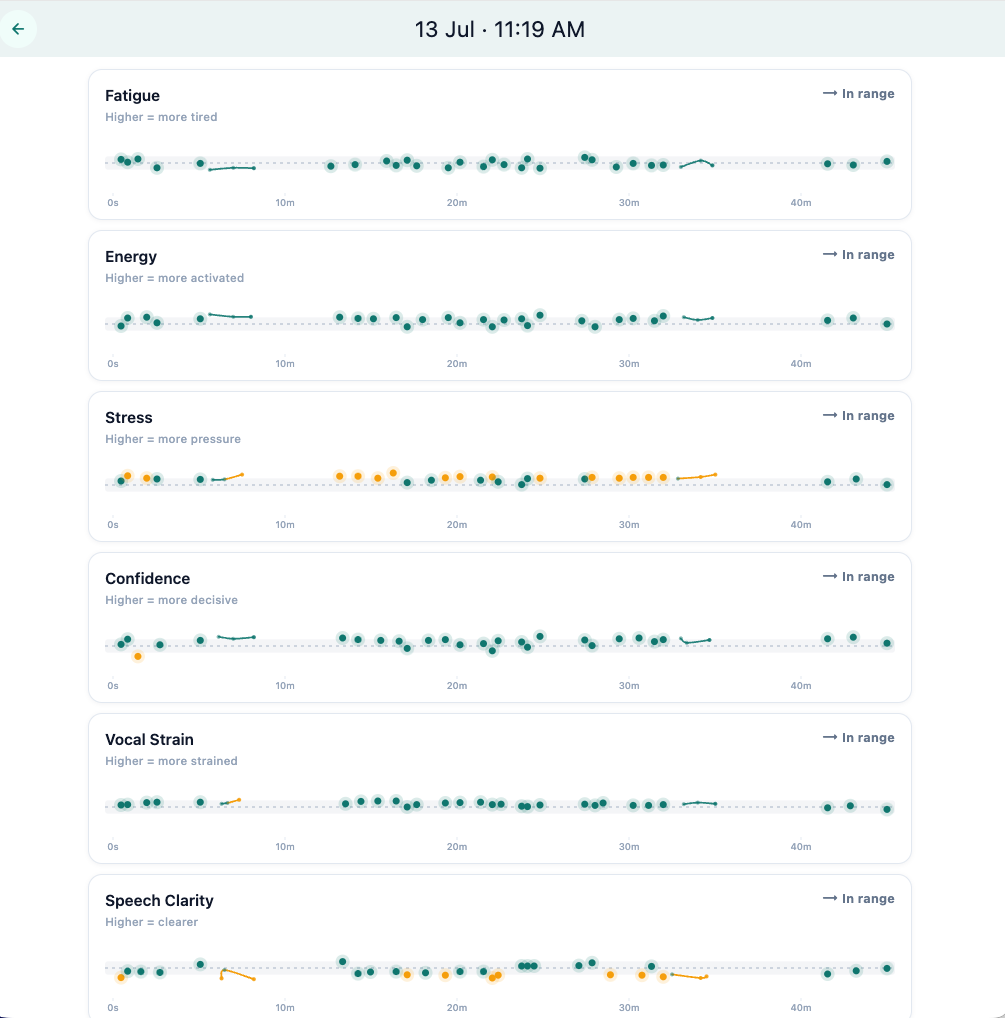
After a meeting-length block I open the session analysis. Markers across about forty minutes sit next to my personal range so I can see whether the stretch stayed in band or drifted. That review is for learning my own pattern on talk-heavy days. It is not a claim that Ontor restored my attention on the call.
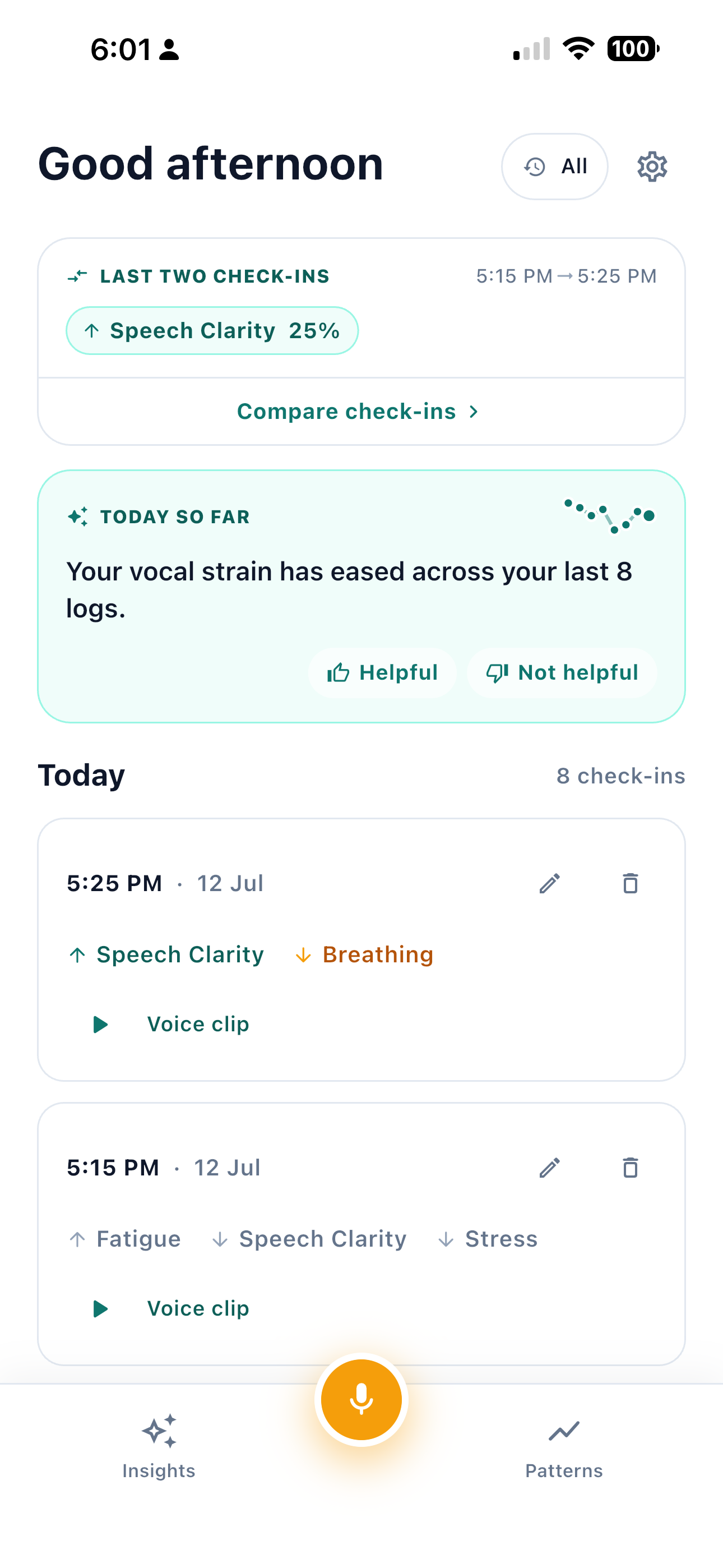
Today is where I look at the stack between calls. Activity time and uninterrupted stretches sit next to history so I can see whether the calendar left any room before the next client block.
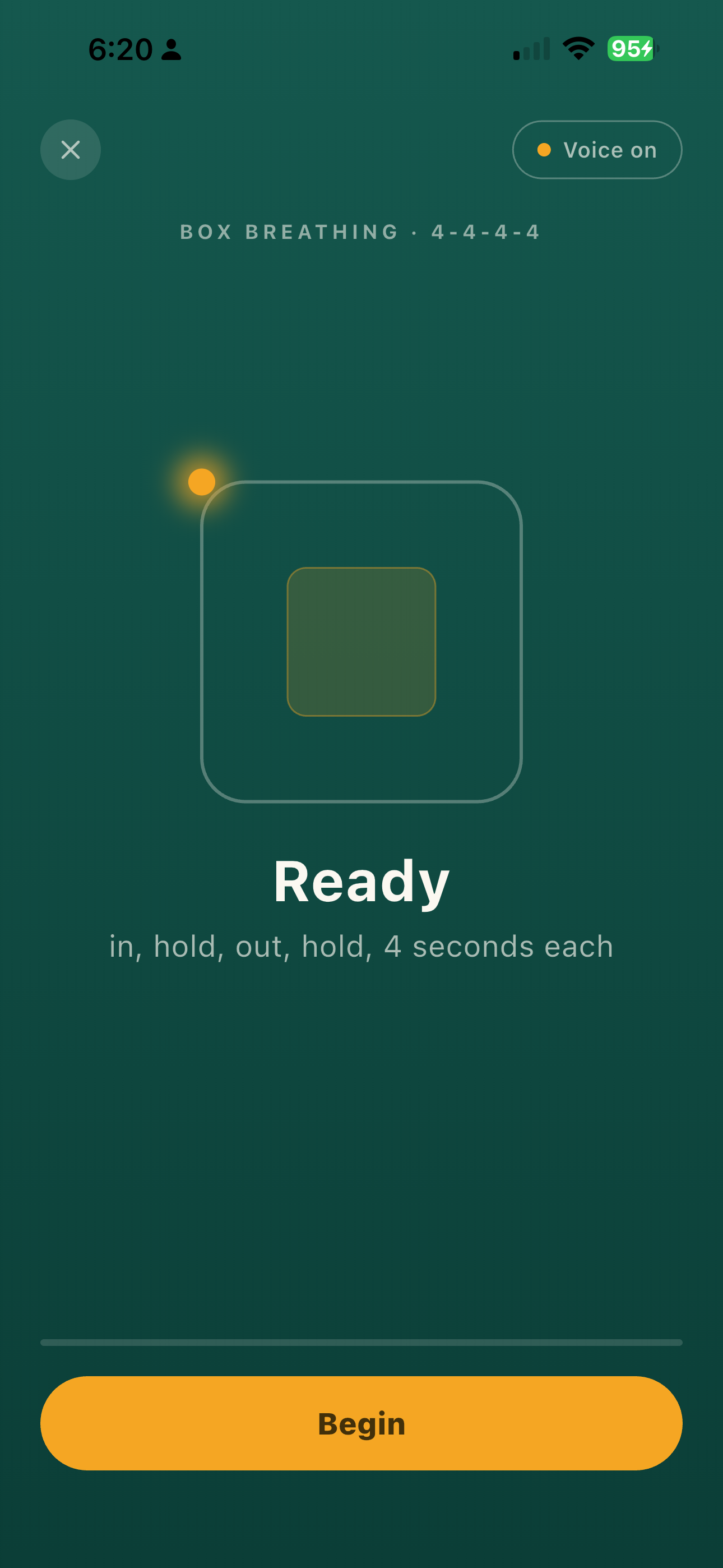
When a short gap is the right next step, box breathing is one guided reset I can take between calls. It is not treatment. It is a few deliberate minutes before the next talk block, and the reminder itself can be snoozed or dismissed.
Try this on your next long client call day
On your next long client call day, treat it as a try-on-next-stretch. Note where your own drop tends to land versus your usual range across the talk blocks. Put a snoozable short gap between calls when the stack would otherwise stay wall to wall. That is for your own clarity on talk-heavy days. Not a sales pilot. Not a team rollout pitch.
This is different from after-zoom-brain-still-in-conversation-mode, notes-while-talking-presence, mid-call-voice-crack-prospect-hears, back-to-back-video-eyes-fried-5pm, and calendar-decided-you-sit-five-hours. Those articles cover post-call residue, typing while listening, a voice crack the other person hears, the all-day fried stack, and dismissed break timers. This one is the unnoticed mid-call plug pull when you are still in the conversation.
Download Ontor - 14 days free, no card required
References and sources
Buyer and peer accounts
- Reddit r/PublicRelations: brain shuts down halfway through long client calls (primary; snippet quotes)
- Reddit r/getdisciplined: zoning out while listening (weak corroboration; snippet quotes)
- Reddit r/BrainFog: meetings and messages load (weak load context only; not a diagnosis)
Science
- Mackworth 1948: The breakdown of vigilance during prolonged visual search
- See, Howe, Warm, and Dember 1995: Meta-analysis of the sensitivity decrement in vigilance
- Warm, Parasuraman, and Matthews 2008: Vigilance requires hard mental work and is stressful
- Ariga and Lleras 2011: Brief and rare mental breaks keep you focused
- Helton and Russell 2015: Rest is best (rest and task interruptions on vigilance)
- Ross, Russell, and Helton 2014: Effects of breaks and goal switches on the vigilance decrement
Product and siblings