
The polished voice locks when the room starts evaluating
Executive, voice, and presence coaches already know the client story. The trained voice is there in the warm-up. It is there an hour before the board, the partner panel, the investor slate, or the high-scrutiny pitch. Then the room starts evaluating, and something changes. Breath tightens. Pace shifts. Tone loses depth. The speaker often cannot hear it from inside. Self-hearing muffles, goes far away, or turns unrecognizable. Practice still "worked." Live evaluation did not.
This piece is for coaches who sell presence and voice into leaders, founders, lawyers, performers, and the sales or call-heavy clients those skills transfer to. It is not practice holds, live dials don't alone. It is not why you can't hear your own voice under pressure as a skull-conduction essay. It is not nervous-system regulation you still can't measure as a general coaching gap. And it is not stage voice dying on the first interruption (interruption is not the same as evaluation freeze). The wedge here is the combo: freeze under scrutiny, trained technique that was present an hour ago failing at open, muffled self-hearing so clients cannot self-correct mid-moment, and a body-first voice that follows without asking permission.
Download Ontor - 14 days free, no card required
Paying coaches already name evaluation freeze
Greg Harrison (Vocal Coach, VoiceCraft) writes the panel moment coaches hear from audition clients and that transfers cleanly to board and partner rooms:
"You have rehearsed the cut until it is automatic… Then you walk in… and somewhere between the slate and the first phrase something changes. The voice that was there an hour ago is not the voice that comes out."
His frame rejects the confidence lecture:
"This is not a confidence problem. It is a physiology problem…"
And he names the mid-moment trap that makes self-correction fail:
"You may hear your own voice as muffled, far away, or unrecognizable."
Breath goes shallow. Throat tightens. Jaw clenches. Hearing shifts. You cannot ask the autonomic nervous system to switch off the threat response by deciding to. That is coach language for evaluation freeze, not a clinical diagnosis. The gig and the audition are different rooms to the nervous system. Being measured is not the same as performing for people who came to hear you. Transfer that language to a board slate, a partner review, a court or client room, or a founder pitch under scrutiny, and the same lock shows up.
Anne Leatherland (executive vocal coach; Vocal Intuition / Be Truly Heard) maps the same board start for capable speakers whose prep still held:
"In everyday conversation, you are thoughtful, clear and capable. In preparation, you know your material inside out. Yet when the board meeting starts… something changes."
"Your breath tightens. Your pace changes. Your tone loses depth."
"Your voice is not separate from your nervous system… When you feel exposed, your system goes into protective mode. That protection shows up in sound."
Just trying to be confident alone does not work. She sells nervous-system leadership for that gap. The audible failure still lands in unsupervised high-scrutiny windows between appointments.
Emma Alston (Voice and Communication Coach; Elevate Your Voice) describes the body-first mechanism from a paid founder session:
"When the stakes are high, the body responds first… if the nervous system tips into urgency, the voice follows without asking permission."
Pace quickens. Breath shortens. Grounded authority from normal conversation diminishes. Her programme copy sells recognizing when pace has accelerated and knowing how to reset. The coach still cannot sit inside every live evaluation moment with an instrument.
Corroboration: cortisol pitch, rehearsed-but-bored, hostile Qs
Claire Shaw (vocal coach for women in law and leadership) maps the lawyer and partner-room version:
"Why does your voice go higher when you're under pressure? Cortisol."
"Your breath shallows. Your throat tightens. You go blank. RESULT: You sound less like yourself."
Clients ask why the voice goes the moment stakes go up even when the material is known. Mouth goes dry. Voice strains. Body works against them. Her line that matches Greg's physiology frame:
"You can't think your way out of a physiological response. But you can breathe your way through it."
Jace Au (Voice of Gold; executive voice coach) hears intake lines that sit next to evaluation freeze without needing more rehearsal alone:
"I rehearsed my speech over and over again but the audience looked bored. Why did it happen?"
"My voice feels tight and trapped. But my ENT said I am alright. What else can I do?"
"As for that tight, trapped feeling in the throat: it's often the body's reflection of stress, not a physical fault."
Hostile AGM questions cannot be rehearsed away. The throat lock under live scrutiny is stress showing up in sound.
Paul Mascetta (executive and voice communication coach) is useful only as light corroboration for the muffled / can't-self-correct side. Do not treat it as a second spine. Speakers think they sound engaged; audiences hear a drone. Under pressure, range compresses; pitch locks into a narrow band. Inner voice has melody that does not travel. Recordings tell the truth after the fact. That overlaps heavily with can't hear your own voice under pressure. Keep it as refresh only. The primary object here remains evaluation freeze at slate or open, not skull-conduction as the whole article.
Distinct from nearby Ontor coaches cuts
| Published Ontor cut | Moment | What this article is not rewriting |
|---|---|---|
| Practice holds, live dials don't | Practice→live dial transfer gap | Not evaluation freeze + muffled self-hearing at slate/open |
| Can't hear own voice under pressure | Skull-conduction self-deafness during pressure | Not the full combo; muffled hearing is one leg here, not the whole spine |
| Measure nervous system regulation | NS coaching without a live measure | Not panel/board evaluation freeze specifically |
| Stage voice dies under live interruption | Prepared stage polish collapses on challenge | Interruption ≠ evaluation freeze; this piece is scrutiny lock at open |
Same coaches channel. Different question: why does the polished, trained voice lock when the room starts evaluating, why can't clients hear or correct it mid-moment, and what sits next to the resets coaches already prescribe when they cannot instrument the live panel?
Download Ontor - 14 days free, no card required
What sessions, recordings, and more rehearsal still miss
Typical stack for coaches selling into boards, panels, and high-scrutiny rooms:
- Warm-up and technique that hold an hour before
- Session ear and after-the-fact recording review
- Nervous-system leadership language and somatic resets
- Structured exposure under lower failure cost
- More rehearsal of the slate or open
Useful. Incomplete for evaluation freeze. Sessions catch what happened when the coach was present. Recordings catch what landed after the room already heard the lock. More rehearsal often rebuilds the voice that was there an hour ago, then fails again when evaluation starts.
None of that continuously asks: during this board open, partner panel, investor slate, or high-scrutiny pitch, did stress, clarity, strain, breath, or energy leave this client's personal usual range in short speech windows, while self-hearing was muffled and trained technique still "felt fine" beforehand? Ontor does not replace your coaching. It does not diagnose anxiety. It reads how someone sounds versus their own usual range while they speak, and can offer a short reset when a lasting shift shows up in a live evaluation window you cannot sit inside.
What Ontor adds when evaluation starts (private first)
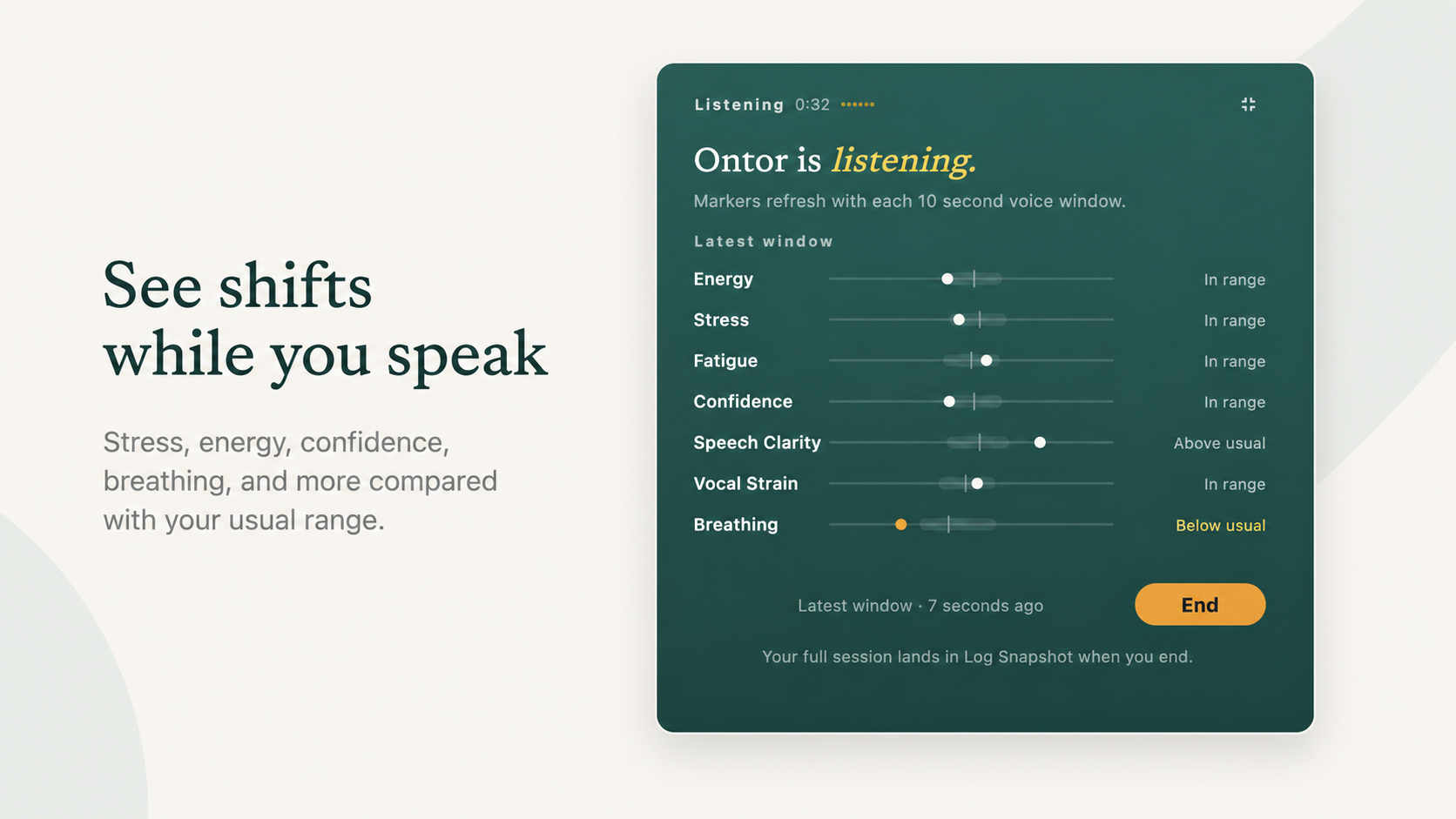
Ontor is a performance tool that reads how someone sounds, not what they said. While a person speaks, it compares voice signals to that person's own usual range. Markers refresh in short voice windows (on the order of about 10 seconds of speech). When a lasting shift shows up (for example stress, fatigue, speech clarity, vocal strain, or breathing), it can suggest a short reset. People can also compare before and after.
For a coach practice training leaders, founders, lawyers, performers, and sales or call-heavy clients, that sits next to the physiology frame Greg sells, the board-start language Anne uses, and the body-first reset Emma teaches. Clients still own their readings. What you gain is a private usual-range view during unsupervised high-scrutiny speech: whether stress, clarity, strain, or breath left their band when the room started evaluating, while the voice that was there an hour ago no longer came out.
Explicit boundaries for this topic:
- Ontor does not claim to fix evaluation anxiety as clinical treatment.
- Ontor does not diagnose health conditions or replace ENT clearance for throat complaints.
- Ontor does not replace 1:1 coaching, board rehearsal, or somatic protocols.
- Ontor does not claim revenue, retention, hire-fire, or courtroom outcome proof from marker changes.
- The claim stays narrow: short live windows against personal usual range, plus optional short resets coaches already prescribe but cannot instrument during the live evaluation moment.
In my own Ontor session history (founder exploratory data from my own product use, not your clients' board outcomes), the evaluation-freeze pattern shows up the same way Greg, Anne, and Emma name it. A speaking block can still feel "fine" as practiced technique beforehand, while stress, clarity, strain, or breath has left my personal usual range in the short windows once scrutiny spikes. I am still "on." The lock is already audible from outside, and self-hearing is the worst judge of whether I left my band.
Here is the live listening view from my own Ontor product use: markers refresh with each ~10 second voice window and sit against my usual range. In this window speech clarity can sit above usual while breathing sits below usual. That is closer to "my breath and state left my band while I kept talking under load" than a confidence tip:
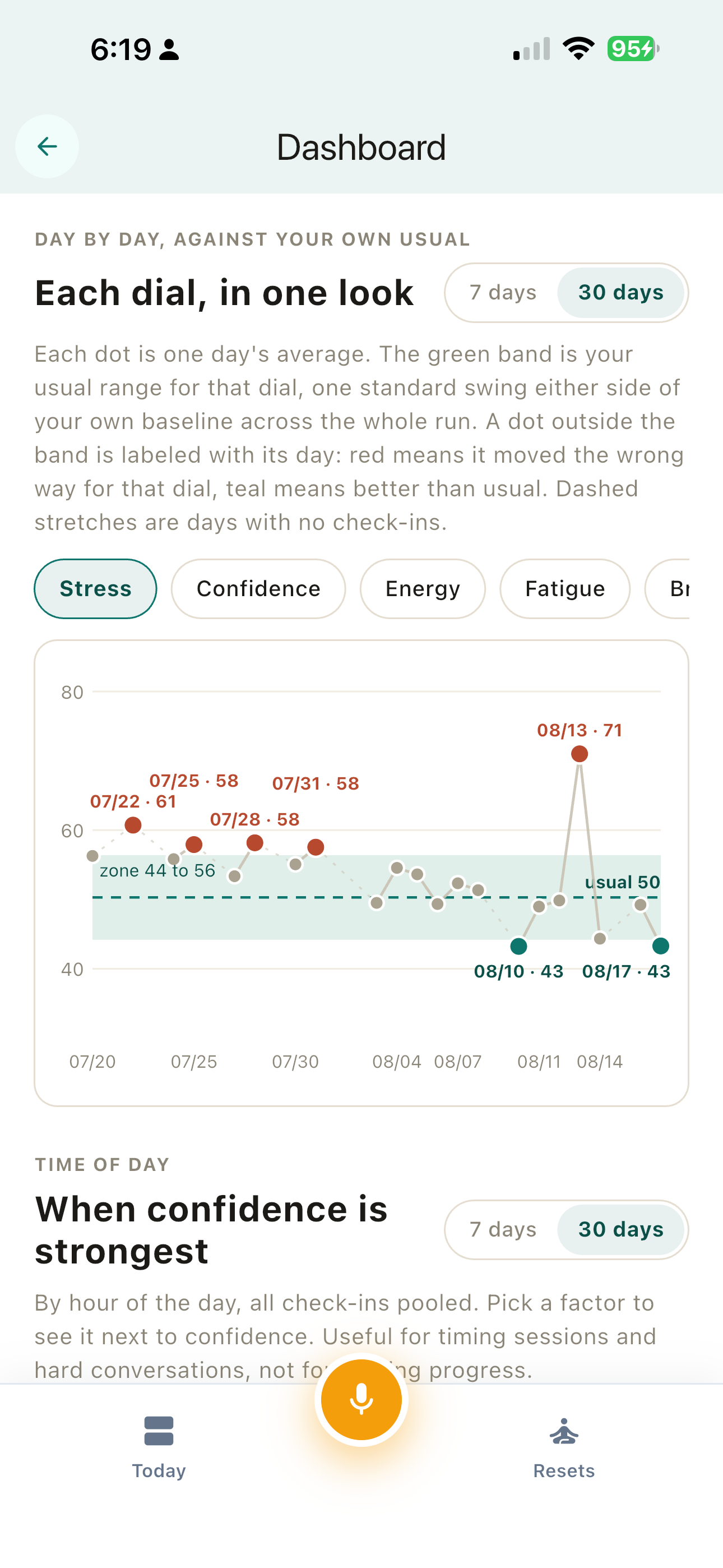
Here is stress day by day against my personal usual band (zone ~44 to 56, usual 50) from the same session history. Red points sit above my usual range. Useful as a private check for how often voice-state leaves the band across speaking blocks that can still feel prepared beforehand. It is not a hire-or-fire score and it is not proof that a suggested reset caused better board delivery:
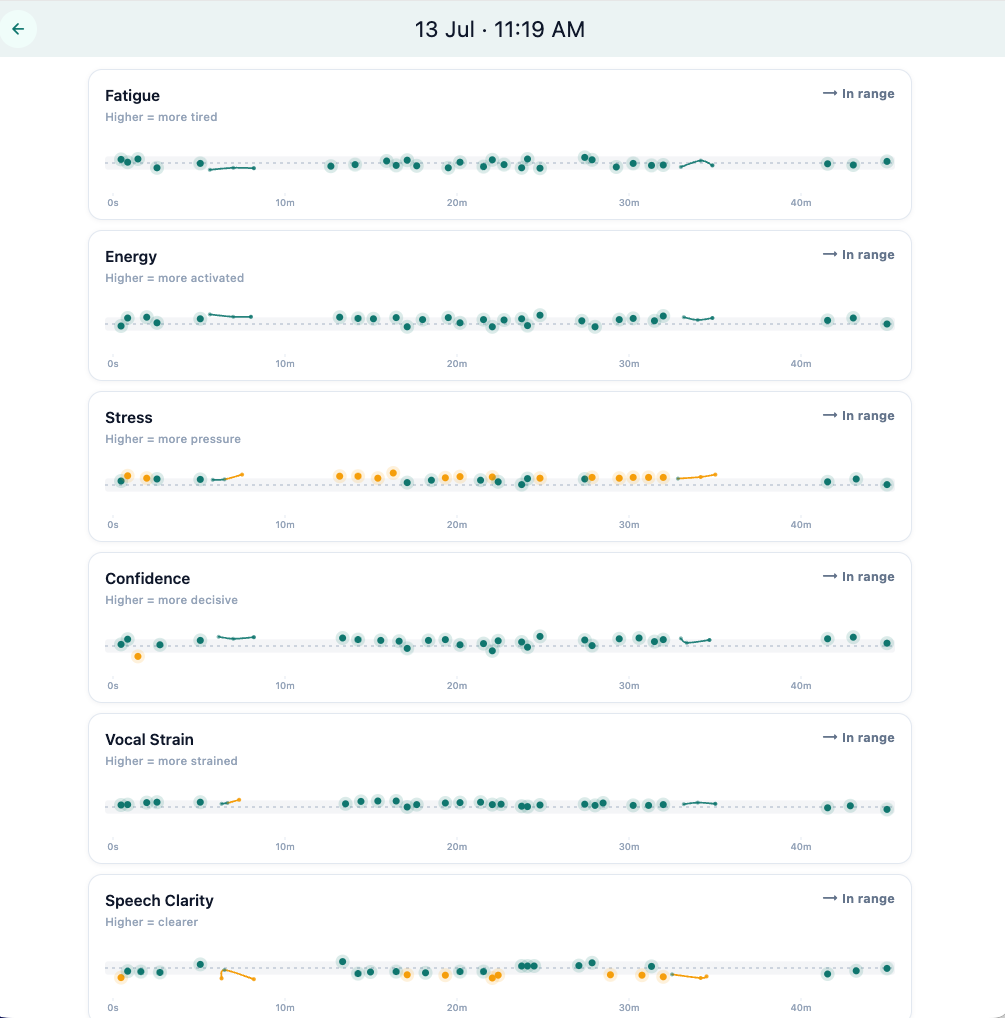
Here is a short meeting analysis from my own Ontor use. A speaking block can look complete as raw activity while the markers already show leave versus personal usual. Read it as founder exploratory data on mid-block drift under load, not evidence of a client's panel outcome:
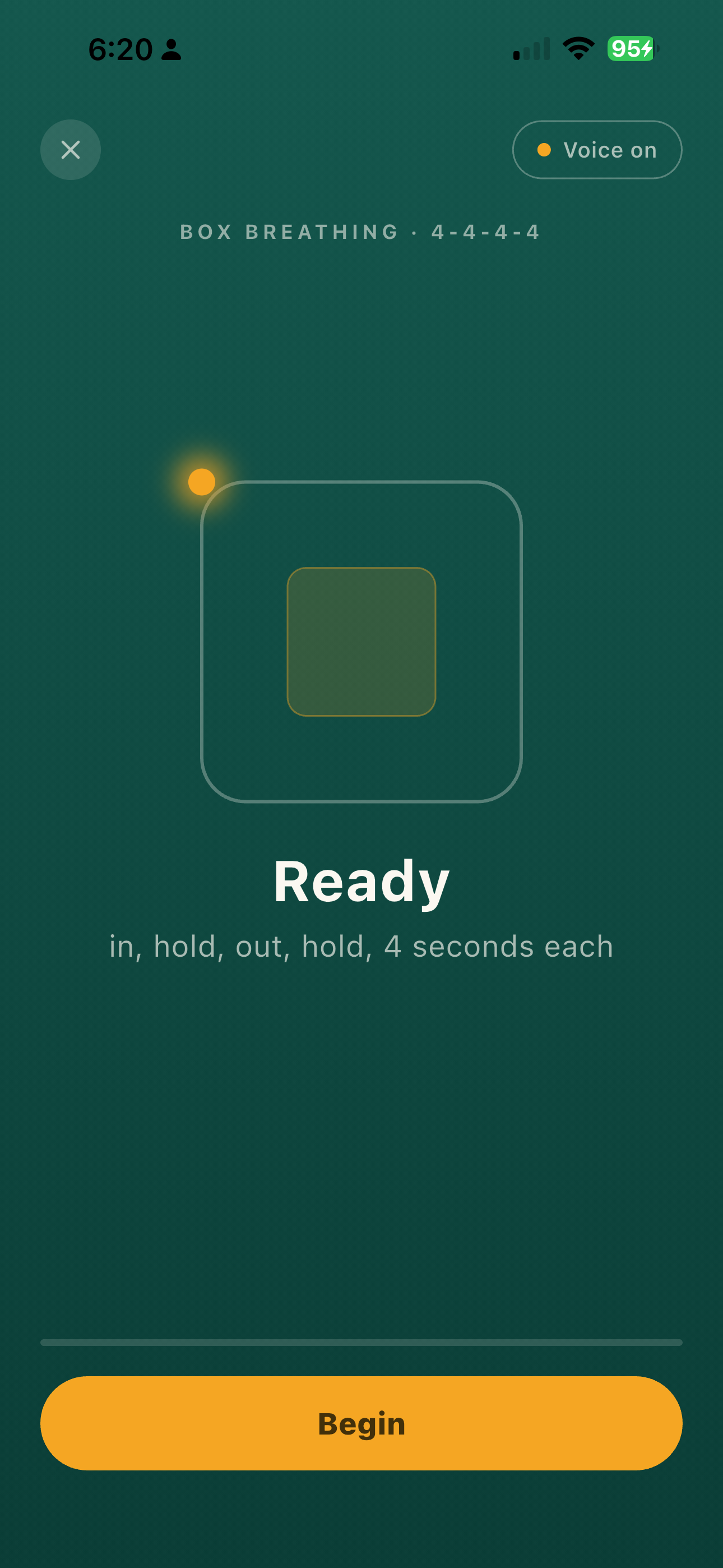
And here is the short reset the product offers when a lasting shift shows up: box breathing, 4-4-4-4. That is the tool form of the body-first / breathe-through response Claire and Emma point at, available privately without a coach in the panel room. It is not a medical protocol and it is not a claim that one cycle restores the polished voice that was there an hour ago:
This is not a claim that voice markers diagnose evaluation anxiety, prove cognitive improvement, predict deals or verdicts, or replace coach judgment. The claim stays narrow: when practice and prep still "work" but live evaluation locks the voice, a private signal plus a short reset is a loop clients can run in the next high-scrutiny moment, while coaches watch patterns only with consent and without turning Ontor into a monitoring scoreboard.
Try this on the next high-scrutiny moment
For coaches' clients (and for coaches transferring the same skill into sales or call-heavy rooms):
- Keep the technique and warm-up you already trust an hour before.
- On the next board open, partner panel, investor slate, court or client room, or high-scrutiny pitch, run Ontor privately during speech.
- Afterward, compare whether stress, clarity, strain, or breath left their personal usual range in the short windows once evaluation started, not only whether the content felt prepared.
- If a lasting shift showed up, use the short reset the product suggests (or the somatic reset you already prescribe), then check before/after on the next unsupervised block.
That is the install loop, not a clinical protocol. Coaches keep the relationship and the curriculum. Ontor adds an instrument for the moment you cannot sit inside.
Download Ontor - 14 days free, no card required
Teams coaching presence into senior rooms can also look at Ontor for teams for aggregate workload and coaching patterns. Individual sessions and readings stay with the person.
References / Sources
- Greg Harrison - Why Your Voice Locks In The Audition Room (VoiceCraft)
- Anne Leatherland - If your ideas are strong but your voice fails to land in high-stakes moments
- Anne Leatherland - Showing up as you when the stakes are high (Be Truly Heard)
- Emma Alston - founder session: body responds first, voice follows
- Claire Shaw - cortisol, pitch rise, sound less like yourself
- Jace Au - rehearsed but bored; tight throat as stress
- Paul Mascetta - inner voice liar / range compress under pressure (corroboration only)
- How Ontor works
- Ontor for teams
- About the founder - Ontor
- Install Ontor
- Practice holds, live dials don't (sibling)
- Can't hear own voice under pressure (sibling)
- Measure nervous system regulation (sibling)
- Stage voice dies under live interruption (sibling)