Why you can't hear your own voice under pressure (and what coaches do about it)
Voice, sales, and executive-presence coaches already know the pattern. Under pressure the voice climbs, thins, rushes, or gets quieter and smaller. The speaker usually cannot hear it while it is happening. You become the mirror in the session or on the after-the-fact recording. Live dials, boards, and challenged calls stay blind between appointments.
This piece is for coaches who train call-heavy sellers and high-stakes leaders. It is not the between-session blind spot as a general coaching gap. It is not practice holds, live dials don't. It is not nervous-system regulation you still can't measure. It is not prospects hear the voice tighten (that cut is inverted: they hear it; the speaker often doesn't). It is not call-mode pitch-voice, anxious or robotic under the same pressure, or stage voice dying on the first interruption. The wedge here is narrower: skull-conduction self-deafness during live pressure, and a live baseline-vs-window ear between sessions.
Download Ontor - 14 days free, no card required
Paying coaches already name the self-deaf gap
Topher Keene (vocal coach for CEOs, founders, and executives) puts the mechanism in plain buyer language. Leaders do not get an accurate read of their own boardroom voice, because bone conduction through the skull is a different signal than the one that crosses the table:
"You cannot accurately hear your own voice. You hear it conducted through the bones of your own skull, which is a completely different signal than the one traveling across the conference table."
That is coach language for why self-monitoring fails under load, not a clinical diagnosis. Sessions open with recording as the first honest mirror. The reaction he hears is nearly universal:
"The reaction is nearly universal - I had no idea I did that. The trailing off at the end of sentences. The pitch climbing under pressure. The pace accelerating until the words blur. None of these are visible from the inside."
Seniority makes the feedback gap worse. Direct reports rarely volunteer that the leader trails off and loses the room. Keene's line that coaches already sell against:
"You can't correct what no one will tell you and you can't hear yourself, which is exactly why an outside ear is worth so much at the senior level."
The mechanical under-pressure failures he names match what sales and presence coaches hear on live dials: shallow chest breath, larynx climbs, voice thins and sounds small, sentences float up seeking approval. His homework for clients is still after-the-fact:
"Record yourself opening your next meeting - just thirty seconds - and listen back for three things: does your pitch climb, does your pace accelerate, and do your sentences land or float up at the end? You'll hear at least one of them, and you've never heard it before."
Recording is a real mirror. It is still delayed. The climb, thin, rush, or shrink already landed on the room.
Same self-deaf cluster: thin/trail, shrink-to-quiet, adrenaline rush, clients feel it first
John J Norton (Voice Zone presentation and voice coach) opens sessions by listening for the tells speakers miss while speaking:
"When pressure rises, the body tends to tighten. Breath becomes shallow. The jaw works harder. The throat tries to compensate. Speech speeds up, pitch climbs, and phrases lose shape."
"Where does the tone thin out? Do key phrases trail off? Are you pushing for volume? Is the pace masking uncertainty? Are nerves showing up in breath, pitch, or muscle tension?"
He also flags the transfer gap coaches already sell into: a healthier sound on a vocal exercise is not the same as holding that quality while explaining quarterly results or handling a hard question. Transfer matters. The coach ear is still appointment-bound for unsupervised live blocks.
Sam Malone (Founder/CEO, Elevate Voice; spoken-voice coach for blue-chip, NHS, and conservatoire clients) names the shrink-to-quiet mode under nervous-system threat:
"Your nervous system is the real reason your voice disappears in high-stakes moments… Suddenly your throat feels tight. Your voice is quieter, smaller even. You can hear it and you hate it… When it senses threat, it tenses your muscles, shortens your breath, and then literally squeezes your voice."
That is the opposite of pitch-climb alone: volume and presence drop. Some speakers catch the quietness as a hated sensation. Many still miss how far they left their usual sound until someone plays it back.
Dominic Colenso (communication and performance coach; ex-actor / RADA tutor; IMPACT / Cut-Through for sales kickoffs and leadership) frames the rush side as adrenaline, not knowledge failure. Under pressure, top sellers slow down rather than speed up. The biological urge is to accelerate. Pausing and breathing restore composure. Rushed premature responses and missed cues still cost deals when the speaker cannot feel the speed-up in the moment.
Danielle Benzon (voice-body coach; founder, The Inspired Speaker), on the She Coaches Coaches channel, closes the loop on why the room often knows first:
"You can hear tension. You can hear holding back. You can hear when someone is trying to sound more confident than they feel."
"That holding back is what allows us to say we're okay when we're not. It's what allows us to pretend we're not as nervous as we are."
"When something is out of alignment, even slightly, your clients feel it… They pull back. They don't fully trust. They can't quite say why."
Speaker self-deafness and listener sensitivity sit on the same call. Coaches already teach breath-voice connection and listen for hold-back in sessions. Live unsupervised dials still do not have that ear.
Distinct from nearby Ontor coaches cuts
| Published Ontor cut | Moment | What this article is not rewriting |
|---|---|---|
| Coaching between sessions | General between-appointment blind spot | Not skull-conduction self-deafness / can't-hear-own-climb while speaking |
| Practice holds, live dials don't | Practice→live dial transfer gap | Not speaker self-deafness during live pressure |
| Measure nervous system regulation | NS coaching without a live measure | Not the cannot-hear-own-voice mechanism |
| Prospects hear voice tighten | Prospect-side hearing of tighten | Inverted: here the speaker misses what the room already feels |
| Call-mode pitch voice | Forced professional phone costume | Not self-deafness to climb/thin/rush/shrink |
| Anxious or robotic under same pressure | One cascade, two audible modes | Not dual-mode misdiagnosis |
| Stage voice dies under live interruption | Prepared stage polish collapses on challenge | Not curriculum collapse; self-deafness during pressure |
Same coaches channel. Different question: why speakers cannot accurately hear pitch climb, thin/trail-off, adrenaline speed-up, or shrink-to-quiet while it is happening, and how a live usual-range ear sits next to coaching between appointments.
Download Ontor - 14 days free, no card required
What Ontor can add between coaching appointments
Ontor is a performance tool that reads how someone sounds, not what they said. While a person speaks, it compares voice signals to that person's own usual range. Markers refresh in short voice windows (on the order of about 10 seconds of speech). When a lasting shift shows up (for example stress, energy, speech clarity, vocal strain, or breathing), it can suggest a short reset. People can also compare before and after.
For a coach practice training sellers and leaders under live pressure, that sits next to the recording mirror and session ear you already sell. Clients still own their readings. What you gain is a private usual-range view during unsupervised live speech: whether activation, pace pressure, throat-side strain, breathing, or clarity left their usual band while they could not hear the climb, thin, rush, or shrink from inside the skull.
This is not a claim that Ontor diagnoses health conditions, proves clinical skull-conduction findings, replaces 1:1 coaching, or guarantees deal or board outcomes. It is narrower: short live windows against personal usual range so coaches and clients can notice self-invisible shifts when the coach is not in the room.
What shows up in my own Ontor history (cannot hear the climb while speaking)
I am Sabber Ahamed, founder of Ontor. I use the product on my own speaking and meeting-heavy days. In my own Ontor sessions, the self-deaf pattern shows up as markers that leave my personal usual range in a live window while I am still mid-sentence and cannot hear the shift the way a coach would on playback. Stress can climb above my usual band mid-block. Breathing can sit below usual. Speech clarity can dip. That is closer to Keene's "none of these are visible from the inside" than to another tip about sounding confident.
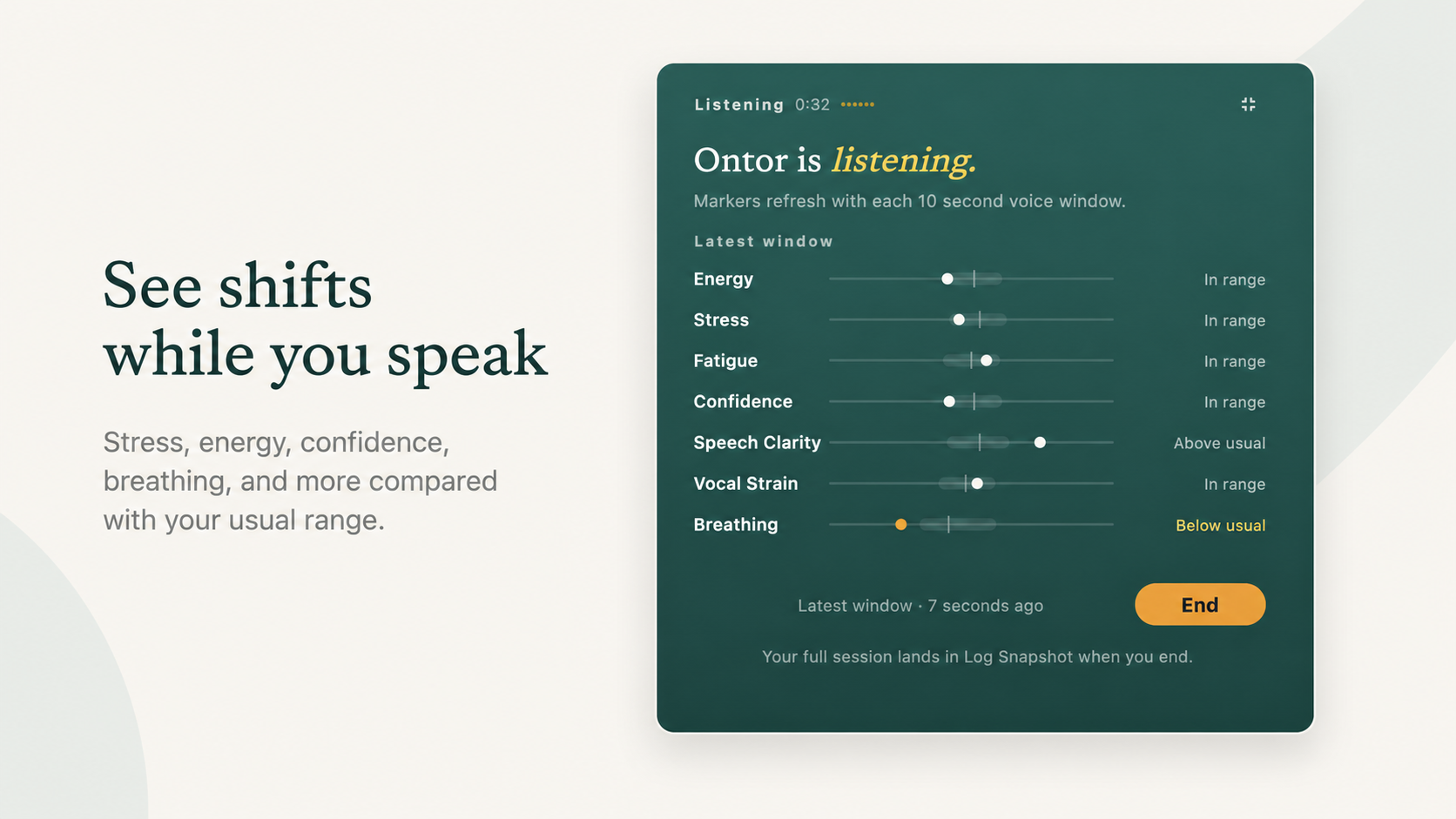
Here is the live listening view from my own Ontor product use. Markers refresh with each short voice window and sit against my usual range. In one window, breathing can sit below usual while other markers stay in range. That is the kind of self-invisible shift a speaker misses while skull conduction is still feeding the wrong self-signal:
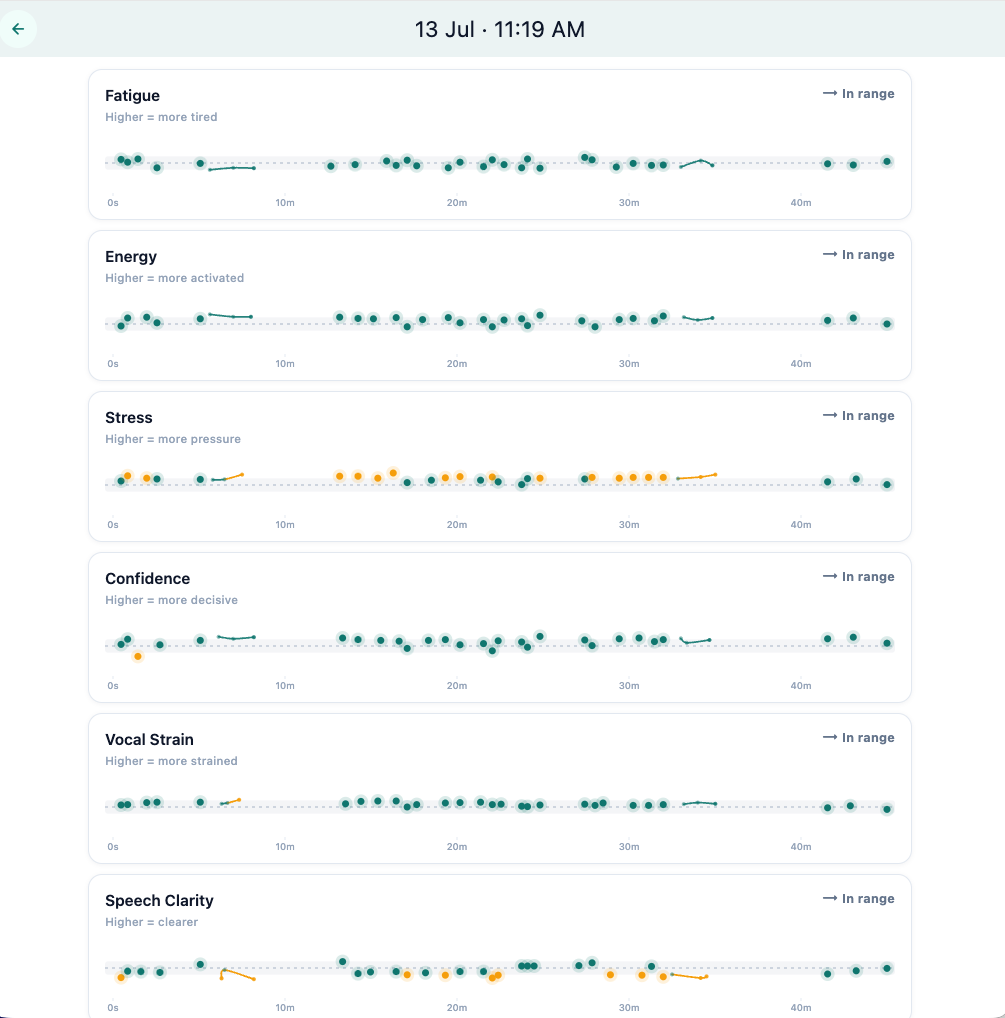
Here is a full meeting analysis from my own Ontor session history (one personal meeting block). Stress leaves my usual band in amber clusters mid-session. Speech clarity also shows brief windows off usual. Early windows can look calm; the live middle of the block is where the climb and thin show. Cap any clinical claim. This is one person's usual-range history, not proof a client's dial outcome will improve:
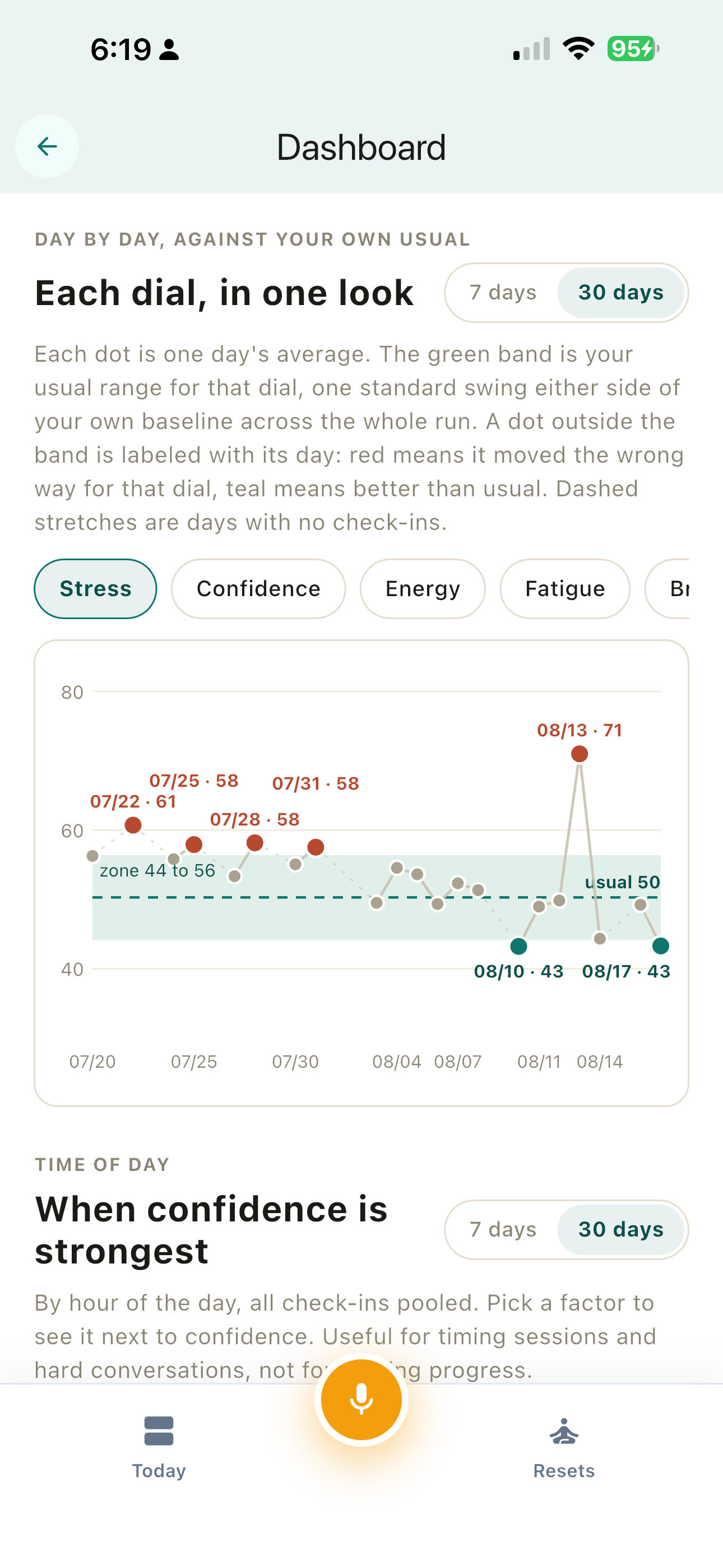
Across dials and days, my own Ontor dashboard also keeps stress against a personal usual zone (for me, roughly mid-40s to mid-50s on that run, with spikes well above usual on hard days). That private band is what makes an unnoticed climb or rush usable as a tool signal: not a population average, your range:
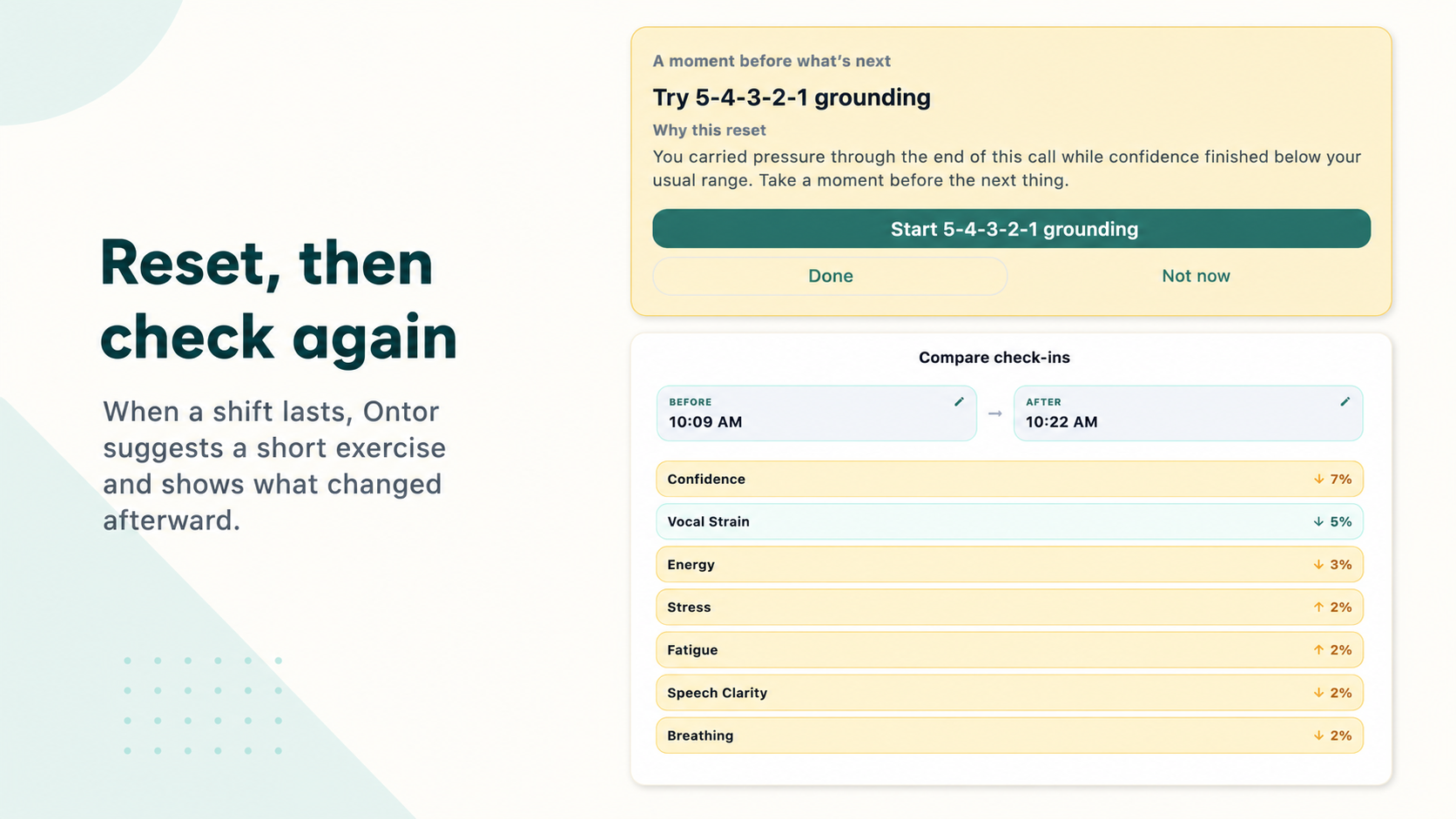
When that private read says I left usual range during a pressured stretch I did not hear accurately while speaking, Ontor can surface a short reset before the next live block. Here is a reset-then-compare view from my own product use. Cap any medical claim. The product point is a short private loop you own so the next live window can move back toward usual range, not a clinical intervention and not another after-the-fact recording tip:
Try it on the next live block your client runs without you
Download Ontor - 14 days free, no card required
Install it for a real unsupervised dial, board open, or challenged call block, not another practice read-through. Ask the client to notice how they sound versus their usual range in the first pressured minutes: did stress, strain, breathing, or clarity leave their personal band while pitch climb, thin/trail-off, adrenaline rush, or shrink-to-quiet was invisible from inside? Take a short reset if the shift lasted. Keep the recording mirror, breath-voice drills, and session listening you already teach. Add a private loop that shows whether the self-deaf pattern showed up when you are not in the room.
If you sell into pods or leadership teams, the soft path is a research or pilot conversation, or Ontor for teams, with aggregate patterns only. The primary next step for this coaches channel is still the next live unsupervised block: hear climb/thin/rush/shrink against personal usual range, not another delayed playback.
Sabber Ahamed is the founder of Ontor and an applied ML scientist (PhD in geophysics and signal processing) who builds on-device voice tools. He has shipped production signal and ML systems across radiology AI, healthcare, and manufacturing. Ontor compares how you sound to your own usual ranges and suggests short resets, without claiming clinical or revenue outcomes from marker changes. LinkedIn · About
References
- Topher Keene - What Can I Learn in an Executive Presence Coaching Session? (buyer evidence; skull conduction; cannot hear own pitch climb / trail-off / pace)
- John J Norton / Voice Zone - Voice Coaching for Presentations That Works (buyer evidence; thin/trail, pitch climb, transfer)
- Sam Malone / Elevate Voice - LinkedIn: nervous system reason voice disappears (buyer evidence; quieter/smaller under threat)
- Sam Malone / Elevate Voice - About (role corroboration)
- Dominic Colenso / Sales Reinvented Ep 496 (buyer evidence; adrenaline urge to accelerate vs slow down)
- Danielle Benzon / She Coaches Coaches Ep 427 - Voice-Body Alignment (buyer evidence; clients feel misalignment; breath hold)
- How Ontor works
- Ontor for teams
- About the founder - Ontor
- Install Ontor