
The pause isn't awkward. Filling silence is how prospects hear you're scared.
You already know the search. Why do I fill silence on sales calls. Silence feels awkward after a good question. How to stop talking over the prospect. Hold the pause on a discovery call. If that is you on live dials, this piece is for individual call-heavy AEs and SDRs, plus the managers coaching how you sound when the quiet hits.
The audible tell is not "ask better questions" as the first answer. After a good question the prospect goes quiet. You treat that pause like danger. So you fill it: a clarification nobody asked for, a reframe of the question you just asked, an example that mostly breaks the silence. The silence was not the problem. What you made it mean was. Filling it removes the honest answer. Prospects hear the rush and over-talk as state, not skill.
This is not when you're off your game you rush and over-explain (pre-call / low-conviction rush before the hard dial). It is not notes while talking / presence (mid-call CRM typing). It is not prospects hear when the voice tightens, afternoon sit-sink by call 30, block-length robot voice, or hangover between sales calls. The object here is live mid-call silence-fill after a good question: personal baseline plus a short reset so the quiet can land.
Download Ontor - 14 days free, no card required
After a good question they go quiet. Everything in you wants to fill it.
Meghann Misiak (seller/coach naming the lived mid-call silence failure) put the stack in buyer language:
"You ask a good question. & then they go quiet. & everything in you wants to fill it. You can feel the words forming before you've even decided to say them. A clarification they didn't ask for. A reframe of the question you just asked. An example that maybe helps but mostly just breaks the silence..."
And the meaning she attaches to why it feels unbearable:
"Bc the silence is doing something to your nervous system that feels a lot like DANGER. So you talk. & the moment is gone."
That "nervous system / DANGER" line stays hers. Ontor's product framing for the same moment is narrower and claim-safe: stress, confidence, and pace leave your personal usual range mid-call, so the urge to rush and fill shows up in how you sound before the prospect finishes thinking.
Meghann's thesis closes the loophole that "silence is just awkward":
"bc silence on a sales call isn't awkward bc of the silence. It's awkward bc of what you make it mean."
"An empty pause feels like rejection. But that pause.... that's often the most valuable moment in the whole call. & when you fill it you take that away from both of you."
Script-correct questions still fail when the fill removes the honest answer. Managers who only coach "don't over-talk" miss the mid-call leave peers already name: the pause felt like danger, so you talked.
Corroboration: tension shows in tone, pacing, and even silence; desperation is audible as energy
Joel Graber (outbound founder reflecting on past 50+ cold-call days) named how pre-block tension leaks into the quiet itself:
"By the time you start dialing, you're already tense. That tension comes through in your tone, in your pacing, and even in your silence."
Peers on that thread underscored the same point: tension in pacing and silence is felt instantly. Joel's prescription sits next to Ontor's short-reset wedge (sixty seconds of box breathing before a block so the voice carries calm). Use it as corroboration that silence is an audible channel for state, not only an empty gap between words. Cap the physiology branding; Ontor does not invent medical claims from his "nervous system fires" language.
Sahiba Mohsin (first-person SDR after rough zero-meeting weeks) named why the fill sounds like fear to the other side:
"When you're desperate, they feel it. When you're curious, they feel that too."
"How you feel is the product. Your energy is the pitch. And no script in the world can fake genuine curiosity."
Peers added deep breath plus stand before tough dials, and that pressure shows up in conversation faster than reps think. Sahiba's energy-as-pitch line corroborates Meghann's fill: when state is desperate, the rush into the pause is how prospects hear you're scared, even with a good question on the page.
Capped color only: smile-to-tone and 2-second tells (do not lead)
Two short IC tips name adjacent how-you-sound craft. Cap them. Do not let robot-voice or smile-dial become this article's spine.
Elliott Azoulay (Deel SDR): smile before you dial; prospects hear it in your voice; a smile changes your tone before they pick up on your pitch. Useful as a physical face-state lever for tone. Not the mid-call silence-fill object.
Chad Baker (tenured SDR): prospects know in about two seconds if you sound scripted, monotone, or salesy/pitchy; know when to slow down. Useful as early-audible delivery craft. Not a lead for block-length robot voice, and not a claim that silence-fill equals monotone.
Use those lines only as light color that prospects hear state fast. This article stays on live silence intolerance after a good question.
What "don't over-talk," self-listen, and "just wait" still miss
Typical stack for an IC who already knows they fill the pause:
- Discovery frameworks so questions are "good enough"
- Manager coaching: stop over-talking, count to three, let them answer
- Peer rituals (stand, breath, smile) invented privately
- Post-call recording review after the fill already killed the moment
- Confidence pep talks when desperation energy is the leak
Useful. Incomplete for the how-you-sound leave mid-call. A good question does not tell you, in the moment, that pace, stress, or confidence left your personal usual range when the quiet hit. "Count to three" does not give you a personal baseline. Self-listen after the fact catches one recording, not lasting shifts across short speech windows while the next pause is already forming.
None of those continuously ask: right after this good question, while they are quiet, did pace, energy, confidence, strain, stress, or breathing leave your own usual range in short voice windows as you rushed to fill? Ontor does not replace discovery training. Ontor does not claim that waiting longer alone is wrong. It reads how you sound versus your personal usual range while you speak, and can offer a short reset when a lasting shift shows up, so the quiet can land instead of getting covered.
Prospects feel the rush first. Managers often meet it as "you talked over them" or "you sounded needy" without a shared signal the IC can check privately mid-call.
How this differs from off-game rush, notes presence, and other siblings
Over-explain when off your game answers: when conviction is low or you skip a pre-call regulate, does rush + over-explain collapse authority before the hard dial?
Notes while talking / presence answers: does CRM typing / split attention show up as half-present delivery?
Prospects hear when the voice tightens, call 30 sit-sink, block-length robot voice, and hangover between sales calls answer different objects: resistance-tightened voice, afternoon flat body-to-voice, monotone by lunch, and between-call carryover.
This article answers a different question: after a good question on a live dial, when the prospect goes quiet, does treating that pause like danger produce a fill (clarification / reframe / example) that removes the honest answer, do prospects hear that rush as scared state, and can a personal voice baseline plus a short reset help the quiet land?
Same call-heavy world. Different trigger. Live mid-call silence-fill, not off-game pre-call rush, not notes distraction, not afternoon sit-sink.
Download Ontor - 14 days free, no card required
What Ontor adds so the quiet can land (private first)
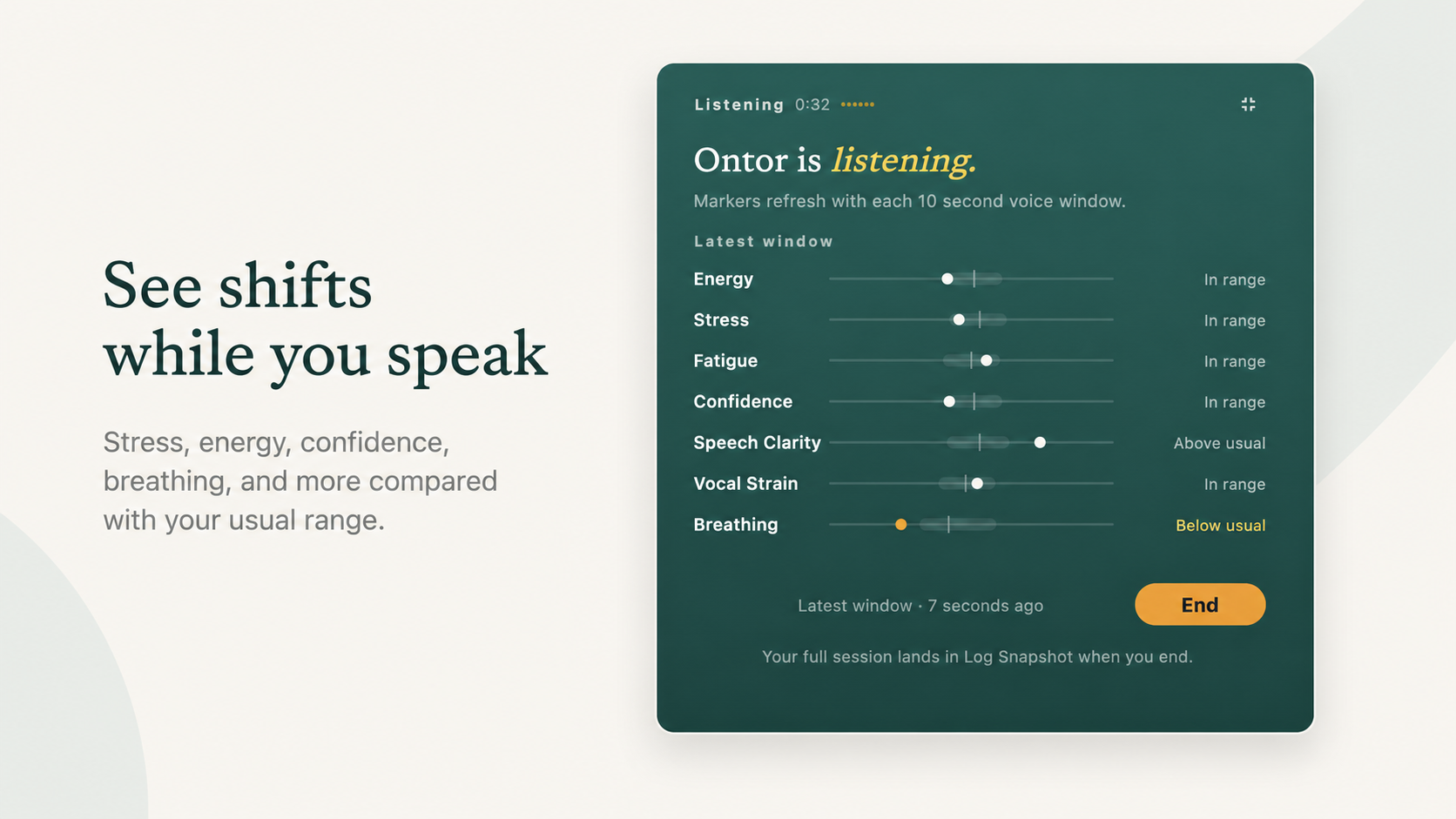
Ontor is a performance tool that reads how you sound, not what you said. While someone speaks, it compares voice signals to that person's own usual range. Markers refresh in short voice windows (on the order of about 10 seconds of speech). When a lasting shift shows up (for example energy, fatigue, stress, confidence, speech clarity, vocal strain, or breathing), it can suggest a short reset. People can also compare before and after.
Explicit boundaries for this topic:
- Ontor does not replace discovery frameworks, objection handling, or "count to three" coaching.
- Ontor does not claim medical or clinical regulation outcomes, and does not diagnose sellers from Meghann's "nervous system / DANGER" buyer language.
- Ontor does not claim that marker changes prove better close rates, quota attainment, or cognitive improvement.
- The claim stays narrow: when mid-call rush-to-fill leaves your personal usual range for stress, confidence, or pace, a private baseline cue plus an optional short reset is a loop you can run so the quiet can land instead of getting covered.
For teams, Ontor's public framing is aggregate patterns for workload, coaching, and support. Individual sessions and readings stay with the person. Managers coaching "stop filling silence" can watch cohort-level energy or confidence drift. They do not get a personal scoreboard for hire or fire decisions. Soft secondary path: Ontor for teams.
In my own Ontor session history (founder exploratory data from my own product use, not your floor's outcome data), the silence-fill pattern shows up the same way Meghann names it. After a good question, or when I can feel the urge to clarify before the other person has finished thinking, pace, stress, or confidence can leave my personal usual range in the short windows. I am still "on script" on paper. Delivery is already drifting toward rush and fill before the honest answer has room. That is the mid-call leave this article is about, visible as personal-baseline leave rather than a bad question.
Here is the live listening view from my own Ontor product use: markers refresh with each ~10 second voice window and sit against my usual range. Read it as a private check for whether energy, confidence, strain, stress, or breathing left my band when I would otherwise rush to fill a live pause:
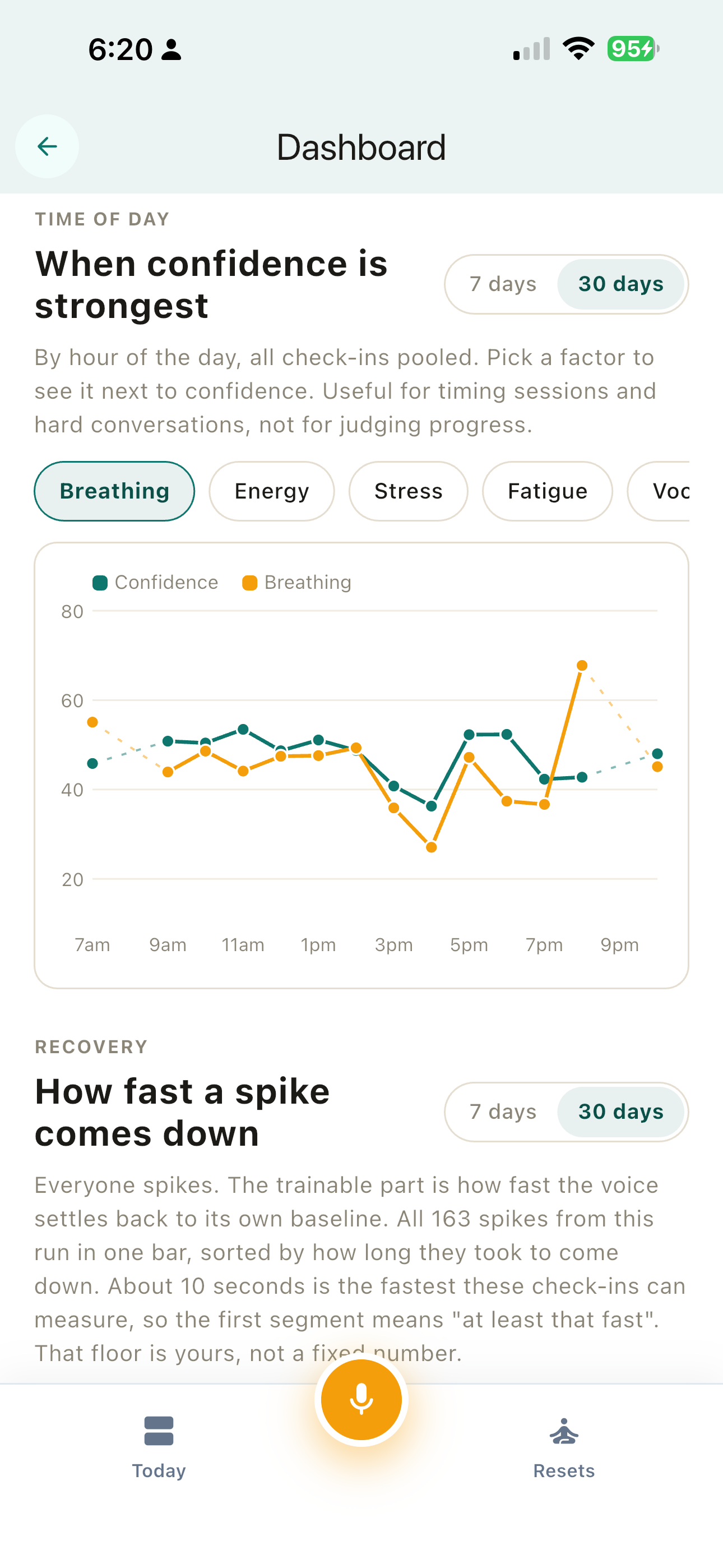
Here is confidence with breathing by hour from that same Ontor history. Confidence can sit fine early, then leave my personal usual later when the day gets harder and pauses feel costlier. Read it as founder exploratory data on personal-baseline drift across a call-heavy day, not proof of quota outcomes and not a claim that Ontor measured "silence intolerance" as a clinical label:
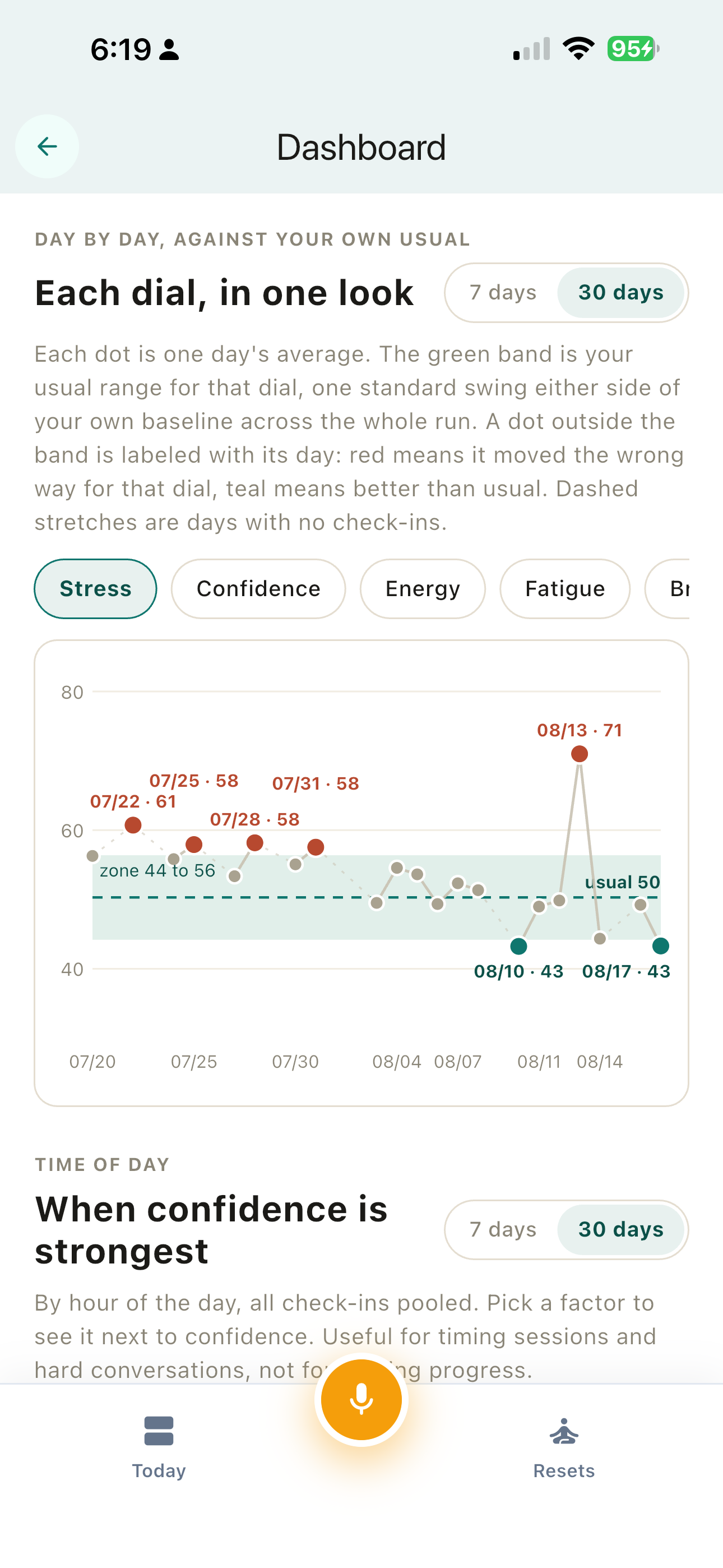
Here is stress day by day against my personal usual band (zone ~44 to 56, usual 50) from the same session history. Red points sit above my usual range. Useful as a private check for how often voice-state leaves the band across calls when a quiet pause would push rush and fill. It is not a hire-or-fire score and it is not proof that a suggested reset caused calmer holding of silence:
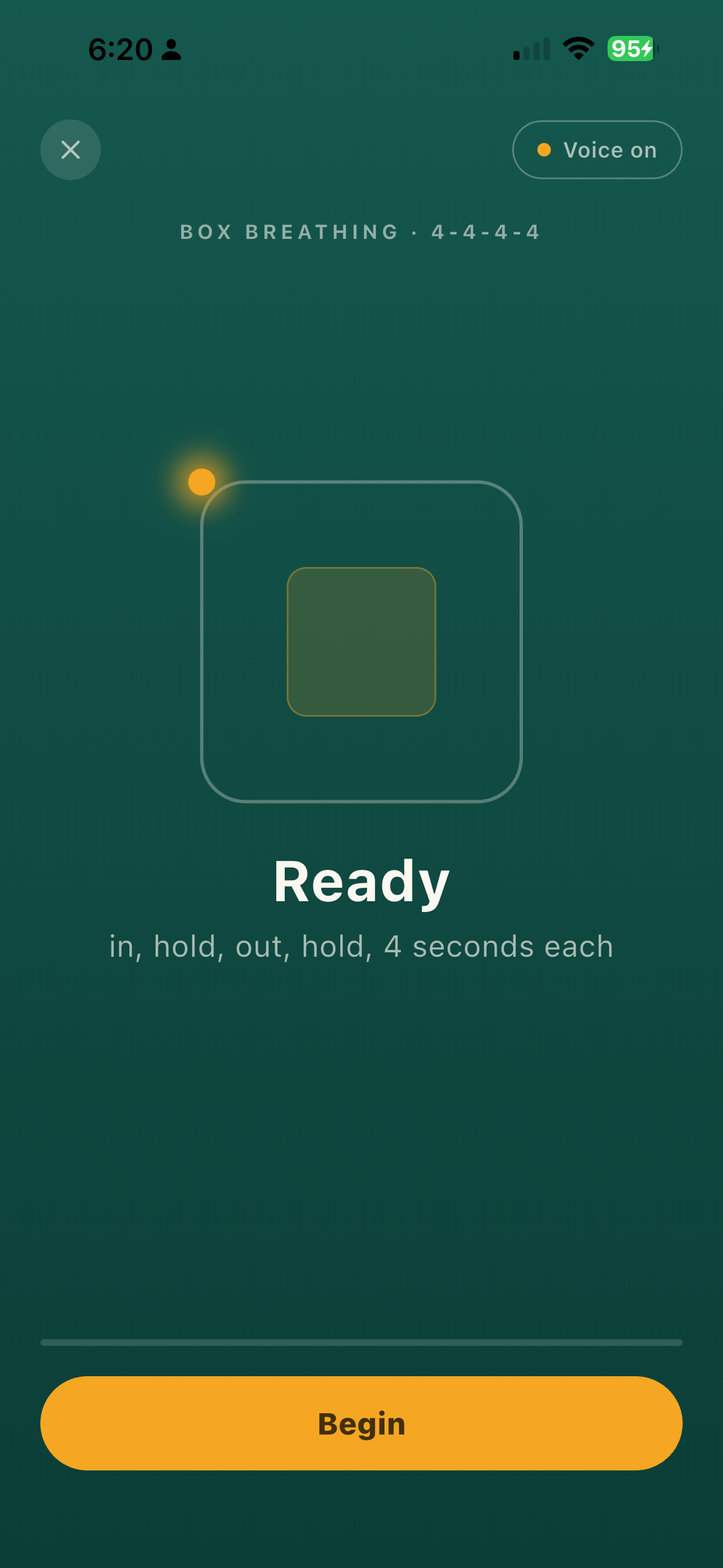
And here is the short reset the product offers when a lasting shift shows up: box breathing, 4-4-4-4. That is the tool form of letting the quiet land, available privately when pace or stress leave your band mid-call or between dials. It is not a medical protocol and it is not a claim that one cycle makes every prospect answer on cue:
This is not a claim that voice markers diagnose fear, prove cognitive improvement, predict revenue, or replace manager judgment. The claim stays narrow: when "just wait" coaching misses the mid-call rush-to-fill leave, a private signal plus a short reset is a loop people can run so the pause can land, while leaders watch cohort patterns only in aggregate.
What to try on your next live dial
Do not wait for a research committee if you are an IC who already feels the words forming in the quiet after a good question, or a manager coaching fills who keeps hearing the same tell.
- Install Ontor on the machine you already use for cold calls, discovery, and demos.
- On the next live dial, after a good question, let the quiet land. Notice whether pace, energy, confidence, strain, stress, or breathing sit outside your usual range in the short speech windows, especially when you can already feel the clarification / reframe / example forming.
- If a lasting shift shows up, or if you know you are about to fill, take the short suggested reset (or a breath between turns) so the quiet can land instead of stacking more rush into the pause. Then continue.
- If you coach a pod, keep leaders on aggregate patterns only for energy / confidence drift under mid-call silence pressure. Personal readings stay with the person. Treat Meghann's silence-fill and Joel's tension-in-silence as performance controls, not only soft skills. Pair with a quick self-listen after a hard discovery block. Do not treat Ontor as a script coach or a hire-fire tool.
Concrete try-on-next-call step: ask one good question, hold the quiet, and notice rush/fill versus your personal baseline before you speak again.
Soft secondary path if you lead mid-market coaching on mid-call composure and want a measured look later: Ontor for teams, or a research conversation / pilot on personal voice baselines versus silence-fill rush.
Do not promise win-rate, retention, or revenue guarantees. Measure whether people can tell when pace and confidence left their usual voice before a prospect names the needy fill.
Bottom line
The pause isn't awkward. Filling silence is how prospects hear you're scared. Meghann named the danger-feel and the fill that kills the honest answer. Joel named tension in tone, pacing, and even silence. Sahiba named desperate energy as the audible product. Capped smile-to-tone and 2-second craft tips stay color only. The gap that remains is personal usual-range stress, confidence, and pace in short speech windows, caught mid-call when the quiet hits, before the next unasked clarification.
Try Ontor on your next live dial. Notice the short voice windows versus your usual range after a good question. Take the short reset when a lasting shift shows up. Let the quiet land.
Download Ontor - 14 days free, no card required
References
- Meghann Misiak. LinkedIn post: why silence on a sales call feels so unbearable; silence doing something to your nervous system that feels like DANGER; silence isn't awkward because of the silence, it's awkward because of what you make it mean; fill kills the valuable pause. https://www.linkedin.com/posts/megmisiak_why-silence-on-a-sales-call-feels-so-unbearable-activity-7480267036397498368-HgRh
- Joel Graber. LinkedIn post: tension comes through in your tone, in your pacing, and even in your silence; oxygen / box breathing before cold-call blocks (corroboration). https://www.linkedin.com/posts/joel-graber-_modern-signal-activity-7374813270320500736-TchQ
- Sahiba Mohsin. LinkedIn post: when you're desperate they feel it; how you feel is the product; your energy is the pitch (corroboration). https://www.linkedin.com/posts/sahibamohsin_i-had-a-terrible-week-as-an-sdr-not-once-activity-7470716477218852864-grRc
- Elliott Azoulay. LinkedIn tip (supporting only, capped): smile before you dial; a smile changes your tone. https://www.linkedin.com/posts/elliott-azoulay-020348207_smile-before-you-dial-prospects-can-hear-activity-7499053011483234304-0rS-
- Chad Baker. LinkedIn tip (supporting only, capped; do not lead robot-voice): prospects know in ~2 seconds if you sound scripted, monotone, or salesy/pitchy. https://www.linkedin.com/posts/chad-baker-288596139_sdr-bdr-sales-activity-7480709589672353792-kScW
- Ontor. "How it works." https://ontor.ai/how-it-works/
- Ontor. "Ontor for teams." https://ontor.ai/for-teams/
- Ontor. "About the founder." https://ontor.ai/about/
- Ontor. "Install Ontor." https://ontor.ai/install/
- Ontor. "When you're off your game you rush and over-explain..." https://ontor.ai/blog/over-explain-when-off-your-game/ (sibling, off-game / pre-call regulate)
- Ontor. "Prospects can tell when you're not present. Typing while listening is not free." https://ontor.ai/blog/notes-while-talking-presence/ (sibling, mid-call notes presence)