
Your remote collectors don't have a hallway. Dials still act like they do.
In-office collections floors got free informal recovery. A hallway walk after a hostile dial. A breakroom vent. A peer asking "you good?" before the next connect. Remote and hybrid collectors lost that. Leaders invent onboarding journeys, AUX codes, and chat check-ins. Dials still assume the reset happened.
This is for collections and contact-center ops and learning leaders (SVP Ops, VP Learning, Dir Ops, training directors) at agencies and BPO recovery floors with remote or hybrid collectors. It is not readiness after a hostile cool-down alone. It is not live-monitor demeanor drift framed for an office floor. It is not break-window distraction on dial boards. It is not first-60-days confidence collapse. The object here is remote and hybrid lost hallway and breakroom peer resets, while dials, AUX, and journeys still act like recovery already happened before the next hostile dial.
Download Ontor - 14 days free, no card required
Remote floors lost the hallway and the breakroom
CJ Johnson (SVP of Operations and Client Services, iQor) put the remote training gap in plain buyer language on an AccountsRecovery panel:
"You can't treat remote work. Just like classroom work."
And what disappeared when collectors stopped walking the floor:
"what the way it used to work is a person went through training and they learned a lot, not just from the training classroom, but the walking to the training room, the break rooms, and all of those things of that nature. Without having those anymore, you have to have a clearly defined journey for what your people are going to experience when they are onboarded to your training environment."
That is not only a curriculum complaint. Walking to the training room and breakroom time were also informal peer resets: composure cues, short vents, and "you good?" moments that never showed up as a disposition code. Remote and hybrid nesting still hits live hostile stacks. The hallway is gone. The dial board still advances.
Angel Villarino (VP of Global Learning, Alorica) puts tone in week-1 remote foundations alongside compliance and call flow:
"Week one, the foundation and the environment set up, make sure that, all the tech is set up, the tools, walk through clear expectations on key performance indicators how the training is going to be conducting. And then, introduction to the fun, fundamentals of what it is that we're gonna train. Your compliance, your tone, your cold flow."
His parting billboard for remote learning:
"For me it would be build training with intentional structure, pair with human connection."
So remote leaders already teach tone early and already try to replace informal bonding with structure plus connection. The gap that remains is what happens after nesting: when there is no hallway peer to notice that voice, energy, or composure left that collector's personal usual range between tough calls, before the next dial.
Leaders already invent breathers, beats, and mid-call re-entry. Dials still miss the leave.
Irene Hoheusle (Armed Compliance Business Solutions; Conflict Management panel) names a leader-assigned off-phone breather after a hostile stack. After about 15 back-to-back frustrated-debtor calls:
"Not everybody could do that after 15 phone calls, especially if they're working a portfolio that has a lot of frustrated debtors. 'cause the type of bill it is, you're getting back to back one after the other. Sometimes it's worth telling them, you know what, put the phone down. How about you help me with this report instead? Let's do some other things for the next half hour. So you could breathe a little bit."
And the range of that temporary pull:
"It might be taking them off the phone for a week, but it might just be taking 'em off the phone for half an hour to give them a breather. And then they also feel you get it."
That is distinct from a scripted Timeout AUX alone. It is a temporary off-phone breather after a hostile stack so the collector can breathe. Useful. Still incomplete for remote: who notices the leave when there is no floor walk-by, and when the next dial is already queued?
Melony Frizzell (Senior Director of Training and Development, Revco Solutions) names the compliance overload that flattens personality on the phone, plus a mid-call deep-breath re-entry as craft color:
"sometimes, they get through and you're right, they hear the compliance and quite frankly, sometimes they're so crippled by everything. They have to remember that they forget to have a personality and, or it's hard for them to remember, like, how do I talk to people?"
Her mid-call recovery move:
"Take a deep breath and just say, Mr. Sexton, I've, I've never dealt with you before. You I've I can hear you're frustrated. You've been going through a lot, sounds like this is like the least the worst thing you wanna deal with right now. The last thing you wanna deal with right now, but I'll tell you this, you've never dealt with me before. Can you give me a chance to help you try to figure this out? Can you give me a chance?"
Tim Woudenberg (Director of Operations, Creditors Bureau USA) coaches the same family of composure under pressure for managers as "take a beat":
"let's take a step back, let's take a beat, let's look at this. Let's walk through this together. Tell me the problem. Okay, great. Now we know what the problem is. Tell me what your options are."
Journeys, Timeout AUX, chat check-ins, off-phone breathers, deep-breath re-entry, and take-a-beat coaching all assume someone notices when recovery did not land. Remote and hybrid dials still advance when voice and energy have already left that person's personal usual range, and there is no hallway peer to catch it.
What this article is not answering
Published Ontor collections pieces already cover adjacent voice moments:
- Cool-downs between hostile calls answer readiness after a hostile disposition, not specifically remote hallway loss.
- Demeanor drift answers live-monitor miss of mid-shift demeanor shift, framed for office-floor reading.
- Break-window fatigue answers schedule-tied distraction around breaks on dial boards.
- Early-tenure confidence answers first-60-days confidence collapse.
Also separate from:
Jake Richards (VP Extended Business Office Operations, State Collection Service) separately argues leaders need each agent's day-to-day demeanor as a personal baseline to spot a shift. Use that only as light corroboration that personal baseline matters. Do not re-center that demeanor-drift spine here.
This article answers a different question: on remote and hybrid collections floors that already design journeys, AUX codes, chat check-ins, off-phone breathers, and week-1 tone foundations, do leaders still miss when a collector's voice, energy, or composure left their own usual range between tough calls, because the hallway and breakroom peer resets are gone, while dials still act like the recovery happened?
Same collections beachhead. Different object. Remote and hybrid lost informal hallway and breakroom peer resets; dials and AUX still assume recovery.
Download Ontor - 14 days free, no card required
What journeys, AUX, and chat check-ins still miss
Typical stack for a remote or hybrid recovery floor:
- Clearly defined remote onboarding journeys (Johnson)
- Week-1 tone foundations plus intentional structure and human connection (Villarino)
- Timeout AUX and leader-assigned off-phone breathers after hostile stacks (Hoheusle)
- Mid-call deep breath and "give me a chance" re-entry (Frizzell)
- Take-a-beat coaching under pressure (Woudenberg)
- Chat check-ins and Slack feedback loops as hallway substitutes
- Dial / connect / recovery boards and QA listen-backs
Useful. Incomplete for the how-you-sound leave when there is no hallway. A defined journey does not tell you, in the moment, that energy or composure left your personal usual range before the next hostile dial. A Timeout AUX code does not give the collector a private baseline. A chat "you good?" catches what someone typed, not lasting voice shifts across short speech windows. Post-call QA catches one recording after the borrower already heard the flat or strained delivery.
None of those continuously ask: between tough calls on a remote or hybrid block, did voice, energy, stress, clarity, or composure leave your own usual range in short speech windows when there was no hallway peer to notice, and before the next dial assumed you had already reset?
Borrowers hear that first. Leaders often meet it later as a "bad call," a compliance near-miss, or attrition after nesting, without a shared private signal the collector can check before the next connect.
What Ontor adds when there is no hallway (private first)
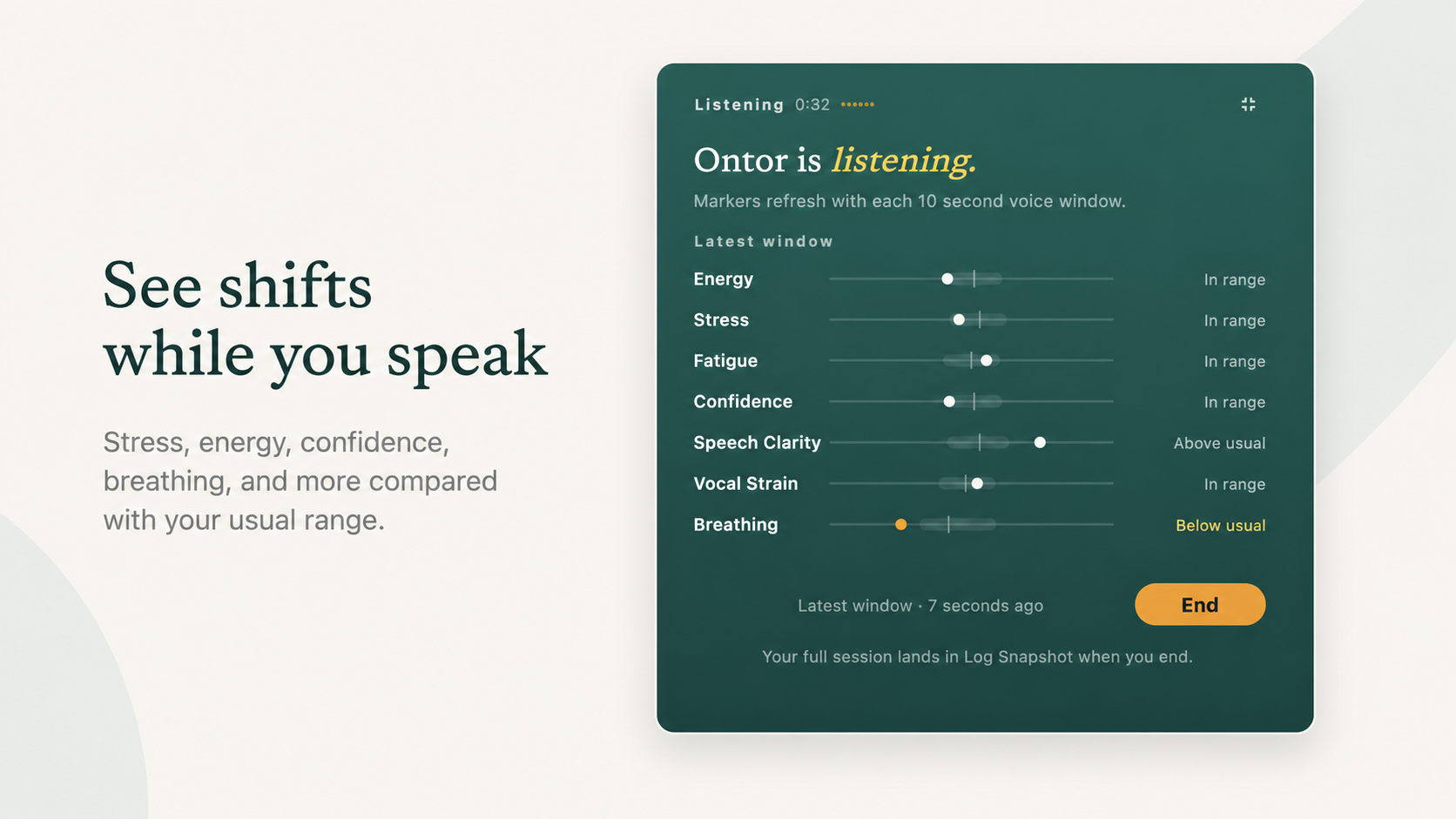
Ontor is a performance tool that reads how you sound, not what you said. While someone speaks, it compares voice signals to that person's own usual range. Markers refresh in short voice windows (on the order of about 10 seconds of speech). When a lasting shift shows up (for example energy, fatigue, stress, confidence, speech clarity, vocal strain, or breathing), it can suggest a short reset. People can also compare before and after.
Explicit boundaries for this topic:
- Ontor does not replace remote journeys, AUX design, week-1 tone training, or manager coaching.
- Ontor does not claim medical or clinical composure outcomes, and it is not breathwork therapy.
- Ontor does not claim that marker changes prove better recovery rates, retention, ramp speed, or cognitive improvement.
- The claim stays narrow: when remote or hybrid collectors lose hallway and breakroom peer resets, a private baseline cue plus an optional short reset is a loop you can run when voice, energy, or composure leave your personal usual range between tough calls, before the next dial.
For teams, Ontor's public framing is aggregate patterns for workload, coaching, and support. Individual sessions and readings stay with the person. Ops and learning leaders can watch cohort-level energy or stress drift on remote pods. They do not get a personal scoreboard for hire or fire decisions. Soft secondary path: Ontor for teams.
In my own Ontor session history (founder exploratory data from my own product use, not your floor's outcome data), the no-hallway pattern shows up the same way Johnson and Villarino name the remote gap. After a hard block, when there is no peer walk-by and the next dial is already queued, stress, energy, or composure can leave my personal usual range in the short windows. I am still "ready" on the talking points. Delivery is already drifting before the next tough call. That is the lost-hallway gap, visible as personal-baseline leave rather than a missing AUX code. A short optional reset before the next dial is the tool form of the hallway breather, not a claim that one cycle fixes recovery rates.
Here is the live listening view from my own Ontor product use: markers refresh with each ~10 second voice window and sit against my usual range. Read it as a private check for whether stress, energy, clarity, strain, or breathing left my band between tough calls when there is no hallway peer reset:
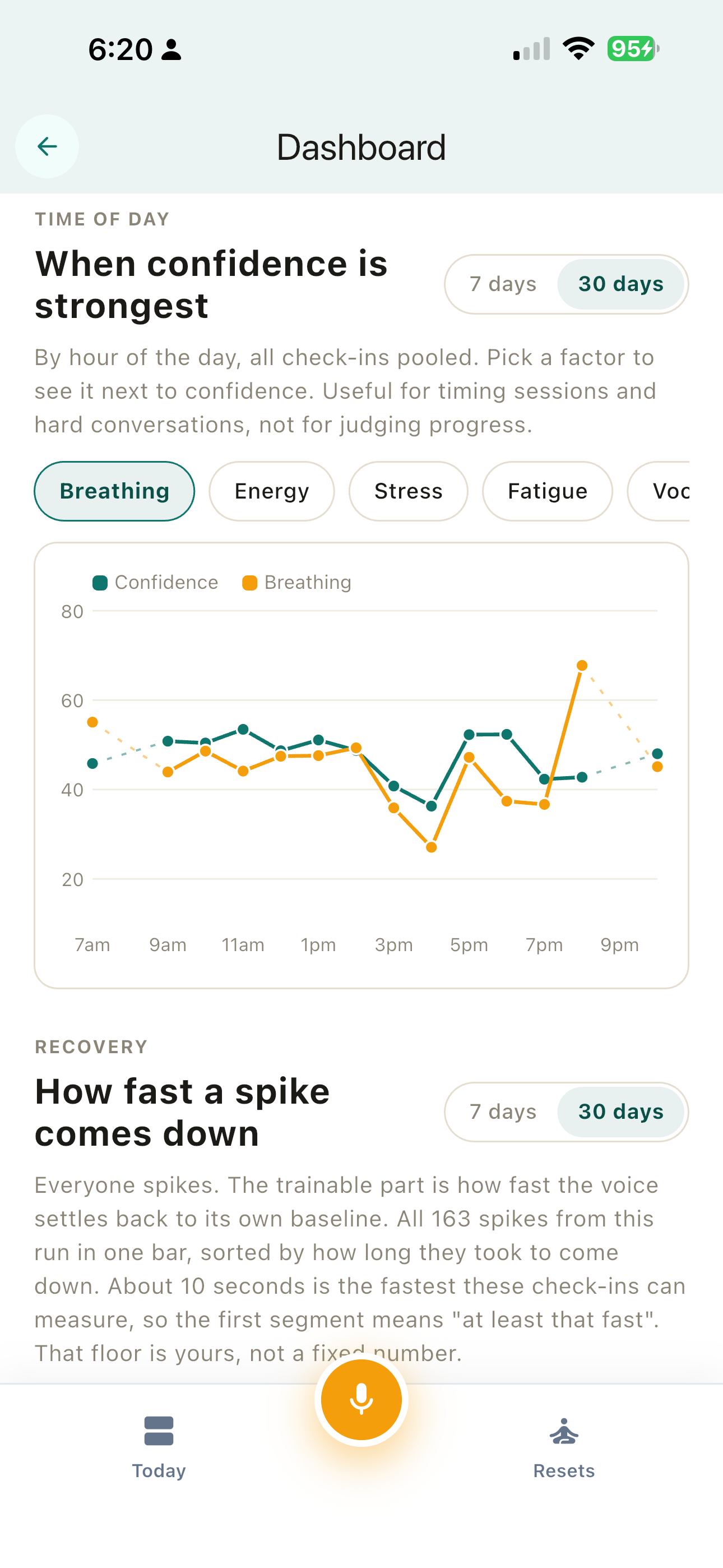
Here is confidence with breathing by hour from that same Ontor history. Confidence can sit fine early, then leave my personal usual later when the day gets harder and hard calls stack without an informal peer reset. Read it as founder exploratory data on personal-baseline drift across a call-heavy day, not proof of remote floor outcomes and not a claim that Ontor measured "hallway recovery" as a label:
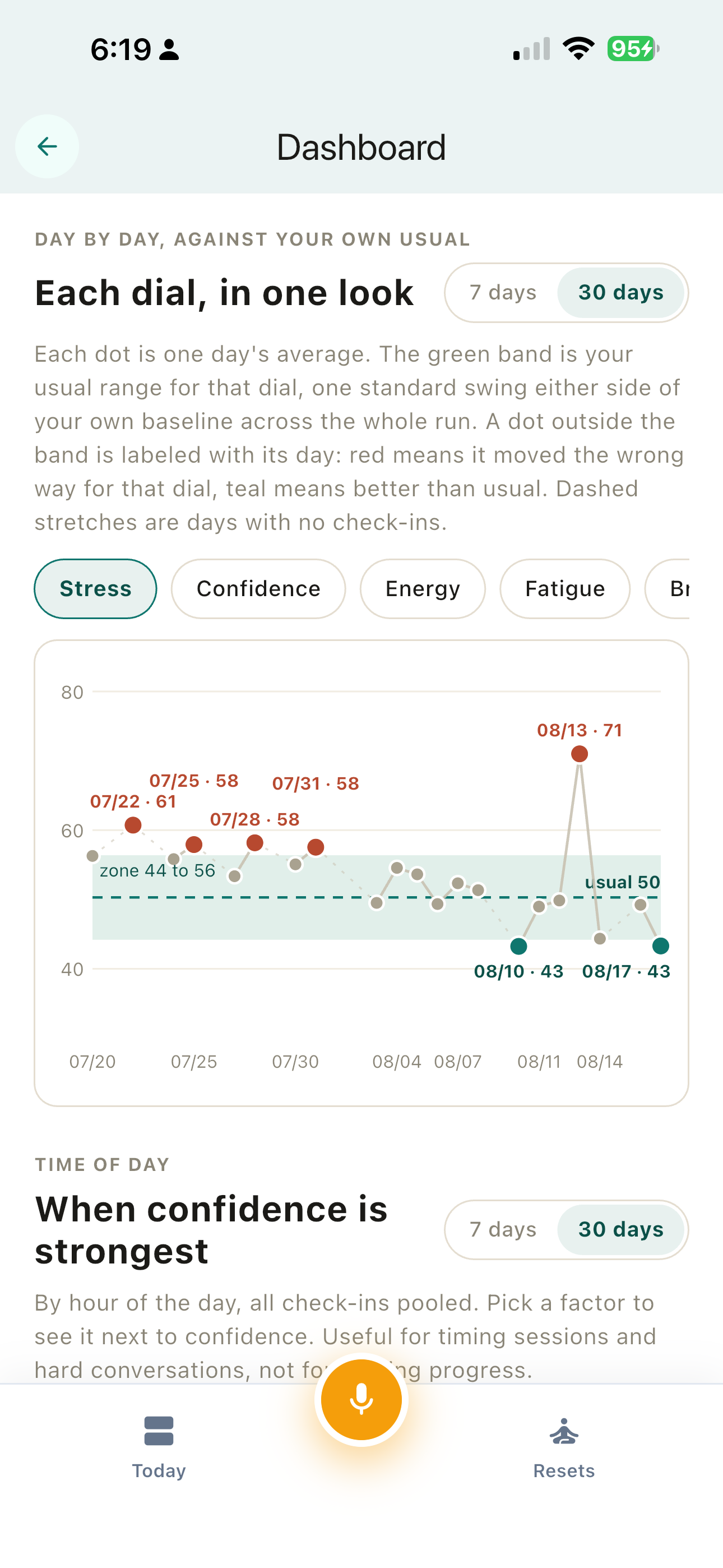
Here is stress day by day against my personal usual band (zone ~44 to 56, usual 50) from the same session history. Red points sit above my usual range. Useful as a private check for how often voice-state leaves the band across calls when the next dial would assume recovery already happened. It is not a hire-or-fire score and it is not proof that a suggested reset caused calmer next-dial tone:
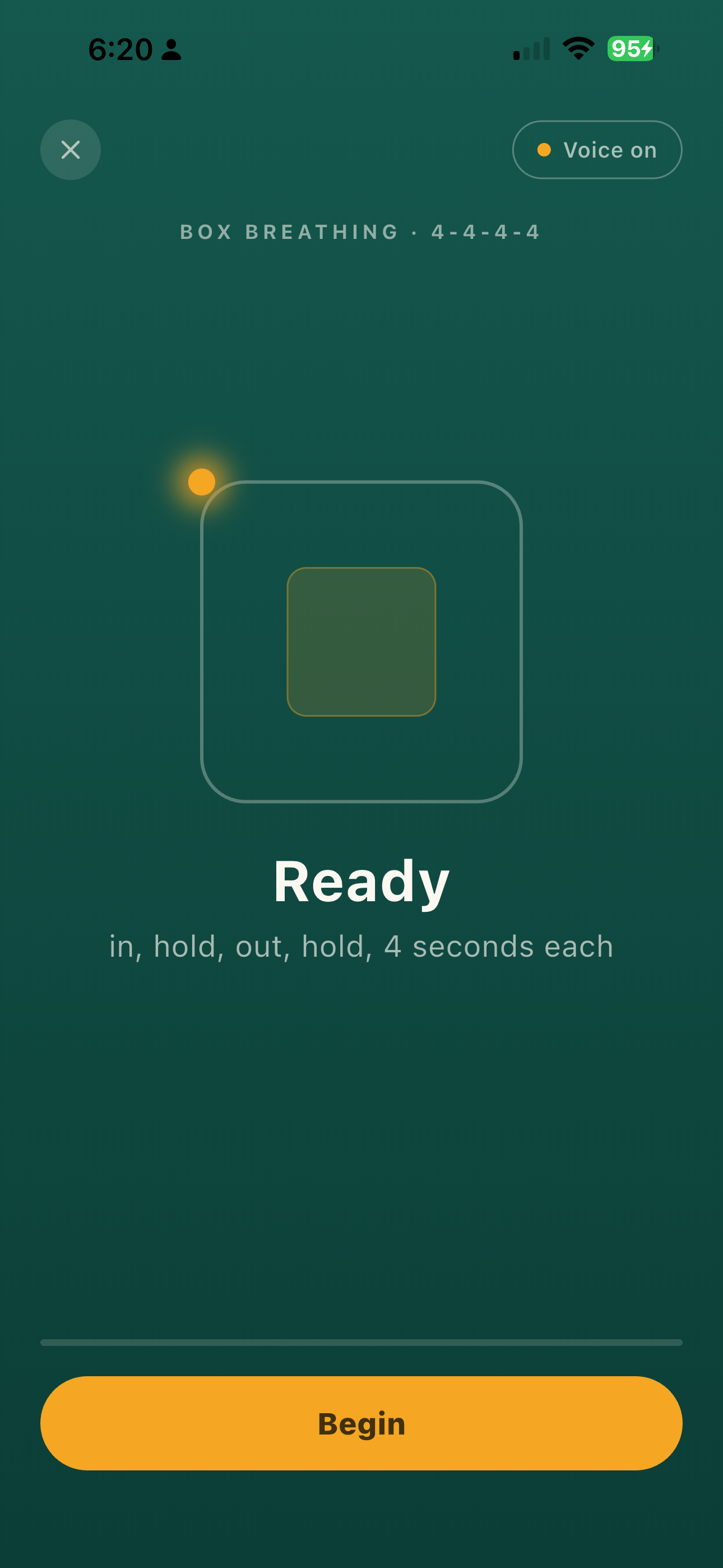
And here is the short reset the product offers when a lasting shift shows up: box breathing, 4-4-4-4. That is the tool form of Hoheusle's breather, Frizzell's deep breath, and Woudenberg's take-a-beat, available privately without waiting for a manager to invent a report task. It is not a medical protocol and it is not a claim that one cycle replaces structure plus human connection:
This is not a claim that voice markers diagnose isolation, prove cognitive improvement, predict revenue, or replace manager judgment. The claim stays narrow: when journeys and AUX miss the personal-baseline leave that hallway peers used to catch, a private signal plus a short optional reset is a loop people can run before the next hostile dial, while leaders watch cohort patterns only in aggregate.
What to try on your next remote call block
Do not wait for a research committee if you run remote or hybrid recovery floors and still assume the hallway reset happened between tough dials.
- Install Ontor on the machine collectors already use for outbound and inbound connects at home or on a hybrid desk.
- On the next live remote block after a hard or hostile stack, notice whether stress, energy, confidence, clarity, strain, or breathing sit outside that person's usual range in the short speech windows, especially when there is no peer walk-by and the next dial is already queued.
- If a lasting shift shows up, take the short suggested reset before the next connect. Then open the next contact instead of letting the dial board assume recovery already landed.
- If you lead a remote or hybrid pod, keep leaders on aggregate patterns only for between-call energy or stress drift. Personal readings stay with the person. Treat Johnson's lost hallway and breakroom as a performance control, not only a training design note. Pair with Villarino's structure plus human connection. Do not treat Ontor as a journey engine or a QA scorecard.
Soft secondary path if you lead collections ops or learning and want a measured look later: Ontor for teams, or a research conversation / pilot on personal voice baselines versus between-call composure leave on remote and hybrid floors.
Do not promise recovery-rate, AHT, retention, or ramp guarantees. Measure whether people can tell when voice and energy left their usual range before the next hostile dial assumed the hallway reset had already happened.
Bottom line
Your remote collectors don't have a hallway. Dials still act like they do. CJ Johnson named the loss of walking-to-training-room and breakroom informal learning. Angel Villarino puts tone in week 1 and pairs intentional structure with human connection. Irene Hoheusle, Melony Frizzell, and Tim Woudenberg already coach breathers, deep-breath re-entry, and take-a-beat. The gap that remains is personal usual-range voice, energy, and composure in short speech windows between tough calls, caught before the next dial, when there is no hallway peer to notice.
Try Ontor on your next remote call block. Notice the short voice windows versus your usual range. Take the short optional reset when a lasting shift shows up. That is the tool form of the lost hallway reset, not only another journey slide.
Download Ontor - 14 days free, no card required
About the author
Sabber Ahamed is the founder of Ontor and an applied ML scientist (PhD in geophysics and signal processing) who builds on-device voice tools. Ontor compares how you sound to your own usual ranges and suggests short resets, without claiming clinical or revenue outcomes from marker changes.
References
- CJ Johnson / Angel Villarino et al. "Training a Remote Workforce" webinar transcript. AccountsRecovery.net, March 2026. https://www.accountsrecovery.net/wp-content/uploads/2026/03/Training-a-Remote-Workforce_Transcript.pdf
- Irene Hoheusle / Jake Richards et al. "Conflict Management Skills for Collectors & Collections Leaders" webinar transcript. AccountsRecovery.net, March 2026. https://www.accountsrecovery.net/wp-content/uploads/2026/03/Conflict-Management-Skills-for-Collectors-Collections-Leaders_Transcript.pdf
- Melony Frizzell et al. "The Art and Science of Negotiation" webinar transcript. AccountsRecovery.net, January 2026. https://www.accountsrecovery.net/wp-content/uploads/2026/01/The-Art-and-Science-of-Negotiation_Transcript.pdf
- Tim Woudenberg et al. "Stop Firefighting: Help Managers Get Ahead of the Chaos" webinar transcript. AccountsRecovery.net, August 2026. https://www.accountsrecovery.net/wp-content/uploads/2026/08/Stop-Firefighting_-Help-Managers-Get-Ahead-of-the-Chaos_Transcript.pdf
- Ontor. "How it works." https://ontor.ai/how-it-works/
- Ontor. "Ontor for teams." https://ontor.ai/for-teams/
- Ontor. "About the founder." https://ontor.ai/about/
- Ontor. "Install Ontor." https://ontor.ai/install/
- Ontor. "Collections leaders can see dials and recovery rates. They still miss readiness after a hostile call." https://ontor.ai/blog/collections-cool-down-between-hostile-calls/ (sibling, hostile cool-down readiness)
- Ontor. "Demeanor drift." https://ontor.ai/blog/collections-demeanor-drift/ (sibling, live-monitor demeanor)
- Ontor. "Collectors sound distracted around breaks..." https://ontor.ai/blog/collections-break-window-fatigue/ (sibling, break-window fatigue)
- Ontor. "Early-tenure confidence." https://ontor.ai/blog/collections-early-tenure-confidence/ (sibling, first-60-days)
- Ontor. "Collections energy match vs flat under hostility." https://ontor.ai/blog/collections-energy-match-vs-flat-under-hostility/ (sibling)
- Ontor. "Collections compliance hangover self-reset." https://ontor.ai/blog/collections-compliance-hangover-self-reset/ (sibling)
- Ontor. "Collections post-RPC ask freeze." https://ontor.ai/blog/collections-post-rpc-ask-freeze/ (sibling)