
Boards count the inbound carrier calls. Leaders still miss when phone exhaustion drains energy before the ones that matter.
Boards on a small carrier-sales desk are good at one number: how many inbound calls landed. They are worse at what that number hides. Unqualified noise can drain the room before the conversation that actually matters, and the next meaningful call goes out flatter than the rep thinks.
Bill Bochkay, President of Whitewater Freight, named that drain phone exhaustion. The account sits in a vendor-hosted case study on vooma.com, so treat the setting as buyer voice inside a vendor page, not as an independent audit. In that writeup, a 10-person team fielded 2,900 inbound carrier calls a week, nearly three a minute. Carriers called about loads already covered, rates outside the margin, and pickups they could not make. A board would log a busy week. Bochkay logged the cost in time.
"Every call took time away from working on relationships, communication with clients, and sales development."
"This impacted every area that's critical for our success."
Hiring more answerers did not look like a root-cause fix. The case study says he ran the headcount math and would have needed three additional reps just to pick up the phone, a costly add that would not address the noise. In the same piece he says:
"I've always hated the idea of automation that puts efficiency over relationships. We would never implement technology that sacrifices the human touch. But with 10 people fielding nearly 3,000 calls a week, half from unqualified prospects, we knew something had to change."
The before-state, in his words:
"With Vooma, we went from phone exhaustion to saving time and resources for every key part of our business."
That line lives on the vendor's page. This article does not evaluate their product, and it does not argue for or against AI deflection. The case study reports that once irrelevant inbound was filtered, the team had more room for meaningful conversations and tailored service, work the writeup calls energizing, with a morale shift. That is their reported outcome, not an Ontor result.
The question left for a sales leader is narrower. After the noise is thinner, or while the stack is still on the desk, the calls that still need a human can already be running on a drained voice. Call counts do not show that. A carrier who finally has a truck hears the residue of the unqualified rings that came first.
This is for freight brokerage sales leaders (President, VP, or Director of Customer and Carrier Sales) with inbound carrier-call volume on a small desk. The object is sustained inbound noise that drains energy before the remaining high-value conversations.
Download Ontor - 14 days free, no card required
What this article is not answering
Published Ontor freight pieces already cover adjacent voice moments. This one does not replace them.
- Freight sales call-block readiness answers outbound readiness between call blocks.
- Freight fires, first 10 seconds answers acute panic in the first 10 seconds after a fire blows up the phones.
- Freight post-rate silence answers filling the quiet after you quote.
- Freight cold calls talk too fast answers pace dump on pickup.
- Freight remove yourself as the threat answers jump-in-hot negotiation and desperate energy.
- Freight first dial of the day answers morning cold-start before dial one.
- Freight post-fallout recovery answers composure on the next recovery dial after a carrier cancel.
Same brokerage sales-leader beachhead. Different object. This is inbound sustained-noise exhaustion draining energy before the remaining meaningful human calls. Not outbound dial readiness. Not acute fire panic. Not negotiation threat. Not silence-fill. Not a pace dump. Not morning composure. Not post-cancel scramble.
The question here: on a small inbound desk, how do you notice when fatigue or energy has left someone's personal usual range before the next call that matters, and take a short reset, without pretending a call counter already showed it?
Capped color: fake smiles, and calm on a phone that is already the job
Two other buyer posts from the same scan name presence. Cap them. Do not let them become the spine.
Esad Sadikovic (Senior Manager, NTP Freight) wrote that brokerage burnout shows up behind the emails, behind the calls, and behind the fake smiles on Zoom. Use that only as presence color: the room can look fine on a screen while the people taking calls are already spent. Do not import hour counts, turnover math, or any clinical read. Ontor is not a burnout detector.
Barry Daniskas (a producing freight agent) argues that the best logistics people are often the calmest on the phone, the ones who answer and stay steady when things go sideways. He also says shippers remember whether you picked up when a load fell apart at 6pm on a Friday. That Friday-fallout line overlaps heavily with post-fallout recovery. Keep it as corroboration that calm on the phone is what people remember. It is not the inbound-stack mechanism Bochkay describes, and it is not this article's spine.
What call counts, extra headcount, and "sound more alive" still miss
Typical stack for a leader watching inbound carrier sales on a small desk:
- A board that counts calls, holds, and connects
- More people hired to answer when the stack grows
- Scripts for the qualified call, once someone finally gets one
- "Be present" or "don't sound tired" coaching after a bad recording
- A listen after the fact, when the meaningful call is already over
Useful. Incomplete for the drain that happens before that call. A perfect script does not tell you, in the moment, that fatigue or energy left your personal usual range while the unqualified stack was still ringing. A manager saying "sound alive" does not give the rep a personal baseline. Self-listen after the fact catches one recording, not a lasting shift across short speech windows before the next conversation that matters.
None of those continuously ask: on this next meaningful inbound call, did fatigue, energy, stress, confidence, strain, or breathing leave your own usual range in short voice windows? Ontor does not filter the queue. Ontor does not replace a carrier-sales process. Ontor does not claim that a calmer voice books the load. It reads how you sound versus your personal usual range while you speak, and it can offer a short reset when a lasting shift shows up, including before you stay on the call that actually matters.
Leaders often meet the miss as "the floor sounded cooked by 2pm" without a private signal the rep can check before the next qualified carrier.
Download Ontor - 14 days free, no card required
What Ontor adds on the calls that still need a human (private first)
Ontor is a performance tool that reads how you sound, not what you said. While someone speaks, it compares voice signals to that person's own usual range. Markers refresh in short voice windows (on the order of about 10 seconds of speech). Fatigue, on the product's own description, is how much tiredness shows through slower speech and longer pauses. Energy is how activated the voice sounds through pace, effort, and flow. Stress, confidence, speech clarity, vocal strain, and breathing sit in the same comparison. When a lasting shift shows up, Ontor can suggest a short reset. People can look at the same markers before and after that reset. A higher or lower reading is not automatically good or bad. It shows what changed for you. Ontor does not determine mood and does not diagnose a health condition.
Explicit boundaries for this topic:
- Ontor does not replace inbound filtering, carrier-sales scripts, or headcount decisions.
- Ontor does not claim medical or clinical outcomes, and it does not detect burnout.
- Ontor does not claim that marker changes prove better morale, booked loads, held margin, or cognitive improvement.
- The claim stays narrow: when an inbound stack drains energy before the next meaningful call, a private baseline cue plus an optional short reset is a loop you can run on that call.
For teams, Ontor's public framing is aggregate patterns for workload, coaching, and support. Individual sessions and readings stay with the person. A leader worried about phone exhaustion can watch cohort-level fatigue or energy drift. They do not get a personal scoreboard for hire or fire decisions. Soft secondary path: Ontor for teams.
In my own Ontor session history (founder exploratory data from my own product use, not your floor's outcome data), the inbound-stack pattern shows up the way Bochkay names the drain. After a long run of low-value speaking, fatigue, energy, or stress can leave my personal usual range in the short windows before the next conversation I actually care about. I can still answer. The voice is already flatter, slower, or tighter than my usual band. That is phone exhaustion on the remaining call, visible as a personal-baseline leave rather than a missing script line. A short reset before that next meaningful call is the tool step. It is not a claim that one cycle restores a desk's morale or books the freight.
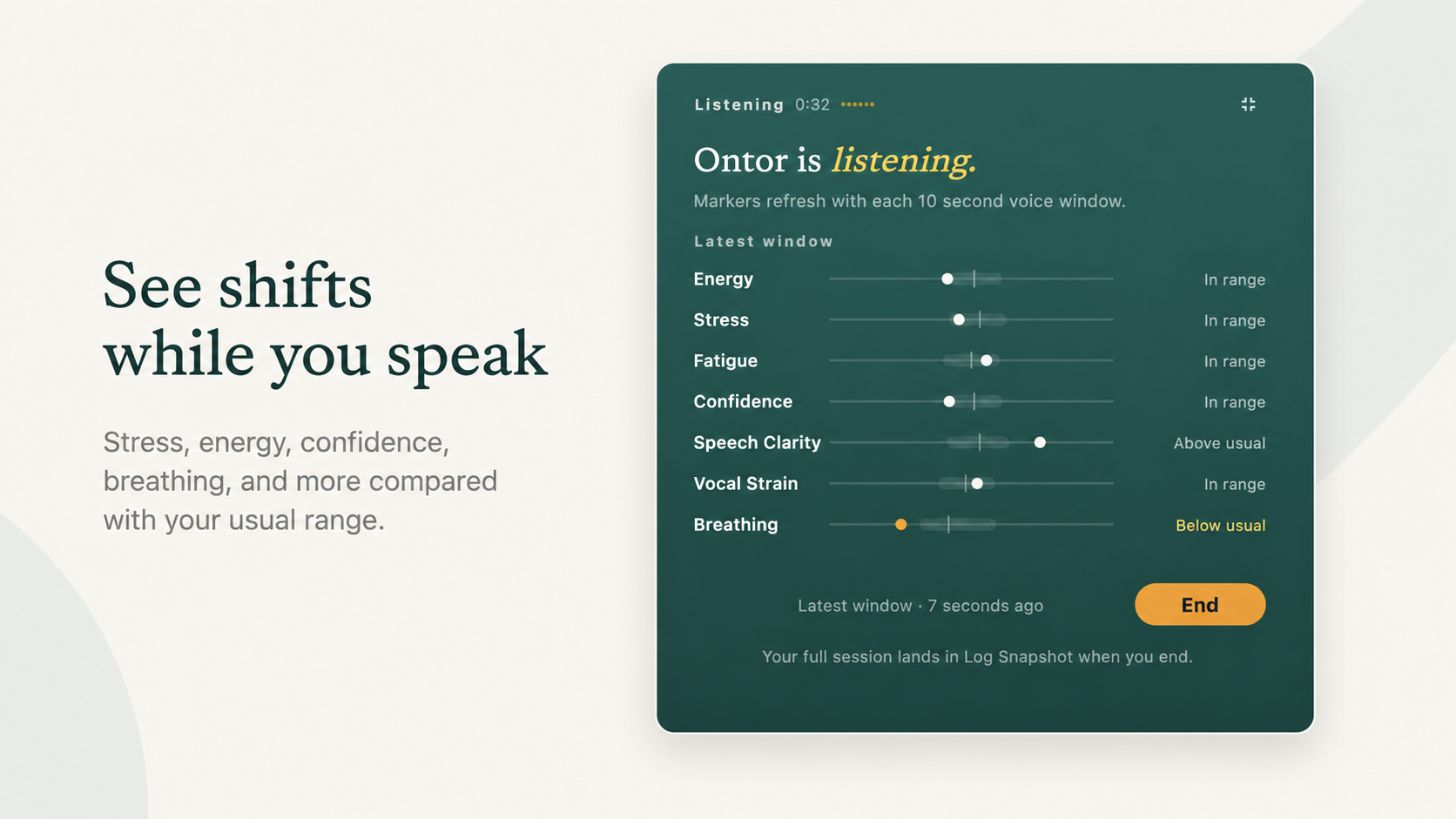
Here is the live listening view from my own Ontor product use. Markers refresh with each ~10 second voice window and sit against my usual range, including fatigue and energy. In this window, breathing sits below my usual while fatigue is still in range. Read it as a private check you would open on the next meaningful call after a noisy inbound stack, not as proof that one window means the stack already drained you:
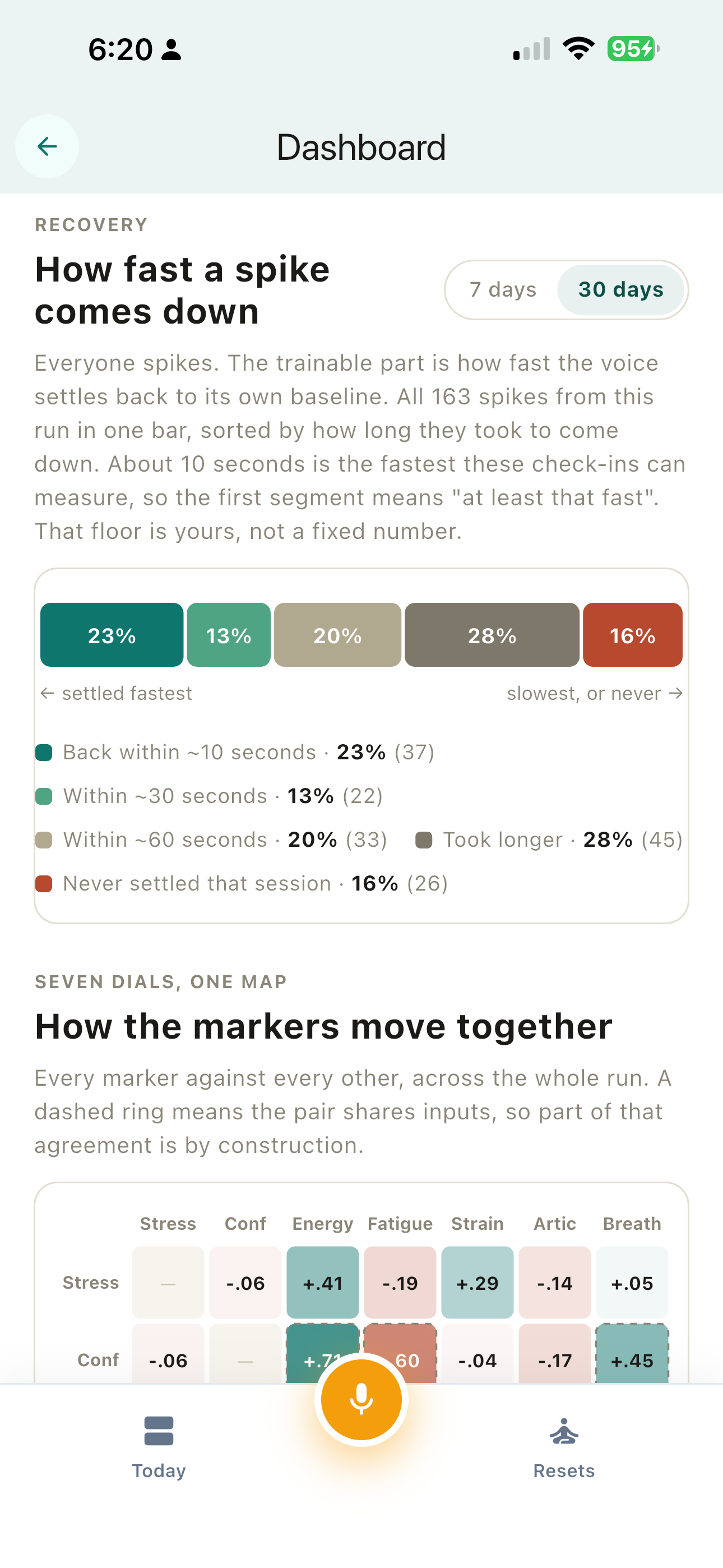
Here is "how fast a spike comes down" from that same Ontor history. The screen counts 163 spikes in this run and sorts how long the voice took to settle toward my own baseline. About 10 seconds is the fastest those check-ins can measure. I am not claiming those shares are your desk, or that a faster settle books freight. It is a private view of whether voice-state comes back before the next call that matters, not a hire-or-fire score and not proof that a suggested reset caused the settle:
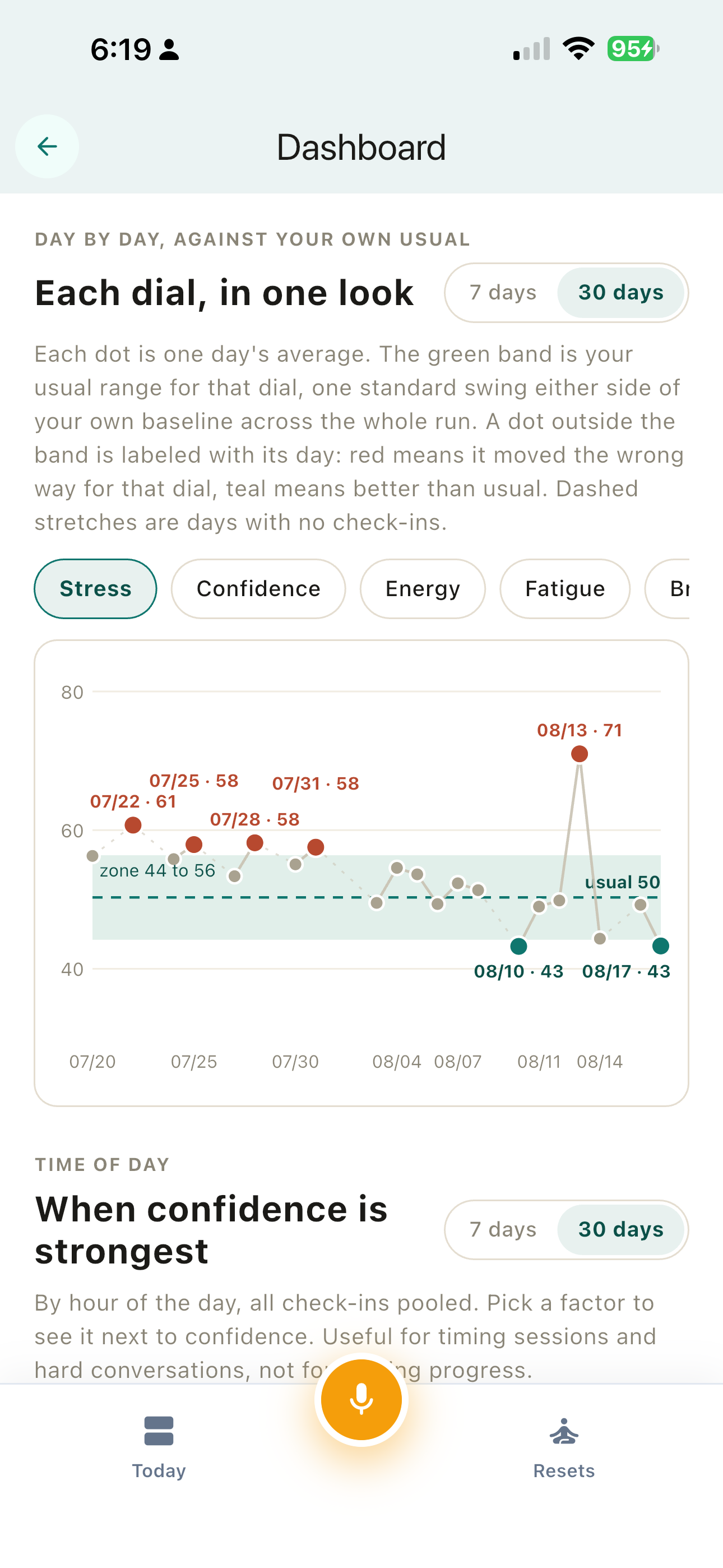
Here is stress day by day against my personal usual band (zone about 44 to 56, usual 50 on this view) from the same session history. Each dot is one day's average. Red points sit above my usual range. Useful as a private check for how often stress leaves the band across a call-heavy stretch, the kind of stretch a 2,900-call week creates for other people. It is not Whitewater's data and it is not proof that a reset produced calmer carrier calls:
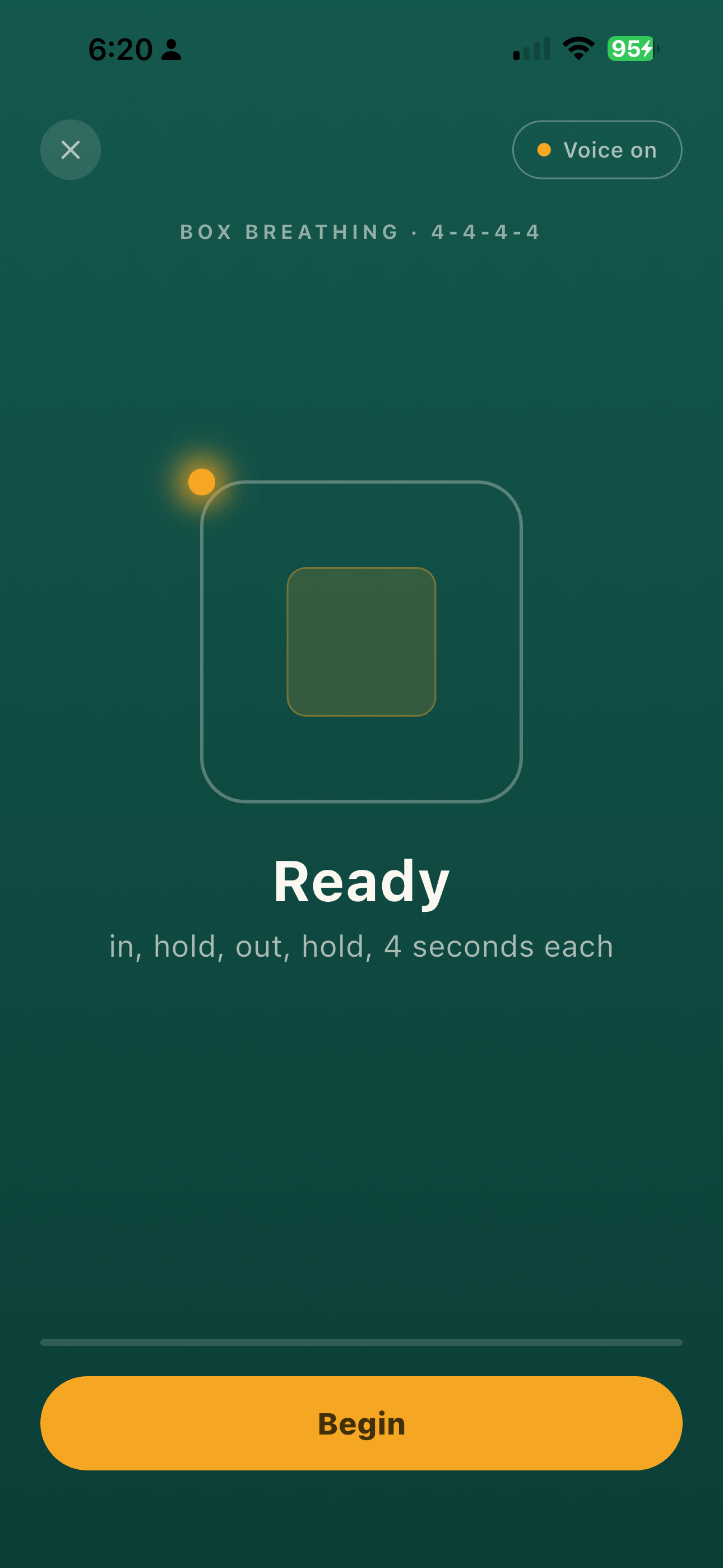
And here is the short reset the product offers when a lasting shift shows up: box breathing, 4-4-4-4, in, hold, out, hold, 4 seconds each. That is the tool form of catching phone exhaustion before the next meaningful call, available privately without a manager guessing from a recording sample. It is not a medical protocol and it is not a claim that one cycle fixes the stack:
What to try on the next call that matters
Do not wait for a research committee if your inbound carrier desk already sounds cooked before the calls you actually wanted.
- Install Ontor on the machine you already use for inbound carrier sales.
- On the next meaningful call after a noisy stack (a qualified carrier, a relationship check, a sales-development conversation), notice how the floor sounds. Then check whether fatigue, energy, stress, confidence, strain, or breathing sit outside your usual range in the short speech windows.
- If a lasting shift shows up, take the short suggested reset before you push through that call, or before you open the next one that matters. Then come back and listen again. Compare the windows. Do not treat the reset as a booking trick.
- If you lead the desk, keep leaders on aggregate patterns only for fatigue or energy drift under inbound load. Personal readings stay with the person. Do not use the tool for hire or fire. Pair it with a quick self-listen after a heavy block. Do not treat Ontor as a call filter, a headcount plan, or a script coach.
Soft secondary path if you lead brokerage Customer and Carrier Sales and want a measured look later: Ontor for teams.
Do not promise morale scores, booked-load lifts, or fewer hires. Measure whether people can tell when fatigue and energy left their usual voice before the next call that matters.
Bottom line
Boards count inbound carrier calls. Leaders still miss phone exhaustion, the drain that hits before the calls that matter. Bochkay's 10-person desk fielded about 2,900 calls a week, nearly 3,000 with half unqualified, and every one of those calls took time from relationships and sales development. Hiring more answerers did not fix the root. Filtering volume is a different category, and this piece does not pitch it. The gap that remains is personal usual-range fatigue and energy in short speech windows, caught on the human calls that are still worth having.
Try Ontor on the next meaningful inbound call. Notice when the stack shows up in how the floor sounds, and in whether fatigue or energy left your usual range. Take the short reset when a lasting shift shows up. That is the phone-exhaustion tool step, not another tally on the board.
Download Ontor - 14 days free, no card required
About the author
Sabber Ahamed is the founder of Ontor and an applied ML scientist. His PhD is in geophysics (University of Memphis), built on signal processing, and he has spent his career turning signals into on-device models. Ontor compares how you sound to your own usual ranges and suggests short resets, without claiming clinical or revenue outcomes from marker changes.
References
- How Whitewater books 86% of their posted loads with Vooma (vendor-hosted case study). Bill Bochkay, President, Whitewater Freight: 10-person team, 2,900 inbound calls a week (nearly three a minute), nearly 3,000 with half unqualified, every call took time from relationships and sales development, three more reps would not fix the root, "phone exhaustion." Vendor outcome metrics on that page are not Ontor results.
- How Broker Burnout Affects Performance. Esad Sadikovic, LinkedIn. Capped color only: burnout behind calls and fake smiles on Zoom. No clinical claims.
- Pressure and calm on the phone. Barry Daniskas, LinkedIn. Capped corroboration only: calm on the phone when things go sideways. High overlap with post-fallout recovery. Not this spine.
- How Ontor works. Usual range, lasting shifts, short resets. Fatigue and energy definitions. No mood read and no health diagnosis.
- Ontor for teams.
- About the founder.
- Install Ontor.
- Freight sales leaders can see dials. They still miss readiness between call blocks. (sibling, outbound between-block)
- When the phones blow up after a freight fire, the first 10 seconds decide the floor. (sibling, acute fire)
- After you quote the rate, the quiet is not a rejection. (sibling, post-rate quiet)
- Freight cold calls die when the pickup becomes a pace dump. (sibling, pace dump)
- Freight deals stall when reps jump in hot. (sibling, negotiation threat)
- The first dial of the day is the hardest. (sibling, morning cold-start)
- The carrier canceled. Your next recovery call still has to sound calm. (sibling, post-cancel)