
Freight deals stall when reps jump in hot. Shippers hear desperate energy before they hear the offer.
Your first job in a freight negotiation is not the pitch. It is removing yourself as the threat.
In logistics sales, reps jump in hot: pitching hard, proving worth, trying to close. Shippers hear desperate energy before they hear the offer. People do not buy under pressure. They buy when they feel safe, understood, and in control. Calm tone, curious questions, and no desperate energy are the trust rules. Tone sets them.
This is for freight brokerage sales leaders (Directors and VPs of Customer and Carrier Sales, plus brokerage sales managers coaching negotiation and objection calls). It is not post-rate quiet-fill. It is not post-cancel scramble composure. It is not pace dump on cold pickup. It is not first-10s panic after a fire. It is not morning cold-start on dial one. The object here is negotiation-threat: jump-in-hot delivery and desperate energy that keep the shipper's guard up.
Download Ontor - 14 days free, no card required
Remove yourself as the threat before you prove the lane
Bridget O'Byrne (Director of Customer and Carrier Sales; freight sales trainer) put the negotiation job in plain buyer language on LinkedIn (2025-06-17):
"Your first job in a negotiation? Remove yourself as the threat."
And the habit that stalls collaboration:
"In logistics sales, we tend to jump in hot - pitching hard, proving our worth, trying to close."
Why that fails on shipper calls:
"People don't "buy" under pressure. They buy when they feel safe, understood, and in control."
Her prescription is short and audible:
"Calm tone" / "Curious questions" / "No desperate energy"
And the trust rule that managers already coach but still struggle to hear on live rate and objection calls:
"Sales isn't a power play. It's a trust game - and tone sets the rules."
The business consequence does not need invented close-rate math. Hot, desperate energy keeps the shipper's guard up. Pressure-close posture collapses trust before content lands. Objection handling that pushes harder raises the threat level instead of lowering it. Load boards and CRM show the quote. Recordings show the script. They still miss whether stress, confidence, or energy left that rep's personal usual range while the urge to jump in hot rose.
What this article is not answering
Five published Ontor freight pieces already cover adjacent voice moments:
- Freight post-rate silence answers filling the quiet after you quote.
- Freight post-fallout recovery answers composure on the next recovery dial after a carrier cancel.
- Freight cold calls talk too fast answers pace dump on pickup.
- Freight fires, first 10 seconds answers first-10s panic when phones blow up after a fire.
- Freight first dial of the day answers morning cold-start before dial one.
Adjacent pieces with different ICP or framing (do not treat as this spine):
- Prospects hear when the voice tightens answers mid-market dialer talk-time vs audible tighten.
- Call-mode pitch voice answers an individual call-mode switch off usual sound.
- Collections energy match vs flat under hostility answers collections hostility energy-match, not freight negotiation threat.
This article answers a different question: on a freight rate talk or objection call, how do you notice when jump-in-hot / desperate energy left the rep's personal usual range for stress, confidence, or energy, take a short private reset, and come back with calm tone and curious questions instead of pitching harder?
Same freight brokerage sales-leader beachhead. Different object. Negotiation-threat removal and no-desperate-energy composure, not silence-fill, not cancel scramble, not pickup pace dump, not fire-floor panic, not morning cold-start.
Capped color: call-40 calm under pressure, and tone that tightens under fear
Two vendor pieces name adjacent pressure and tone. Cap them as color. Do not let their CTAs become this article's answer. Prefer Bridget's negotiation-threat spine.
Chambr (AI sales-roleplay vendor; Alex Poe) argues freight ramp fails in the gap between knowing what to say and saying it under live shipper pressure. Knowledge training alone does not build the muscle memory that keeps a rep calm on call 40 of the day. Nested buyer voice from Tristan MacLean (Growth and Marketing Director, Fero Logistics) says the difference showed up when new hires could build confidence before live dials. Use that only as late-block confidence-under-pressure vernacular. Do not reuse ramp ROI percentages. Ontor is not claiming to replace roleplay tooling.
LogiHire (Australian freight-forwarding recruiting firm; Sam Smeaton) describes a cold-call fear cycle for logistics BDMs where thinking gets less clear and tone becomes tighter or more uncertain, which then reinforces the next hard dial. Cap that as audible tone-tightens-under-fear color from an adjacent AU forwarding market. Do not import medical or threat-response physiology claims. Do not take the hiring CTA. Ontor's wedge stays private baseline plus a short reset when stress, confidence, or energy leave your usual range during rate talks and objection handling.
What scripts, objection trees, and "sound more confident" still miss
Typical stack for a brokerage sales leader coaching negotiation and objection calls:
- Script and objection trees so the next line is ready
- "Slow down / be curious / stop sounding desperate" coaching from managers
- Shadowing and mock calls until structure feels automatic
- Post-call recording review after the shipper already heard the hot pitch
- Activity targets that still count dials while tone stays desperate
Useful. Incomplete for the how-you-sound leave. A perfect objection tree does not tell you, in the moment, that stress or confidence left your personal usual range while you jumped in hot. A manager saying "no desperate energy" does not give the rep a personal baseline. Self-listen after the fact catches one recording, not lasting shifts across short speech windows before the next push.
None of those continuously ask: during this rate talk or objection, did stress, confidence, energy, strain, or breathing leave your own usual range in short voice windows while the urge to prove worth and close rose? Ontor does not replace negotiation training. Ontor does not claim that calm tone alone books the load. It reads how you sound versus your personal usual range while you speak, and can offer a short reset when a lasting shift shows up, including before the next hard push on a stalled shipper.
Shippers feel the threat first. Managers often meet it as "you sounded desperate" or "you pushed too hard" without a shared signal the rep can check privately before the next objection.
Download Ontor - 14 days free, no card required
What Ontor adds on rate talks and objection calls (private first)
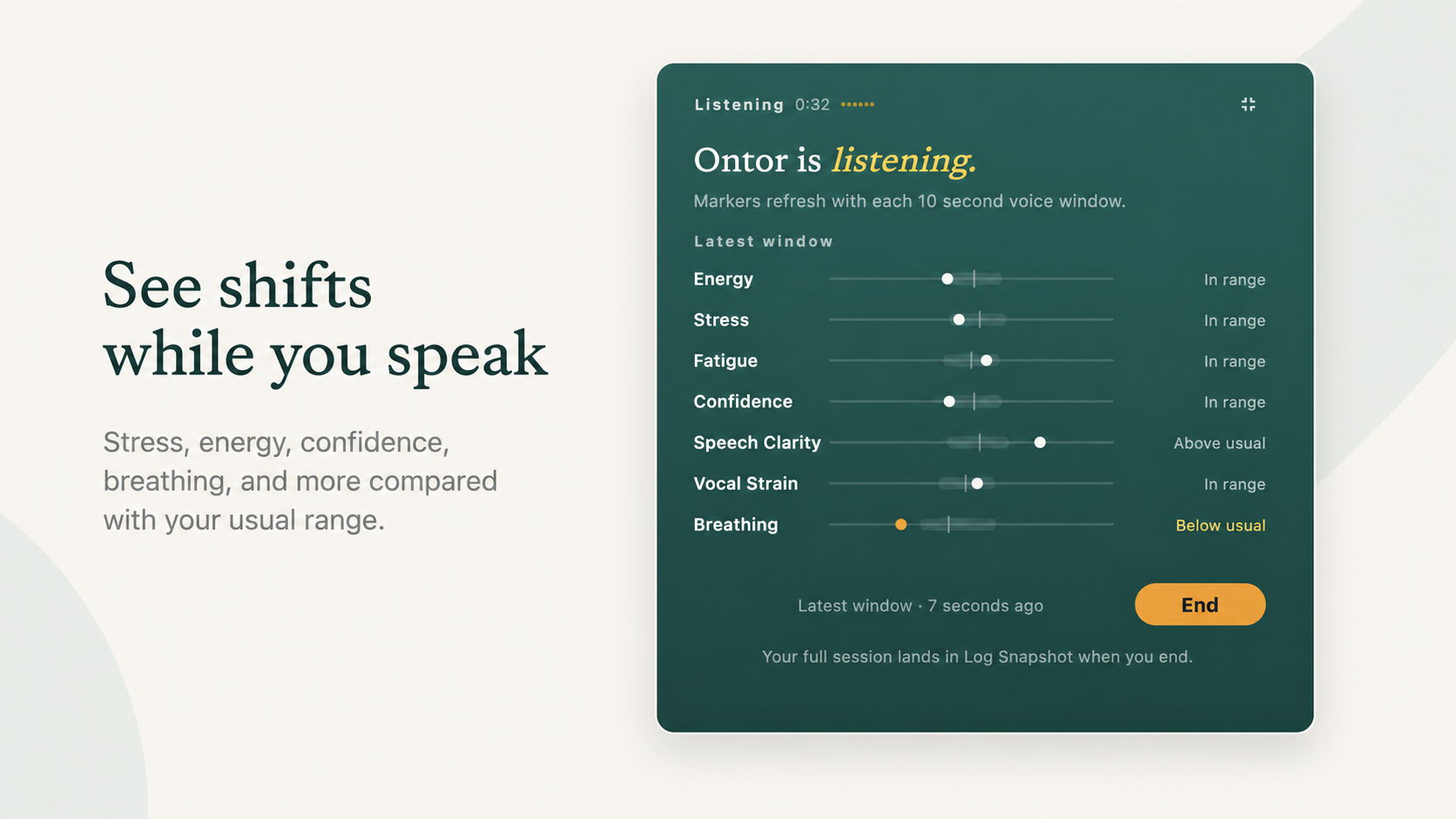
Ontor is a performance tool that reads how you sound, not what you said. While someone speaks, it compares voice signals to that person's own usual range. Markers refresh in short voice windows (on the order of about 10 seconds of speech). When a lasting shift shows up (for example energy, fatigue, stress, confidence, speech clarity, vocal strain, or breathing), it can suggest a short reset. People can also compare before and after.
Explicit boundaries for this topic:
- Ontor does not replace negotiation frameworks, objection trees, or rate strategy.
- Ontor does not claim medical or clinical composure outcomes.
- Ontor does not claim that marker changes prove better close rates, held margin, ramp speed, or cognitive improvement.
- The claim stays narrow: when jump-in-hot / desperate energy leaves your personal usual range during rate talks or objection handling, a private baseline cue plus an optional short reset is a loop you can run before the next push.
For teams, Ontor's public framing is aggregate patterns for workload, coaching, and support. Individual sessions and readings stay with the person. Managers coaching "remove yourself as the threat" can watch cohort-level energy or confidence drift. They do not get a personal scoreboard for hire or fire decisions. Soft secondary path: Ontor for teams.
In my own Ontor session history (founder exploratory data from my own product use, not your floor's outcome data), the jump-in-hot pattern shows up the same way Bridget names it. During a hard rate talk or when an objection lands and the urge to pitch harder rises, stress, confidence, or energy can leave my personal usual range in the short windows. I am still "ready" on the talking points. Delivery is already drifting toward desperate energy before the next prove-your-worth line lands. That is the remove-yourself-as-the-threat gap, visible as personal-baseline leave rather than a missing script line. A short reset before the next push is the tool form of calm tone, not a claim that one cycle wins the negotiation.
Here is the live listening view from my own Ontor product use: markers refresh with each ~10 second voice window and sit against my usual range. Read it as a private check for whether stress, confidence, energy, strain, or breathing left my band when I would otherwise jump in hot on a rate or objection call:
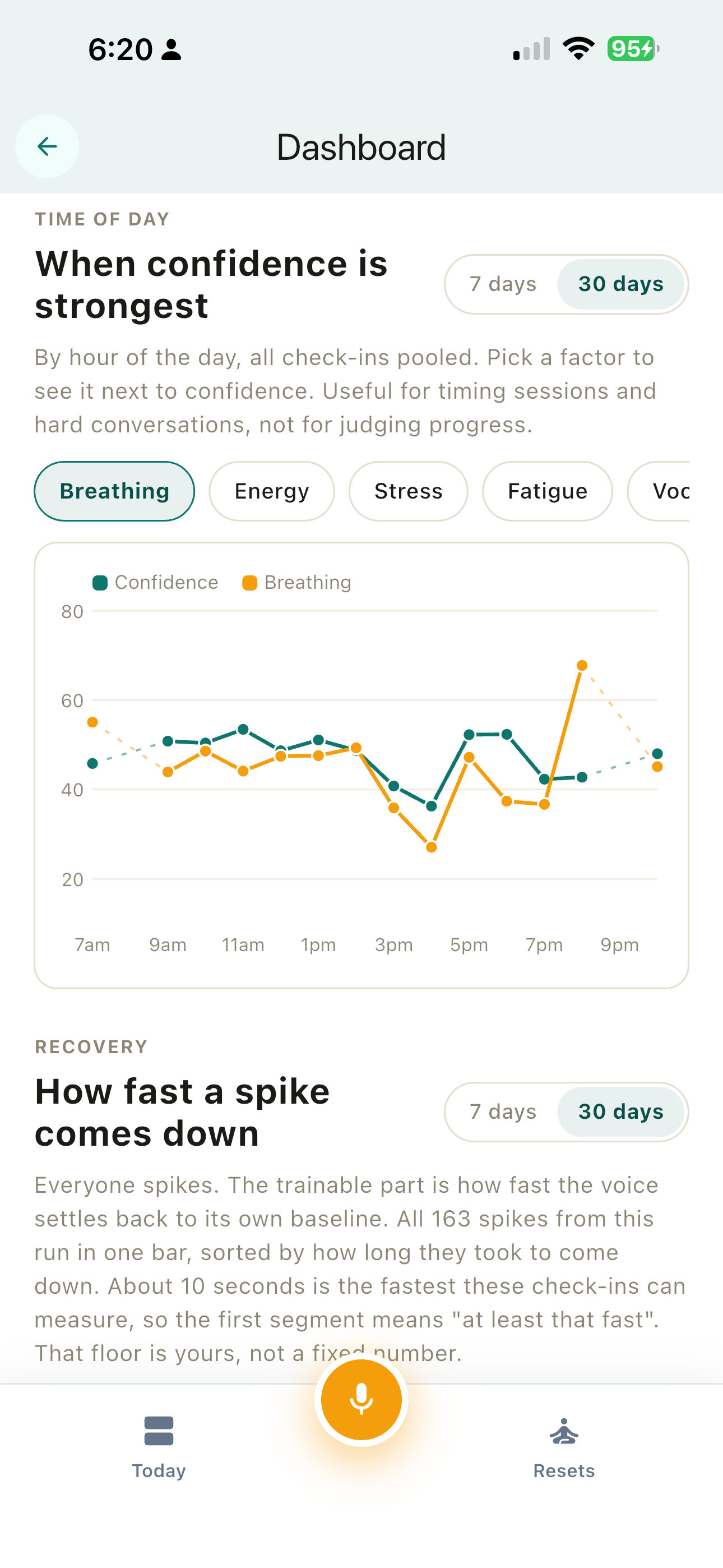
Here is confidence with breathing by hour from that same Ontor history. Confidence can sit fine early, then leave my personal usual later when the day gets harder and objections stack. Read it as founder exploratory data on personal-baseline drift across a call-heavy day, not proof of booked loads and not a claim that Ontor measured "desperate energy" as a label:
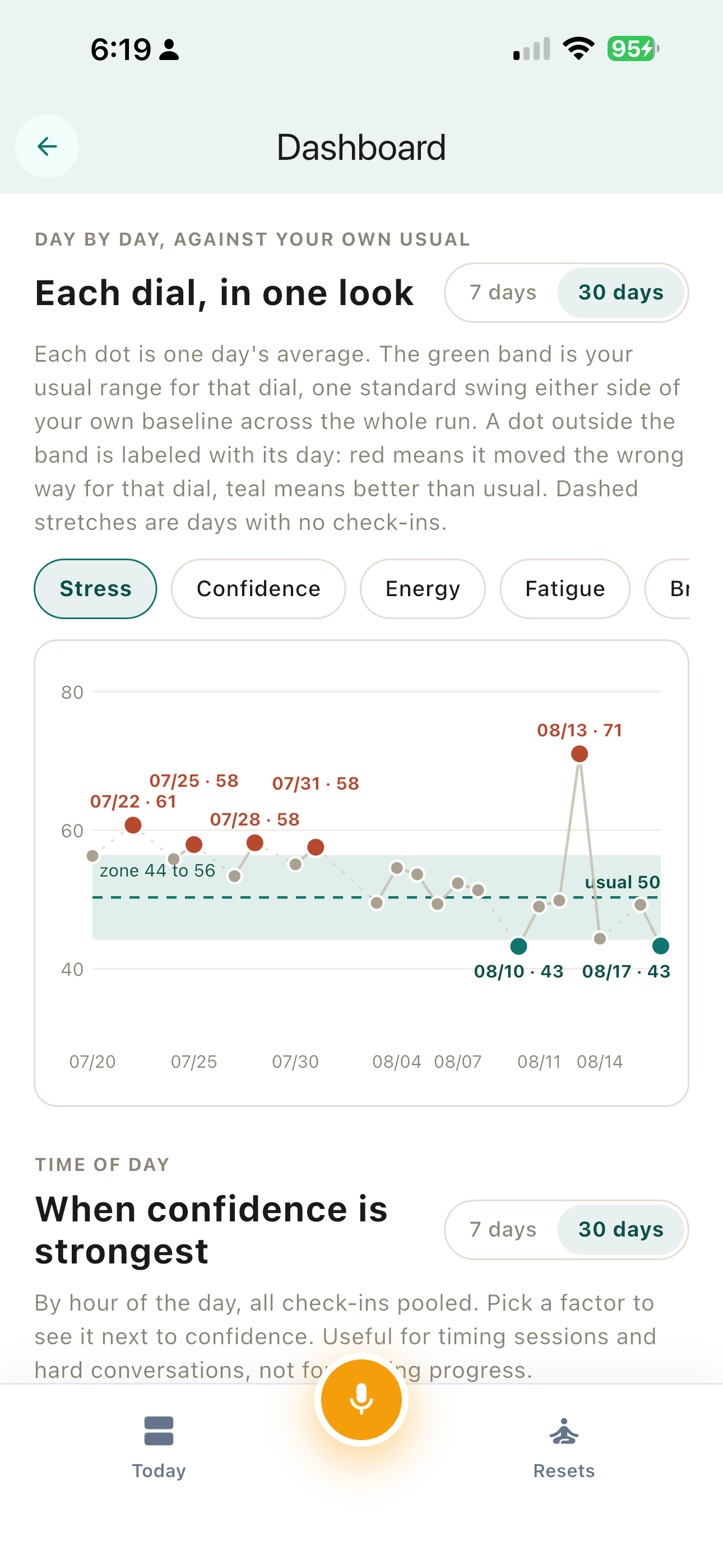
Here is stress day by day against my personal usual band (zone ~44 to 56, usual 50) from the same session history. Red points sit above my usual range. Useful as a private check for how often voice-state leaves the band across calls when the urge to prove worth and close would push desperate energy. It is not a hire-or-fire score and it is not proof that a suggested reset caused calmer negotiation tone:
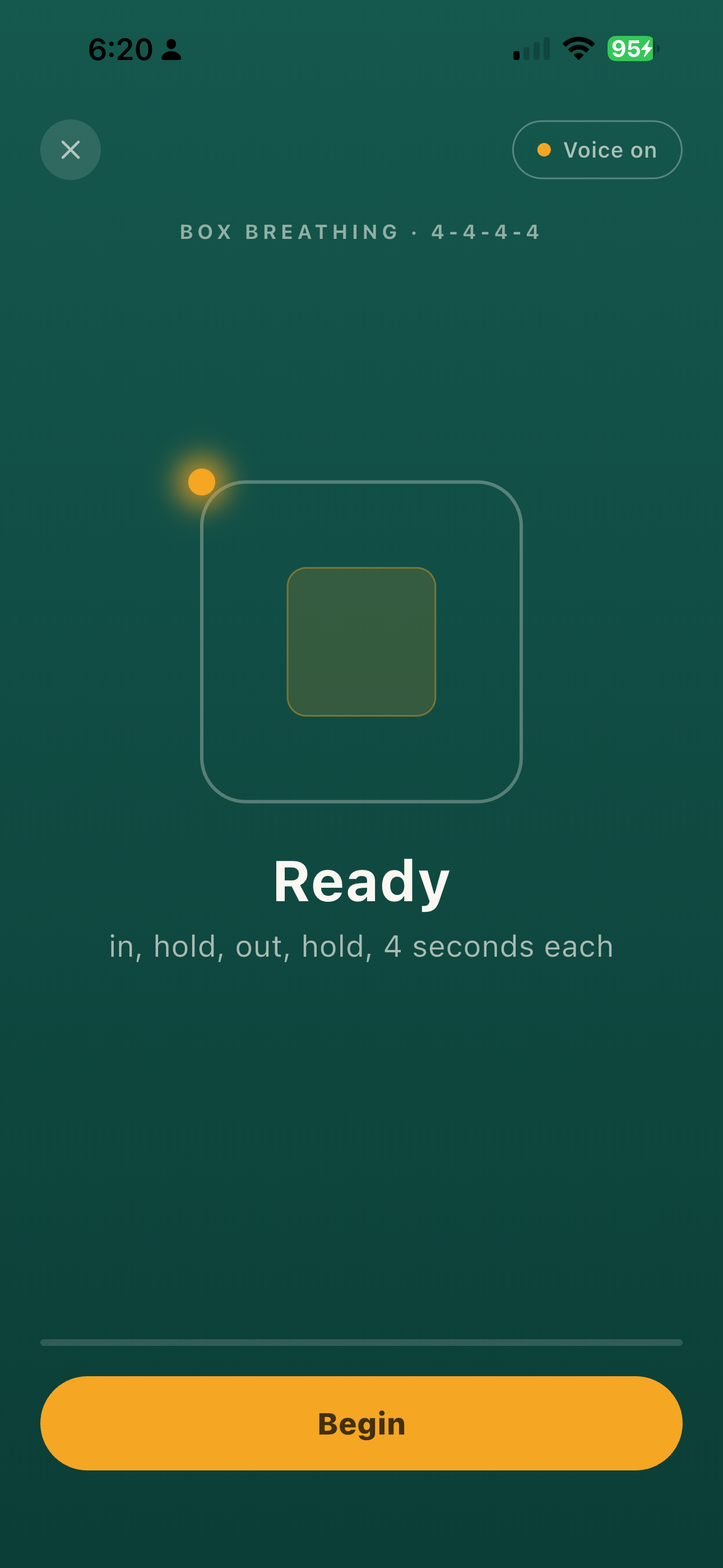
And here is the short reset the product offers when a lasting shift shows up: box breathing, 4-4-4-4. That is the tool form of Bridget's calm tone and no desperate energy, available privately without a manager guessing from a recording sample. It is not a medical protocol and it is not a claim that one cycle removes threat for the shipper:
This is not a claim that voice markers diagnose desperation, prove cognitive improvement, predict revenue, or replace manager judgment. The claim stays narrow: when scripts and "sound more confident" miss the jump-in-hot leave, a private signal plus a short reset is a loop people can run before the next push, while leaders watch cohort patterns only in aggregate.
What to try on your next rate or objection call
Do not wait for a research committee if you coach freight negotiation and still hear desperate energy on live shipper calls, or if you are the rep who still jumps in hot when the objection lands.
- Install Ontor on the machine you already use for shipper rate talks and objection handling.
- On the next live negotiation or objection call, notice whether stress, confidence, energy, strain, or breathing sit outside your usual range in the short speech windows, especially when you can already feel the urge Bridget names: pitch hard, prove worth, try to close.
- If a lasting shift shows up, take the short suggested reset before your next push. Then continue with calm tone and a curious question instead of stacking more desperate energy into the close.
- If you coach a pod, keep leaders on aggregate patterns only for energy / confidence drift under negotiation pressure. Personal readings stay with the person. Treat Bridget's remove-yourself-as-the-threat and no-desperate-energy rules as performance controls, not only soft skills. Pair with a quick self-listen after a hard block. Do not treat Ontor as a rate engine or a script coach.
Soft secondary path if you lead brokerage Customer and Carrier Sales and want a measured look later: Ontor for teams, or a research conversation / pilot on personal voice baselines versus jump-in-hot delivery on rate and objection calls.
Do not promise win-rate, held margin, ramp speed, or revenue guarantees. Measure whether people can tell when stress and confidence left their usual voice before a shipper names the desperate close.
Bottom line
Freight deals stall when reps jump in hot. Shippers hear desperate energy before they hear the offer. Bridget named remove yourself as the threat, calm tone, curious questions, and no desperate energy as the trust rules. Tone sets them. Cap Chambr call-40 calm and LogiHire tone-tightens only as vendor color. The gap that remains is personal usual-range stress, confidence, and energy in short speech windows, caught during rate talks and objection handling, before the next prove-your-worth push.
Try Ontor on your next rate or objection call. Notice the short voice windows versus your usual range. Take the short reset when a lasting shift shows up. That is the remove-yourself-as-the-threat tool step, not only a pep talk about confidence.
Download Ontor - 14 days free, no card required
About the author
Sabber Ahamed is the founder of Ontor and an applied ML scientist (PhD in geophysics and signal processing) who builds on-device voice tools. Ontor compares how you sound to your own usual ranges and suggests short resets, without claiming clinical or revenue outcomes from marker changes.
References
- Bridget O'Byrne. LinkedIn post: first job in a negotiation is remove yourself as the threat; logistics sales jumps in hot; people buy when safe/understood/in control; calm tone, curious questions, no desperate energy; sales is a trust game and tone sets the rules. https://www.linkedin.com/posts/bridgetobyrne_salespsychology-logisticssales-negotiationtactics-activity-7340755127873523713-pefT
- Alex Poe / Chambr. "Why freight brokerages are switching to AI sales training" (vendor corroboration only; Tristan MacLean / Fero Logistics nested): gap between knowing what to say and saying it under pressure; calm on call 40; no ramp ROI reused. https://chambr.ai/blog/freight-broker-ai-sales-training
- Sam Smeaton / LogiHire. "How to Overcome the Fear of Cold Calling in Freight Forwarding Sales" (vendor corroboration only): tone becomes tighter or more uncertain under fear cycle; no medical physiology claims; no hiring CTA. https://logihire.com.au/insights/cold-calling-fear
- Ontor. "How it works." https://ontor.ai/how-it-works/
- Ontor. "Ontor for teams." https://ontor.ai/for-teams/
- Ontor. "About the founder." https://ontor.ai/about/
- Ontor. "Install Ontor." https://ontor.ai/install/
- Ontor. "After you quote the rate, the quiet is not a rejection..." https://ontor.ai/blog/freight-post-rate-silence/ (sibling, post-rate quiet)
- Ontor. "The carrier canceled. Your next recovery call still has to sound calm." https://ontor.ai/blog/freight-post-fallout-recovery/ (sibling, post-cancel)
- Ontor. "Freight cold calls die when the pickup becomes a pace dump." https://ontor.ai/blog/freight-cold-call-talk-too-fast/ (sibling, pickup pace dump)
- Ontor. "When the phones blow up after a freight fire, the first 10 seconds decide the floor." https://ontor.ai/blog/freight-fires-first-10s/ (sibling, fire-floor first 10s)
- Ontor. "The first dial of the day is the hardest..." https://ontor.ai/blog/freight-first-dial-of-day/ (sibling, morning cold-start)