
The deal closed. Your nervous system didn't. Why the next call still sounds sharp.
The big call ends. Maybe the deal landed. Maybe the Account Director just survived a hard negotiation. Either way, the calendar already has another client conversation waiting. Coaches who sell nervous-system work into sales floors already know what that gap feels like from the client's side: still sympathetic, still "tired but wired," still sharp when the next room needs calm conviction.
This piece is for coaches who already teach post-meeting resets, breath priming, and composure into call-heavy sellers. It is not the hangover between sales calls (generic between-call unpaid recovery on a mid-market floor). It is not the broader category cut on measuring nervous-system regulation. The spine here is narrower: post-deal / high-stakes Account Director "tired but wired," coaches already selling an explicit two-minute post-meeting parasympathetic prime, and still no live check on whether voice energy, clarity, or strain actually recovered to that person's own usual range before the next talk.
Download Ontor - 14 days free, no card required
Sabin Lakhani / Kokorology: tired but wired after the high-stakes call
Sabin Lakhani (Founder, Kokorology) published a case study on an Account Director in New York under intense quarterly pressure. The presenting state is the buyer phrase coaches already hear:
"Her usual state was this low hum of 'tired but wired' - physically drained, mentally spinning."
That is not laziness and it is not a pep-talk hole. The same case names what the next client conversation hears when that state is still running:
"Her responses to client feedback felt too sharp, lacking the calm conviction that closes big accounts."
Kokorology's protocol already includes the tool this channel sells by name: post-meeting parasympathetic priming. The case lists it as:
"Post-meeting parasympathetic priming: a two-minute reset immediately after high-stakes calls, using specific eye movements and exhale-focused breathing to down-regulate."
And the outcome line coaches quote back to sellers:
"The sales pressure was still there. She just stopped taking it home in her bloodstream."
Treat that as coach case writing, not an Ontor customer story and not a clinical claim Ontor owns. Cap the HRV and sleep-score packaging on that page. Ontor does not claim those metrics, diagnose sympathetic dominance, or treat nervous-system conditions. The channel-useful object is narrower: after a high-stakes sales call, "tired but wired" still leaks into the next talk as sharp delivery that lacks calm conviction, and coaches already sell a two-minute post-meeting reset for that exact gap.
The product-shaped blind spot is what happens after the reset is taught. Did energy, clarity, or strain actually move back toward that person's own usual range before the next client conversation starts? The priming is sold. The verification before the next talk usually is not.
Corroboration only: breath, pitch under objection, shake as NS not confidence
Louise Crowley (BeSpoke Coaching; supporting only) maps the fight-flight breath path into what the next room hears. Under high-stress speaking, the body shifts into shallow, rapid breaths. The audible result she names:
"Shaky hands, a voice that cracks, and a brain fog that makes you forget what you were saying mid-sentence."
And on breath support:
"Without proper breath support, it can becomes tight, high pitched or shaky."
Use Crowley only as corroboration that post-pressure shallow breath can still write crack, tight, high, or shaky into the next speaking window. Do not lead this piece as a public-speaking breath blog. The spine stays Sabin's post-deal tired-wired Account Director plus an unverified two-minute prime.
Siddharth Gangal (Gangly; vendor, capped) names the live-pressure pitch leave sellers hear when the next objection hits before recovery:
"Under pressure - a tough gatekeeper, an aggressive prospect, an unexpected objection - most reps' voices rise two to four semitones."
And the practice-versus-live gap coaches already feel:
"Tone degrades under pressure, not in the practice room."
Cap Gangly CTA and conversion packaging. Vendor corroboration only: pitch can jump under live objection pressure even when practice sounded fine. That is adjacent to "next call still sounds sharp," not a second spine.
Rahul Iyengar (SpeakUp; vendor, capped) keeps the shaky-voice mechanism in buyer language coaches already use:
"It's not a character flaw. It's your nervous system. And it's fixable."
And the FAQ line that matters for this cut:
"The tremor is a breathing problem, not a confidence problem, which is why willpower alone does not stop it."
Cap SpeakUp product claims. Supporting only: shaky delivery after activation is often named as nervous-system / breathing, not a confidence tip that failed. Ontor does not diagnose tremor, treat anxiety, or turn those vendor lines into medical product claims. Clinical or NS wording stays attributed to the source pages above.
Distinct from hangover-between-calls and measure-NS-regulation
Published Ontor pieces already cover nearby recovery and coaching problems. Overlap on "voice versus personal usual range" is real (~50 to 55 percent under 70). The spine here is different.
- Hangover between sales calls answers: leaders treat the minutes between dials as empty while rejection or rough-call carryover is unpaid. Mid-market between-call hangover. Not the coaches-channel post-deal Account Director "tired but wired" plus an explicit two-minute post-meeting prime that still goes unverified on voice recovery before the next talk.
- You coach the nervous system. You've never been able to measure it. answers: the broader coaches category problem of measuring regulation at all. Not this narrower post-high-stakes / post-deal verification gap after priming is already sold.
- Nearby coaches cuts such as anxious or robotic under the same pressure, practice holds, live dials don't, and voice masks crack on the price ask stay adjacent. They are not the post-deal tired-wired -> next-call-still-sharp object.
Same coaches ICP as several of those. Different mechanical question: after the high-stakes call, and after the two-minute prime you already teach, did energy, clarity, and strain actually recover toward personal usual range before the next client conversation inherits the sharp leave?
Download Ontor - 14 days free, no card required
What two-minute priming, pep talks, and self-feel still miss
Typical stack for a coach already selling post-meeting NS work into sellers:
- Explicit two-minute post-meeting parasympathetic priming (eye movements, exhale-focused breath, or similar)
- "Shake it off" / pep talk before the next calendar block
- Self-rating: "I feel calmer now"
- Sparse ride-along or autopsy clip after the sharp leave already wrote into the next talk
- More confidence tips when the client feedback was "too sharp"
Useful. Incomplete for the post-deal verification gap. The prime can be done correctly and still leave energy, clarity, or strain off that person's own usual range when the next client conversation starts. Feeling calmer is not the same as a private usual-range check on how the voice sounds before the next talk. A post-hoc clip catches one recording after the sharp leave already landed.
None of those continuously ask: after this high-stakes call and this short reset, did energy, clarity, strain, stress, or confidence return toward my personal usual range in short speech windows before the next conversation? Ontor does not replace Lakhani-style priming protocols, Crowley-style breath craft, or coach 1:1 work. It reads how someone sounds versus their personal usual range while they speak, and can offer a short optional reset when a lasting shift shows up.
What Ontor adds for post-deal tired-wired -> next-call readiness (private first)
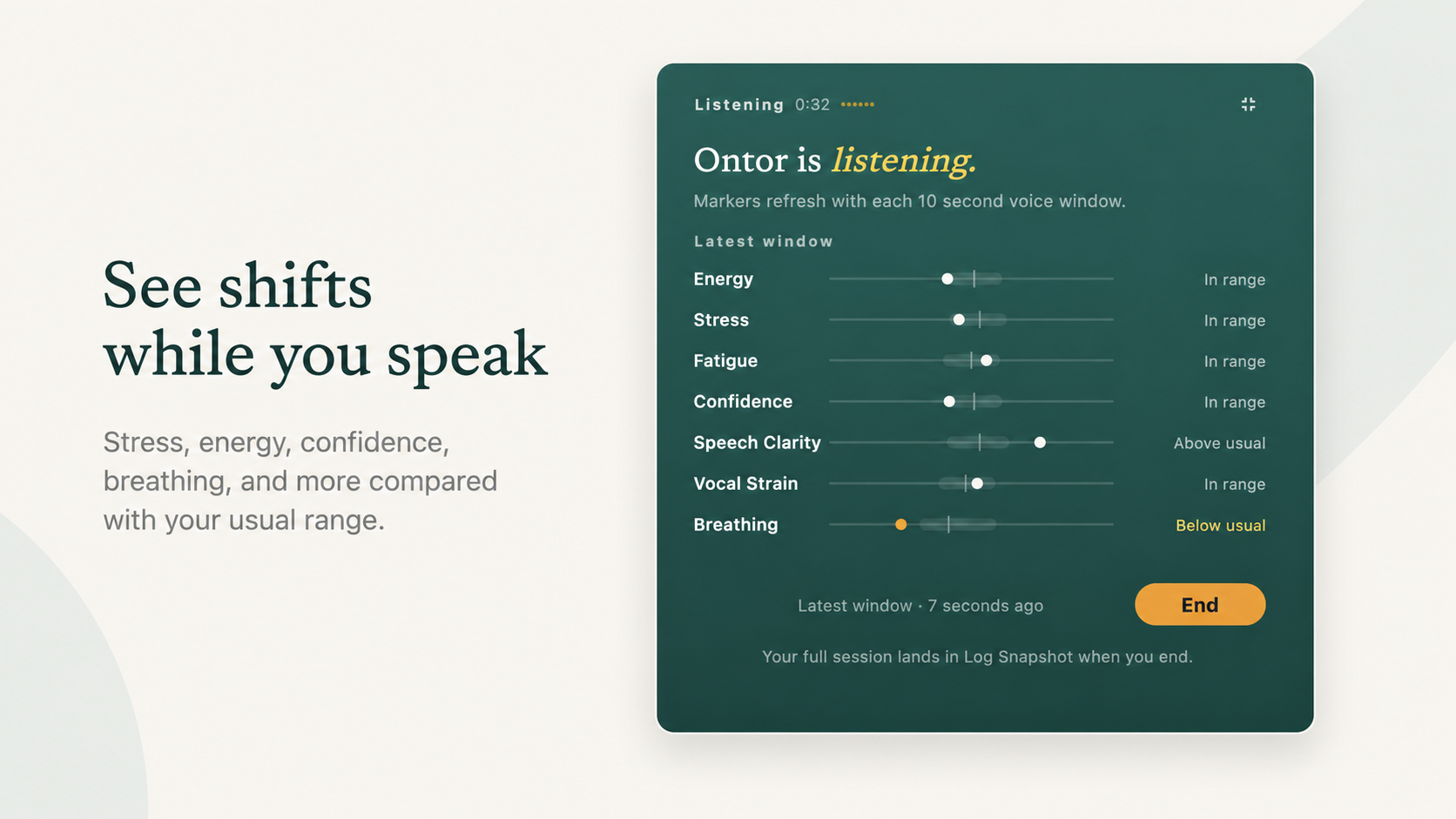
Ontor is a performance tool that reads how you sound, not what you said. While someone speaks, it compares voice signals with that person's own usual range. Markers refresh in short voice windows (on the order of about 10 seconds of speech). It does not react to every unusual second. It looks for a lasting shift. Signals on the public product page include energy, stress, fatigue, confidence, speech clarity, vocal strain, and breathing. Each one is how the voice sounds versus your own usual range, not a population grade. When a lasting shift shows up, Ontor can suggest a short reset. You can compare before and after.
For a coach practice that already sells two-minute post-meeting priming into Account Directors and sellers, that sits next to the protocol. You still teach the prime. Clients still own their readings. What you gain is a private usual-range view after the high-stakes call and before the next talk: whether energy, clarity, strain, stress, or confidence actually moved back toward usual range, or whether "tired but wired" is still writing sharp delivery into the next conversation.
Boundaries, said plainly:
- Ontor does not replace Kokorology-style post-meeting priming, Crowley breath coaching, or 1:1 nervous-system coaching.
- Ontor does not diagnose sympathetic dominance, treat anxiety, or claim HRV / sleep outcomes from the Kokorology case.
- Ontor does not claim that marker changes prove deal closure, calm-conviction ROI, cognitive improvement, or clinical recovery.
- Ontor is a tool / product / platform (not an "app" in our outward copy). It is not a hire/fire scoreboard. Individual sessions and readings stay with the person.
The claim stays narrow: when coaches already sell a two-minute post-meeting reset for post-deal "tired but wired," a private personal-baseline cue for energy, clarity, strain, stress, and confidence in short windows, plus an optional short reset when lasting shifts show, gives a way to notice whether readiness actually returned before the next client talk inherits the sharp leave. Soft secondary path if you later sell into pods of sellers: Ontor for teams.
What shows up in my own Ontor history (post-high-stakes leave before the next talk)
I am Sabber Ahamed, founder of Ontor (about; LinkedIn). I use the product on my own speaking and call-heavy days. In my own Ontor session history (founder exploratory data from my own product use, not your floor's outcome data), the Sabin "tired but wired -> next talk still sharp" object shows up as personal-baseline leave in energy, clarity, strain, stress, and confidence-adjacent markers after a hard speaking block, before the next conversation. I can still feel like I "reset" while a short window stays off my band. Delivery drifts toward the tighter, sharper leave buyers hear as missing calm conviction. That is the post-deal recovery object this article is about: readiness versus my own usual range before stacking the next talk.
Here is the live listening view from my own Ontor product use: markers refresh with each ~10 second voice window and sit against my usual range. Read it as a private check for whether energy, clarity, strain, or stress left my band in the windows after a high-stakes block and before the next client conversation:
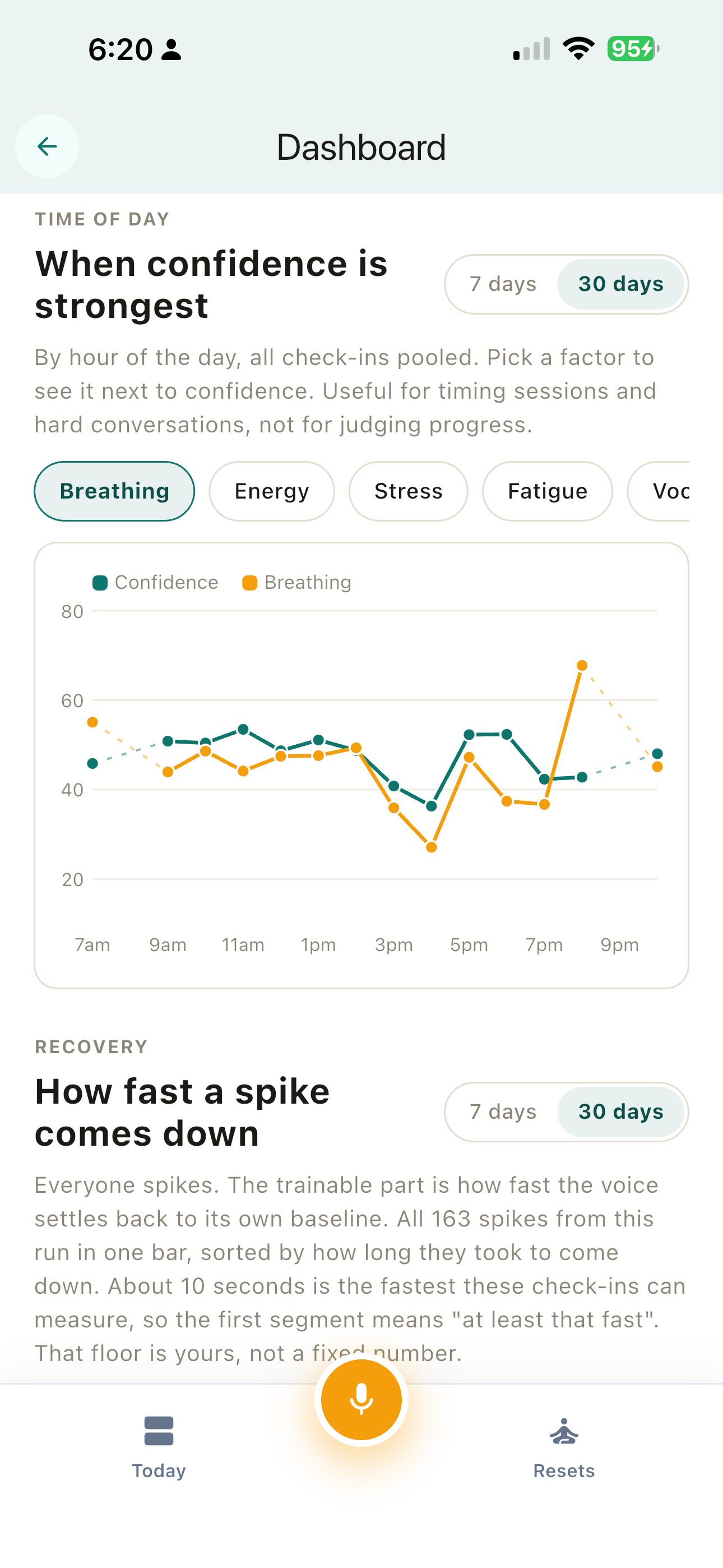
Here is confidence with breathing by hour from that same Ontor history. Confidence can sit near usual early, then leave later when the speaking day stacks hard blocks without a verified recovery window. Read it as founder exploratory data on personal-baseline drift across a call-heavy day, not proof of deal outcomes and not a claim that Ontor diagnosed a nervous-system condition:
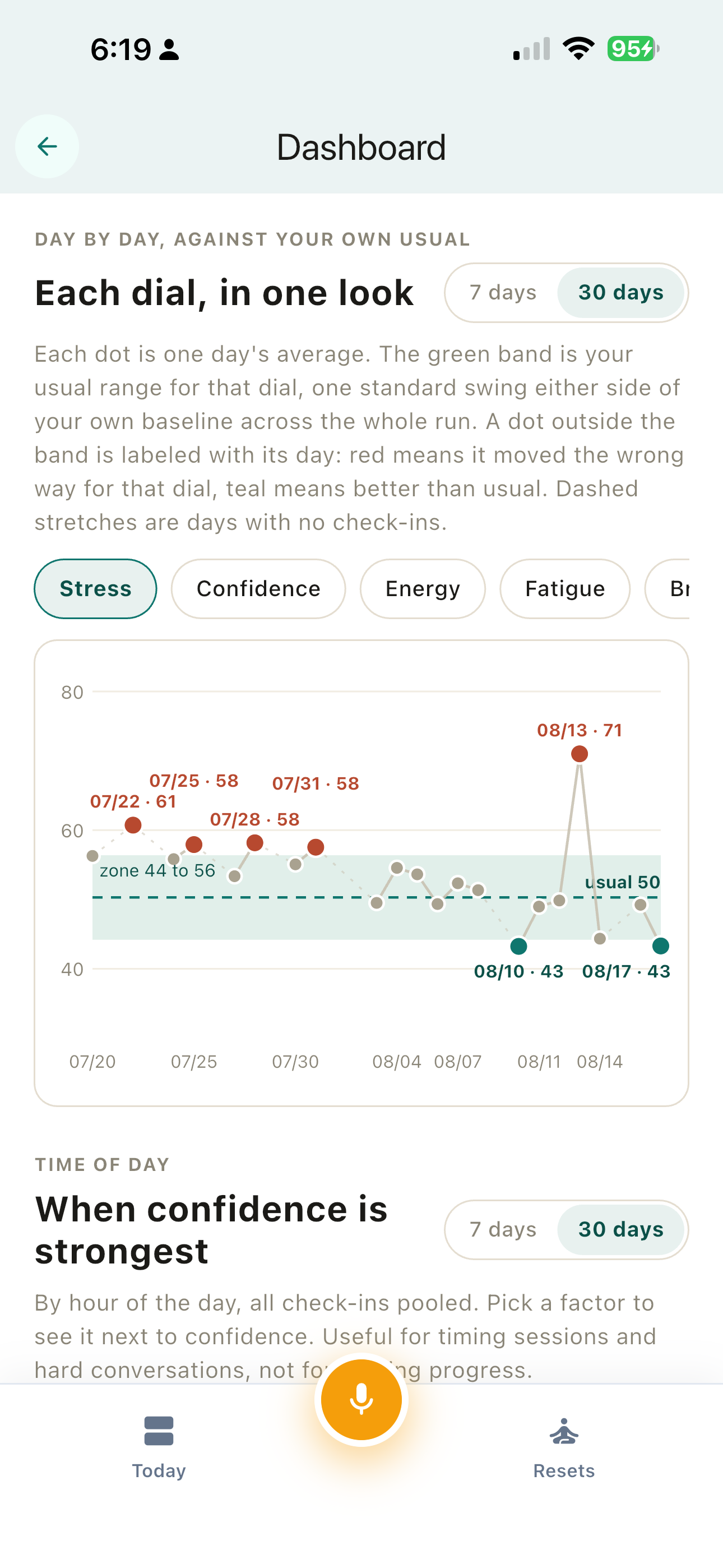
Here is stress day by day against my personal usual band (zone ~44 to 56, usual 50) from the same session history. Red points sit above my usual range. Useful as a private check for how often voice-state leaves the band across calls when post-deal tired-wired risk is highest before the next talk. It is not a hire-or-fire score and it is not proof that a suggested reset caused clinical improvement:
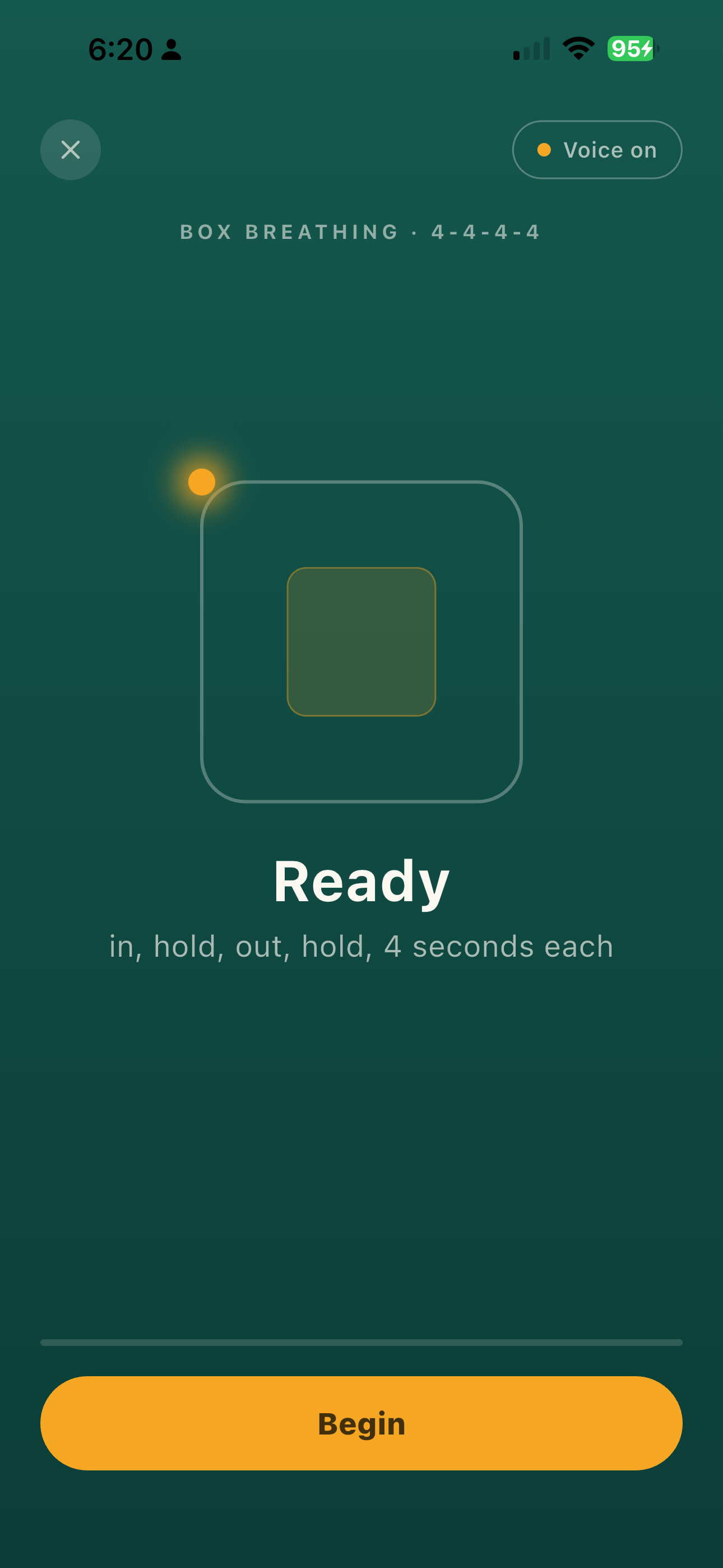
And here is the short reset the product offers when a lasting shift shows up: box breathing, 4-4-4-4. That is a private between-talk tool when energy, clarity, strain, stress, or confidence leave your band after a high-stakes call and before stacking the next conversation. It is not a medical protocol and it is not a claim that one cycle replaces the two-minute prime coaches already teach:
Claim-safe science note from Ontor's internal reset-effects and founder longitudinal work (exploratory n=1, not population proof): short resets can show temporary movement in stress-related voice markers in some recorded cases, and lasting recovery is not established as a general rule. High-stress stretches in founder exploratory data often do not show an observed return to personal median within an hour. Do not leap from those notes to medical nervous-system treatment. Ontor compares how you sound to your personal usual ranges and can suggest a short optional reset when lasting shifts show. Marker changes are not clinical outcomes.
What to try on the next high-stakes call (then before the next talk)
Do not wait for a research committee if you already sell post-meeting priming and still hear "too sharp" on the conversation after the deal.
- Install Ontor on the machine your client already uses for high-stakes sales calls and follow-ups.
- After the next high-stakes call (and after the two-minute prime you already teach), notice energy, clarity, strain, stress, and confidence versus personal usual range in the short speech windows before the next client talk starts.
- If a lasting shift shows up, or if the sharp / wired leave persists across windows, take the short suggested reset (or re-run the prime you already sold). Then start the next conversation.
- If you coach pods of sellers later, keep leaders on aggregate patterns only for post-high-stakes energy / strain / clarity drift. Personal readings stay with the person. Treat Sabin's tired-wired case as a performance control coaches already sell into, not a medical label. Pair with the priming protocol you already teach. Do not treat Ontor as a script coach or a hire-fire tool.
Concrete try-on-next-call step: after your next high-stakes sales call (and after the short post-meeting reset), notice whether energy, clarity, strain, stress, or confidence left personal usual range before the following client conversation; if lasting shifts persist, take another short reset before that next talk.
Soft secondary path if you sell into teams of sellers and want a measured look later: Ontor for teams.
Do not promise win-rate, deal closure, or revenue guarantees. Measure whether people can tell when post-deal energy, clarity, or strain left their usual voice before the next client names the sharp leave.
Bottom line
The deal closed. Your nervous system didn't. Why the next call still sounds sharp. Sabin Lakhani / Kokorology named Account Director "tired but wired," responses "too sharp, lacking the calm conviction that closes," and an explicit two-minute post-meeting parasympathetic prime after high-stakes calls. Crowley (supporting) maps fight-flight shallow breath into crack / tight / high / shaky. Gangal (vendor capped) maps pitch +2 to 4 semitones under live objection. Iyengar (vendor capped) maps shaky voice as nervous-system / breathing, not confidence. The gap that remains is personal usual-range energy, clarity, strain, stress, and confidence in short speech windows, caught after the high-stakes call and the prime you already teach, before the next talk inherits the sharp leave.
Try Ontor after the next high-stakes call. Notice the short voice windows versus usual range for energy, clarity, strain, stress, and confidence before the following conversation. Take the short reset when a lasting shift shows up. Let the next client hear a voice that moved back toward the band, not the tired-wired sharpness you already know they can hear.
Download Ontor - 14 days free, no card required
References
- Sabin Lakhani / Kokorology (coach case study). "Managing Sales Pressure" / Mastering sales pressure from tired to tactful: Account Director "tired but wired"; responses too sharp, lacking calm conviction; two-minute post-meeting parasympathetic priming after high-stakes calls; "stopped taking it home in her bloodstream." Cap HRV/sleep packaging; not an Ontor case. https://kokorology.com/case-studies/s/mastering-sales-pressure-from-tired-to-tactful
- Louise Crowley / BeSpoke Coaching (supporting only). "Speak Easy: The Science of Breathing for Public Speaking": fight-flight shallow breath; voice cracks; tight, high pitched or shaky without breath support. https://bespoke-coaching.com/blog/speak-easy-the-science-of-breathing-for-public-speaking/
- Siddharth Gangal / Gangly (vendor_marketing, capped corroboration). "Sales Call Voice Tone": under pressure pitch rises two to four semitones; tone degrades under pressure, not in the practice room. Cap vendor CTA / conversion packaging. https://getgangly.com/blog/sales-call-voice-tone
- Rahul Iyengar / SpeakUp (vendor_marketing, capped corroboration). "Why Your Voice Shakes During Presentations": shaky voice as nervous system / adrenaline; tremor is a breathing problem, not a confidence problem. Cap vendor product claims. https://speakupcoach.com/voice-shaking-presentation
- Ontor. "How it works." https://ontor.ai/how-it-works/
- Ontor. "Ontor for teams." https://ontor.ai/for-teams/
- Ontor. "About the founder." https://ontor.ai/about/
- Ontor. "Install Ontor." https://ontor.ai/install/
- Ontor. Sabber Ahamed LinkedIn. https://www.linkedin.com/in/sabber-ahamed
- Ontor. "Leaders treat the minutes between calls as empty. The hangover isn't." https://ontor.ai/blog/hangover-between-sales-calls/ (sibling, between-call hangover)
- Ontor. "You Coach the Nervous System. You've Never Been Able to Measure It." https://ontor.ai/blog/measure-nervous-system-regulation/ (sibling, broader coach measure-NS)
- Ontor. "A pressured voice can sound anxious or robotic. Coaches still treat them as different problems." https://ontor.ai/blog/coaches-anxious-or-robotic-same-pressure/ (sibling, dual-mode under pressure)
- Ontor. "Practice holds. Live dials don't. Coaches still can't see the transfer gap in voice." https://ontor.ai/blog/practice-holds-live-dials-dont/ (sibling, practice-live transfer)
- Ontor. "Coaches train the voice. The Voice Mask still cracks when they name the price." https://ontor.ai/blog/voice-masks-crack-on-price-ask/ (sibling, price/ask mask crack)