
If your sentences end like your voice is buffering, prospects hear the authority drop
You finish the important line. The last word softens, crackles, or trails off. Coaches hear it before you do. Prospects register it as weaker conviction even when the content was fine. Cecilia Brändström names that end-of-sentence crackly fade as vocal fry that feels like your voice is buffering. Under slight stress or tiredness, breath drops, air runs out, and authority drops with it. It is an airflow and support issue, not a character flaw about confidence.
This piece is for coaches as a channel into call-heavy sellers, and for the sellers themselves who keep hearing end-of-phrase fade on playback. The object is last-word fry, fade, trailing endings, and "buffering" under stress or fatigue. It is not thin-tight voice as everyday baseline, not voice reports your breathing, not your feelings (breath-to-anxiety fingerprint overall), not block-length robot voice, and not voice masks that crack on the price ask. Also do not collapse it into call-mode pitch-voice or coaches: anxious or robotic under the same pressure. Unique wedge here: end-of-phrase / last-word energy and clarity leave personal usual range; Ontor can make that last-word drift visible in live speech windows.
Download Ontor - 14 days free, no card required
Cecilia Brändström: buffering at the end of the sentence is airflow, not confidence
Cecilia Brändström (vocal coach / executive presence via Speakonline and CharismaCode; 30+ years coaching leaders, including courses for female executives) named the failure mode in buyer language:
"If your sentences end like your voice is buffering… this is for you."
"Ever notice that crackly fade-out at the end of your sentences? That's vocal fry."
"It's not a confidence issue. It's an airflow issue."
"When you're slightly stressed or tired, your breath drops. Air runs out. Your voice powers down. Unfortunately… so does your authority."
Her fix framing stays mechanical:
"The fix isn't 'speak louder.' It's stabilize your breath support. Supported air = supported authority."
"Say, 'This is an important decision.' Did the last word fade? Awareness first. Adjustment second."
Treat Cecilia as a channel coach naming a delivery mechanism. Ontor does not turn her language into a medical diagnosis, a clinical fatigue label, or proof that one breath drill restores authority. The takeaway is narrow: last-word fade under stress or tiredness is often support running out on the phrase, and listeners hear the authority drop even when you felt fine until that syllable.
Leon Trayman and Alisa Fedele: trailing endings, empty breath, crack and fade mid-meeting
Leon Trayman (voice and performance coach, London; Estill Master Trainer; online executive voice coaching) diagnoses how delivery undercuts message with trailing sentence endings, breathy onset, and racing pace under pressure. On workplace voice fatigue he names the all-day pattern:
"Together you analyse what is working and where your voice undercuts your message, for example trailing sentence endings, breathy onset, or a racing pace."
"By mid-afternoon your throat is scratchy, your sound has lost its edge, and you may find yourself avoiding contributions simply because your voice is tired."
"A noticeable drop in volume or clarity as you move through meetings or calls."
"Speaking on empty - talking at the end of a breath rather than allowing yourself to pause and breathe."
That pairs with Cecilia's buffering fry: trailing endings and speaking on empty breath are the same phrase-end leave coaches already hear across back-to-back calls.
Alisa Fedele (Aussie executive vocal coach; programs for CEOs, founders, and women leaders) frames mid-sentence cracks and fades as the body reporting tired, tense, or unsupported breath, not a confidence character judgment:
"You know that moment when your voice cracks mid-sentence?"
"That little crack isn't random. It's your body saying, 'Hey, babe… I'm tired, tense, or unsupported right now.'"
"So if your voice keeps cracking, fading, or giving out mid-meeting, don't ignore it."
"It's not that you're "bad at speaking" or "not confident enough.""
"When your breath is strong, your body relaxed, and your vocal stamina solid - you don't crack, you command."
Cap Alisa as corroboration for crack/fade under tired or tense support failure mid-delivery. Distinct from price-ask Voice Mask crack (situational protection on a sell moment). Here the object is fatigue/tension/unsupported breath writing the crack or fade into the live sentence.
Capped color only: "just be confident" fails mid-call; rushed/robotic is not the spine
Michelle Terpstra (Founder, Revenue Rascals; sales coach) argues that "just be confident" is not transferable advice when the body is already activated mid-call. Attribute her physiology language to her. Ontor does not measure cortisol and does not claim clinical stress chemistry:
"Most sales coaching tells you to, 'Just be confident.' That's not advice. That's avoidance."
"Confidence is a state, not a decision. You cannot will your way out of a stress response. You cannot talk your body out of cortisol."
"You cannot think your way out of fight or flight response mid call."
Use Michelle only as capped color that pep-talk confidence does not restore last-word support once breath has already dropped. Do not lead this article as a cortisol or first-60-seconds piece.
Meghann Misiak (Sales Magic with Meg / That Sales Witch; SaaS sales coach) hears rushed tones and robotic energy as survival-mode presence rather than "being on." Cap tightly. Do not hijack this article into block-length robot voice or silence-fill spines. One line of corroboration only: under pressure, audible state can undercut content before the brain finishes the pitch. The spine here stays end-of-phrase buffering / fry / trailing endings, not full-call robot mode.
Distinct from thin-tight baseline, breath-anxiety fingerprint, robot voice, and price-ask mask crack
Published Ontor pieces already cover nearby voice moments. Overlap on "voice versus your own usual range" is real. The spine here is different.
- Thin-tight voice became everyday baseline answers: thin/tight delivery that stopped being a bad day and became the new normal. Not last-word buffering under a stress or fatigue spike.
- Voice reports your breathing, not your feelings answers: shallow chest breath writes a full sonic fingerprint of stress (tight pitch, clipped phrases, mid-sentence air starve) even when you feel fine. Adjacent breath mechanics, different object: overall anxiety fingerprint, not phrase-END fry/fade/authority drop.
- Block-length robot voice answers: delivery that goes flat/robotic across a block. Not end-of-sentence trailing or buffering.
- Voice masks crack on the price ask answers: situational protectiveness that cracks on a sell/price moment. Different mechanism from fatigue/tension crack or last-word airflow collapse.
Also avoid collapsing this into call-mode pitch-voice or coaches: anxious or robotic under the same pressure. Same call-heavy world. Different mechanical object: end-of-phrase / last-word vocal fry, fade, trailing endings, "buffering" under stress or fatigue → authority drop. Coaches name airflow/support. Ontor shows last-word drift versus personal usual range in speech windows, plus an optional short reset when fade persists.
What "speak louder," confidence pep talks, and post-call self-listen still miss
Typical stack for a coach or call-heavy seller who already knows the last word dies:
- Speak louder / project more
- "Be more confident" on the next pitch
- Breath-support drills without a live cue when fade returns
- Post-call recording review after the buffering already wrote into the take
- Mid-day voice tips that ignore whether energy, clarity, strain, or breathing left your personal usual range on the phrase endings
Useful. Incomplete for live last-word drift. Louder does not restore support when air already ran out on the sentence. A pep talk does not show whether the fade is repeating across short speech windows. Self-listen after the fact catches one recording. It does not catch lasting phrase-end leave before the next key line inherits the same trail-off.
None of those continuously ask: on this call, did energy, clarity, strain, or breathing-related markers leave my own usual range on the ends of phrases while I was still mid-argument? Ontor does not replace Cecilia's breath-support awareness drill, Leon's trailing-ending diagnostics, or Alisa's stamina work. It reads how you sound versus your personal usual range while you speak, and can offer a short reset when a lasting shift shows up.
Download Ontor - 14 days free, no card required
What Ontor adds for last-word drift (private first)
Ontor is a performance tool that reads how you sound, not what you said. While someone speaks, it compares voice signals with that person's own usual range. Markers refresh in short voice windows (on the order of about 10 seconds of speech). It does not react to every unusual second. It looks for a lasting shift. Signals on the public product page include energy, stress, fatigue, confidence, speech clarity, vocal strain, and breathing. Each one is how the voice sounds versus your own usual range, not a population grade. When a lasting shift shows up, Ontor can suggest a short reset. You can compare before and after.
Boundaries, said plainly:
- Ontor does not replace Cecilia's supported-air drill, Leon's trailing-ending coaching, or Alisa's vocal stamina training.
- Ontor does not diagnose medical conditions, measure cortisol, or turn coach phrases about stress, fatigue, or survival mode into clinical labels.
- Ontor does not claim that marker changes prove quota lift, retention, cognitive improvement, or clinical recovery.
- Ontor is a tool / product / platform (not an "app" in our outward copy). It is not a hire/fire scoreboard. Individual sessions and readings stay with the person.
The claim stays narrow: when end-of-phrase fry, fade, or trailing endings keep showing under stress or fatigue, a private personal-baseline cue for energy, clarity, strain, and breathing-related voice markers in short windows, plus an optional short reset when lasting fade persists, gives you a way to notice last-word drift before the next key line inherits it. Soft secondary path if you later buy for a coaching practice or pod: Ontor for teams.
What shows up in my own Ontor history (end-of-phrase energy / clarity / strain leave)
I am Sabber Ahamed, founder of Ontor (about; LinkedIn). I use the product on my own speaking and call-heavy days. In my own Ontor session history (founder exploratory data from my own product use, not your floor's outcome data), Cecilia's buffering / last-word leave shows up as personal-baseline leave in energy, clarity, strain, and breathing-related markers across short speech windows, not as a separate "confidence personality" problem. I can still feel fine mid-sentence. By the last word, energy or clarity can already sit outside my usual band. Delivery drifts toward the softer, thinner, or more strained trail-off coaches hear as authority drop. That is the end-of-phrase object this article is about: audible last-word drift against my own usual range when support thins under load.
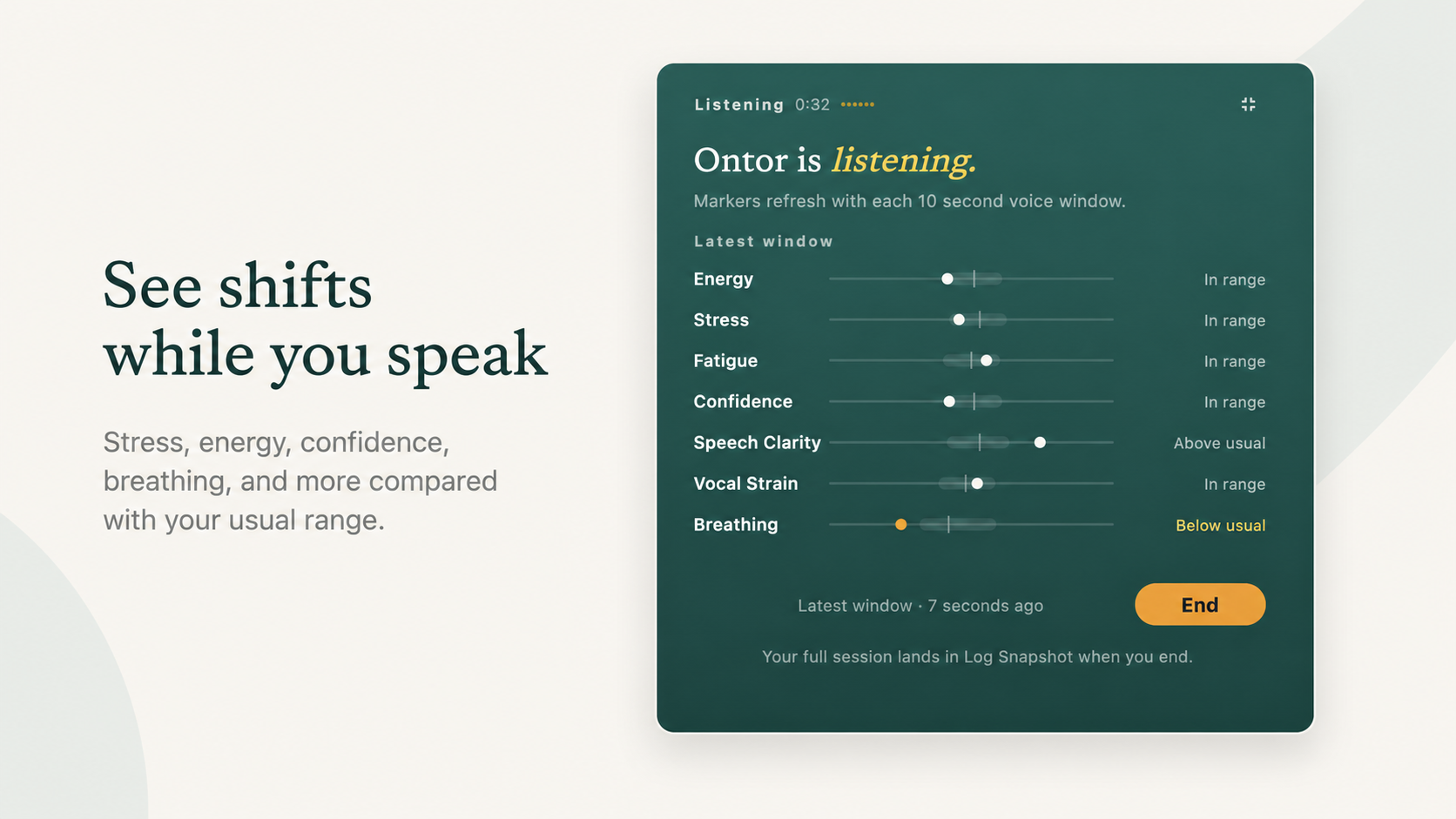
Here is the live listening view from my own Ontor product use: markers refresh with each ~10 second voice window and sit against my usual range. Read it as a private check for whether energy, clarity, strain, or breathing left my band when phrase endings would otherwise buffer:
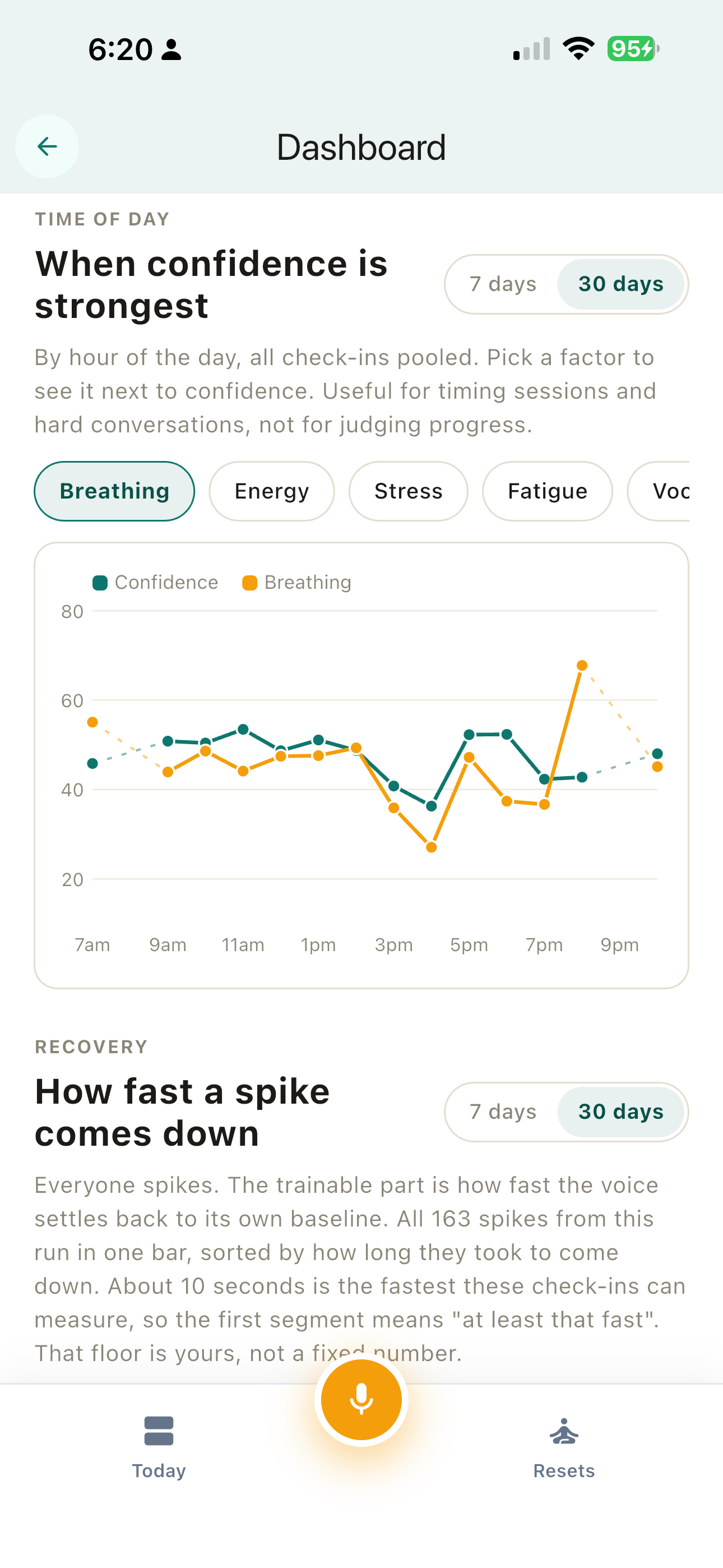
Here is confidence with breathing by hour from that same Ontor history. Support-linked markers can sit near usual early, then leave later when the speaking day gets longer and phrase endings thin out. Read it as founder exploratory data on personal-baseline drift across a long speaking day, not proof of win-rate outcomes and not a claim that Ontor diagnosed vocal pathology:
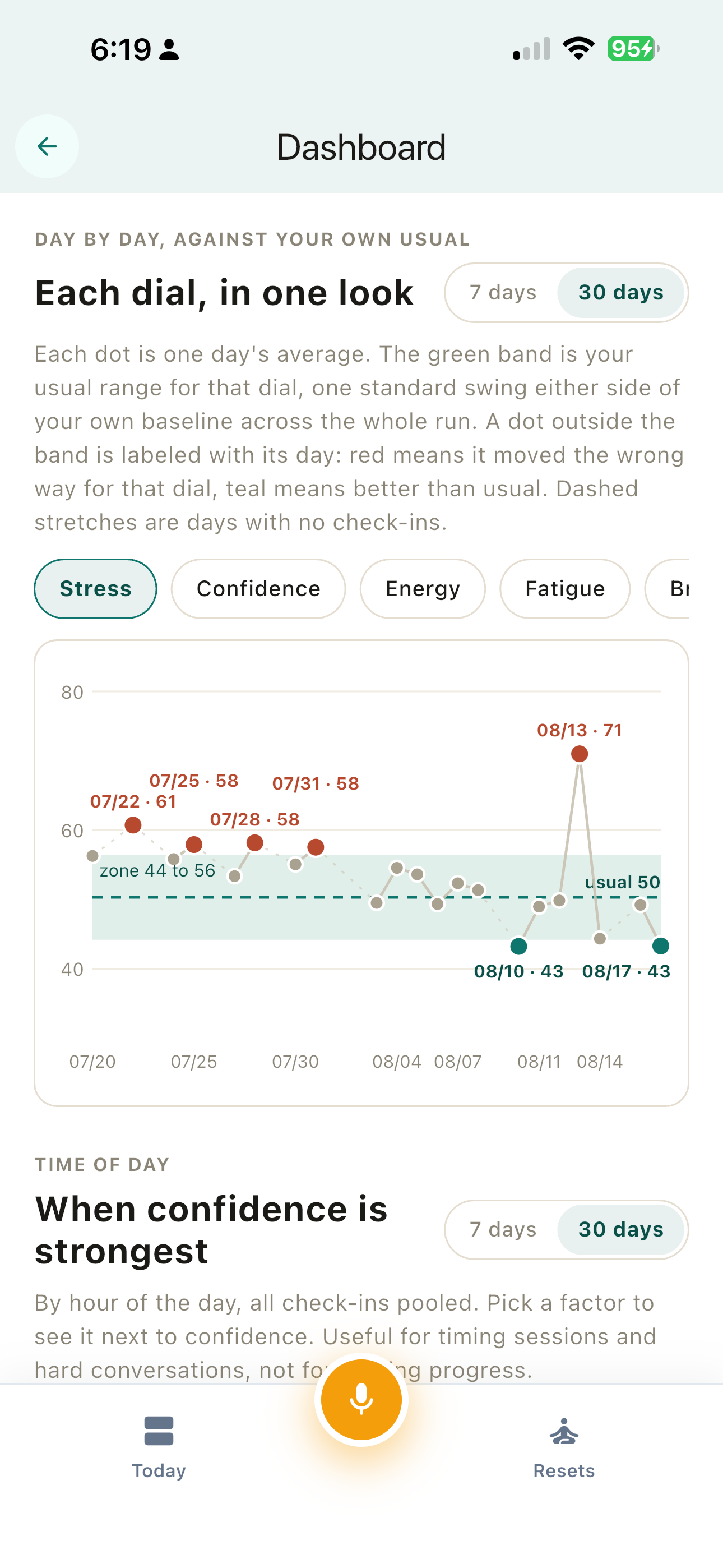
Here is stress day by day against my personal usual band (zone ~44 to 56, usual 50) from the same session history. Red points sit above my usual range. Useful as a private check for how often voice-state leaves the band across calls when end-of-phrase fade risk rises under load. It is not a hire-or-fire score and it is not proof that a suggested reset caused clinical improvement:
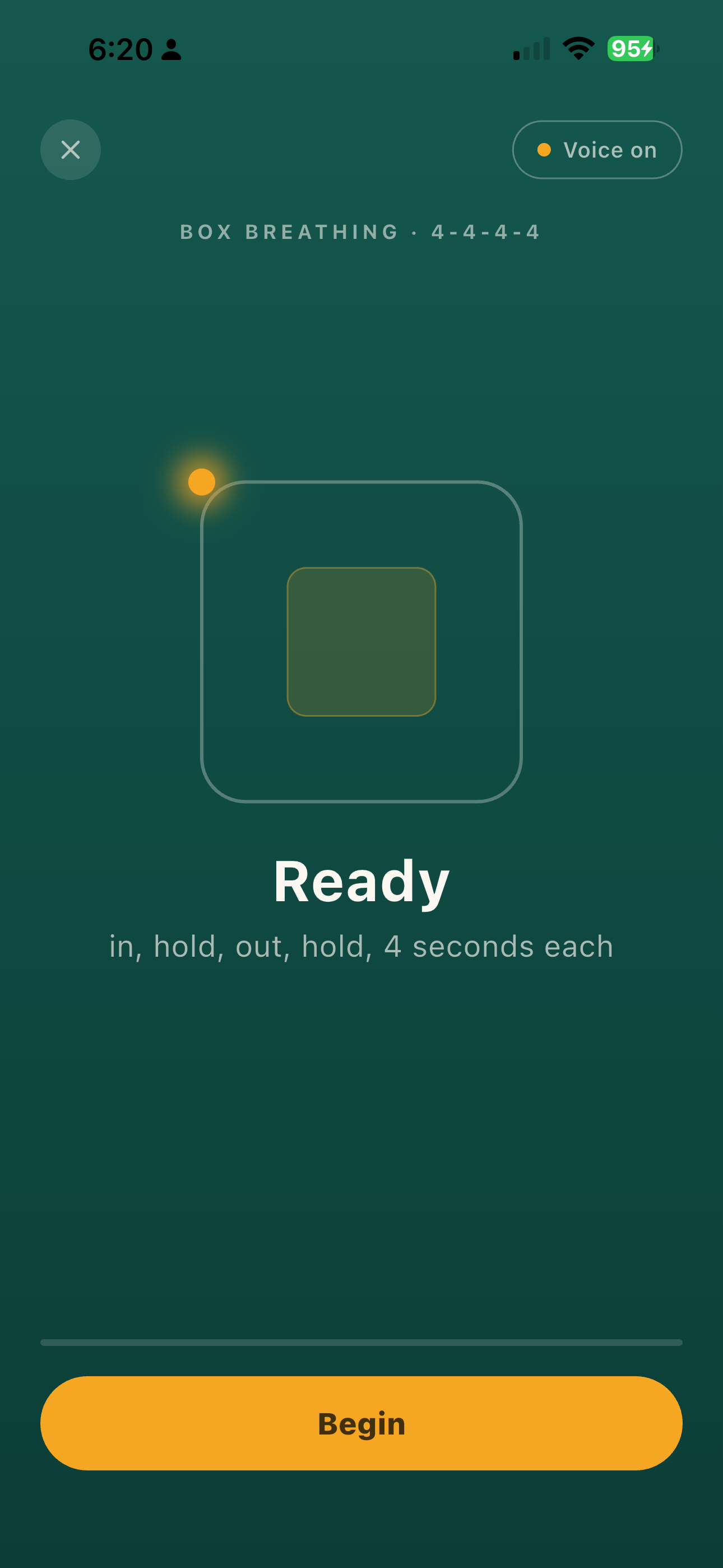
And here is the short reset the product offers when a lasting shift shows up: box breathing, 4-4-4-4. That is a tool-form pause when energy, clarity, strain, or breathing leave your band and last-word fade keeps repeating. It is not a medical protocol and it is not a claim that one cycle makes every prospect hear full authority on the next line:
Claim-safe science note from Ontor's internal reset-effects and founder longitudinal work (exploratory n=1, not population proof): short resets can show temporary movement in stress-related voice markers in some recorded cases, and lasting recovery is not established as a general rule. High-stress stretches in founder exploratory data often do not show an observed return to personal median within an hour. Do not leap from those notes to clinical treatment. Ontor compares how you sound to your personal usual ranges and can suggest a short optional reset when lasting shifts show. Marker changes are not clinical outcomes.
What to try on your next call
Do not wait for a research committee if you already hear the last word die on important lines.
- Install Ontor on the machine you already use for coaching sessions, discovery, demos, or live dials.
- On the next live call, notice energy, clarity, strain, and breathing versus your personal usual range in the short speech windows, especially on sentence endings when stress or fatigue is in play.
- If a lasting shift shows up, or if end-of-phrase fade persists across windows, take the short suggested reset (or a brief breath-support reset between blocks, the mechanical form coaches already name). Then continue.
- If you coach others later, keep leaders on aggregate patterns only for energy / clarity / strain drift under phrase-end pressure. Personal readings stay with the person. Treat Cecilia's airflow frame and Leon / Alisa corroboration as performance controls, not medical labels. Pair with a quick self-listen after a hard block. Do not treat Ontor as a script coach or a hire-fire tool.
Concrete try-on-next-call step: pick one high-stakes line on your next call ("This is an important decision," or your equivalent). Notice whether energy, clarity, or strain left your personal usual range on the last word; if fade persists across windows, take a short breath-support reset before the following block.
Soft secondary path if you lead a coaching practice or mid-market pod and want a measured look later: Ontor for teams.
Do not promise win-rate, retention, or revenue guarantees. Measure whether people can tell when last-word energy and clarity left their usual voice before a prospect names the weaker ending.
Bottom line
If your sentences end like your voice is buffering, prospects hear the authority drop. Cecilia named end-of-sentence vocal fry as an airflow issue under stress or tiredness, not a confidence flaw. Leon named trailing endings and speaking on empty breath across back-to-back calls. Alisa named crack and fade when the body is tired, tense, or unsupported. Michelle (capped) says you cannot pep-talk the body out of mid-call activation. Meghann (capped) stays light color only. The gap that remains is personal usual-range energy, clarity, strain, and breathing in short speech windows, caught on phrase endings before the next key line inherits the same trail-off.
Try Ontor on your next live call. Notice the short voice windows versus your usual range on sentence endings. Take the short reset when lasting fade shows up. Let the last word land with the support you meant, not the buffering default.
Download Ontor - 14 days free, no card required
References
- Cecilia Brändström (vocal coach / Speakonline / CharismaCode). LinkedIn post: sentences end like voice is buffering; end-of-sentence vocal fry; airflow not confidence; stress/tiredness → breath drops → authority drops; supported air = supported authority; last-word awareness drill. https://www.linkedin.com/posts/ceciliabr%C3%A4ndstr%C3%B6m_if-your-sentences-end-like-your-voice-is-activity-7432051391604518913-Nbmm
- Leon Trayman (Voice & Performance Coach London; Estill Master Trainer). Online voice coaching for executives: trailing sentence endings, breathy onset, racing pace; vocal fatigue across back-to-back meetings; speaking on empty breath; mid-afternoon lost edge. https://www.leontrayman.co.uk/online-voice-coaching-for-executives/ and https://www.leontrayman.co.uk/voice-fatigue-at-work-how-to-protect-your-voice-all-day/
- Alisa Fedele (executive vocal coach). LinkedIn post: mid-sentence voice cracks; body saying tired, tense, or unsupported; cracking/fading mid-meeting; not "bad at speaking" or "not confident enough." https://www.linkedin.com/posts/alisafedelebizvocalcoach_you-know-that-moment-when-your-voice-cracks-activity-7382686441480552448-JjDx
- Michelle Terpstra / Revenue Rascals (capped corroboration). "The Science of Selling": "just be confident" as avoidance; cannot will cortisol down or think out of fight/flight mid-call. Attribute physiology language to her; Ontor does not measure cortisol. https://revenuerascals.com/post/the-science-of-selling
- Meghann Misiak / Sales Magic with Meg (capped color only). LinkedIn post: rushed/robotic as survival mode vs sales presence; prep nervous system before slides. Do not lead as robot-voice spine. https://www.linkedin.com/posts/megmisiak_stress-response-vs-sales-presence-learn-activity-7379138128781164544-6hr_
- Ontor. "How it works." https://ontor.ai/how-it-works/
- Ontor. "Ontor for teams." https://ontor.ai/for-teams/
- Ontor. "About the founder." https://ontor.ai/about/
- Ontor. "Install Ontor." https://ontor.ai/install/
- Ontor. Sabber Ahamed LinkedIn. https://www.linkedin.com/in/sabber-ahamed
- Ontor. "Your thin, tight voice stopped being a bad day. It became your everyday baseline." https://ontor.ai/blog/thin-tight-voice-became-everyday-baseline/ (sibling)
- Ontor. "Your voice sounds anxious because you're breathing like someone who is." https://ontor.ai/blog/voice-reports-your-breathing-not-your-feelings/ (sibling, breath→anxiety fingerprint overall)
- Ontor. Block-length robot voice. https://ontor.ai/blog/block-length-robot-voice/ (sibling)
- Ontor. "Voice masks crack on the price ask." https://ontor.ai/blog/voice-masks-crack-on-price-ask/ (sibling)
- Ontor. "Your cold-call voice isn't missing enthusiasm. It's a mode switch off your usual sound." https://ontor.ai/blog/call-mode-pitch-voice/ (sibling)
- Ontor. "A pressured voice can sound anxious or robotic. Coaches still treat them as different problems." https://ontor.ai/blog/coaches-anxious-or-robotic-same-pressure/ (sibling)