
Your thin voice isn't the boardroom version. It's become your everyday baseline.
Executive and voice coaches keep hearing the same quiet complaint from clients who already know their board-room voice. The thin, tight version that used to show up only under stakes has stopped being a one-off. It shows up on ordinary Zoom blocks, tough questions in staff meetings, and midweek investor updates. Pitch climbs without a notice. Cadence speeds when someone pushes back. Throat tightens mid-sentence. The mic makes them feel like they are projecting while the room hears flat energy. By the time the coach hears the clip, that compromised band already feels like "how I sound."
This is for coaches who sell Personal Voice Blueprints, WhatsApp between-session micro-coaching, and pre-stakes pitch checks against resting voice, and for the executives those coaches serve. It is not measuring nervous-system regulation as a category. It is not skull-conduction can't-hear-your-own-voice under pressure. It is not call-mode pitch costume. It is not between-session coaching blind spot alone. It is not block-length robot stamina. It is not polished voice that locks under evaluation. It is not anxious OR robotic as two outputs of one pressured cascade. The wedge here is narrower: chronic baseline replacement. The thin, tight version became everyday normal, not only a stakes-day leave.
Download Ontor - 14 days free, no card required
The thin, tight version became their normal
Dr Melina Hashemi (executive coach; Joyful Approach) packages the failure mode in coach language coaches already recognize:
"most executives have been running in sympathetic activation so long, they've forgotten what their regulated voice sounds like. The thin, tight version became their normal."
That is not "nervous on the big pitch." That is identity drift. The compromised instrument replaces the remembered range until the client cannot hear the leave anymore. Melina also names the live tells coaches catch after the fact:
"When it detects threat, your vocal cords tighten, your pitch climbs, and your cadence speeds up without you noticing."
"You think you sound authoritative. The room hears someone under pressure."
And the pre-stakes protocol many coaches already sell as a first-sentence check:
"Speak your first sentence aloud before you walk in. Hear your own pitch. If it's higher than your resting voice, you're already activated."
Useful. Still blind to the unsupervised windows after the walk-in: staff Zooms, midweek challenge, the fifteenth virtual block of the week, where thin/tight has already become the everyday band vs the resting voice the coach checked once.
Attribute Melina's nervous-system language carefully. Coaches talk about regulation state. Ontor does not claim to measure the nervous system medically, diagnose dysregulation, or treat anything. The product-shaped gap is simpler: notice when pitch, energy, or pace leave your personal usual range in short speech windows, including the ordinary days when the thin version has already become the baseline.
Coaches already sell "sound more like yourself under pressure"
Jay Alexander Poulton (The Accent Coach) productizes a Personal Voice Blueprint plus WhatsApp micro-coaching between sessions because leaders feel the room hears only part of what they bring. The outcome he sells is identity under pressure, not a fake executive voice:
"You sound more like yourself under pressure. The work adds precision and control without changing who you are."
"WhatsApp micro-coaching between sessions"
"You're tired of feeling like the room hears 80% of what you bring."
That channel already staffs diagnostics, blueprints, and between-session text loops by hand. The remaining blind spot is the unsupervised live window vs that person's own usual range: not another tip in WhatsApp after the call, but a private read during the call when thin/tight, faster cadence, or flat mic energy has replaced the remembered band.
Virtual energy collapse while the mic feels loud enough
Marco Polito (online presentation / voice training) names the everyday Zoom version of the same drift:
"most speakers' vocal energy drops 30 to 40 percent within the first ten minutes of a virtual presentation precisely when the stakes are highest."
That 30 to 40 percent figure is Marco's coaching observation. It is not an Ontor measurement, and Ontor does not claim to reproduce it. What matters for this cut is the mic paradox he also names:
"You feel like you are projecting. You feel like your voice is present and authoritative. But your audience is hearing compressed, flat, low energy audio that signals exactly the opposite of what you intend."
Chronic baseline replacement shows up here as early virtual energy leave that the speaker cannot hear against their own usual range, while they still feel "projected." Coaches already sell stamina and presence for Zoom weeks. They still cannot see those first-ten-minute leaves across unsupervised client blocks without a personal baseline instrument.
Corroboration coaches already hear in the office
Catherine Peloquin (PCC somatic / Performance Under Pressure coach) lists how under-pressure voice shows up in her coaching office:
"A voice that climbs higher and thinner under pressure."
"A tight throat during challenging conversations."
"A pace without space or pause."
That is the same pitch-climb / thin / throat pattern Melina names as chronic when it stops being a stakes-only leave.
Allison Geller (Connected Speech Pathology; executive voice coaching) documents anonymized client delivery patterns under pushback. Cap any clinical packaging. Use the under-pressure delivery only:
"One vice president of a company came to us because her recommendations kept getting talked over. Her voice got quieter and faster whenever someone pushed back on her numbers, so her strongest points came out sounding unsure."
Quieter and faster on challenge is another way the everyday baseline can leave the remembered range in live unsupervised windows. Not a medical claim. Not a diagnosis. Delivery under pressure.
Maria Pellicano (voice coaching and public speaking trainer) names the Zoom version clients often miss:
"In the current climate with Zoom or Microsoft Teams meetings, your voice tone can come across as monotone, lacking confidence and in some cases intimidating without you knowing."
"A leader's nervous system is often heard before their words are processed."
Again: attribute coach NS language carefully. Ontor's wedge is not medical nervous-system measurement. It is noticing when monotone, thin/tight, higher pitch, or lower energy has become the band you live in across ordinary virtual blocks vs your personal usual range.
Distinct from the nearby Ontor cuts
| Published Ontor cut | Moment | What this article is not rewriting |
|---|---|---|
| Measure nervous-system regulation | Category problem of measuring regulation | Not chronic thin/tight became everyday normal vs remembered range |
| Coaches can't hear own voice under pressure | Skull-conduction / self-hearing gap | Not baseline replacement; not "became their normal" |
| Call-mode pitch voice | Forced professional phone costume off personal baseline | Not leading with costume switch; chronic thin/tight as everyday band |
| Coaching between sessions | Between-session blind spot as a category | Not the spine of forgotten regulated range / thin became normal |
| Block-length robot voice | Cumulative fade into robot voice by lunch | Not stamina-only robot; chronic thin/tight identity drift |
| Polished voice locks under evaluation | Evaluation freeze / polished lock | Not evaluation-only lock; everyday baseline replacement |
| Anxious or robotic, same pressure | One pressured cascade, two audible modes | Not dual-mode misdiagnosis; chronic "became their normal" |
Same coaches channel. Different question: when did the thin, tight version stop being a boardroom one-off and become the everyday baseline the client can no longer hear?
Download Ontor - 14 days free, no card required
What Ontor can add between coaching sessions
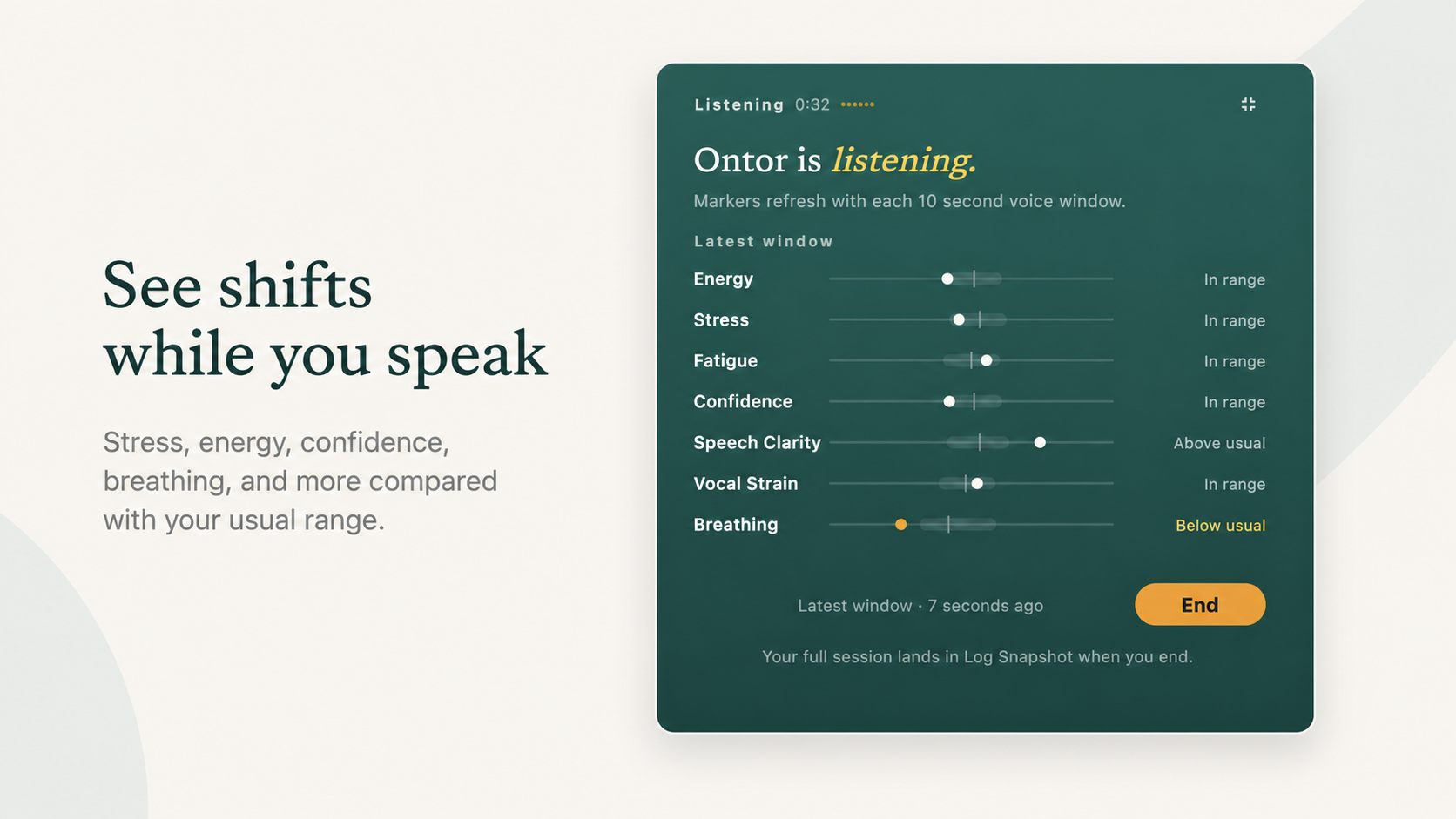
Ontor is a performance tool that reads how someone sounds, not what they said. While a person speaks, it compares voice signals to that person's own usual range. Markers refresh in short voice windows (on the order of about 10 seconds of speech). When a lasting shift shows up (for example stress, energy, speech clarity, vocal strain, or breathing), it can suggest a short optional reset. People can also compare before and after.
For a coach practice already selling blueprints, WhatsApp micro-coaching, and pre-stakes resting-voice checks, that sits next to the work you already do. Clients still own their readings. Rep-first privacy. What you gain is an unsupervised instrument for "sound more like yourself under pressure": a private usual-range view during ordinary live speech, not only the first-sentence check before a board walk-in. When thin/tight, higher pitch, faster cadence, or lower energy leaves that person's personal usual range and sticks, they can take a short reset before the next Zoom block or tough question.
This is not a claim that Ontor diagnoses health conditions, measures the nervous system medically, treats dysregulation, replaces 1:1 coaching, proves workshop transfer, or guarantees board outcomes. It does not reproduce Marco's 30 to 40 percent virtual-energy figure as a product metric. It is narrower: short live windows against personal usual range so coaches and clients can see when the thin, tight version has become the everyday band between sessions.
What shows up in my own Ontor history (thin/tight as everyday band)
I am Sabber Ahamed, founder of Ontor. I use the product on my own speaking and call-heavy days. In my own Ontor session history (founder exploratory data from my own product use, not your clients' outcome data), the chronic baseline pattern shows up the way Melina, Jay, and Marco name it. Across unsupervised live windows, not only a pre-stakes check, pitch, energy, or pace can leave my personal usual range and stay there. The thin, tighter, higher, or lower-energy band starts to feel like the normal day rather than a remembered regulated range. When that shift sticks, a short optional reset is the tool form of noticing the leave before the next board Zoom or tough call block. It is not a claim that one cycle restores anyone's regulated voice for a whole coaching roster.
Here is the live listening view from my own Ontor product use: markers refresh with each short voice window and sit against my usual range. In one window, stress or energy can sit off usual while clarity, strain, or breathing leave the band that used to feel like my resting delivery. That is the kind of everyday-band drift a single pre-stakes pitch check misses:
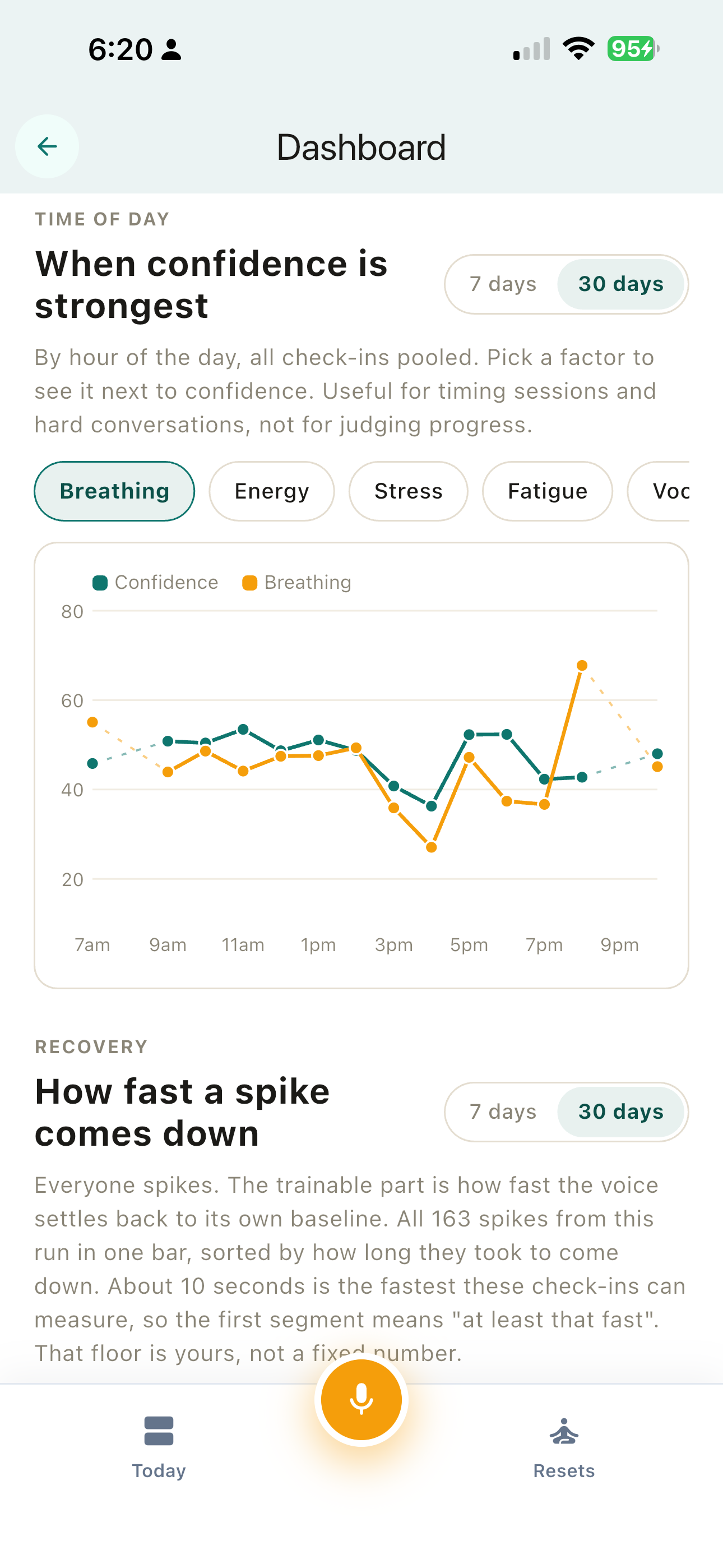
Here is confidence plotted with breathing across the day, from my own Ontor dashboard and session history. Under ordinary pressured stretches, confidence and breathing often leave the personal usual band together. That is closer to unnoticed everyday activation than to a one-off boardroom costume. It is not proof a client's authority score will rise:
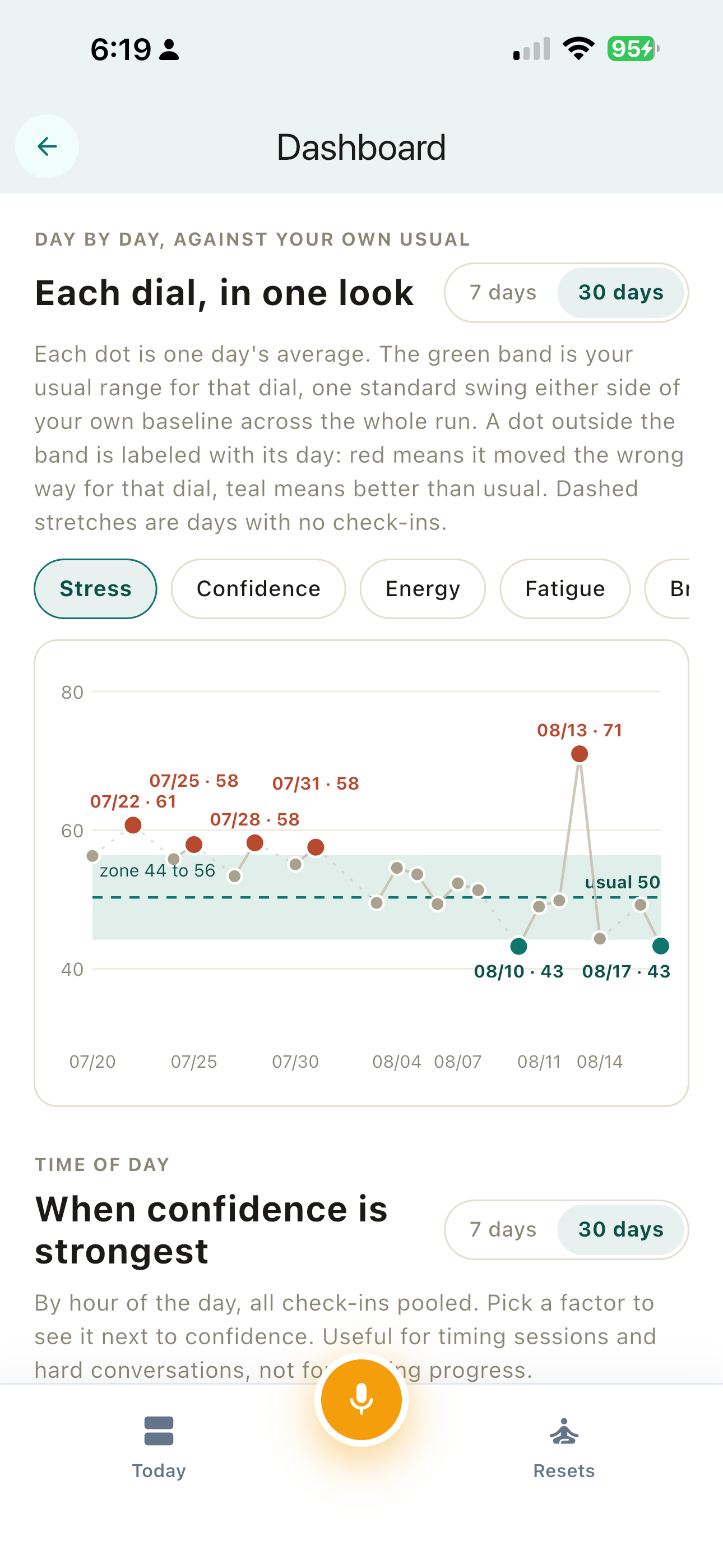
Here is stress against the personal usual band across dials and speaking blocks, from my own Ontor session history. When the high side of the band becomes the place I live for most of the day, the thin/tight "normal" Melina names is already running before anyone books a refresh session:
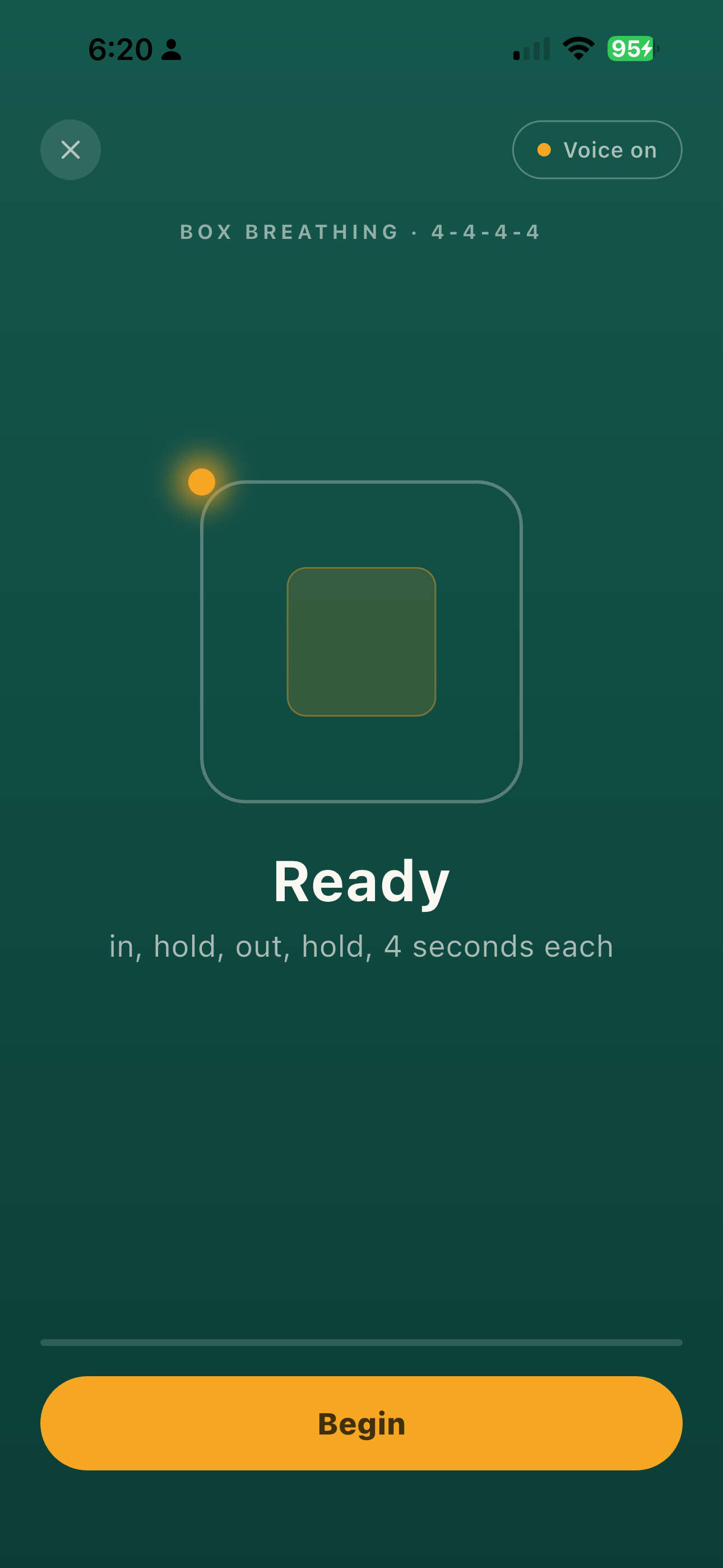
When that private read says I left usual range and the shift stuck, Ontor can surface a short reset before the next live window. Here is a short breathing reset from my own product use. Cap any medical claim. The product point is a short private loop you own so the next Zoom or board block can move back toward usual range, not a clinical intervention and not another workshop tip:
In exploratory work on that same personal Ontor history (one person, not a population study), high-stress stretches often did not show an observed return to my personal median within an hour. State also carried forward across nearby windows. That is one reason a private usual-range check during unsupervised live speech matters for chronic baseline replacement. It is not evidence that a suggested reset caused recovery, improved coaching outcomes, or restored anyone's regulated voice as a clinical result.
Try it on the next board Zoom or call block your client runs without you
Download Ontor - 14 days free, no card required
Install it for a real unsupervised block, not another role-play. Ask the client to notice how they sound versus their usual range across an ordinary Zoom stack or the next board update: has pitch climbed, energy dropped, or cadence sped so the thin/tight band feels like the everyday normal rather than a remembered resting range? Take a short optional reset if that shift sticks before the next tough question or the next virtual block. Keep the blueprints, WhatsApp micro-coaching, and first-sentence resting-voice checks you already sell. Add a private loop that shows when the compromised version has become the baseline when you are not in the room.
If you sell into pods or teams, the soft path is a research or pilot conversation, or Ontor for teams, with aggregate patterns only. The primary next step for this coaches channel is still the next live block: hear thin/tight against personal usual range on an everyday Zoom or board call, not only on the stakes-day walk-in.
Sabber Ahamed is the founder of Ontor and an applied ML scientist (PhD in geophysics and signal processing) who builds on-device voice tools. He has shipped production signal and ML systems across radiology AI, healthcare, and manufacturing. Ontor compares how you sound to your own usual ranges and suggests short resets, without claiming clinical or revenue outcomes from marker changes. LinkedIn · About
References
- Dr Melina Hashemi - LinkedIn: thin, tight version became their normal; first-sentence check vs resting voice (buyer evidence; Joyful Approach)
- Jay Alexander Poulton / The Accent Coach - Executive Voice Blueprint: sound more like yourself under pressure; WhatsApp micro-coaching (buyer evidence)
- Marco Polito - Online presentation voice training: virtual energy drop in first 10 minutes; mic paradox (buyer evidence)
- Catherine Peloquin - LinkedIn: pitch climbs higher and thinner under pressure; tight throat; pace without pause (buyer evidence)
- Allison Geller / Connected Speech Pathology - Executive voice coaching: quieter and faster on pushback (delivery pattern only) (buyer evidence; non-medical use)
- Maria Pellicano - LinkedIn: Zoom monotone without knowing; NS heard before words (buyer evidence)
- How Ontor works
- Ontor for teams
- About the founder - Ontor
- Install Ontor
- Measure nervous-system regulation (sibling)
- Coaches can't hear own voice under pressure (sibling)
- Call-mode pitch voice (sibling)
- Coaching between sessions (sibling)
- Block-length robot voice (sibling)
- Polished voice locks under evaluation (sibling)
- Coaches anxious or robotic same pressure (sibling)