
Sounding calm when freight is on fire is its own skill
Freight brokerage founders admit it out loud: they are not always calm when loads go sideways. What they practice is how to sound calm while the board is still on fire. Customers remember the voice on the update call. They do not remember how many channels you lit up while you scrambled.
Ricky Sidhu (Founder / owner, Bever Logistics Group) named that gap in plain buyer language on LinkedIn:
"Confession: I am not always calm when freight gets chaotic."
"But I have learned, through years of experience and an unfortunate number of stressful Fridays, how to sound calm."
"And in logistics, sounding calm when things are on fire is genuinely its own skill."
His practical sequence is the opposite of panic-noise:
"Make one call at a time. Panic-calling six carriers simultaneously while texting the dispatcher and emailing the client is not a strategy. It's just noise."
"Freight chaos is inevitable. The calm is a choice."
He also names the update discipline: name the specific problem before you try to solve it, tell the customer what you know even if it is incomplete, and when the save lands, do not narrate how close it was. The skill he is teaching is audible composure under exception pressure. It is not a claim that the person feels calm inside.
This is for freight brokerage sales leaders (President, VP, or Director of Customer and Carrier Sales, plus brokerage owners coaching the desk). The object is sounding calm on exception and update calls when the board is hot: one call at a time, not panic-noise across six carriers, texts, and emails at once.
Download Ontor - 14 days free, no card required
What this article is not answering
Published Ontor freight pieces already cover adjacent voice moments. This one does not replace them.
- Freight fires, first 10 seconds answers acute panic in the first 10 seconds after a fire blows up the phones.
- Freight post-fallout recovery answers composure on the next recovery dial after a carrier cancel.
- Freight remove yourself as the threat answers jump-in-hot negotiation and desperate energy.
- Freight nervous system says fifteen answers concurrent exception weight across a few loads that feel like many.
- Freight inbound phone exhaustion answers sustained inbound noise draining energy before the calls that matter.
- Freight post-rate silence answers filling the quiet after you quote.
- Freight cold calls talk too fast answers pace dump on pickup.
- Freight first dial of the day answers morning cold-start before dial one.
- Freight overnight voice composure answers sounding awake on overnight coverage.
- Freight sales call-block readiness answers outbound readiness between call blocks.
Same brokerage sales-leader beachhead. Different object. This is the skill of sounding calm on exception and update calls when you do not feel calm, plus one-call-at-a-time discipline versus panic-noise. Not first-10s panic-matching. Not post-cancel recovery dial alone. Not remove-threat desperate energy. Not concurrent load-count weight. Not inbound exhaustion. Not silence-fill. Not a pace dump. Not morning cold-start. Not overnight awake-sound. Not between-block outbound readiness.
The question here: when an exception is live and the update call still has to land, how do you notice when stress, energy, or clarity left someone's personal usual range mid-exception, coach the sound-calm skill (not only the SOP), and keep the desk on one call at a time instead of noise?
Capped color: urgency without panic, calm on messy loads, and a vendor pace warning
Three other pieces from the same scan name adjacent pressure. Cap them. Do not let them become the spine.
TJ Anderson (General Manager, Bailey's Logistics) draws the line as urgency versus panic in freight brokerage. Urgency means focus, communication, and a bias for action. Panic means chaos, finger-pointing, and poor decisions. He coaches calm communication when things go wrong, clear priorities on a full board, and a team that moves with purpose, not emotion. Use that only as leader corroboration that calm communication under exceptions is an operating mode. It is not Sidhu's how-you-sound skill, and it is not a voice-baseline claim.
Rafael Quintana (Partner and VP of Operations, Big Truck Logistics) argues you can tell a lot about someone by how they handle loads that do not go as planned: late trucks, rejected loads, weather delays. Anyone manages easy days. Brokers who build long careers stay calm, communicate, and own the outcome when things get messy. That is the professionalism customers remember. Cap that as composure-under-mess corroboration. It is thinner on audible tone than Sidhu, and it is not this article's one-call-at-a-time spine.
Nicholas Shao (Founder, Agogee; freight/logistics sales training vendor) writes that pressure after hard questions, pricing, and objections makes reps speed up, and that buyers hear nervous energy rather than smarts. He argues for slowing on purpose, a short pause before hard answers, and one calm inhale to stop shallow breath and a shaky, fast voice. Cap that as vendor physiology color only. Do not take the vendor CTA. Do not treat talk-too-fast drills as this article's spine. Ontor's wedge stays private baseline plus a short reset when stress, energy, or clarity leave your usual range mid-exception while you are still trying to sound calm on the update call.
What SOPs, multi-channel scramble, and post-call listens still miss
Typical stack for a leader watching a desk mid-exception:
- A board that shows the hot load, status, and who owns the update
- Carrier cover lists, TMS notes, and timed customer update reminders
- "Stay calm / one call at a time" coaching after a rough recording
- Scripts for the shipper update, the re-cover ask, the detention talk
- A listen after the fact, when the update window already closed
Useful. Incomplete for sounding calm under fire. A perfect update script does not tell you, in the moment, that stress or energy left your personal usual range while you were still trying to sound steady. A manager saying "make one call at a time" does not give the rep a personal baseline while six channels are already open. Self-listen after the fact catches one recording, not lasting shifts across short speech windows while the next customer update is already due.
None of those continuously ask: mid-exception, did stress, energy, clarity, confidence, strain, or breathing leave your own usual range in short voice windows while you were still on the update call? Ontor does not replace the board, the cover process, or Sidhu's one-call discipline. Ontor does not claim that a calmer voice covers the load. It reads how you sound versus your personal usual range while you speak, and it can offer a short reset when a lasting shift shows up, including mid-exception before the next update.
Leaders often meet the miss as "the desk sounded rattled on the update even though we eventually covered it" without a private signal the rep can check before the next call in the stack.
Download Ontor - 14 days free, no card required
What Ontor adds mid-exception on the update call (private first)
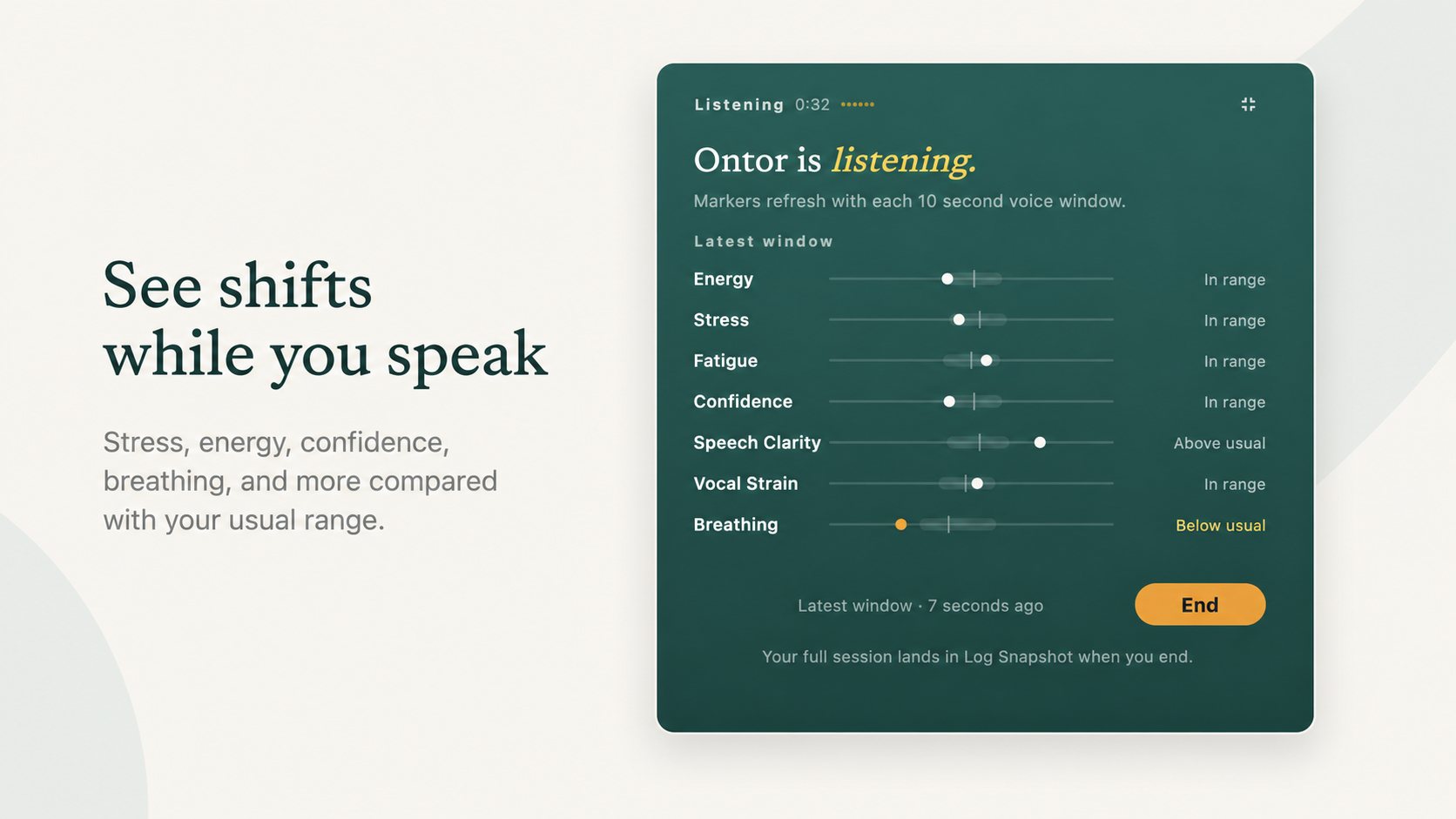
Ontor is a performance tool that reads how you sound, not what you said. While someone speaks, it compares voice signals to that person's own usual range. Markers refresh in short voice windows (on the order of about 10 seconds of speech). Stress is how much tension and instability show in the voice. Energy is how activated the voice sounds through pace, effort, and flow. Speech clarity is how crisp and distinct the speech sounds. Confidence, fatigue, vocal strain, and breathing sit in the same comparison. When a lasting shift shows up, Ontor can suggest a short reset. People can look at the same markers before and after that reset. A higher or lower reading is not automatically good or bad. It shows what changed for you. Ontor does not determine mood and does not diagnose a health condition.
Explicit boundaries for this topic:
- Ontor does not replace load boards, TMS, cover lists, or Sidhu's one-call-at-a-time discipline.
- Ontor does not claim medical or clinical outcomes.
- Ontor does not claim that marker changes prove covered loads, saved customer relationships, or cognitive improvement.
- The claim stays narrow: when exception pressure leaves your personal usual range for stress, energy, or clarity while you are trying to sound calm on the update call, a private baseline cue plus an optional short reset is a loop you can run before the next call in the stack.
For teams, Ontor's public framing is aggregate patterns for workload, coaching, and support. Individual sessions and readings stay with the person. A leader coaching the sound-calm skill can watch cohort-level stress or energy drift under exception-heavy days. They do not get a personal scoreboard for hire or fire decisions. Soft secondary path: Ontor for teams.
In my own Ontor session history (founder exploratory data from my own product use, not your floor's outcome data), the sound-calm-under-fire pattern shows up the way Sidhu separates feeling calm from sounding calm. When exception pressure stacks (a driver no-show on one lane, a border clock on another, a customer who wants an update in 30 minutes), stress, energy, or clarity can leave my personal usual range in the short windows mid-call while I am still trying to keep the voice steady. I can still make the update. Delivery is already tighter, flatter, or more strained than my usual band before the next call in the stack. That is sounding calm as a skill with a private baseline leave underneath, not a missing SOP line. A short reset before the next call is the tool step. It is not a claim that one cycle covers the load or saves the shipper relationship.
Here is the live listening view from my own Ontor product use. Markers refresh with each ~10 second voice window and sit against my usual range, including stress, energy, confidence, and clarity-adjacent signals. Read it as a private check you would open mid-exception before the next update call, not as proof that one window means you already sounded rattled to the customer:
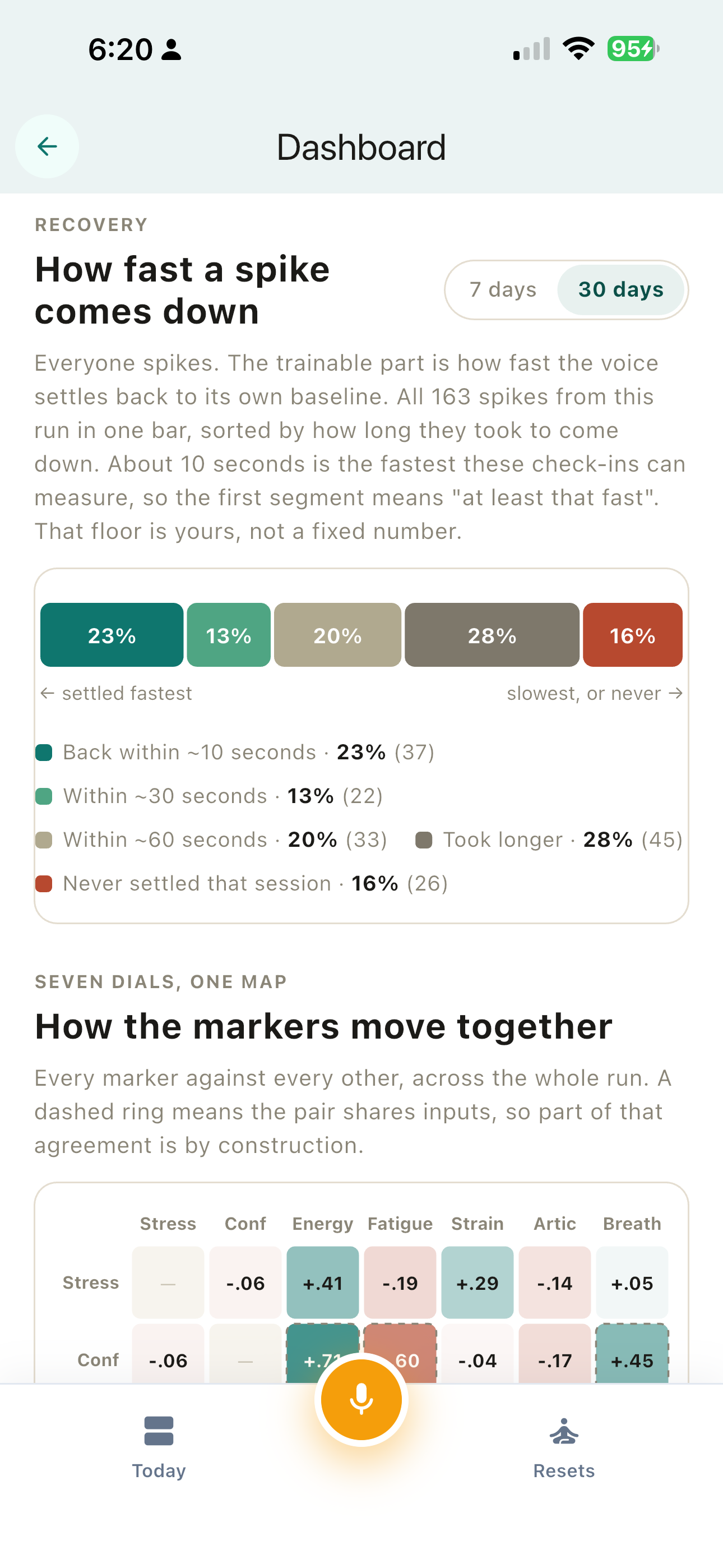
Here is "how fast a spike comes down" from that same Ontor history. The screen counts 163 spikes in this run and sorts how long the voice took to settle toward my own baseline. About 10 seconds is the fastest those check-ins can measure. I am not claiming those shares are your desk, or that a faster settle covers the load. It is a private view of whether voice-state comes back before the next call in an exception stack, not a hire-or-fire score and not proof that a suggested reset caused the settle:
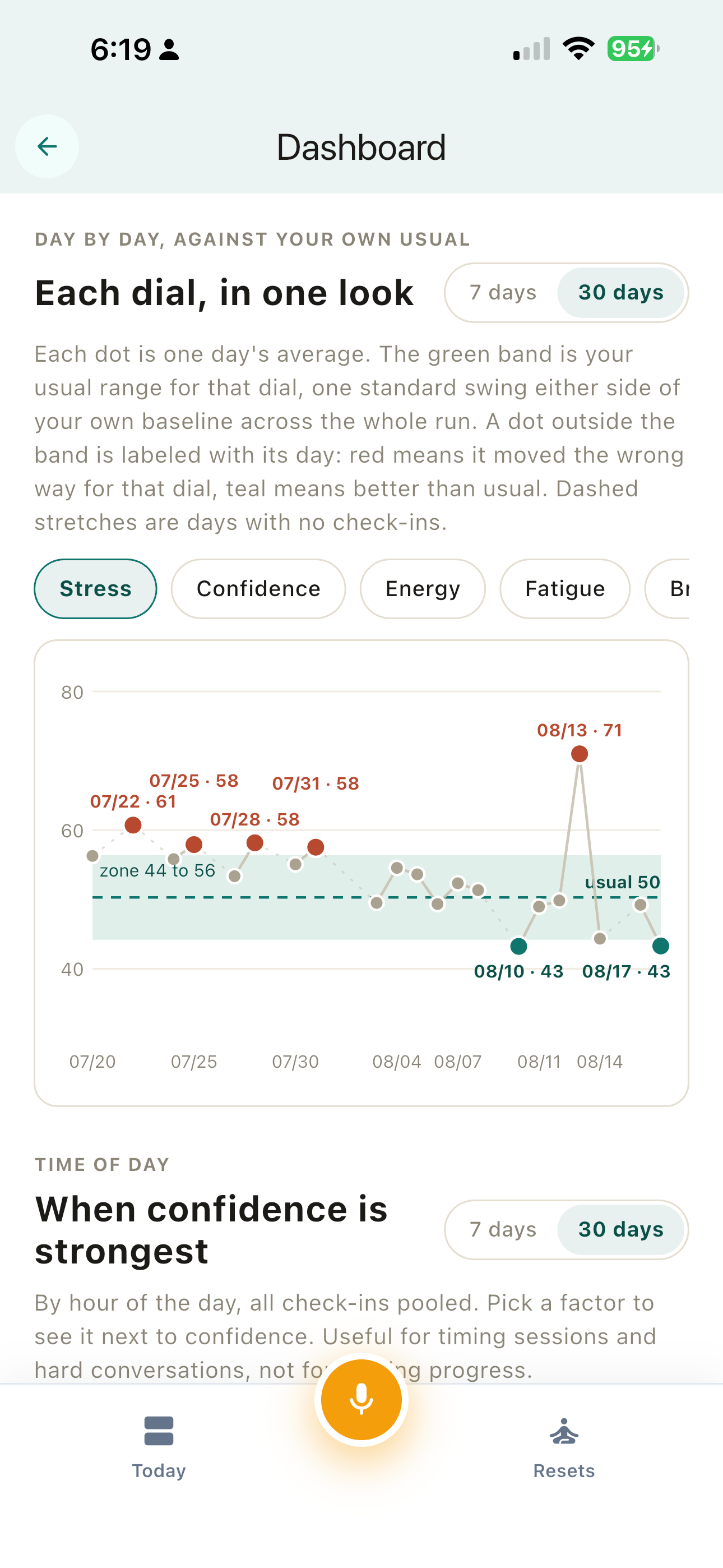
Here is stress day by day against my personal usual band (zone about 44 to 56, usual 50 on this view) from the same session history. Each dot is one day's average. Red points sit above my usual range. Useful as a private check for how often stress leaves the band across a stretch of exception-heavy days, the kind of days Sidhu's stressful Fridays describe for other people. It is not Bever Logistics data and it is not proof that a reset produced calmer update calls:
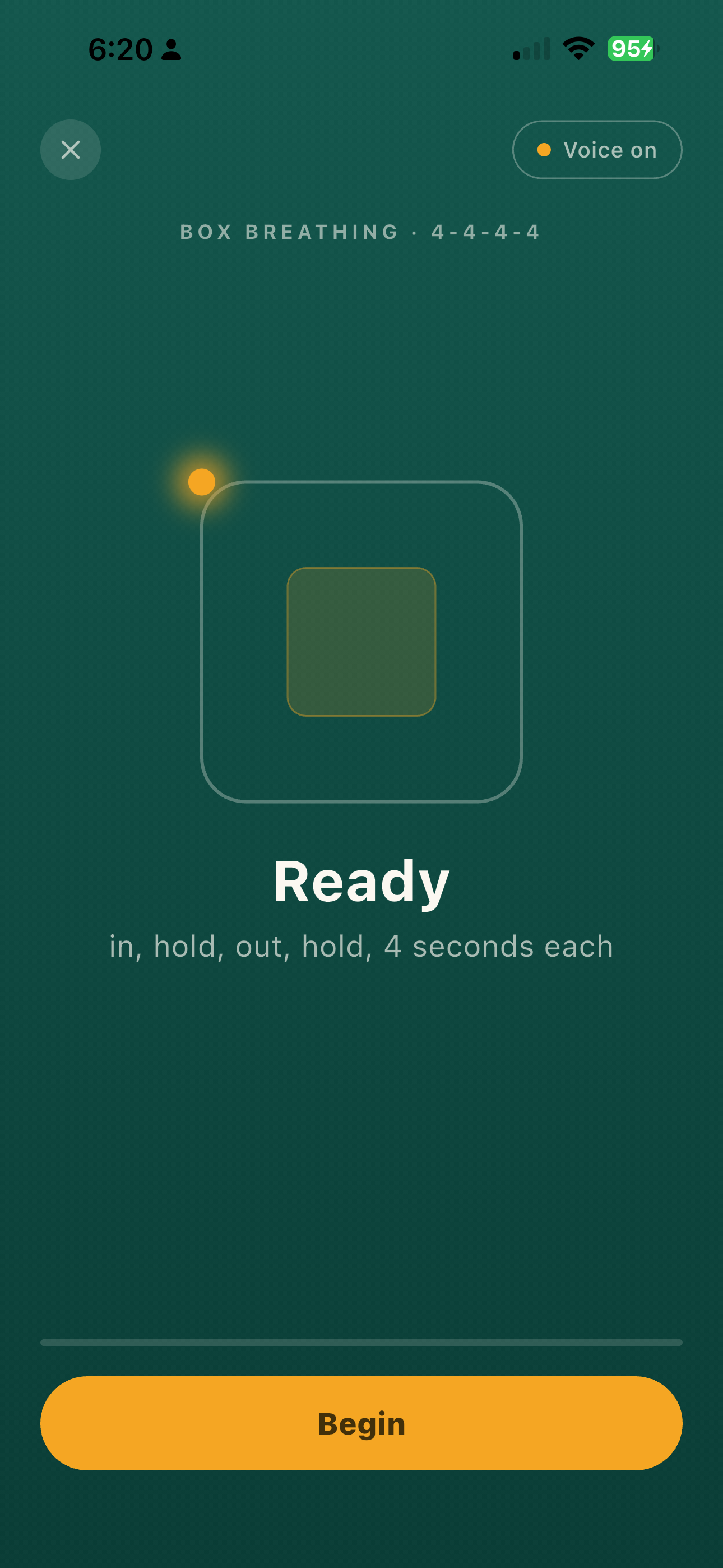
And here is the short reset the product offers when a lasting shift shows up: box breathing, 4-4-4-4, in, hold, out, hold, 4 seconds each. That is the tool form of catching the leave before the next call in the stack, available privately without a manager guessing from a recording sample. It is not a medical protocol and it is not a claim that one cycle clears the exception:
What to try on the next exception update call
Do not wait for a research committee if the board is already on fire and the customer wants an update.
- Install Ontor on the machine you already use for shipper, carrier, and update calls.
- On the next live exception (driver no-show, late truck, rejected load, weather delay, border clock, or another timed customer update), make one call at a time. Notice how the desk sounds. Then check whether stress, energy, clarity, confidence, strain, or breathing sit outside your usual range in the short speech windows.
- If a lasting shift shows up, take the short suggested reset before you push through that update, or before you open the next call in the stack. Then come back and listen again. Compare the windows. Do not treat the reset as a cover trick. Do not treat Ontor as permission to panic-call six carriers at once.
- If you lead the desk, keep leaders on aggregate patterns only for stress or energy drift under exception-heavy days. Personal readings stay with the person. Do not use the tool for hire or fire. Pair it with Sidhu's one-call-at-a-time discipline and a quick self-listen after a hot exception block. Do not treat Ontor as a TMS, a load board, or a script coach.
Soft secondary path if you lead brokerage Customer and Carrier Sales and want a measured look later: Ontor for teams.
Do not promise cover rates, saved relationships, or fewer falloffs. Measure whether people can tell when stress, energy, or clarity left their usual voice mid-exception while they were still trying to sound calm.
Bottom line
Boards show the hot load. Leaders still miss when the update voice leaves a personal usual range while the person is trying to sound calm. Sidhu named the skill in buyer language: he is not always calm when freight gets chaotic, but he learned how to sound calm when things are on fire. Panic-calling six carriers while texting and emailing is noise, not strategy. One call at a time is the discipline. Hiring more people or staring harder at the board does not show the leave in how someone sounds mid-exception. The gap that remains is personal usual-range stress, energy, and clarity in short speech windows, caught before the next call in the stack.
Try Ontor on the next exception update. Notice when the fire shows up in how the desk sounds, and in whether stress, energy, or clarity left your usual range. Take the short reset when a lasting shift shows up. That is the sound-calm-under-fire tool step, not another channel of noise.
Download Ontor - 14 days free, no card required
About the author
Sabber Ahamed is the founder of Ontor and an applied ML scientist. His PhD is in geophysics (University of Memphis), built on signal processing, and he has spent his career turning signals into on-device models. Ontor compares how you sound to your own usual ranges and suggests short resets, without claiming clinical or revenue outcomes from marker changes.
References
- Confession: I am not always calm when freight gets chaotic.. Ricky Sidhu, LinkedIn. Buyer evidence spine: sounding calm when things are on fire is its own skill; one call at a time; panic-calling six carriers while texting and emailing is noise; freight chaos is inevitable, the calm is a choice.
- Urgency vs. Panic - There's a Big Difference in Freight Brokerage. TJ Anderson, LinkedIn. Capped corroboration only: urgency vs panic; calm communication when things go wrong. Not this spine.
- You can tell a lot about someone by how they handle the loads that don't go as planned.. Rafael Quintana, LinkedIn. Capped corroboration only: stay calm, communicate, own the outcome on messy loads. Not this spine.
- Sales Call Confidence: Sound Calm Without Talking Faster. Nicholas Shao / Agogee (vendor). Capped vendor color only: pace-up under pressure, shallow breath, shaky voice. Not freight brokerage buyer evidence. Not this spine.
- How Ontor works. Usual range, lasting shifts, short resets. Stress, energy, speech clarity definitions. No mood read and no health diagnosis.
- Ontor for teams.
- About the founder.
- Install Ontor.
- When the phones blow up after a freight fire, the first 10 seconds decide the floor. (sibling, acute fire)
- The carrier canceled. Your next recovery call still has to sound calm. (sibling, post-cancel)
- Freight deals stall when reps jump in hot. (sibling, negotiation threat)
- Load count says 3. Your nervous system says 15. (sibling, concurrent exception weight)
- Boards count the inbound carrier calls. Leaders still miss when phone exhaustion drains energy before the ones that matter. (sibling, inbound exhaustion)
- After you quote the rate, the quiet is not a rejection. (sibling, post-rate quiet)
- Freight cold calls die when the pickup becomes a pace dump. (sibling, pace dump)
- The first dial of the day is the hardest. (sibling, morning cold-start)
- Freight never sleeps. Your voice still has to sound awake at 3AM. (sibling, overnight)
- Freight sales leaders can see dials. They still miss readiness between call blocks. (sibling, between-block)